
Life, 1923-03-29 · page 30 of 40
Life — March 29, 1923 — page 30: what you’re looking at
What you’re looking at
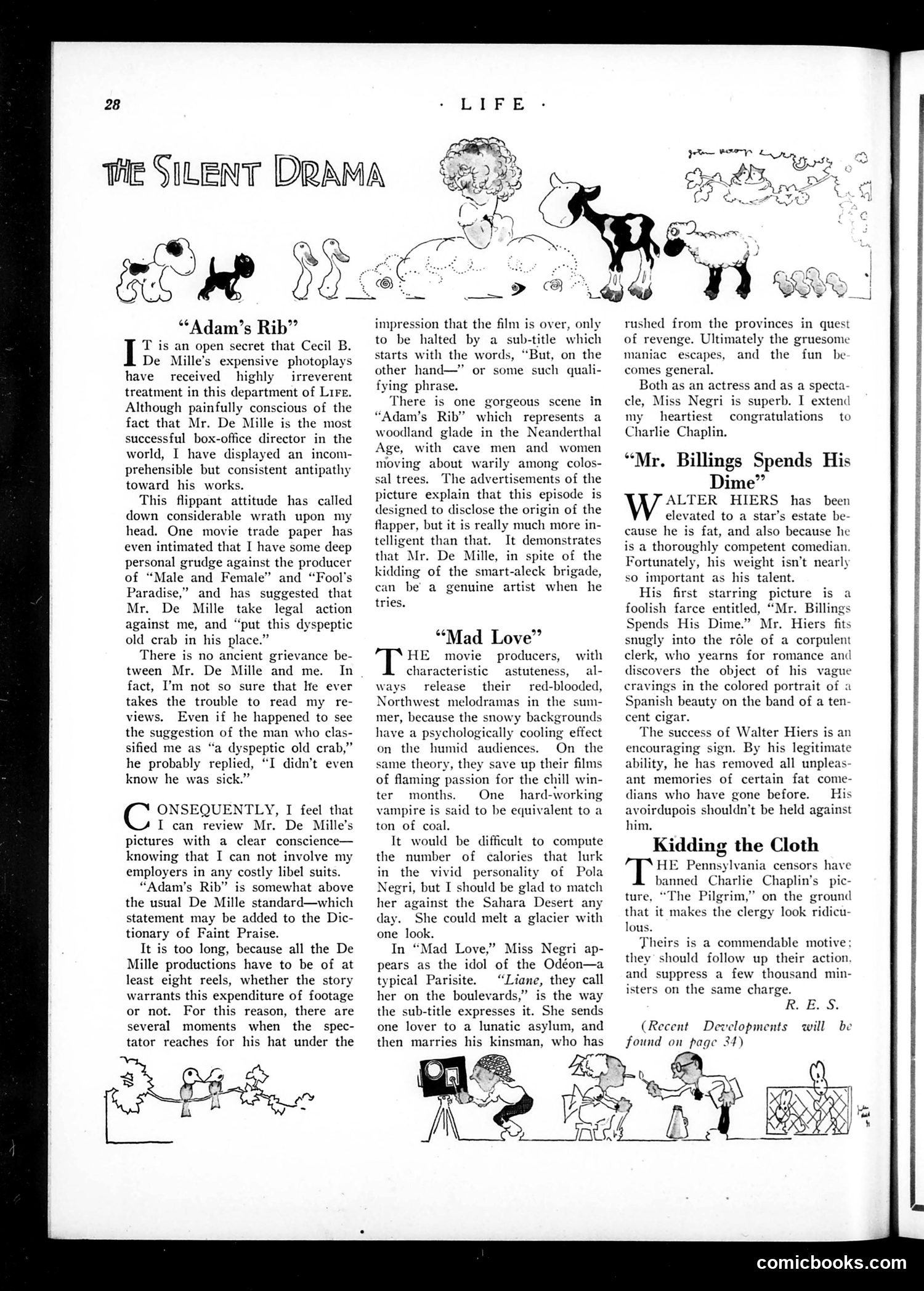
This page from *Life* magazine contains film reviews of three silent movies, accompanied by satirical commentary and small cartoon illustrations. The critic reviews Cecil B. De Mille's "Adam's Rib," praising one prehistoric forest scene while criticizing De Mille's characteristic tendency toward excessive length. He notes De Mille's habit of adding qualifying subtitle phrases like "But, on the other hand—" just when audiences think the film has ended. The second review covers "Mad Love," featuring actress Pola Negri, with the critic using hyperbolic language about her "vivid personality" to describe her screen presence—comparing her attractiveness to melting glaciers. The third reviews Walter Hiers' "Mr. Billings Spends His Dime," noting Hiers was elevated to stardom partly because of his weight, which he leverages for comedy. The small cartoon illustrations at bottom appear to humorously depict scenes from these films or the reviewing process itself.
📄 Transcribed text from this page (OCR, searchable)
Machine-transcribed from the original scan — historical spelling and the odd misread are preserved.
28 tie SILENT DRAMA “Adam’s Rib” T is an open secret that Cecil B. De Mille’s expensive photoplays have received highly irreverent treatment in this department of Lire. Although painfully conscious of the fact that Mr. De Mille is the most successful box-office director in the world, I have displayed an incom- prehensible but consistent antipathy toward his works. This flippant attitude has called down considerable wrath upon my head. One movie trade paper has even intimated that I have some deep personal grudge against the producer of “Male and Female” and “Fool's Paradise,” and has suggested that Mr. De Mille take legal action against me, and “put this dyspeptic old crab in his place.” There is no ancient grievance be- tween Mr. De Mille and me. In fact, I’m not so sure that He ever takes the trouble to read my re- views. Even if he happened to see the suggestion of the man who clas- sified me as “a dyspeptic old crab,” he probably replied, “I didn’t even know he was sick.” ONSEQUENTLY, I feel that I can review Mr. De Mille’s pictures with a clear conscience— knowing that I can not involve my employers in any costly libel suits. “Adam’s Rib” is somewhat above the usual De Mille standard—which statement may be added to the Dic- tionary of Faint Praise. It is too long, because all the De Mille productions have to be of at least eight reels, whether the story warrants this expenditure of footage or not. For this reason, there are several moments when the spec- tator reaches for his hat under the impression that the film is over, only to be halted by a sub-title which starts with the words, “But, on the other hand—” or some such quali- fying phrase. There is one gorgeous scene in “Adam’s Rib” which represents a woodland glade in the Neanderthal Age, with cave men and women moving about warily among colos- sal trees. The advertisements of the picture explain that this episode is designed to disclose the origin of the flapper, but it is really much more in- telligent than that. It demonstrates that Mr. De Mille, in spite of the kidding of the smart-aleck brigade, can be’ a genuine artist when he tries. “Mad Love” HE movie producers, with characteristic astuteness, al- ys release their red-blooded, Northwest melodramas in the sum- mer, because the snowy backgrounds have a psychologically cooling effect on the humid audiences. On the same theory, they save up their films of flaming passion for the chill win- ter months. One _ hard-working vampire is said to be equivalent to a ton of coal. It would be difficult to compute the number of calories that lurk in the vivid personality of Pola Negri, but I should be glad to match her against the Sahara Desert any day. She could melt a glacier with one look. In “Mad Love,” Miss Negri ap- pears as the idol of the Odéon—a typical Parisite. “Liane, they call her on the boulevards,” is the way the sub-title expresses it. She sends one lover to a lunatic asylum, and then marries his kinsman, who has SA ‘a rushed from the provinces in quest of revenge. Ultimately the gruesome maniac escapes, and the fun be comes general. Both as an actress and as a specta- cle, Miss Negri is superb. I extend my heartiest congratulations to Charlie Chaplin. “Mr. Billings Spends His Dime” ALTER HIERS has been elevated to a star’s estate be- cause he is fat, and also because he is a thoroughly competent comedian. Fortunately, his weight isn’t nearly so important as his talent. His first starring picture is a foolish farce entitled, “Mr. Billings Spends His Dime.” Mr. Hiers fits snugly into the role of a corpulent clerk, who yearns for romance and discovers the object of his vague cravings in the colored portrait of « Spanish beauty on the band of a ten- cent cigar. The success of Walter Hiers is an encouraging sign. By his legitimate ability, he has removed all unpleas- ant memories of certain fat come- dians who have gone before. His avoirdupois shouldn't be held against him. Kidding the Cloth HE Pennsylvania censors have banned Charlie Chaplin’s pic- ture, “The Pilgrim,” on the ground that it makes the clergy look ridicu- lous. Theirs is a commendable motive: they should follow up their action, and suppress a few thousand min- isters on the same charge. R. ELS. (Recent Developments will be found on page 34) Ke bh. ate! comicbooks.com