
Life, 1923-03-29 · page 28 of 40
Life — March 29, 1923 — page 28: what you’re looking at
What you’re looking at
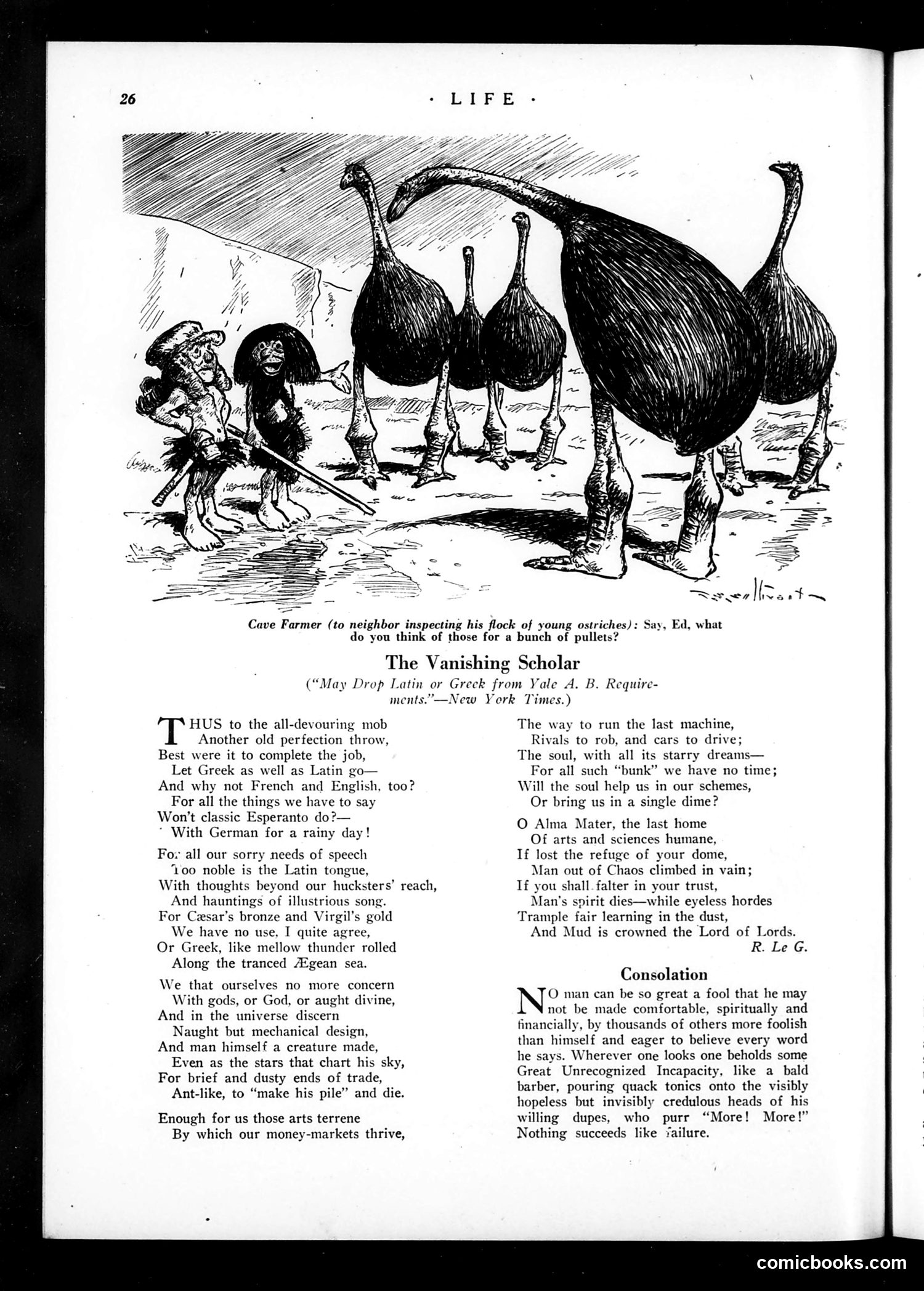
The cartoon depicts a farmer proudly showing off young ostriches to a neighbor, calling them "pullets" (young hens)—a joke about rural ignorance mistaking exotic birds for common poultry. The accompanying poem satirizes the erosion of classical education. Written as commentary on Yale's potential elimination of Latin and Greek requirements, it mocks the utilitarian mindset replacing humanistic learning. The speaker sarcastically endorses dropping classical languages in favor of Esperanto and German, arguing that only practical skills for commerce matter—"the way to run the last machine, / Rivals to rob, and cars to drive." The poem's real argument reverses this: it mourns that education has become purely transactional. By abandoning classical arts and spiritual learning, universities betray their purpose. The final lines warn that without "the refuge of your dome," civilization itself collapses into chaos where "Mud is crowned the Lord of Lords." This reflects early-20th-century anxiety about modernization eroding intellectual and moral foundations in favor of profit-driven pragmatism.
📄 Transcribed text from this page (OCR, searchable)
Machine-transcribed from the original scan — historical spelling and the odd misread are preserved.
Ssye7 iz. Pho Cave Farmer (to neighbor inspecting his flock of young ostriches): Say, Ed, what do you think of those for a bunch of pullets? The Vanishing Scholar (“May Drop Latin ments.” HUS to the all-devouring mob Another old perfection throw, Best were it to complete the job, Let Greek as well as Latin go— And why not French and English, too? For all the things we have to say Won't classic Esperanto do?— * With German for a rainy day! Foy all our sorry needs of speech ‘Loo noble is the Latin tongue, With thoughts beyond our hucksters’ reach, And hauntings of illustrious song. For Cesar’s bronze and Virgil's gold We have no use, I quite agree, Or Greek, like mellow thunder rolled Along the tranced 7Egean sea. We that ourselves no more concern With gods, or God, or aught divine, And in the universe discern Naught but mechanical design, And man himself a creature made, Even as the stars that chart his sky, For brief and dusty ends of trade, Ant-like, to “make his pile” and die. Enough for us those arts terrene By which our money-markets thrive, k from Yale A. B. Require- New York Times.) The way to run the last machine, Rivals to rob, and cars to drive; The soul, with all its starry dreams— For all such “bunk” we have no time; Will the soul help us in our schemes, Or bring us in a single dime? O Alma Mater, the last home Of arts and sciences humane, If lost the refuge of your dome, Man out of Chaos climbed in vain; If you shall.falter in your trust, Man’s spirit dies—while eyeless hordes Trample fair learning in the dust, And Mud is crowned the Lord of Lords. R. Le G. Consolation O man can be so great a fool that he may not be made comfortable, spiritually and financially, by thousands of others more foolish than himself and eager to believe every word he says. Wherever one looks one beholds some Great Unrecognized Incapacity, like a bald barber, pouring quack tonics onto the visibly hopeless but invisibly credulous heads of his willing dupes, who purr “More! More!” Nothing succeeds like failure. comicbooks.com