
Life, 1923-03-29 · page 7 of 40
Life — March 29, 1923 — page 7: what you’re looking at
What you’re looking at
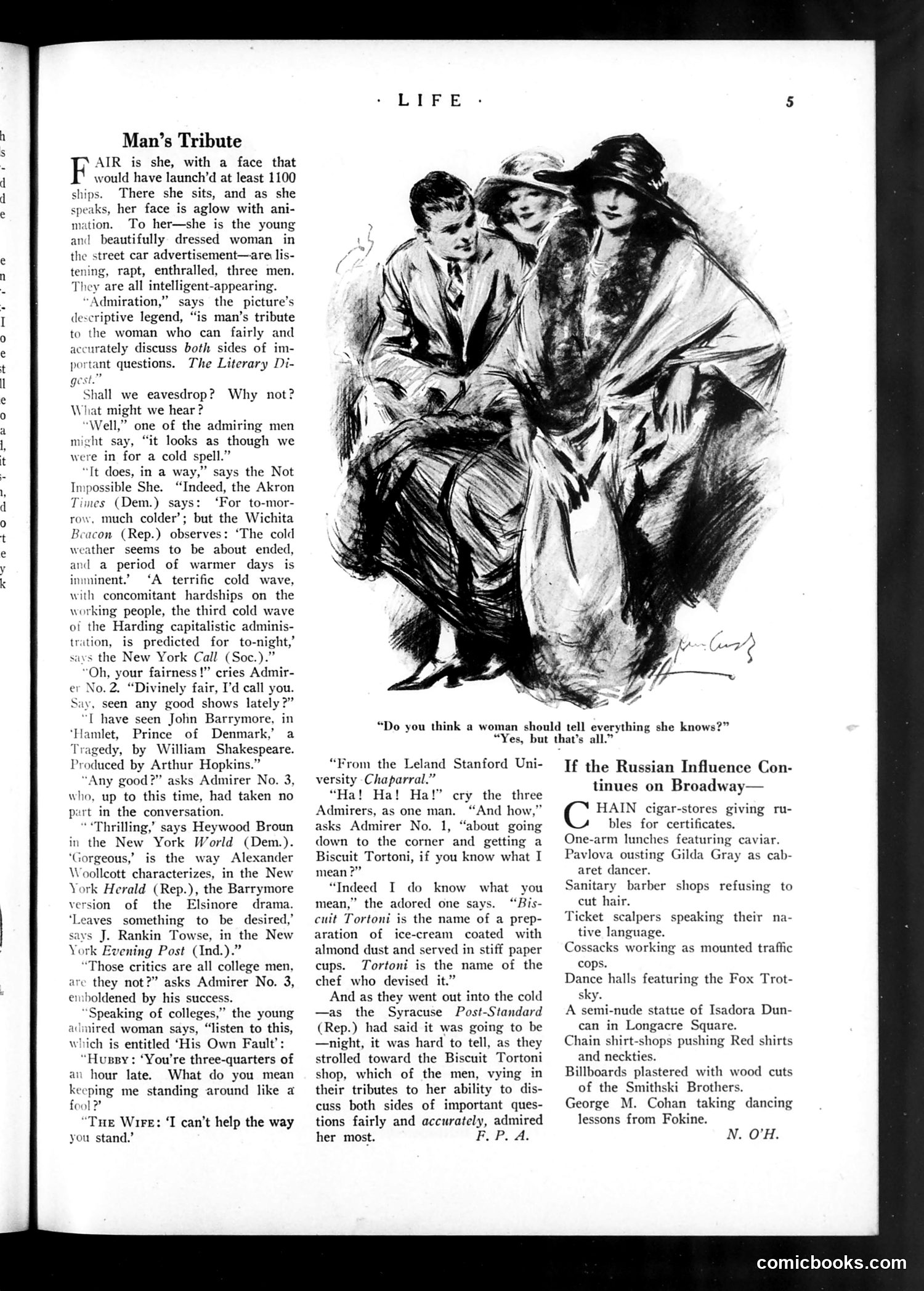
This cartoon satirizes men's admiration of women by depicting three well-dressed men engaged in serious discussion about a beautiful woman on a streetcar. The piece mocks how men discuss women with exaggerated reverence—calling their tribute "man's admiration of the woman who can fairly and accurately discuss both sides of important questions." The satire hinges on the caption: "Do you think a woman should tell everything she knows?" with the response "Yes, but that's all!" This reveals the cartoon's cynical point: men claim to admire intellectually capable women, yet the punchline suggests women possess limited knowledge worth discussing. The satire targets masculine hypocrisy—professing respect for female intelligence while simultaneously dismissing women's actual intellect.
📄 Transcribed text from this page (OCR, searchable)
Machine-transcribed from the original scan — historical spelling and the odd misread are preserved.
Man’s Tribute AIR is she, with a face that would have launch’d at least 1100 ps. There she sits, and as she speaks, her face is aglow with ani- mation. To her—she is the young and beautifully dressed woman in the street car advertisement—are lis- tening, rapt, enthralled, three men. They are all intelligent-appearing. “Admiration,” says the picture’s descriptive legend, “is man’s tribute to the woman who can fairly and accurately discuss both sides of im- portant questions. The Literary Di- gest. Shall we eavesdrop? Why not? What might we hear? Well,” one of the admiring men might say, “it looks as though we were in for a cold spell.” “It does, in a way,” says the Not Impossible She. “Indeed, the Akron Times (Dem.) says: ‘For to-mor- row, much colder’; but the Wichita Beacon (Rep.) observes: ‘The cold weather seems to be about ended, and a period of warmer days is imminent.’ ‘A terrific cold wave, with concomitant hardships on the working people, the third cold wave oi the Harding capitalistic adminis- tration, is predicted for to-night,’ says the New York Call (Soc.).” “Oh, your fairness!” cries Admir- er No. 2. “Divinely fair, I'd call you. Say, seen any good shows lately?” “[ have seen John Barrymore, in ‘Hamlet, Prince of Denmark,’ a Tragedy, by William Shakespeare. Produced by Arthur Hopkins.” “Any good?” asks Admirer No. 3, who, up to this time, had taken no part in the conversation. ‘Thrilling,’ says Heywood Broun in the New York World (Dem.). ‘Gorgeous,’ is the way Alexander Woollcott characterizes, in the New York Herald (Rep.), the Barrymore version of the Elsinore drama. es something to be desired,’ says J. Rankin Towse, in the New York Evening Post (Ind.).” “Those critics are all college men, are they not?” asks Admirer No. 3, emboldened by his success. “Speaking of colleges,” the young admired woman says, “listen to this, which is entitled ‘His Own Fault’: “Hussy: ‘You're three-quarters of an hour late. What do you mean keeping me standing around like a fool ? ‘Tue Wire: ‘I can’t help the way you stand.’ “Do you think a woman should tell everything she knows?” “Yes, but that’s all.’ om the Leland Stanford Uni- versity Chaparral.” “Ha! Ha! Ha!” cry the three Admirers, as one man. “And how,” asks Admirer No. 1, “about going down to the corner and getting a Biscuit Tortoni, if you know what I mean ?” “Indeed I do know what you mean,” the adored one says. “Bis- cuit Tortoni is the name of a prep- aration of ice-cream coated with almond dust and served in stiff paper cups. Tortoni the name of the chef who devised it.” And as they went out into the cold —as the Syracuse Post-Standard (Rep.) had said it was going to be —night, it was hard to tell, as they strolled toward the Biscuit Tortoni shop, which of the men, vying in their tributes to her ability to dis- cuss both sides of important ques- tions fairly and accurately, admired her most. F, P. A. If the Russian Influence Con- tinues on Broadway— HAIN cigar-stores giving ru- bles for certificates. One-arm lunches featuring caviar. Pavlova ousting Gilda Gray as cab- aret dancer. Sanitary barber shops refusing to cut hair. Ticket scalpers speaking their na- tive language. Cossacks working as mounted traffic cops. Dance halls featuring the Fox Trot- sky. A semi-nude statue of Isadora Dun- can in Longacre Square. Chain shirt-shops pushing Red shirts and neckties. Billboards plastered with wood cuts of the Smithski Brothers. George M. Cohan taking dancing lessons from Fokine. N. O’H. comicbooks.com