
Life, 1923-03-29 · page 16 of 40
Life — March 29, 1923 — page 16: what you’re looking at
What you’re looking at
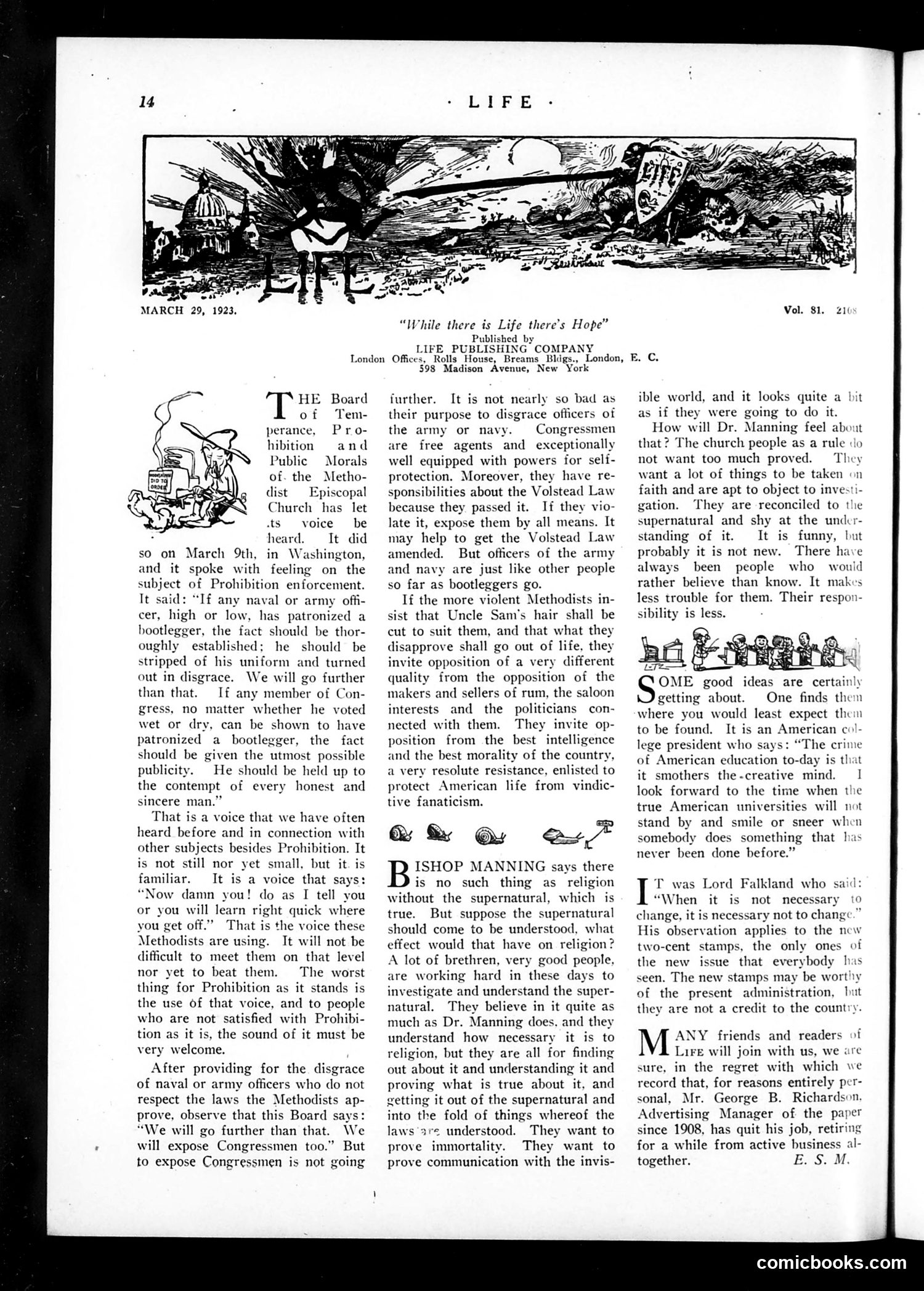
This page contains editorial commentary on Prohibition enforcement rather than a political cartoon. The main article criticizes the Methodist Church's board for demanding that military officers and congressmen be stripped of their uniforms if they patronize bootleggers—calling this stance disgraced and unenforceable. The piece argues that enforcing Prohibition through character attacks on public officials is ineffective and that the real issue involves "makers and sellers of rum" and corrupt politicians. It advocates instead for "revolute resistance" to protect American life from "vindictive fanaticism." The secondary article quotes Bishop Manning's views on reconciling religion with the supernatural, and notes the retirement of Life's advertising manager, George B. Richardson. No specific caricatures appear on this page.
📄 Transcribed text from this page (OCR, searchable)
Machine-transcribed from the original scan — historical spelling and the odd misread are preserved.
MARCH 29, 1923, “While there is Life there’s Hope” Published by LIFE PUBLISHING COMPANY London Offices, Rolls House, Breams Bldgs., London, E. Cc fi HE Board of Tem- Pro- and perance, hibition Public Morals of. the Metho- dist | Episcopal Church has let ts voice be heard. It _ did so on March 9th, in Washington, and it spoke with feeling on the subject of Prohibition enforcement. It said: “If any naval or army offi- cer, high or low, has patronized a bootlegger, the fact should be thor- oughly established; he should be stripped of his uniform and turned out in disgrace. We will go further than that. If any member of Con- gress, no matter whether he voted wet or dry, can be shown to have patronized a bootlegger, the fact should be given the utmost possible publicity. He should be held up to the contempt of every honest and sincere man.” That is a voice that we have often heard before and in connection with other subjects besides Prohibition. It is not still nor yet small, but it. is familiar. It is a voice that says: “Now damn you! do as I tell you or you will learn right quick where you get off.” That is the voice these Methodists are using. It will not be difficult to meet them on that level nor yet to beat them. The worst thing for Prohibition as it stands is the use of that voice, and to people who are not satisfied with Prohibi- tion as it is, the sound of it must be very welcome. After providing for the disgrace of naval or army officers who do not respect the laws the Methodists ap- prove, observe that this Board says: “We will go further than that. We will expose Congressmen too.” But to expose Congressmen is not going 598 Madison Avenue, New York further. It is not nearly so bad as their purpose to disgrace officers of the army or navy. Congressmen are free agents and exceptionally well equipped with powers for self- protection. Moreover, they have re- sponsibilities about the Volstead Law because they passed it. If they vio- late it, expose them by all means. It may help to get the Volstead Law amended. But officers of the army and navy are just like other people so far as bootleggers go. If the more violent Methodists in- sist that Uncle Sam’s hair shall be cut to suit them, and that what they disapprove shall go out of life, they invite opposition of a very different quality from the opposition of the makers and sellers of rum, the saloon interests and the politicians con- nected with them. They invite op- position from the best intelligence and the best morality of the country, a very resolute resistance, enlisted to protect American life from vindic- tive fanaticism. @ame @ a,* ISHOP MANNING says there is no such thing as religion without the supernatural, which is true. But suppose the supernatural should come to be understood, what effect would that have on religion? A lot of brethren, very good people, are working hard in these days to investigate and understand the super- natural. They believe in it quite as much as Dr. Manning does. and they understand how necessary it is to religion, but they are all for finding out about it and understanding it and proving what is true about it, and getting it out of the supernatural and into the fold of things whereof the laws'are understood. They want to prove immortality. They want to prove communication with the invis- ible world, and it looks quite a bit as if they were going to do it. How will Dr. Manning feel about that? The church people as a rule «io not want too much proved. They nt a lot of things to be taken on faith and are apt to object to inv gation. They are reconciled to the supernatural and shy at the undcr- standing of it. It is funny, but probably it is not new. There have always been people who would rather believe than know. It makes less trouble for them. Their respon- sibility is less. OME good ideas are certainly getting about. One finds them where you would least expect them to be found. It is an American col- lege president who says: “The crime of American education to-day is that it smothers the-creative mind. | look forward to the time when the true American universities will not stand by and smile or sneer when somebody does something that has never been done before.” T was Lord Falkland who said: “When it is not necessary change, it is necessary not to change.” His observation applies to the new two-cent stamps, the only ones of the new issue that everybody has seen. The new stamps may be worthy of the present administration, hut they are not a credit to the country. ANY friends and readers of Lire will join with us, we are sure, in the regret with which we record that, for reasons entirely per- sonal, Mr. George B. Richardson. Advertising Manager of the paper since 1908, has quit his job, retiring for a while from active business al- together. E. S; M. comicbooks.com