
Life, 1923-03-29 · page 24 of 40
Life — March 29, 1923 — page 24: what you’re looking at
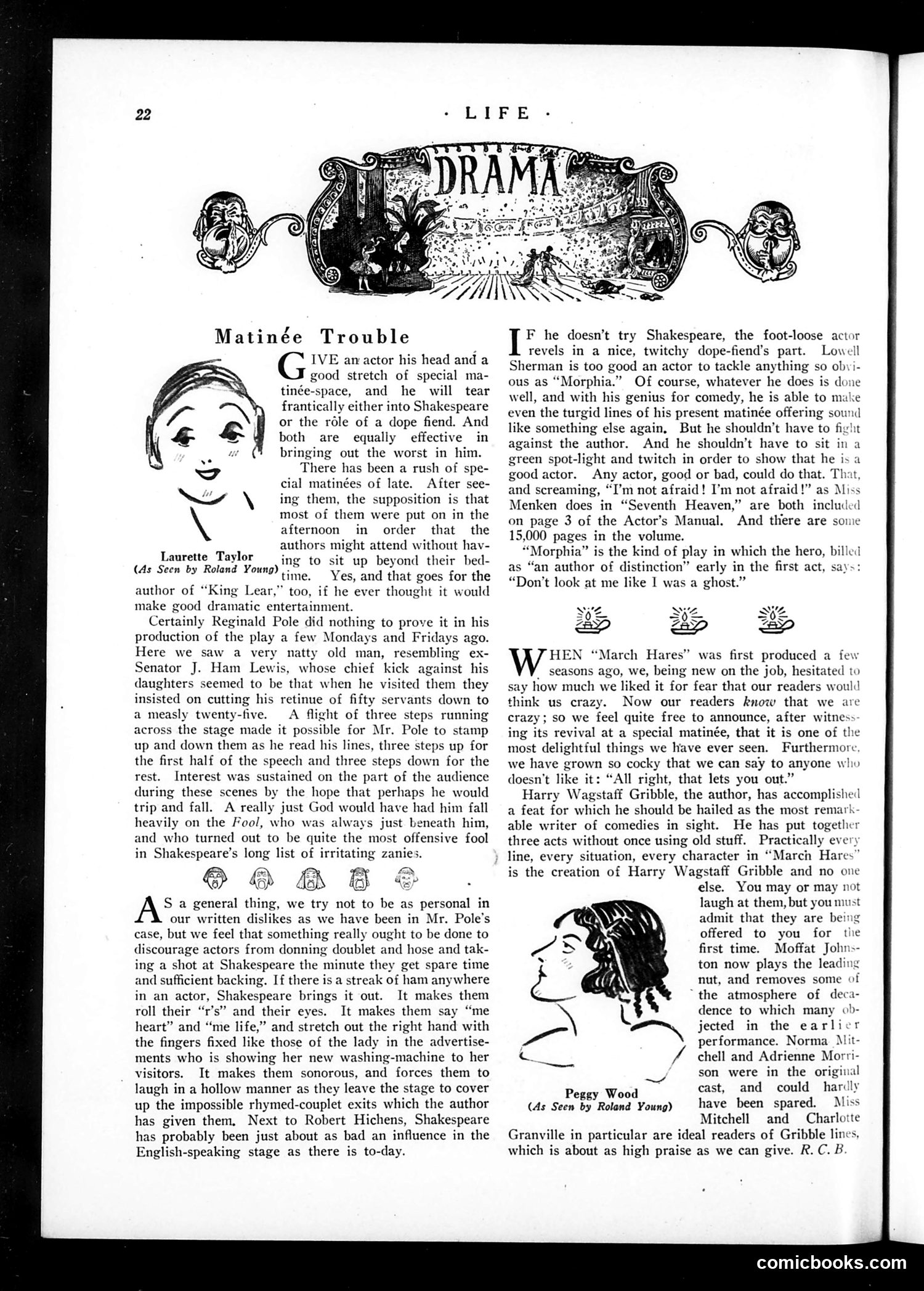
What you’re looking at
This is a theater criticism column attacking theatrical excess and poor playwriting. The page features two caricatured portraits: **Laurette Taylor** and **Peggy Wood**, contemporary actresses of the 1920s era. The critic (likely identified as "K.C.B." at column's end) satirizes three main problems: 1. **Shakespearean overreach**: Actors with ham tendencies donning period costumes to perform Shakespeare, turning the Bard's work into unintentional comedy through affected delivery ("me heart," exaggerated gestures). 2. **Poor direction**: A production of *King Lear* directed by Reginald Pole, where an old man merely climbs three stage steps repeatedly—absurd staging masquerading as drama. 3. **Melodramatic drug plays**: Actors like Lowell Sherman wasting talent on predictable "dope fiend" roles requiring obvious twitching and screaming ("I'm not afraid!"). The underlying point: good actors deserve better material and shouldn't compensate for bad writing through theatrical posturing. The satire targets not the performers but the system enabling mediocre productions.
📄 Transcribed text from this page (OCR, searchable)
Machine-transcribed from the original scan — historical spelling and the odd misread are preserved.
Matinée Trouble IVE ar actor his head and a good stretch of special ma- pace, and he will tear frantically either into Shakespeare or the role of a dope fiend. And both are equally effective in bringing out the worst in him. There has been a rush of spe- cial matinées of late. After see- ing them, the supposition is that most of them were put on in the afternoon in order that the authors might attend without hav- ing to sit up beyond their bed- time. Yes, and that goes for the Laurette Taylor (As Seen by Roland Young) author of “King Lear,” too, if he ever thought it would make good dramatic entertainment. Certainly Reginald Pole did nothing to prove it in his production of the play a few Mondays and Fridays ago. Here we saw a very natty old man, resembling ex Senator J. Ham Lewis, whose chief k against his daughters seemed to be that when he visited them they insisted on cutting his retinue of fifty servants down to a measly twenty-five. <A flight of three steps running across the stage made it possible for Mr. Pole to stamp up and down them as he read his lines, three steps up for the first half of the speech and three steps down for the rest. Interest was sustained on the part of the audience during these scenes by the hope that perhaps he would trip and fall. A really just God would have had him fall heavily on the Fool, who was always just beneath him, and who turned out to be quite the most offensive fool in Shakespeare’s long list of irritating zanies. S a general thing, we try not to be as personal in our written dislikes as we have been in Mr. Pole’s case, but we feel that something really ought to be done to discourage actors from donning doublet and hose and tak- ing a shot at Shakespeare the minute they get spare time and sufficient backing. If there is a streak of ham anywhere in an actor, Shakespeare brings it out. It makes them roll their “r’s” and their eyes. It makes them say “me heart” and “me life,” and stretch out the right hand with the fingers fixed like those of the lady in the advertise- ments who is showing her new washing-machine to her visitors. It makes them sonorous, and forces them to laugh in a hollow manner as they leave the stage to cover up the impossible rhymed-couplet exits which the author has given them. Next to Robert Hichens, Shakespeare has probably been just about as bad an influence in the English-speaking stage as there is to-day. F he doesn’t try Shakespeare, the foot-loose actor revels in a nice, twitchy dope-fiend’s part. Lowell Sherman is too good an actor to tackle anything so obyi- ous as “Morphia.” Of course, whatever he does is done well, and with his genius for comedy, he is able to make even the turgid lines of his present matinée offering sound like something else again, But he shouldn't have to against the author. And he shouldn't have to sit in a green spot-light and twitch in order to show that he is a good actor. Any actor, good or bad, could do that. That, and screaming, “I’m not afraid! I’m not afraid!” as Miss Menken does in “Seventh Heaven,” are both included on page 3 of the Actor’s Manual. And there are sone 15,000 pages in the volume. “Morphia” is the kind of play in which the hero, billed as “an author of distinction” early in the first act, say “Don’t look at me like I was a ghost.” se HEN “March Hares” was first produced a few _ Seasons ago, we, being new on the job, hesitated to say how much we liked it for fear that our readers would think us crazy. Now our readers know that we are crazy; so we feel quite free to announce, after witnes ing its revival at a special matinée, that it is one of the most delightful things we have ever seen. Furthermore we have grown so cocky that we can say to anyone wl doesn’t like it: “All right, that lets you out.” Harry Wagstaff Gribble, the author, has accomplishe: a feat for which he should be hailed as the most remark- able writer of comedies in sight. He has put together three acts without once using old stuff. Practically every line, every situation, every character in “March Hares” is the creation of Harry Wagstaff Gribble and no one else. You may or may not laugh at them, but you must admit that they are being offered to you for tie first time. Moffat Johr ton now plays the leac nut, and removes some the atmosphere of dec dence to which many 0 jected in the earl performance. Norma Mi Je chell and Adrienne Morr son were in the origi cast, and could harill) have been spared. Miss Mitchell and Charlotte Granville in particular are ideal readers of Gribble lines, which is about as high praise as we can give. R.C. B 1 ~~ Peggy Wood (As Seen by Roland Young) comicbooks.com