
Life, 1923-03-29 · page 18 of 40
Life — March 29, 1923 — page 18: what you’re looking at
What you’re looking at
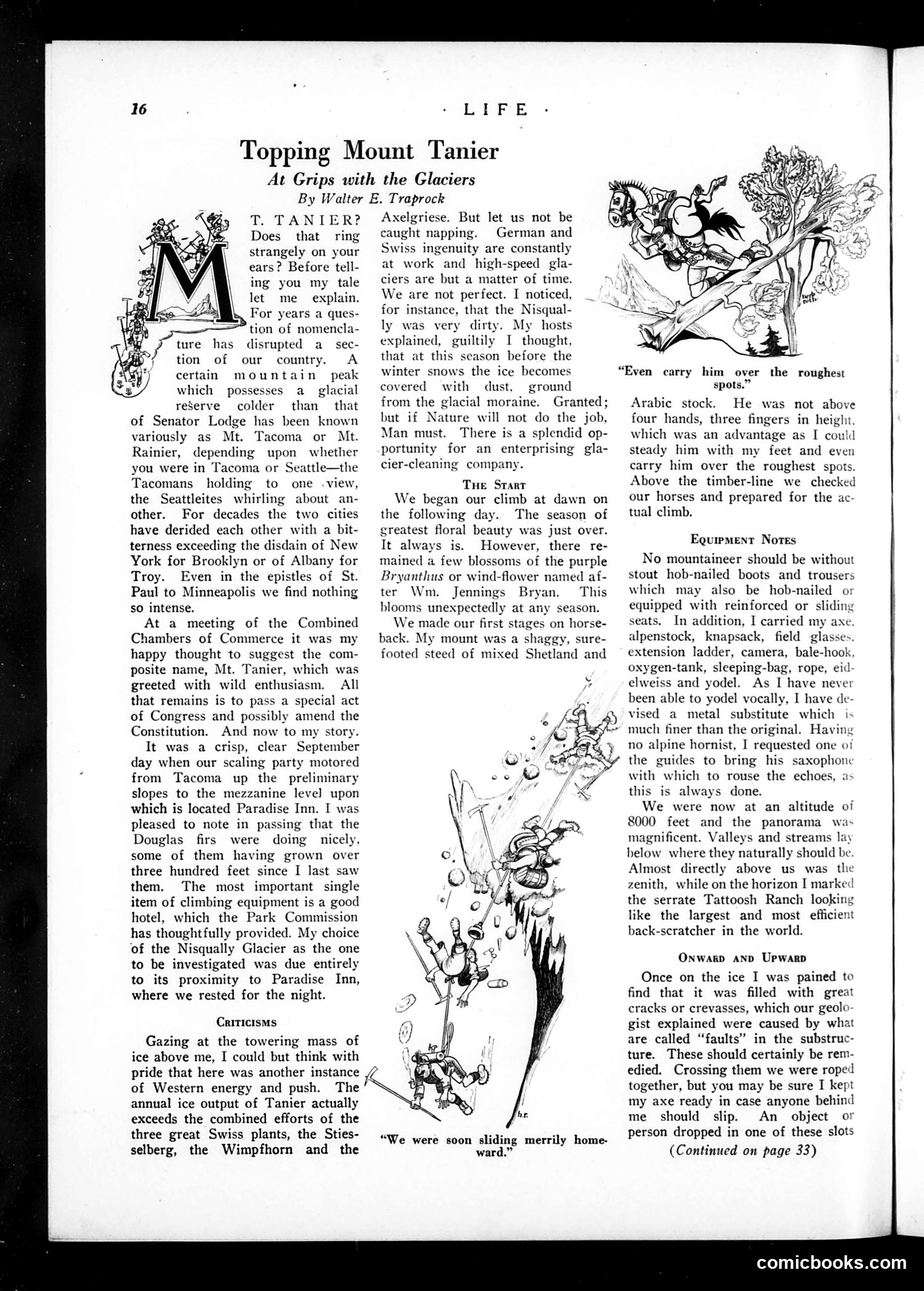
This is a humorous travel narrative by Walter E. Traprock (a pseudonym for a satirical writer), illustrated with comic drawings of mountain climbing mishaps. The satire targets Pacific Northwest civic rivalry: Tacoma and Seattle have feuded for decades over whether to call the peak "Mt. Tacoma" or "Mt. Rainier." Traprock proposes the compromise name "Mt. Tanier"—a joke about splitting differences. The narrator satirizes American boosterism and competitive anxiety, boasting that the glacier's ice output exceeds Swiss production, then worrying Germans and Swiss are developing "high-speed glaciers." He comically suggests hiring a "glacier-cleaning company" to remove dust. The equipment list parodies overwrought mountaineering guides, absurdly including "oxygen-tank," "extension ladder," and "elweiss and yodel"—the last item noted because he "cannot yodel vocally" so he invented a mechanical substitute. The cartoon illustrations show climbers in ridiculous situations, emphasizing the story's comedic tone about earnest but bumbling outdoor adventure.
📄 Transcribed text from this page (OCR, searchable)
Machine-transcribed from the original scan — historical spelling and the odd misread are preserved.
LIFE - Topping Mount Tanier At Grips with the Glaciers By Walter E. Traprock T. TANIER? Does that ring strangely on your ears? Before tell- ing you my tale let me explain. For years a ques- tion of nomencla- disrupted a_ sec- our country. A mountain peak which possesses a_ glacial reserve colder than that of Senator Lodge has been known variously as Mt. Tacoma or Mt. Rainier, depending upon whether you were in Tacoma or Seattle—the Tacomans holding to one .view, the Seattleites whirling about an- other. For decades the two cities have derided each other with a bit- terness exceeding the disdain of New York for Brooklyn or of Albany for Troy. Even in the epistles of St. ture has tion of certain Paul to Minneapolis we find nothing so intense. At a meeting of the Combined Chambers of Commerce it was my happy thought to suggest the com- posite name, Mt. Tanier, which was greeted with wild enthusiasm. All that remains is to pass a special act of Congress and possibly amend the Constitution. And now to my story. It was a crisp, clear September day when our scaling party motored from Tacoma up the preliminary slopes to the mezzanine level upon which is located Paradise Inn. I was pleased to note in passing that the Douglas firs were doing nicely, some of them having grown over three hundred feet since I last saw them. The most important single item of climbing equipment is a good hotel, which the Park Commission has thoughtfully provided. My choice of the Nisqually Glacier as the one to be investigated was due entirely to its proximity to Paradise Inn, where we rested for the night. Criticisms Gazing at the towering mass of ice above me, I could but think with pride that here was another instance of Western energy and push. The annual ice output of Tanier actually exceeds the combined efforts of the three great Swiss plants, the Sties- selberg, the Wimpfhorn and the Axelgriese. But let us not be caught napping. German and Swiss ingenuity are constantly at work and high-speed gla- ciers are but a matter of time. We are not perfect. I noticed, for instance, that the Nisqual- ly was very dirty. My hosts explained, guiltily I thought, that at this season before the winter snows the ice becomes covered with dust, ground from the glacial moraine. Granted; but if Nature will not do the job, Man must. There is a splendid op- portunity for an enterprising gla- cier-cleaning company. Tue Start We began our climb at dawn on the following day. The season of greatest floral beauty was just over. It always is. However, there re- mained a few blossoms of the purple Bryanthus or wind-flower named af- ter Wm. Jennings Bryan. This blooms unexpectedly at any season. We made our first stages on horse- back. My mount was a shaggy, sure- footed steed of mixed Shetland and “We were soon sliding merrily home- ward.” Arabic stock. He was not above four hands, three fingers in height, which was an advantage as I could steady him with my feet and even carry him over the roughest spots. Above the timber-line we checked our horses and prepared for the ac- tual climb. Equipment Notes No mountaineer should be without stout hob-nailed boots and trousers which may also be hob-nailed or equipped with reinforced or sliding seats. In addition, I carried my axe, alpenstock, knapsack, field glasses extension ladder, camera, bale-hook, oxygen-tank, sleeping-bag, rope, eid elweiss and yodel. As I have never been able to yodel vocally, I have de- vised a metal substitute which is much finer than the original. Having no alpine hornist, I requested one oi the guides to bring his saxophone with which to rouse the echoes, as this is always done. We were now at an altitude of 8000 feet and the panorama was magnificent. Valleys and streams lay below where they naturally should be. Almost directly above us was the zenith, while on the horizon I marked the serrate Tattoosh Ranch looking like the largest and most efficient back-scratcher in the world. Onwagp ano Upwarp Once on the ice I was pained to find that it was filled with great cracks or crevasses, which our geolo. gist explained were caused by what are called “faults” in the substruc- ture. These should certainly be rem- edied. Crossing them we were roped together, but you may be sure I kept my axe ready in case anyone behind me should slip. An object or person dropped in one of these slots (Continued on page 33) comicbooks.com