
A complete issue · 36 pages · 1922
Life — July 20, 1922
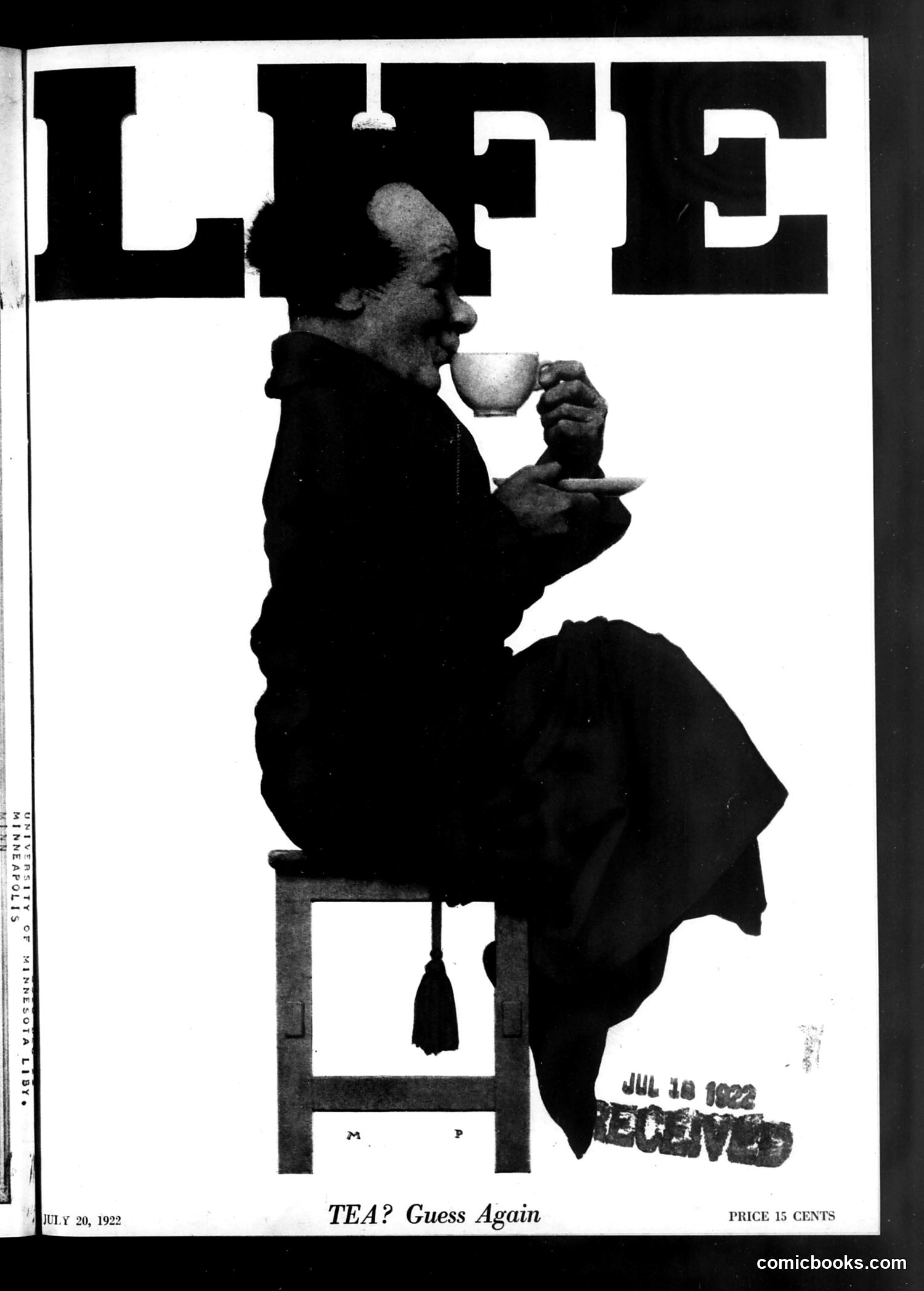
This satirical cover plays on the phrase "Tea? Guess Again"—likely referencing the **Teapot Dome Scandal**, a major political corruption case of the early 1920s involving the secret leasing of federal oil reserves to private companies. The figure sits uncomfortably on a stool, holding a teacup in an awkward pose. The caption suggests that what appears to be an innocent "tea" (social gathering) is actually something far more sinister. The silhouetted profile and body language convey discomfort and guilt. The artist is mocking government officials involved in the scandal, suggesting they have something to hide. The simple composition and stark black-and-white style emphasize the message: what looks respectable on the surface conceals corruption underneath. The 15-cent price reflects Life's status as a premium satirical weekly.
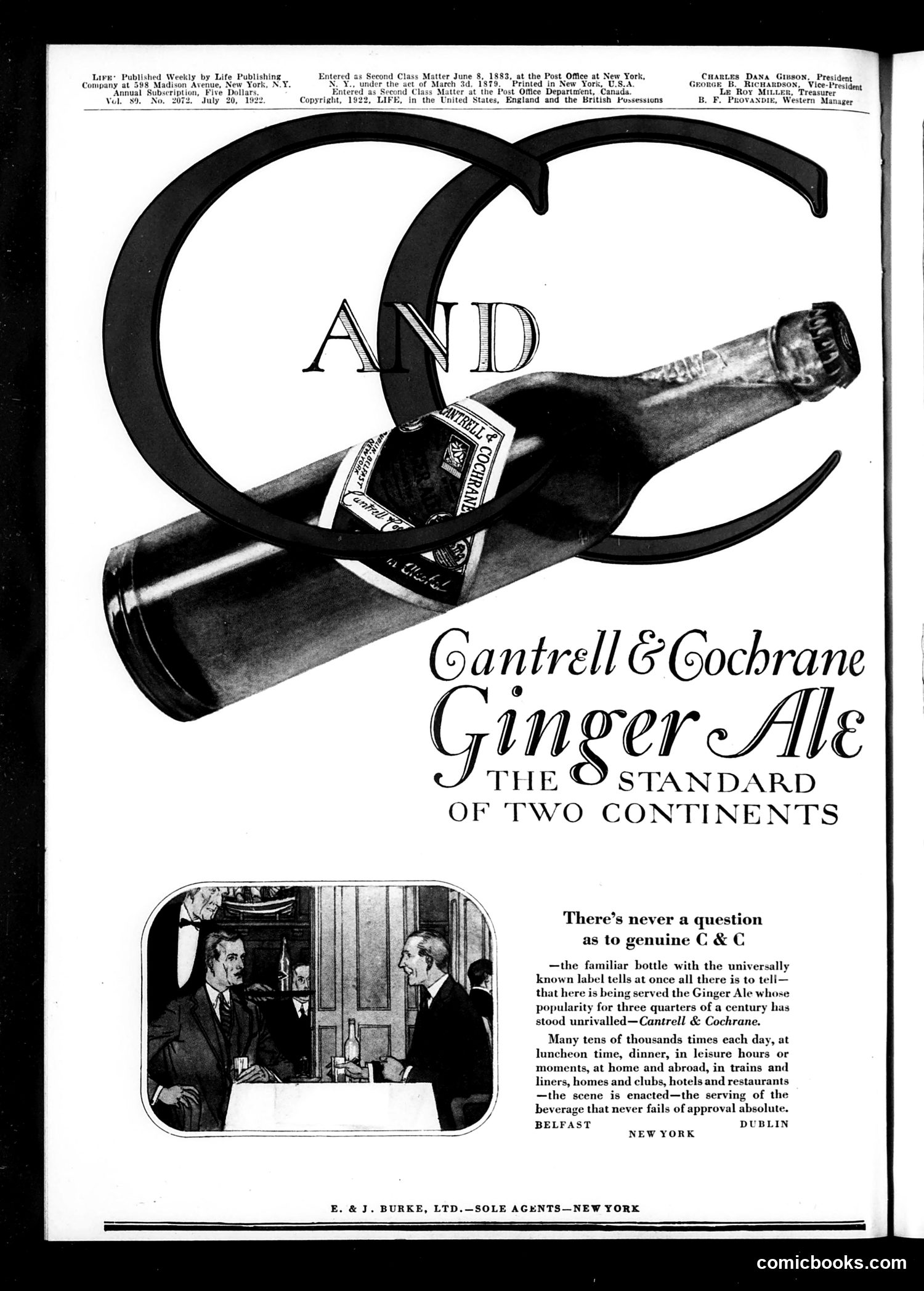
This is primarily a **product advertisement**, not political satire. The page promotes Cantrell & Cochrane Ginger Ale, marketed as "The Standard of Two Continents." The design features a large decorative "C&C" formed by stylized bottle openers or hooks, with a bottle of ginger ale positioned through the center. Below is a photograph showing two men in what appears to be a formal dining or social setting. The copy emphasizes the product's widespread popularity and consistent quality across three-quarters of a century, noting its ubiquity in leisure settings globally—"homes and clubs, hotels and restaurants" in Belfast, New York, and Dublin. This is commercial marketing material typical of 1920s magazine advertising, not editorial commentary or political cartoon.
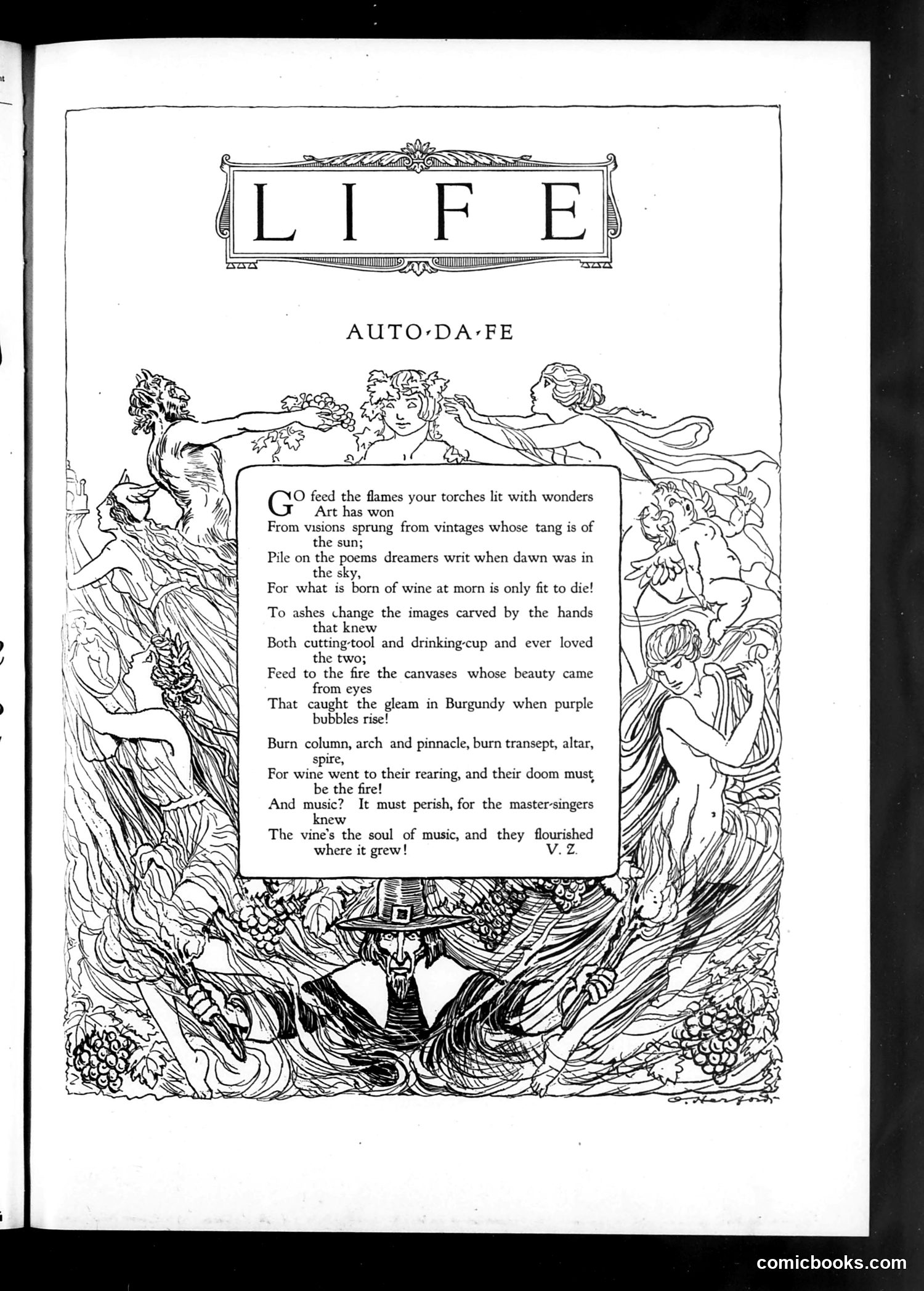
This page features an "Auto da Fé" (a historical term for the public burning of heretics by the Inquisition, repurposed here as satire). The elaborate border illustration shows classical and allegorical figures surrounding a central poem attributed to "V.Z." The poem appears to be a mordant critique of artistic and cultural destruction—specifically calling for the burning of artistic achievements: "canvases," "column, arch and pinnacle," musical compositions, and other cultural works. References to "Burgundy wine" and artistic tools ("cutting tool and drinking-cup") suggest satire targeting either cultural philistinism or destructive movements. The inquisitor figure at the bottom reinforces the parallel to religious persecution. Without identifying V.Z. definitively or the specific historical moment, the page satirizes the destruction or devaluation of high art and culture, treating such destruction as equivalent to religious persecution.
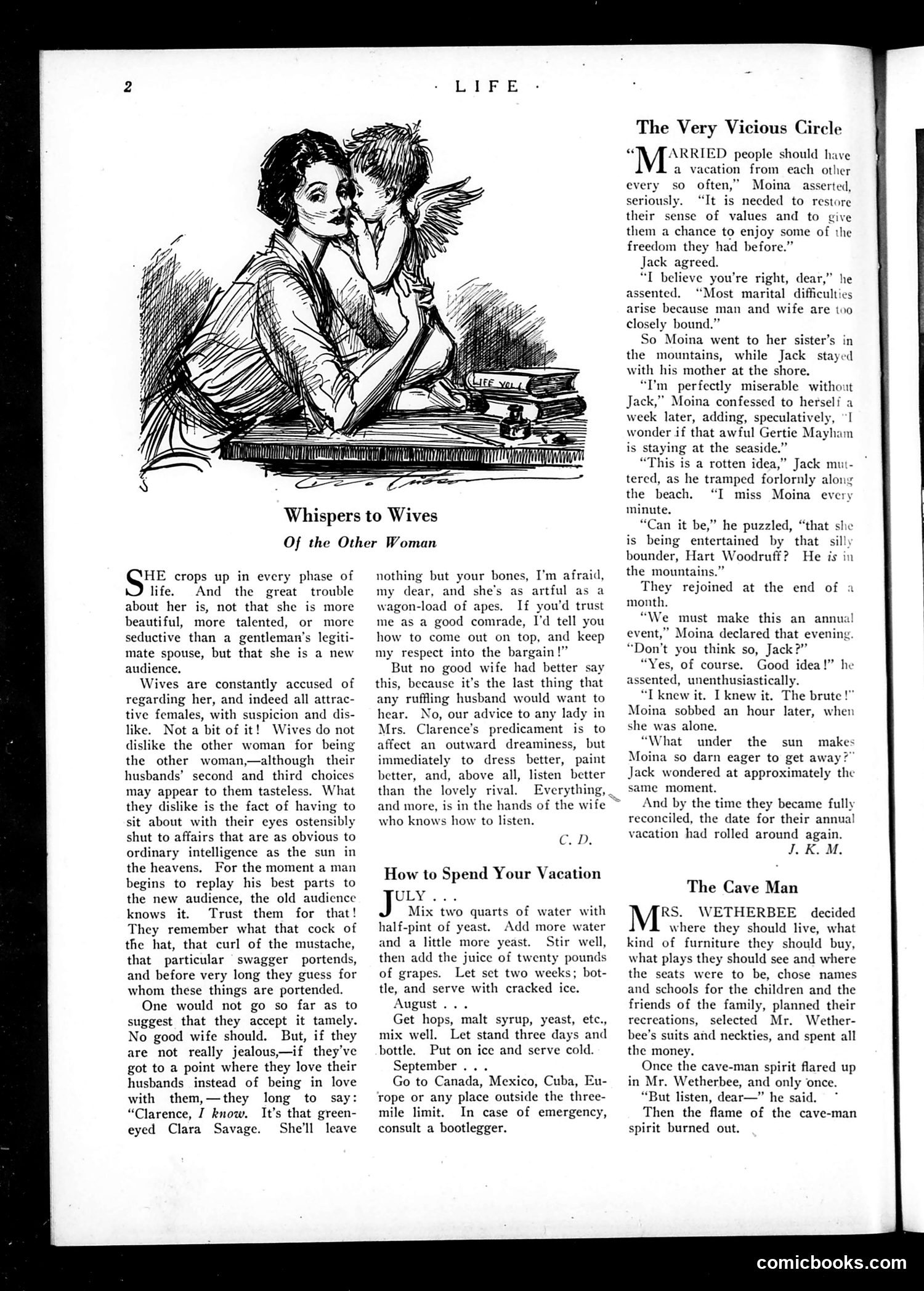
This page contains three short satirical pieces about marriage and domestic life, typical of Life's early 20th-century humor. **"Whispers to Wives of the Other Woman"** mocks wives' jealousy of rivals. The accompanying illustration shows a woman and cupids, likely representing temptation or infidelity. The text argues wives shouldn't worry excessively about "the other woman," suggesting husbands find such rivals manageable nuisances rather than genuine threats. **"The Very Vicious Circle"** satirizes married couples' need for separation vacations to restore their relationship—a commentary on marital tedium and the irony that distance supposedly helps closeness. **"The Cave Man"** humorously describes Mr. Wetherbee's domestication, where even his "cave-man spirit" (wildness) dies once married. The satire targets Victorian-era marriage conventions and gender dynamics, presenting marriage as simultaneously confining and absurdly necessary.
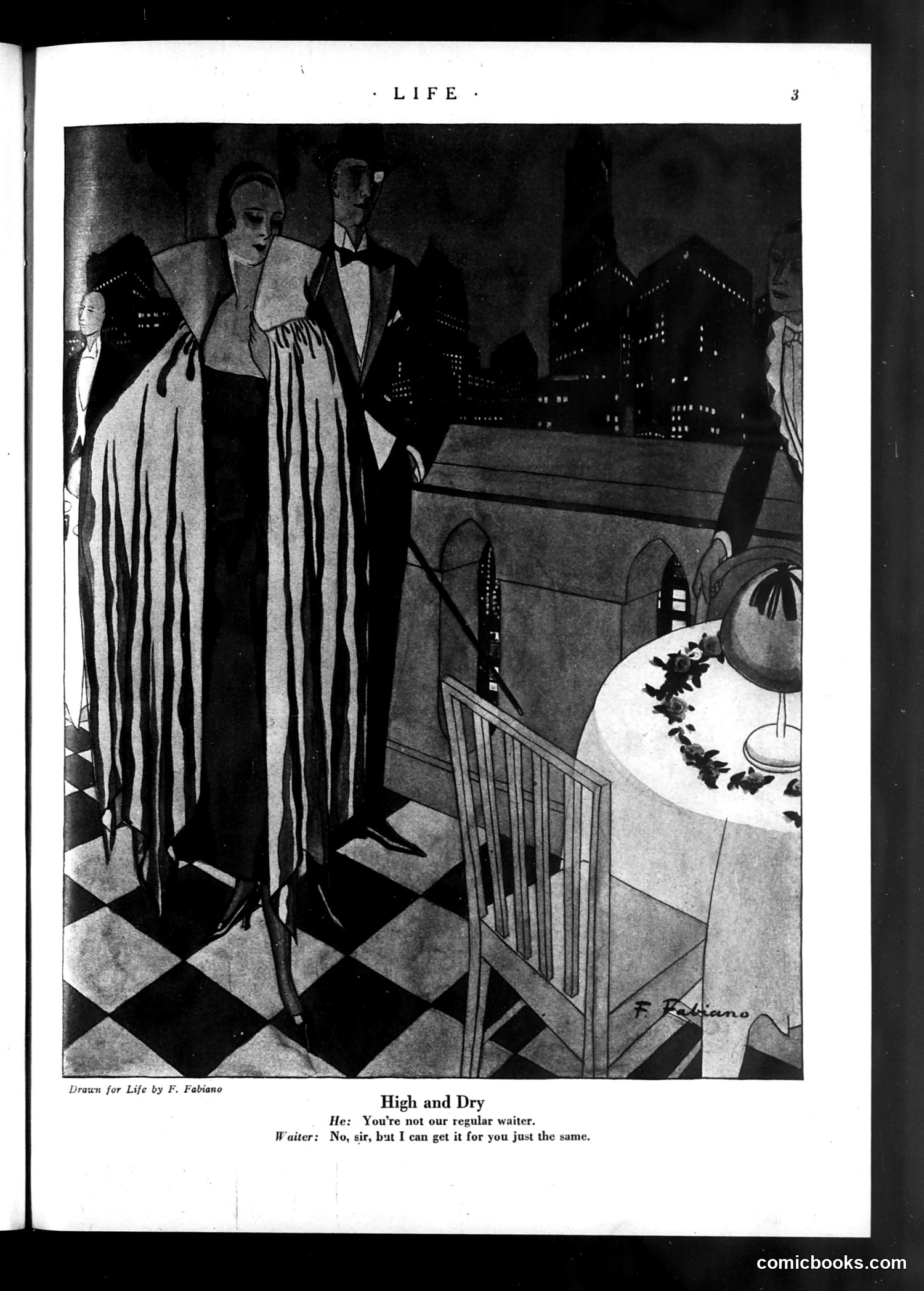
This cartoon by F. Fabiano depicts a formal dinner scene where a waiter in an elaborate striped costume approaches a well-dressed couple. The joke hinges on a misunderstanding about "dry" service—the gentleman states the waiter isn't their "regular waiter," to which the waiter responds he can serve them "just the same." The humor likely references Prohibition-era anxieties about alcohol service. "High and Dry" suggests both intoxication and abandonment. The waiter's willingness to serve despite not being the "regular" implies circumventing proper channels—a dig at how Prohibition was widely flouted through informal arrangements and black-market alcohol distribution during this period.
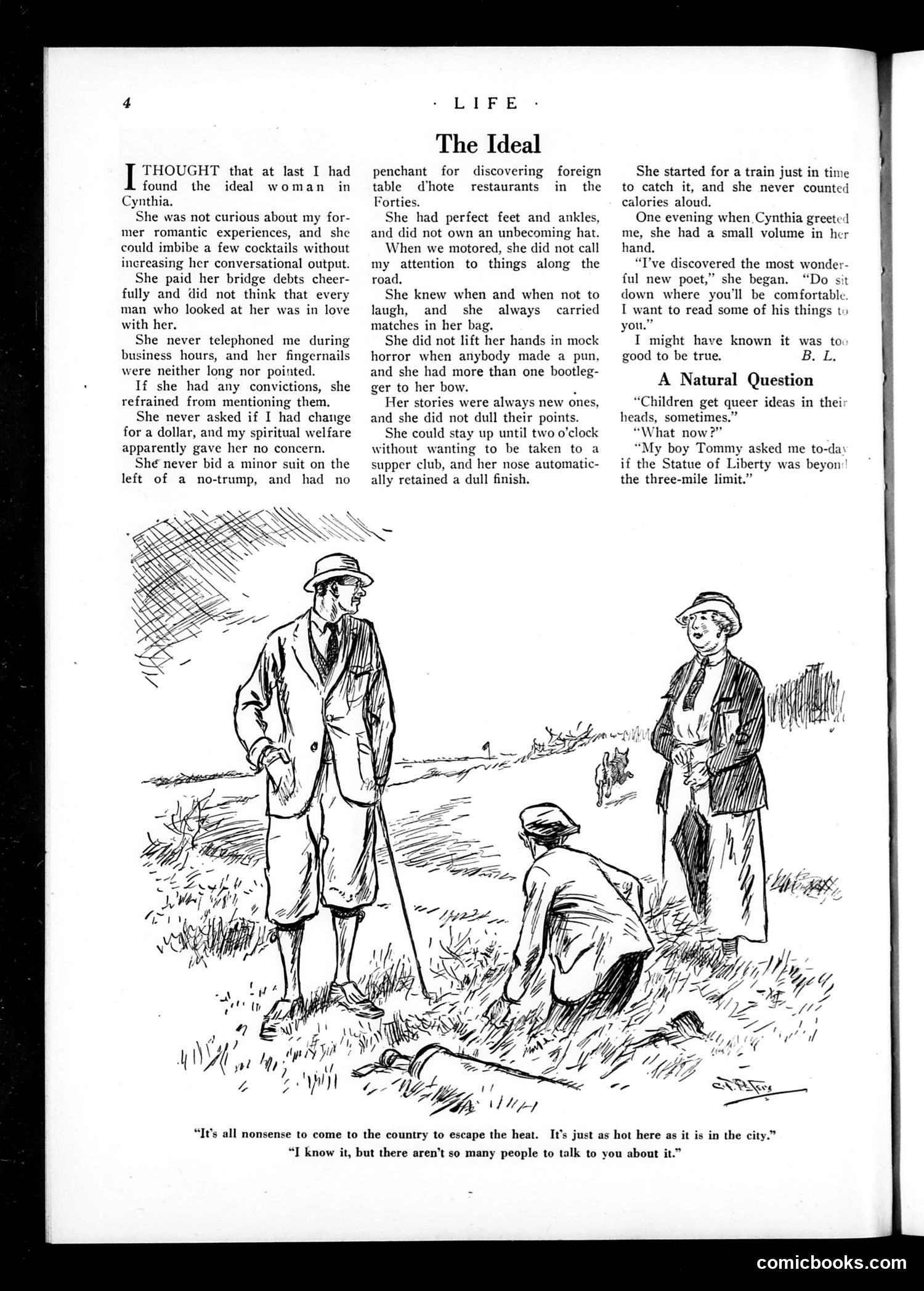
This page from *Life* magazine presents a social satire about urban versus rural living. The story describes an ideal woman named Cynthia—cultured, independent, and undemanding. The accompanying cartoon depicts three figures in a rural setting, with two men standing and one crouching or sitting. The dialogue satirizes the tension between city and country life. One character dismisses escaping to the countryside as pointless ("It's all nonsense to come to the country to escape the heat"), while another notes the real advantage: fewer people for social conversation ("I know it, but there aren't so many people to talk to you about it"). This reflects early 20th-century social anxieties about urbanization, where rural retreat was marketed as escape, yet offered isolation as its actual benefit—satirizing both city society's demands and country life's loneliness.
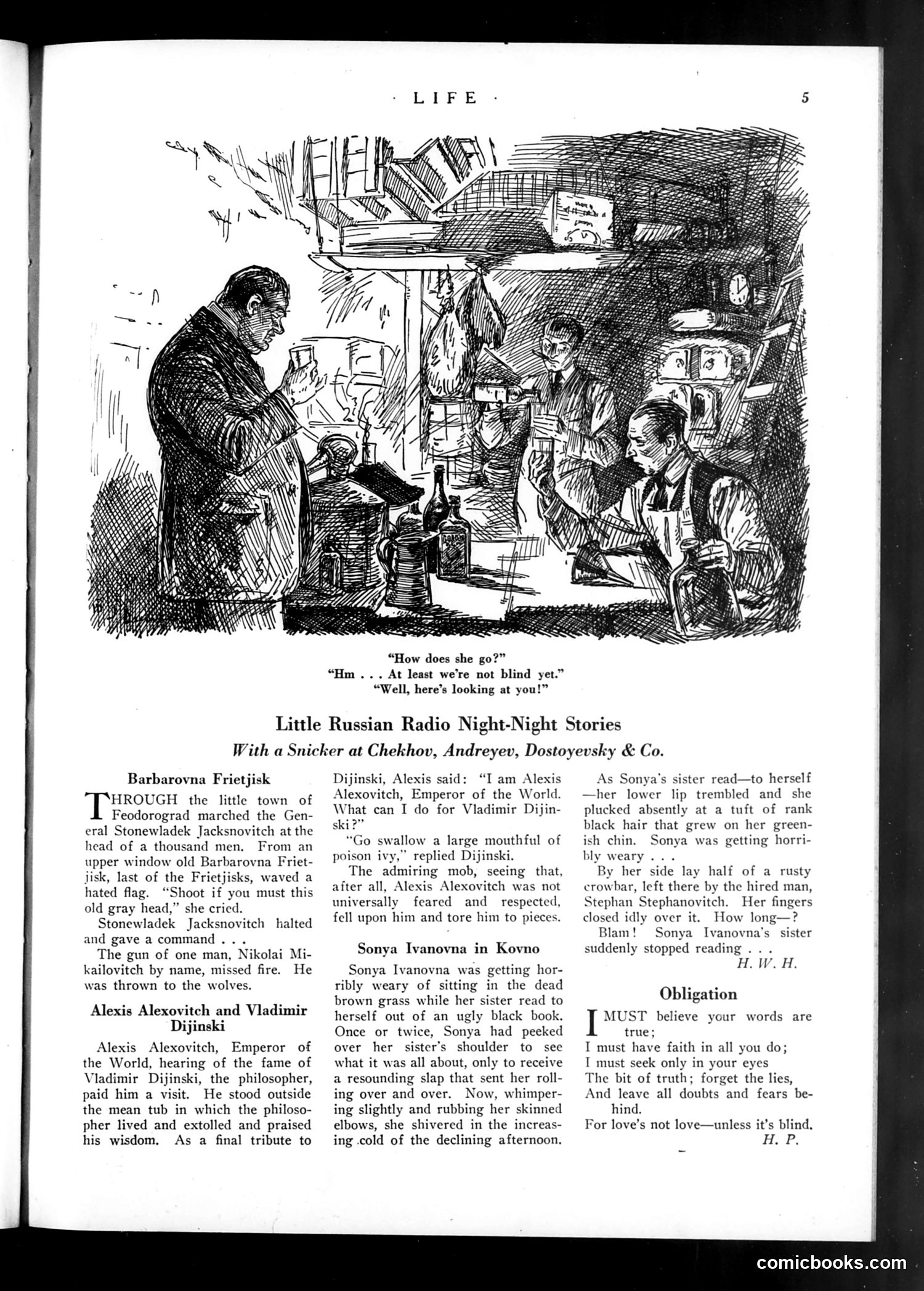
This page from *Life* magazine features a satirical cartoon about Russian political figures. The cartoon depicts what appears to be a tense meeting in a modest Russian interior, with the caption "How does she go?" / "Hm...At least we're not blind yet" / "Well, here's looking at you!" The accompanying text discusses "Little Russian Radio Night-Night Stories" featuring characters named Alexis Alexovitch, Vladimir Dijinski, and Sonya Ivanovna. The satire appears to mock Russian revolutionary or Soviet leadership through these fictional characters and their interactions. The crude living conditions depicted and the oblique dialogue suggest commentary on Russian political dysfunction or the contrast between leaders' pretensions and harsh reality. Without precise dating, the exact historical event referenced remains unclear, though the Russian-focused satire suggests Cold War-era American perspective.
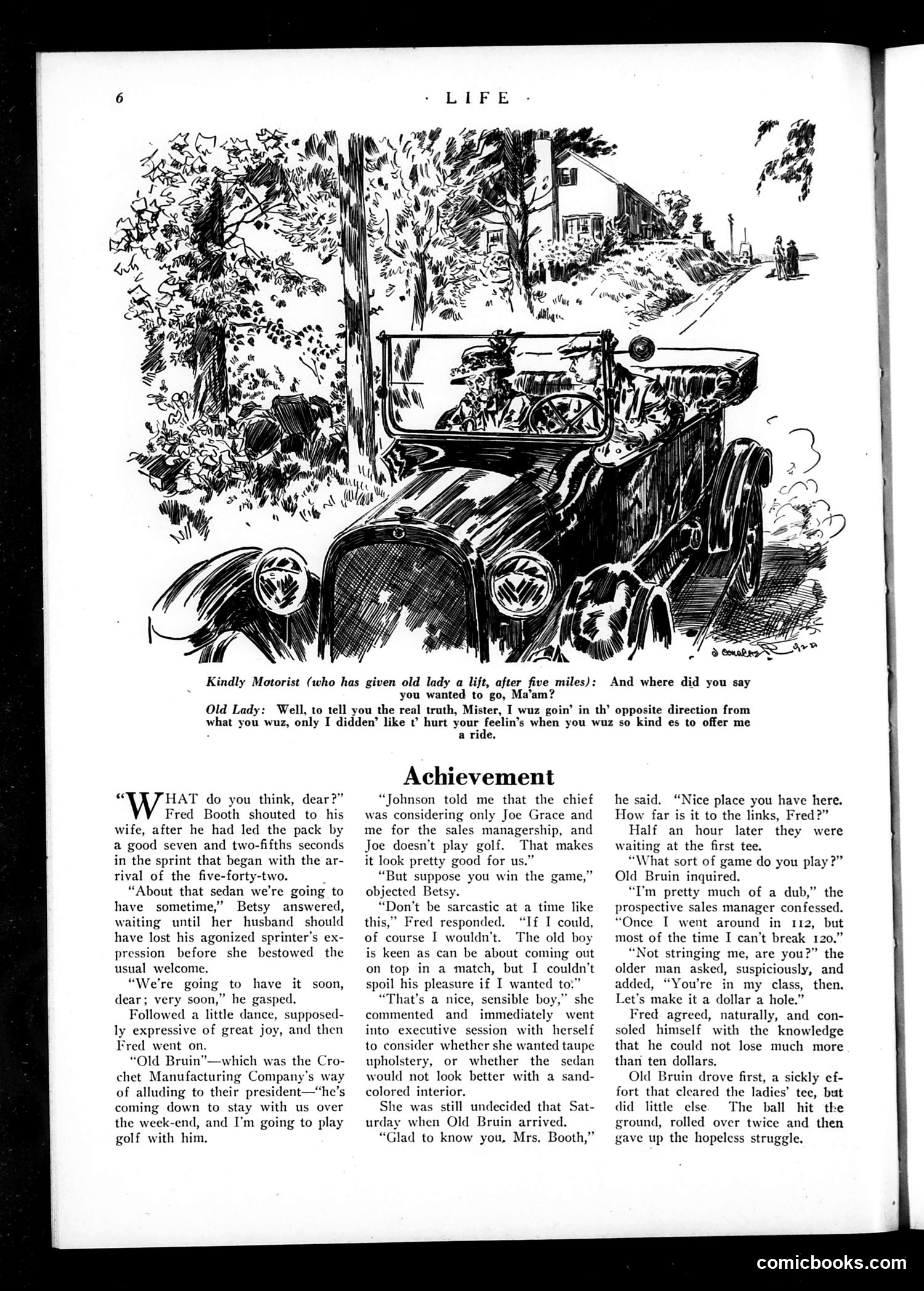
This page contains a cartoon and accompanying humorous story about a motorist giving an elderly woman a ride. The cartoon depicts an early automobile (appears to be from the 1910s-1920s era based on the styling) with the driver offering assistance to an older woman. The joke plays on class and gender dynamics: the "kindly motorist" assumes the old lady wanted to go somewhere specific, but she reveals she was actually heading in the opposite direction—she simply appreciated the courteous offer of a ride, regardless of destination. The accompanying "Achievement" story satirizes business ambition and social climbing, depicting Fred Booth's efforts to impress his wife and win a sales position by adopting leisure activities like golf. The satire mocks how middle-class characters performed respectability and competed for professional advancement through carefully cultivated social behaviors.
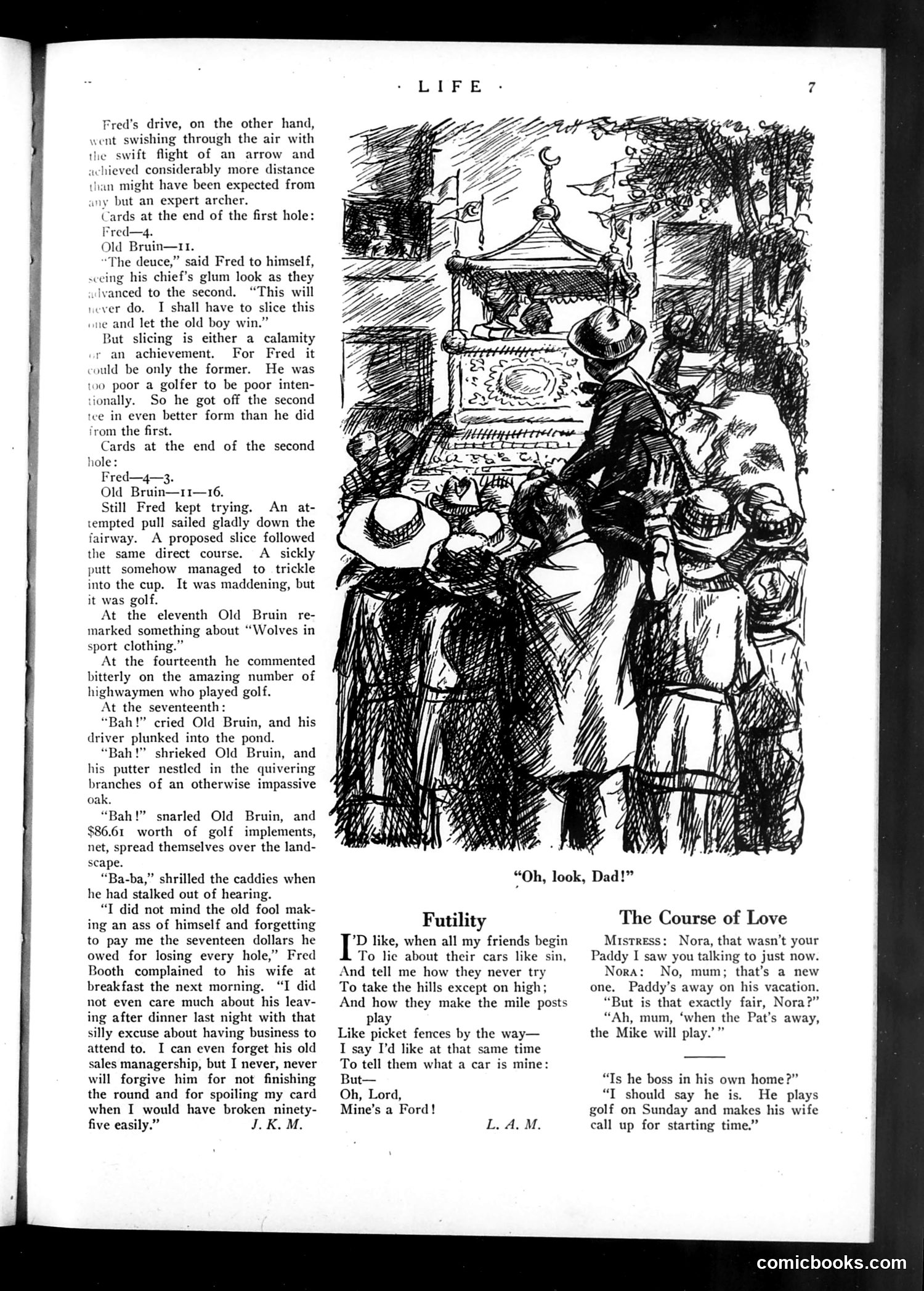
This page contains two satirical pieces: **Main Story**: A golf narrative about "Fred" and "Old Bruin," depicting a competitive match where Fred's superior drive frustrates his chief. The humor mocks poor golfing ability, with references to "slicing" and amateur incompetence—suggesting Old Bruin is a bad golfer trying to maintain dignity despite failure. **Two Poems Below**: - "Futility" by J.K.M. satirizes how friends brag about car ownership and casual infidelity - "The Course of Love" by L.A.M. jokes about marital dynamics—a wife complaining her husband prioritizes golf over family time The accompanying illustration shows period-dressed figures at what appears to be a golf clubhouse. The satire targets early 20th-century masculine leisure culture, marital power dynamics, and status-seeking behavior among the upper-middle class.
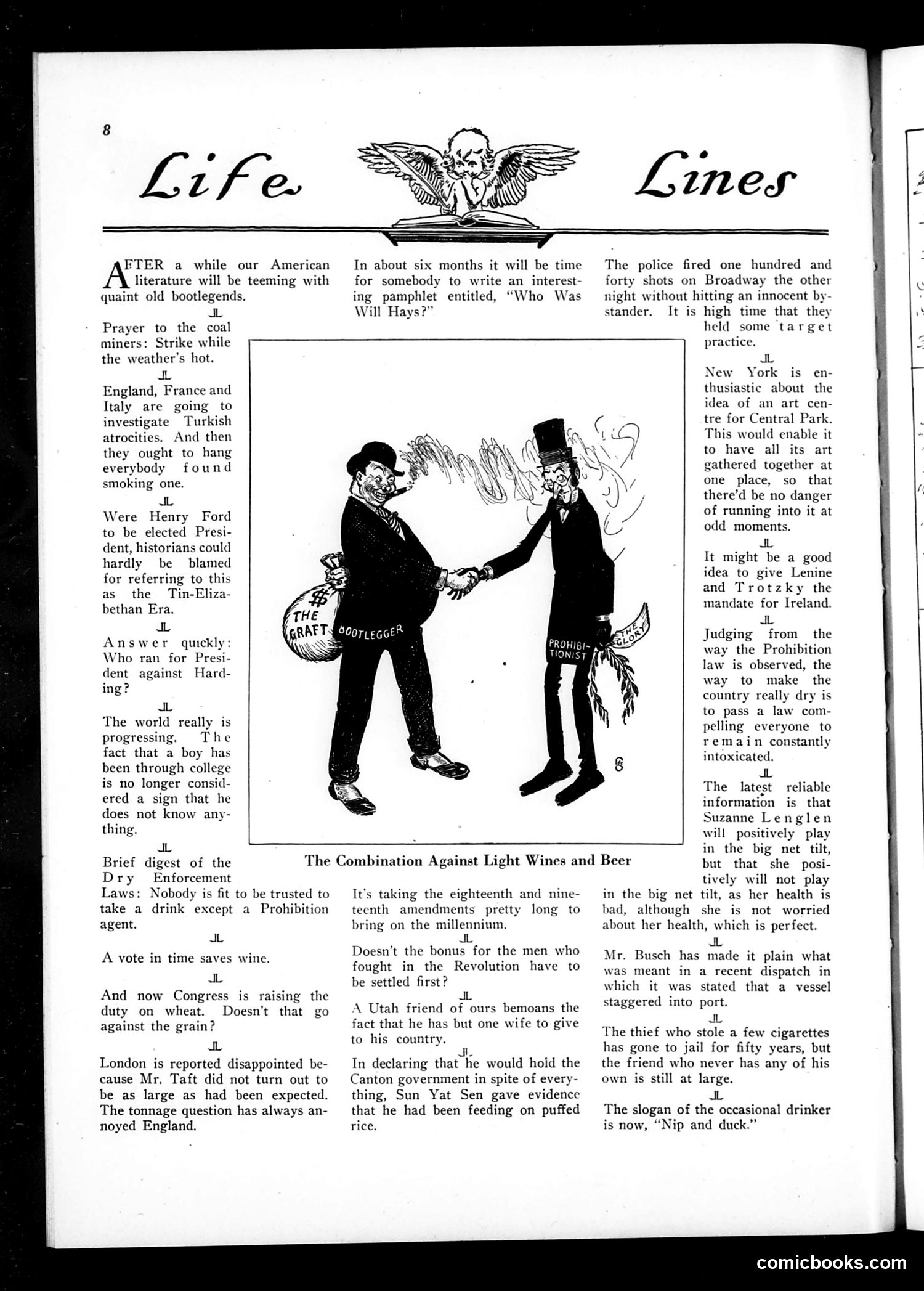
The central cartoon depicts two men in formal dress shaking hands while exchanging contraband. One figure labeled "THE CRAFT BOOTLEGGER" holds a sack, while the other labeled "PROHIBIT POLITICIAN" receives it. This satirizes the hypocrisy of Prohibition enforcement: politicians publicly supporting the alcohol ban while privately obtaining liquor from bootleggers. The surrounding "Life Lines" column contains brief satirical comments about Prohibition's failures, including commentary on the difficulty of enforcing total abstinence and criticism of enforcement methods (like the Broadway police shootings mentioned). The overall message mocks the contradiction between Prohibition's stated goals and its actual implementation—that those in power circumvented their own laws while ordinary citizens faced strict enforcement.
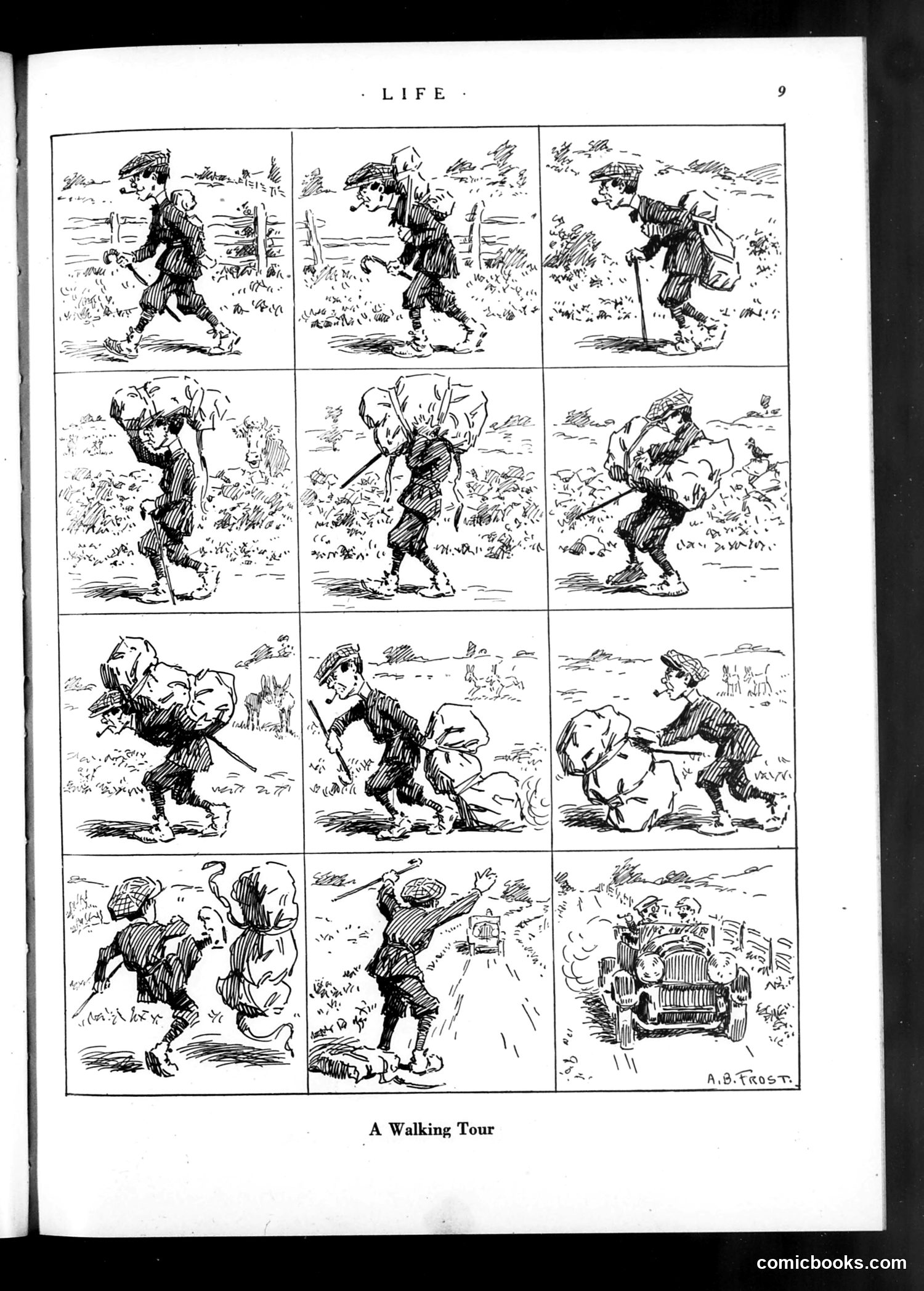
This is a 12-panel sequential comic strip by A.B. Frost showing a man's increasingly exhausting country walk. The narrative progresses from the figure confidently striding through pastoral landscapes (top panels) to struggling with progressively heavier bundles of collected items—flowers, branches, and debris. By the middle panels, he's visibly overburdened and weary. The final panel reveals the punchline: an automobile zooms past, suggesting modern transportation has made this "walking tour" comically obsolete. The satire mocks the era's romanticization of nature walks and rural rambling while subtly commenting on how emerging automobile technology was displacing traditional leisure activities. It's gentle humor about changing times and the gap between nostalgic ideals and modern reality.
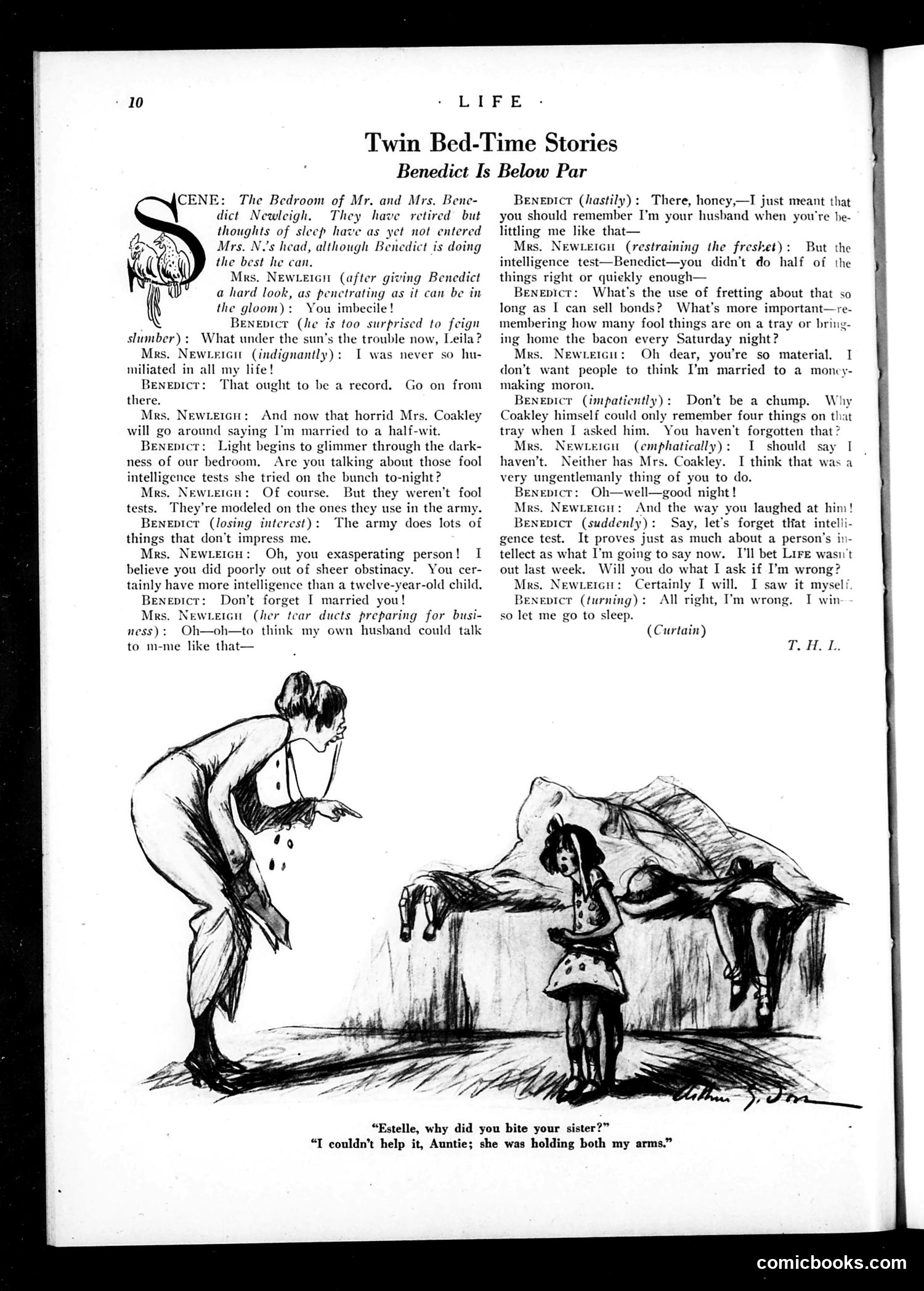
This is a humorous marital sketch where Mr. and Mrs. Benedict argue in their bedroom. Mrs. Newleigh (a guest) has criticized Benedict's intelligence after he failed an "intelligence test," comparing him unfavorably to a twelve-year-old child. The sketch satirizes early-20th-century marriage dynamics and gender relations. Benedict grows defensive about his masculinity and competence, while Mrs. Newleigh reinforces domestic stereotypes—she mentions him bringing home bacon and references his poor performance on formal tests. The accompanying cartoon shows a child biting her aunt; the caption suggests the aunt was holding both the child's arms, implying the child found a creative workaround. It's a simple joke about childhood mischief and physical helplessness. Both pieces rely on domestic conflict humor typical of the era's comedic sketch format.
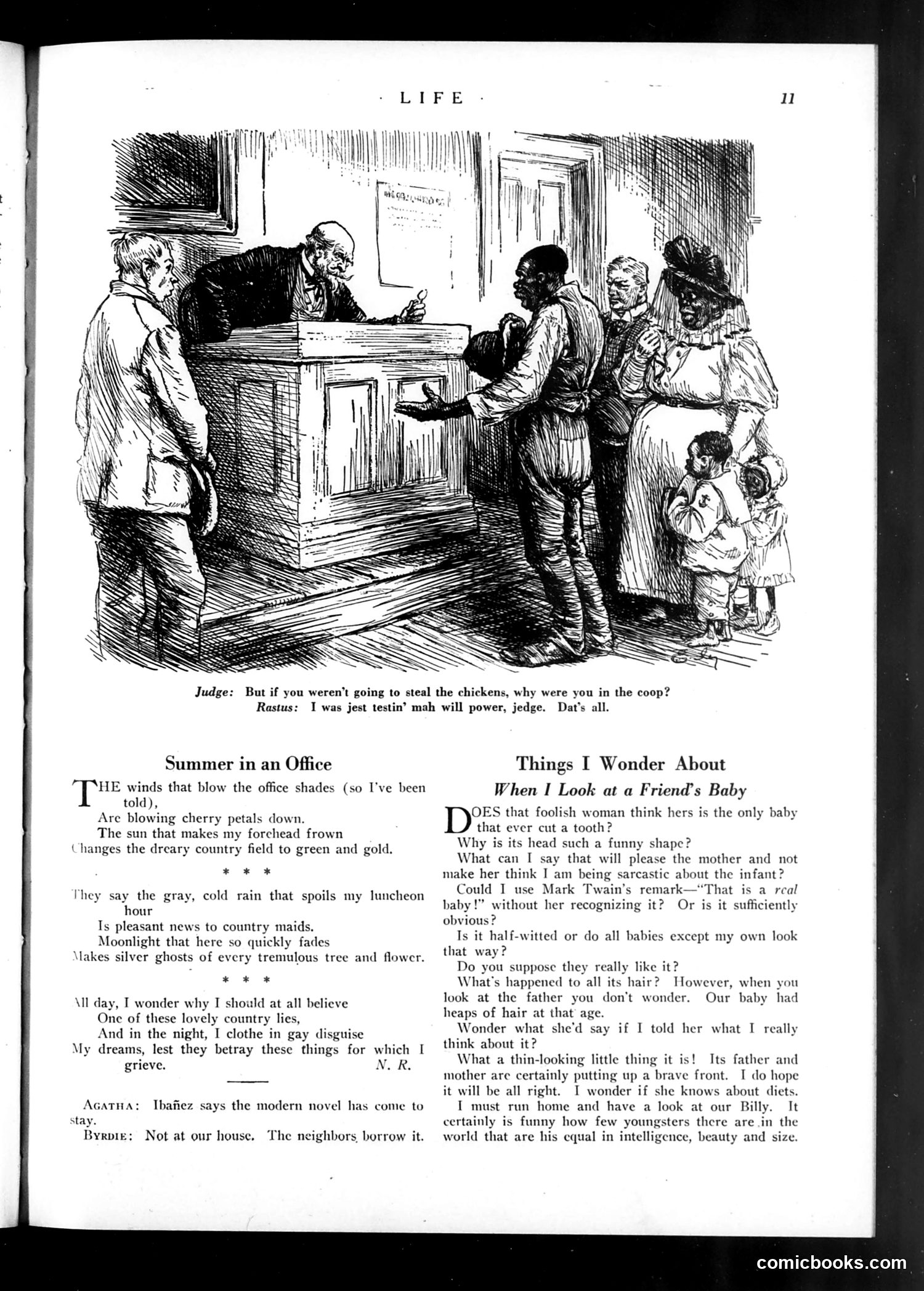
The main cartoon depicts a courtroom scene where a Black defendant named "Rastus" is accused of stealing chickens. The judge questions why he was in the coop if not to steal; Rastus responds he was "jest testin' mah will power." This reflects early 20th-century racial stereotypes common in American humor, portraying Black people through dialect and criminal accusations. The cartoon relies on offensive caricature and derogatory depiction that was normalized in period satirical magazines. The page also contains two unrelated pieces: "Summer in an Office" (poetry about workplace discomfort) and "Things I Wonder About When I Look at a Friend's Baby" (humorous observations about infants). The racial content represents problematic historical attitudes this publication openly published.
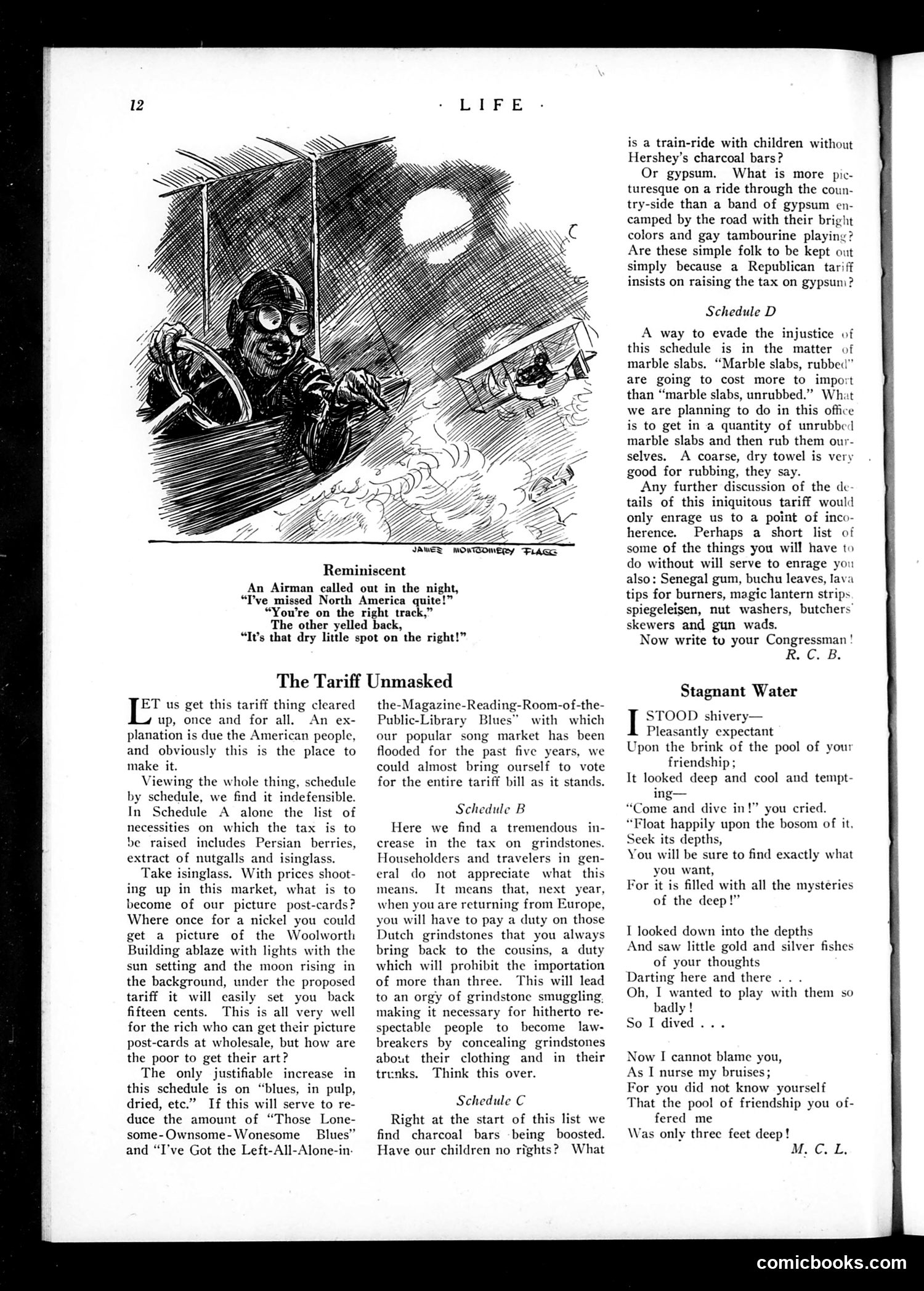
This cartoon by James Montgomery Flagg depicts two figures in what appears to be a wartime scene—likely WWI era based on the military goggles and gear visible. The caption references an airman calling out at night about missing "North America" and "Senegal," with another responding "It's that dry little spot on the right!" The humor appears to satirize navigational errors or disorientation during military operations. The accompanying article "The Tariff Unmasked" discusses various tariff schedules affecting everyday goods (gypsum, marble slabs, grindstones, charcoal). The satire criticizes how tariff policies supposedly protect American industries while affecting common citizens' access to basic materials and goods.
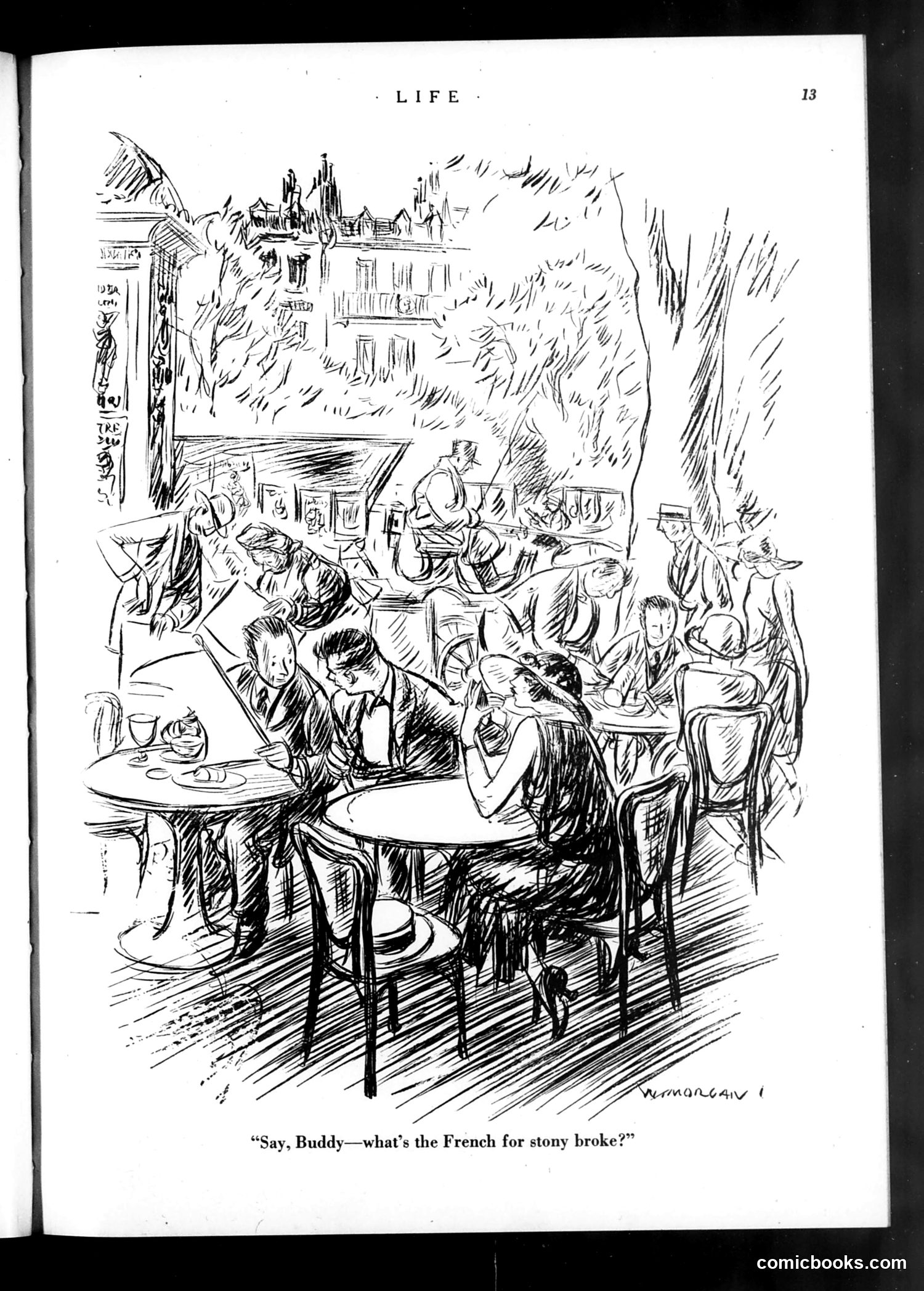
This is a single-panel cartoon from *Life* magazine (page 13) depicting an outdoor café or restaurant scene with well-dressed patrons dining. The sketch shows multiple figures at tables in what appears to be a European setting, with buildings and foliage in the background. The caption reads: "Say, Buddy—what's the French for stony broke?" The joke is a play on American slang and language barriers. One man asks his companion for the French translation of "stony broke" (an American idiom meaning completely out of money). The humor relies on the contrast between casual American vernacular and formal French, and likely suggests that wealthy Americans abroad were spending money freely in European restaurants and cafés—so much so that the question itself seems absurdly out of place in that luxurious setting.
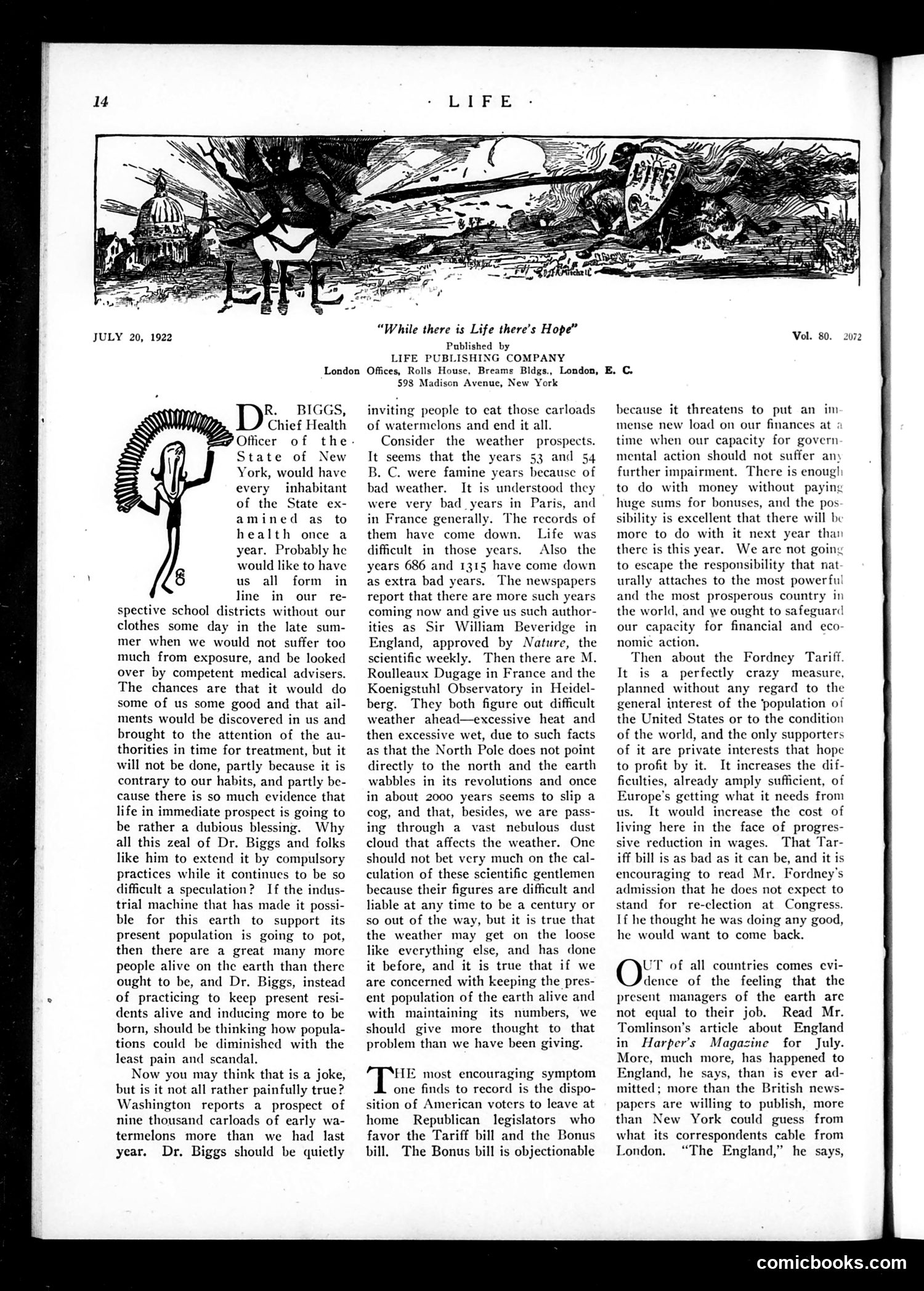
The page features an editorial by Dr. Biggs, Chief Health Officer of New York State, criticizing proposals to restrict watermelon consumption due to weather concerns. The satirical angle mocks what appears to be alarmist public health advice: officials worried that eating watermelons during hot years (specifically years 53 and 54 of the French famine) posed financial burdens on government capacity. The cartoon at top illustrates this absurdity—a figure sits beneath a gnarled tree in a surreal landscape, embodying the tension between natural appetite and bureaucratic control. Biggs argues the real issue is overzealous government intervention in citizens' private choices, using watermelons as a proxy for broader concerns about expanding state authority and regulations that restrict personal freedom without genuine public benefit.
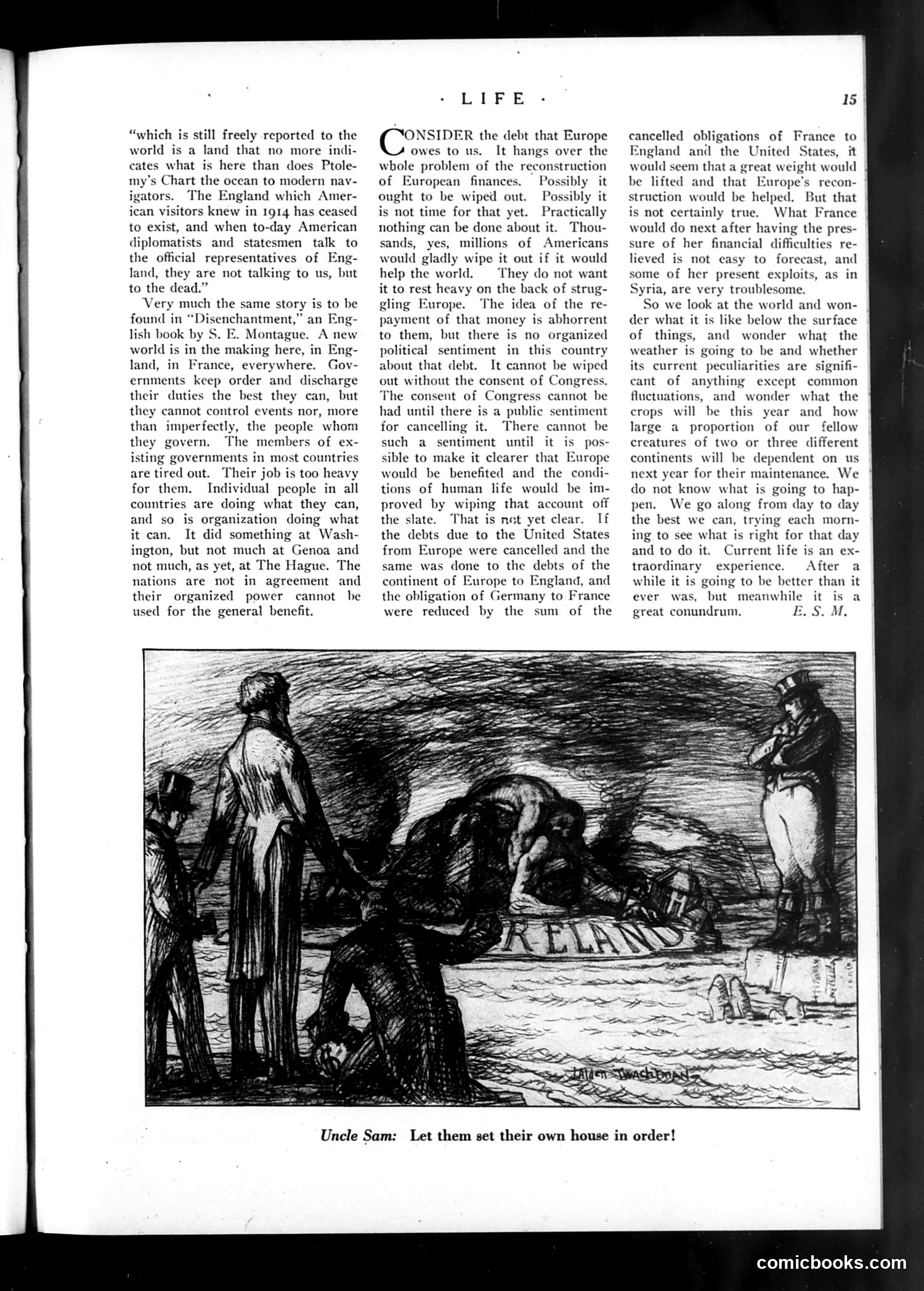
This editorial cartoon depicts Uncle Sam (personified America, left) observing European nations in disarray on a damaged ship labeled "RUIN." The accompanying article discusses post-WWI European debt to America and reconstruction challenges. The satire expresses American isolationism: Uncle Sam refuses involvement in Europe's problems, insisting Europeans solve their own crises. The cartoon reflects contemporary frustration with European war debts, political instability, and the perceived incompetence of European governments. The text argues that while Americans sympathize with European suffering, there's insufficient political will to cancel war debts without clearer justification. The "house in order" idiom emphasizes that Europe must demonstrate financial responsibility and stability before America should provide relief—a common post-WWI American sentiment opposing continued international entanglement.
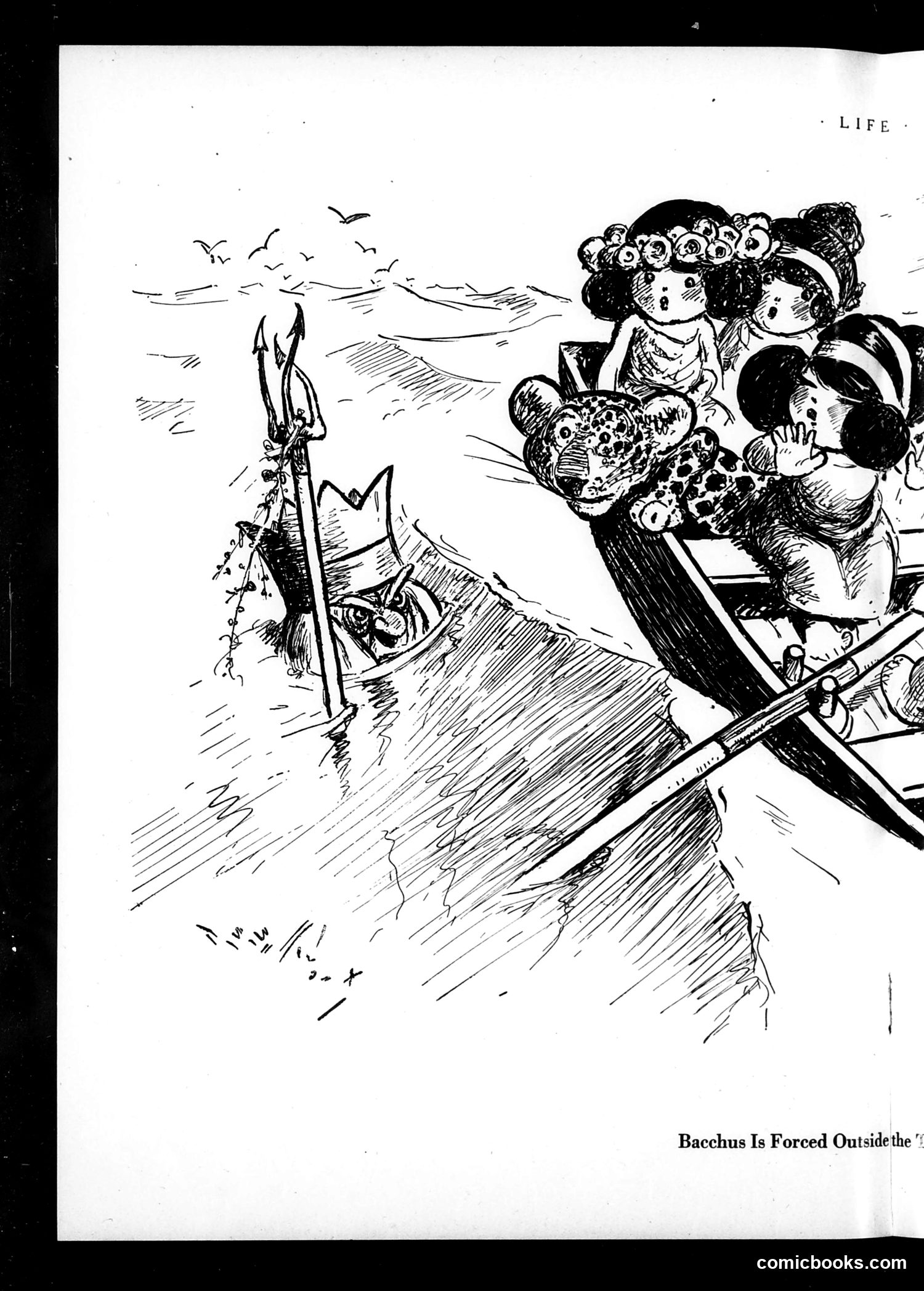
This appears to be a classical mythology-themed illustration from *Life* magazine. The caption indicates Bacchus (the Roman god of wine) is being forced outside, though the caption is cut off. The image shows a boatload of cherubic figures (suggesting Roman/classical abundance and revelry) encountering what appears to be a thin, weaponless figure on the shore. Given the caption's reference to Bacchus being "forced outside," this likely satirizes Prohibition—the forced removal of alcohol from American society (1920-1933). The contrast between the plump, celebratory figures with wine/revelry and the figure being expelled suggests commentary on how Prohibition attempted to eliminate drinking culture. The classical gods and cherubs symbolize the pleasure and tradition being eliminated.
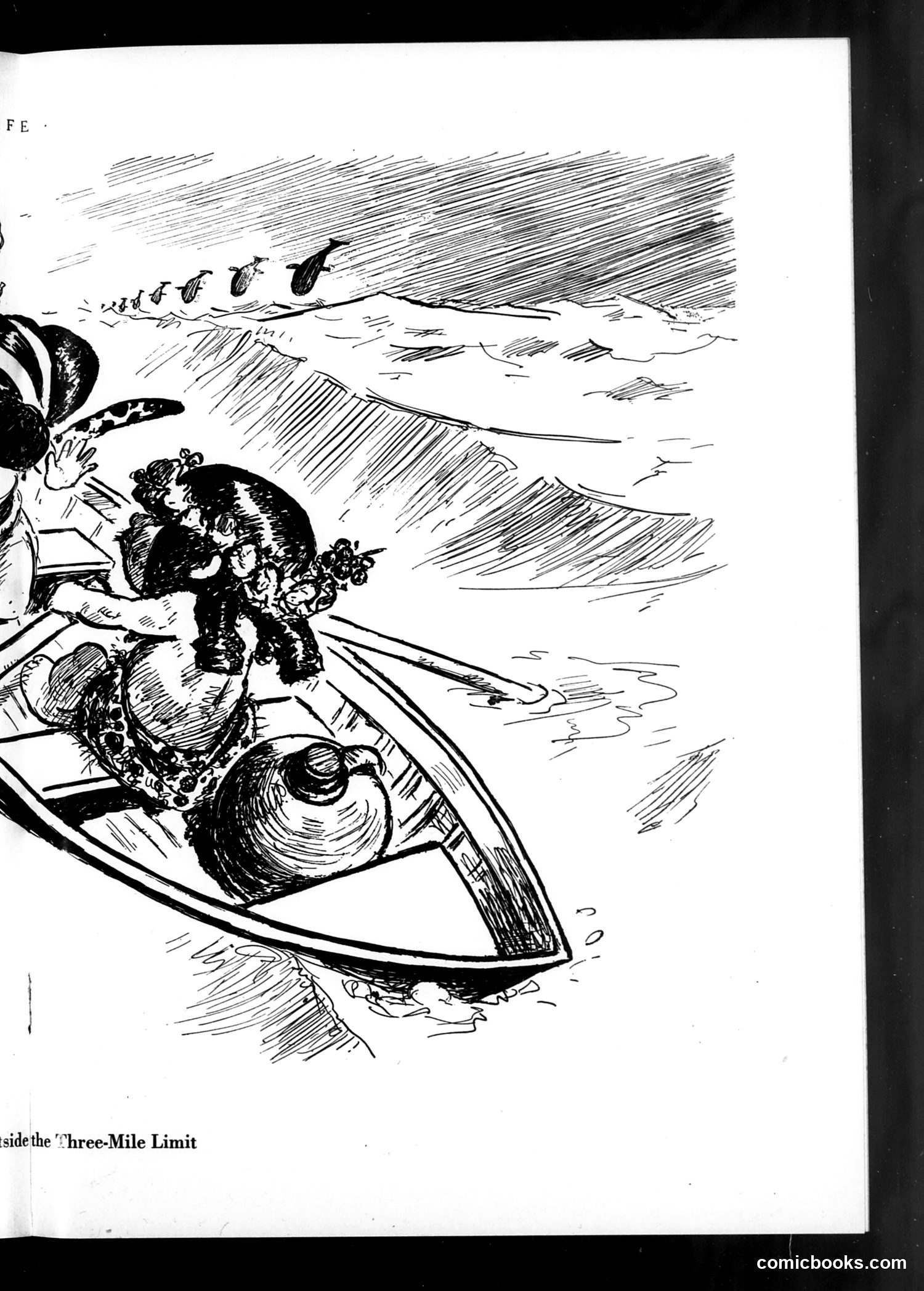
This political cartoon depicts a small boat with passengers (appearing to be wealthy or well-dressed figures) venturing beyond American territorial waters. The "three-mile limit" refers to the boundary of U.S. jurisdiction during Prohibition—a historical period when alcohol was illegal domestically but could be legally obtained outside American waters. The cartoon satirizes wealthy Americans who circumvented Prohibition laws by traveling to international waters to drink and obtain alcohol. The passengers' apparent affluence and the boat's deliberate journey suggest the cartoon criticizes how the wealthy could easily evade laws that ordinary citizens faced strict enforcement of. This represents Life magazine's commentary on class inequality and the selective enforcement of Prohibition.
This is a humorous theater review of a German expressionist play ("Der Kinder-Mörder"/"The Child-Killer") performed in Berlin. The unnamed American reviewer uses comedic exaggeration to mock both the play's incomprehensibility and his own inability to understand German. The satire works on multiple levels: the reviewer claims to understand only 1 in 193 German words, yet "translates" the plot—which involves absurd, disconnected scenes (a department store, a murder in the forest, resurrection, inexplicable violence). He mocks Germanic dramatic conventions: the heavy symbolism (spoons representing fate?), the arbitrary staging, the overwrought emotion, and the heavy-handed patriotic ending about "teamwork." The humor lies in portraying avant-garde European theater as pretentious nonsense that confuses even attentive viewers. It's a satirical jab at Weimar-era German drama's perceived opacity and self-importance.
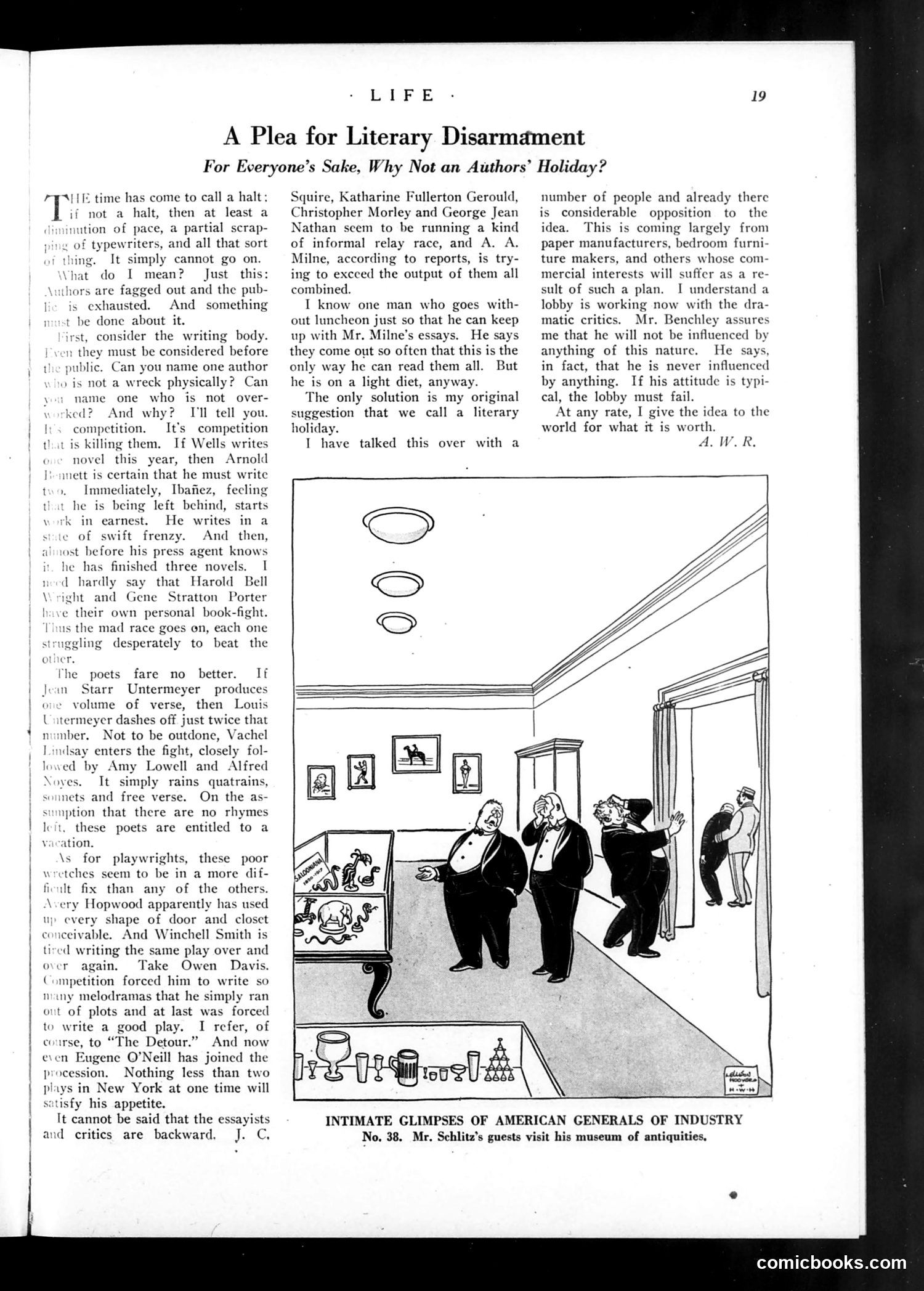
This article satirizes the competitive frenzy among early 20th-century authors and poets. The writer argues that famous authors—H.G. Wells, Arnold Bennett, Blasco Ibáñez, Harold Bell Wright, Gene Stratton Porter—are locked in an exhausting "mad race," each compulsively publishing to outpace rivals. Poets similarly compete: if Louis Untermeyer produces verse, his rival must produce more. The cartoon below depicts wealthy industrialists (likely the Schlitz brewery family) viewing art in a mansion, illustrating ironic contrast with the text's theme about commercial pressures destroying creativity—here showing how business success enables cultured leisure that authors cannot afford. The satire's point: literary competition driven by commercial interests exhausts writers physically and creatively. The proposed solution—a mandatory "authors' holiday"—faces resistance from paper manufacturers and furniture makers whose profits depend on continuous output. The piece mocks both the competitive publishing industry and vested commercial interests blocking reform.
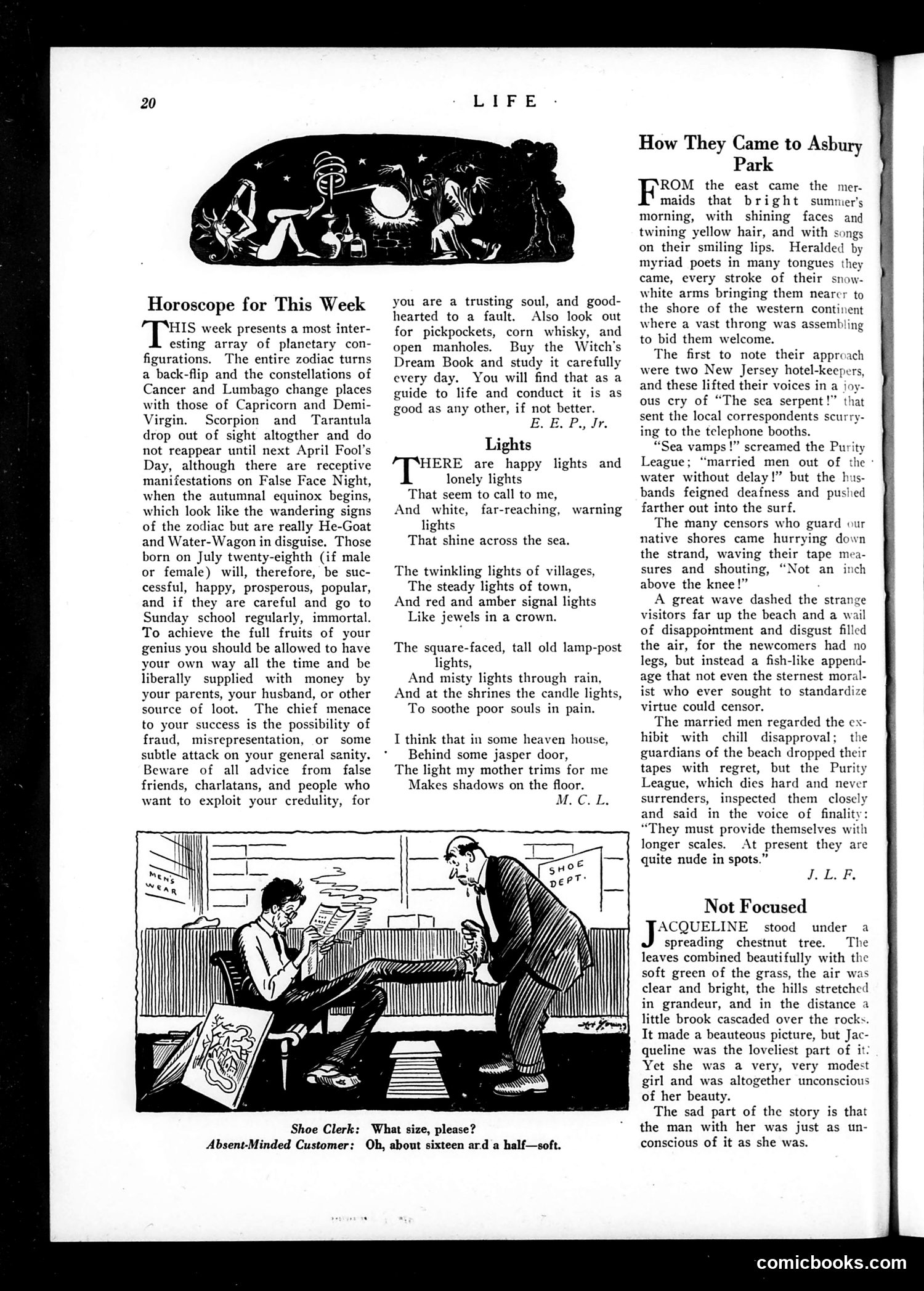
This page contains three satirical pieces satirizing American social attitudes circa early 20th century. The **"Horoscope" column** mocks fortune-telling and astrology as worthless guides, while simultaneously lampooning gullible readers who seek such advice. The humor lies in absurd planetary configurations and the ironic advice to blindly follow your impulses while avoiding fraud. The **shoe clerk cartoon** depicts an absent-minded customer requesting size "sixteen and a half—soft," a nonsensical answer implying either stupidity or deliberate evasion—satirizing everyday human foolishness. The **"Asbury Park" story** satirizes American prudishness and hypocrisy. Mermaids arriving at the New Jersey shore trigger simultaneous reactions: hotel owners see profit, the "Purity League" demands censorship of their exposed bodies, and married men sneak looks while pretending propriety. The mermaids lack legs entirely, rendering all moral objections absurd—the ultimate joke on excessive modesty policing.
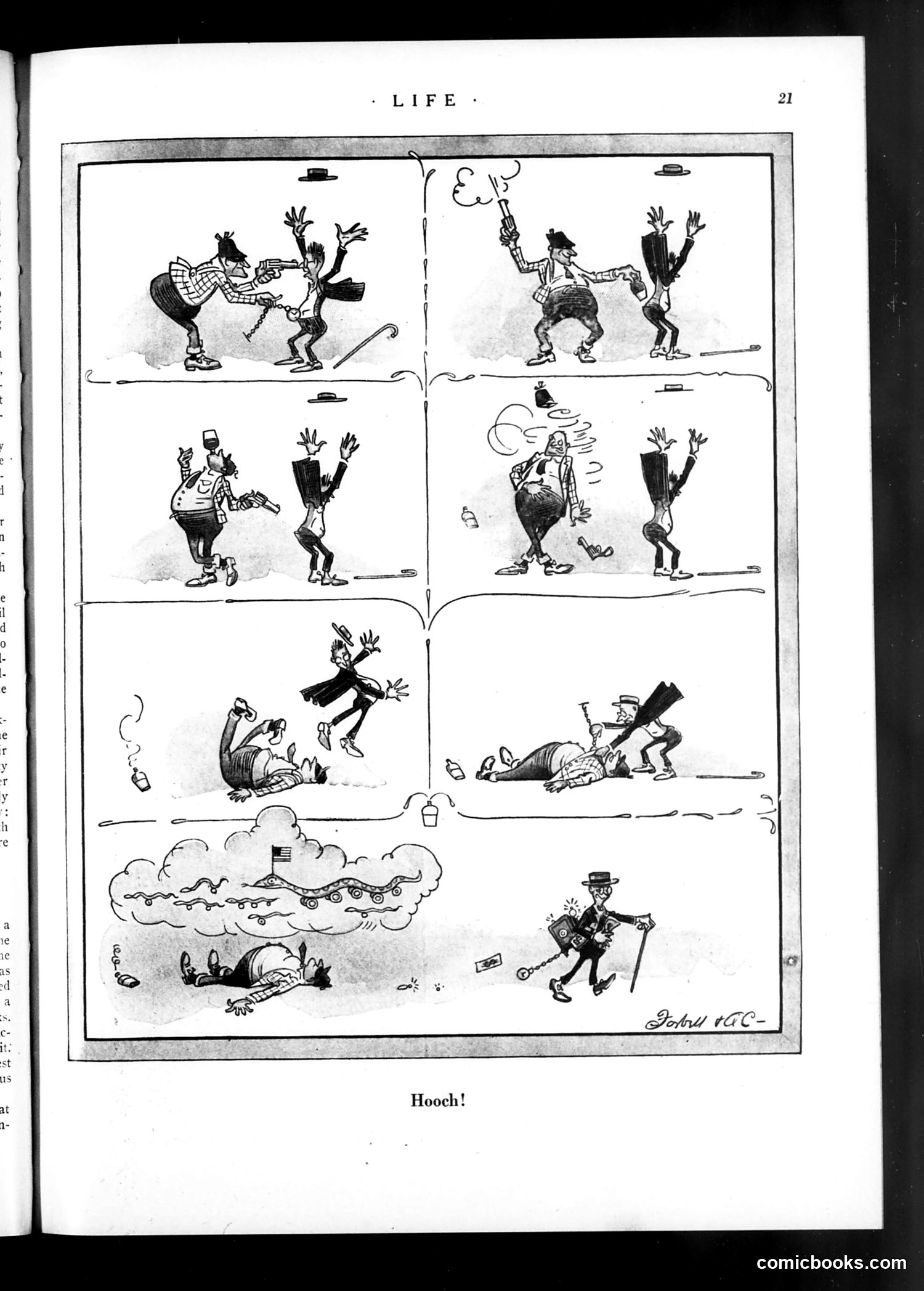
This multi-panel comic depicts the chaotic consequences of alcohol prohibition (likely 1920s-era America). The strip shows a sequence where characters attempt to hide, transport, or consume illegal liquor ("hooch"). The progression illustrates slapstick humor: figures engage in increasingly frantic and destructive behavior—running, falling, crashing into objects—as they interact with bootleg alcohol. The final panels show what appears to be an explosion or major mishap, with a figure escaping amid destruction. The satire mocks the futility and danger of Prohibition enforcement. The cartoon suggests that attempts to hide and consume illegal alcohol inevitably lead to absurd, violent consequences. The title "Hooch!" (slang for bootleg liquor) directly references the era's central social conflict between law and public demand for alcohol.
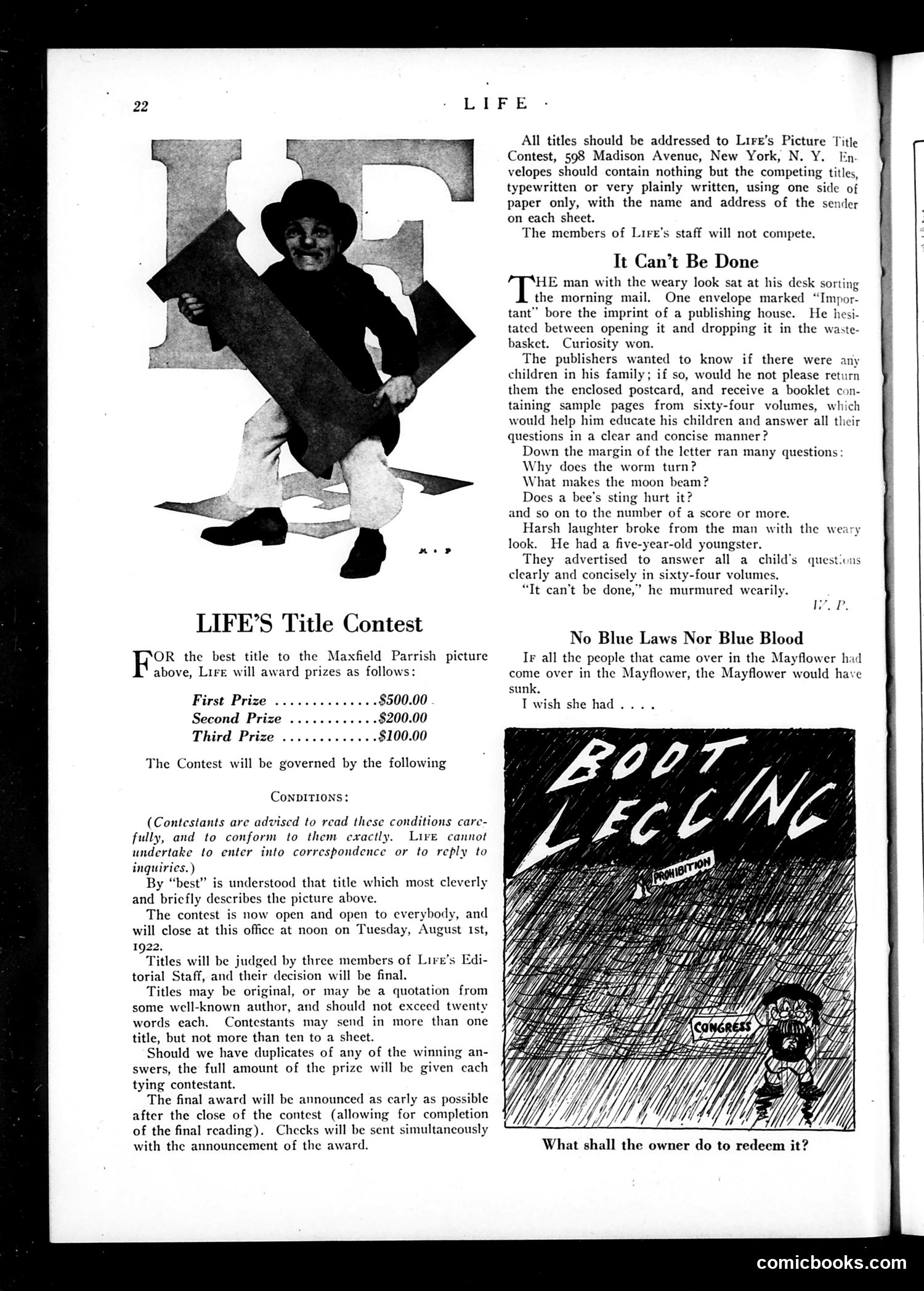
This page from Life (circa 1922) contains a title-naming contest and satirical commentary on American publishing and pretension. **The Maxfield Parrish Picture Contest**: Life invites readers to submit titles for an illustrated artwork, offering $500, $200, and $100 prizes. The rules emphasize brevity and originality. **"It Can't Be Done"**: A satirical article mocking an overly ambitious publisher advertising a 64-volume encyclopedia claiming to answer all children's questions "clearly and concisely." The joke: a man with a five-year-old child laughs bitterly at this impossible promise, recognizing the absurdity of such comprehensive, simple answers to the endless "why?" questions children ask. **"No Blue Laws Nor Blue Blood"**: A brief, darker joke about Mayflower descendants and American class pretension. The reference to "Blue Laws" (Puritan moral restrictions) suggests ironic commentary on the hypocrisy of America's "founding families" claiming moral superiority. Both pieces satirize American overconfidence in commercial solutions and inherited social status.
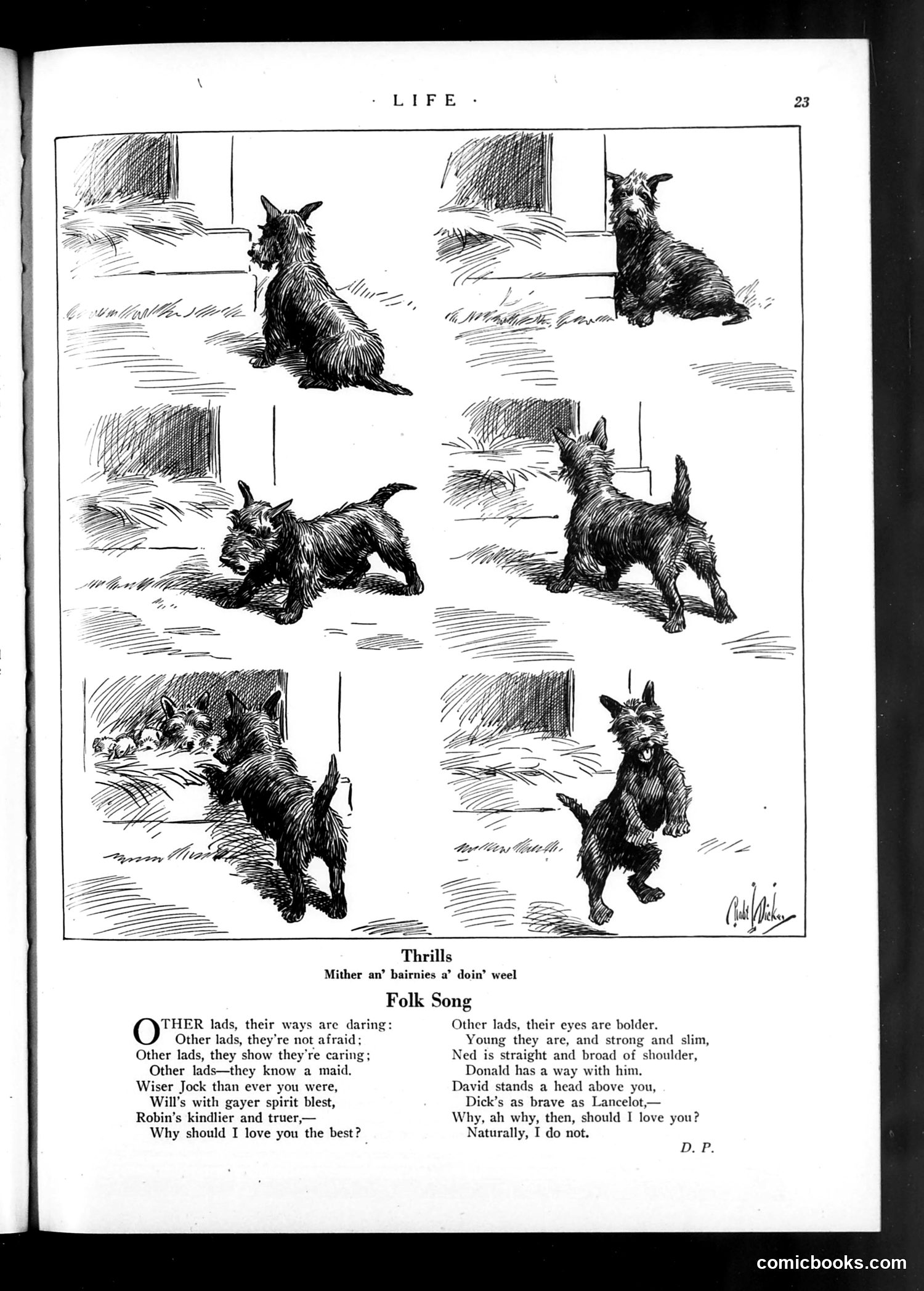
This page features a comic strip titled "Thrills" (credited to artist initials, likely early 1900s) depicting a Scottish terrier's playful antics across six panels. The dog displays typical terrier behavior: sitting, walking, playing, and interacting with its surroundings. Below is a folk song, apparently unrelated to the comic, that humorously lists desirable qualities in various suitors (Jock, Will, Robin, Ned, Donald, David, Dick) while the narrator paradoxically insists she loves none of them—ending with "Naturally, I do not." The song mocks romantic indecision or satirizes women who claim indifference despite abundant options. The comic and poem appear separate; their connection, if intended, is unclear from the page alone.
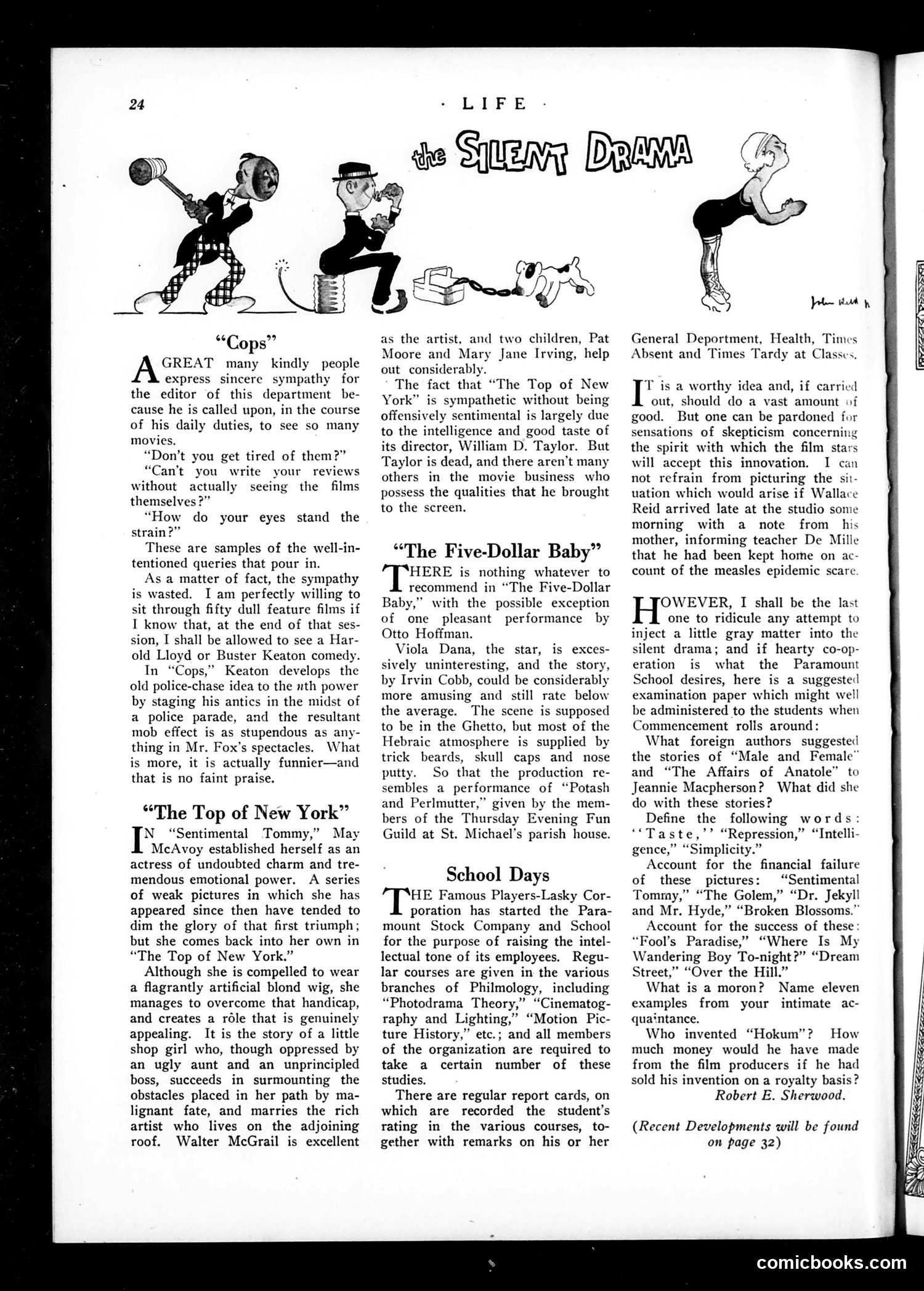
This page reviews contemporary silent films (likely early 1920s) with satirical illustrations at the top depicting slapstick comedy scenarios. **The cartoons** show physical comedy sequences typical of silent film stars like Buster Keaton and Harold Lloyd — people juggling, being chased, and performing exaggerated acrobatics. **Key reviews discussed:** - **"Cops"** — Keaton praised for developing a police-chase gag into elaborate slapstick - **"The Top of New York"** — May McAvoy vehicle, noted as sympathetic without being overly sentimental; the author laments director William D. Taylor's death as a loss to the industry - **"The Five-Dollar Baby"** — harshly criticized as tedious, with mock-ethnic stereotyping (fake beards and "nose putty") for Ghetto scenes **"School Days" section** satirizes Paramount's new employee training program claiming to educate film stars in "Philmology" and cinematography theory — the author expresses skepticism that actors will genuinely embrace such intellectual pursuits.
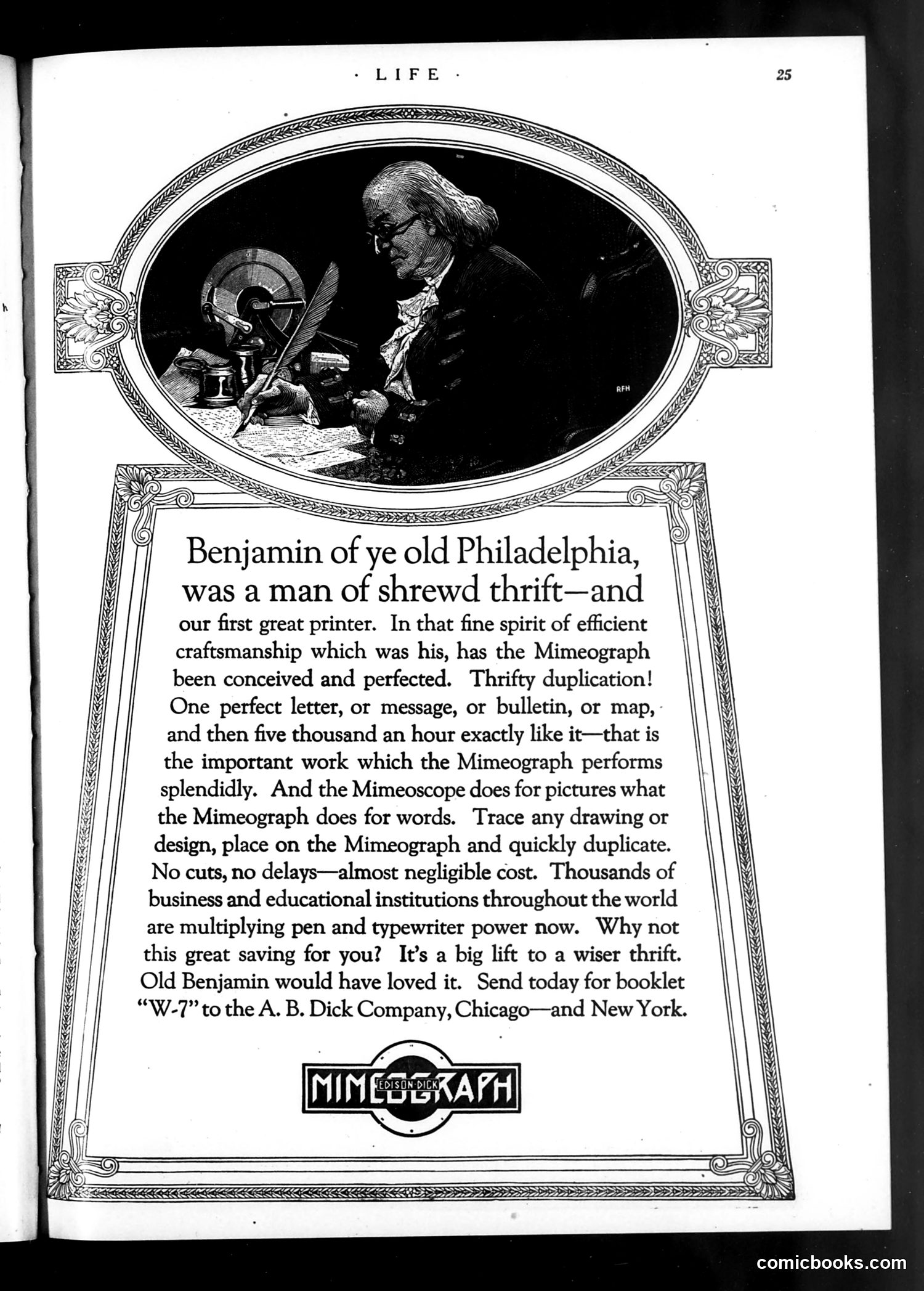
This is a **full-page advertisement**, not editorial content or satire. It promotes the Mimeograph and Mimeoscope (early duplicating machines) made by the A. B. Dick Company. The ad invokes **Benjamin Franklin**—depicted in the illustration as "ye old Philadelphia" printer—to lend historical credibility and appeal to thrift. Franklin's reputation for efficient craftsmanship and shrewd business sense parallels the machines' value proposition: perfect duplication at minimal cost. The pitch targets businesses and educational institutions by emphasizing economy: one original document duplicated "five thousand an hour exactly like it" with "almost negligible cost." This was genuinely innovative technology for the era, automating what had previously required manual reproduction. The satire is mild—playing on Franklin as a thrift-minded American icon. For modern readers, the main interest is seeing early office technology marketing and the era before photocopiers.
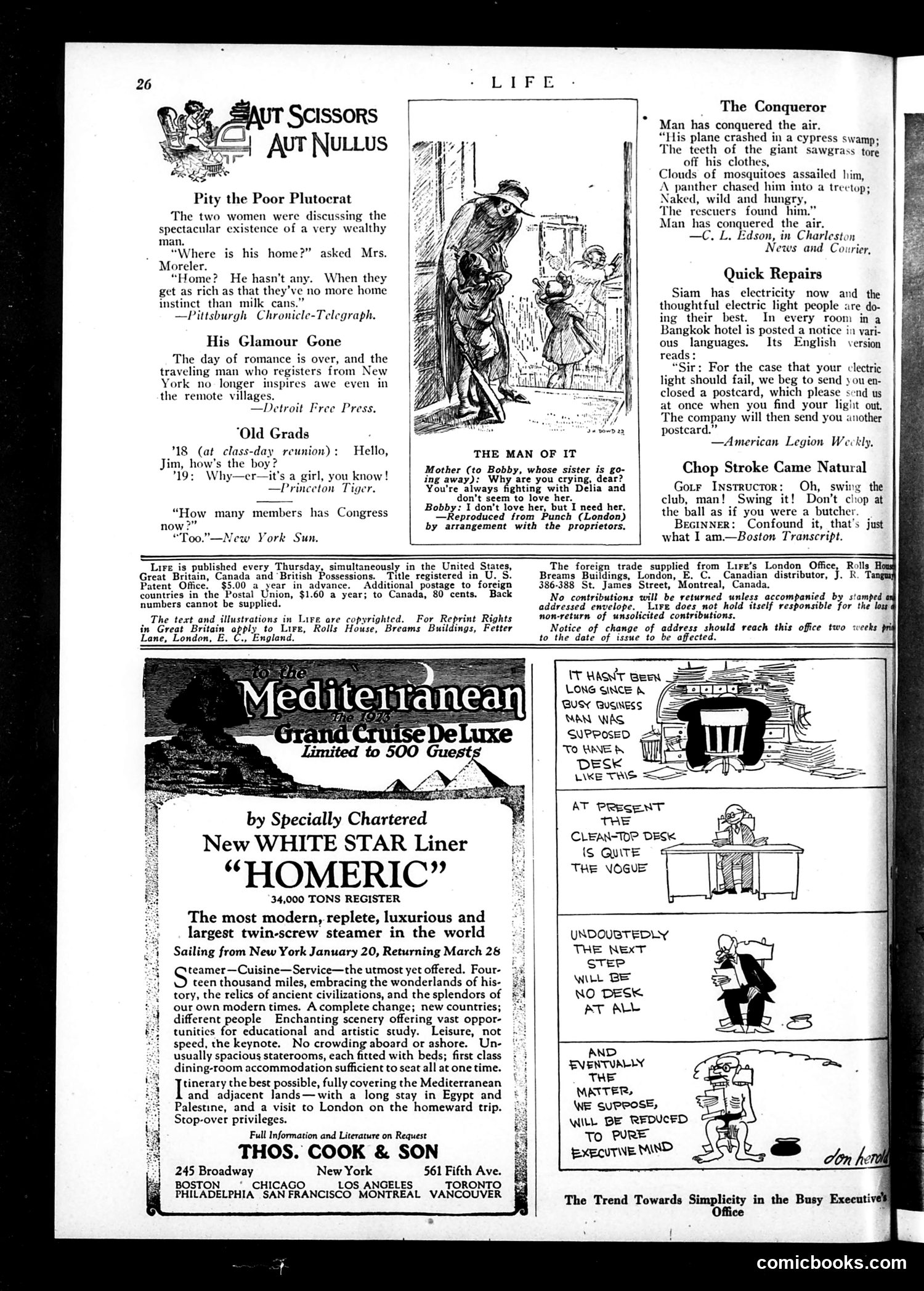
This page contains several brief satirical jokes typical of *Life* magazine's humor section, plus advertisements. **The cartoons/jokes** mock: 1. **Wealthy people's rootlessness**: The rich become so absorbed in accumulating wealth they lose normal domestic instability—comparing them unfavorably to "milk cans." 2. **Faded glamour of traveling salesmen**: Once impressive to small-town observers; now commonplace. 3. **Sibling dynamics**: A boy needs his sister despite fighting with her—touching on childhood realities. 4. **Man's technological hubris**: Ironically titled "The Conqueror," it describes an aviator who crashed and was stripped naked by nature (swamp, insects, predators)—the "conquest" of air is undercut by natural vulnerability. 5. **Bureaucratic absurdity**: Siam's electric company responds to outages by mailing postcards—solving nothing. 6. **Class/profession humor**: A beginner golfer chops at the ball because he's a butcher by trade. The **large advertisement** promotes a luxury Mediterranean cruise on the White Star Liner *Homeric*.
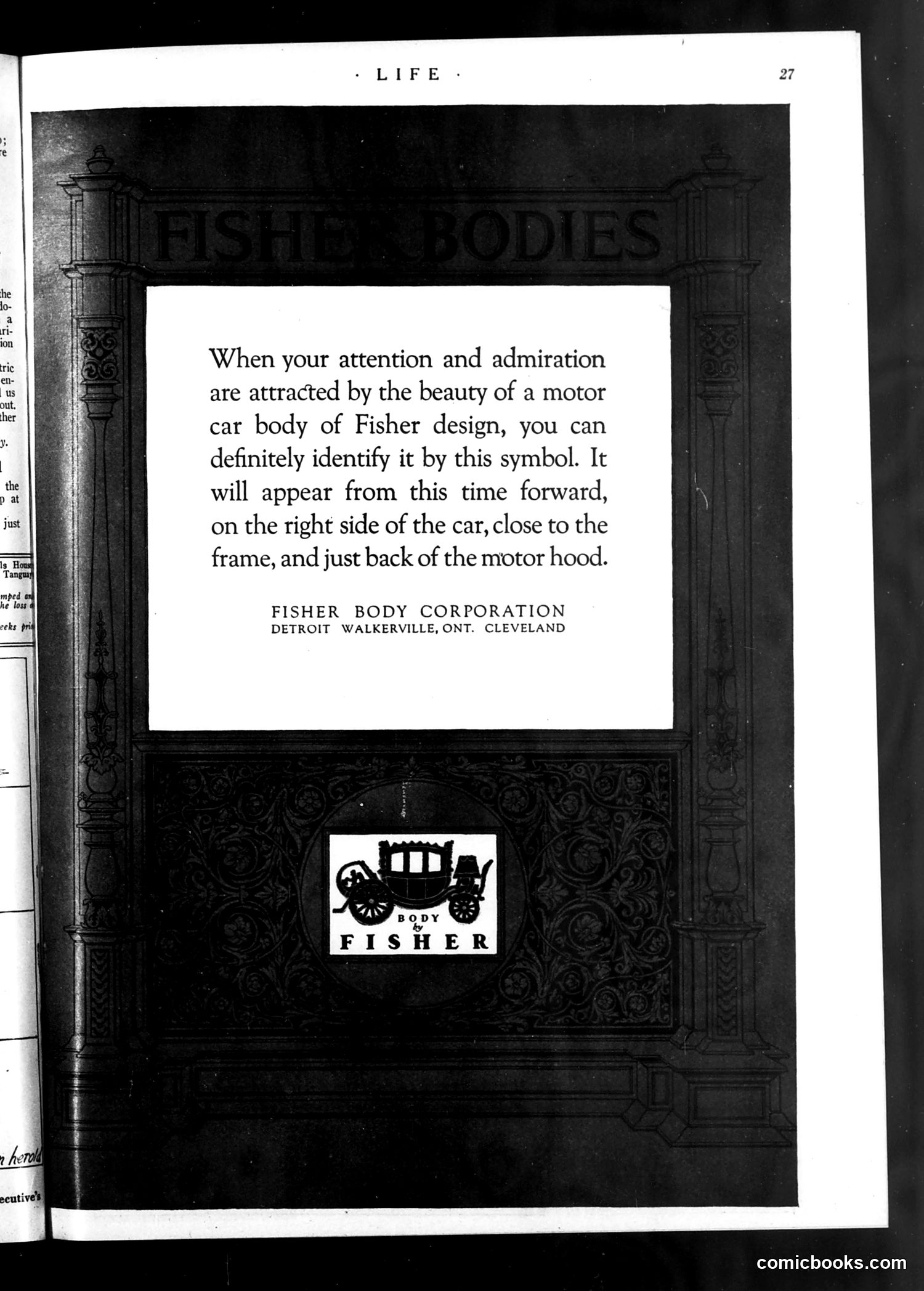
This is a **advertisement, not satire or editorial content**. It announces that Fisher Body Corporation—a major automotive supplier—will now place an identifying symbol on car bodies they manufacture. The symbol, shown at bottom, depicts a horse-drawn carriage (referencing Fisher's origins in coach-building) with the word "FISHER" beneath it. The ad explains that consumers can recognize Fisher-designed car bodies by this logo, which will appear on the right side near the motor hood. The company operated in Detroit, Walkerville (Ontario), and Cleveland. This represents early automotive branding and quality-assurance marketing—Fisher Body was establishing itself as a prestigious maker of vehicle bodies for various automobile manufacturers.
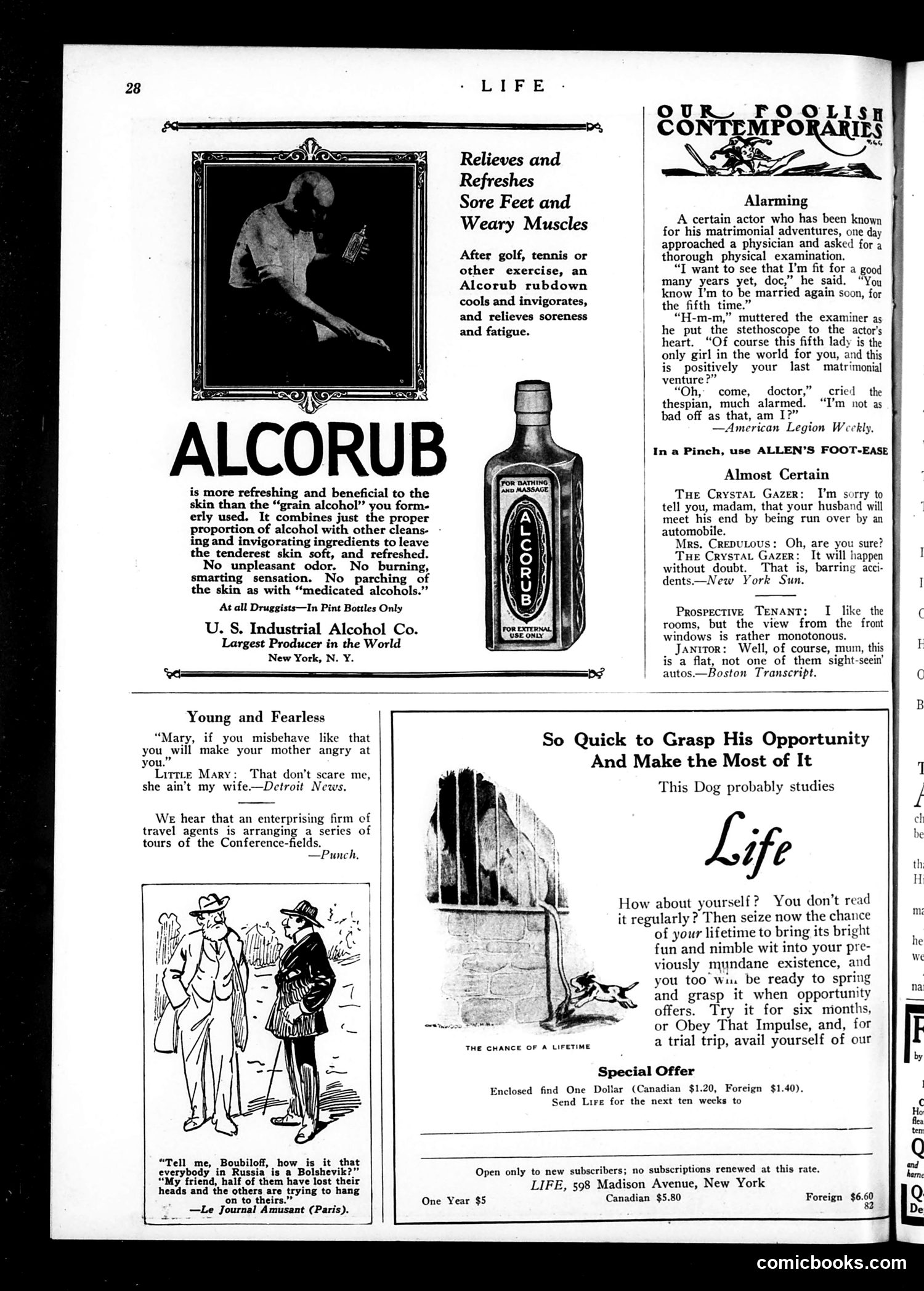
This page mixes advertisements with humor columns typical of 1920s Life magazine. The main content includes: **Alcorub Advertisement**: Promotes an alcohol-based muscle rub for post-exercise soreness, emphasizing it's superior to "grain alcohol" formerly used—likely referencing Prohibition-era concerns about medicinal alcohol abuse. **Satirical Jokes**: Several brief comic anecdotes mock contemporary figures and situations: - An actor marrying for the fifth time, unconcerned about commitment - A fortune teller predicting automobile death (reflecting new 1920s car culture anxieties) - A tenant's mundane apartment view complaint - A Russian joke about Bolsheviks losing their heads—referencing the recent Russian Revolution and Communist purges **Life Magazine Subscription Offer**: Uses a cartoon of a dog studying to encourage subscriptions, positioning the magazine as essential wit for modern life. The humor reflects 1920s preoccupations: multiple divorces, automobile dangers, and anti-Communist sentiment. The page is primarily commercial, mixing product ads with light satirical content.
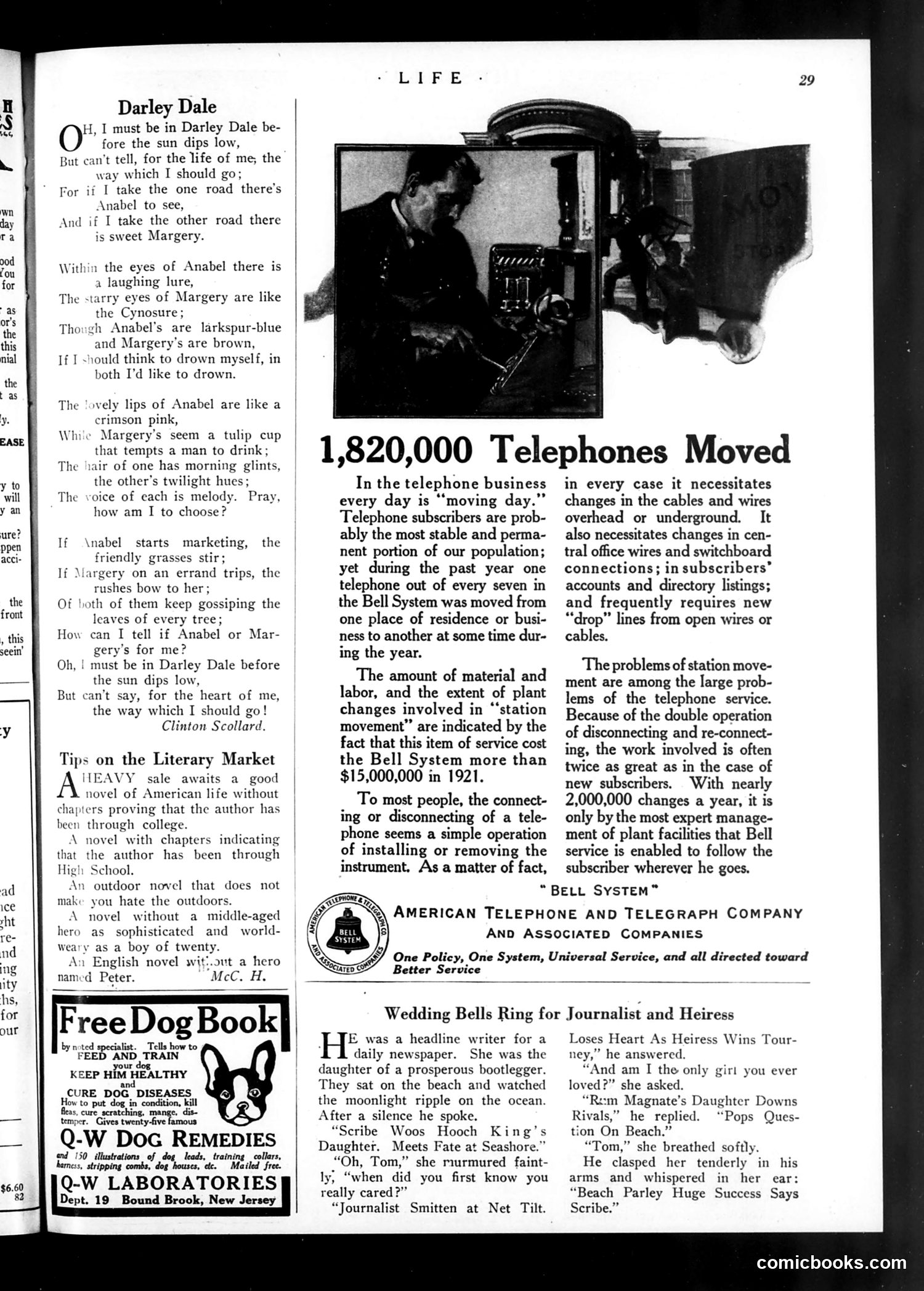
This page contains no political cartoon. Instead, it features: **Left side:** A romantic poem titled "Darley Dale" by Clinton Scollard about a man unable to choose between two women (Anabel and Margery) before sunset. It's sentimental verse, typical of Life's literary content. **Center:** A Bell Telephone System advertisement about "1,820,000 Telephones Moved," explaining that telephone subscribers frequently relocate, requiring extensive infrastructure changes. The ad emphasizes Bell's operational complexity and efficiency—a corporate image-building piece. **Bottom:** A satirical column "Tips on the Literary Market" mocking publishing trends, advising editors to reject novels featuring college-educated or overly sophisticated characters, and a brief "Wedding Bells" column. **Additional content:** Advertisements for a free dog training book and dog remedies. This appears to be a typical 1920s Life magazine page mixing poetry, corporate advertising, literary satire, and consumer ads—not political commentary or cartooning.
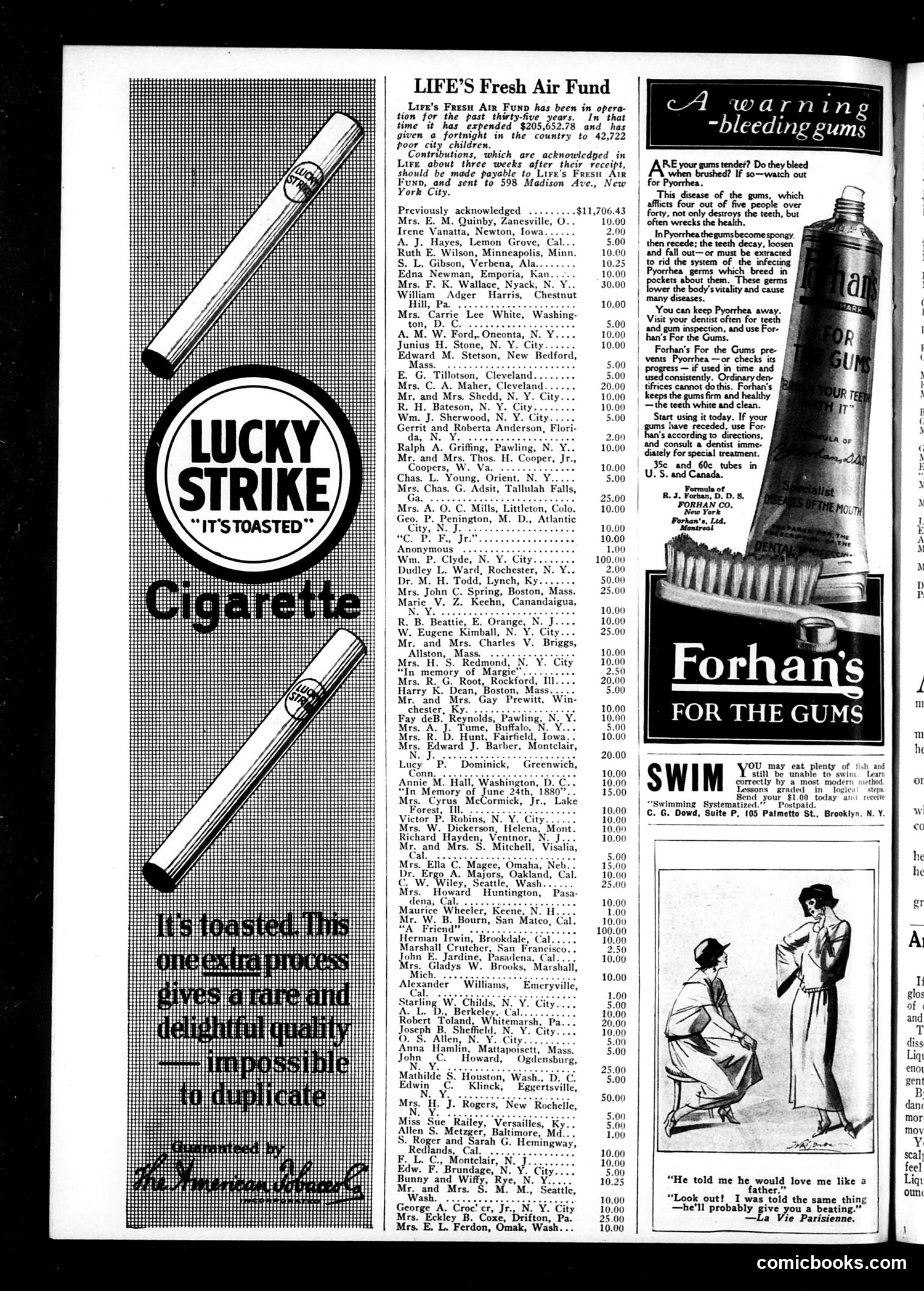
This page contains three distinct elements: **Left side:** A Lucky Strike cigarettes advertisement emphasizing their "toasting" process as producing "a richer and weightier impossible to duplicate." The ad features cigarette pack imagery. **Center:** Life's Fresh Air Fund—a charitable fundraising list documenting donations to the magazine's longstanding program (35 years old at publication) providing country vacations for poor city children. The detailed donor list with contribution amounts ($1-$100) demonstrates public philanthropic participation typical of this era. **Right side:** Two advertisements—Forhan's toothpaste (addressing pyorrhea/gum disease, a serious health concern of the period) and a swimming lessons program by C.G. Dowd. The page itself isn't satirical; it's primarily a fundraising/advertising publication page. The "cartoon" element appears minimal—only a small illustration accompanies the swimming lessons ad showing instructional figures. The page reflects early 20th-century public health awareness and charitable giving practices.
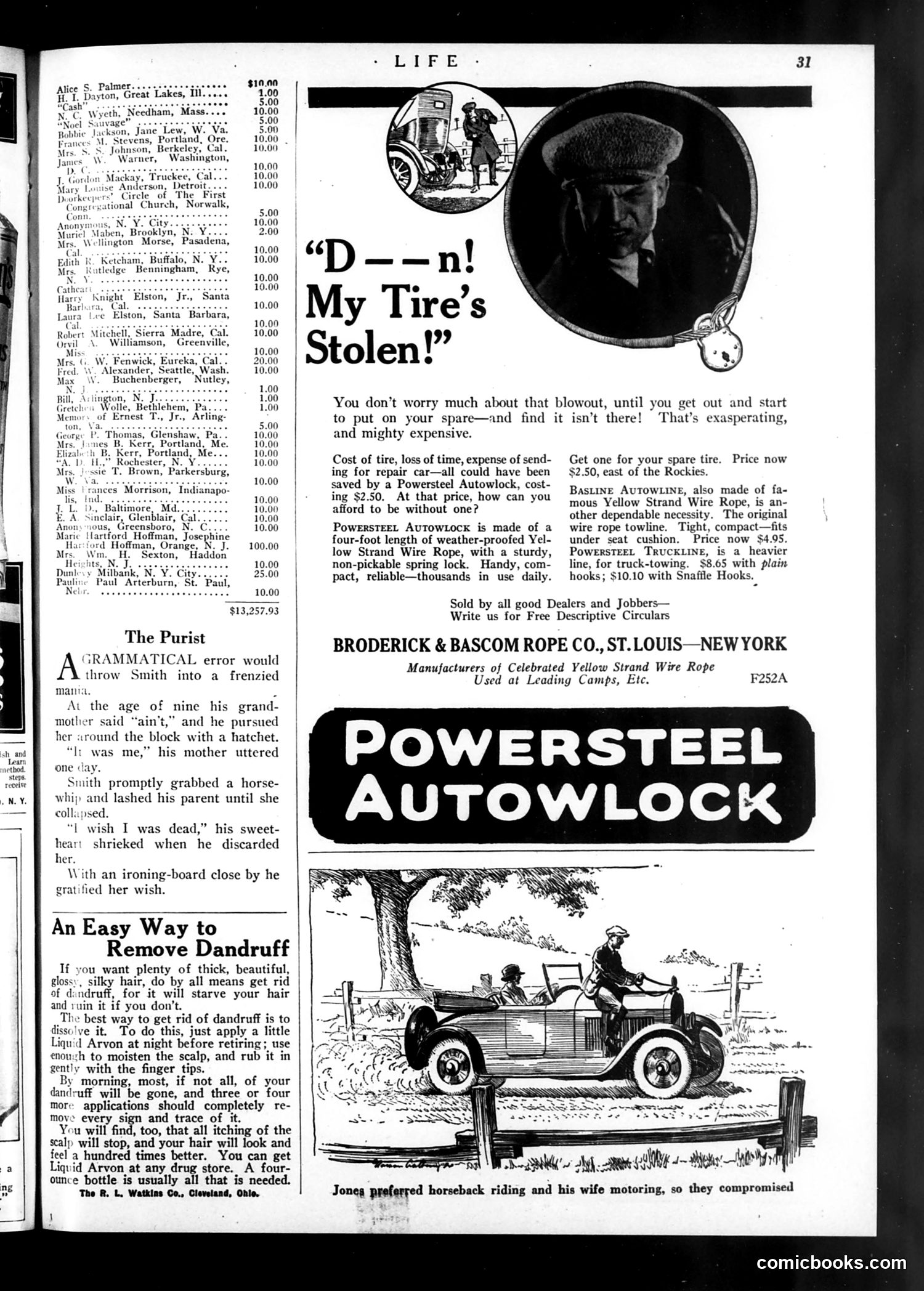
This Life magazine page contains three distinct elements: **The Purist** (left column): A dark humor story about a grammar-obsessed man named Smith who violently punishes anyone committing grammatical errors—pursuing his grandmother with a hatchet for saying "ain't," whipping his mother, and killing his sweetheart with an ironing board. The satire mocks linguistic pedantry taken to absurd, murderous extremes. **"D—n! My Tire's Stolen!"** (top right): An advertisement disguised as a cautionary tale. The cartoon shows a frustrated motorist discovering their spare tire missing. The ad sells the Powersteel Autowlock ($2.50), a wire-rope lock preventing tire theft, and related products. The framing as a relatable problem makes the product pitch more persuasive. **An Easy Way to Remove Dandruff** (bottom left): A straightforward advertisement for Liquid Arvon hair product. The page demonstrates Life's mix of satirical humor and advertising revenue—a common early-20th-century magazine format where ads were presented entertainingly rather than as obvious commercials.
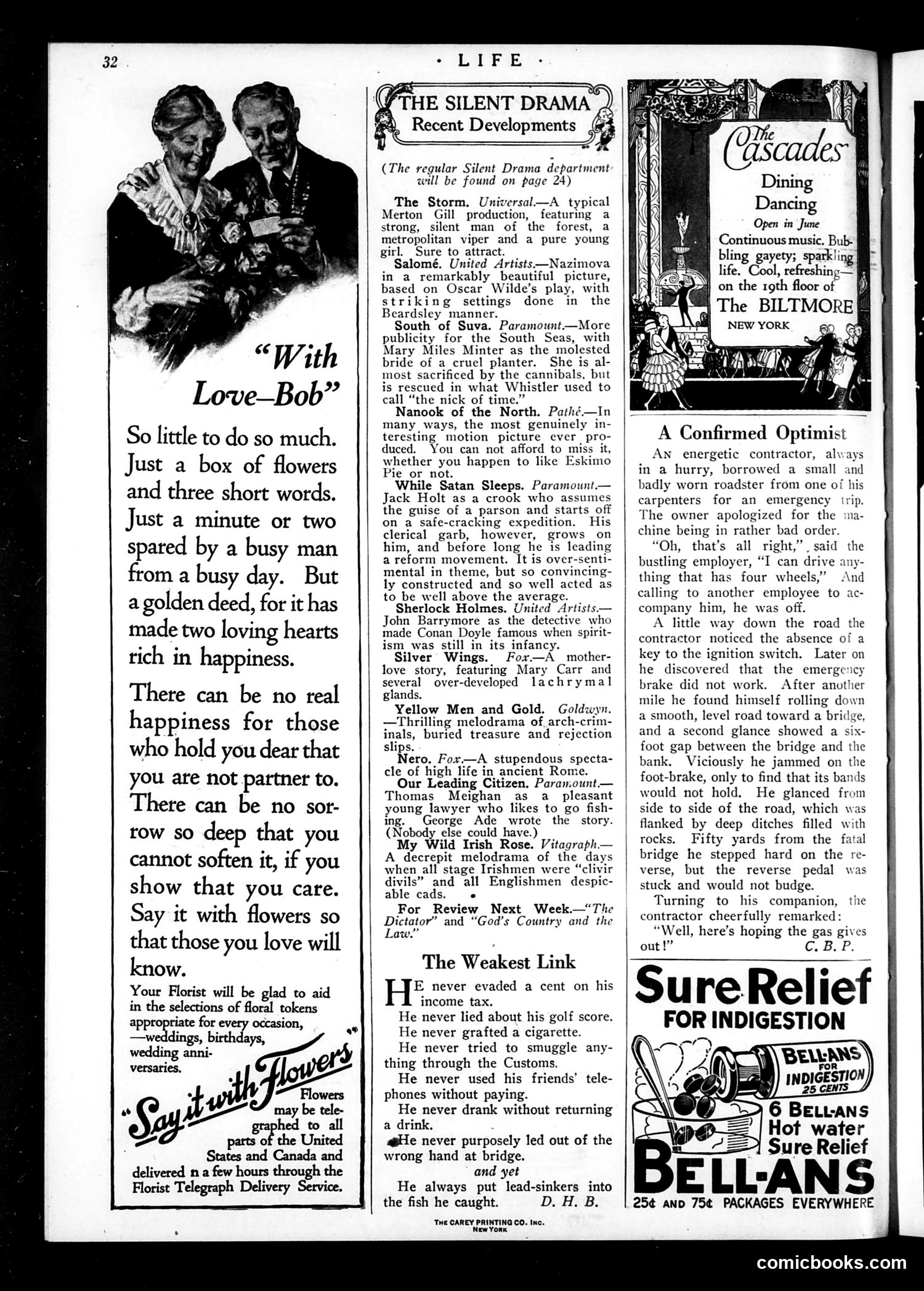
The left page is a commercial advertisement for the florist industry, promoting the "Say it with Flowers" campaign. The copy uses sentimentalist language to encourage busy people to send flowers as expressions of care, positioning flowers as meaningful gestures requiring minimal time investment. The right page reviews contemporary silent films (circa early 1920s), including *Nanook of the North*, *Salomé* (with Nazimova), and *Sherlock Holmes* (with John Barrymore). These reviews are straightforward plot summaries and quality assessments typical of entertainment journalism of the era. At bottom is "The Weakest Link," a humorous character sketch about a man of perfect moral integrity in major matters—honest on taxes, truthful about golf—who nonetheless cheats by putting lead sinkers in fish he catches. The joke satirizes selective morality: apparent virtue masking petty dishonesty. The Biltmore Hotel advertisement and Sure Relief (indigestion remedy) ads are standard period marketing.
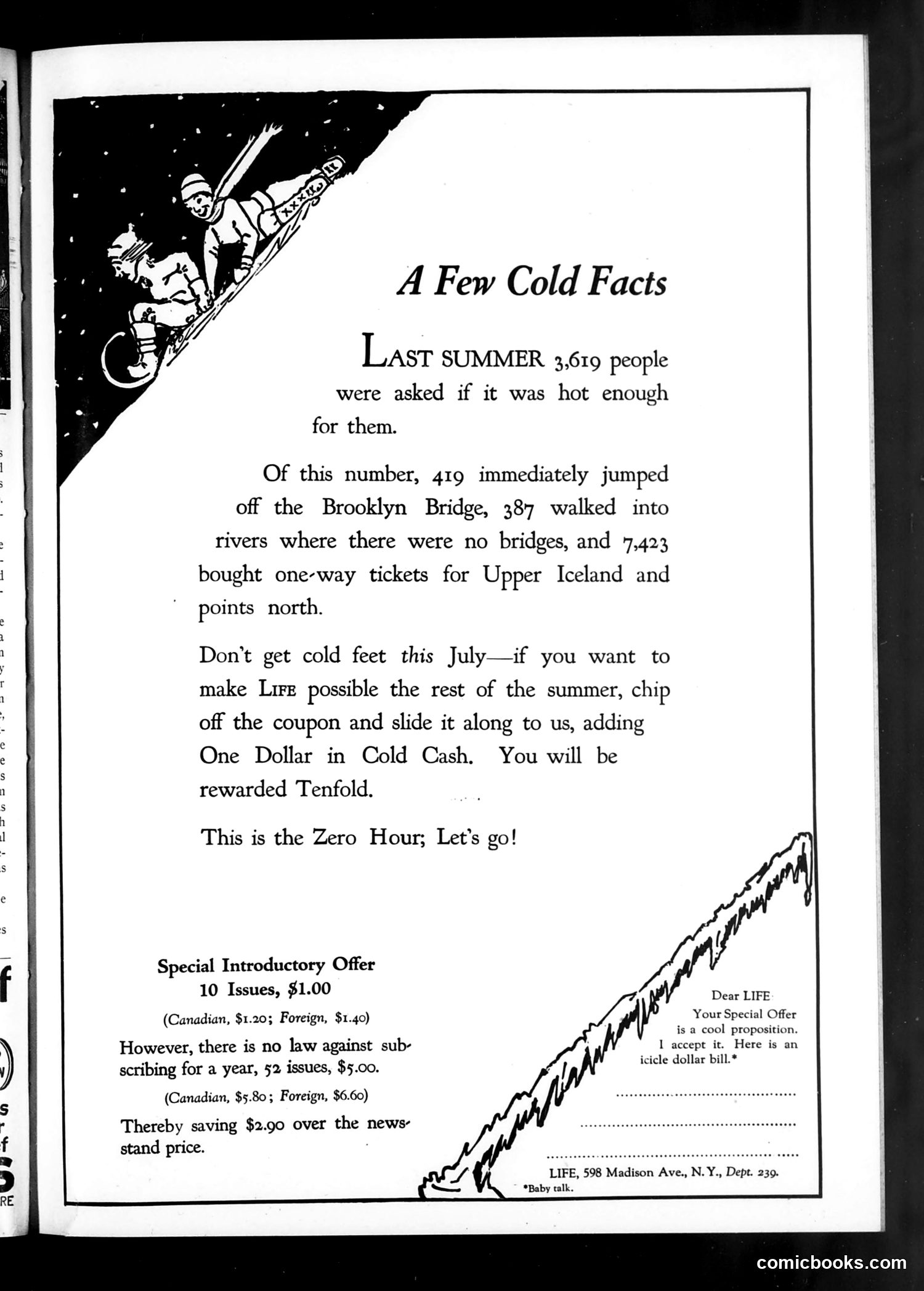
This is a subscription advertisement for *Life* magazine employing dark humor about heat-induced desperation. The "Cold Facts" section uses exaggerated, absurdist statistics claiming that when surveyed about summer heat, respondents reacted so desperately that hundreds jumped off the Brooklyn Bridge or walked into rivers, while thousands fled to "Upper Iceland." The joke plays on the common complaint "Is it hot enough for you?"—treated here as so unbearable that people choose death or emigration as alternatives. This reflects early 20th-century American anxieties about urban summer heat before widespread air conditioning. The ad then pivots to promoting a *Life* subscription as a "cool" escape from the heat, requesting a dollar donation. The illustration shows a skier descending a snowy slope—reinforcing the "cold" theme as desirable relief. The satire mocks both the triteness of heat-related complaints and uses dark humor typical of *Life* magazine's irreverent style to sell subscriptions.
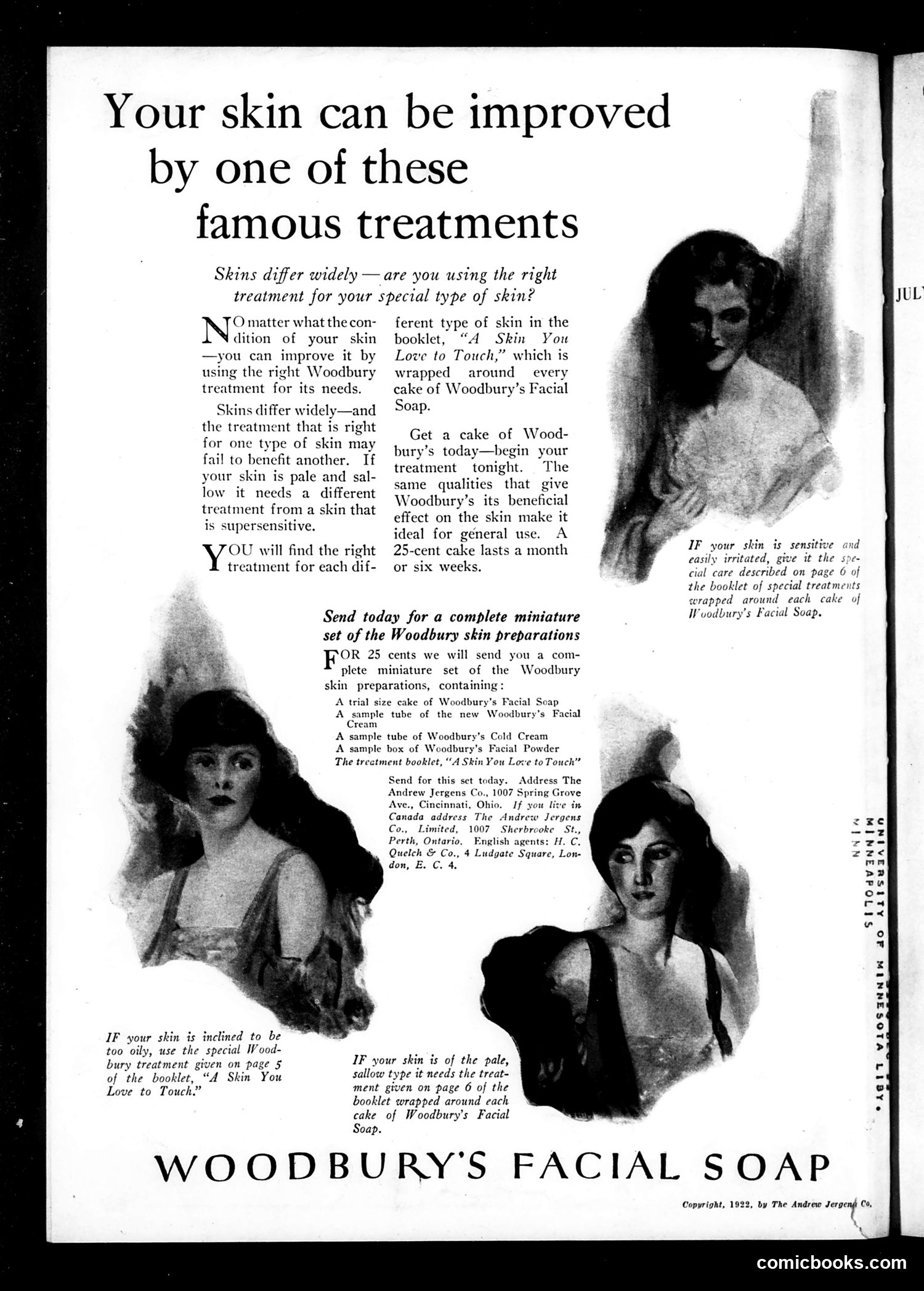
This is a **beauty product advertisement**, not political satire or a cartoon. It promotes Woodbury's Facial Soap by presenting four portrait photographs of women with different skin types—pale/sallow, oily, sensitive, and normal—to argue that different skin conditions require different treatments. The advertisement's strategy was modern for 1922: it segmented consumers by skin type and positioned Woodbury's as offering specialized solutions for each. The booklet "A Skin You Love to Touch" (wrapped around the soap) directed users to appropriate pages based on their skin condition. The offer—a miniature set of products for 25 cents—was a common marketing tactic to convert prospects into customers. The address lists both U.S. and Canadian distributors (Andrew Jergens Co.), indicating broader commercial reach. This represents early 20th-century consumer beauty marketing targeting women's insecurities about skin appearance.