
Life, 1922-07-20 · page 20 of 36
Life — July 20, 1922 — page 20: what you’re looking at
What you’re looking at
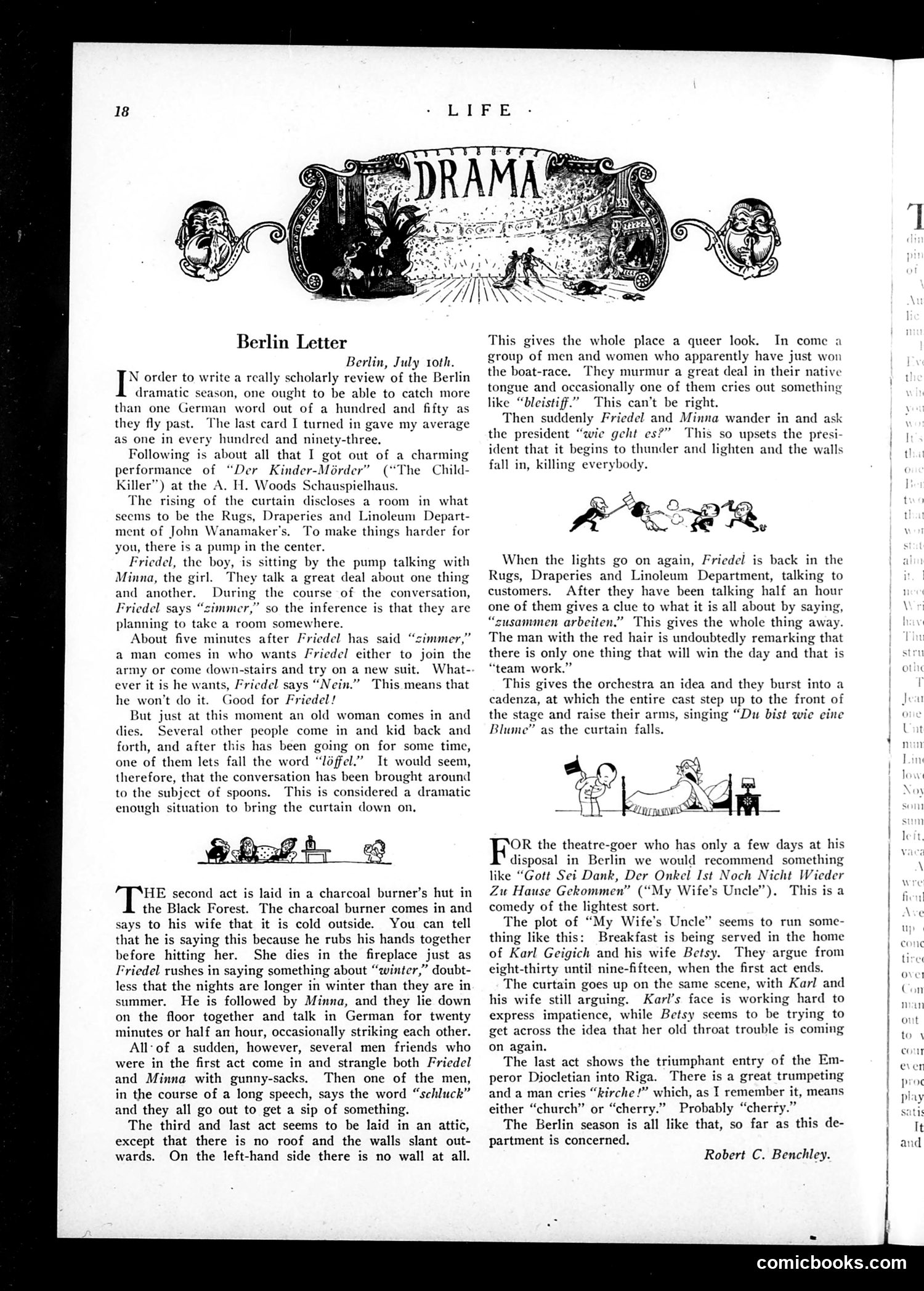
This is a humorous theater review of a German expressionist play ("Der Kinder-Mörder"/"The Child-Killer") performed in Berlin. The unnamed American reviewer uses comedic exaggeration to mock both the play's incomprehensibility and his own inability to understand German. The satire works on multiple levels: the reviewer claims to understand only 1 in 193 German words, yet "translates" the plot—which involves absurd, disconnected scenes (a department store, a murder in the forest, resurrection, inexplicable violence). He mocks Germanic dramatic conventions: the heavy symbolism (spoons representing fate?), the arbitrary staging, the overwrought emotion, and the heavy-handed patriotic ending about "teamwork." The humor lies in portraying avant-garde European theater as pretentious nonsense that confuses even attentive viewers. It's a satirical jab at Weimar-era German drama's perceived opacity and self-importance.
📄 Transcribed text from this page (OCR, searchable)
Machine-transcribed from the original scan — historical spelling and the odd misread are preserved.
Berlin Letter Berlin, July 1oth. N order to write a really scholarly review of the Berlin dramatic season, one ought to be able to catch more than one German word out of a hundred and fifty as they fly past. The last card I turned in gave my average as one in every hundred and ninety-three. Following is about all that I got out of a charming performance of “Der Kinder-Mérder” (“The Child- Killer”) at the A. H. Woods Schauspielhaus. The rising of the curtain discloses a room in what seems to be the Rugs, Draperies and Linoleum Depart- ment of John Wanamaker’s. To make things harder for you, there is a pump in the center. Friedel, the boy, is sitting by the pump talking with Minna, the girl. They talk a great deal about one thing and another. During the course of the conversation, Friedel says “simmer,” so the inference is that they are planning to take a room somewhere. About five minutes after Friedel has said “simmer,” a man comes in who wants Friedel either to join the army or come down-stairs and try on a new suit. What- ever it is he wants, Friedel says “Nein.” This means that he won't do it. Good for Friedel! But just at this moment an old woman comes in and dies. Several other people come in and kid back and forth, and after this has been going on for some time, one of them lets fall the word “léffel.” It would seem, therefore, that the conversation has been brought around to the subject of spoons. This is considered a dramatic enough situation to bring the curtain down on, HE second act is laid in a charcoal burner’s hut in the Black Forest. The charcoal burner comes in and says to his wife that it is cold outside. You can tell that he is saying this because he rubs his hands together before hitting her. She dies in the fireplace just as Friedel rushes in saying something about “zinter,” doubt- less that the nights are longer in winter than they are in summer. He is followed by Minna, and they lie down on the floor together and talk in German for twenty minutes or half an hour, occasionally striking each other. All-of a sudden, however, several men friends who were in the first act come in and strangle both Friedel and Minna with gunny-sacks. Then one of the men, in the course of a long speech, says the word “schluck” and they all go out to get a sip of something. The third and last act seems to be laid in an attic, except that there is no roof and the walls slant out- wards. On the left-hand side there is no wall at all. This gives the whole place a queer look. In come a group of men and women who apparently have just won the boat-race. They murmur a great deal in their native tongue and occasionally one of them cries out something like “bleistiff.” This can’t be right. Then suddenly Friedel and Minna wander in and ask the president “wie geht es?” This so upsets the presi- ident that it begins to thunder and lighten and the walls fall in, killing everybody. ACL R, When the lights go on again, Friedel is back in the Rugs, Draperies and Linoleum Department, talking to customers. After they have been talking half an hour one of them gives a clue to what it is all about by saying, “gusammen arbeiten.” This gives the whole thing away. The man with the red hair is undoubtedly remarking that there is only one thing that will win the day and that is “team work.” This gives the orchestra an idea and they burst into a cadenza, at which the entire cast step up to the front of the stage and raise their arms, singing “Du bist wie eine Blume” as the curtain falls. Pda ah “Clnrpsnws ‘OR the theatre-goer who has only a few days at his disposal in Berlin we would recommend something like “Gott Sei Dank, Der Onkel Ist Noch Nicht Wieder Zu Hause Gekommen” (“My Wife’s Uncle”). This is a comedy of the lightest sort. The plot of “My Wife’s Uncle” seems to run some- thing like this: Breakfast is being served in the home of Karl Geigich and his wife Betsy. They argue from eight-thirty until nine-fifteen, when the first act ends. The curtain goes up on the same scene, with Karl and his wife still arguing. Karl’s face is working hard to express impatience, while Betsy seems to be trying to get across the idea that her old throat trouble is coming on again. The last act shows the triumphant entry of the Em- peror Diocletian into Riga. There is a great trumpeting anda man cries “kirche!” which, as I remember it, means either “church” or “cherry.” Probably “cherry.” The Berlin season is all like that, so far as this de- partment is concerned. Robert C. Benchley. comicbooks.com