
Life, 1922-07-20 · page 4 of 36
Life — July 20, 1922 — page 4: what you’re looking at
What you’re looking at
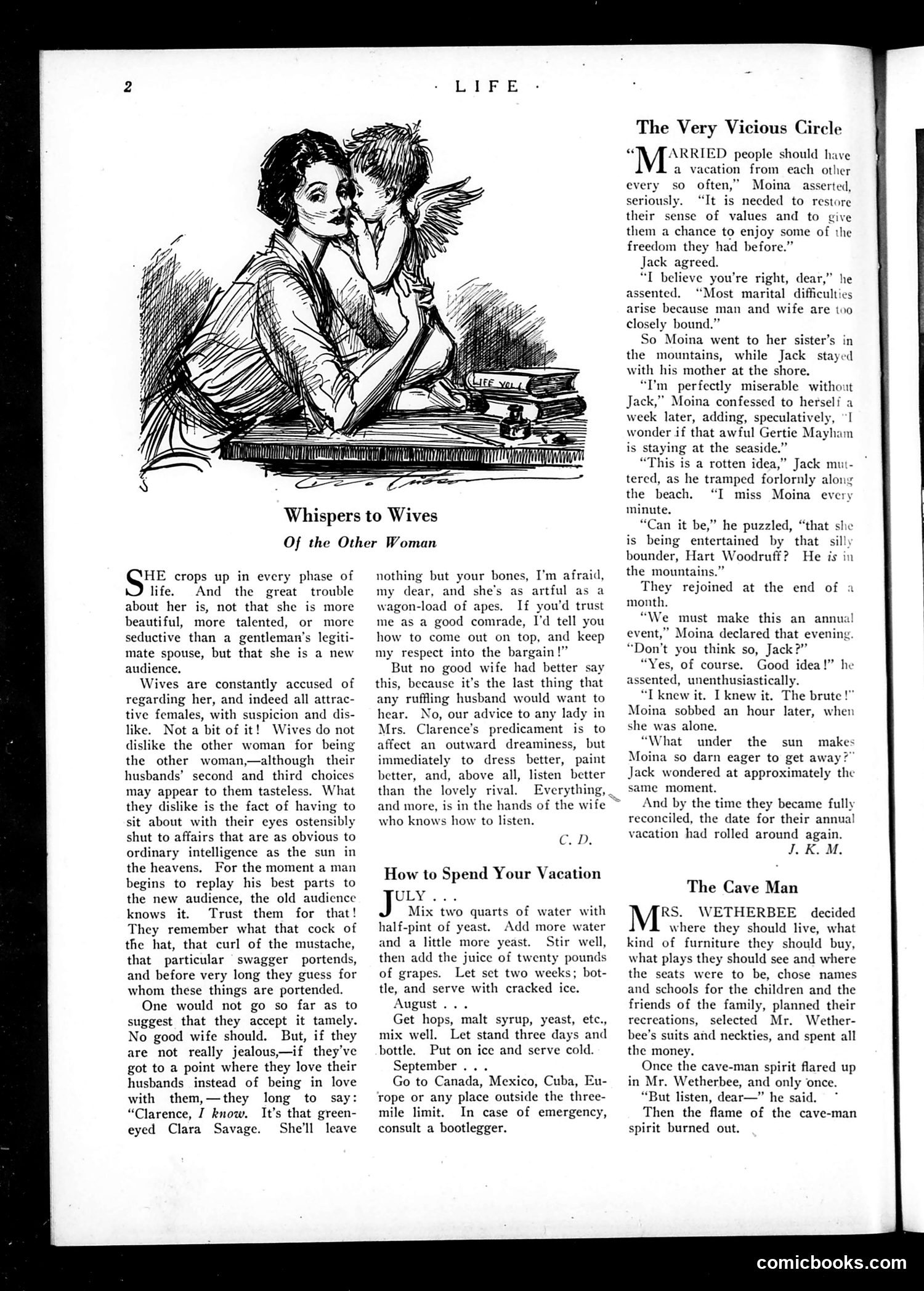
This page contains three short satirical pieces about marriage and domestic life, typical of Life's early 20th-century humor. **"Whispers to Wives of the Other Woman"** mocks wives' jealousy of rivals. The accompanying illustration shows a woman and cupids, likely representing temptation or infidelity. The text argues wives shouldn't worry excessively about "the other woman," suggesting husbands find such rivals manageable nuisances rather than genuine threats. **"The Very Vicious Circle"** satirizes married couples' need for separation vacations to restore their relationship—a commentary on marital tedium and the irony that distance supposedly helps closeness. **"The Cave Man"** humorously describes Mr. Wetherbee's domestication, where even his "cave-man spirit" (wildness) dies once married. The satire targets Victorian-era marriage conventions and gender dynamics, presenting marriage as simultaneously confining and absurdly necessary.
📄 Transcribed text from this page (OCR, searchable)
Machine-transcribed from the original scan — historical spelling and the odd misread are preserved.
Whispers to Wives Of the Other Woman HE crops up in every phase of life. And the great trouble about her is, not that she is more beautiful, more talented, or more seductive than a gentleman's legiti- mate spouse, but that she is a new audience. Wives are constantly accused of regarding her, and indeed all attrac- tive females, with suspicion and dis- like. Not a bit of it! Wives do not dislike the other woman for being the other woman,—although their husbands’ second and third choices may appear to them tasteless. What they dislike is the fact of having to sit about with their eyes ostensibly shut to affairs that are as obvious to ordinary intelligence as the sun in the heavens. For the moment a man begins to replay his best parts to the new audience, the old audience knows it. Trust them for that! They remember what that cock of the hat, that curl of the mustache, that particular swagger portends, and before very long they guess for whom these things are portended. One would not go so far as to suggest that they accept it tamely. No good wife should. But, if they are not really jealous,—if they've got to a point where they love their husbands instead of being in love with them,—they long to say: “Clarence, J know. It’s that green- eyed Clara Savage. She'll leave nothing but your bones, I'm afraid, my dear, and she’s as artful as a wagon-load of apes. If you'd trust me as a good comrade, I'd tell you how to come out on top, and keep my respect into the bargain!” But no good wife had better say this, because it’s the last thing that any ruffling husband would want to hear. No, our advice to any lady in Mrs. Clarence’s predicament is to affect an outward dreaminess, but immediately to dress better, paint better, and, above all, listen better than the lovely rival. and more, is in the hands of the wife who knows how to listen. Cc. De How to Spend Your Vacation ULY.... Mix two quarts of water with half-pint of ye Add more water and a little more yeast. Stir well, then add the juice of twenty pounds of grapes. Let set two weeks; bot- tle, and serve with cracked ice. August... Get hops, malt syrup, yeast, etc., mix well. Let stand three days and bottle. Put on ice and serve cold. September... Go to Canada, Mexico, Cuba, Eu- rope or any place outside the three- mile limit. In case of emergency, consult a bootlegger. Everything, . The Very Vicious Circle ss ARRIED people should have a vacation from each other every so often,” Moina asserted, seriously. “It is needed to restore their sense of values and to give them a chance to enjoy some of the freedom they had before.” Jack agreed. “I believe you're right, dear,” he assented. “Most marital difficulties arise because man and wife are too closely bound.” So Moina went to her sister’s in the mountains, while Jack stayed with his mother at the shore. “I'm perfectly miserable without Jack,” Moina confessed to herself a week later, adding, speculatively, “| wonder if that awful Gertie Mayham is staying at the seaside.” “This is a rotten idea,” Jack mut- tered, as he tramped forlornly along the beach. “I miss Moina every minute. “Can it be,” he puzzled, “that she is being entertained by that silly bounder, Hart Woodruff? He is iy the mountains.” They rejoined at the end of a month. “We must make this an annual event,” Moina declared that evening. “Don’t you think so, Jack?” “Yes, of course. Good idea!” he assented, unenthusiastically. “I knew it. I knew it. The brute !” Moina sobbed an hour later, when she was alone. “What under the sun makes Moina so darn eager to get away? Jack wondered at approximately the same moment. And by the time they became fully reconciled, the date for their annual vacation had rolled around again. JK. M. The Cave Man RS. WETHERBEE decided where they should live, what kind of furniture they should buy, what plays they should see and where the seats were to be, chose names and schools for the children and the friends of the family, planned their recreations, selected Mr. Wether- bee’s suits and neckties, and spent all the money. Once the cave-man spirit flared up in Mr. Wetherbee, and only once. “But listen, dear—” he said. Then the flame of the cave-man spirit burned out. comicbooks.com