
Life, 1922-07-20 · page 26 of 36
Life — July 20, 1922 — page 26: what you’re looking at
What you’re looking at
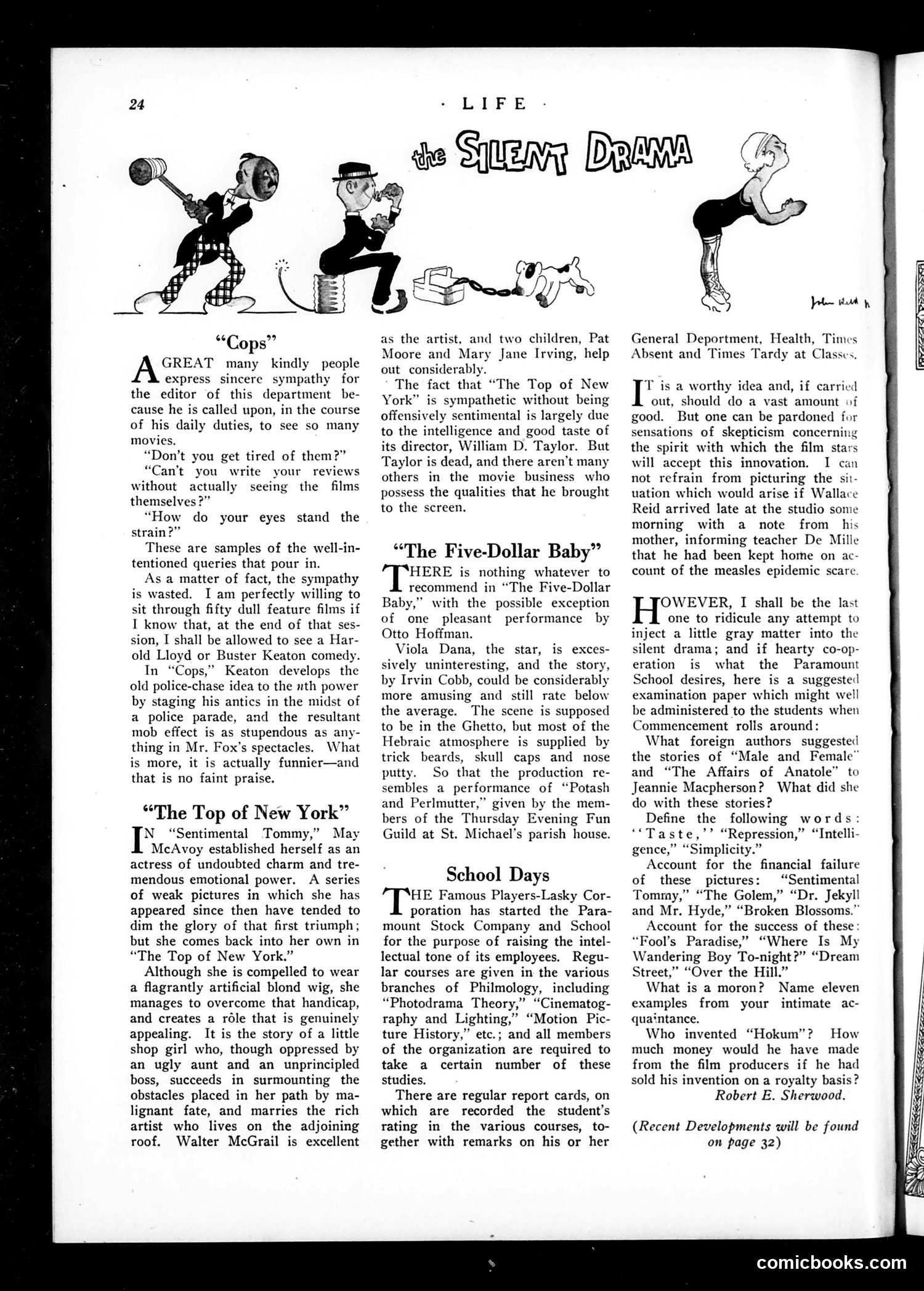
This page reviews contemporary silent films (likely early 1920s) with satirical illustrations at the top depicting slapstick comedy scenarios. **The cartoons** show physical comedy sequences typical of silent film stars like Buster Keaton and Harold Lloyd — people juggling, being chased, and performing exaggerated acrobatics. **Key reviews discussed:** - **"Cops"** — Keaton praised for developing a police-chase gag into elaborate slapstick - **"The Top of New York"** — May McAvoy vehicle, noted as sympathetic without being overly sentimental; the author laments director William D. Taylor's death as a loss to the industry - **"The Five-Dollar Baby"** — harshly criticized as tedious, with mock-ethnic stereotyping (fake beards and "nose putty") for Ghetto scenes **"School Days" section** satirizes Paramount's new employee training program claiming to educate film stars in "Philmology" and cinematography theory — the author expresses skepticism that actors will genuinely embrace such intellectual pursuits.
📄 Transcribed text from this page (OCR, searchable)
Machine-transcribed from the original scan — historical spelling and the odd misread are preserved.
GREAT many kindly people express sincere sympathy for the editor of this department be- cause he is called upon, in the course of his daily duties, to see so many movies. “Don’t you get tired of them?” “Can't you write your reviews without actually seeing the films themselves?” “How do your eyes stand the strain?” These are samples of the well-in- tentioned queries that pour in. As a matter of fact, the sympathy is wasted. I am perfectly willing to sit through fifty dull feature films if I know that, at the end of that ses- sion, I shall be allowed to see a Har- old Lloyd or Buster Keaton comedy. In “Cops,” Keaton develops the old police-chase idea to the nth power by staging his antics in the midst of a police parade, and the resultant mob effect is as stupendous as any- thing in Mr. Fox’s spectacles. What is more, it is actually funnier—and that is no faint praise. “The Top of New York” | “Sentimental Tommy,” May McAvoy established herself as an actress of undoubted charm and tre- mendous emotional power. A series of weak pictures in which she has appeared since then have tended to dim the glory of that first triumph; but she comes back into her own in “The Top of New York.” Although she is compelled to wear a flagrantly artificial blond wig, she manages to overcome that handicap, and creates a role that is genuinely appealing. It is the story of a little shop girl who, though oppressed by an ugly aunt and an unprincipled boss, succeeds in surmounting the obstacles placed in her path by ma- lignant fate, and marries the rich artist who lives on the adjoining roof. Walter McGrail is excellent as the artist, and two children, Pat Moore and Mary Jane Irving, help out considerably. The fact that “The Top of New York” is sympathetic without being offensively sentimental is largely due to the intelligence and good taste of its director, William D. Taylor. But Taylor is dead, and there aren’t many others in the movie business who possess the qualities that he brought to the screen. “The Five-Dollar Baby” HERE is nothing whatever to recommend in “The Five-Dollar Baby,” with the possible exception of one pleasant performance by Otto Hoffman. Viola Dana, the star, is exces- sively uninteresting, and the story, by Irvin Cobb, could be considerably more amusing and still rate below the average. The scene is supposed to be in the Ghetto, but most of the Hebraic atmosphere is supplied by trick beards, skull caps and nose putty. So that the production re- sembles a performance of “Potash and Perlmutter,” given by the mem- bers of the Thursday Evening Fun Guild at St. Michael’s parish house. School Days HE Famous Players-Lasky Cor- poration has started the Para- mount Stock Company and School for the purpose of raising the intel- lectual tone of its employees. Regu- lar courses are given in the various branches of Philmology, including “Photodrama Theory,” “Cinematog- raphy and Lighting,” “Motion Pic- ture History,” etc.; and all members of the organization are required to take a certain number of these studies. There are regular report cards, on which are recorded the student’s rating in the various courses, to- gether with remarks on his or her < Jae bua General Deportment, Health, Times Absent and Times Tardy at Classes. i ie is a worthy idea and, if carried out, should do a vast amount of good. But one can be pardoned for sensations of skepticism concerning the spirit with which the film stars will accept this innovation. I can not refrain from picturing the sit- uation which would arise if Wallace Reid arrived late at the studio some morning with a note from his mother, informing teacher De Mille that he had been kept home on ac- count of the measles epidemic scare OWEVER, I shall be the last one to ridicule any attempt to inject a little gray matter into the silent drama; and if hearty co-op- eration is what the Paramount School desires, here is a suggested examination paper which might well be administered to the students when Commencement rolls around: What foreign authors suggested the stories of “Male and Female” and “The Affairs of Anatole” to Jeannie Macpherson? What did she do with these stories? Define the following words: “*Taste,’’ “Repression,” “Intelli- gence,” “Simplicity.” Account for the financial failure of these pictures: “Sentimental Tommy,” “The Golem,” “Dr. Jekyll and Mr. Hyde,” “Broken Blossoms.” Account for the success of these: “Fool’s Paradise,” “Where Is My Wandering Boy To-night?” “Dream Street,” “Over the Hill.” What is a moron? Name eleven examples from your intimate ac- quaintance. Who invented “Hokum”? How much money would he have made from the film producers if he had sold his invention on a royalty basis? Robert E. Sherwood. (Recent Developments will be found on page 32) comicbooks.com