
Life, 1922-07-20 · page 6 of 36
Life — July 20, 1922 — page 6: what you’re looking at
What you’re looking at
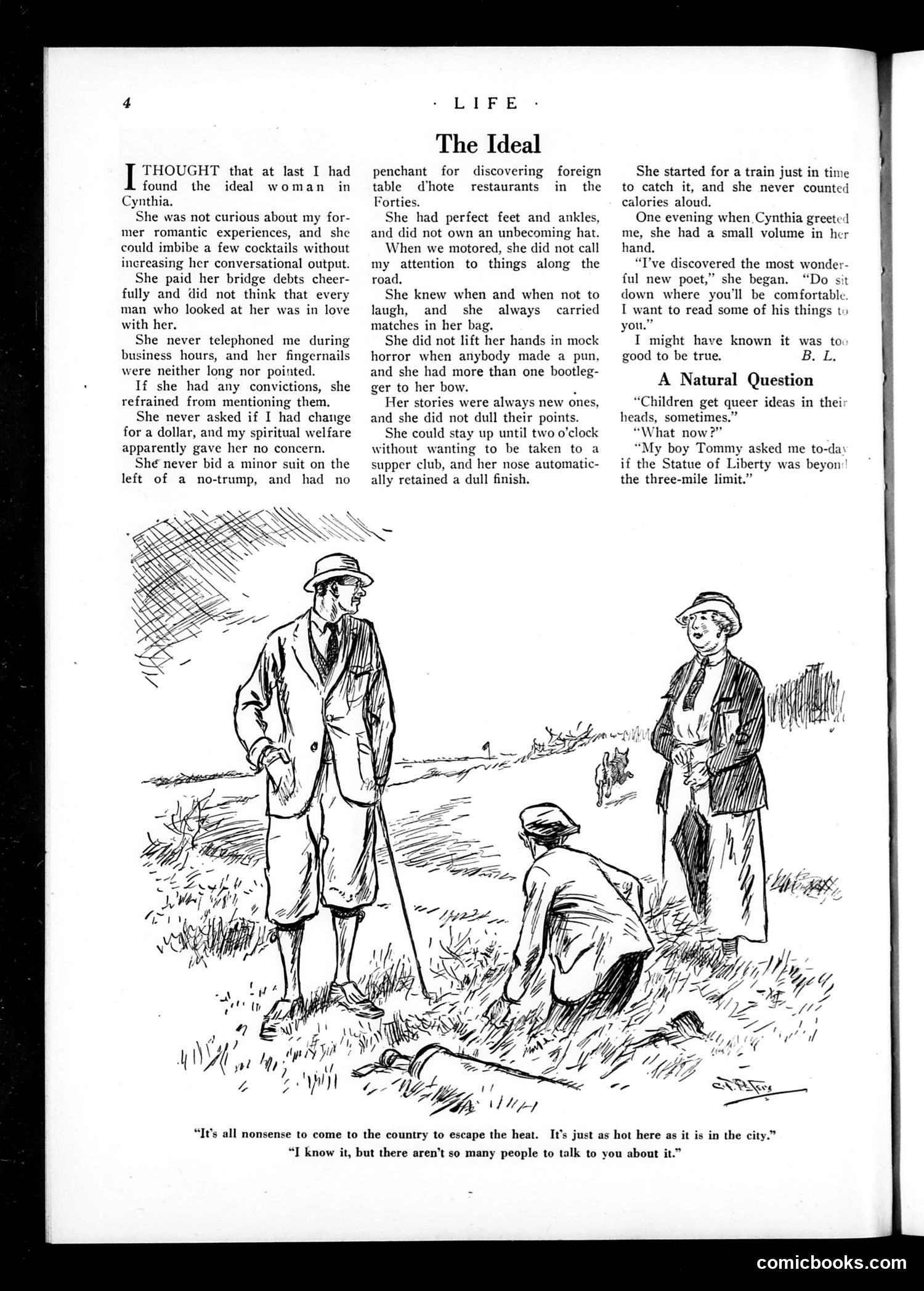
This page from *Life* magazine presents a social satire about urban versus rural living. The story describes an ideal woman named Cynthia—cultured, independent, and undemanding. The accompanying cartoon depicts three figures in a rural setting, with two men standing and one crouching or sitting. The dialogue satirizes the tension between city and country life. One character dismisses escaping to the countryside as pointless ("It's all nonsense to come to the country to escape the heat"), while another notes the real advantage: fewer people for social conversation ("I know it, but there aren't so many people to talk to you about it"). This reflects early 20th-century social anxieties about urbanization, where rural retreat was marketed as escape, yet offered isolation as its actual benefit—satirizing both city society's demands and country life's loneliness.
📄 Transcribed text from this page (OCR, searchable)
Machine-transcribed from the original scan — historical spelling and the odd misread are preserved.
THOUGHT that at last I had found the ideal woman _ in Cynthia. She was not curious about my for- mer romantic experiences, and she could imbibe a few cocktails without increasing her conversational output. She paid her bridge debts cheer- fully and did not think that every man who looked at her was in love with her. She never telephoned me during business hours, and her fingernails were neither long nor pointed. If she had any convictions, she refrained from mentioning them. She never asked if I had change for a dollar, and my spiritual welfare apparently gave her no concern. She never bid a minor suit on the left of a no-trump, and had no “Tt’s all nonsense to come to the country to escape the heat. LIFE The Ideal penchant for table d’hote Forties. She had perfect feet and ankles, and did not own an unbecoming hat. When we motored, she did not call my attention to things along the road, She knew when and when not to laugh, and she always carried matches in her bag. She did not lift her hands in mock horror when anybody made a pun, and she had more than one bootleg- ger to her bow. . Her stories were always new ones, and she did not dull their points. She could stay up until two o'clock without wanting to be taken to a supper club, and her nose automatic- ally retained a dull finish. discovering foreign restaurants in the She started for a train just in time to catch it, and she never counted calories aloud. One evening when Cynthia greeted me, she had a small volume in her hand. “T’ve discovered the most wonder- ful new poet,” she began. “Do sit down where you'll be comfortable. I want to read some of his things to you.” I might have known it was to good to be true. BE. A Natural Question “Children get queer ideas in thei heads, sometimes.” “What now?” “My boy Tommy asked me to-day if the Statue of Liberty was beyon the three-mile limit.” It’s just as hot here as it is in the city.” “T know it, but there aren’t so many people to talk to you about it.” comicbooks.com