
Life, 1922-07-20 · page 17 of 36
Life — July 20, 1922 — page 17: what you’re looking at
What you’re looking at
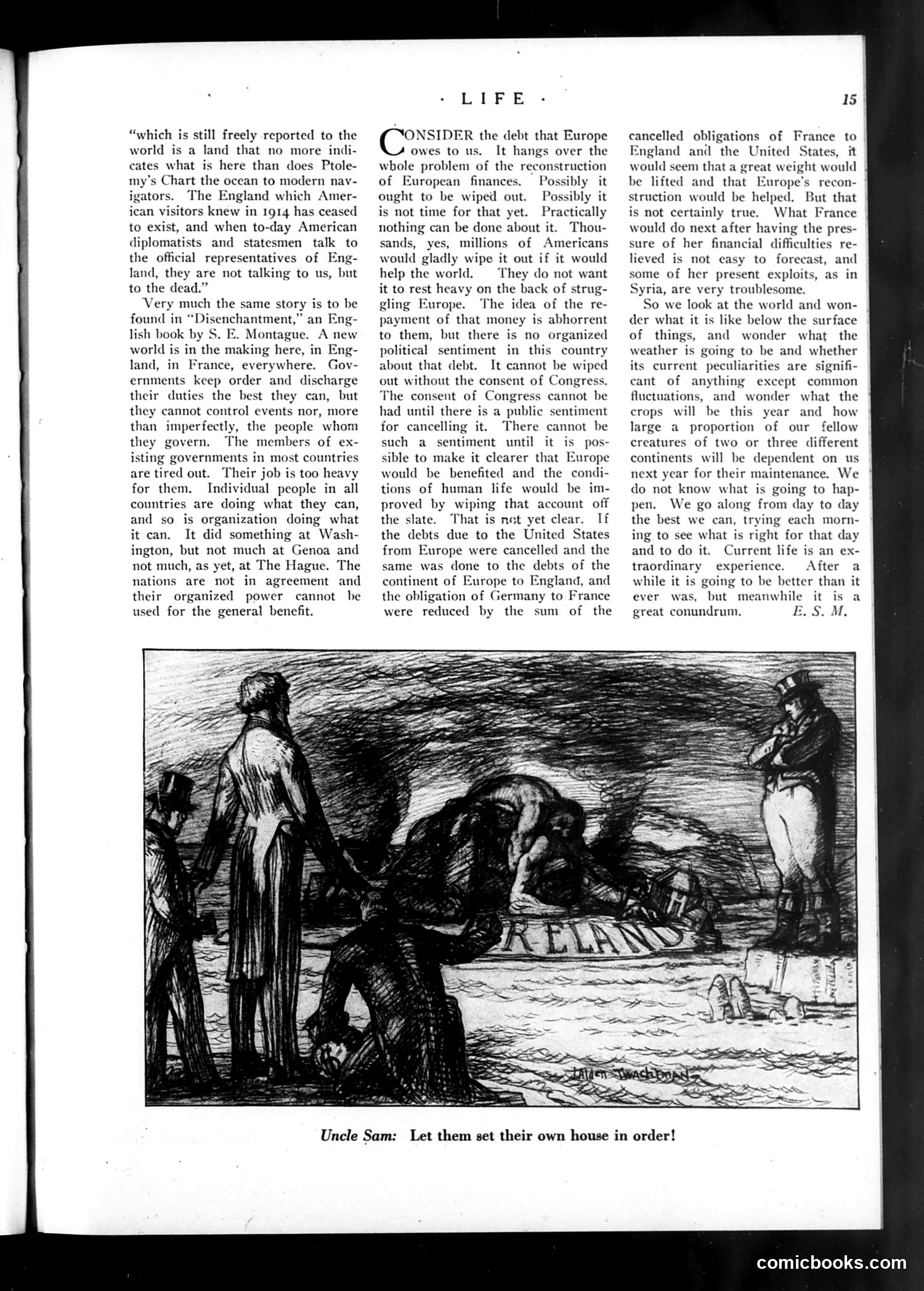
This editorial cartoon depicts Uncle Sam (personified America, left) observing European nations in disarray on a damaged ship labeled "RUIN." The accompanying article discusses post-WWI European debt to America and reconstruction challenges. The satire expresses American isolationism: Uncle Sam refuses involvement in Europe's problems, insisting Europeans solve their own crises. The cartoon reflects contemporary frustration with European war debts, political instability, and the perceived incompetence of European governments. The text argues that while Americans sympathize with European suffering, there's insufficient political will to cancel war debts without clearer justification. The "house in order" idiom emphasizes that Europe must demonstrate financial responsibility and stability before America should provide relief—a common post-WWI American sentiment opposing continued international entanglement.
📄 Transcribed text from this page (OCR, searchable)
Machine-transcribed from the original scan — historical spelling and the odd misread are preserved.
“which is still freely reported to the world is a land that no more indi- cates what is here than does Ptole- my’s Chart the ocean to modern nav- igators. The England which Amer- ican visitors knew in 1914 has ceased to exist, and when to-day American diplomatists and statesmen talk to the official representatives of Eng- land, they are not talking to us, but to the dead.” ‘Very much the same story is to be found in “Disenchantment,” an Eng- lish book by S. E. Montague. A new world is in the making here, in Eng- land, in France, everywhere. Gov- ernments keep order and discharge their duties the best they can, but they cannot control events nor, more than imperfectly, the people whom they govern. The members of ex isting governments in most countries are tired out. Their job is too heavy for them, Individual people in all countries are doing what they can, and so is organization doing what it can. It did something at Wash- ington, but not much at Genoa and not much, as yet, at The Hague. The nations are not in agreement and their organized power cannot be used for the general benefit. > LIFE - 'ONSIDER the debt that Europe owes to us. It hangs over the whole problem of the reconstruction of European finances. ought to be wiped out. s is not time for that yet. Practically nothing can be done about it. Thou- sands, yes, millions of Americans would gladly wipe it out if it would help the world. They do not want it to rest heavy on the back of strug- gling Europe. The idea of the re- payment of that money is abhorrent to them, but there is no organized political sentiment in this country about that debt. It cannot be wiped out without the consent of Congress. The consent of Congress cannot be had until there is a public sentiment for cancelling it. There cannot be such a sentiment until it is pos- sible to make it clearer that Europe would be benefited and the condi- tions of human life would be im- proved by wiping that account off the slate. That is net yet clear. If the debts due to the United States from Europe were cancelled and the same was done to the debts of the continent of Europe to England, and the obligation of Germany to France were reduced by the sum of the 15 cancelled obligations of France to gland and the United States, it would seem that a great weight would be lifted and that Europe's recon- struction would be helped. But that is not certainly true. What France would do next after having the pres- sure of her financial difficulties re- lieved is not to forecast, and some of her present exploits, as in Syria, are very troublesome. So we look at the world and won- der what it is like below the surface of things, and wonder what the weather is going to be and whether its current peculiarities are signifi- cant of anything except common fluctuations, and wonder what the crops will be this year and how large a proportion of our fellow creatures of two or three different continents will be dependent on us next year for their maintenance. We do not know what is going to hap- pen. We go along from day to day the best we can, trying each morn- ing to see what is right for that day and to do it. Current life is an ex- traordinary experience. After a while it is going to be better than it ever was, but meanwhile it is a great conundrum, S. M, Uncle Sam: Let them set their own house in order! comicbooks.com