
Life, 1922-07-20 · page 16 of 36
Life — July 20, 1922 — page 16: what you’re looking at
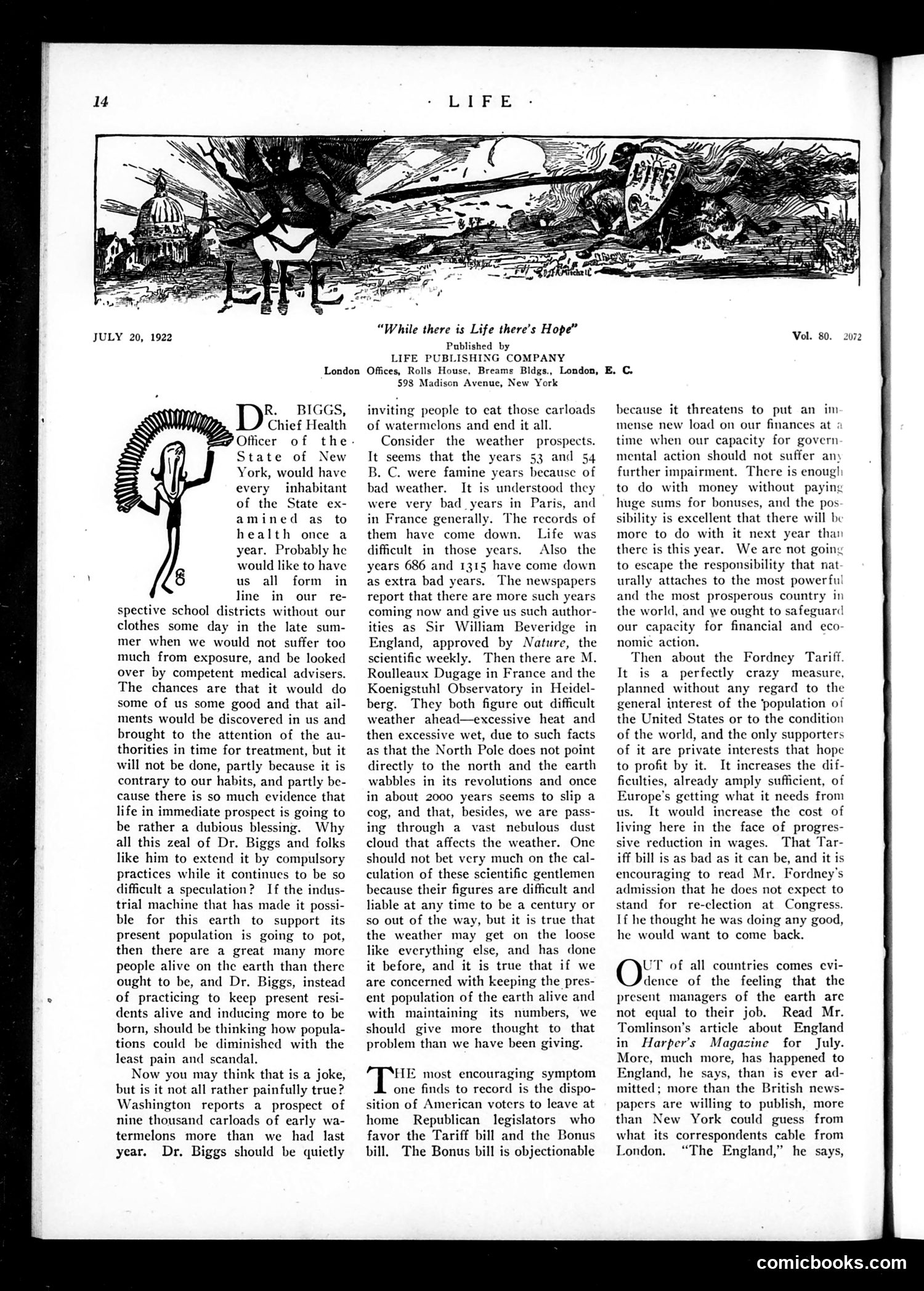
What you’re looking at
The page features an editorial by Dr. Biggs, Chief Health Officer of New York State, criticizing proposals to restrict watermelon consumption due to weather concerns. The satirical angle mocks what appears to be alarmist public health advice: officials worried that eating watermelons during hot years (specifically years 53 and 54 of the French famine) posed financial burdens on government capacity. The cartoon at top illustrates this absurdity—a figure sits beneath a gnarled tree in a surreal landscape, embodying the tension between natural appetite and bureaucratic control. Biggs argues the real issue is overzealous government intervention in citizens' private choices, using watermelons as a proxy for broader concerns about expanding state authority and regulations that restrict personal freedom without genuine public benefit.
📄 Transcribed text from this page (OCR, searchable)
Machine-transcribed from the original scan — historical spelling and the odd misread are preserved.
JULY 20, 1922 Chief Health of the. State of New York, would have every inhabitant of the State ex- amined as to health once a year. Probably he would like to have us all form in line in our re- spective school districts without our clothes some day in the late sum- mer when we would not suffer too much from exposure, and be looked over by competent medical advisers. The chances are that it would do some of us some good and that ail- ments would be discovered in us and brought to the attention of the au- thorities in time for treatment, but it will not be done, partly because it is contrary to our habits, and partly be- cause there is so much evidence that life in immediate prospect is going to be rather a dubious blessing. Why all this zeal of Dr. Biggs and folks like him to extend it by compulsory practices while it continues to be so difficult a speculation? If the indus- trial machine that has made it possi- ble for this earth to support its present population is going to pot, then there are a great many more people alive on the earth than there ought to be, and Dr. Biggs, instead of practicing to keep present resi- dents alive and inducing more to be born, should be thinking how popula- tions could be diminished with the least pain and scandal. Now you may think that is a joke, but is it not all rather painfully true? Washington reports a prospect of nine thousand carloads of early wa- termelons more than we had last year. Dr. Biggs should be quietly “While there is Life there’s Hope” Published by LIFE PUBLISHING COMPANY Vol. 80. 2072 Offices, Rolls House, Breams Bldgs., London, E. C. 598 Madison Avenue, New York inviting people to eat those carloads of watermelons and end it all. Consider the weather prospects. It seems that the years and 54 B. C. were famine years because of bad weather. It is understood they were very bad years in Paris, and in France generally. The records of them have come down. Life was difficult in those years. Also the years 686 and 1315 have come down as extra bad years. The newspapers report that there are more such years coming now and give us such author- ities as Sir William Beveridge in England, approved by Nature, the scientific weekly. Then there are M. Roulleaux Dugage in France and the Koenigstuhl Observatory in Heidel- berg. They both figure out difficult weather ahead—excessive heat and then excessive wet, due to such facts as that the North Pole does not point directly to the north and the earth wabbles in its revolutions and once in about 2000 years seems to slip a cog, and that, besides, we are pass- ing through a vast nebulous dust cloud that affects the weather. One should not bet very much on the cal- culation of these scientific gentlemen because their figures are difficult and liable at any time to be a century or so out of the way, but it is true that the weather may get on the loose like everything else, and has done it before, and it is true that if we are concerned with keeping the pres- ent population of the earth alive and with maintaining its numbers, we should give more thought to that problem than we have been giving. HIE most encouraging symptom one finds to record is the dispo- sition of American voters to leave at home Republican legislators who favor the Tariff bill and the Bonus bill. The Bonus bill is objectionable because it threatens to put an im mense new load on our finances at : time when our capacity for govern mental action should not suffer any further impairment. There is enoug! to do with money without paying huge sums for bonuses, and the pos sibility is excellent that there will bc more to do with it next year than there is this year. We are not going to escape the responsibility that nat urally attaches to the most powerful and the most prosperous country in the world, and we ought to safeguard our capacity for financial and eco- nomic action. Then about the Fordney Tariff. It is a perfectly crazy measure, planned without any regard to the general interest of the ‘population of the United States or to the condition of the world, and the only supporters of it are private interests that hope to profit by it. It increases the dif- ficulties, already amply sufficient, of Europe's getting what it needs from us. It would increase the cost of living here in the face of progres- sive reduction in wages. That Tar- iff bill is as bad as it can be, and it is encouraging to read Mr. Fordney’s admission that he does not expect to stand for re-clection at Congress. If he thought he was doing any good, he would want to come back. UT of all countries comes evi- dence of the feeling that the present managers of the earth are not equal to their job. Read Mr. Tomlinson’s article about England in Harper's Magazine for July. More, much more, has happened to England, he says, than is ever ad- mitted; more than the British news- papers are willing to publish, more than New York could guess from what its correspondents cable from London. “The England,” he says, comicbooks.com