
Life, 1922-07-20 · page 21 of 36
Life — July 20, 1922 — page 21: what you’re looking at
What you’re looking at
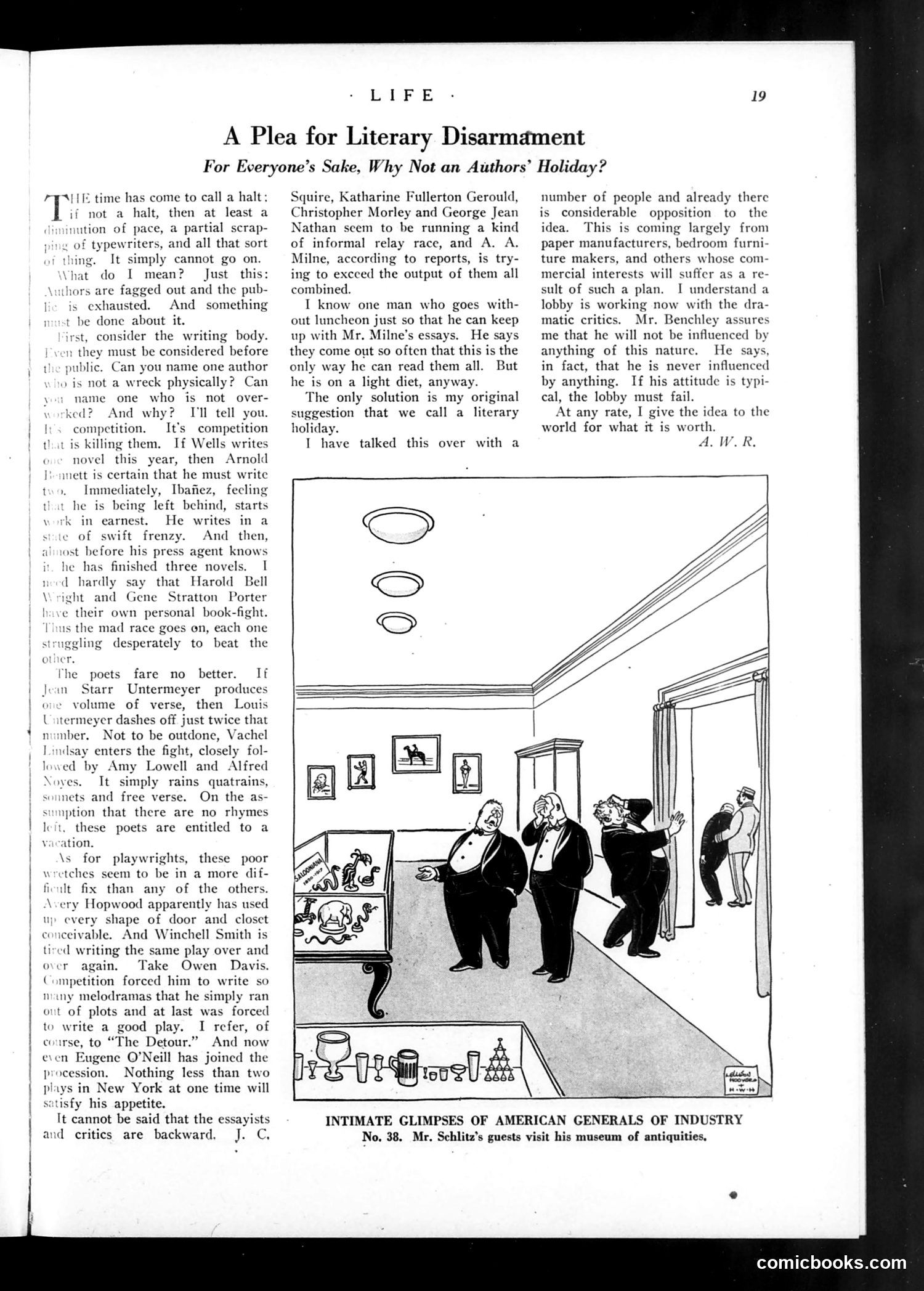
This article satirizes the competitive frenzy among early 20th-century authors and poets. The writer argues that famous authors—H.G. Wells, Arnold Bennett, Blasco Ibáñez, Harold Bell Wright, Gene Stratton Porter—are locked in an exhausting "mad race," each compulsively publishing to outpace rivals. Poets similarly compete: if Louis Untermeyer produces verse, his rival must produce more. The cartoon below depicts wealthy industrialists (likely the Schlitz brewery family) viewing art in a mansion, illustrating ironic contrast with the text's theme about commercial pressures destroying creativity—here showing how business success enables cultured leisure that authors cannot afford. The satire's point: literary competition driven by commercial interests exhausts writers physically and creatively. The proposed solution—a mandatory "authors' holiday"—faces resistance from paper manufacturers and furniture makers whose profits depend on continuous output. The piece mocks both the competitive publishing industry and vested commercial interests blocking reform.
📄 Transcribed text from this page (OCR, searchable)
Machine-transcribed from the original scan — historical spelling and the odd misread are preserved.
LIFE 19 A Plea for Literary Disarmament For Everyone’s Sake, Why Not an Authors’ Holiday? PIAIIE time has come to call a halt: I if not a halt, then at least a diminution of pace, a partial scrap- of typewriters, and all that sort ing. It simply cannot go on. hat do I mean? Just this: \uthors are fagged out and the pub- is exhausted. And something must be done about it. rst, consider the writing body. » they must be considered before the public. Can you name one author » is not a wreck physically? Can y name one who is not over- ked? And why? I'll tell you. | competition. It's competition that is killing them, If Wells writes c novel this year, then Arnold Ii-nnett is certain that he must write Immediately, Ibafiez, fecling tlt he is being left behind, starts work in earnest. He writes in a site of swift fren And _ then, alaost before his press agent knows it, he has finished three novels. I need hardly say that Harold Bell \\right and Gene Stratton Porter have their own personal book-fight. ims the mad race goes on, each one struggling desperately to beat the rr, othe the poets fare no better. If Starr Untermeyer produces ¢ volume of verse, then Louis Untermeyer dashes off just twice that number, Not to be outdone, Vachel dsay enters the fight, closely fol- lowed by Amy Lowell and Alfred It simply rains quatrains, sounets and free verse. On the as- sumption that there are no rhymes leit, these poets are entitled to a vacation, \s for playw ves. ights, these poor wretches seem to be in a more dif- ficult fix than any of the others. ery Hopwood apparently has used up every shape of door and closet conceivable. And Winchell Smith is tired writing the same play over and over again. Take Owen Davis. Competition forced him to write so ny melodramas that he simply ran out of plots and at last was forced write a good play. I refer, of course, to “The Detour.” And now even Eugene O'Neill has joined the on. Nothing less than two New York at one time will tisfy his appetite. It cannot be said that the essayists and critics are backward, J. C, Squire, Katharine Fullerton Gerould, Christopher Morley and George Jean Nathan seem to be running a kind of informal relay race, and A. Milne, according to reports, is try- ing to excced the output of them all combined. I know one man who goes with- out luncheon just so that he can keep up with Mr. Milne’s essays. He says they come out so often that this is the only way he can read them all. But he is on a light diet, anyway. The only solution is my original suggestion that we call a literary holiday. I have talked this over with a number of people and already there is considerable opposition to the idea. This is coming largely from paper manufacturers, bedroom furni- ture makers, and others whose com- mercial interests will suffer as a re- sult of such a plan. I understand a lobby is working now with the dra- matic critics. Mr. Benchley assures me that he will not be influenced by anything of this nature. He say in fact, that he is never influence by anything. If his attitude is typi- cal, the lobby must fail. At any rate, I give the idea to the world for what it is worth. A,W.R, INTIMATE GLIMPSES OF AMERICAN GENERALS OF INDUSTRY No. 38. Mr. Schlitz’s guests visit his museum of antiquities, comicbooks.com