
A complete issue · 36 pages · 1922
Life — July 13, 1922
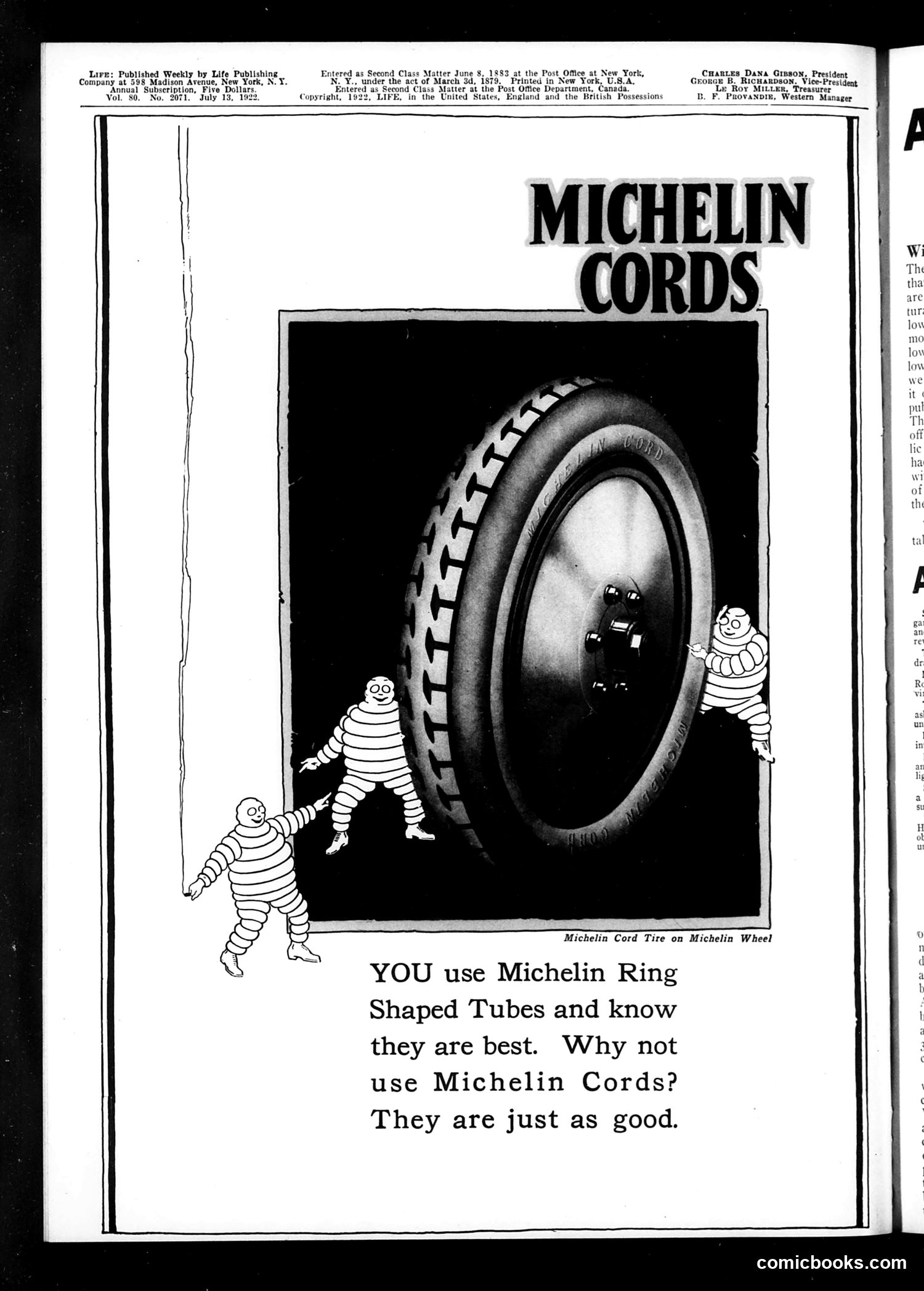
This is a **product advertisement**, not a political cartoon. It promotes Michelin tire cords—the internal reinforcing material in tires. The ad features the famous **Michelin Man** (Bibendum), the brand's mascot character made of tire rings, depicted here in a humorous scene with three smaller Michelin Men appearing to struggle with or install a large tire. The text's logic is straightforward marketing: since consumers already trusted Michelin's "Ring Shaped Tubes," why not trust their cord products? The implication is that Michelin's quality extends across all tire components. The playful illustration with the undersized figures and oversized tire creates visual humor to catch readers' attention—a common advertising technique in 1920s publications.
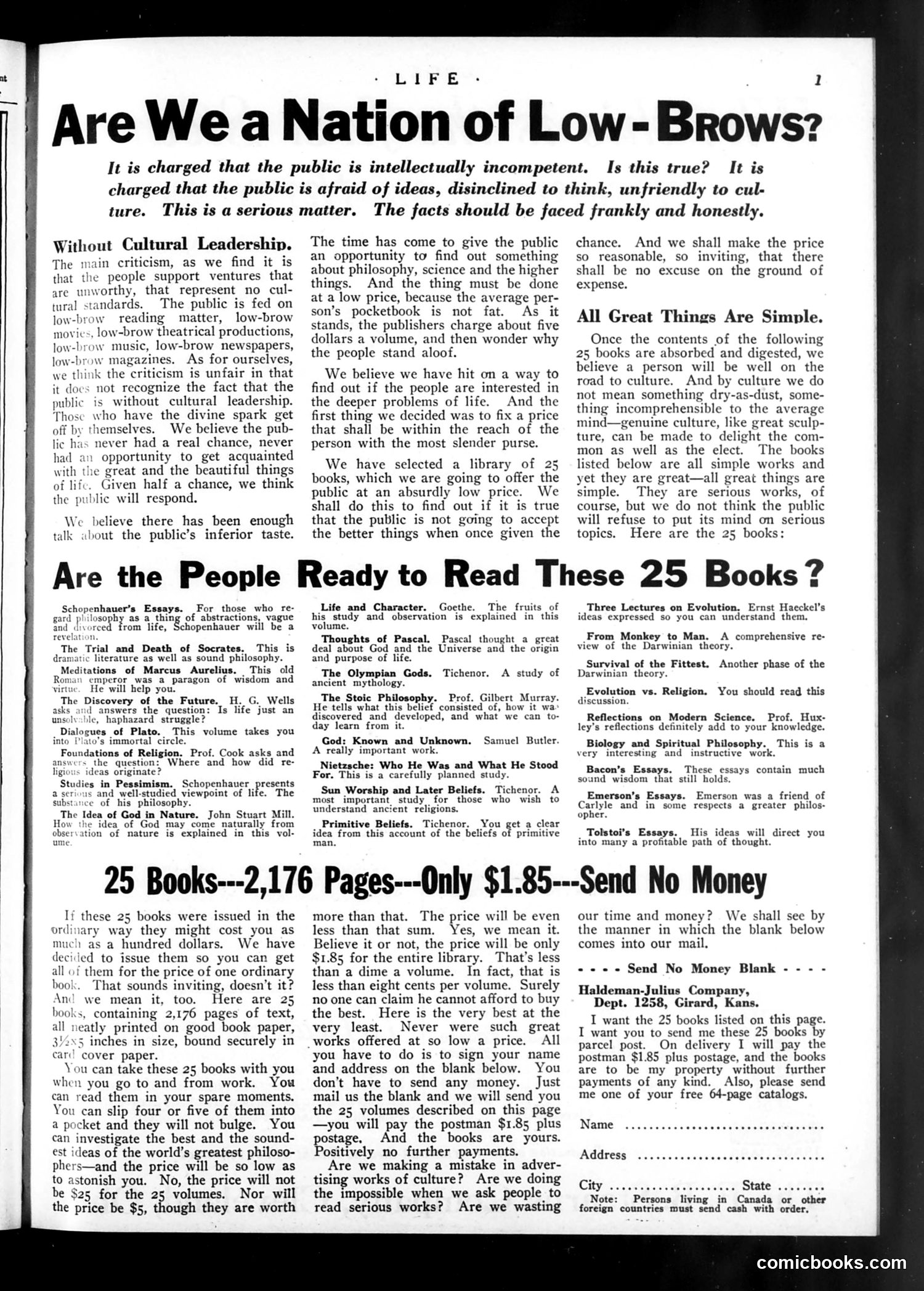
This page is primarily **advertising content**, not satire or political commentary. It's a direct-mail advertisement for the Haldeman-Julius Company promoting a 25-book library collection on philosophy, science, and culture. The headline "Are We a Nation of Low-Brows?" frames the pitch: the publishers argue that American public lacks cultural leadership and intellectual engagement. They position their cheap book collection ($1.85 for 2,176 pages) as democratizing access to serious ideas—works by Schopenhauer, Pascal, Darwin, and others. The rhetorical strategy uses mild social anxiety (questioning American intellectual standards) to motivate purchase. It's marketing, not mockery—appealing to readers' aspirations toward self-improvement through affordable literature during what was likely the early 20th century.
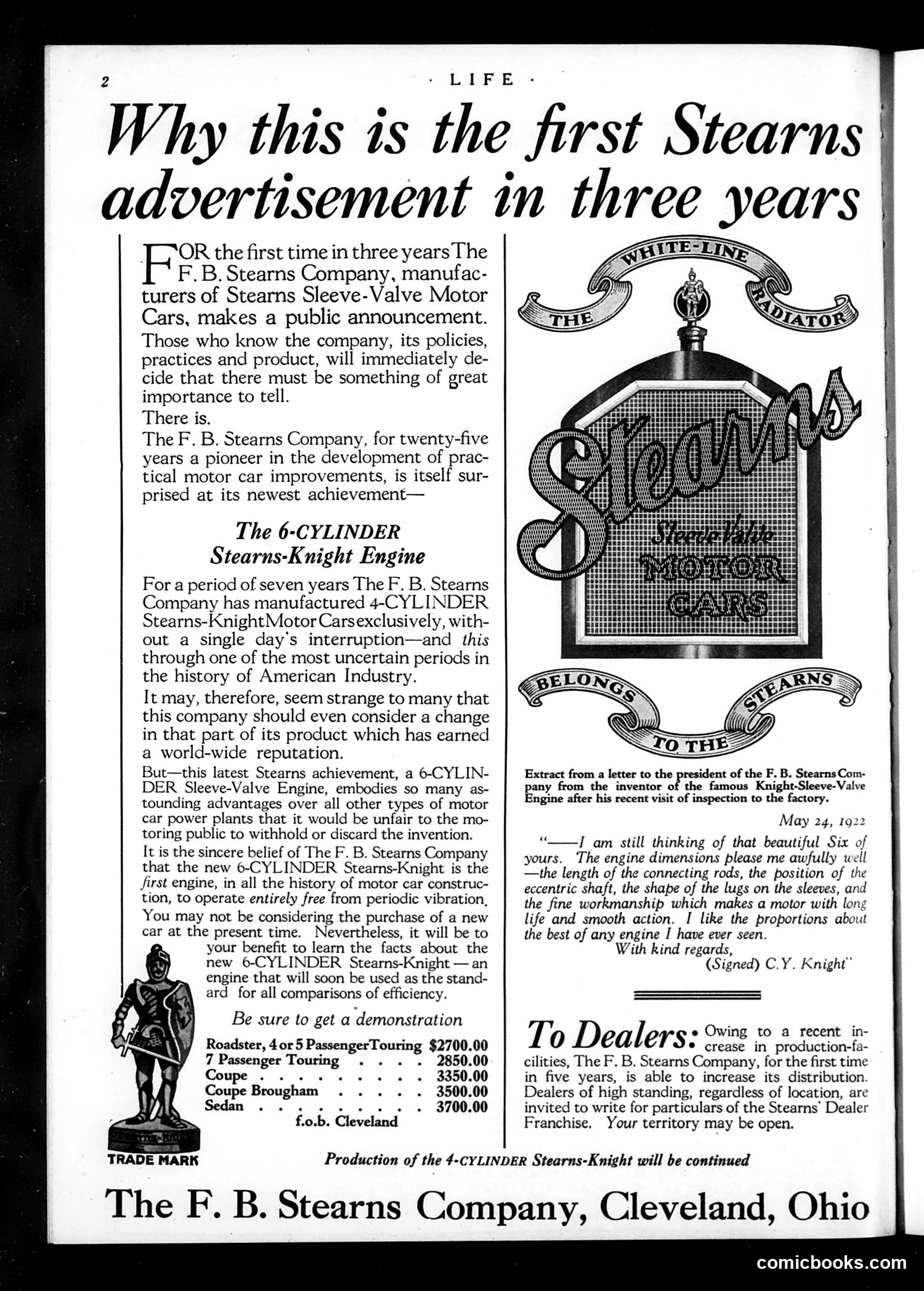
This page is primarily **advertising content**, not satire or editorial cartoon. It's a 1922 advertisement for the F. B. Stearns Company of Cleveland, Ohio, promoting their new 6-cylinder Stearns-Knight automobile engine. The page includes: - A radiator mascot illustration (decorative car ornament) - Pricing for various models ($2,700-$3,850) - A testimonial letter from C. Y. Knight (the engine's inventor) praising the new design - Information for potential dealers The only figurative element is a small knight illustration (the "Stearns-Knight" brand mascot), which appears to be a decorative heraldic knight rather than political satire. This is straightforward product advertisement aimed at both consumers and automobile dealers.
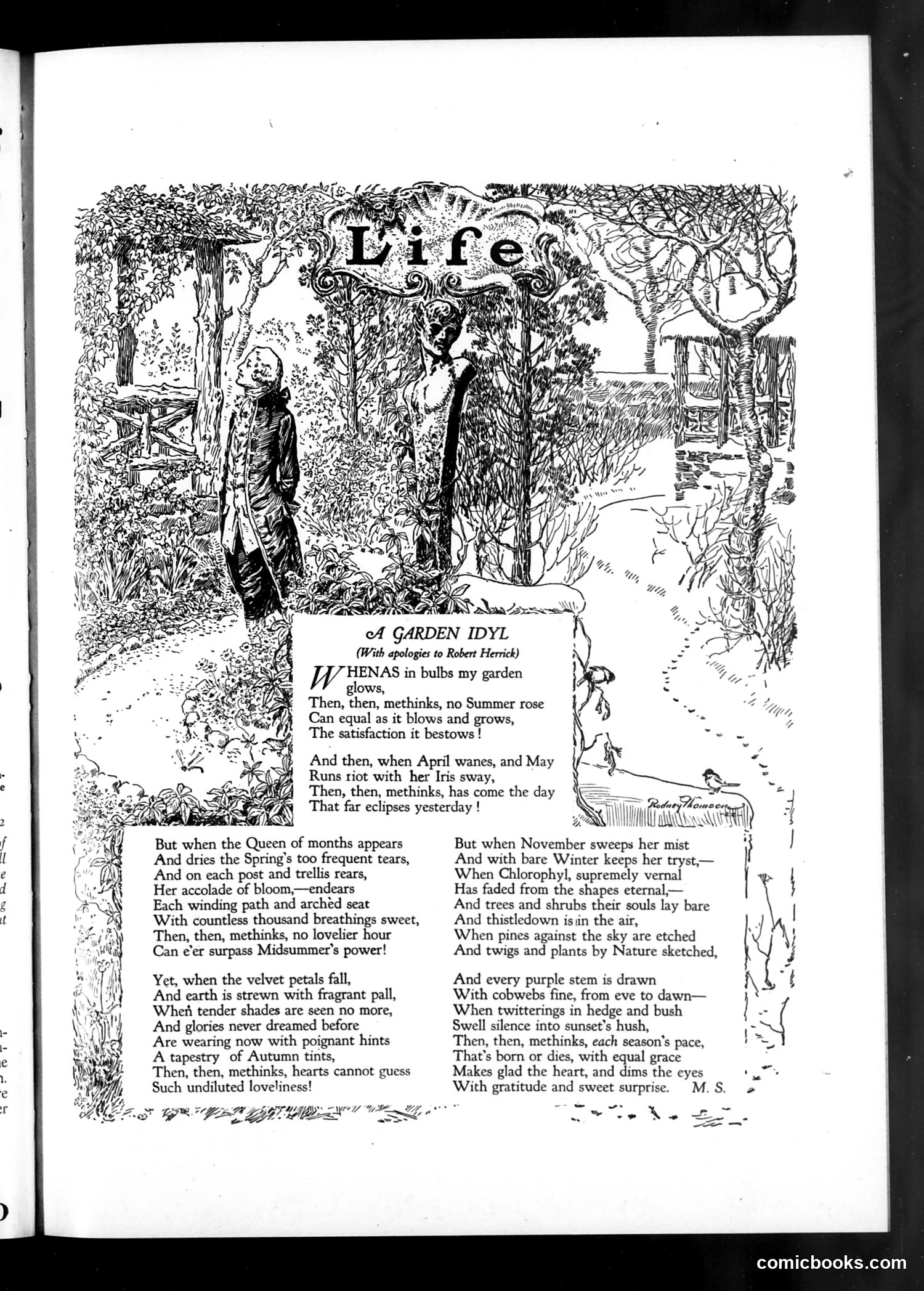
This page features a poem titled "A Garden Idyl" (with an apology to Robert Herrick, the 17th-century poet). It's not political satire but rather a literary parody celebrating seasonal garden changes. The poem contrasts the garden's beauty across seasons—spring bulbs and roses, April's iris, summer's velvet petals—with November's barrenness when "Chlorophyl, supremely vernal / Has faded from the shapes eternal." The accompanying illustration shows figures in a wooded garden setting. The "idyl" humorously suggests that despite nature's cycles of growth and decay, each season's changes bring "equal grace" that "Makes glad the heart, and dims the eyes / With gratitude and sweet surprise." This is nostalgic, nature-focused content rather than social commentary.
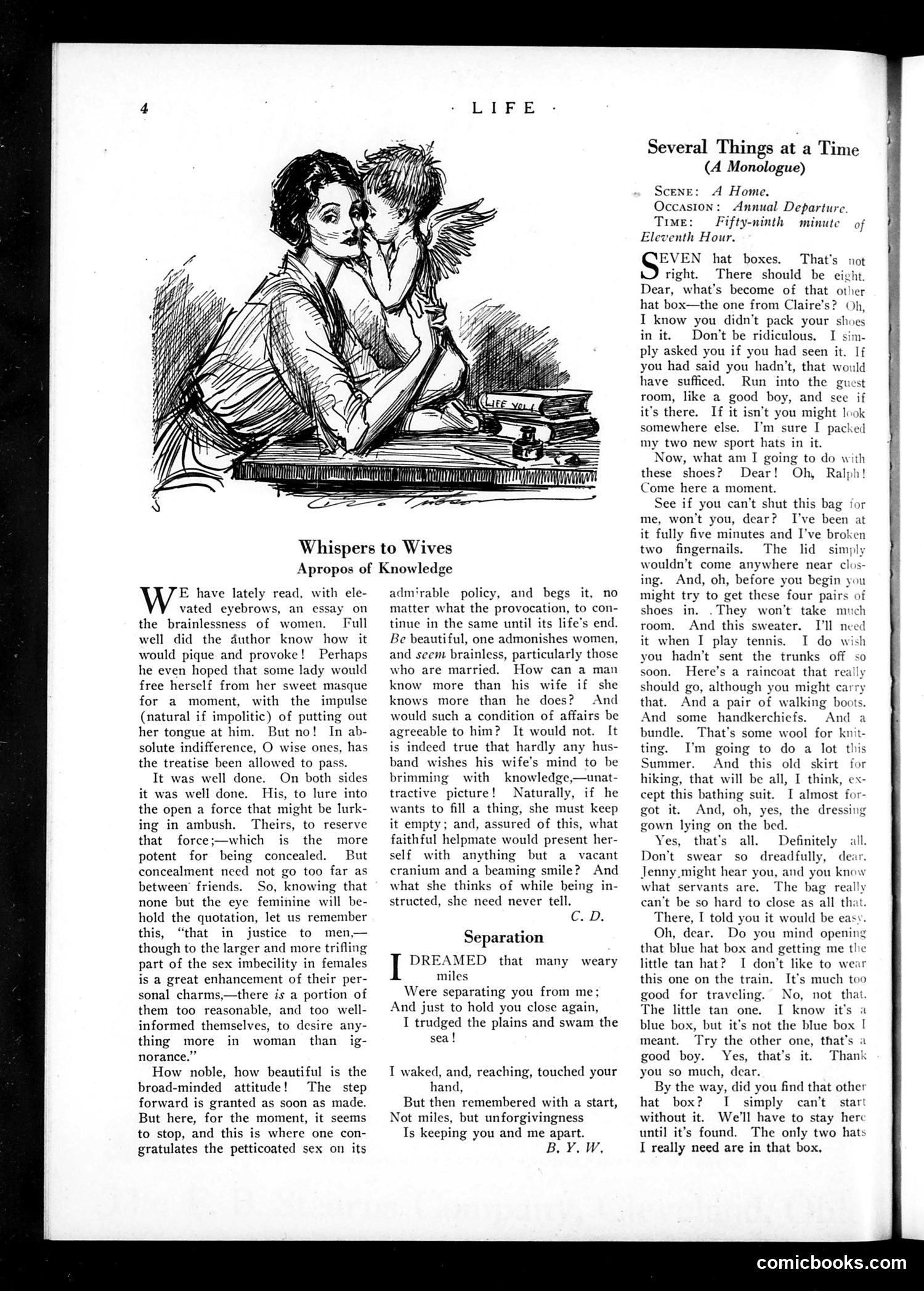
This page contains three distinct literary pieces rather than political cartoons: 1. **"Whispers to Wives: Apropos of Knowledge"** — A satirical essay critiquing men who feel threatened by their wives' intelligence. The author argues that educated women enhance marriages rather than threaten them, mocking the male insecurity that wives might know more than husbands. 2. **"Several Things at a Time (A Monologue)"** — A comedic domestic scene where a woman frantically lists packing problems before an annual departure, portraying the chaos of travel preparation. 3. **"Separation"** — A sentimental poem about lovers parting, with the speaker consoling themselves that separation will be temporary. The illustration shows an intimate couple, likely accompanying the romantic content. These pieces represent Life's satirical commentary on domestic relationships and gender dynamics of the era.
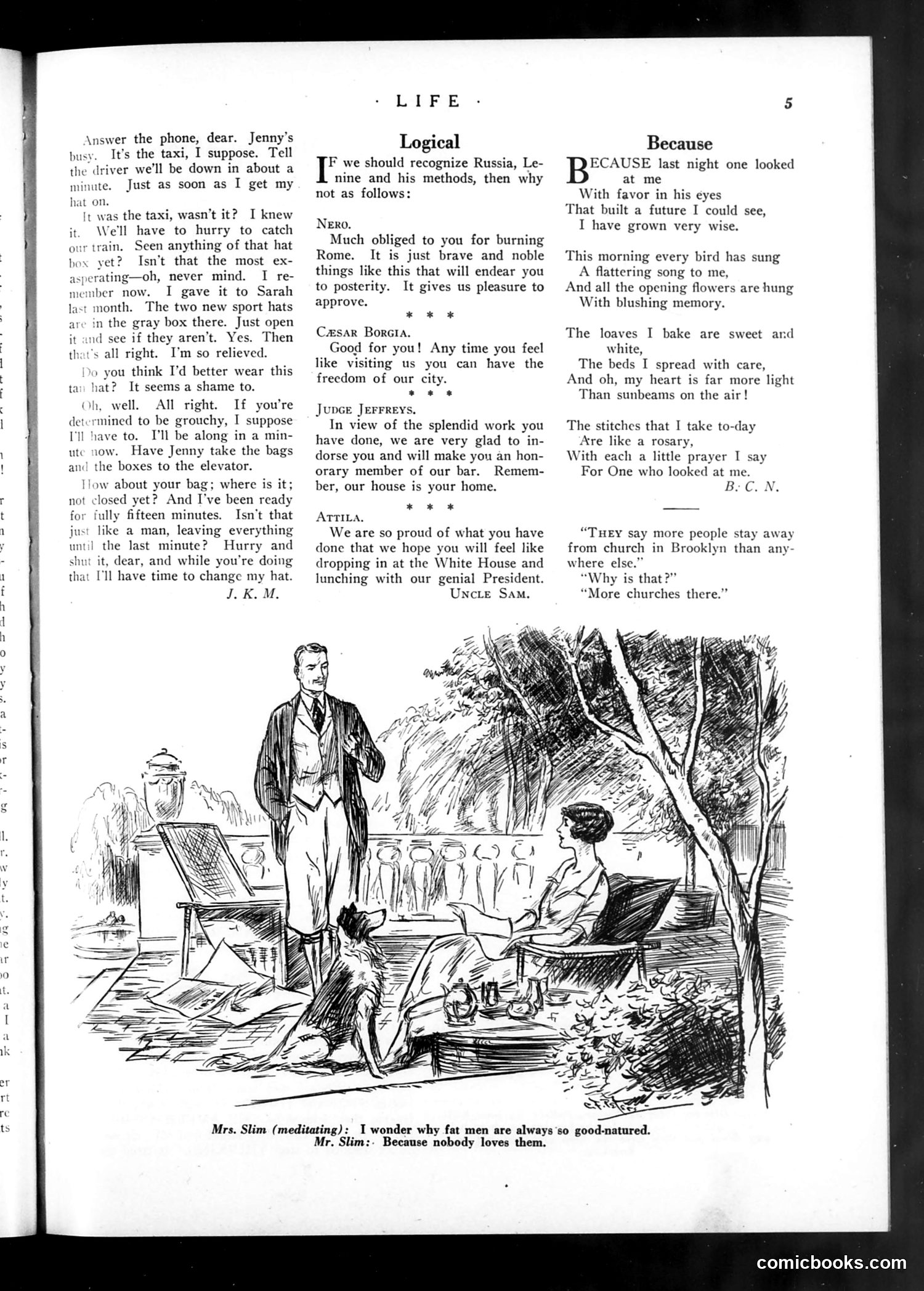
This page contains several satirical pieces mocking social conventions and politics of the era. The main cartoon depicts a picnic scene where **Mrs. Slim addresses her husband Mr. Slim**. She comments that "fat men are always so good-natured," to which he replies, "Because nobody loves them." This is straightforward social satire about appearance and kindness—suggesting overweight people compensate for being unloved with cheerfulness. The text sections above ("Logical," "Because") appear to be humorous commentary on contemporary political figures, including references to **Russia, Lenin, Caesar Borgia, and various judges and uncles**. However, without clearer context or dates, the specific political targets remain unclear. The tone is generally mocking of pretension and hypocrisy. The overall page represents *Life*'s characteristic blend of social observation and political commentary through humor.
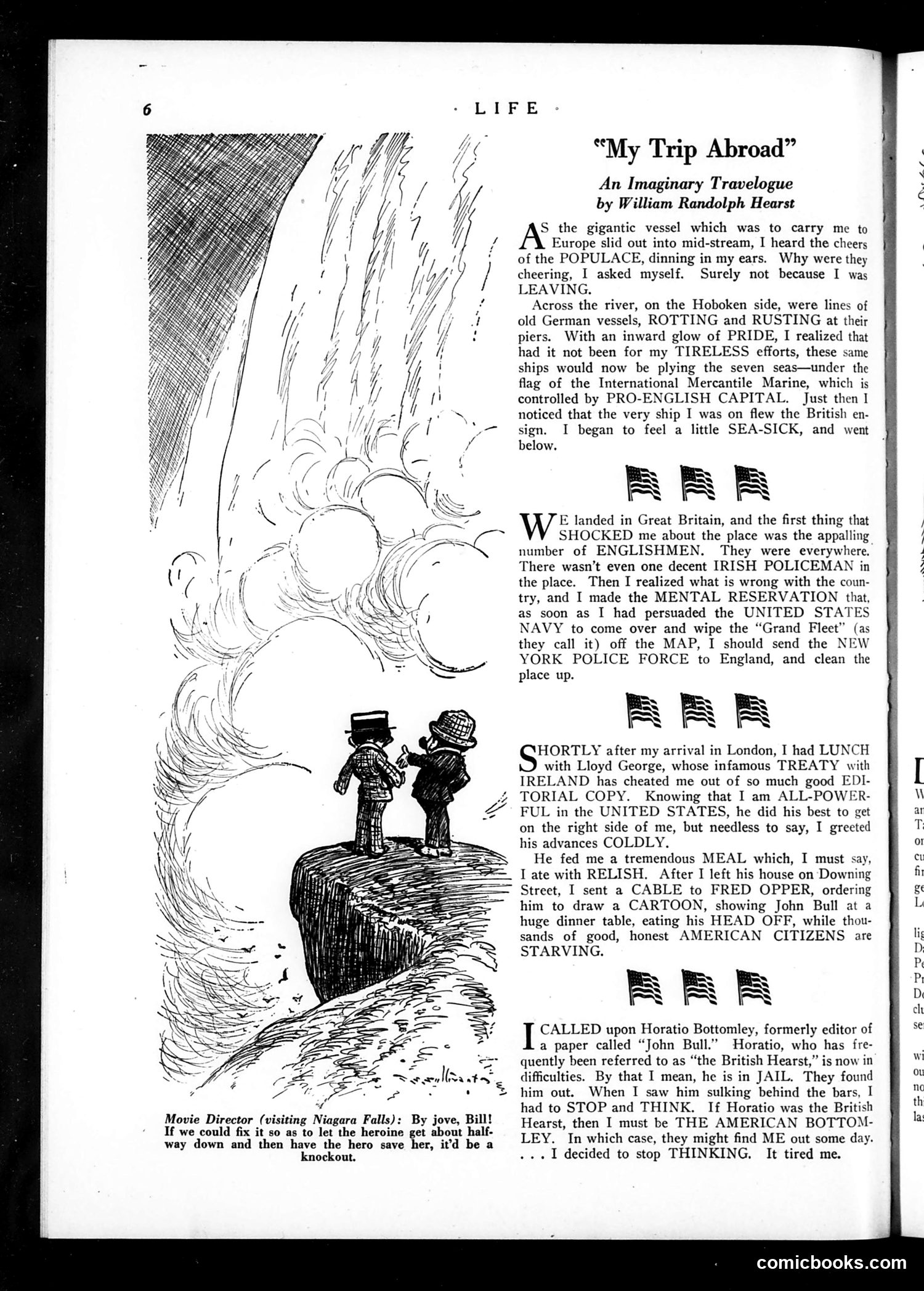
This is Hearst's satirical "Imaginary Travelogue" mocking British politics and American-British relations. The main cartoon shows two figures (appearing to be British political figures) standing on a cliff as a massive wave threatens them—likely representing political upheaval or crisis. The text references Lloyd George's "infamous TREATY with IRELAND" and mentions sending the "GRAND FLEET" to clean up England. Hearst criticizes British governance, specifically mocking the shortage of Irish policemen and threatening to deploy American naval power to restore order. The piece satirizes British political incompetence while boasting American superiority. References to "John Bull" (Britain personified) eating his "HEAD OFF" suggest Hearst viewed Britain as glutinous and wasteful during a period of social hardship.
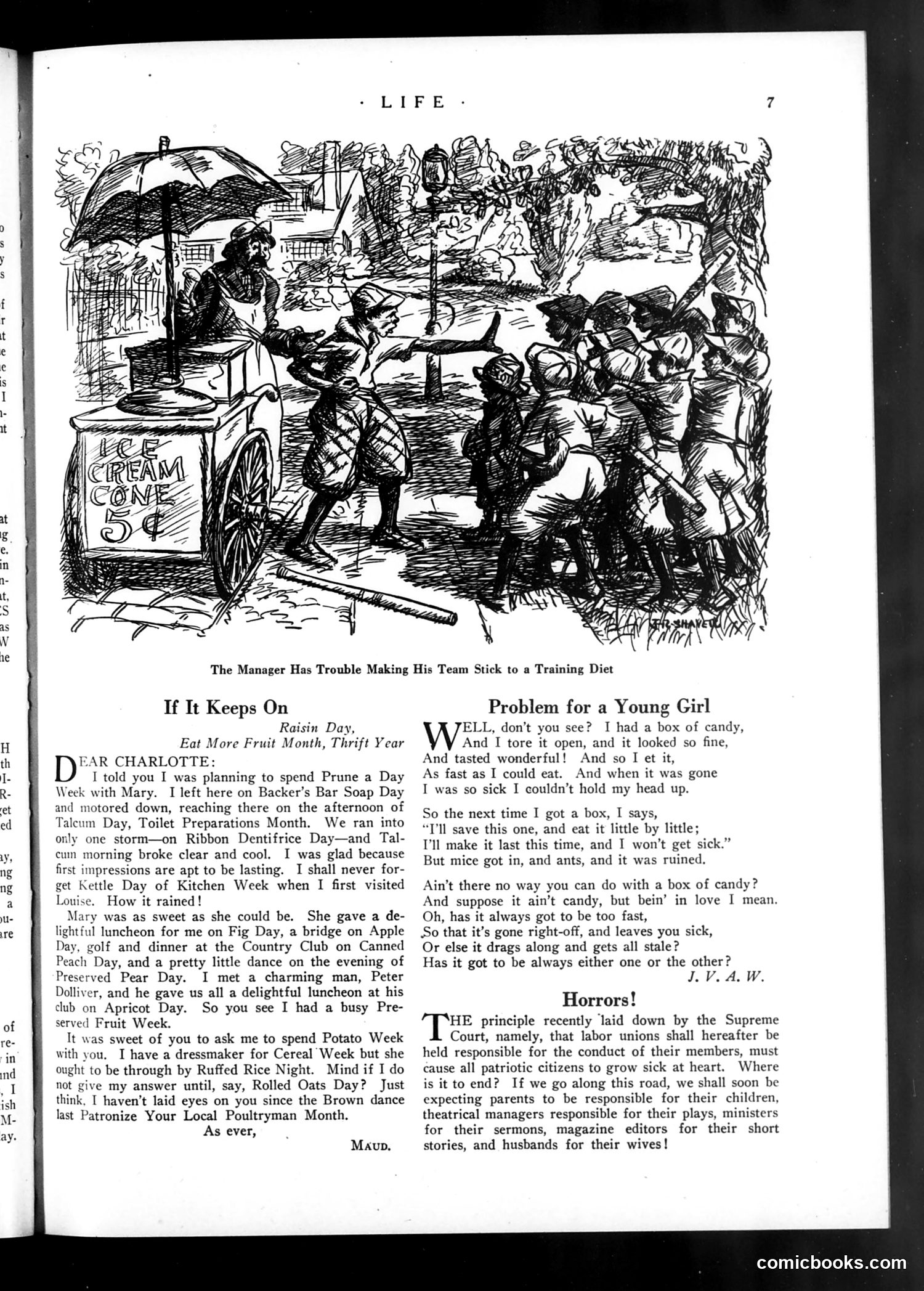
**The Cartoon:** The illustration depicts an ice cream vendor with an umbrella and cart labeled "ICE CREAM CONE 5¢" surrounded by children. The caption reads "The Manager Has Trouble Making His Team Stick to a Training Diet." **The Satire:** This is a straightforward visual joke about discipline. A baseball team manager (likely) has established a strict training diet for his players, but children gathered around an ice cream vendor represent the temptation undermining his efforts. The humor lies in the absurd comparison: managing professional athletes' dietary restrictions is as difficult as keeping children away from cheap ice cream treats. **Context:** The 5¢ price point reflects early 20th-century economics. The joke assumes readers understand that athletes require dietary control for peak performance, while ice cream represents irresistible indulgence.
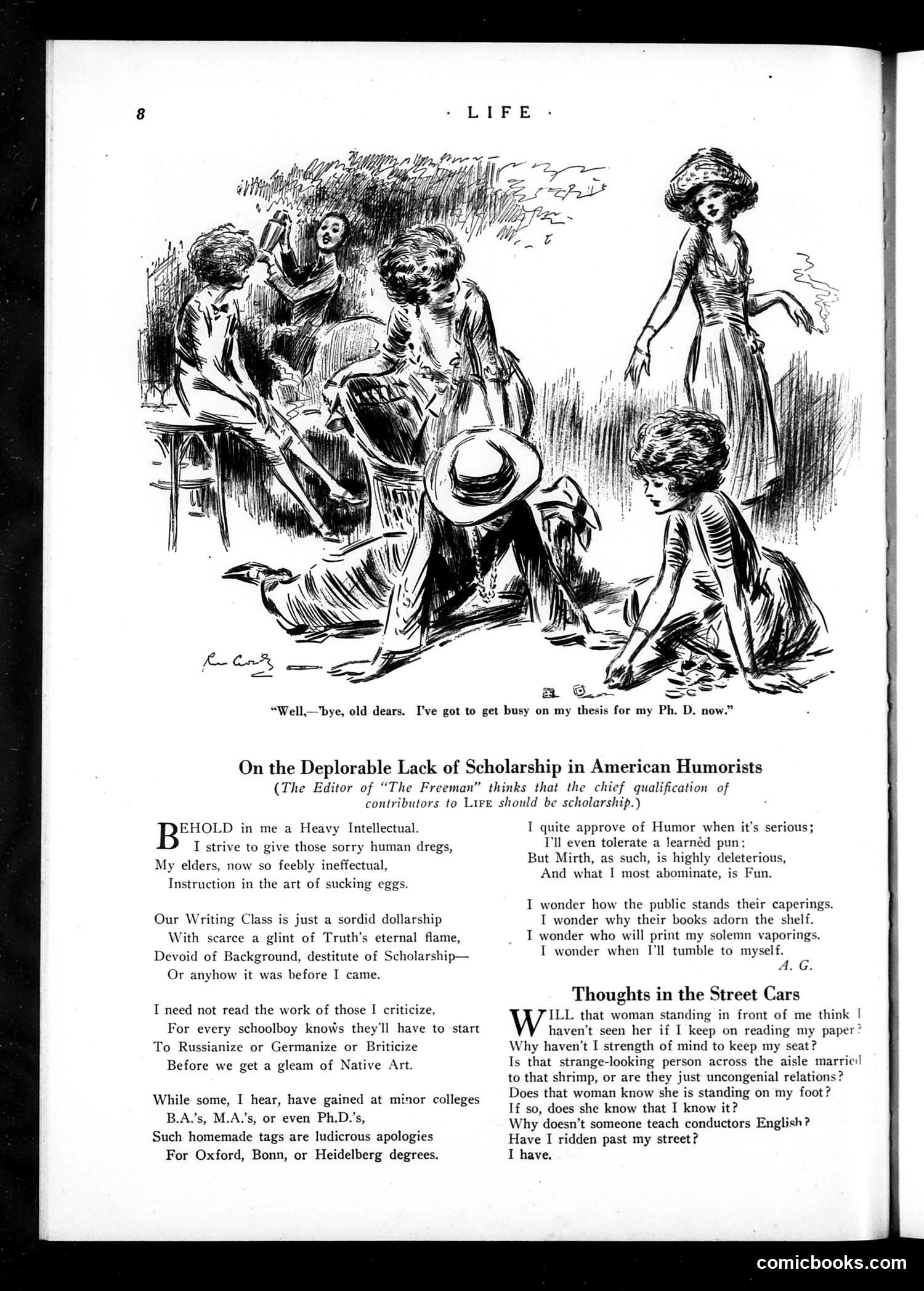
**The Cartoon:** The illustration depicts a woman in a large hat telling a group of seated women she must leave to work on her Ph.D. thesis. The satire mocks educated women attempting serious academic work while maintaining social obligations—a tension of early 20th-century feminism. **The Articles:** "On the Deplorable Lack of Scholarship in American Humorists" criticizes humor writers for lacking intellectual depth and formal education. The author complains that contemporary humorists rely on entertainment ("Fun") rather than learning from classical sources or academic traditions like Oxford or Heidelberg degrees. "Thoughts in the Street Cars" presents mundane observations from urban transit—an absurdist commentary on modern life's trivialities and social anxieties. Both pieces satirize contemporary American culture's anti-intellectual tendencies.
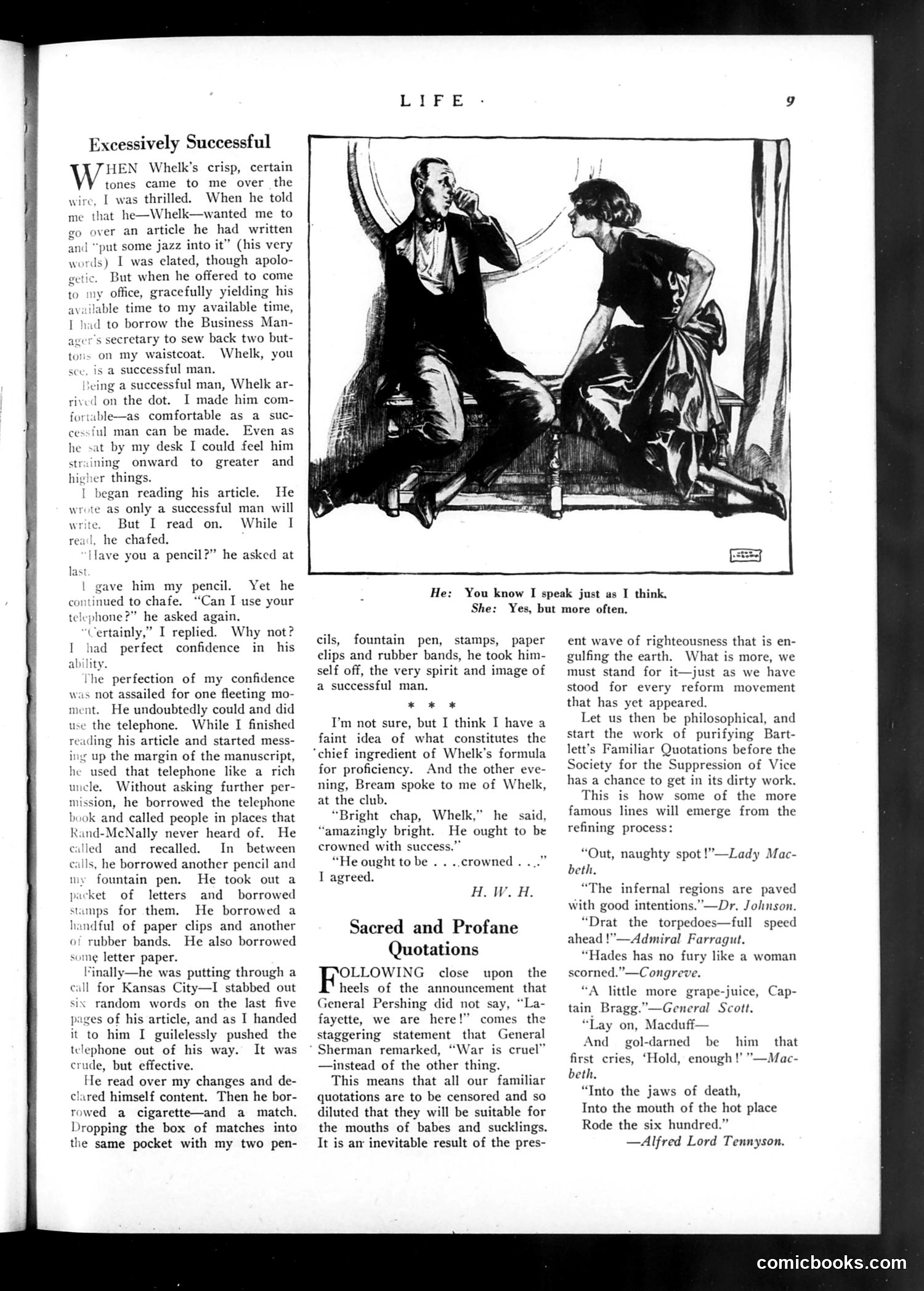
This satirical piece mocks a successful businessman named Whelk who visits the author's office. The cartoon depicts two men in conversation, with the caption showing Whelk saying "You know I speak just as I think" and the author replying "Yes, but more often." The joke satirizes Whelk's supposed success: despite his obvious lack of refinement (he can't write properly, chafes at using borrowed writing instruments), he's achieved business success. The author humorously demonstrates this by describing how confidently Whelk borrowed office supplies and used the telephone—acting entirely comfortable despite being incompetent. The satire critiques how financial success doesn't correlate with intelligence, manners, or genuine ability—a commentary on Gilded Age social climbing and the disconnect between wealth and merit.
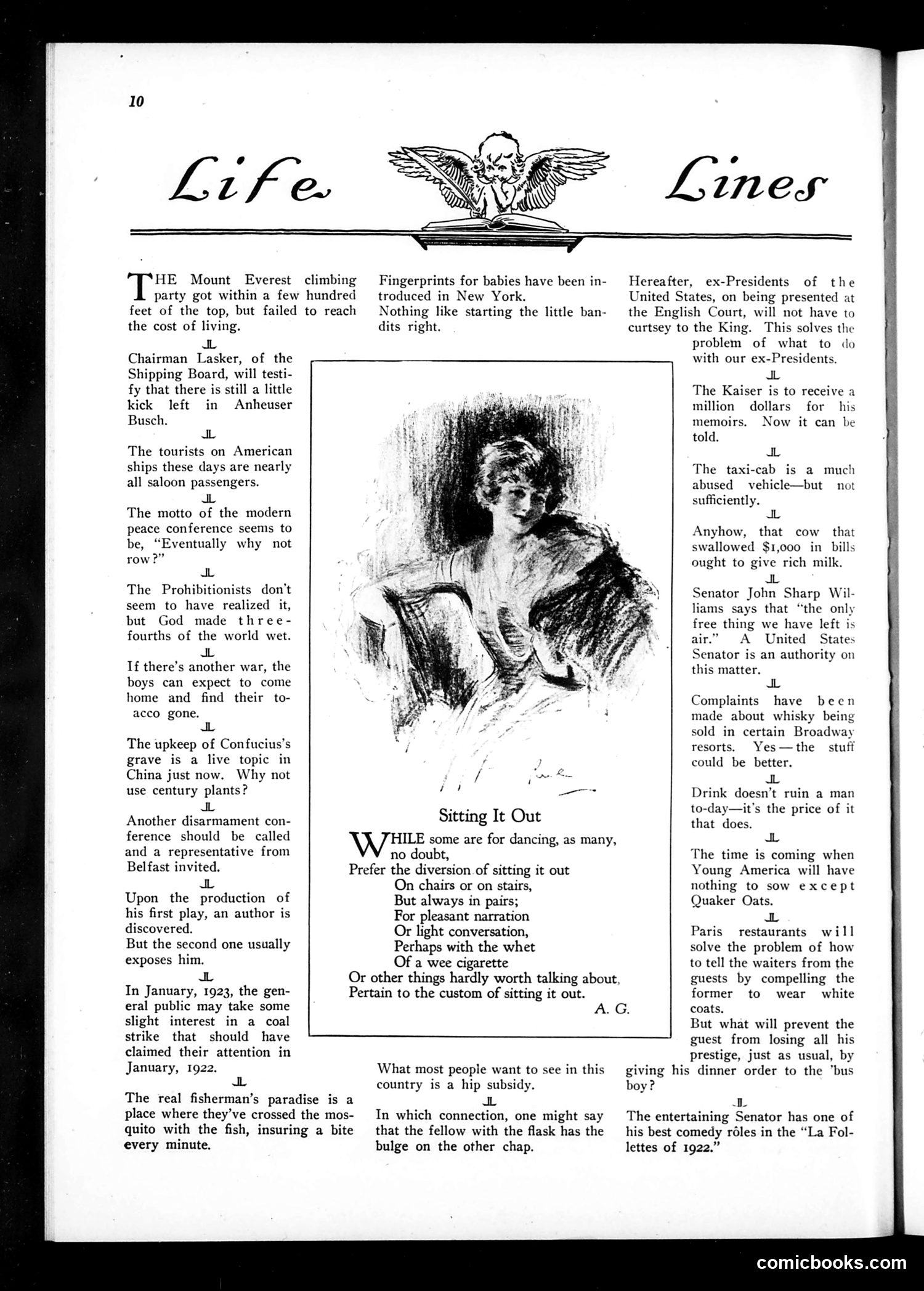
This is a humor/satire page from *Life* magazine featuring brief social commentary and a sketch titled "Sitting It Out" by A.G. The main cartoon depicts a young woman in 1920s style, shown in profile. The accompanying poem humorously contrasts preferences: some enjoy dancing, but others prefer "sitting it out" on chairs or stairs—"always in pairs"—engaging in conversation, cigarette smoking, and flirtation instead. The surrounding "Life Lines" consist of brief satirical jabs at contemporary issues: Prohibition enforcement, peace conferences, taxi regulations, whisky quality on Broadway, and Senator John Sharp Williams's claims about American freedom. The humor targets 1920s social concerns—drinking laws, diplomacy, and public complaints about urban services and product quality. The overall tone is witty, dismissive commentary on current events and social foibles.
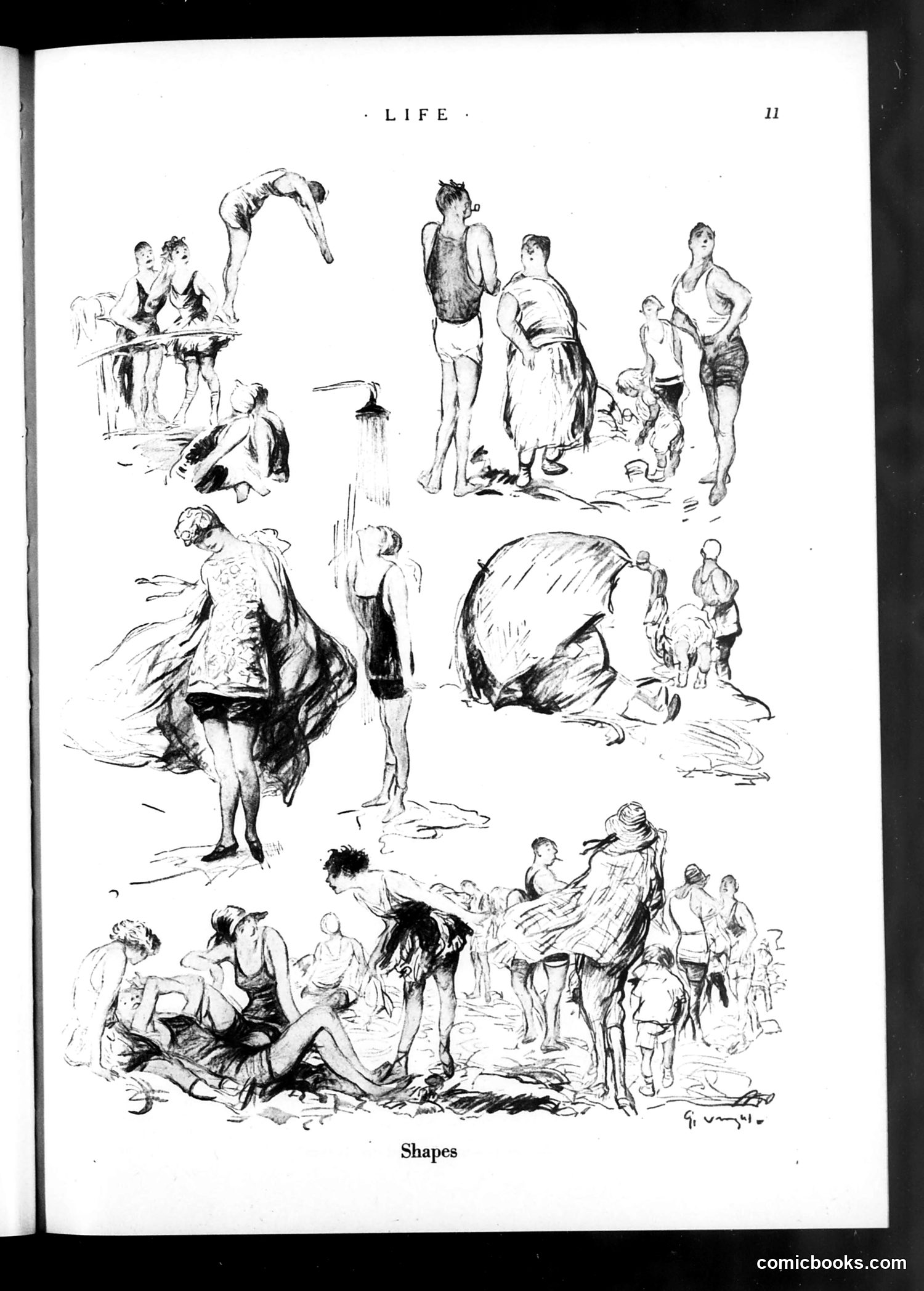
This page from *Life* magazine presents sketches titled "Shapes," depicting beachgoers in various poses and states of undress at what appears to be an early-to-mid 20th century beach setting. The satire likely mocks the diversity of body types visible at public beaches—contrasting athletic swimmers with heavier-set vacationers, dignified poses with awkward ones. The sketches emphasize unflattering physical forms: sagging bodies, unusual postures, and ungainly movements. This reflects *Life's* tradition of gentle social satire targeting middle-class leisure activities. The humor derives from observing ordinary people's unglamorous reality versus idealized notions of beach recreation and physical beauty. The artist captures candid, undignified moments to amuse readers at their contemporaries' expense.
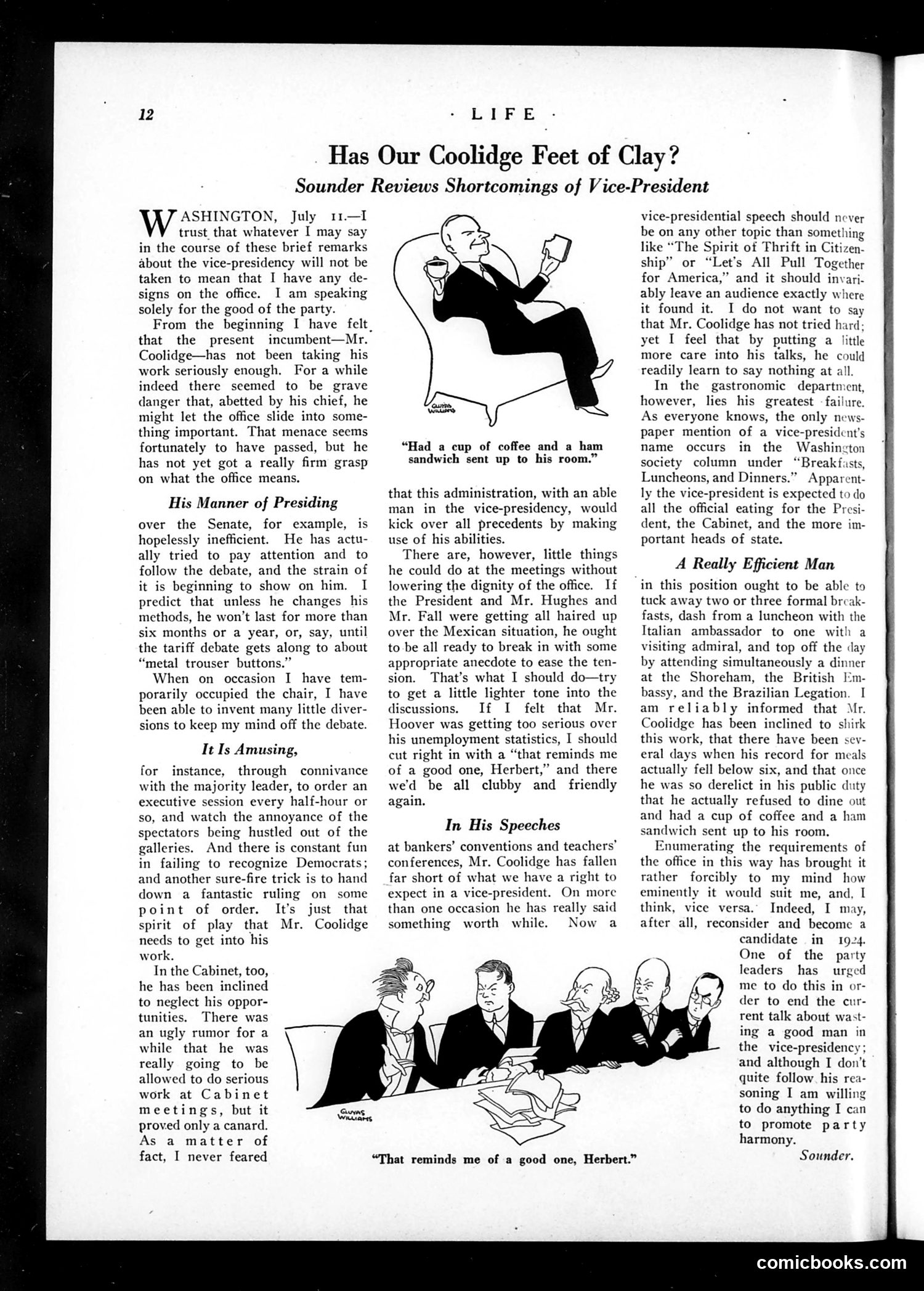
This 1924 Life article critiques Vice President Calvin Coolidge's ineffectiveness in office. The author (signed "Sounder") argues Coolidge is lazy and uninspired, offering only bland platitudes in speeches rather than substantive contributions. The first cartoon shows Coolidge relaxing with coffee and a ham sandwich—visual shorthand for his laziness and disengagement. The second cartoon depicts Cabinet members at a meeting, with one saying "That reminds me of a good one, Herbert," suggesting Coolidge provides so little leadership that officials resort to swapping anecdotes rather than conducting serious business. The satire's point: a vice president should actively contribute to governance and policy discussions, not merely coast through the position. The article mocks Coolidge's apparent indifference to his duties.
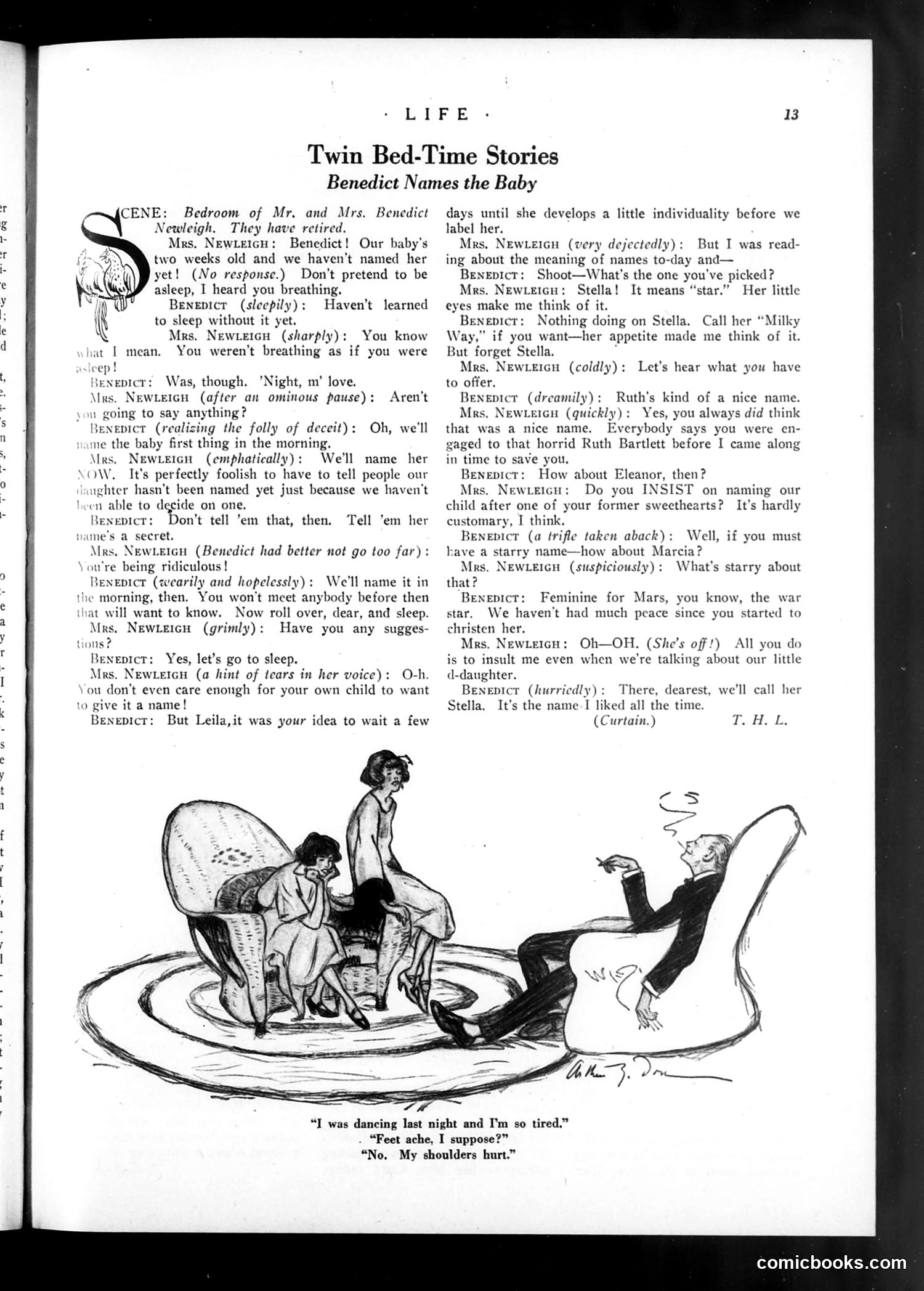
This is a domestic comedy sketch about a married couple, Mr. and Mrs. Benedict Newleigh, debating what to name their two-week-old daughter. Mrs. Newleigh proposes various names—Stella, Ruth, Eleanor, Marcia—each triggering her husband's objections or associations. When she suggests "Marcia" (feminine for Mars, the war god), he objects that they haven't had peace since she "started to christen her." The humor relies on gentle marital dynamics: the husband's exasperation with his wife's decision-making, and the running joke that naming the baby is impossibly difficult. The accompanying illustration shows a man in bed appearing exhausted while others celebrate around him—humorously suggesting the naming debate has worn him out. This reflects early 20th-century domestic satire conventions.
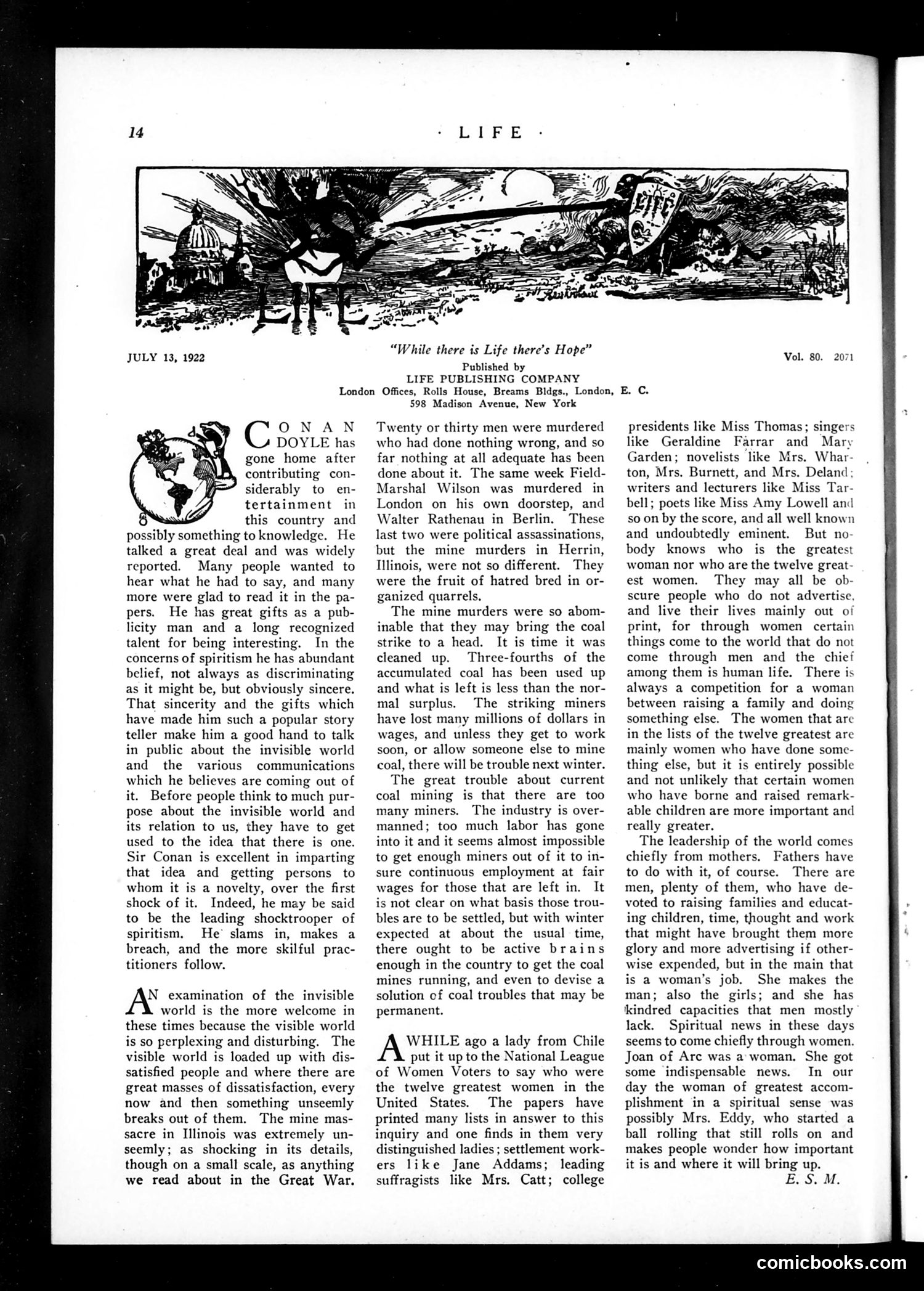
The masthead illustration depicts a apocalyptic landscape with explosions, a domed building (possibly a capitol), and figures amid destruction—visualizing societal chaos. The main article, titled "While there is Life there's Hope," is by Conan Doyle and discusses the invisible world's relevance to contemporary crises. Doyle references recent political assassinations (Field-Marshal Wilson in London, Rathenau in Berlin) and labor unrest, particularly the coal miners' strike in Illinois. He argues that spiritual awareness and belief in an afterlife might reduce social violence and discord. The article's subheading about "the twelve greatest women" suggests a sidebar on female leadership in voting and social reform. The cartoon and text together suggest Doyle was using supernatural/spiritual themes to address 1920s post-war instability, labor conflict, and political violence.
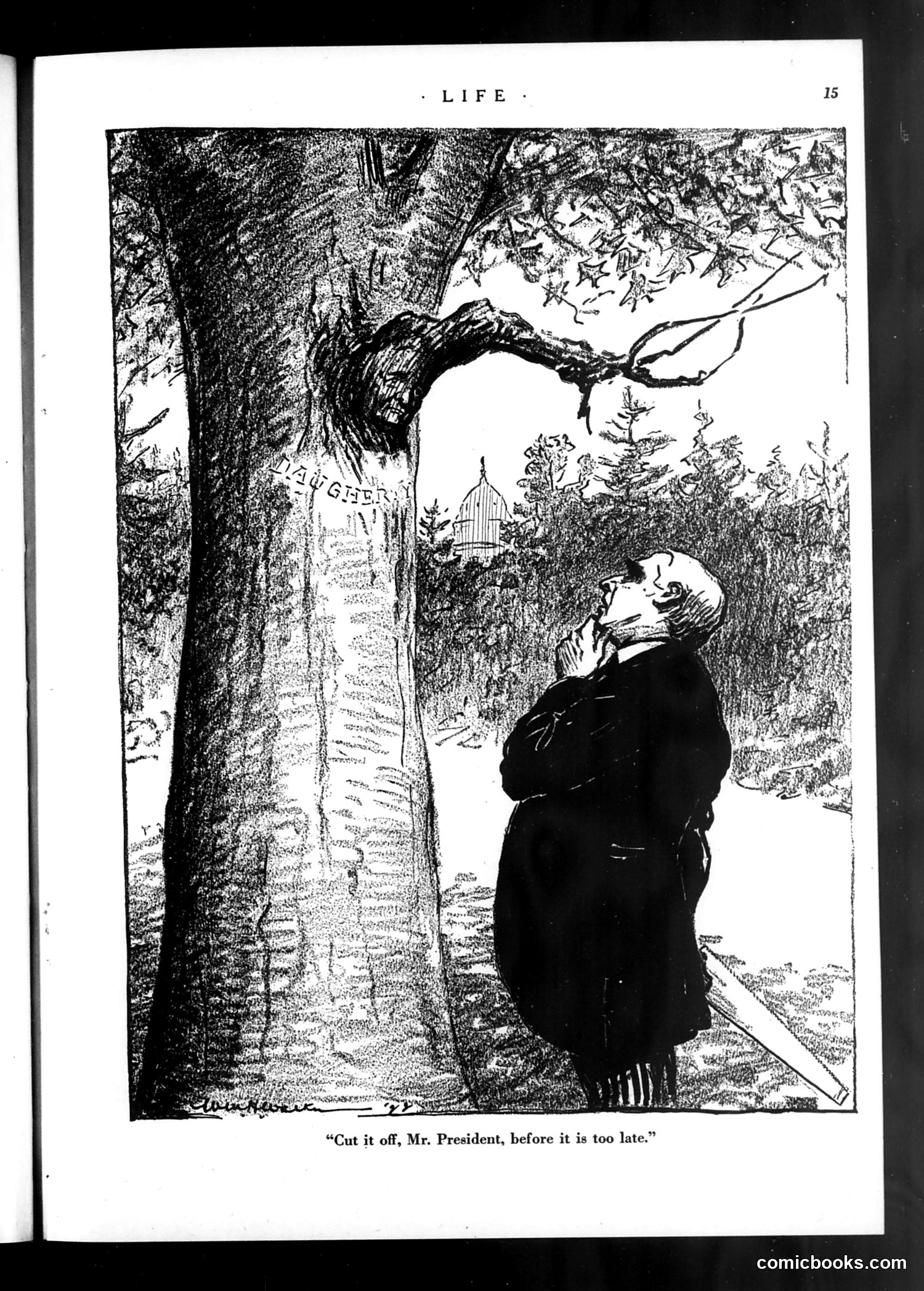
This political cartoon depicts a figure labeled "Mr. President" looking upward at a large tree branch. The caption warns him to "Cut it off, Mr. President, before it is too late." The cartoon appears to be cautionary allegory: the tree branch likely represents a growing problem or threat that requires immediate presidential action. The birdcage visible in the background suggests the domestic sphere. Without knowing the specific date or issue of *Life*, the exact referent remains unclear—it could concern environmental destruction, monopolistic business practices, or another policy concern of the era. The message is clear: delay risks catastrophic consequences. The visual metaphor of a severed branch emphasizes urgency and irreversibility if action isn't taken promptly.
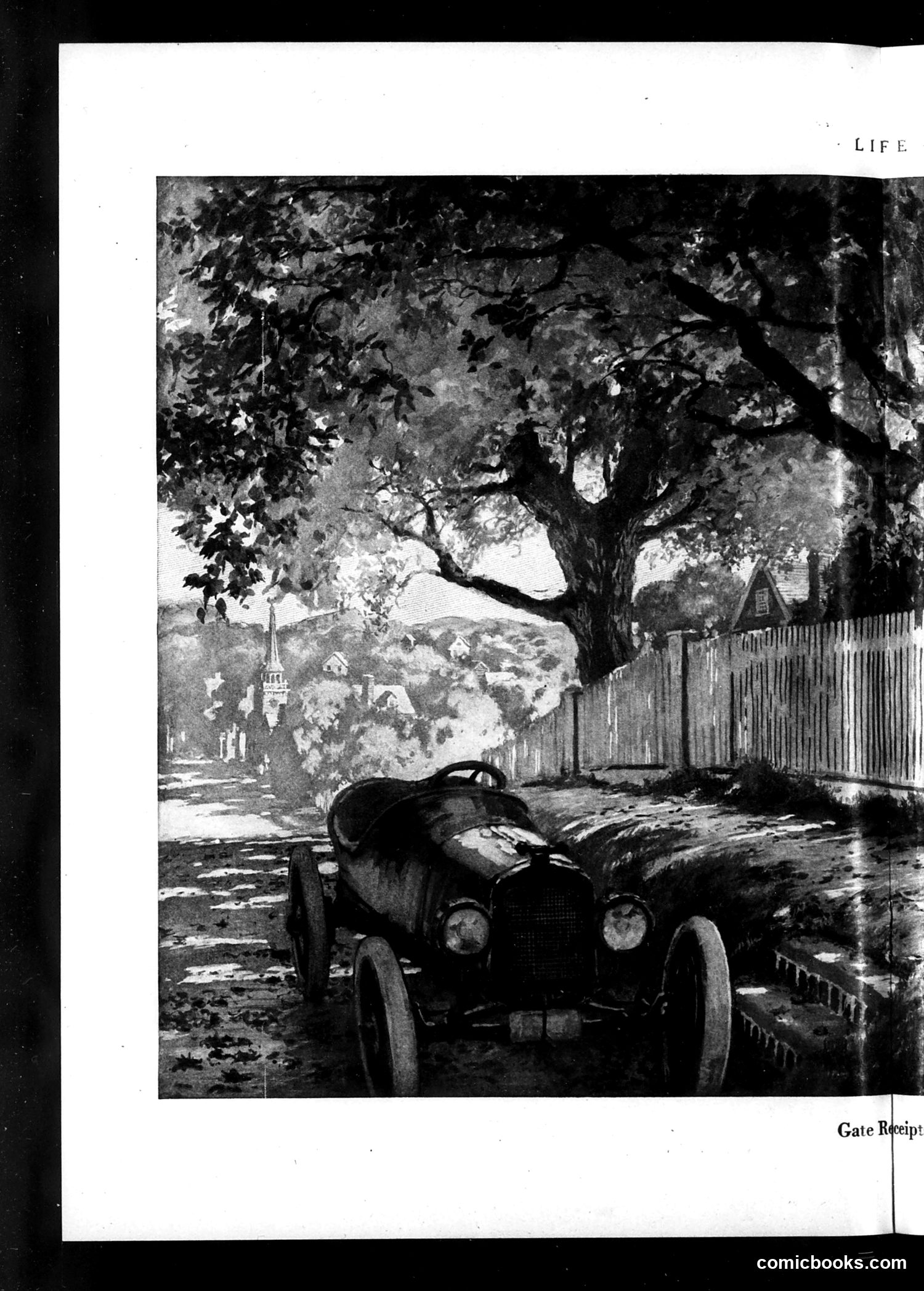
This appears to be a photograph or illustration rather than a political cartoon. It depicts an vintage racing automobile parked beneath a large tree near a white picket fence, with a small village and church visible in the misty background. The image is titled "Gate Receipt," though the connection between this title and the scene is unclear—it may be a caption or ironic commentary on the photograph itself. Without additional context from the magazine issue, the specific satirical point remains unclear. It could reference early automotive culture, leisure activities, or wealth during the era when *Life* magazine was published, but I cannot definitively identify what social or political satire this represents.
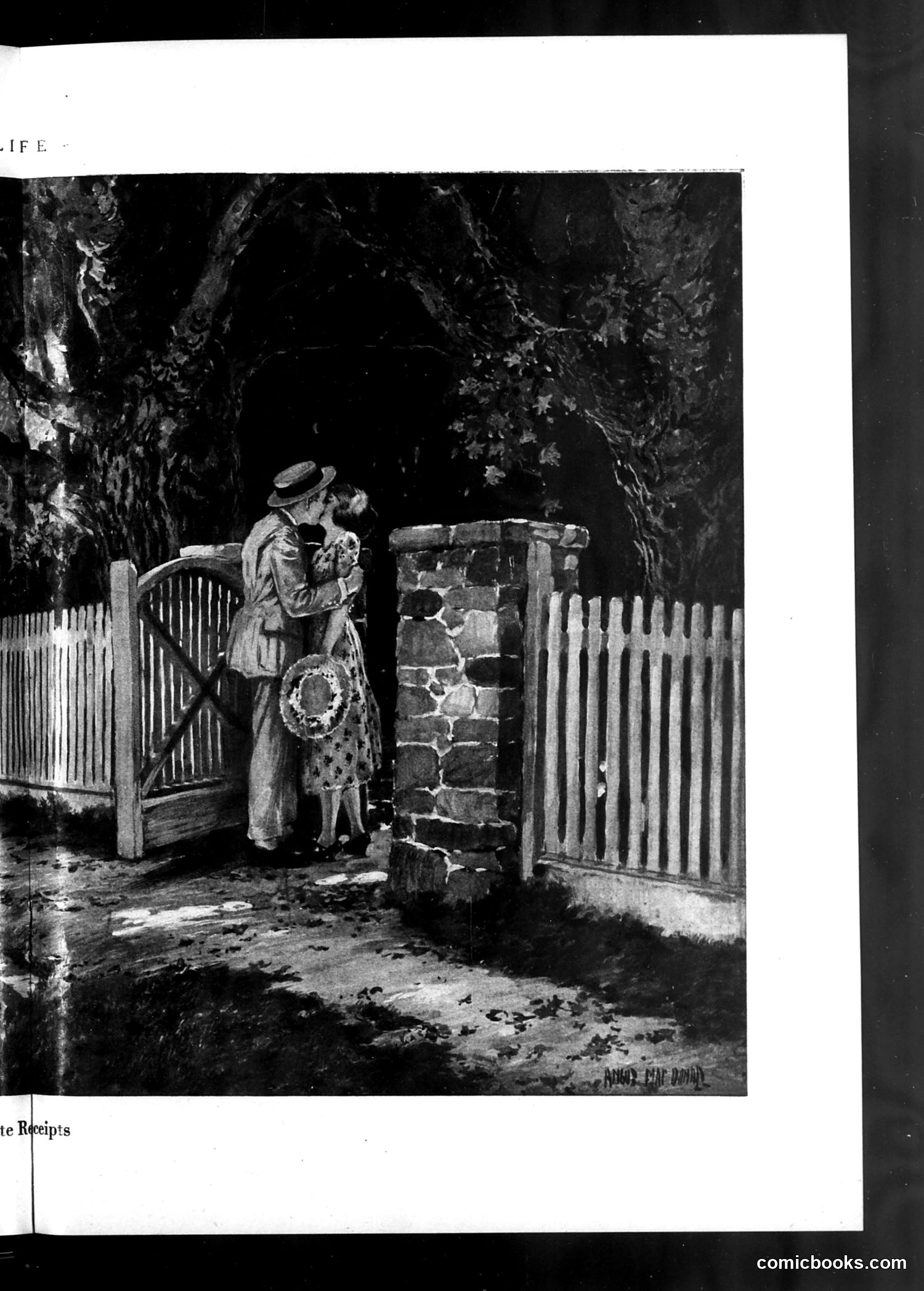
This black and white photograph appears to be a scene from an early film or theatrical production rather than a political cartoon. It depicts two figures in period costume standing at a gate beneath an archway of gnarled trees. The figure on the left wears a hat and patterned clothing, while the smaller figure beside them wears light-colored dress. White picket fencing frames both sides of the composition. Without clearer context from surrounding text or captions on this page, I cannot definitively identify the specific figures, story, or satirical point being illustrated. The dramatic lighting and gothic atmosphere suggest this may reference a literary adaptation or melodramatic scenario, but the exact meaning and historical reference remain unclear from the visible information.
This is a theatre review column from Life magazine's Paris correspondent, dated June 26th (year unclear from image). The page contains no political cartoons—it's straightforward cultural criticism. The writer humorously comments on Parisian theatre, praising French playwrights' sophistication in handling risqué material. He references productions like "La Demi-Vierge" and "Mille. Lulu Bett," noting French audiences accept adultery plots as charming rather than scandalous. The satire targets American prudishness: the writer suggests Americans couldn't handle such material with the "naive" elegance of Frenchmen. A secondary anecdote about American tourist Thomas W. McMerkle getting ill before the Louvre appears to mock American tourists. The ornamental "Drama" header and theatrical masks are decorative period elements, not satirical content. This page demonstrates how Life mixed sophisticated cultural commentary with gentle mockery of American attitudes toward European sophistication.
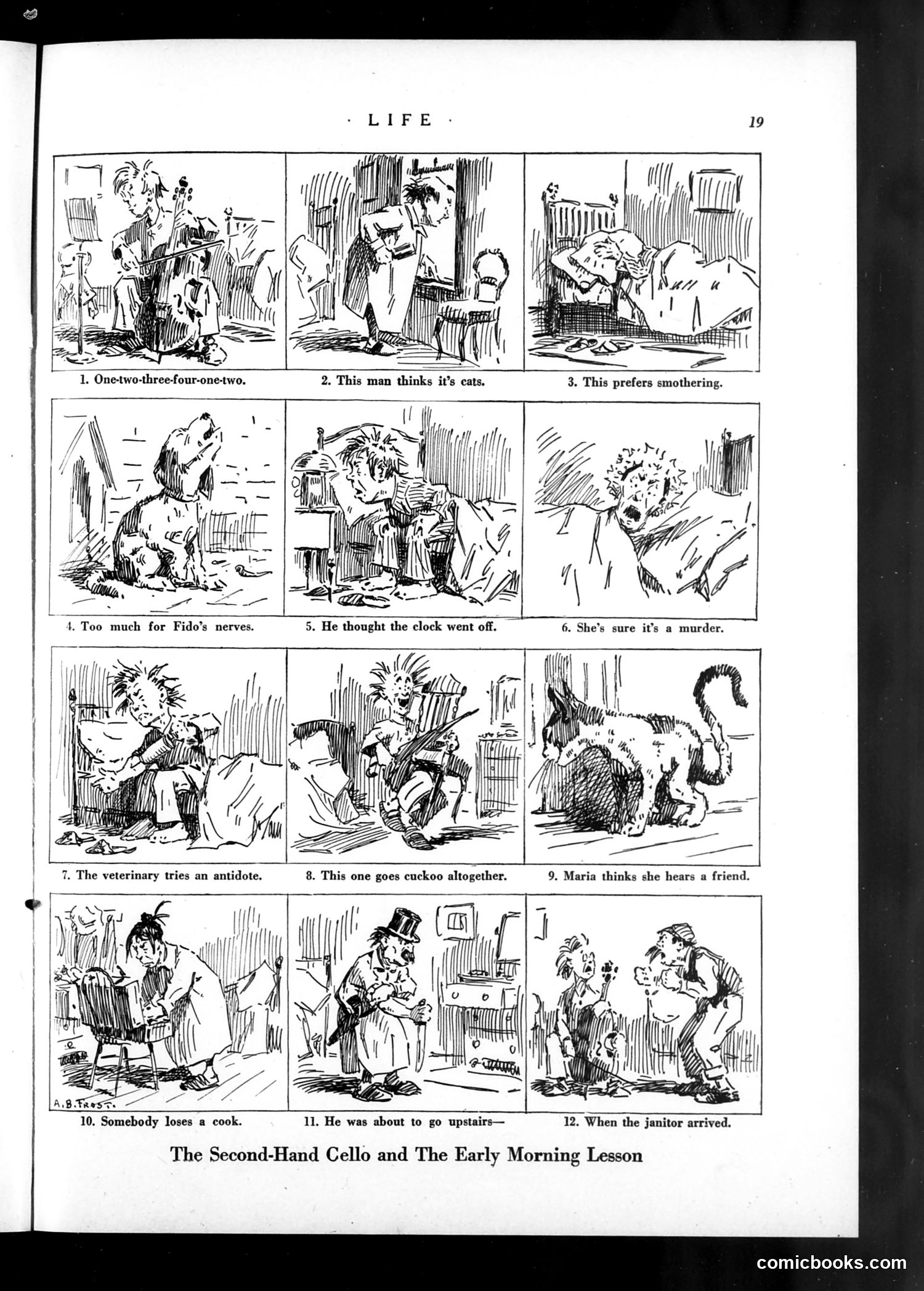
This is a humorous comic strip depicting domestic chaos involving a musical instrument—specifically a second-hand cello and an early morning music lesson. The twelve panels show escalating comedic mishaps: a man counting frantically, suspecting cats are involved, someone preferring suffocation, a dog overwhelmed, a clock malfunction, a suspected "murder," a veterinary antidote attempt, the dog going "cuckoo," a woman hearing a "friend," a cook being lost, interrupted stairs-climbing, and a janitor's arrival. The satire targets the disruptions caused by amateur musicianship in household life—the cello lesson creates chaos affecting pets, servants, and family members. The humor relies on physical comedy and the assumption that early morning cello practice would naturally drive household members to distraction.
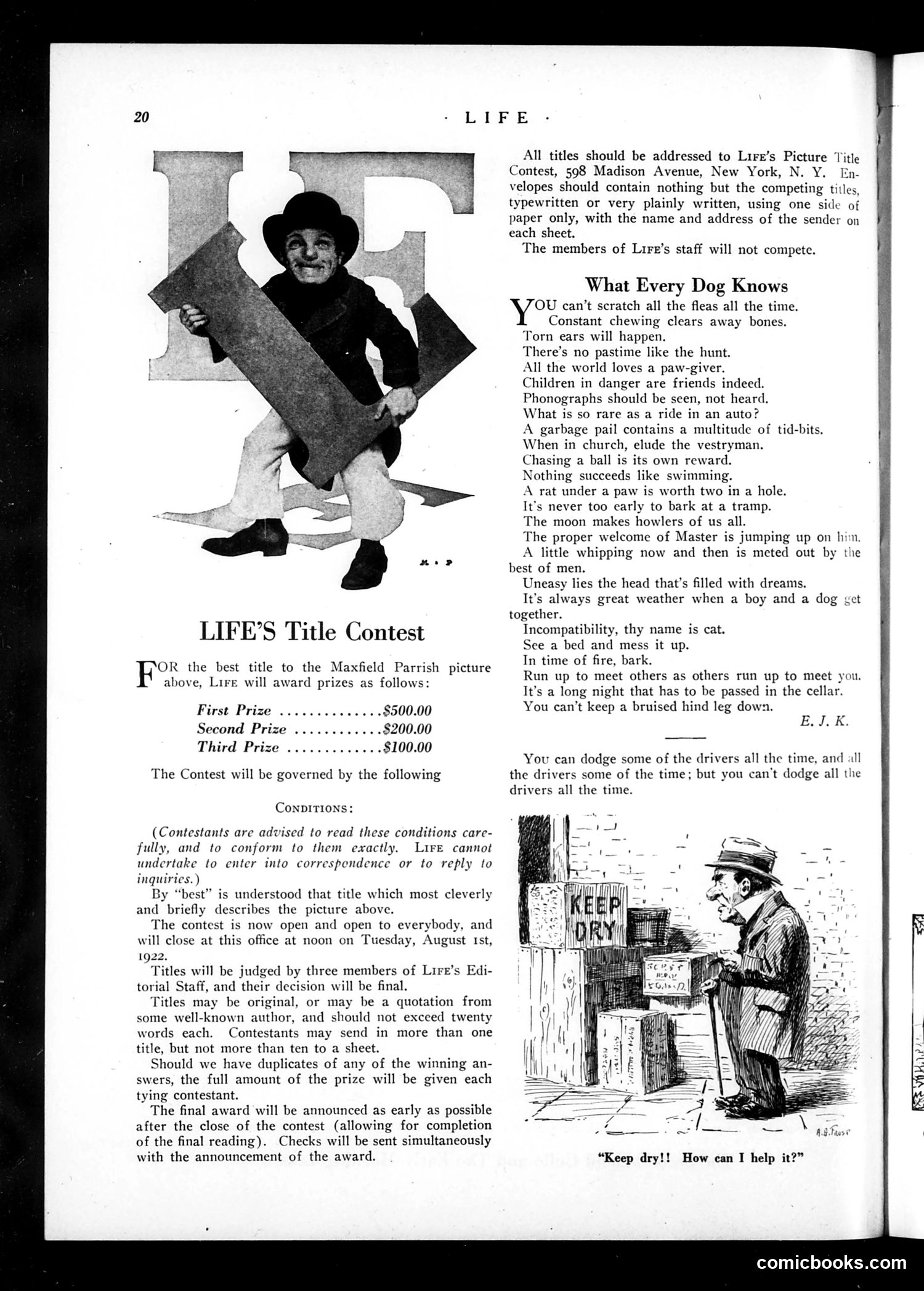
This page contains **Life's Title Contest** for a Maxfield Parrish painting (not visible in this excerpt). Readers submit titles competing for prizes up to $500, judged by Life's editorial staff by August 1st, 1922. The main satirical content is **"What Every Dog Knows,"** a humorous list mimicking philosophical aphorisms—likely parodying earnest self-help or wisdom literature popular in the era. Lines like "You can't scratch all the fleas all the time" and "Incompatibility, thy name is cat" are mock-serious observations about dog behavior, with the final entry joking about dodging traffic ("you can't dodge all the drivers all the time"). The **cartoon below** shows a man at a doorway marked "KEEP DRY" during apparent rain, asking "How can I help it?"—a visual punchline about the impossibility of staying dry in a downpour, echoing the dog list's theme of unavoidable predicaments. Both elements reflect Life's satirical style: gentle mockery of human pretension through animal perspective and everyday absurdities.
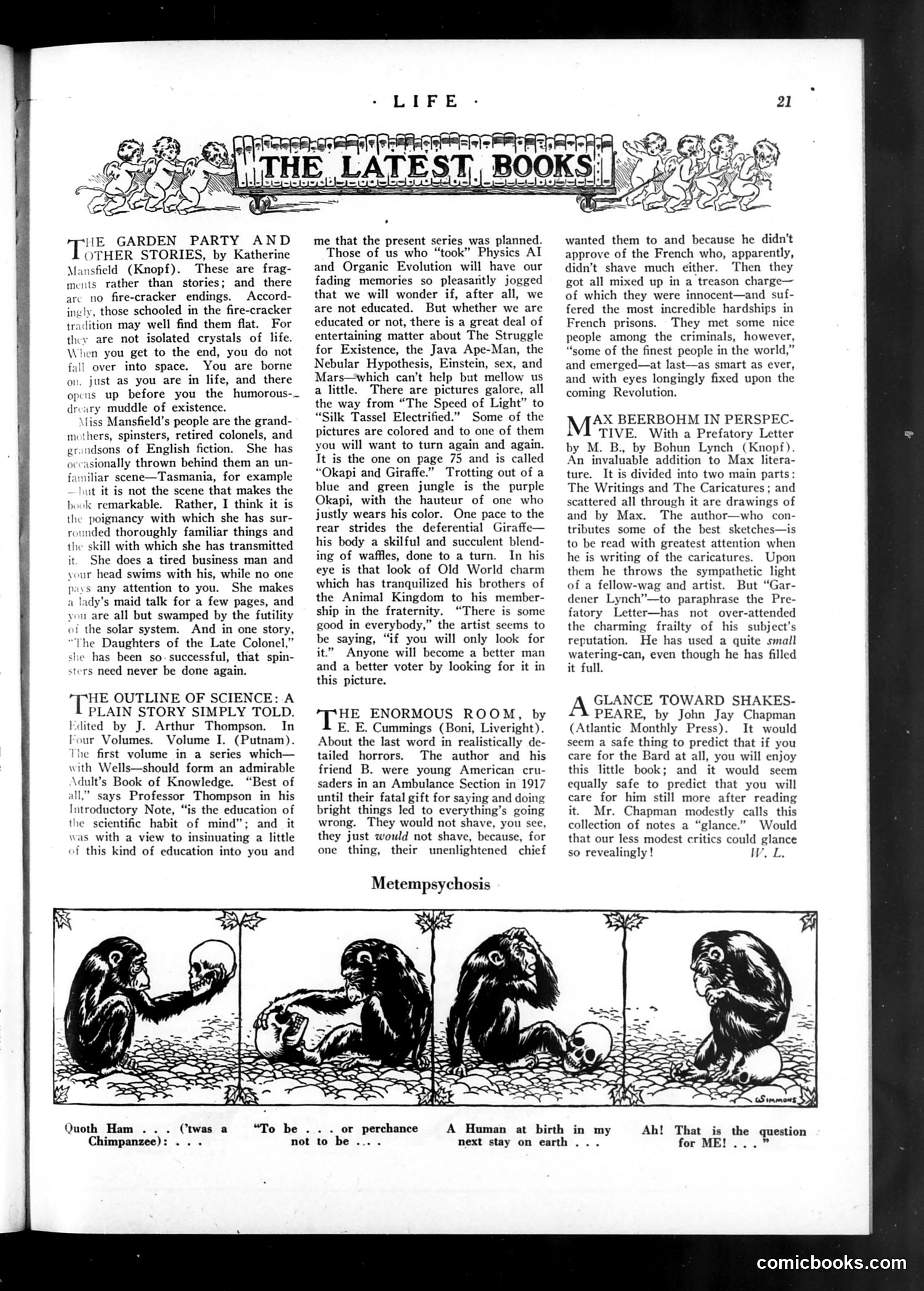
This four-panel comic strip illustrates the philosophical concept of metempsychosis (the transmigration of souls/reincarnation). It depicts a chimpanzee contemplating its own existence and potential future incarnations. **Panel progression:** The chimp first questions "To be or not to be" (referencing Hamlet's famous soliloquy), then wonders "or perchance not to be," followed by pondering "A Human at birth in my next stay on earth," and finally concluding "Ah! That is the question for ME!" **The satire:** The joke inverts the typical human-animal hierarchy. Rather than humans considering evolution from animals, here the ape humorously worries about the *reverse*—being reincarnated as a human. The implicit commentary suggests that human existence, with all its complications and absurdities (evident from the book reviews above discussing life's muddles and horrors), might actually be *worse* than animal existence. This aligns with the page's literary themes: Katherine Mansfield's stories about life's mundane struggles and Cummings' detailed descriptions of human suffering.
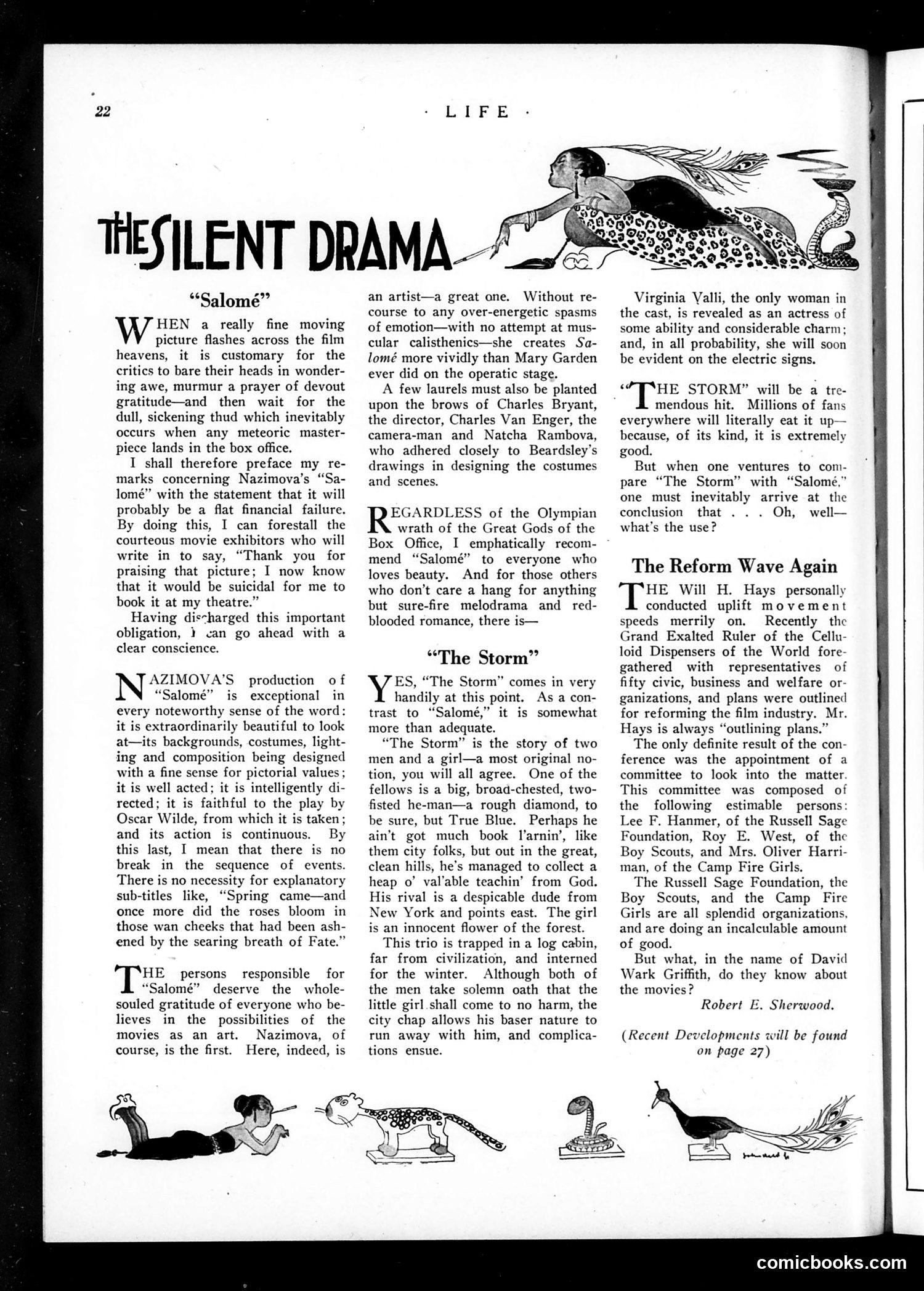
This is a film review column from Life magazine circa 1920s, discussing two silent movies: "Salomé" and "The Storm." The critic praises "Salomé"—starring Alla Nazimova, directed by Charles Bryant, based on Oscar Wilde's play—as artistically superior: beautiful cinematography, intelligent direction, and restrained acting (contrasted favorably with Mary Garden's operatic style). However, he predicts it will be a financial failure because audiences prefer spectacle over art. "The Storm" represents the opposite: a conventional melodrama featuring stock characters—a rough-hewn hero, a despicable city dude rival, and an innocent forest girl trapped in a cabin during winter. The critic acknowledges it will be commercially successful precisely because it delivers the "sure-fire melodrama and red-blooded romance" audiences crave, unlike the artistic but commercially risky "Salomé." The piece satirizes the film industry's tension between artistic merit and box-office returns.
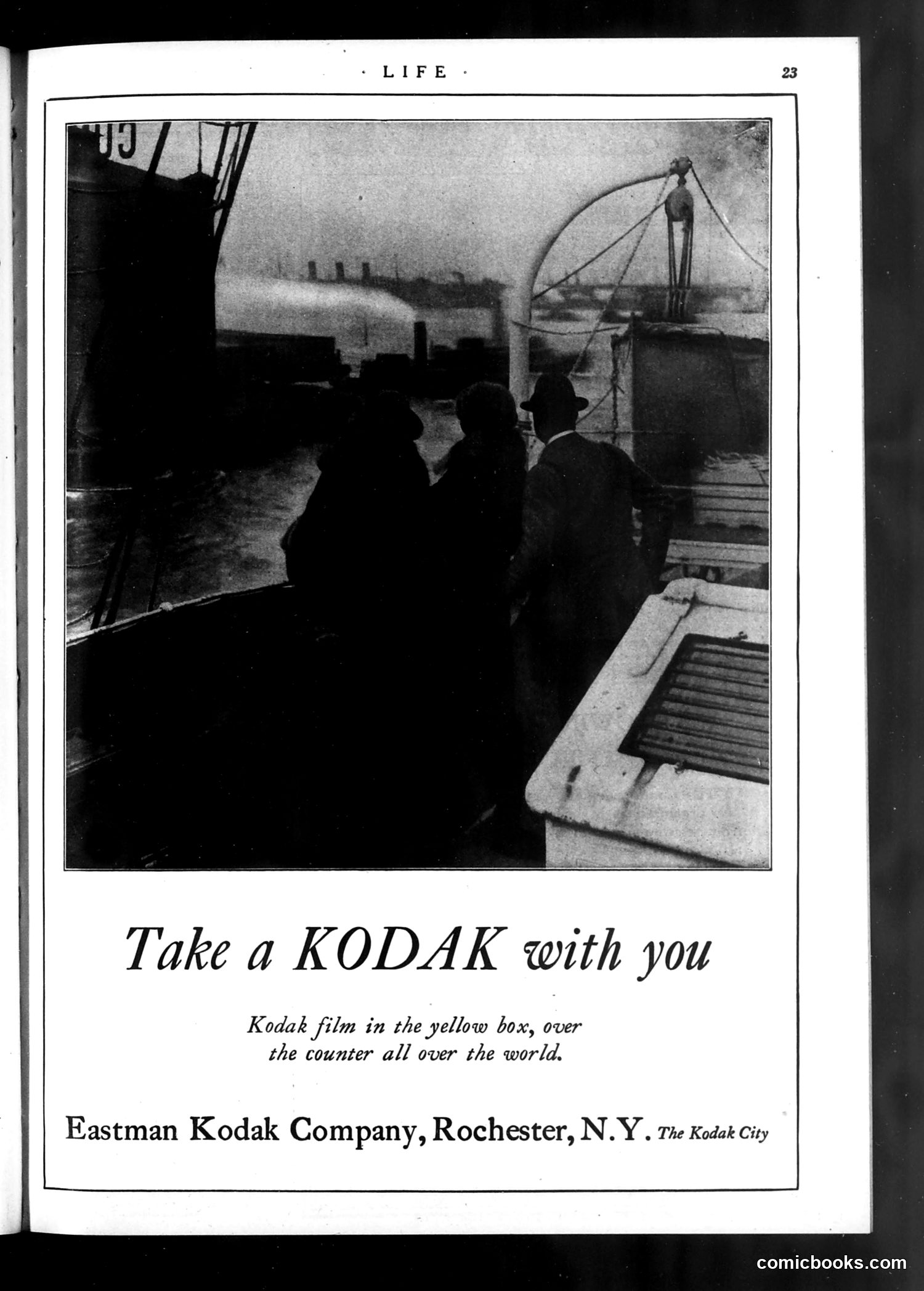
This is a **Kodak advertisement**, not political satire or a cartoon. The page shows silhouetted figures aboard what appears to be a ship, observing other vessels and industrial waterfront activity in the distance. The ad's message is straightforward: travelers should bring Kodak film (sold in distinctive yellow boxes) to document their journeys, since it's available worldwide. The maritime setting emphasizes travel and adventure—appealing to early 20th-century consumers who might voyage internationally. This represents Kodak's marketing strategy of positioning photography as an essential travel companion, democratizing picture-taking beyond professional photographers. The "Kodak City" tagline references Kodak's Rochester headquarters. There is no political commentary or satire present—it's purely commercial advertising.
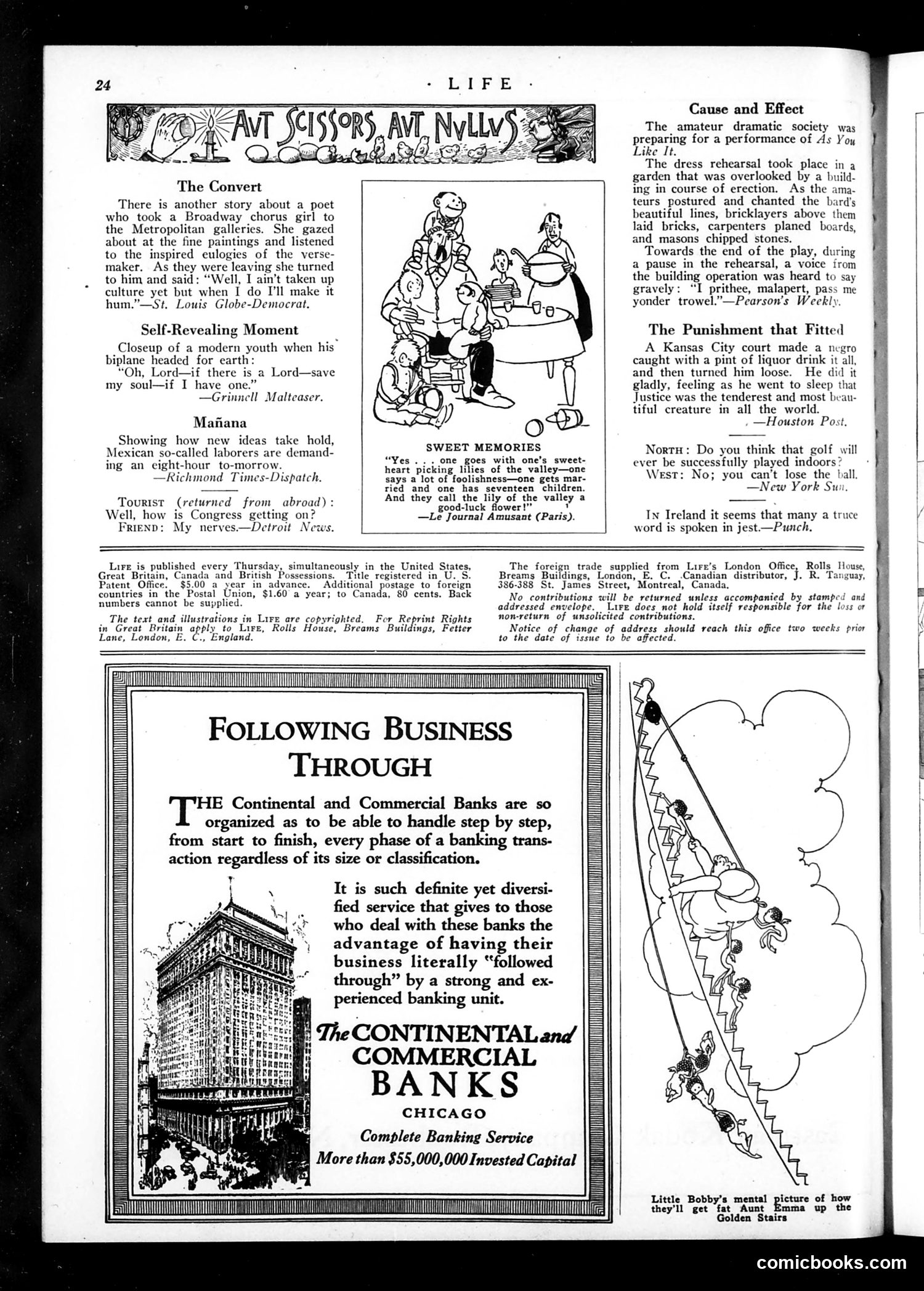
This page contains several short humorous anecdotes typical of Life's satirical format, plus a banking advertisement. The cartoons mock social pretension and human nature: - **"The Convert"**: A Broadway chorus girl visits art galleries with a poet, claims she'll "make culture hum"—satirizing superficial adoption of high culture. - **"Self-Revealing Moment"**: A young man in a failing airplane suddenly prays, revealing his true character when facing death—mocking hypocrisy and shallow modern youth. - **"Cause and Effect"**: Shakespeare actors rehearsing *As You Like It* in a garden near construction are interrupted by a bricklayer quoting the play back at them—humor derived from unexpected eloquence from a working-class laborer. The remaining pieces mock Mexican labor demands, Congressional dysfunction, and romantic sentimentality. The page is primarily **advertising** for the Continental and Commercial Banks of Chicago, emphasizing their comprehensive financial services and large capital base.
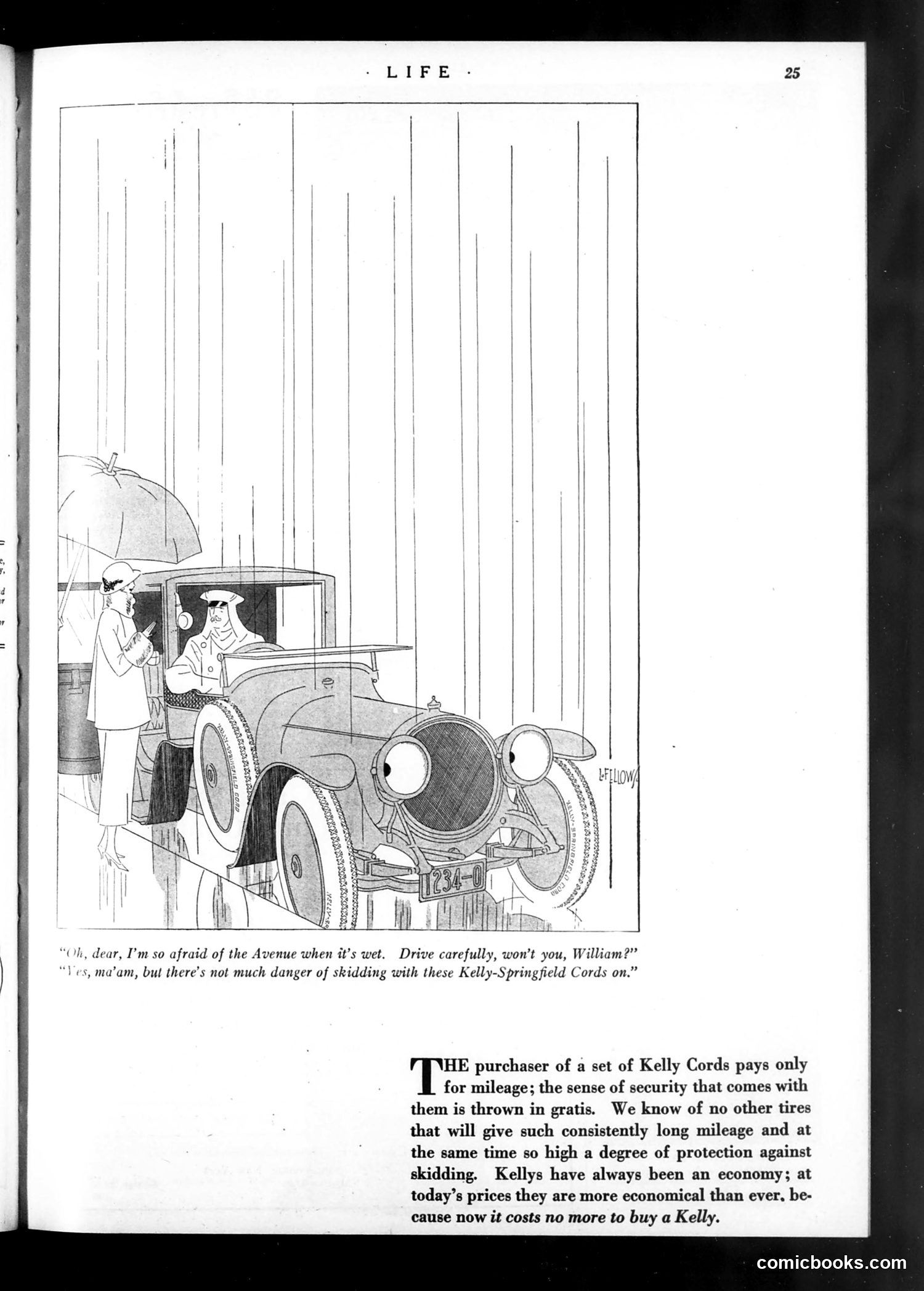
This is primarily a **Kelly-Springfield Cords tire advertisement** disguised as editorial content in Life magazine. The cartoon depicts a woman nervously asking her chauffeur (William) to drive carefully on a wet avenue. His confident response—that Kelly-Springfield Cords prevent skidding—serves as the advertisement's hook. **The satire/appeal**: The piece uses class signaling (a woman with a chauffeur) to suggest that even wealthy, cautious people trust Kelly tires for safety. The "sense of security" is positioned as a bonus benefit beyond mileage. **For modern readers**: This represents early 20th-century automobile advertising that blended editorial-style content with advertising to feel more credible. The emphasis on skidding danger reflects genuine concerns about early automotive safety on wet roads. The pricing language ("costs no more to buy a Kelly") suggests competitive tire market positioning, likely during post-WWI economic adjustment. This is essentially native advertising before that term existed.
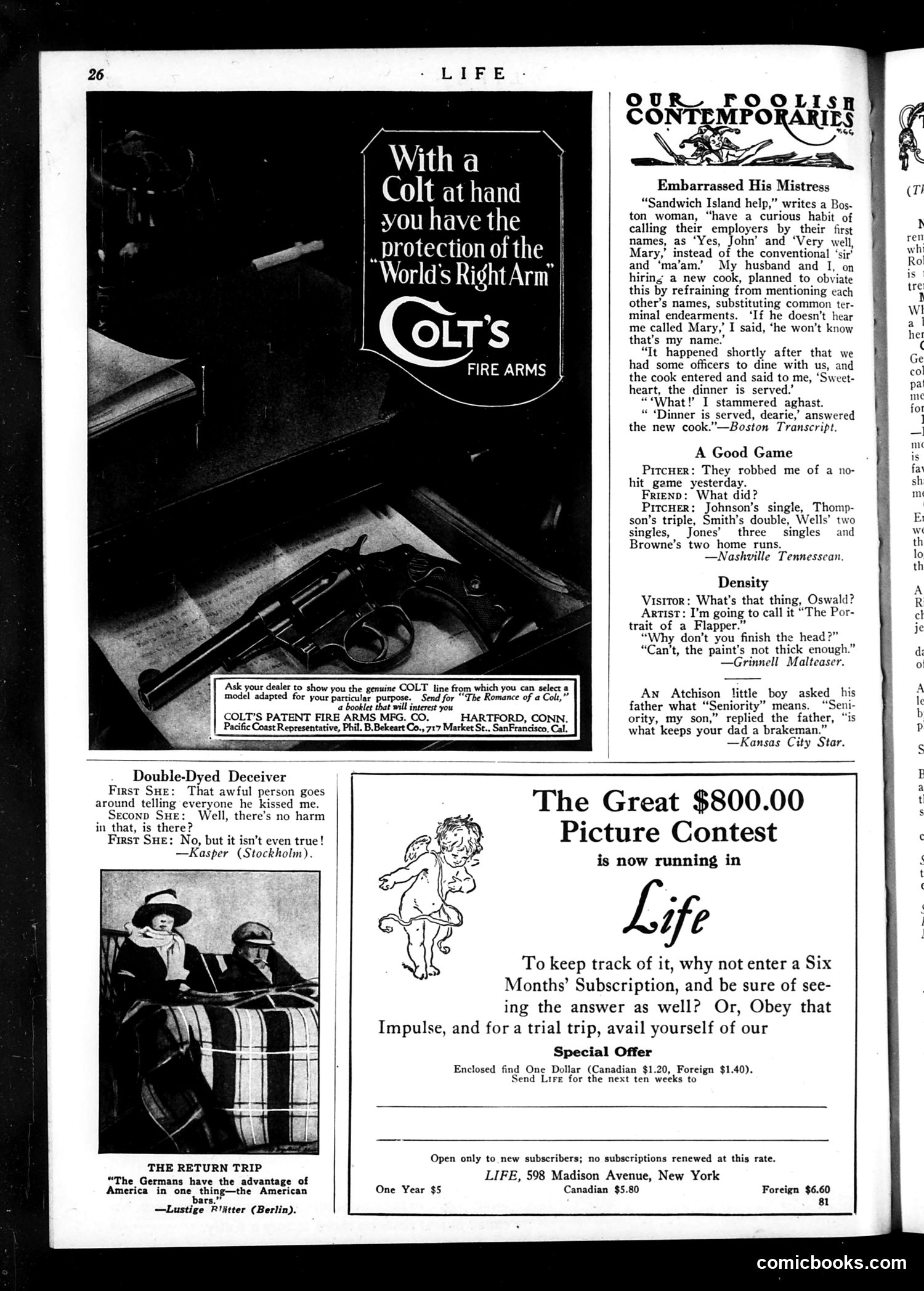
This page mixes advertising and humor content typical of Life magazine's satirical format. **Main Advertisement**: A Colt firearms ad dominates the left side, using the slogan "With a Colt at hand you have the protection of the World's Right Arm"—appealing to early 20th-century American masculinity and self-defense. **Cartoon Content**: The page features several short joke submissions from international readers: - **"Double-Dyed Deceiver"**: A woman complains her reputation is damaged not by a false kiss rumor, but by its untruth—satirizing women's social vulnerability to gossip. - **"The Return Trip"**: A Berlin publication's quip comparing American and German culture (specific comparison unclear from OCR). - **Short humor pieces** about a Hawaiian servant using nicknames, baseball terminology misunderstanding, and a child's definition of "seniority" as job security for railroad workers. The page reflects Life's formula: combining consumer advertising with gentle social satire drawn from readers' contributions, representing early 1900s middle-class American anxieties and humor.
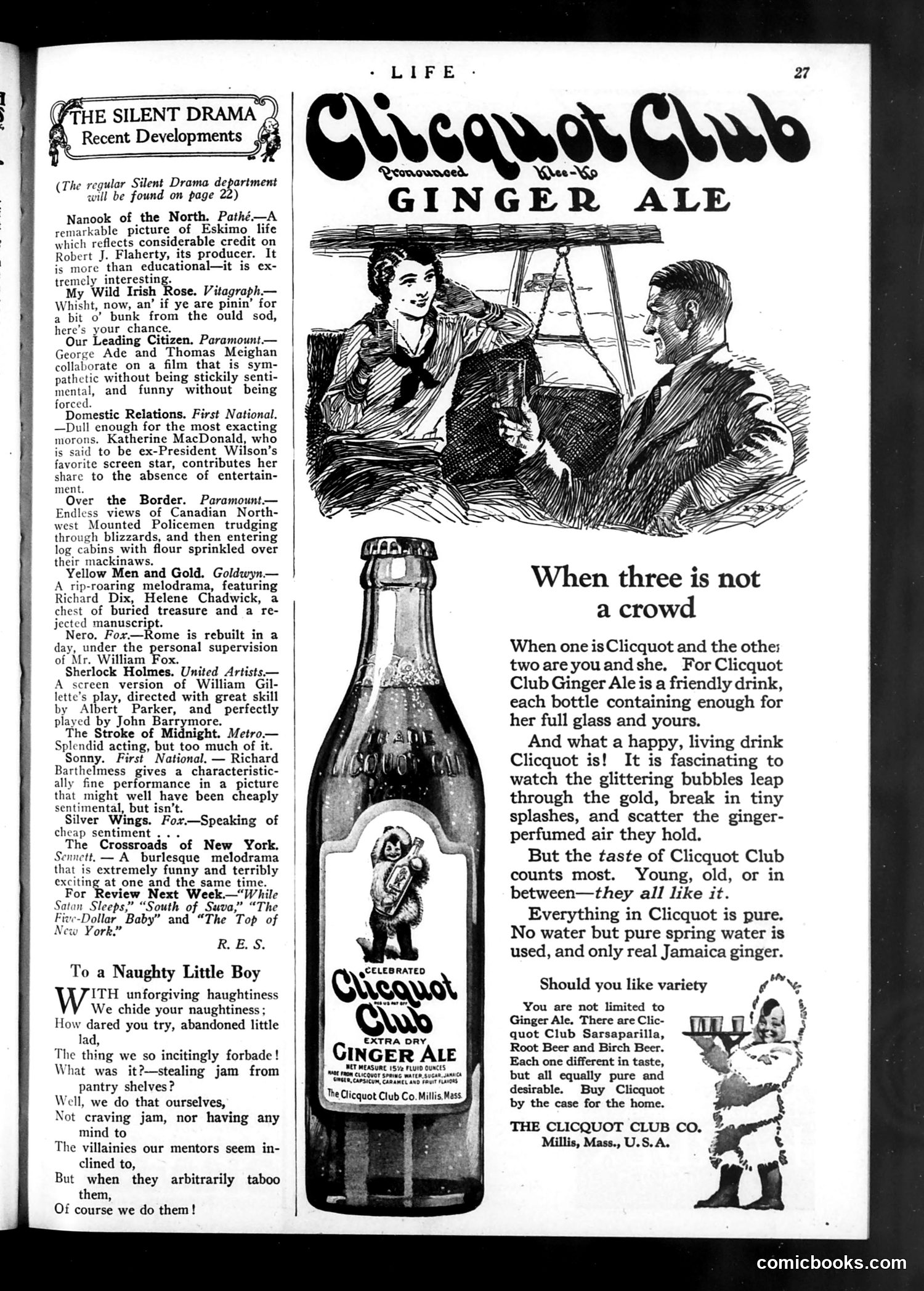
This page combines film reviews with an advertisement and a short satirical poem. **"The Silent Drama" Reviews**: Life critiques recent silent films, praising *Nanook of the North* for its documentary value and John Barrymore's performance in *Sherlock Holmes*, while dismissing others like *Domestic Relations* as "dull enough for the most exacting morons." **"To a Naughty Little Boy"**: This brief poem satirizes parental hypocrisy—adults forbid children from misbehavior (stealing jam) that adults themselves commit. The joke is that prohibitions make forbidden acts more tempting; children mimic their elders' rule-breaking while being punished for it. It's social commentary on inconsistent moral standards. **Clicquot Club Advertisement**: The bulk of the page promotes ginger ale as a sophisticated drink for romantic situations ("when three is not a crowd"), emphasizing purity and taste. The page reflects 1920s concerns: cinema's cultural importance, generational criticism of adult hypocrisy, and consumer advertising during Prohibition (ginger ale as a respectable beverage).
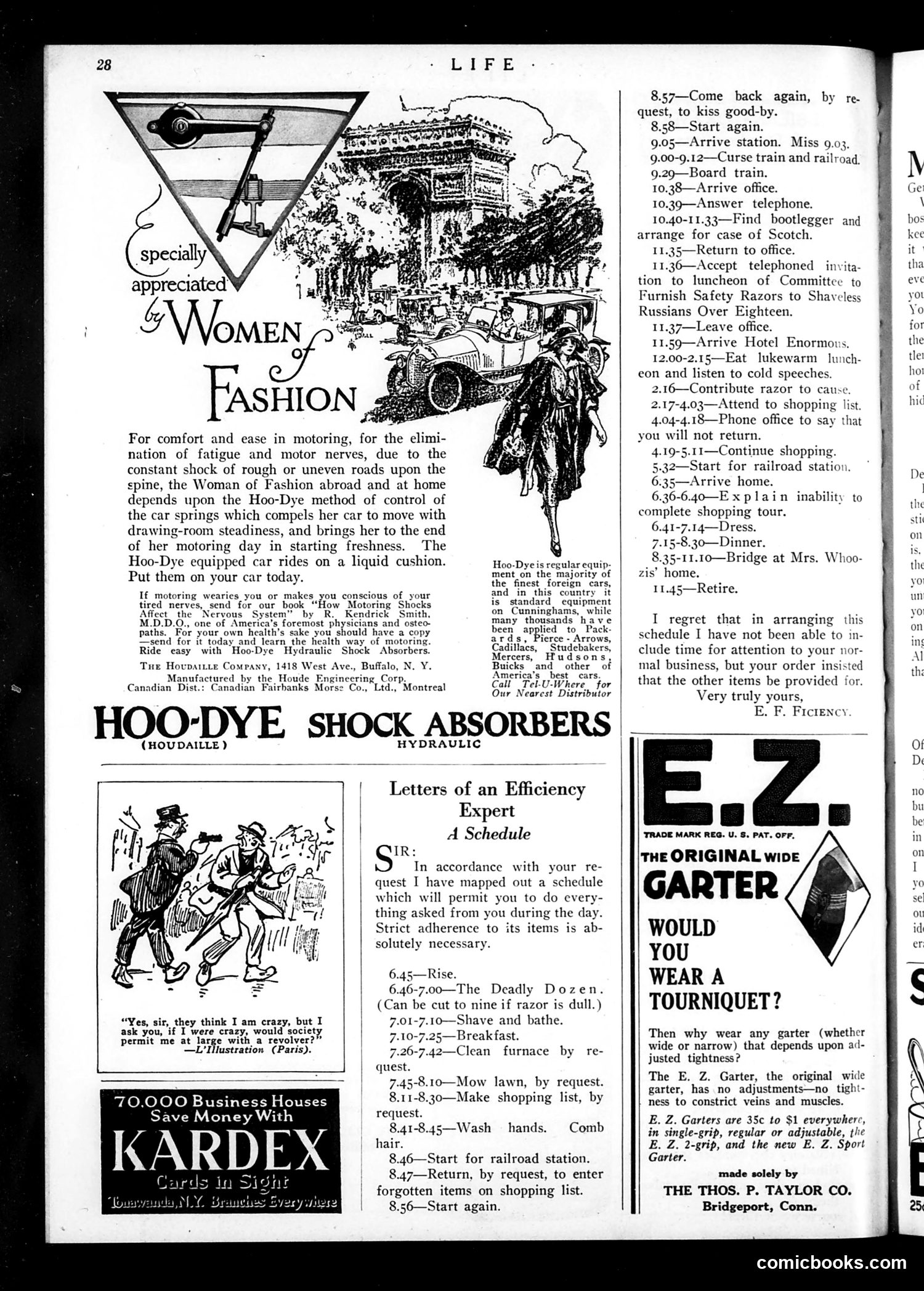
This page satirizes the modern woman's chaotic daily schedule through an "Efficiency Expert's" timeline. The humor lies in the absurd contradiction: the expert promises to organize "everything asked from you during the day," yet the schedule reveals a woman constantly interrupted—she leaves for the station, returns to add forgotten shopping items, misses trains, attends obligatory luncheons with cold speeches, shops unsuccessfully, and bridges the gap between duty and exhaustion. The satire targets both the *illusion* of efficiency in the 1920s and women's impossible competing demands: business appointments, domestic duties, social obligations, and shopping. The closing note admits failure—the schedule omits "time for attention to your normal business"—underlining that perfect organization of a woman's day is actually impossible. The ads (Hoo-Dye shock absorbers, Kardex cards) ironically reinforce this theme: products promising comfort and order to harried moderns.
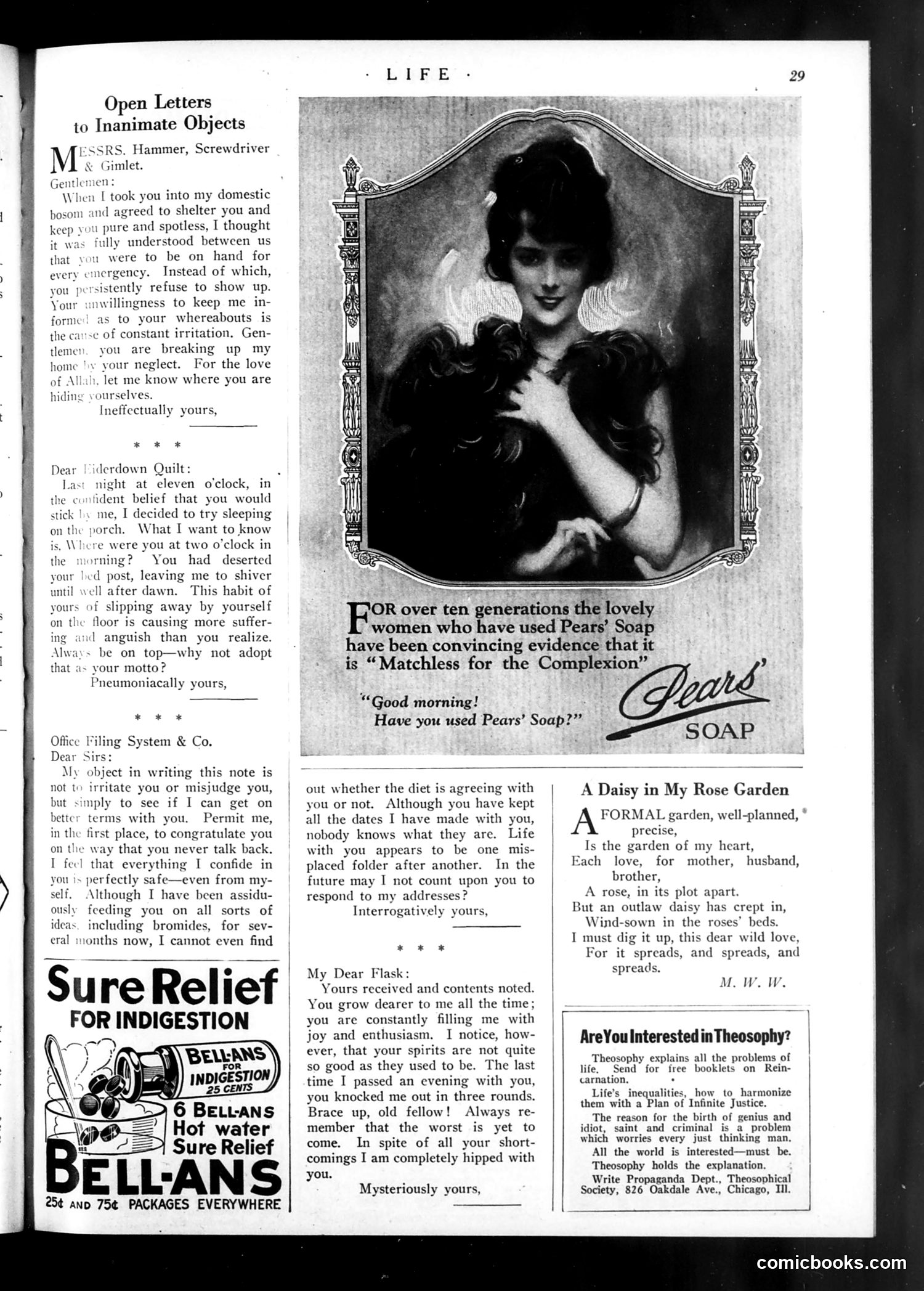
This page combines humorous "Open Letters to Inanimate Objects"—a satirical column mocking human frustrations with everyday items. The writer personifies tools (hammer, screwdriver), bedding, and filing systems, addressing them as if they were negligent servants or romantic interests. The humor relies on treating household objects with exaggerated emotional complaint: tools that disappear when needed, quilts that abandon you in the night, filing systems that never respond. The satire reflects early 20th-century domestic life frustrations and class anxiety (servants who don't perform their duties). Interspersed are period advertisements for Pears' Soap and Bell-Ans indigestion remedy, typical of Life magazine's mixed content. A poem titled "A Daisy in My Rose Garden" uses garden metaphor for romantic temptation—a "wild love" disrupting ordered life. The page also advertises Theosophical Society materials, reflecting era interests in spiritualism and philosophy.
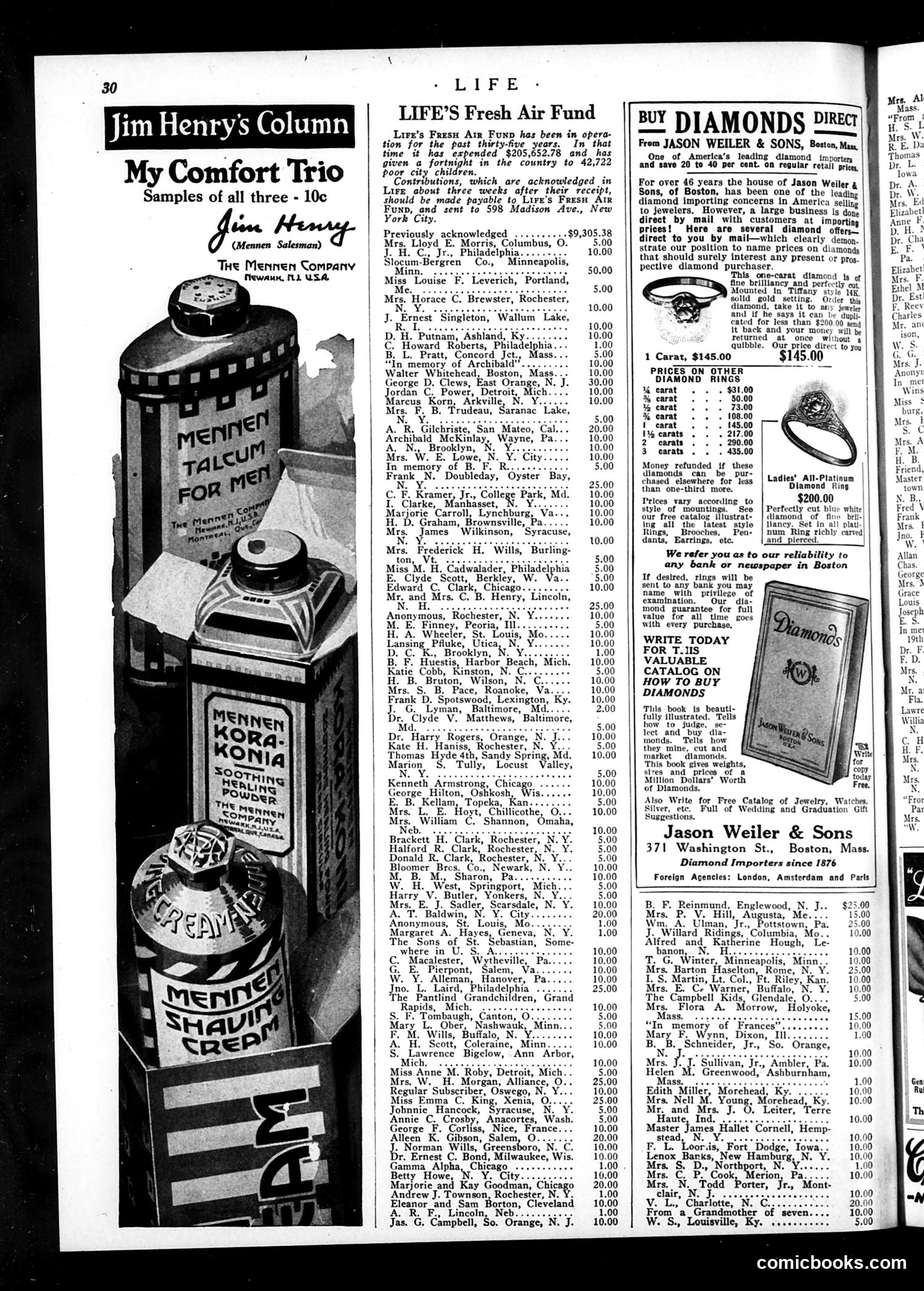
This page is primarily **advertising and charitable fundraising**, not satire or political commentary. The left side features a **Jim Henry advertisement** for Mennen grooming products (talcum powder, shaving cream, cologne), showing the "Comfort Trio" sample set for 10 cents. This is straightforward product marketing typical of 1920s magazines. The center column lists **Life's Fresh Air Fund**—a genuine charitable initiative that had operated for 35 years, providing country vacations to poor urban children. The extensive donor list represents genuine contributions, not satire. This reflects early 20th-century Progressive Era philanthropy addressing urban poverty and child welfare. The right side advertises **diamond sales from Jason Weiler & Sons** of Boston, emphasizing direct-mail purchasing at "importing prices" rather than retail markup. **For modern readers:** This page demonstrates how early Life magazine mixed satirical humor (elsewhere) with serious advertising and genuine charitable fundraising—a common magazine format of the era. The Fresh Air Fund entry shows period attitudes toward addressing urban poverty through charitable organizations.
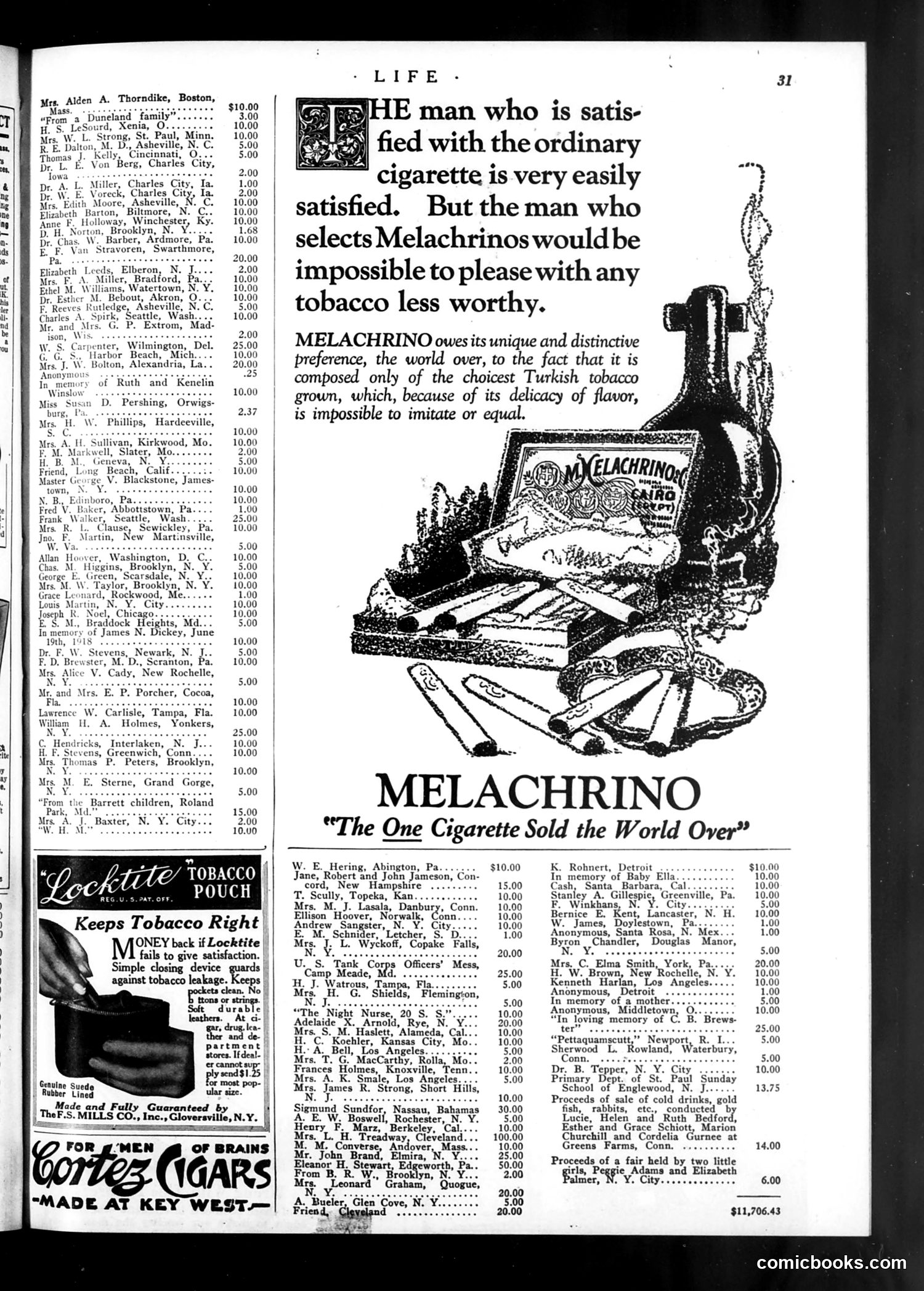
This Life magazine page is primarily **advertising**, not satire or political commentary. The main advertisement promotes **Melachrino cigarettes**, a luxury Turkish tobacco brand positioned as "The One Cigarette Sold the World Over." The ad's rhetoric claims Melachrino's superiority: a man who smokes ordinary cigarettes is "easily satisfied," but selecting Melachrino means being "impossible to please with any tobacco less worthy." The accompanying illustration shows an ornate Melachrino package with decorative foliage and what appears to be cigarettes displayed prominently. The page also contains smaller ads for **Locktite tobacco pouches** (emphasizing product preservation) and **Cortez cigars** ("Made at Key West"), plus a long list of names and monetary donations—likely contributions to a charitable cause supported by Life magazine. There is no political cartoon or social satire visible on this page. It represents standard early 20th-century luxury goods advertising.
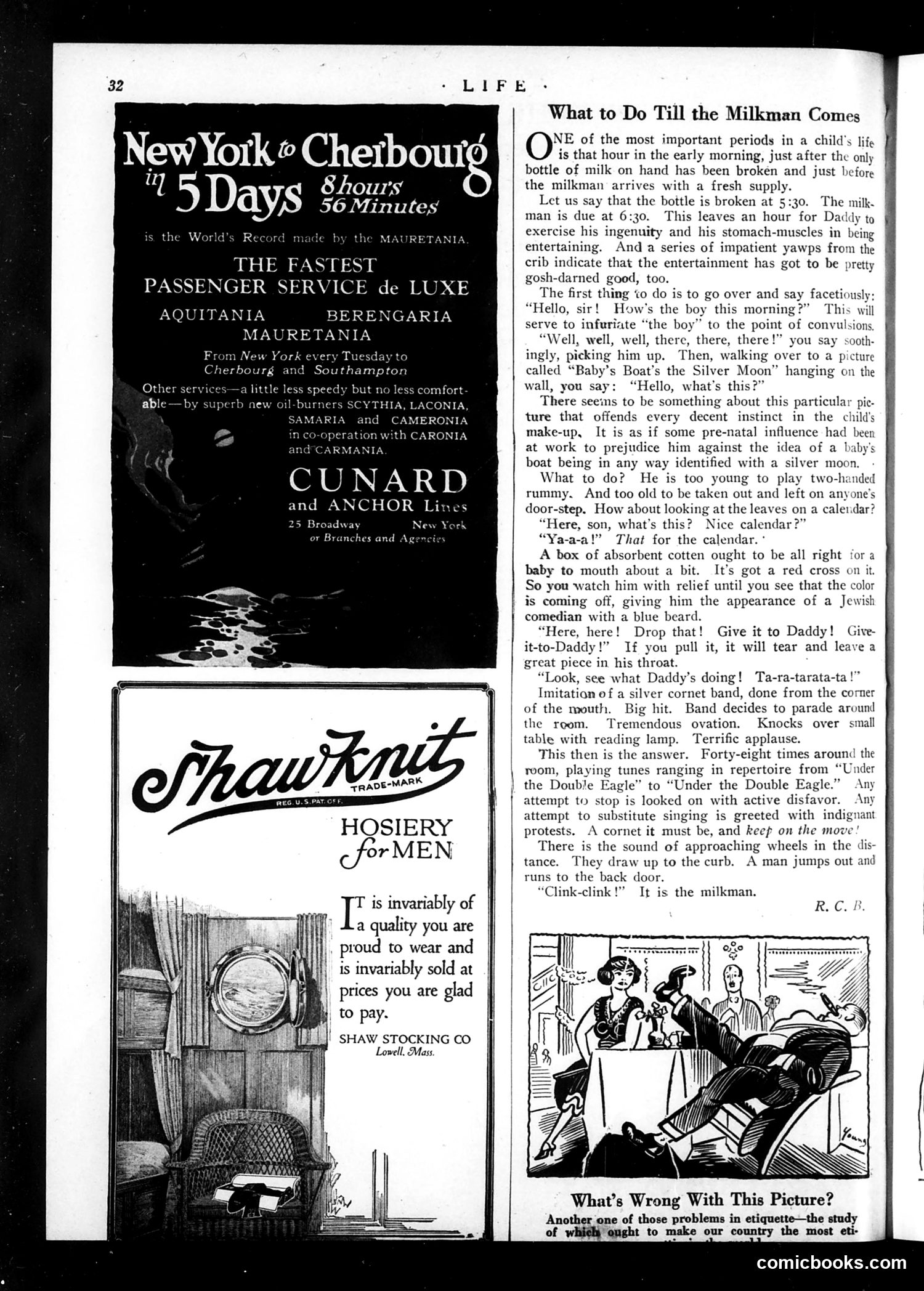
This humorous advice piece satirizes the early 20th-century father's complete helplessness in childcare. The joke: a desperate parent must entertain a screaming infant for an hour between a broken milk bottle and the milkman's arrival. The satire mocks both parental incompetence and gender roles—the implicit assumption that childcare is utterly foreign to fathers. Solutions proposed are absurd: showing a baby a painting called "Baby's Boat's the Silver Moon" (which inexplicably enrages him), letting him mouth absorbent cotton that stains his face like "a Jewish comedian with a blue beard," and then parading around the room 48 times imitating a cornet band—anything to delay until help arrives. The humor relies on exaggerated desperation and the chaos that ensues. The final cartoon (partially visible, titled "What's Wrong With This Picture?") appears to continue etiquette humor but is cut off.
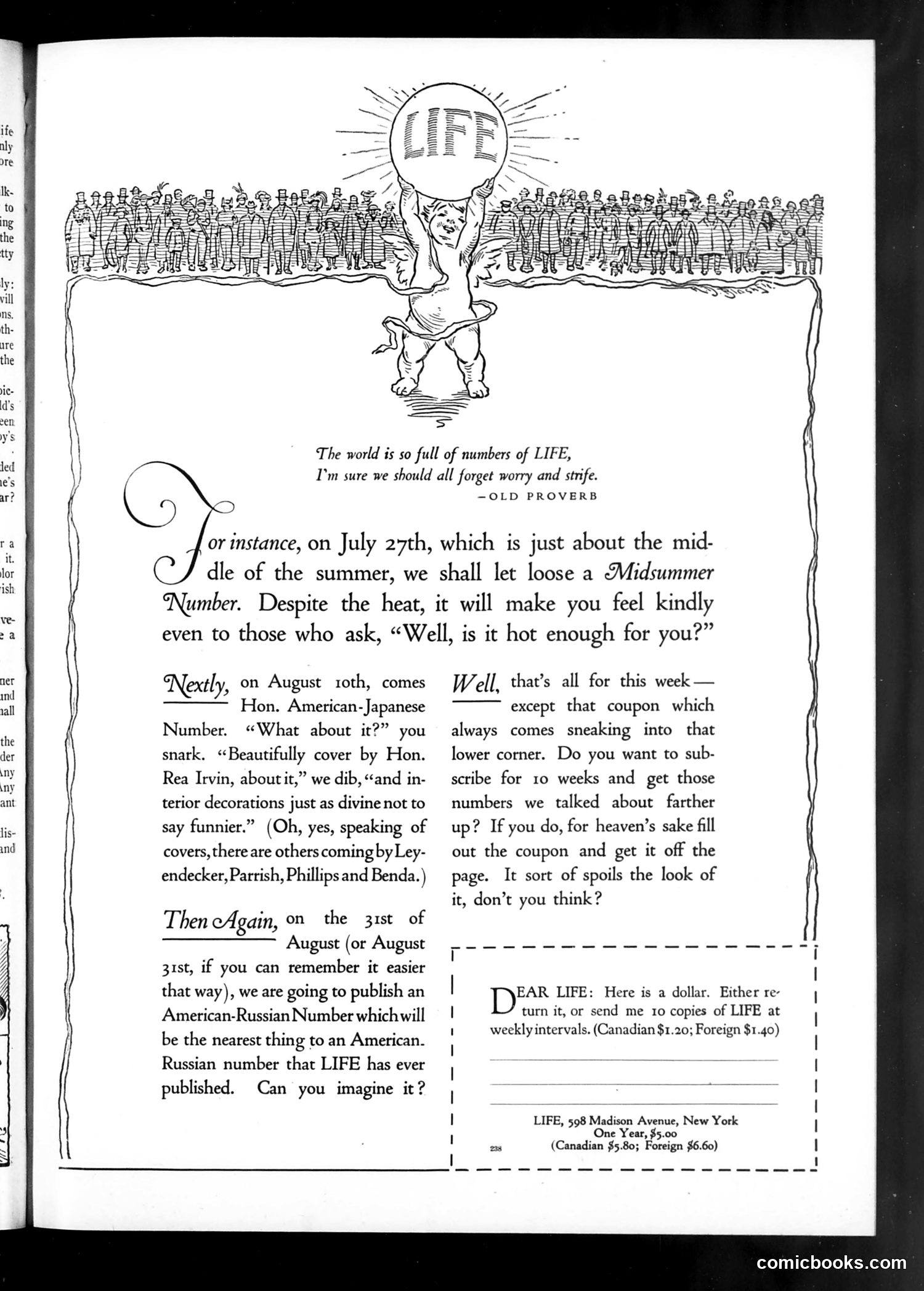
This is a promotional page announcing upcoming special issues of *Life* magazine. The main cartoon shows a figure holding aloft a globe labeled "LIFE," surrounded by crowds below—a visual metaphor for the magazine's cultural significance and wide readership. The text announces three themed issues: 1. **Midsummer Number** (July 27th) 2. **Hon. American-Japanese Number** (August 10th)—with cover art by Rea Irvin 3. **American-Russian Number** (August 31st) The tone is humorous and self-promotional, poking fun at the magazine's own proliferation of special editions. The "Old Proverb" epigraph sarcastically suggests *Life* offers so many issues readers should forget their worries. The subscription coupon at bottom offers 10 weekly copies for one dollar, with pricing for Canadian and foreign readers noted. The specific international-themed issues suggest this appears from a period when America was engaging with both Japan and Russia—likely the 1920s-1930s era—though the exact date isn't specified on this page.
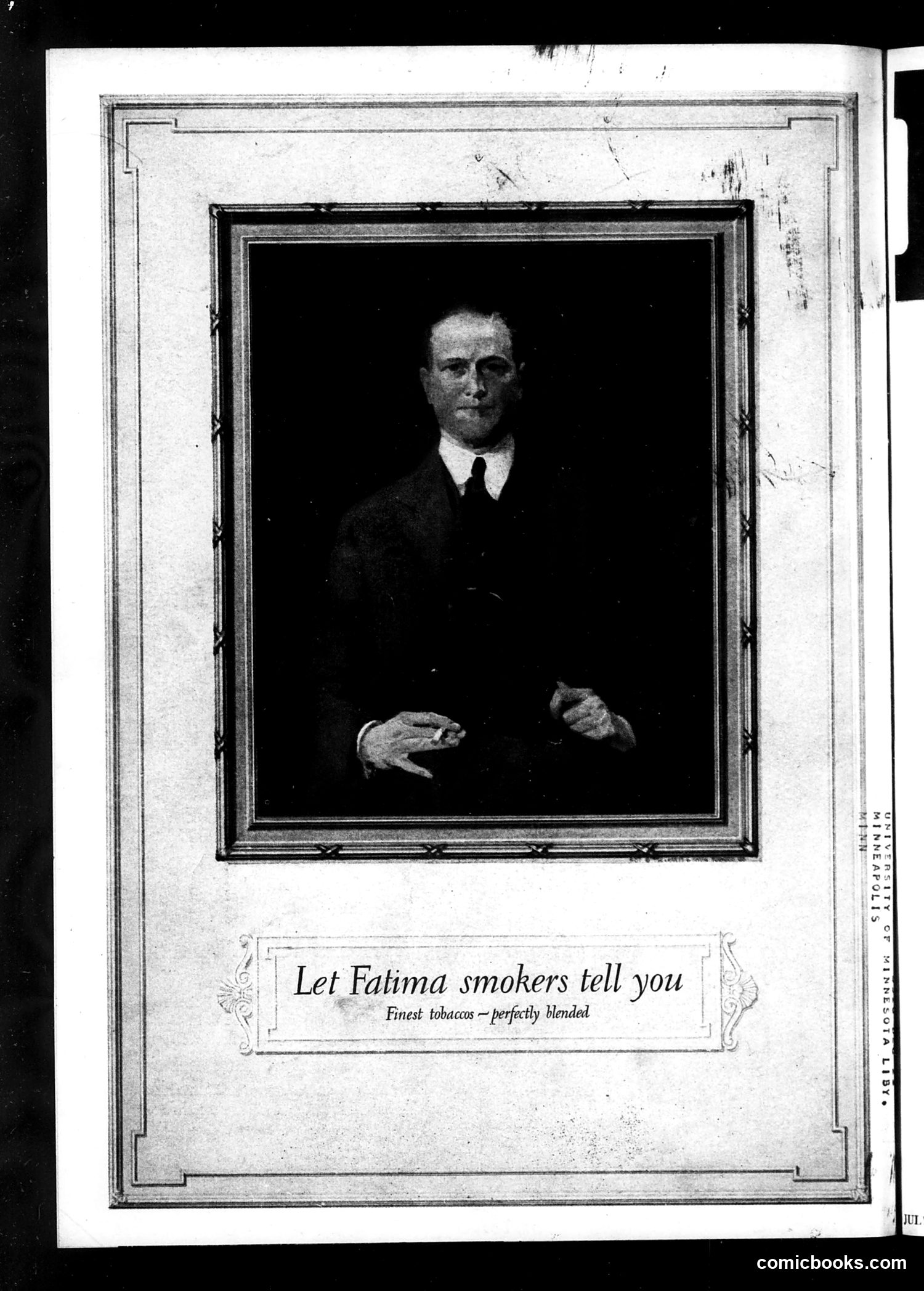
This is a **Fatima cigarette advertisement**, not political satire. The page features a portrait of a well-dressed man in formal attire (suit and tie) against a dark background, presented in an ornate frame. Below runs the advertising tagline: "Let Fatima smokers tell you / Finest tobaccos — perfectly blended." This represents early 20th-century cigarette marketing that relied on testimonial-style advertising, using respectable-looking gentlemen to suggest that smoking Fatima cigarettes conveyed sophistication and quality. The "let smokers tell you" approach implied authentic user endorsement. There is no political commentary or satire present—this is straightforward commercial advertising from *Life* magazine's pages.