
Life, 1922-07-13 · page 24 of 36
Life — July 13, 1922 — page 24: what you’re looking at
What you’re looking at
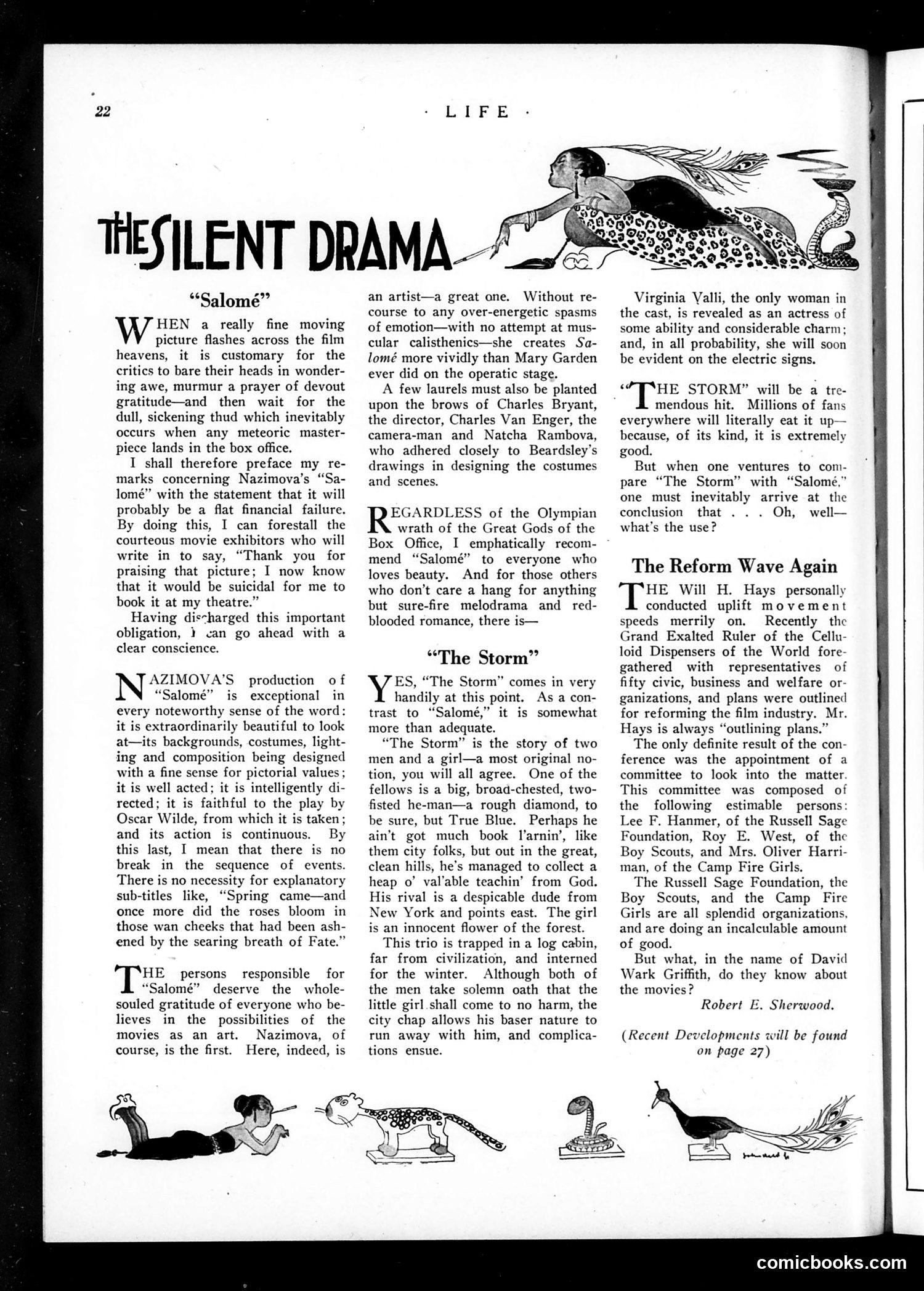
This is a film review column from Life magazine circa 1920s, discussing two silent movies: "Salomé" and "The Storm." The critic praises "Salomé"—starring Alla Nazimova, directed by Charles Bryant, based on Oscar Wilde's play—as artistically superior: beautiful cinematography, intelligent direction, and restrained acting (contrasted favorably with Mary Garden's operatic style). However, he predicts it will be a financial failure because audiences prefer spectacle over art. "The Storm" represents the opposite: a conventional melodrama featuring stock characters—a rough-hewn hero, a despicable city dude rival, and an innocent forest girl trapped in a cabin during winter. The critic acknowledges it will be commercially successful precisely because it delivers the "sure-fire melodrama and red-blooded romance" audiences crave, unlike the artistic but commercially risky "Salomé." The piece satirizes the film industry's tension between artistic merit and box-office returns.
📄 Transcribed text from this page (OCR, searchable)
Machine-transcribed from the original scan — historical spelling and the odd misread are preserved.
TESILENT DRAMA “Salomé” HEN a really fine moving picture flashes across the film heavens, it is customary for the critics to bare their heads in wonder- ing awe, murmur a prayer of devout gratitude—and then wait for the dull, sickening thud which inevitably occurs when any meteoric master- piece lands in the box office. I shall therefore preface my re- marks concerning Nazimova’s “Sa- lomé” with the statement that it will probably be a flat financial failure. By doing this, I can forestall the courteous movie exhibitors who will write in to say, “Thank you for praising that picture; I now know that it would be suicidal for me to book it at my theatre.” Having discharged this important obligation, } can go ahead with a clear conscience. AZIMOVA’S production of “Salomé” is exceptional in every noteworthy sense of the word: it is extraordinarily beautiful to look at—its backgrounds, costumes, light- ing and composition being designed with a fine sense for pictorial values ; it is well acted; it is intelligently di- rected; it is faithful to the play by Oscar Wilde, from which it is taken; and its action is continuous. By this last, I mean that there is no break in the sequence of events. There is no necessity for explanatory sub-titles like, “Spring came—and once more did the roses bloom in those wan cheeks that had been ash- ened by the searing breath of Fate.” HE persons responsible for “Salomé” deserve the whole- souled gratitude of everyone who be- lieves in the possibilities of the movies as an art. Nazimova, of course, is the first. Here, indeed, is Ds an artist—a great one. Without re- course to any over-energetic spasms of emotion—with no attempt at mus- cular calisthenics—she creates Sa- lomé more vividly than Mary Garden ever did on the operatic stage. A few laurels must also be planted upon the brows of Charles Bryant, the director, Charles Van Enger, the camera-man and Natcha Rambova, who adhered closely to Beardsley’s drawings in designing the costumes and scenes. EGARDLESS of the Olympian wrath of the Great Gods of the Box Office, I emphatically recom- mend “Salomé” to everyone who loves beauty. And for those others who don’t care a hang for anything but sure-fire melodrama and red- blooded romance, there is— “The Storm” ES, “The Storm” comes in very handily at this point. As a con- trast to “Salomé,” it is somewhat more than adequate. “The Storm” is the story of two men and a girl—a most original no- tion, you will all agree. One of the fellows is a big, broad-chested, two- fisted he-man—a rough diamond, to be sure, but True Blue. Perhaps he ain’t got much book I’arnin’, like them city folks, but out in the great, clean hills, he’s managed to collect a heap o’ val’able teachin’ from God. His rival is a despicable dude from New York and points east. The girl is an innocent flower of the forest. This trio is trapped in a log cabin, far from civilization, and interned for the winter. Although both of the men take solemn oath that the little girl shall come to no harm, the city chap allows his baser nature to run away with him, and complica- tions ensue. Virginia Valli, the only woman in the cast, is revealed as an actress of some ability and considerable charm; and, in all probability, she will soon be evident on the electric signs. ¢ HE STORM” will be a tre- mendous hit. Millions of fans everywhere will literally eat it up— because, of its kind, it is extremely good. But when one ventures to com- pare “The Storm” with “Salomé,” one must inevitably arrive at the conclusion that . . . Oh, well— what's the use? The Reform Wave Again HE Will H. Hays personally conducted uplift movement speeds merrily on. Recently the Grand Exalted Ruler of the Cellu- loid Dispensers of the World fore- gathered with representatives of fifty civic, business and welfare or- ganizations, and plans were outlined for reforming the film industry. Mr. Hays is always “outlining plans.” The only definite result of the con- ference was the appointment of a committee to look into the matter. This committee was composed of the following estimable persons: Lee F. Hanmer, of the Russell Sage Foundation, Roy E. West, of the Boy Scouts, and Mrs. Oliver Harri- man, of the Camp Fire Girls. The Russell Sage Foundation, the Boy Scouts, and the Camp Fire Girls are all splendid organizations, and are doing an incalculable amount of good. But what, in the name of David Wark Griffith, do they know about the movies? Robert E, Sherwood. (Recent Developments will be found on page 27) | comicbooks.com