
Life, 1922-07-13 · page 20 of 36
Life — July 13, 1922 — page 20: what you’re looking at
What you’re looking at
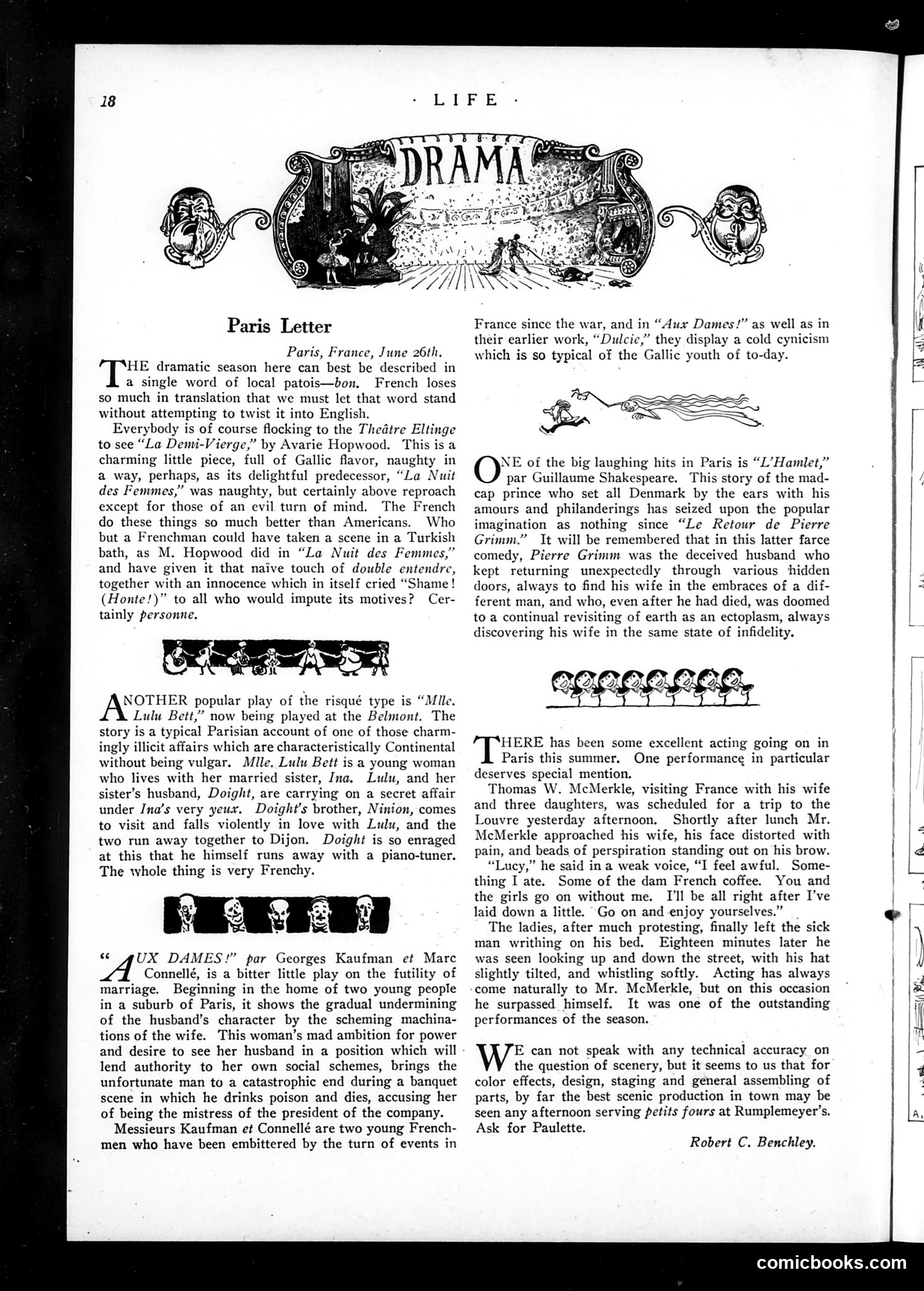
This is a theatre review column from Life magazine's Paris correspondent, dated June 26th (year unclear from image). The page contains no political cartoons—it's straightforward cultural criticism. The writer humorously comments on Parisian theatre, praising French playwrights' sophistication in handling risqué material. He references productions like "La Demi-Vierge" and "Mille. Lulu Bett," noting French audiences accept adultery plots as charming rather than scandalous. The satire targets American prudishness: the writer suggests Americans couldn't handle such material with the "naive" elegance of Frenchmen. A secondary anecdote about American tourist Thomas W. McMerkle getting ill before the Louvre appears to mock American tourists. The ornamental "Drama" header and theatrical masks are decorative period elements, not satirical content. This page demonstrates how Life mixed sophisticated cultural commentary with gentle mockery of American attitudes toward European sophistication.
📄 Transcribed text from this page (OCR, searchable)
Machine-transcribed from the original scan — historical spelling and the odd misread are preserved.
Paris Letter Paris, France, June 26th. HE dramatic season here can best be described in a single word of local patois—bon, French loses so much in translation that we must let that word stand without attempting to twist it into English. Everybody is of course flocking to the Theatre Eltinge to see “La Demi-Vierge,” by Avarie Hopwood. This is a charming little piece, full of Gallic flavor, naughty in a way, perhaps, as its delightful predecessor, “La Nuit des Femmes,” was naughty, but certainly above reproach except for those of an evil turn of mind. The French do these things so much better than Americans. Who but a Frenchman could have taken a scene in a Turkish bath, as M. Hopwood did in “La Nuit des Femmes,” and have given it that naive touch of double entendre, together with an innocence which in itself cried “Shame! (Honte!)” to all who would impute its motives? Cer- tainly personne. NOTHER popular play of the risqué type is “Mlle. Lulu Bett,” now being played at the Belmont. The story is a typical Parisian account of one of those charm- ingly illicit affairs which are characteristically Continental without being vulgar. Mlle, Lulu Bett is a young woman who lives with her married sister, Ina. Lulu, and her sister’s husband, Doight, are carrying on a secret affair under Jna’s very yeux. Doight’s brother, Ninion, comes to visit and falls violently in love with Lulu, and the two run away together to Dijon. Doight is so enraged at this that he himself runs away with a piano-tuner. The whole thing is very Frenchy. ss UX DAMES!” par Georges Kaufman et Mare Connellé, is a bitter little play on the futility of marriage. Beginning in the home of two young people in a suburb of Paris, it shows the gradual undermining of the husband’s character by the scheming machina- tions of the wife. This woman’s mad ambition for power and desire to see her husband in a position which will lend authority to her own social schemes, brings the unfortunate man to a catastrophic end during a banquet scene in which he drinks poison and dies, accusing her of being the mistress of the president of the company. Messieurs Kaufman et Connellé are two young French- men who have been embittered by the turn of events in France since the war, and in “dur Dames!” as well as in their earlier work, “Dulcie,” they display a cold cynicism which is so typical of the Gallic youth of to-day. RIN _SREISS, NE of the big laughing hits in Paris is “L’Hamlet,” par Guillaume Shakespeare. This story of the mad- cap prince who set all Denmark by the ears with his amours and philanderings has seized upon the popular imagination as nothing since “Le Retour de Pierre Grimm.” It will be remembered that in this latter farce comedy, Pierre Grimm was the deceived husband who kept returning unexpectedly through various hidden doors, always to find his wife in the embraces of a dif- ferent man, and who, even after he had died, was doomed to a continual revisiting of earth as an ectoplasm, always discovering his wife in the same state of infidelity. HERE has been some excellent acting going on in Paris this summer. One performance in particular deserves special mention. Thomas W. McMerkle, visiting France with his wife and three daughters, was scheduled for a trip to the Louvre yesterday afternoon. Shortly after lunch Mr. McMerkle approached his wife, his face distorted with pain, and beads of perspiration standing out on his brow. “Lucy,” he said in a weak voice, “I feel awful. Some- thing I ate. Some of the dam French coffee. You and the girls go on without me. I'll be all right after I’ve laid down a little. Go on and enjoy yourselves.” The ladies, after much protesting, finally left the sick man writhing on his bed. Eighteen minutes later he was seen looking up and down the street, with his hat slightly tilted, and whistling softly. Acting has always come naturally to Mr. McMerkle, but on this occasion he surpassed himself. It was one of the outstanding performances of the season. E can not speak with any technical accuracy on the question of scenery, but it seems to us that for color effects, design, staging and general assembling of parts, by far the best scenic production in town may be seen any afternoon serving petits fours at Rumplemeyer’s. Ask for Paulette. Robert C. Benchley. comicbooks.com