
Life, 1922-07-13 · page 12 of 36
Life — July 13, 1922 — page 12: what you’re looking at
What you’re looking at
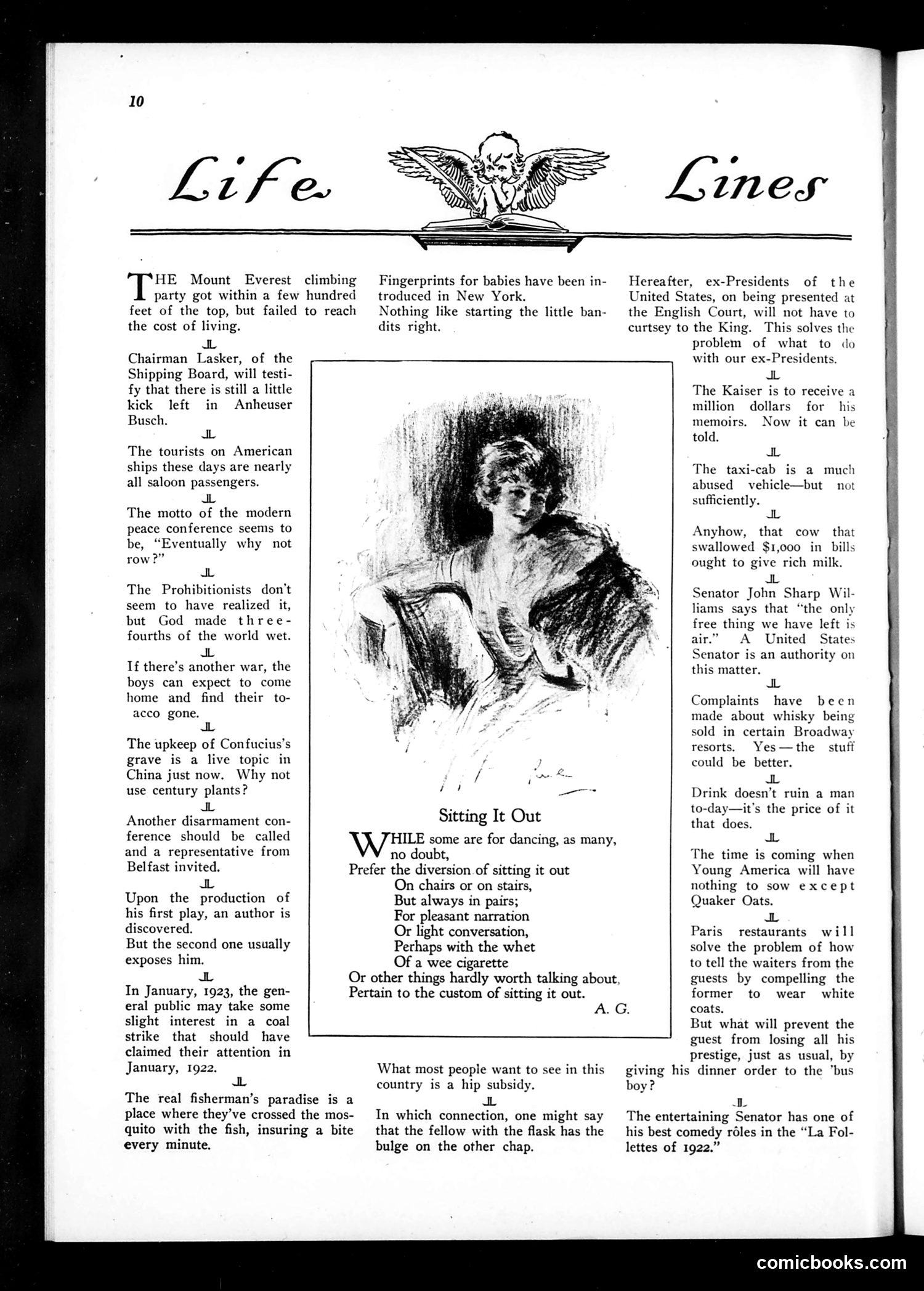
This is a humor/satire page from *Life* magazine featuring brief social commentary and a sketch titled "Sitting It Out" by A.G. The main cartoon depicts a young woman in 1920s style, shown in profile. The accompanying poem humorously contrasts preferences: some enjoy dancing, but others prefer "sitting it out" on chairs or stairs—"always in pairs"—engaging in conversation, cigarette smoking, and flirtation instead. The surrounding "Life Lines" consist of brief satirical jabs at contemporary issues: Prohibition enforcement, peace conferences, taxi regulations, whisky quality on Broadway, and Senator John Sharp Williams's claims about American freedom. The humor targets 1920s social concerns—drinking laws, diplomacy, and public complaints about urban services and product quality. The overall tone is witty, dismissive commentary on current events and social foibles.
📄 Transcribed text from this page (OCR, searchable)
Machine-transcribed from the original scan — historical spelling and the odd misread are preserved.
HE Mount Everest climbing party got within a few hundred feet of the top, but failed to reach the cost of living. Chairman Lasker, of the Shipping Board, will testi- fy that there is still a little kick left in Anheuser Busch. aL The tourists on American ships these days are nearly all saloon passengers. JL The motto of the modern peace conference seems to be, “Eventually why not row?” JL The Prohibitionists don't seem to have realized it, but God made three- fourths of the world wet. aL If there’s another war, the boys can expect to come home and find their to- acco gone. -L The upkeep of Confucius’s grave is a live topic in China just now. Why not use century plants? JL Another disarmament con- ference should be called and a representative from Belfast invited. IL Upon the production of his first play, an author is discovered. But the second one usually exposes him. Fingerprints for babies have been in- troduced in New York. Nothing like starting the little ban- dits right. Hereafter, ex-Presidents of the United States, on being presented at the English Court, will not have to curtsey to the King. This solves the problem of what to do with our ex-Presidents. — Sitting It Out \ » JHILE some are for dancing, as many, no doubt, Prefer the diversion of sitting it out On chairs or on stairs, But always in pairs; For pleasant narration Or light conversation, Perhaps with the whet Of a wee cigarette LL Or other things hardly worth talking about In January, 1923, the gen- eral public may take some slight interest in a coal strike that should have claimed their attention in January, 1922. The real fisherman’s paradise is a place where they’ve crossed the mos- quito with the fish, insuring a bite every minute. Pertain to the custom of sitting it out. A.G. aL The Kaiser is to receive a million dollars for his memoirs. Now it can be told. aL The taxi-cab is a much abused vehicle—but not sufficiently. Anyhow, that cow that swallowed $1,000 in_ bills ought to give rich milk. L Senator John Sharp Wil- liams says that “the only free thing we have left is air.” A United States Senator is an authority on this matter. aL Complaints have been made about whisky being sold in certain Broadway resorts. Yes—the stuff could be better. -L Drink doesn’t ruin a man to-day—it’s the price of it that does. aL The time is coming when Young America will have nothing to sow except Quaker Oats. -L Paris restaurants will solve the problem of how to tell the waiters from the guests by compelling the former to wear white coats. But what will prevent the What most people want to see in this country is a hip subsidy. LL In which connection, one might say that the fellow with the flask has the bulge on the other chap. guest from losing all his prestige, just as usual, by giving his dinner order to the "bus boy? -L The entertaining Senator has one of his best comedy rdles in the “La Fol- lettes of 1922.” comicbooks.com