
Life, 1922-07-13 · page 23 of 36
Life — July 13, 1922 — page 23: what you’re looking at
What you’re looking at
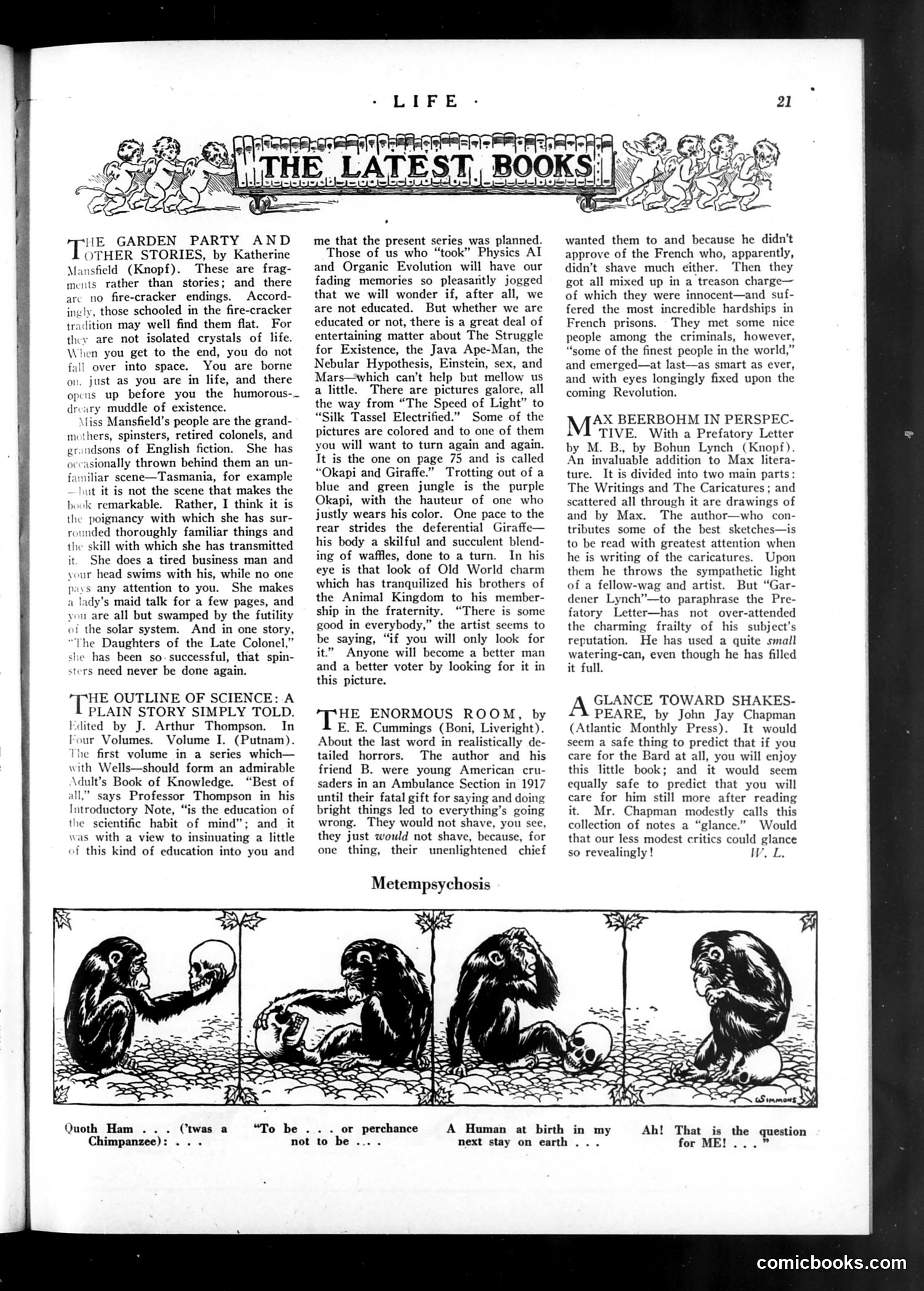
This four-panel comic strip illustrates the philosophical concept of metempsychosis (the transmigration of souls/reincarnation). It depicts a chimpanzee contemplating its own existence and potential future incarnations. **Panel progression:** The chimp first questions "To be or not to be" (referencing Hamlet's famous soliloquy), then wonders "or perchance not to be," followed by pondering "A Human at birth in my next stay on earth," and finally concluding "Ah! That is the question for ME!" **The satire:** The joke inverts the typical human-animal hierarchy. Rather than humans considering evolution from animals, here the ape humorously worries about the *reverse*—being reincarnated as a human. The implicit commentary suggests that human existence, with all its complications and absurdities (evident from the book reviews above discussing life's muddles and horrors), might actually be *worse* than animal existence. This aligns with the page's literary themes: Katherine Mansfield's stories about life's mundane struggles and Cummings' detailed descriptions of human suffering.
📄 Transcribed text from this page (OCR, searchable)
Machine-transcribed from the original scan — historical spelling and the odd misread are preserved.
‘THe GARDEN PARTY AND OTHER STORIES, by Katherine Mansfield (Knopf). These are frag- ments rather than stories; and there are no fire-cracker endings. Accord- ingly, those schooled in the fire-cracker tradition may well find them flat. For they are not isolated crystals of life. When you get to the end, you do not fall over into space. You are borne on, just as you are in life, and there opens up before you the humorous-~ dreary muddle of existence. liss Mansfield’s people are the grand- mothers, spinsters, retired colonels, and grandsons of English fiction. She has occasionally thrown behind them an un- familiar scene—Tasmania, for example it it is not the scene that makes the book remarkable. Rather, I think it is the poignancy with which she has sur- rounded thoroughly familiar things and the skill with which she has transmitted it. She does a tired business man and your head swims with his, while no one pays any attention to you. She makes a lady’s maid talk for a few pages, and you are all but swamped by the futility of the solar system. And in one story, the Daughters of the Late Colonel,” she has been so- successful, that spin- sters need never be done again. *THE OUTLINE OF SCIENCE: A PLAIN STORY SIMPLY TOLD. Edited by J. Arthur Thompson. In Four Volumes. Volume I. (Putnam). The first volume in a series which— with Wells—should form an admirable \dult’s Book of Knowledge. “Best of ill,” says Professor Thompson in his Introductory Note, “is the education of the scientific habit of mind”; and it was with a view to insinuating a little of this kind of education into you and Quoth Ham .. . (‘twas a Chimpanzee): . . . “To be . . . or perchance not to be ... . me that the present series was planned. Those of us who “took” Physics AI and Organic Evolution will have our fading memories so pleasantly jogged that we will wonder if, after all, we are not educated. But whether we are educated or not, there is a great deal of entertaining matter about The Struggle for Existence, the Java Ape-Man, the Nebular Hypothesis, Einstein, sex, and Mars—which can’t help but mellow us a little. There are pictures galore, all the way from “The Speed of Light” to “Silk Tassel Electrified.” Some of the pictures are colored and to one of them you will want to turn again and again. It is the one on page 75 and is called “Okapi and Giraffe.” Trotting out of a blue and green jungle is the purple Okapi, with the hauteur of one who justly wears his color. One pace to the rear strides the deferential Giraffe— his body a skilful and succulent blend- ing of waffles, done to a turn. In his eye is that look of Old World charm which has tranquilized his brothers of the Animal Kingdom to his member- ship in the fraternity. “There is some good in everybody,” the artist seems to be saying, “if you will only look for it”. Anyone will become a better man and a better voter by looking for it in this picture. THe ENORMOUS ROOM, by E. E. Cummings (Boni, Liveright). About the last word in realistically de- tailed horrors. The author and his friend B. were young American cru- saders in an Ambulance Section in 1917 until their fatal gift for saying and doing bright things led to everything’s going wrong. They would not shave, you see, they just would not shave, because, for one thing, their unenlightened chief Metempsychosis A Human at birth in my next stay on earth ... wanted them to and because he didn't approve of the French who, apparently, didn’t shave much either. Then they got all mixed up in a treason charge— of which they were innocent—and suf- fered the most incredible hardships in French prisons. They met some nice people among the criminals, however, “some of the finest people in the world,” and emerged—at last—as smart as ever, and with eyes longingly fixed upon the coming Revolution. AX BEERBOHM IN PERSPEC- a TIVE. With a Prefatory Letter by M. B., by Bohun Lynch (Knopf). An invaluable addition to Max litera- ture. It is divided into two main parts: The Writings and The Caricatures ; and scattered all through it are drawings of and by Max. The author—who con- tributes some of the best sketches—is to be read with greatest attention when he is writing of the caricatures. Upon them he throws the sympathetic light of a fellow-wag and artist. But “Gar- dener Lynch”—to paraphrase the Pre- fatory Letter—has not over-attended the charming frailty of his subject's reputation. He has used a quite small watering-can, even though he has filled it full. A GLANCE TOWARD SHAKES- PEARE, by John Jay Chapman (Atlantic Monthly Press). It would seem a safe thing to predict that if you care for the Bard at all, you will enjoy this little book; and it would seem equally safe to predict that you will care for him still more after reading it. Mr. Chapman modestly calls this collection of notes a “glance.” Would that our less modest critics could glance so revealingly! WL. That is the question for ME! ...” comicbooks.com