
Life, 1922-07-13 · page 11 of 36
Life — July 13, 1922 — page 11: what you’re looking at
What you’re looking at
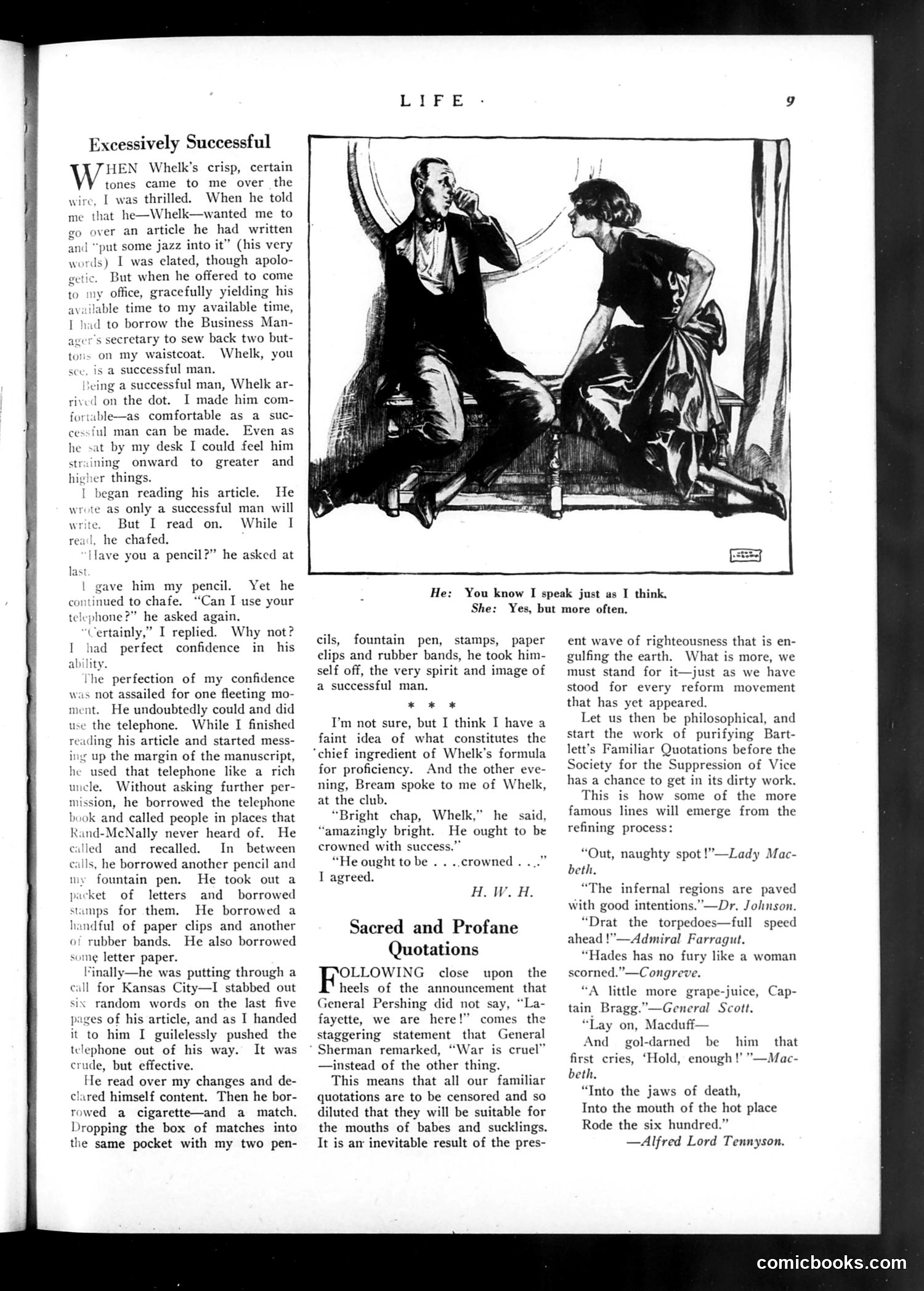
This satirical piece mocks a successful businessman named Whelk who visits the author's office. The cartoon depicts two men in conversation, with the caption showing Whelk saying "You know I speak just as I think" and the author replying "Yes, but more often." The joke satirizes Whelk's supposed success: despite his obvious lack of refinement (he can't write properly, chafes at using borrowed writing instruments), he's achieved business success. The author humorously demonstrates this by describing how confidently Whelk borrowed office supplies and used the telephone—acting entirely comfortable despite being incompetent. The satire critiques how financial success doesn't correlate with intelligence, manners, or genuine ability—a commentary on Gilded Age social climbing and the disconnect between wealth and merit.
📄 Transcribed text from this page (OCR, searchable)
Machine-transcribed from the original scan — historical spelling and the odd misread are preserved.
Excessively Successful HEN Whelk’s crisp, certain V tones came to me over the wire, I was thrilled. When he told me that he—Whelk—wanted me to go over an article he had written and * put some jazz into it” (his very words) I was elated, though apolo- getic. But when he offered to come to my office, gracefully yielding his available time to my available time, I had to borrow the Business Man- s secretary to sew back two but- on my waistcoat. Whelk, you is a successful man. cing a successful man, Whelk ar- lon the dot. I made him com- table—as comfortable as a suc- ful man can be made. Even as sat by my desk I could feel him ning onward to greater and gher things. began reading his article. He te as only a successful man will . But I read on. While I he chafed. lave you a pencil?” he asked at gave him my pencil. Yet he inued to chafe. “Can I use your hone?” he asked again. Certainly,” I replied. Why not? I had perfect confidence in his ability. lhe perfection of my confidence was not assailed for one fleeting mo- ment. He undoubtedly could and did use the telephone. While I finished reading his article and started mess- ing up the margin of the manuscript, he used that telephone like a rich uncle. Without asking further per- mission, he borrowed the telephone book and called people in places that d-McNally never heard of. He called and recalled. In between calls, he borrowed another pencil and fountain pen. He took out a packet of letters and borrowed ps for them. He borrowed a Iful of paper clips and another rubber bands. He also borrowed ing letter paper. nally—he was putting through a call for Kansas City—I stabbed out six random words on the last five pages of his article, and as I handed it to him I guilelessly pushed the telephone out of his way. It was crude, but effective. He read over my changes and de- clared himself content. Then he bor- rowed a cigarette—and a match. Dropping the box of matches into the same pocket with my two pen- He: You know I speak just as I think. She: cils, fountain pen, stamps, paper elips and rubber bands, he took him- self off, the very spirit and image of a successful man. + * * I’m not sure, but I think I have a faint idea of what constitutes the “chief ingredient of Whelk’s formula for proficiency. And the other eve- ning, Bream spoke to me of Whelk, at the club. “Bright chap, Whelk,” he said, “amazingly bright. He ought to be crowned with success.” “He ought to be . . ..crowned . ...” I agreed. H.W. H. Sacred and Profane Quotations Poyerns close upon the heels of the announcement that General Pershing did not say, “La- fayette, we are here!” comes the staggering statement that General Sherman remarked, “War is cruel” —instead of the other thing. This means that all our familiar quotations are to be censored and so diluted that they will be suitable for the mouths of babes and sucklings. It is am inevitable result of the pres- Yes, but more often. ent wave of righteousness that is en- gulfing the earth. What is more, we must stand for it—just as we have stood for every reform movement that has yet appeared. Let us then be philosophical, and start the work of purifying Bart- lett’s Familiar Quotations before the Society for the Suppression of Vice has a chance to get in its dirty work. This is how some of the more famous lines will emerge from the refining process: “Out, naughty spot !”—Lady Mac- beth. “The infernal regions are paved with good intentions.”—Dr. Johnson. “Drat the torpedoes—full speed ahead !"—Admiral Farragut. “Hades has no fury like a woman scorned.”—Congreve. “A little more grape-juice, Cap- tain Bragg.”"—General Scott. “Lay on, Macduff— And gol-darned be him that first cries, ‘Hold, enough !’ "—Mac- beth, “Into the jaws of death, Into the mouth of the hot place Rode the six hundred.” —Alfred Lord Tennyson. comicbooks.com