
A complete issue · 34 pages · 1922
Life — April 27, 1922
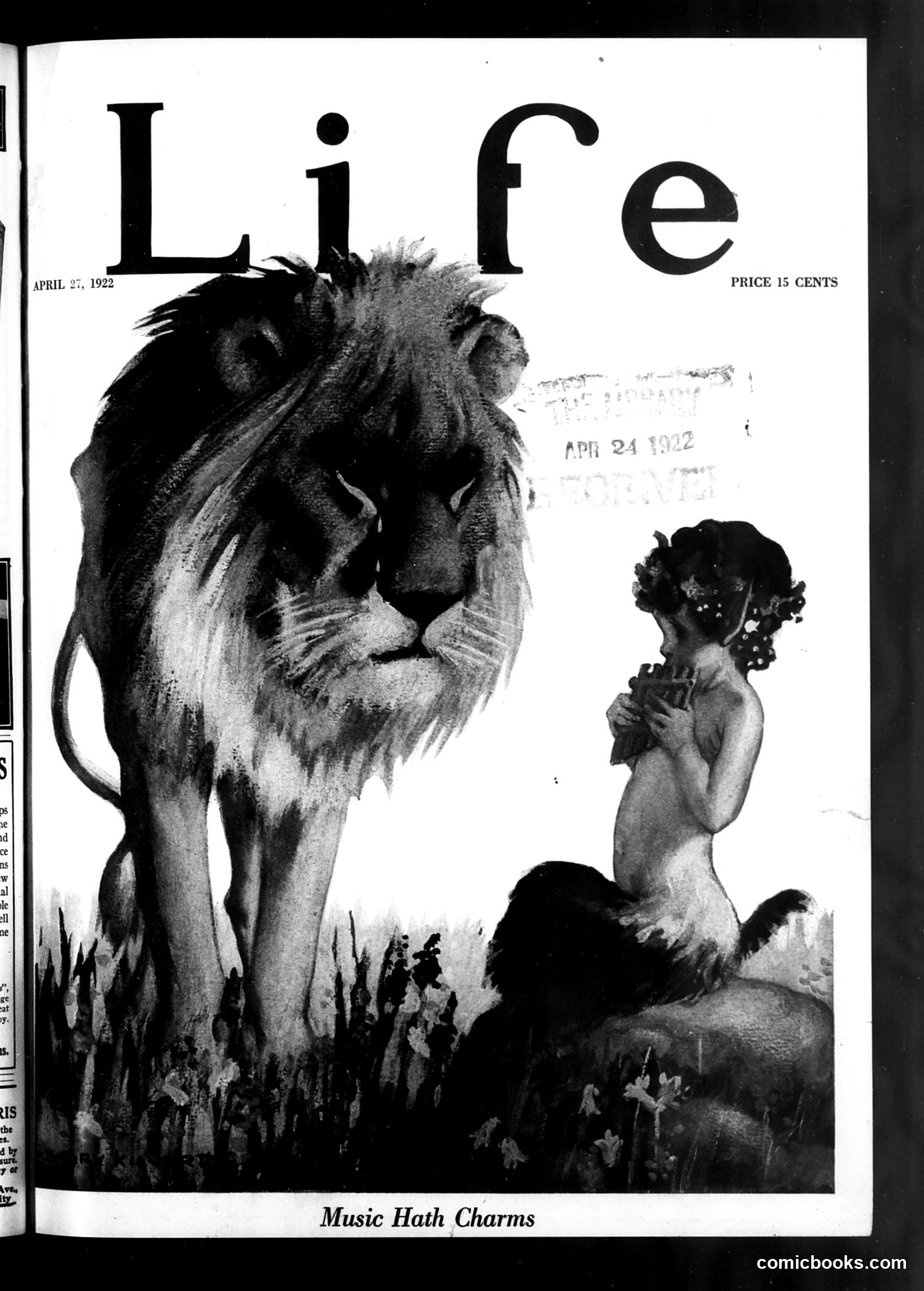
This cover illustrates the classical adage "music hath charms to soothe the savage beast." The image depicts a mythological or fantastical scenario: a fierce lion is depicted gazing downward at a nude cherub or cupid figure playing what appears to be a pan flute or similar instrument. The satire likely comments on the civilizing or pacifying power of music and art—suggesting that even the most dangerous or "savage" force can be tamed by aesthetic refinement. The juxtaposition of the threatening lion with the innocent, delicate cherub emphasizes this contrast between wildness and domestication through culture. The reference remains recognizable today as it plays on a timeless proverb about art's universal power.
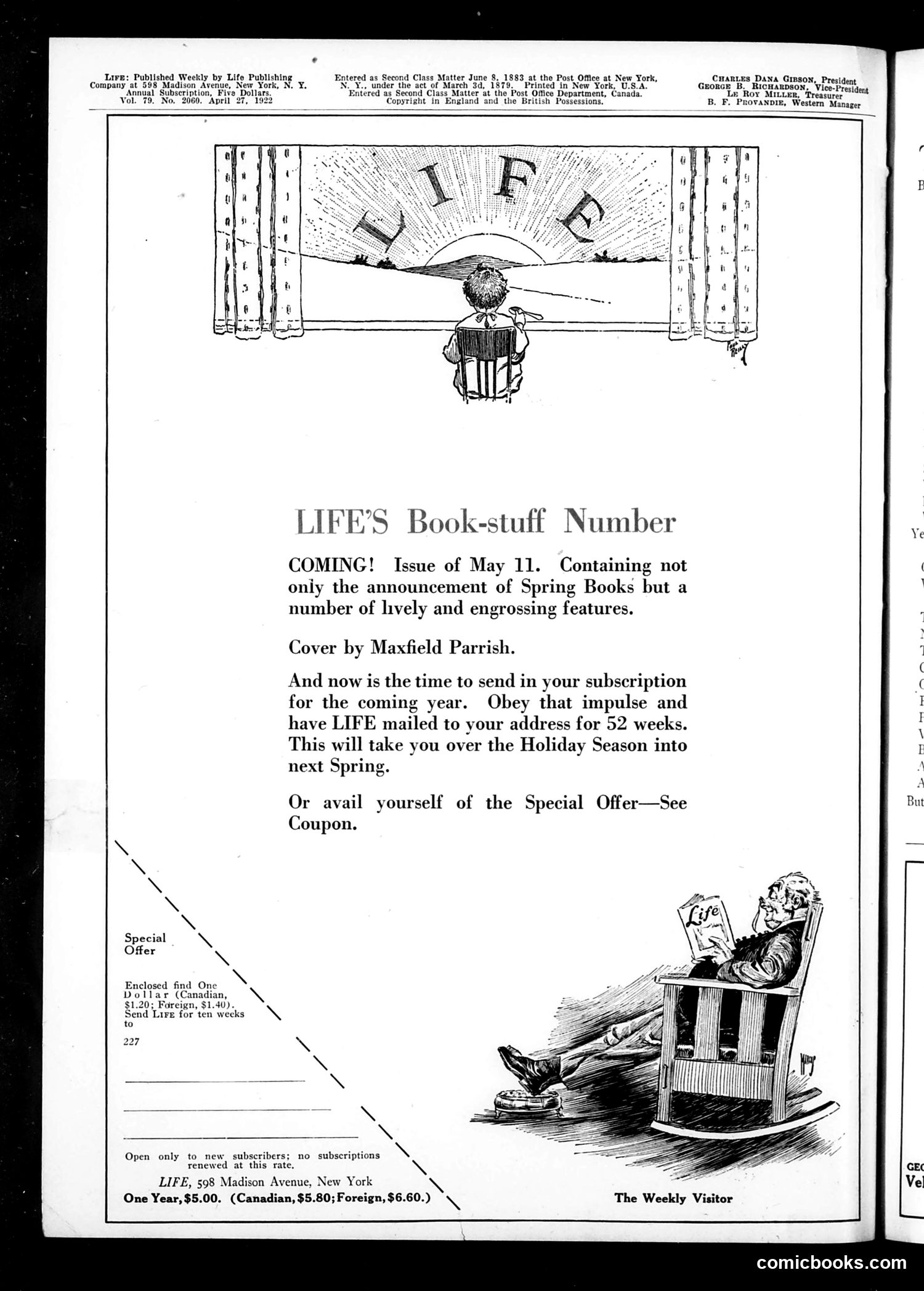
This page is primarily **advertising content** for Life magazine's upcoming "Book-stuff Number" (May 11 issue). The central visual shows a figure viewing a sunrise or landscape labeled "LIFE"—a metaphorical image suggesting renewal and literary content. The advertisement promotes: - An upcoming spring books announcement issue - A cover by artist Maxfield Parrish - Subscription offers for the coming year at $5.00 (or $5.80 Canadian) - A special promotional coupon offering one dollar toward a ten-week subscription The lower illustration depicts a man contentedly reading Life magazine in a rocking chair, reinforcing the leisure and relaxation the publication promises its readers. This is essentially **promotional material** rather than satirical political commentary.
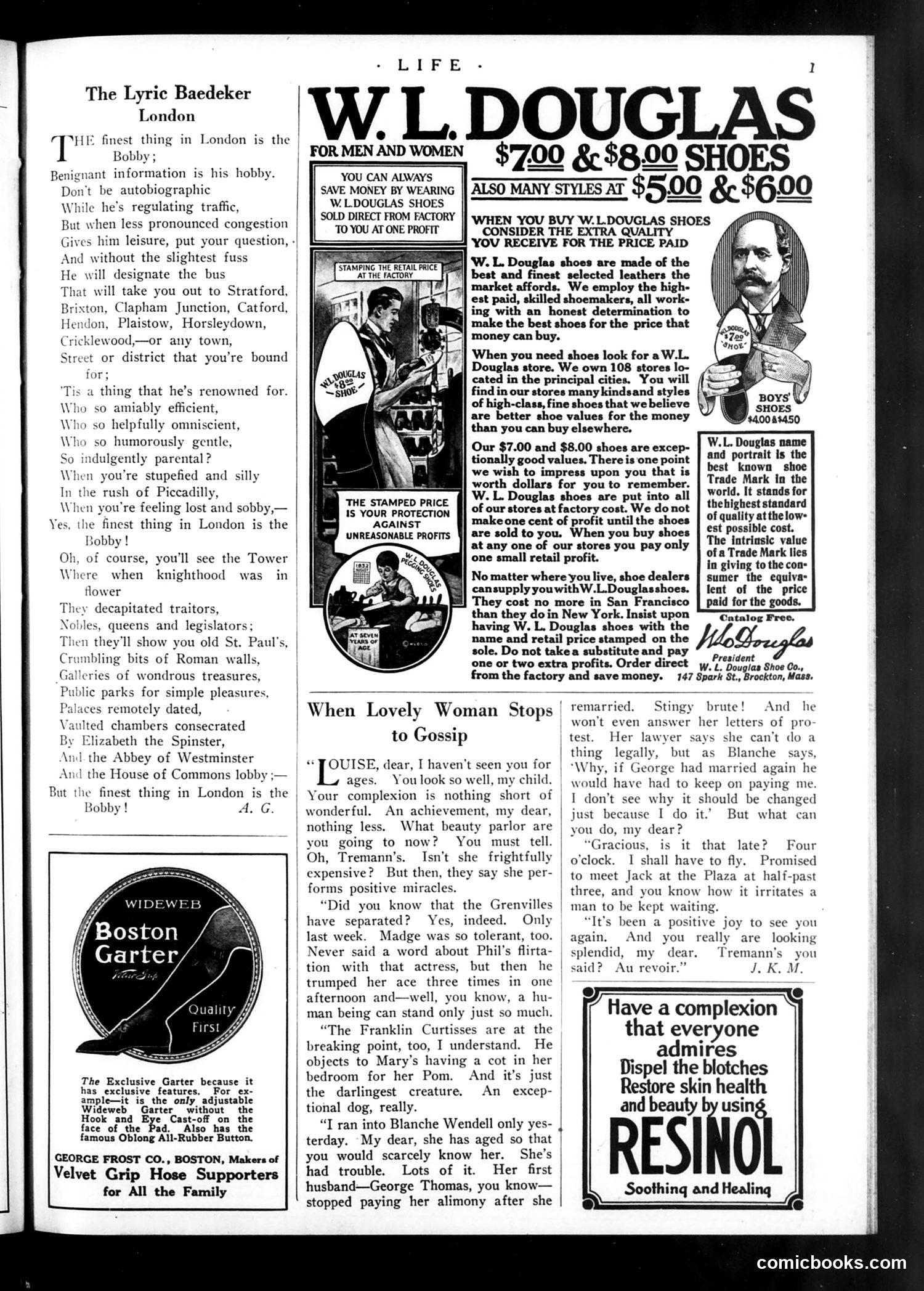
This page is primarily **advertising and prose fiction**, not political satire. The dominant content is a large W.L. Douglas shoe advertisement emphasizing factory-direct sales and value, featuring a mustachioed man's portrait. Below that appears to be the beginning of a gossipy short story titled "When Lovely Woman Stops to Gossip," featuring dialogue between characters named Louise, George, and references to social scandals (infidelity, alimony disputes, flirtations). The page also contains smaller ads for Boston Garter hose and Resinol skin product. A poem titled "The Lyric Baedeker" celebrates London's attractions. There is **no apparent political cartoon or satire** on this page—it reflects Life magazine's mixed format of advertising, light humor, and consumer product promotions typical of early 20th-century American magazines.
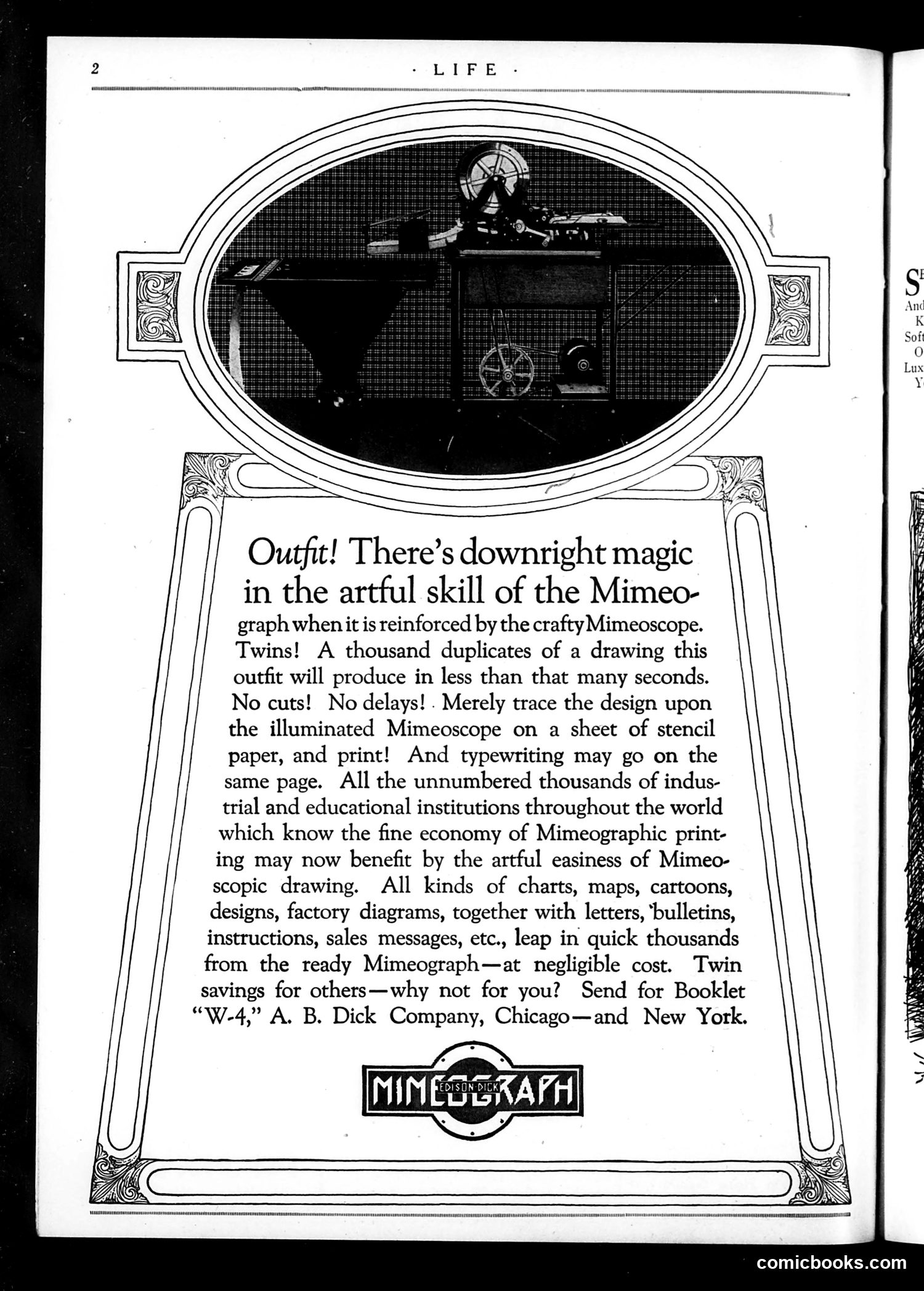
This page is primarily **advertising, not editorial content or satire**. It advertises the Mimeograph and Mimeoscope, duplicating machines made by A.B. Dick Company of Chicago and New York. The ad uses hyperbolic language ("downright magic," "artful skill") to promote the Mimeoscope's ability to rapidly reproduce drawings and documents. The oval illustration at top shows the device in operation. The pitch targets "industrial and educational institutions" worldwide, emphasizing speed and economy—a thousand duplicates in seconds at negligible cost. The ad promises the machine will benefit printing, charts, maps, factory diagrams, and business communications. This reflects early-twentieth-century office technology marketing, before photocopiers and computers made such machines obsolete.
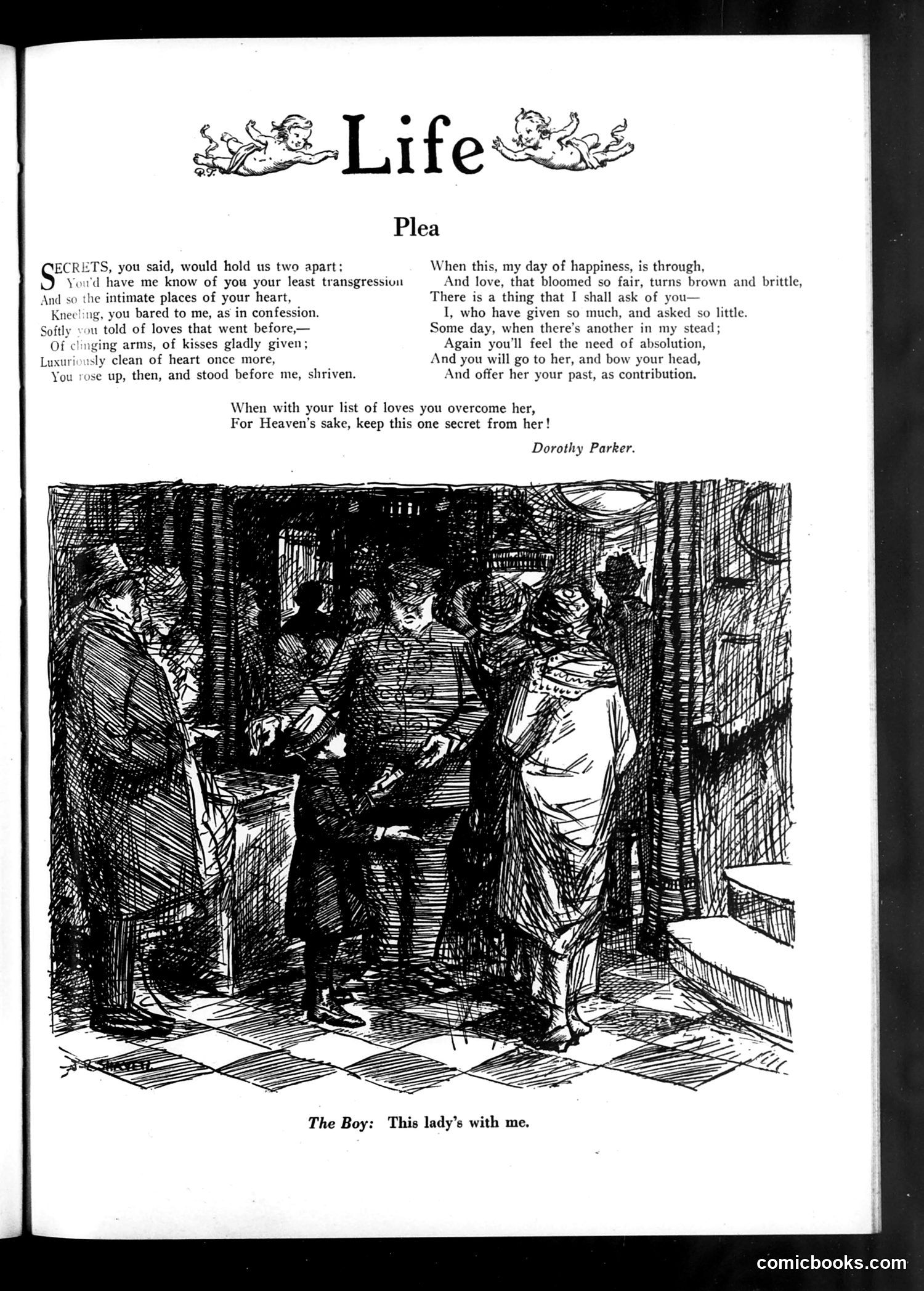
This page contains a poem by Dorothy Parker titled "Plea," accompanying an ink sketch of what appears to be a social scene with multiple figures in an interior setting. The poem addresses relationship secrets and infidelity. The speaker confesses to past transgressions ("loves you overcame her") and asks their current partner to keep these secrets hidden from another woman ("keep this one secret from her"). The poem suggests romantic entanglement with multiple people and requests discretion to avoid hurting the other woman. The accompanying sketch depicts what appears to be a tense social gathering—possibly showing the awkward scenario the poem describes. The caption "The Boy: This lady's with me" suggests a man asserting his claim on a woman amid social tension. The satire targets the hypocrisy and emotional complications of romantic relationships in modern society.
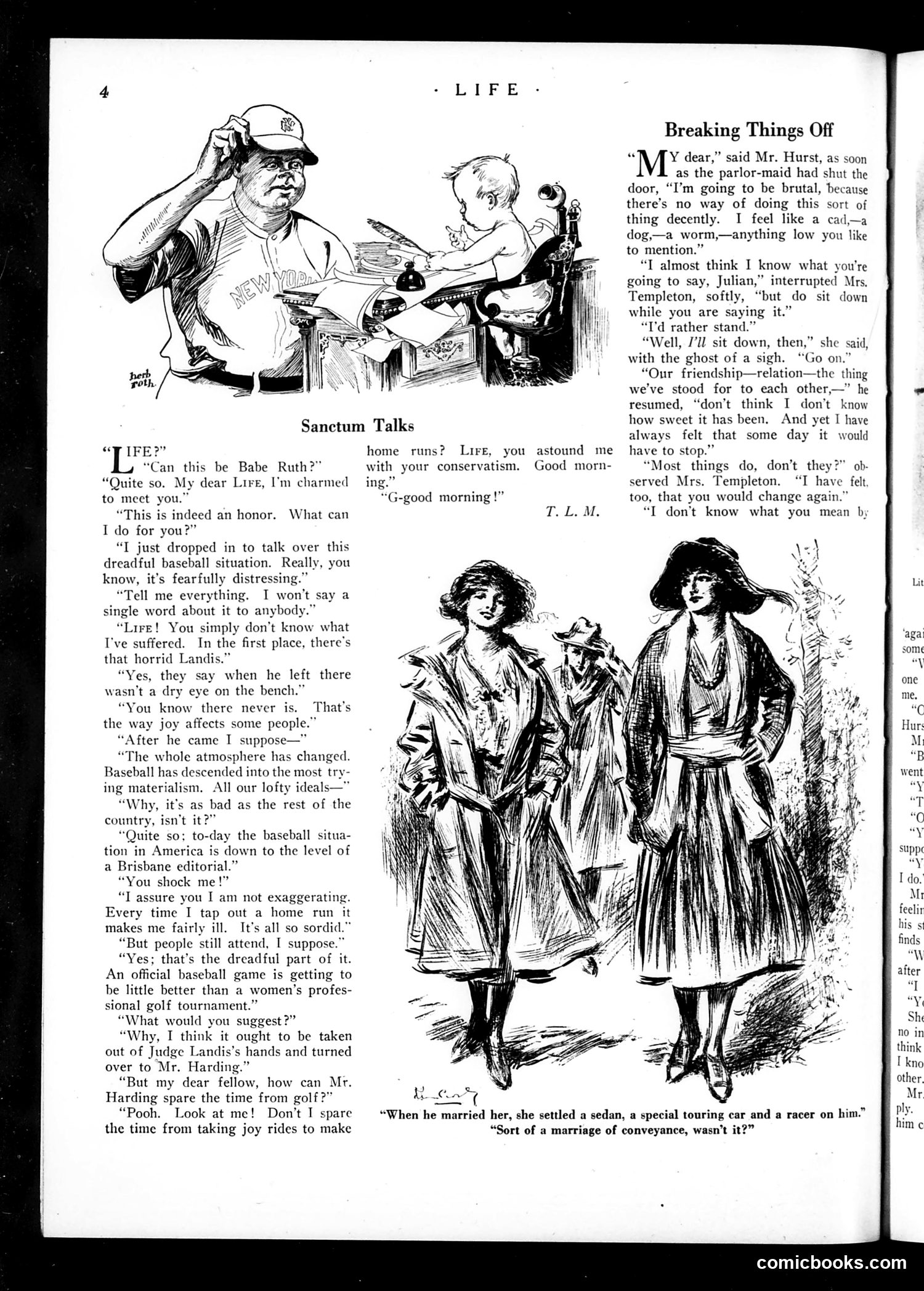
**"Sanctum Talks"** (left column): A conversation between Babe Ruth and an unnamed editor ("Life"). The editor complains that baseball has become materialistic and trivial—players now chase money rather than ideals. Ruth defends the sport, noting fans still attend games. The satire targets post-WWI American concerns that commercial sports corrupted national values. Ruth appears as baseball's defender against intellectual criticism. **"Breaking Things Off"** (right): A domestic scene where Mr. Hurst attempts to end a relationship with his wife Mrs. Templeton. The caption suggests their marriage was transactional—"a marriage of conveyance"—implying she married him for his possessions (sedan, touring car, racer). The satire mocks wealthy marriages based on material exchange rather than genuine affection. Both pieces critique 1920s materialism.
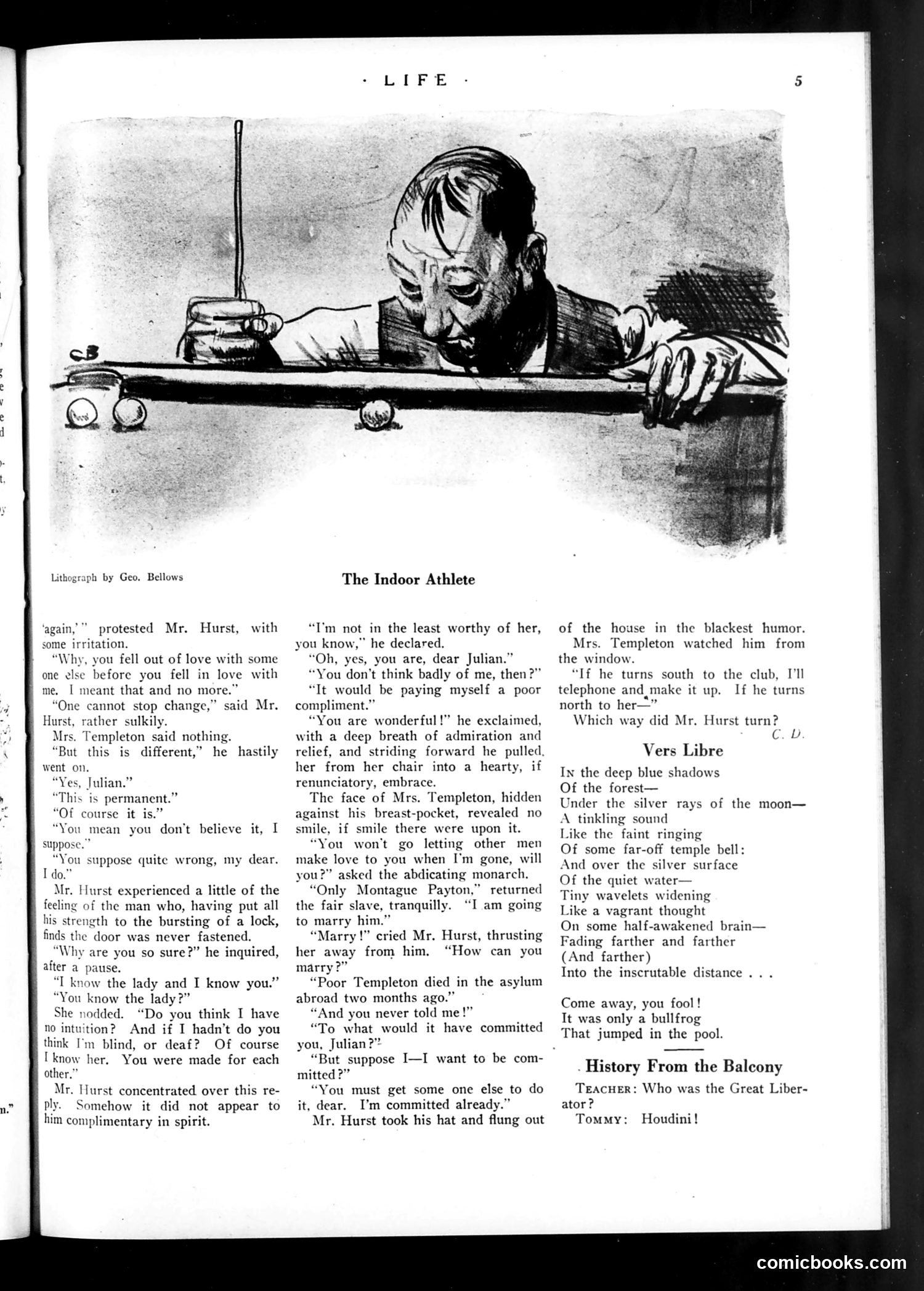
The lithograph by Geo. Bellows depicts a man hunched over a billiards table, intensely focused on his shot. The cartoon satirizes the concept of "indoor athletics"—mocking the notion that playing pool/billiards constitutes legitimate athletic activity. The exaggerated facial features and body position emphasize the absurdity: rather than genuine sports requiring physical exertion, this "athlete" merely bends over a table with a cue. The satire targets sedentary leisure activities being rebranded as athletic pursuits, likely reflecting early 20th-century debates about what constitutes "exercise" versus mere indoor recreation. The surrounding text appears to be unrelated fiction, but the cartoon's message is clear: billiards players aren't real athletes.
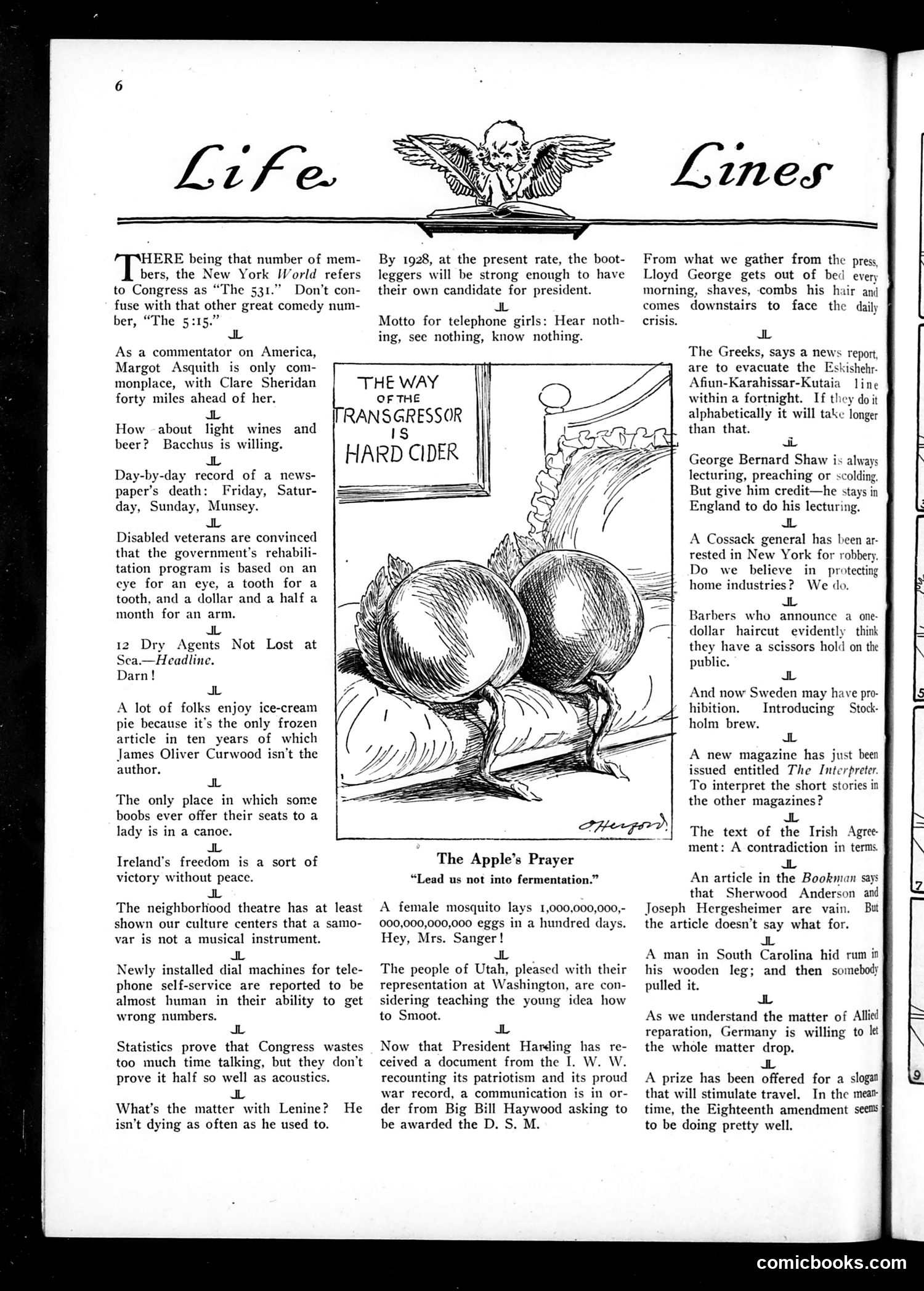
This single-panel cartoon depicts anthropomorphized apples with a caption reading "Lead us not into fermentation." The joke targets Prohibition-era anxieties about alcohol production. The image shows apples in what appears to be a cider press, with the heading "THE WAY OF THE TRANSGRESSOR IS HARD CIDER"—a pun on the biblical phrase "the way of the transgressor is hard." The satire works on multiple levels: apples "pray" to avoid being processed into hard cider (illegal under Prohibition), while the setup mocks both religious piety and the widespread illegal alcohol production occurring despite the 18th Amendment (1920-1933). The cartoon assumes readers recognize cider-making as common bootlegging activity during this period.
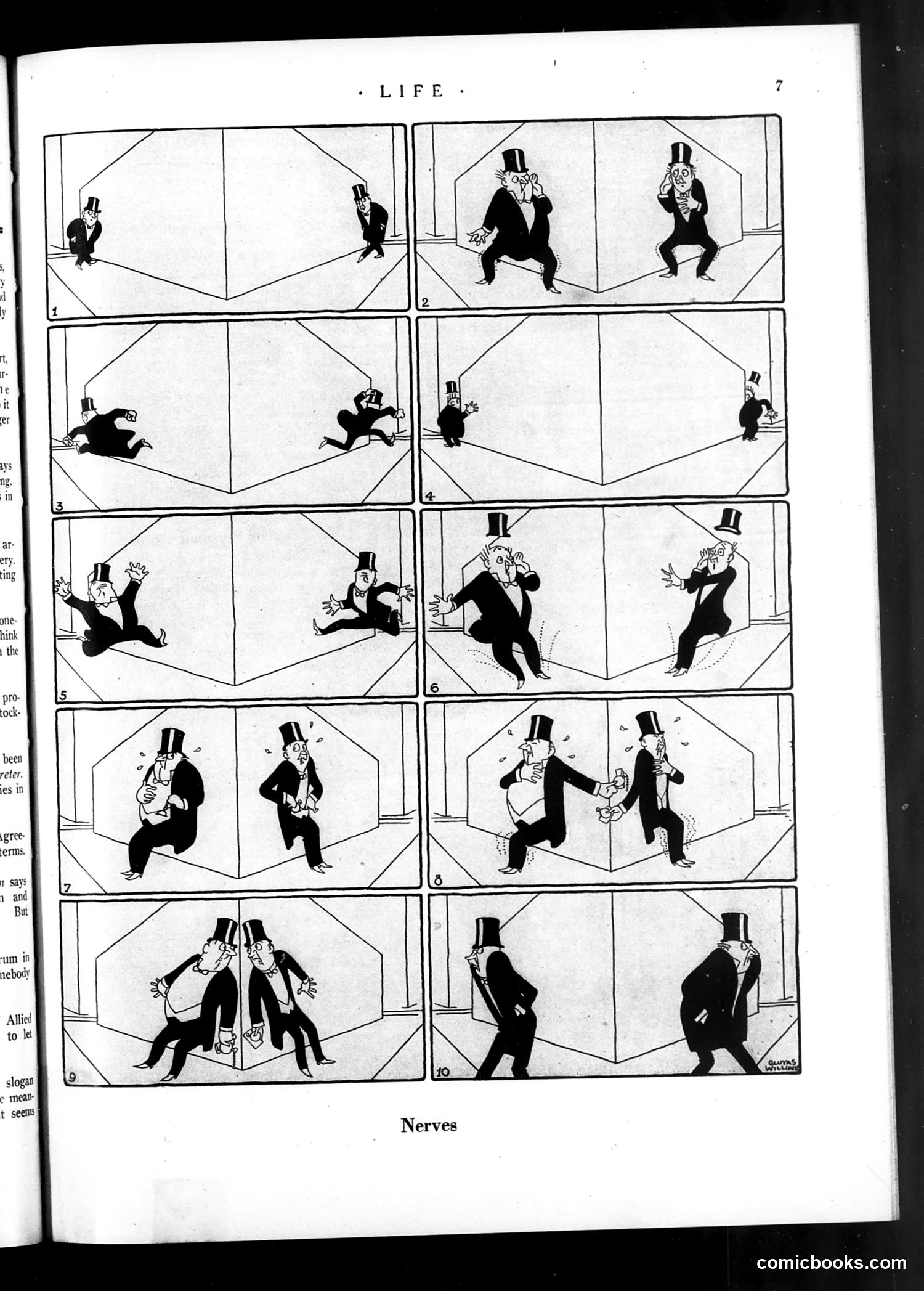
This is a humorous comic strip about nervous behavior in confined spaces, likely an elevator or narrow hallway. The strip shows two formally-dressed men (wearing top hats, suggesting upper-class figures) exhibiting increasingly erratic and anxious behavior as they occupy the same small space together. The progression depicts classic "nervous" reactions: awkward posturing, exaggerated movements, fidgeting, and ultimately physical comedy as both men become visibly distressed by their proximity. The joke plays on the social awkwardness and tension that arise when strangers are forced into close quarters—a relatable scenario for early 20th-century urban readers familiar with elevators and crowded public spaces. The satire gently mocks human anxiety and the absurd behaviors people display when socially uncomfortable.
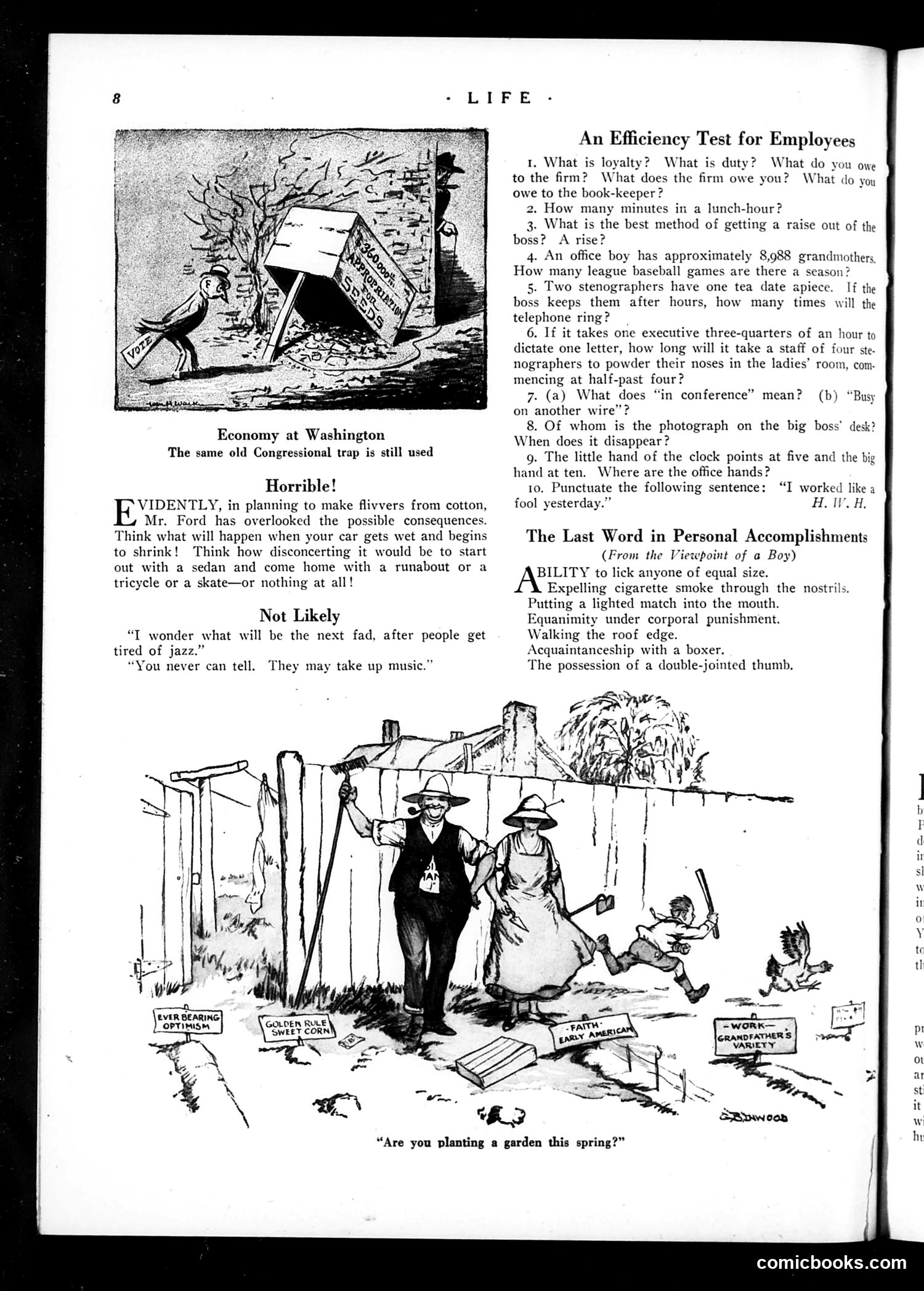
This page contains two distinct sections: **Top cartoon** ("Economy at Washington"): Depicts a Congressional representative trapped in an old-fashioned vehicle, satirizing outdated legislative approaches to modern problems. The caption suggests Congress hasn't updated its methods despite changing times. **Bottom cartoon** ("Are you planting a garden this spring?"): Shows a couple surrounded by labeled concepts—"Ever Bearing Optimism," "Golden Rule," "Faith," "Early American," "Work," and "Grandfather's Variety." This appears to be satirizing Depression-era self-sufficiency rhetoric, mocking the notion that traditional virtues and home gardening alone could solve economic hardship. The cartoon's tone suggests skepticism toward such simplistic solutions during serious economic crisis. Both cartoons critique inadequate responses to contemporary problems through gentle mockery rather than harsh denunciation.
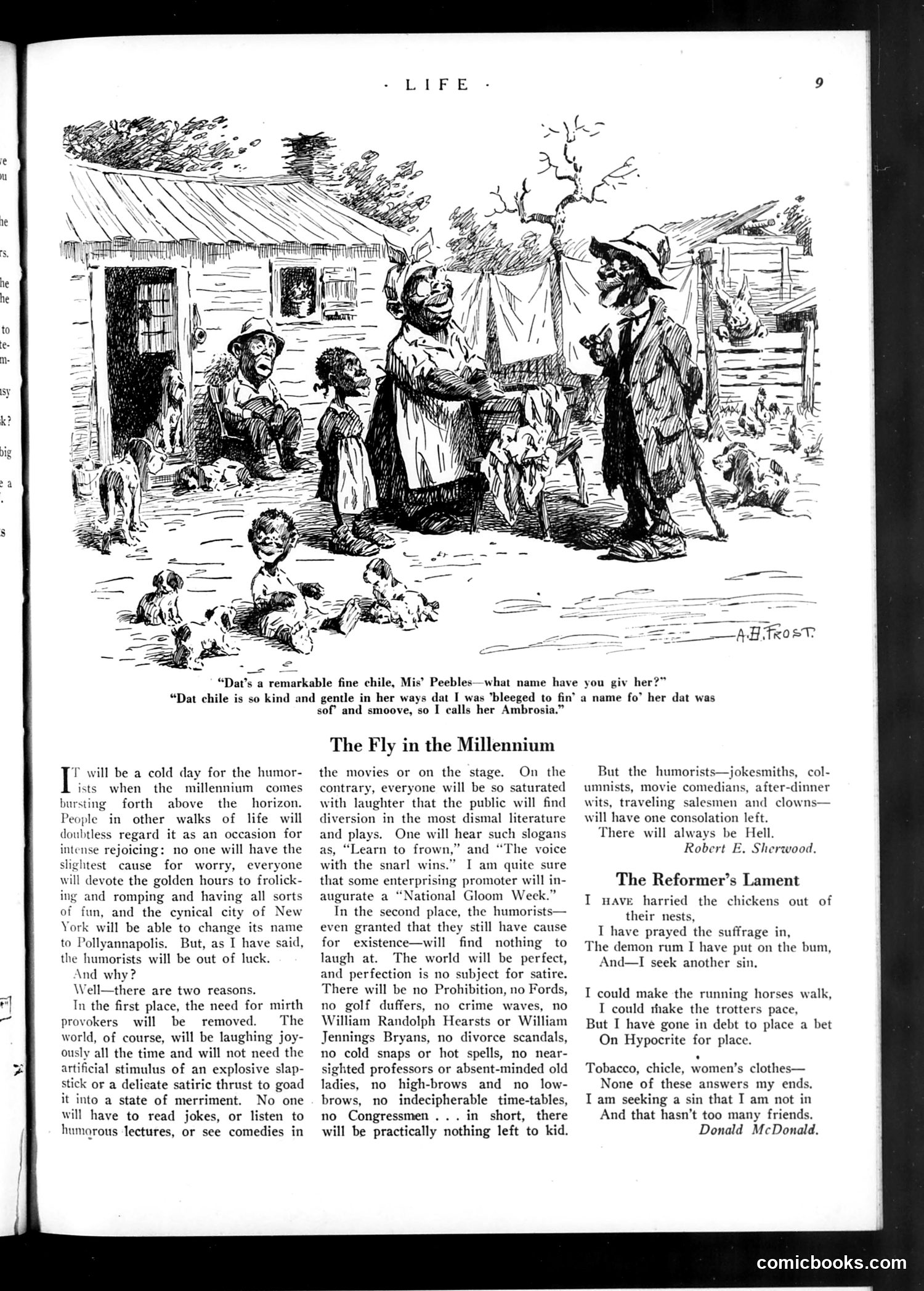
The cartoon depicts a rural scene with working-class figures and children. The dialogue identifies a child as "Ambrosia," with commentary on her gentle nature. The illustration is signed by A.B. Frost, a noted cartoonist. Below are three short humorous pieces. "The Fly in the Millennium" satirizes optimism about the coming 20th century, arguing that humorists will become obsolete in a "perfect" future world without crime, golf disputes, or divorce scandals. "The Reformer's Lament" mocks a social reformer frustrated that their causes—suffrage, temperance, and various moral reforms—haven't eliminated all vices, leaving them without purpose. The content reflects Progressive Era anxieties about social reform and technological optimism circa 1900.
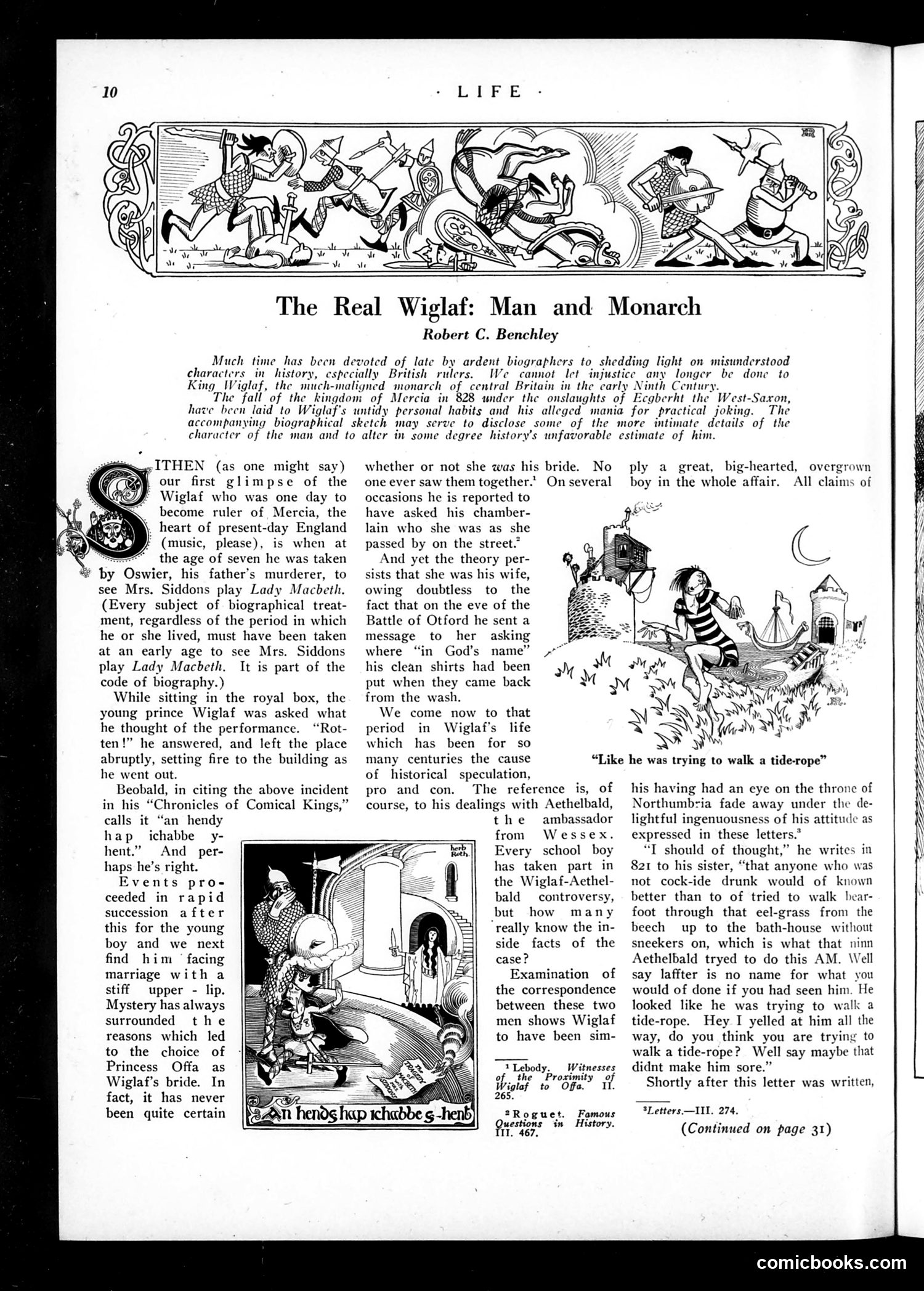
This page discusses the historical figure Wiglaf, who became ruler of Mercia (in present-day England) in the early Ninth Century. Benchley uses Wiglaf's biography to examine how little we truly know about historical figures, despite claims made about them. The article references Wiglaf's alleged bride and domestic incidents, questioning historical accuracy. The accompanying illustrations show medieval scenes—including what appears to be a figure trying to "walk a tide-rope" (likely a humorous metaphor for maintaining balance or dignity in difficult circumstances). Benchley's point is satirical: we construct elaborate narratives about historical "great men" based on fragmentary evidence, creating false certainty about intimate details we cannot possibly verify. The essay is part of Life's tradition of witty commentary on historical pretension.
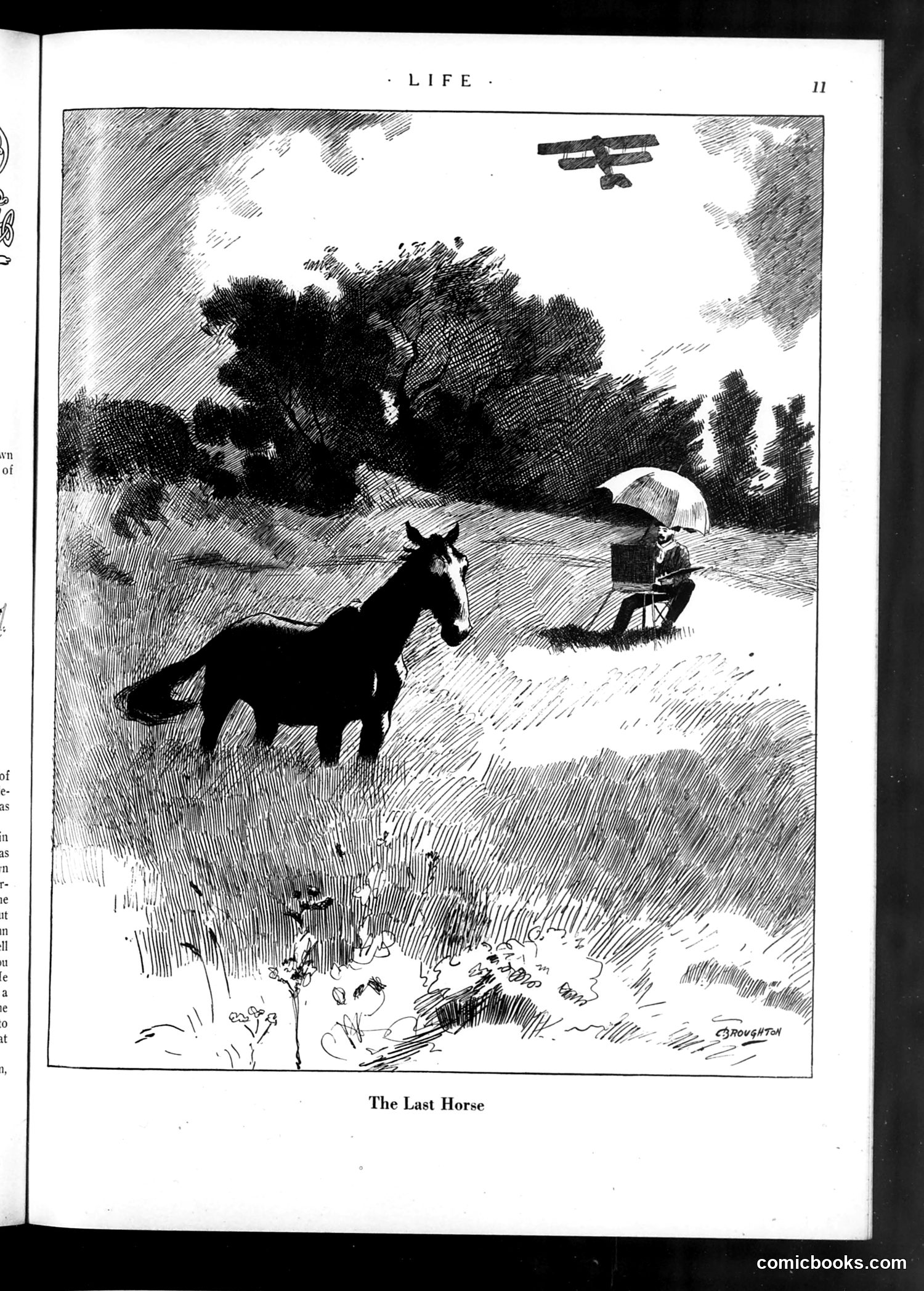
This cartoon depicts a horse standing in a rural landscape while an airplane flies overhead and a person with an umbrella sits in what appears to be an early motorized vehicle. The title "The Last Horse" suggests anxieties about technological obsolescence during the early aviation and automobile era (likely early 20th century). The satire contrasts traditional transportation—the horse—with modern innovations: the airplane and automobile. The horse appears isolated and anachronistic, surrounded by these new technologies. This reflects period concerns about industrialization rendering traditional forms of transport, labor, and rural life obsolete. The cartoon likely resonated with contemporary debates about progress, technology's social impact, and nostalgia for pre-industrial ways of life.
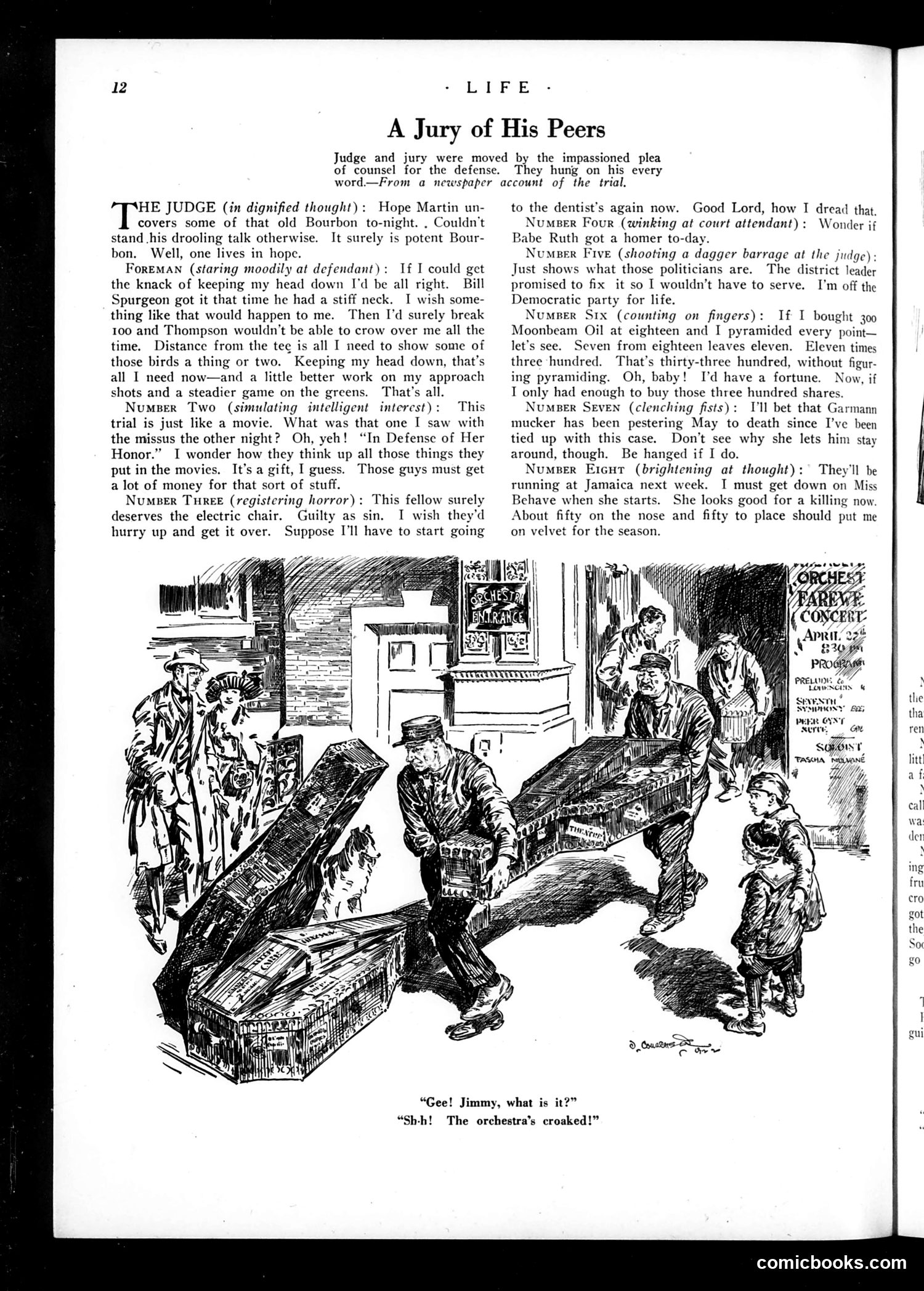
This page satirizes a murder trial through the commentary of jurors. The title references the legal concept of trial "by a jury of his peers," but Life's satire suggests jurors are distracted, incompetent, and self-interested rather than serious arbiters of justice. The jurors discuss: avoiding jury duty, financial calculations, gambling on horses, baseball statistics, and social plans—anything except the actual case. One mentions a Babe Ruth baseball game; another calculates stock dividends. The illustration shows a coffin delivery scene, with the caption joke: "Gee! Jimmy, what is it?" / "Sh-h! The orchestra's croaked!" The satire mocks both jurors' frivolousness and American popular culture's distraction from serious civic duties. The coffin imagery emphasizes the life-or-death stakes they're ignoring.
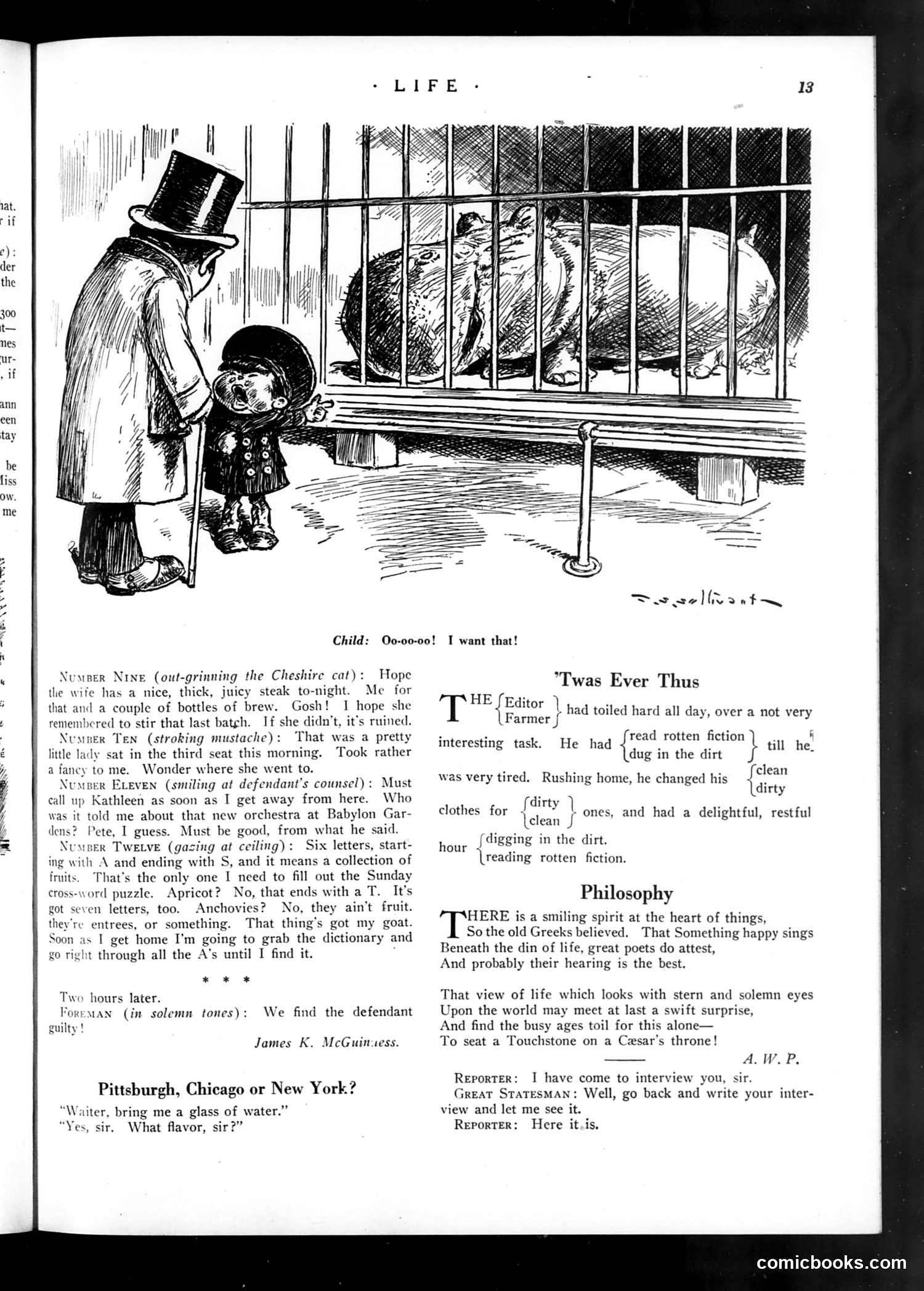
**The Main Cartoon** (top) shows a well-dressed man in a top hat and a small child viewing an elephant in a cage at what appears to be a zoo. The child exclaims "Oo-oo-oo! I want that!" — a humorous moment capturing childish desire for something completely impractical. **The Numbered Humor Entries** (left column) are brief jokes about crossword puzzles, orchestras, and dictionary definitions — typical lighthearted magazine filler. **"'Twas Ever Thus"** (center) is an editorial anecdote about a farmer-editor who had a tiring day dealing with "rotten fiction" submissions and changing clothes multiple times. **"Philosophy"** (right) is a brief essay reflecting on ancient Greek philosophy and life's meaning, ending with a joke about a reporter interviewing a "Great Statesman." This is typical satirical magazine content from the early 20th century.
This editorial page discusses Irish political turmoil following the Free State Treaty. The text references Colonel Frederick Palmer's firsthand reporting on factional violence, specifically mentioning the "Corner Boys" (described as "gangsters or Hooligans") opposing the Free State government. The piece argues Ireland needs a capable police force to maintain order, comparing the situation to Britain's handling of similar insurgency in Cuba. It expresses cautious optimism that once Ireland establishes political stability and "cleaned up," it could become an attractive destination for American tourists. The satirical tone suggests skepticism about Irish governance capacity while hoping for eventual peace and economic benefit—a typically detached American view of Irish independence struggles in the early 1920s.
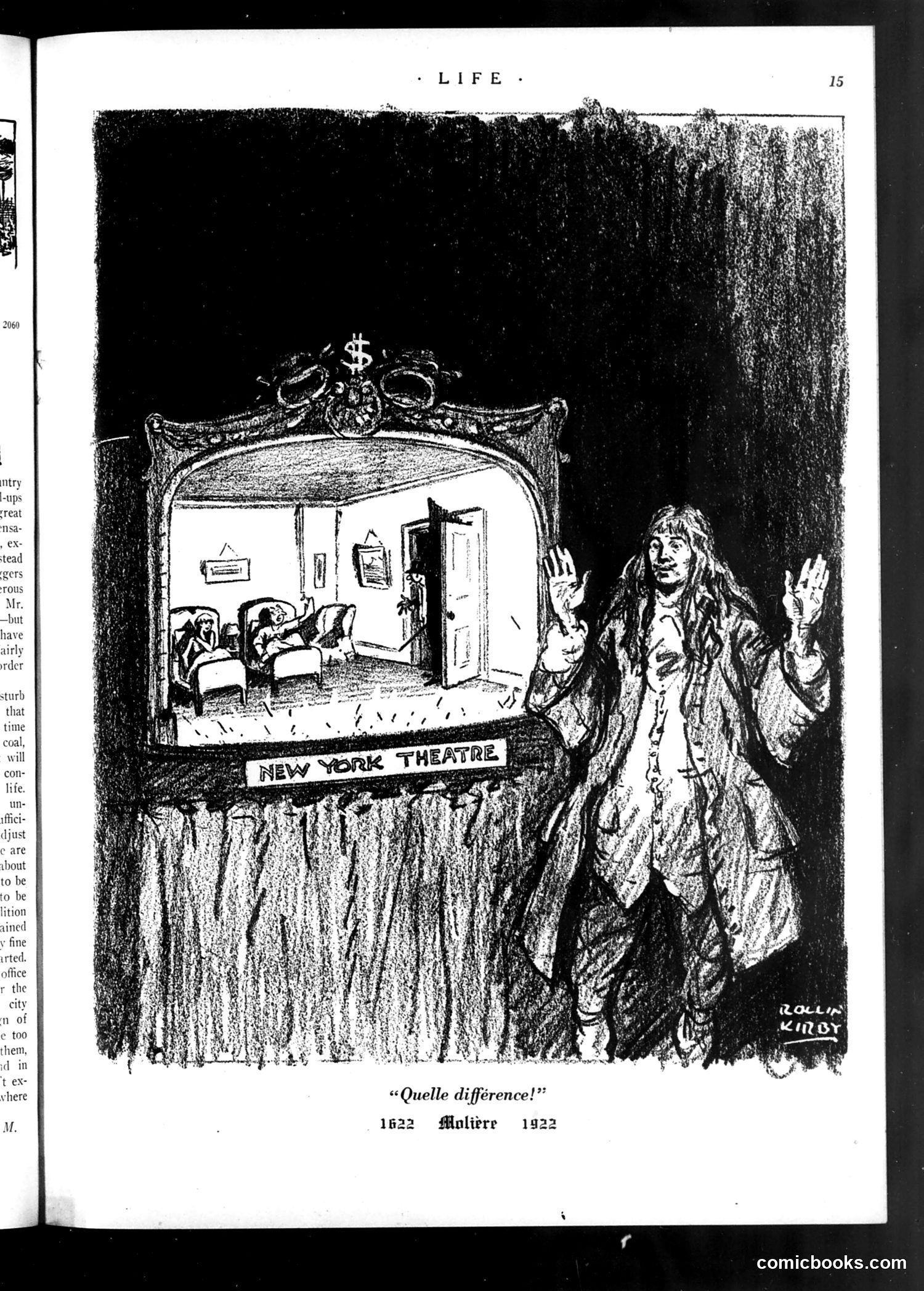
This satirical cartoon compares theatrical production across 300 years. The left side shows a modest 17th-century Molière theater setup (labeled "1622 Molière 1922"), with simple furnishings and sparse staging. The right depicts a figure gesturing at an elaborate "New York Theatre" with ornate framing, suggesting modern American theatrical grandeur and commercial excess. The caption "Quelle différence!" ironically highlights how theater has transformed from Molière's era to 1922—likely critiquing either American theatrical commercialism or the pretension of contemporary productions compared to classical French drama's simplicity. The contrast emphasizes how profit-driven spectacle has replaced artistic restraint.
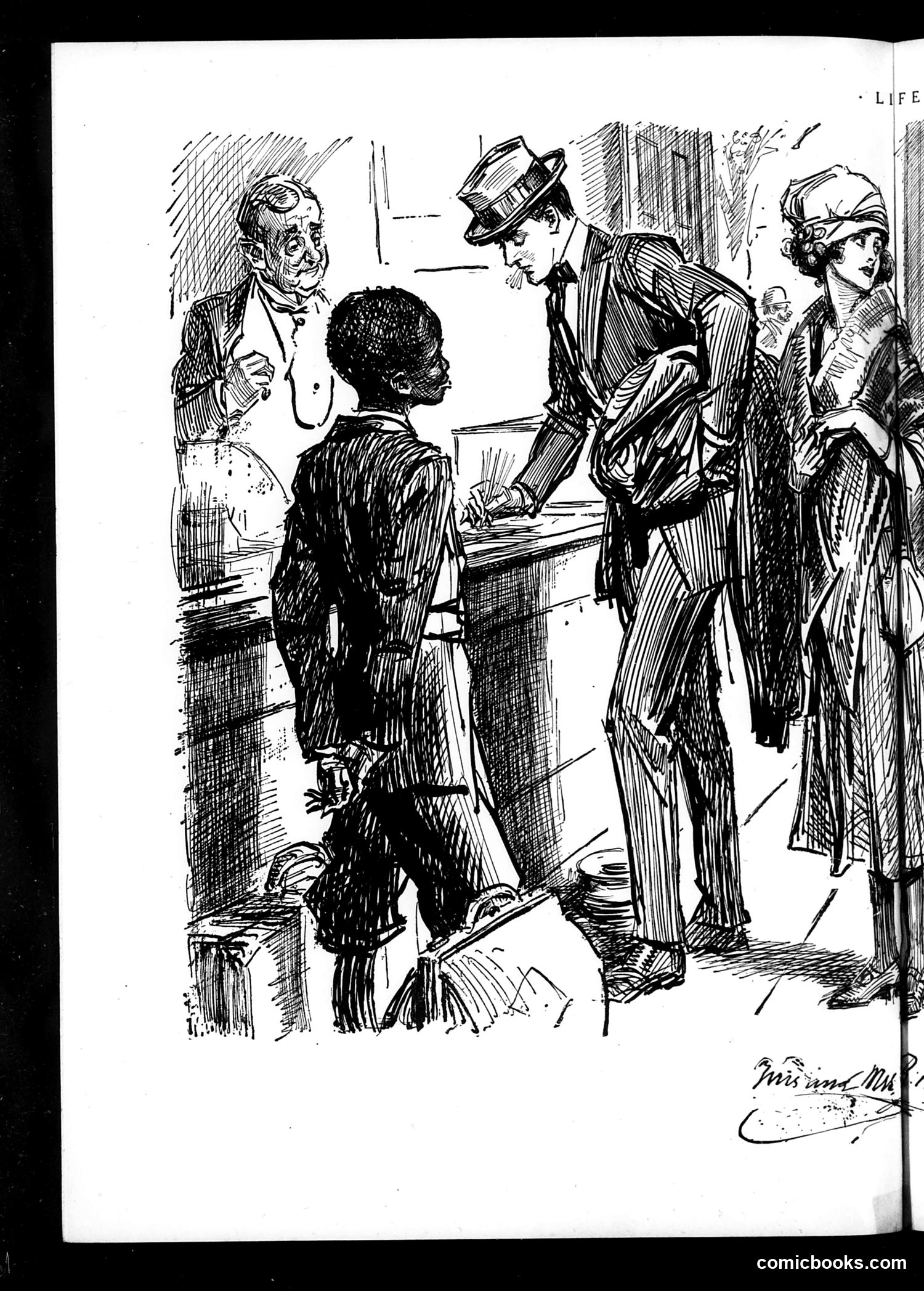
The OCR text is too corrupted to read, so I'm relying on the image alone. This appears to be a satirical cartoon from *Life* magazine depicting a social scene, likely from the early 20th century based on the clothing styles (suits, hats, women's formal dress). The scene shows several well-dressed figures in what appears to be an official or formal setting, with a dark-skinned figure (rendered in exaggerated caricature style) at the center interacting with white figures of apparent higher social status. Without legible text, I cannot definitively identify the specific political or social reference, but the composition suggests commentary on racial dynamics, social hierarchy, or exclusion during an era of significant racial segregation in America. The artist's signature appears visible but is unclear.
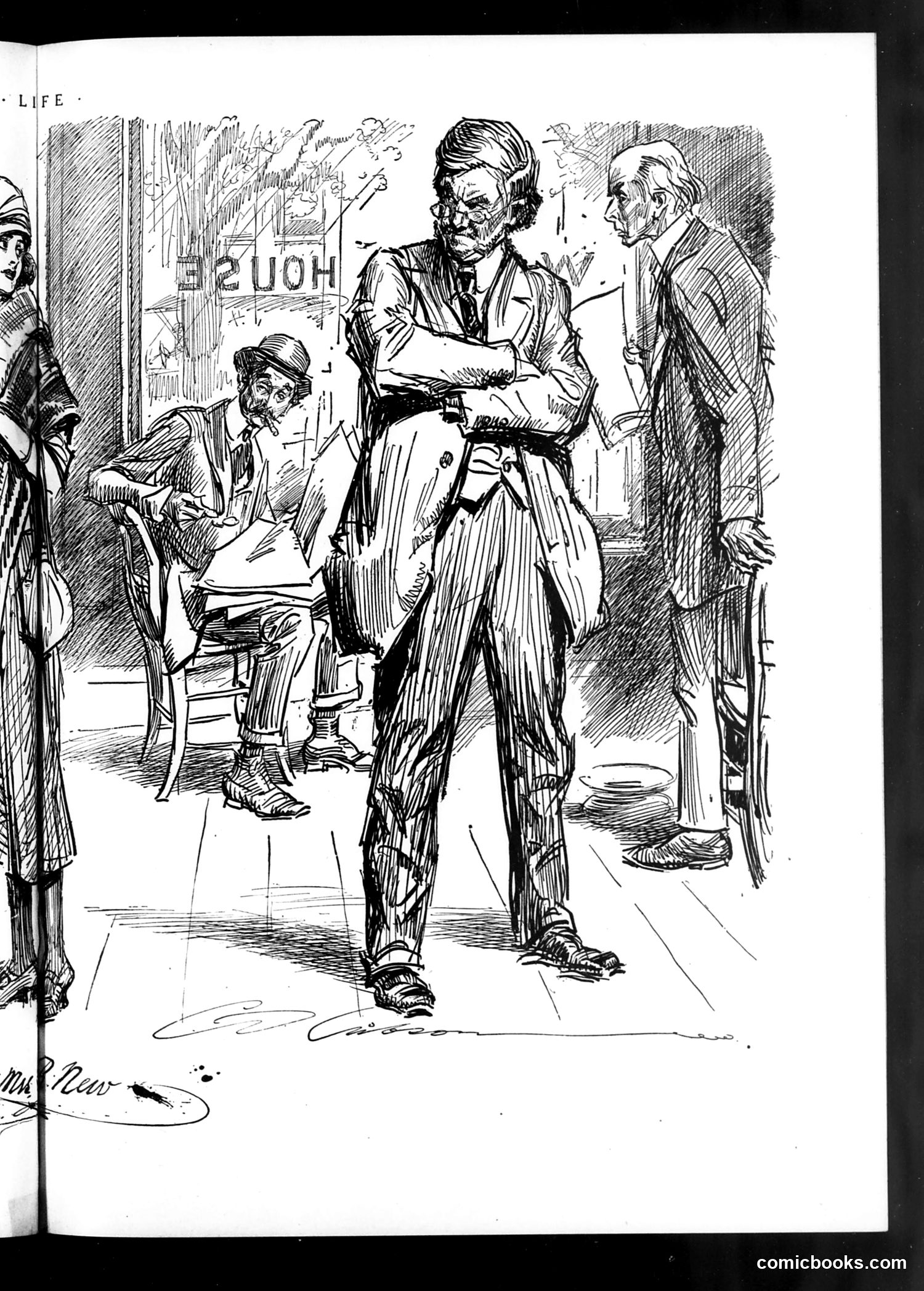
This appears to be a satirical sketch from *Life* magazine depicting an indoor scene with several figures. A man in the center stands prominently in work clothes, addressing or being examined by what appear to be well-dressed observers or officials—one seated, others standing. The setting suggests a workshop or office environment. Without clearer identifying details or accompanying caption text, I cannot definitively identify the specific figures or political/social commentary. The composition suggests commentary on labor conditions, class differences, or a confrontation between working-class and authority figures, but the exact historical reference remains unclear from the image alone.
This is a theater review critiquing summer Broadway shows featuring established comedians Charlotte Greenwood, Eddie Cantor, and DeWolf Hopper. The reviewer praises Greenwood's genuine comedic talent—her ability to make old jokes work through her distinctive physical comedy and expressive eyes—while finding the shows themselves mediocre. The satire targets two issues: first, the use of midgets to play child roles (the reviewer threatens to disrupt performances if this continues), comparing them sardonically to men old enough to have voted for Benjamin Harrison (president 1889-1893, making the reference roughly 20+ years old by publication). Second, it satirizes child actors generally as either unnaturally precocious or unconvincingly played by adults. The reviewer suggests keeping children entirely offstage, communicated to audiences only through parents' anecdotes—mirroring how real people share stories about their children.
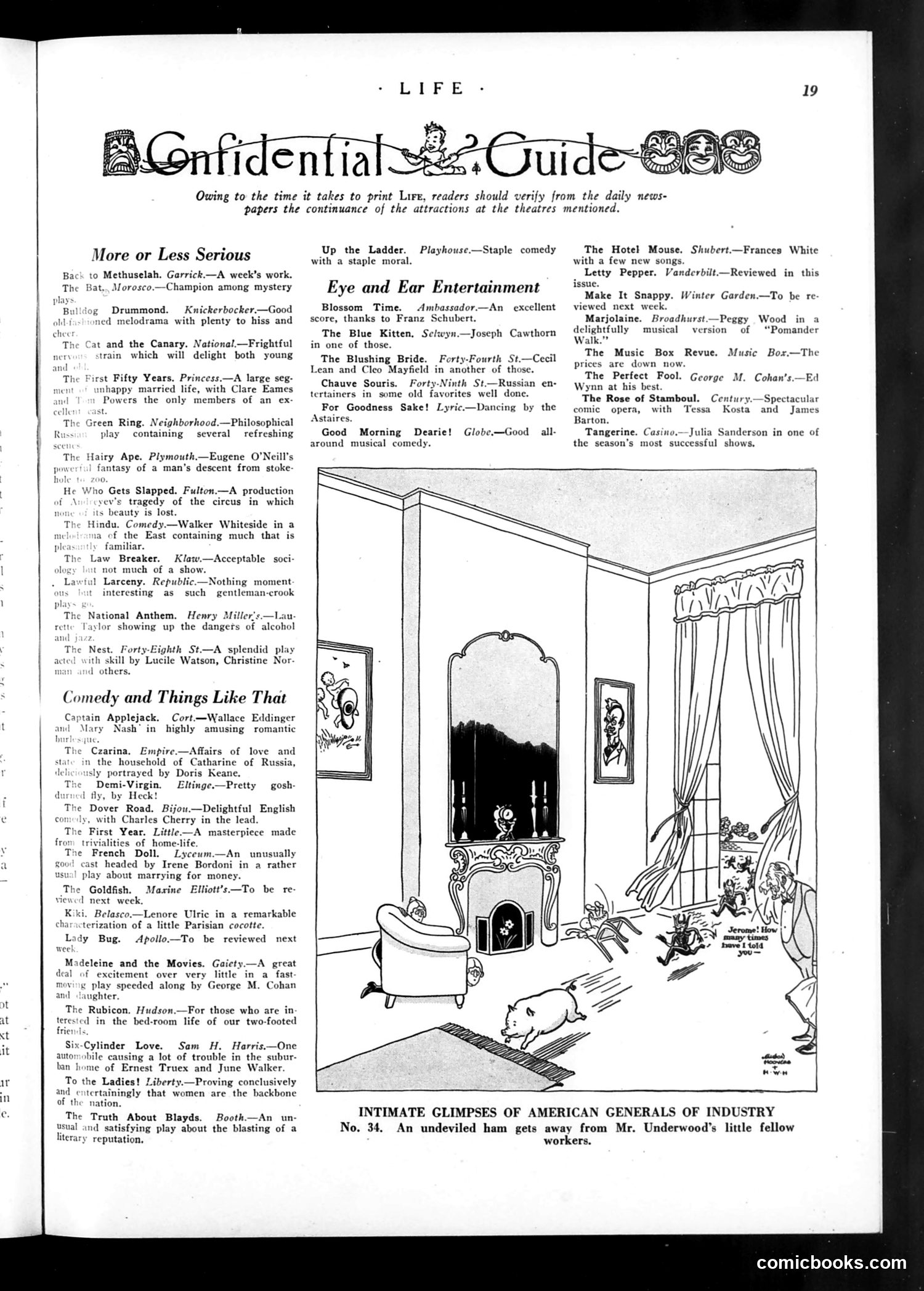
This page is a **theater guide** for Broadway productions, not political satire. It's a "Confidential Guide" reviewing current plays, musicals, and revues with brief critical notes and venue information. The **cartoon illustration** (captioned "An undeviled ham gets away from Mr. Underwood's little fellow workers") depicts a domestic scene: a ham or meat joint escaping from workers in what appears to be a kitchen or butcher shop. The joke plays on "ham" as both literal meat and theatrical slang for overacting performers—a pun connecting the theater reviews above to this slapstick image. The content reflects 1920s Broadway entertainment: musicals like *Blossom Time*, comedies, and dance revues featuring contemporary stars like Peggy Wood and Ed Wynn. Most reviews are brief, dismissive, or mildly encouraging—typical of era entertainment criticism aimed at middle-class readers deciding which shows to attend.
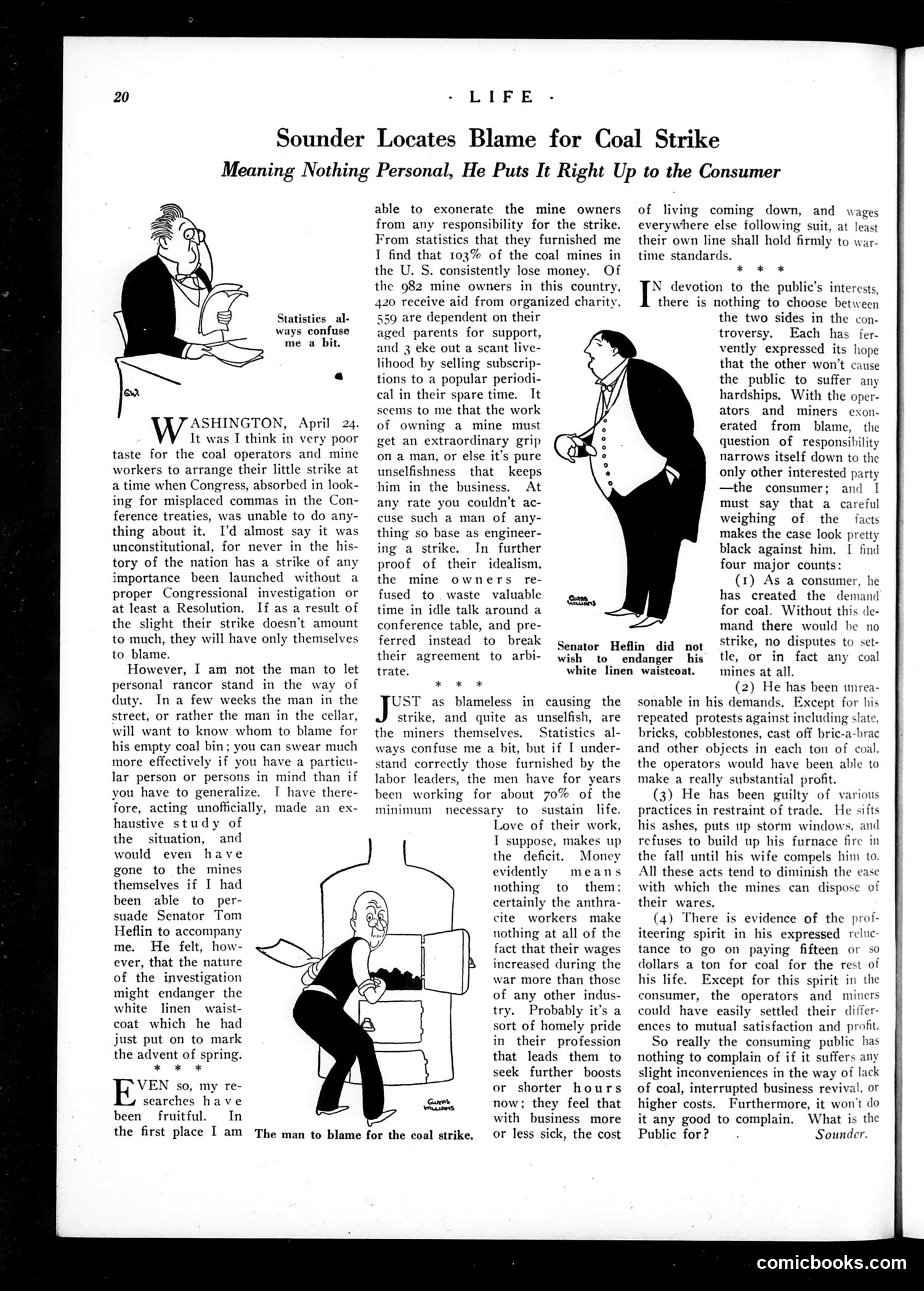
This satirical article by "Sounder" (a Life magazine columnist) uses heavy irony to critique both coal operators and miners during a 1920s coal strike, ultimately blaming consumers. **The Setup:** The author pretends to conduct an "impartial investigation" to help angry citizens identify whom to blame when their coal bins empty. **The Satire:** - Mine owners are absurdly exonerated despite losing money (allegedly 103% of mines) and breaking arbitration agreements—the author sarcastically praises their "idealism" - Miners are equally mocked for accepting poverty wages (70% subsistence) out of supposed professional pride, ignoring wartime wage increases - The cartoon illustrations show these groups as the "man to blame"—visual embodiments of the problem **The Point:** By claiming both sides are equally blameless and selfless, Sounder reveals the absurdity of their dispute. His final verdict—that consumers must accept higher prices without complaint—targets the public's frustration. The joke: when labor and management both cite noble motives while causing public hardship, ordinary people bear the cost. The piece criticizes strike dynamics and corporate/labor rhetoric rather than taking either side.
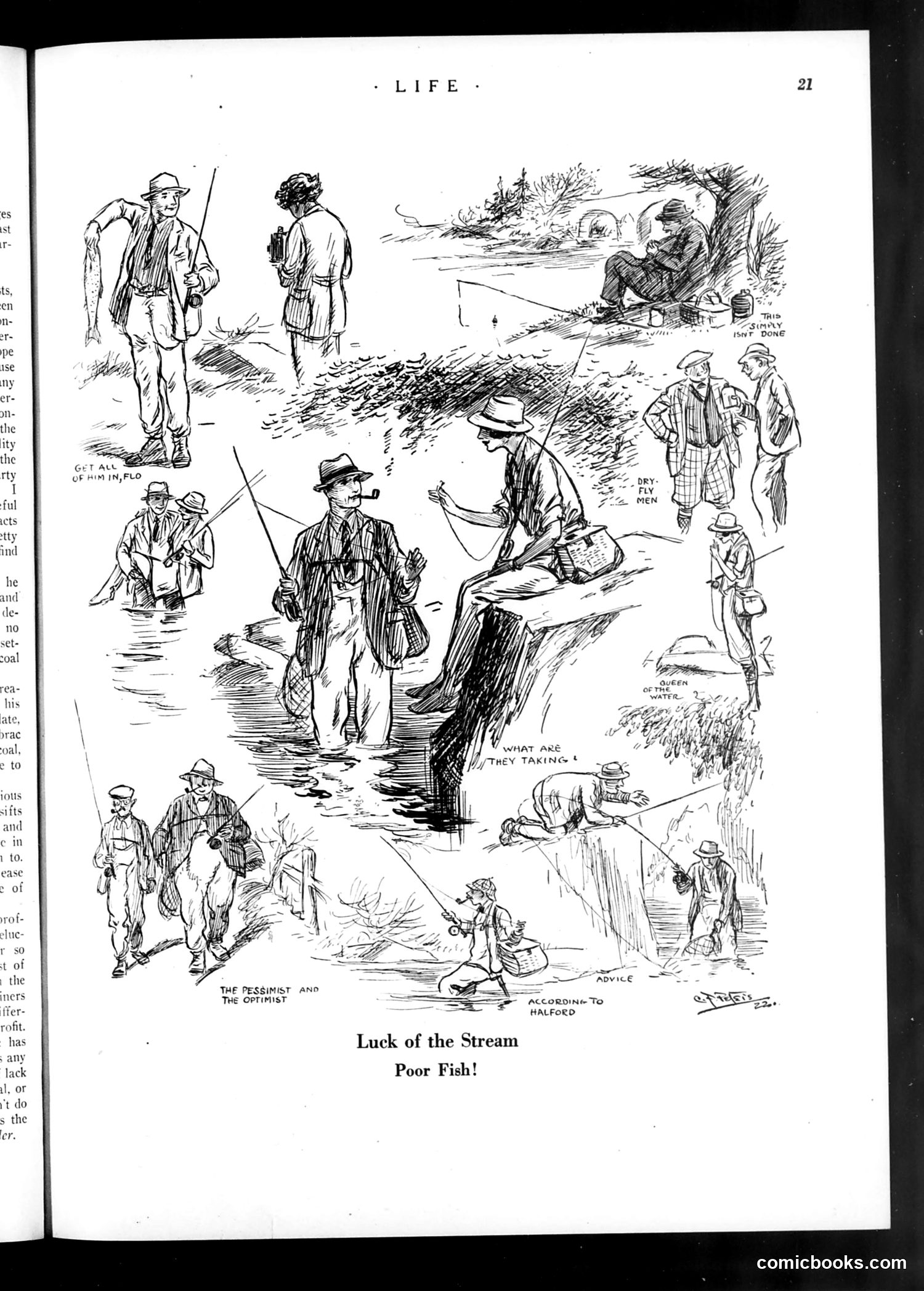
This is a humorous illustrated page showing various fishermen and fishing scenarios along a stream. The cartoon depicts contrasting attitudes through labeled vignettes: "The Pessimist and the Optimist," "According to Halford" (likely referring to fishing authority Frederick Halford), and "What are they taking?" The satire appears to mock different fishing philosophies and the obsessive, sometimes absurd nature of fishermen—some catching fish while others struggle, some offering advice, others philosophizing. The title "Poor Fish!" suggests sympathy for the fish rather than the anglers. The sketches use exaggerated character types and situational humor typical of early 20th-century Life magazine's social commentary, poking gentle fun at the fishing hobby and the various personalities it attracts.
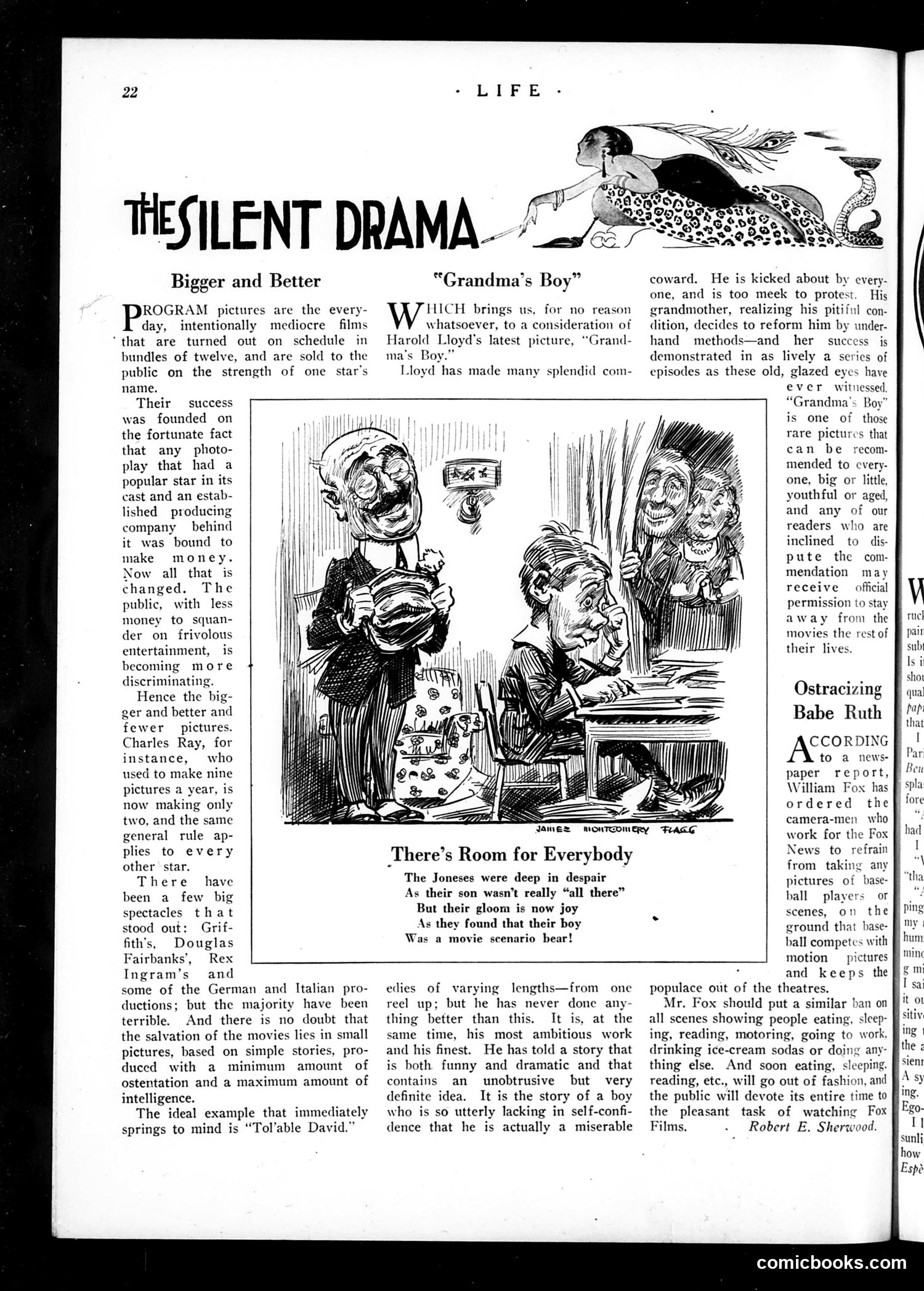
This page reviews silent films and industry trends. The central cartoon depicts a scene from Harold Lloyd's "Grandma's Boy," showing the titular grandmother with other characters—likely illustrating the plot where she reforms her timid grandson through "underhand methods." The main article argues that **Program pictures** (cheap, formulaic studio output) are dying because audiences, with less disposable income (post-WWI economic constraints), now discriminate between quality films. Studios are reducing output—Charles Ray from nine pictures yearly to two—prioritizing fewer, better productions. A secondary item satirizes **William Fox's decision to ban cameramen from filming baseball players**, claiming sports compete with movies for audiences. The writer mocks this logic: if Fox removes sports footage, shouldn't he also ban all scenes of eating, sleeping, working—anything people do in real life? The satire highlights the absurdity of blaming entertainment competitors rather than improving film quality.
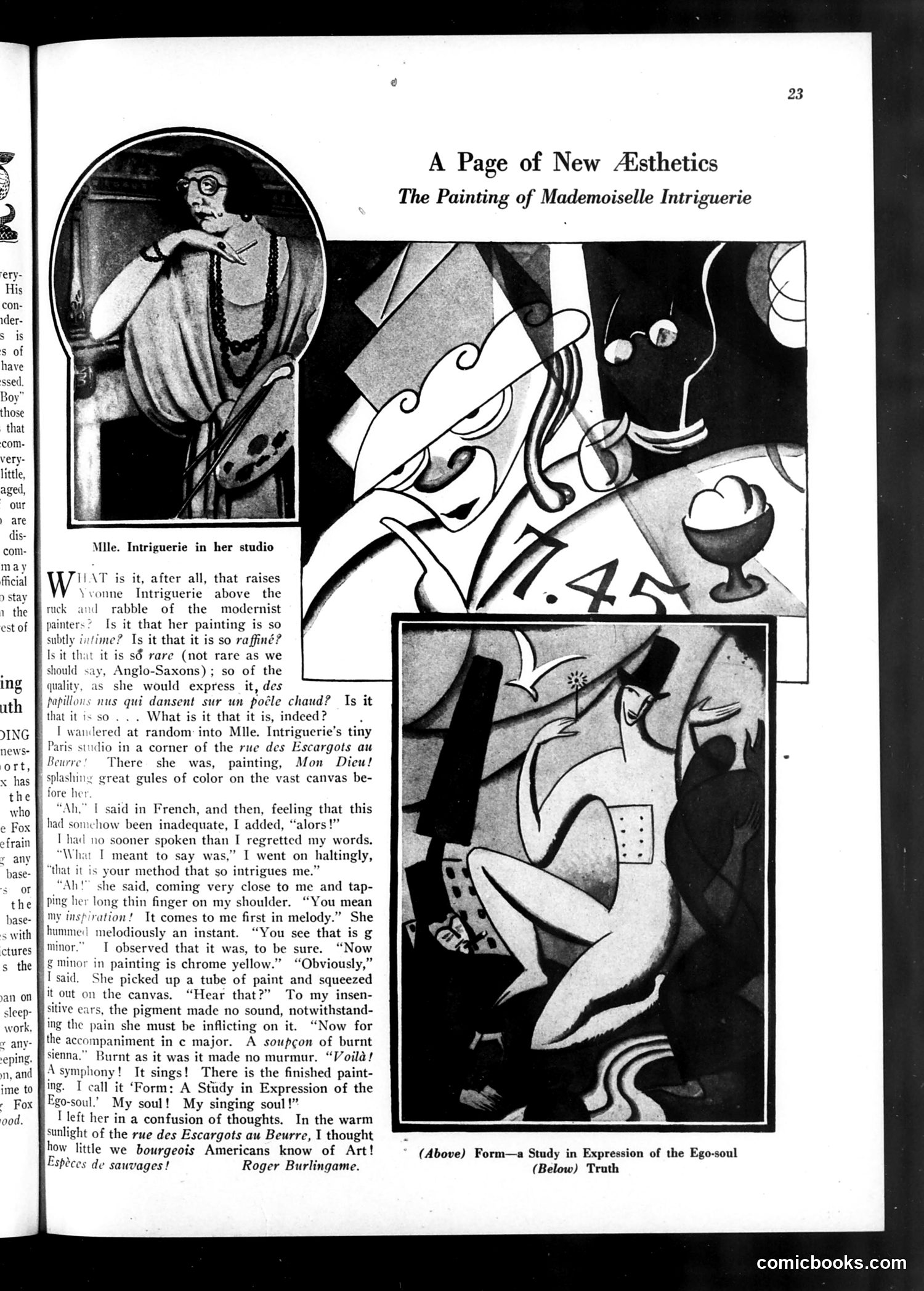
This is satirical commentary on modernist art pretension. The piece mocks a fictional French female painter whose work is presented as incomprehensibly abstract. The satire targets: **The subject:** Mademoiselle Intriguerie represents affected modernist artists who justify nonsensical work through pseudo-intellectual language about "inspiration," "the ego-soul," and translating music into color. **The joke:** She "paints" by squeezing pigment onto canvas while speaking of symphonies and profound expression—the paintings appear to be meaningless abstractions. She claims paintings communicate through synesthesia (mixing senses: "g minor in painting is chrome yellow"). **The target audience:** American bourgeois viewers unfamiliar with European avant-garde art, presented as foolish for not understanding pretentious modernism. The author (Roger Burlingame) concludes Americans are "savages" artistically—ironically, since the whole piece suggests the emperor has no clothes. The accompanying sketches appear to show abstract compositional studies labeled as serious artistic expression.
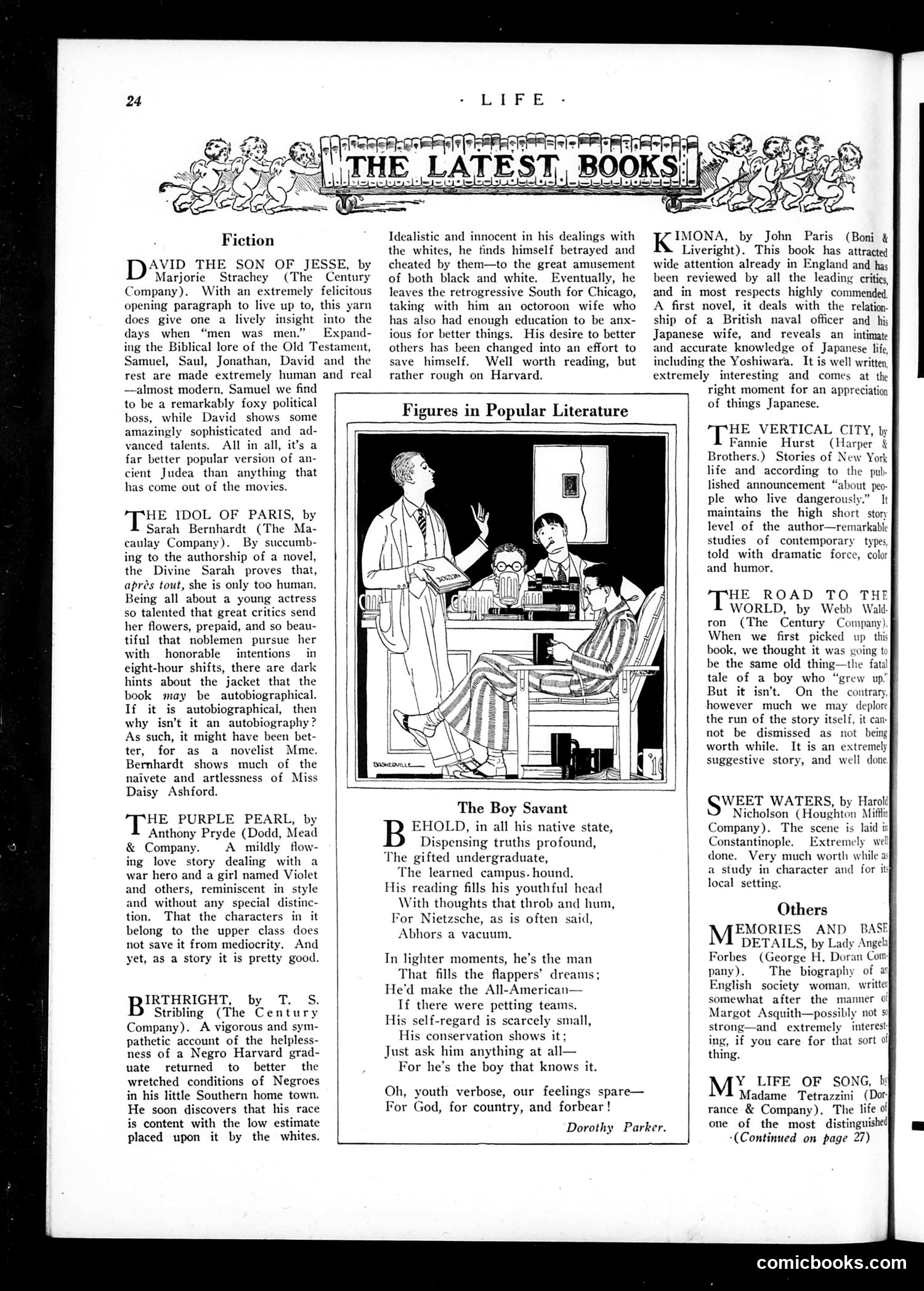
This illustration accompanies a book review section. The cartoon depicts a domestic scene with an adult (likely a parent or teacher) instructing a young boy at a desk, while two other figures observe from nearby furniture. The boy wears glasses and appears intellectually precocious. The accompanying poem "The Boy Savant" satirizes an overly educated, philosophically pretentious child who speaks in abstract intellectual language ("Dispensing truths profound," referencing Nietzsche). The satire mocks both the boy's affected sophistication and the contemporary trend of parents cultivating unnaturally intellectual children. The humor lies in the contrast between the child's youthful nature and his pompous, verbose manner. The final lines ("For he's the boy that knows it") suggest mockery of this type of precocious child who confidently displays learning beyond his years—a recognizable social phenomenon of the era that Life's readers would find amusing.
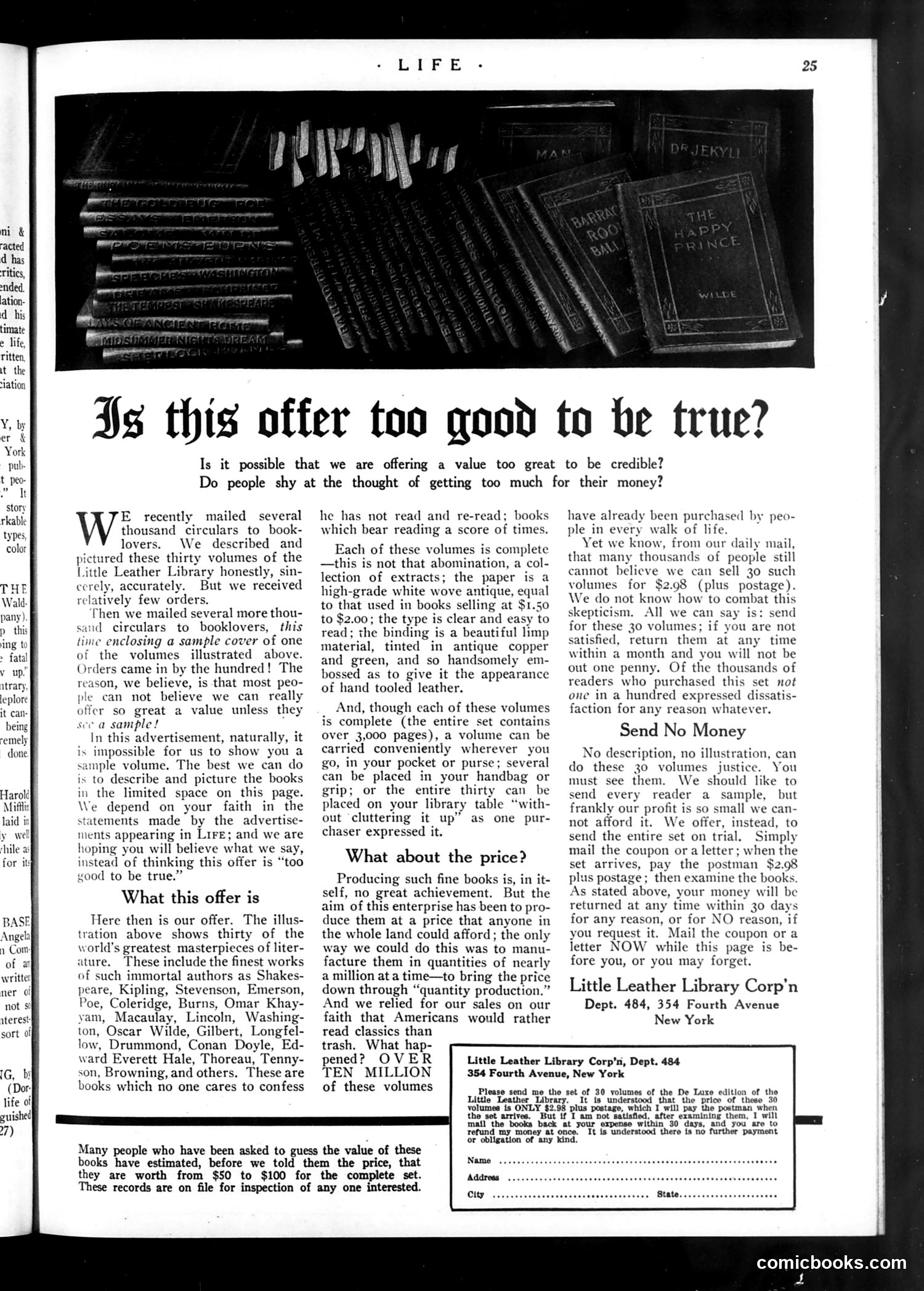
This is primarily a **book advertisement**, not political satire. The Little Leather Library Corporation advertises a 30-volume classic literature set for $2.98 plus postage. The page addresses consumer skepticism about the offer's legitimacy. The company acknowledges that initial marketing circulars failed until they included a **physical sample**—showing readers the actual book quality convinced them the price wasn't fraudulent. The ad lists canonical authors (Shakespeare, Kipling, Poe, Emerson, etc.) and emphasizes production economies: manufacturing "a million at a time" enabled affordable pricing. The company claims over 10 million sets already sold. The "joke" or satirical angle is subtle: the advertisement *itself* becomes the product demonstration, showing the high-quality binding and paper to overcome buyer hesitation about getting "too much for their money." This reflects early-20th-century consumer psychology—people distrusted deals that seemed impossibly generous. The coupon at bottom offers a 30-day trial period to address remaining doubt.
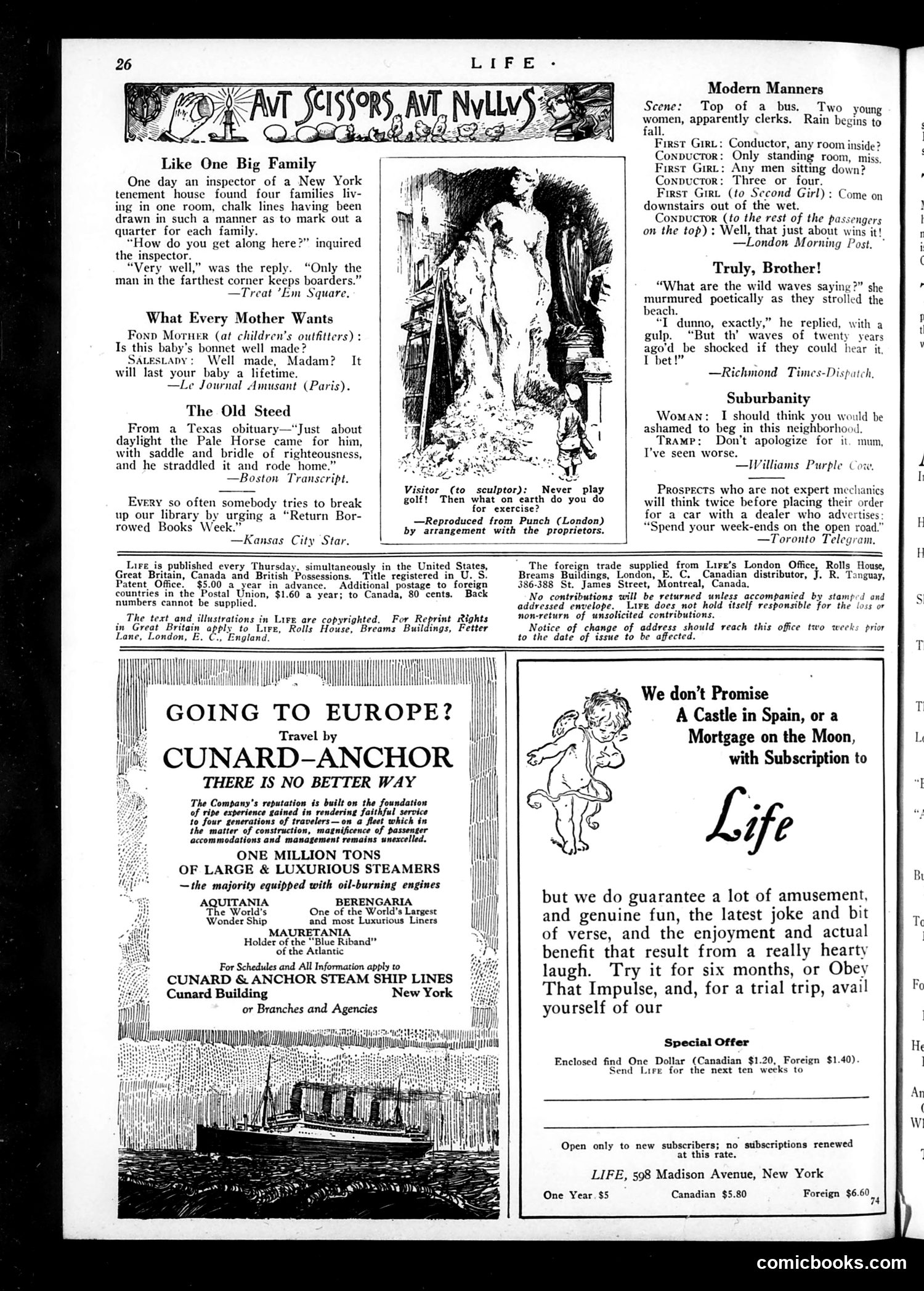
This page contains six brief satirical pieces typical of Life's humor column format: **"Modern Manners"** mocks class distinctions: two working-class women (clerks) seek shelter from rain on a bus, but the conductor suggests they go downstairs—implying upper-class passengers occupy the top deck. **"Like One Big Family"** satirizes tenement poverty: an inspector finds four families crammed in one room with chalk lines dividing "quarters," and discovers the man in the worst corner sublets to boarders for income. **Other vignettes** humorously address: impractical baby bonnets, rural death terminology, library management, romantic naïveté about ocean waves, panhandling in suburbs, and automobile dealer marketing. The page also includes advertisements for Cunard-Anchor steamship travel and a subscription offer for Life itself. The humor is gentle, observational social commentary targeting class divisions, urban poverty, and human folly—typical of early 20th-century American satirical journalism.
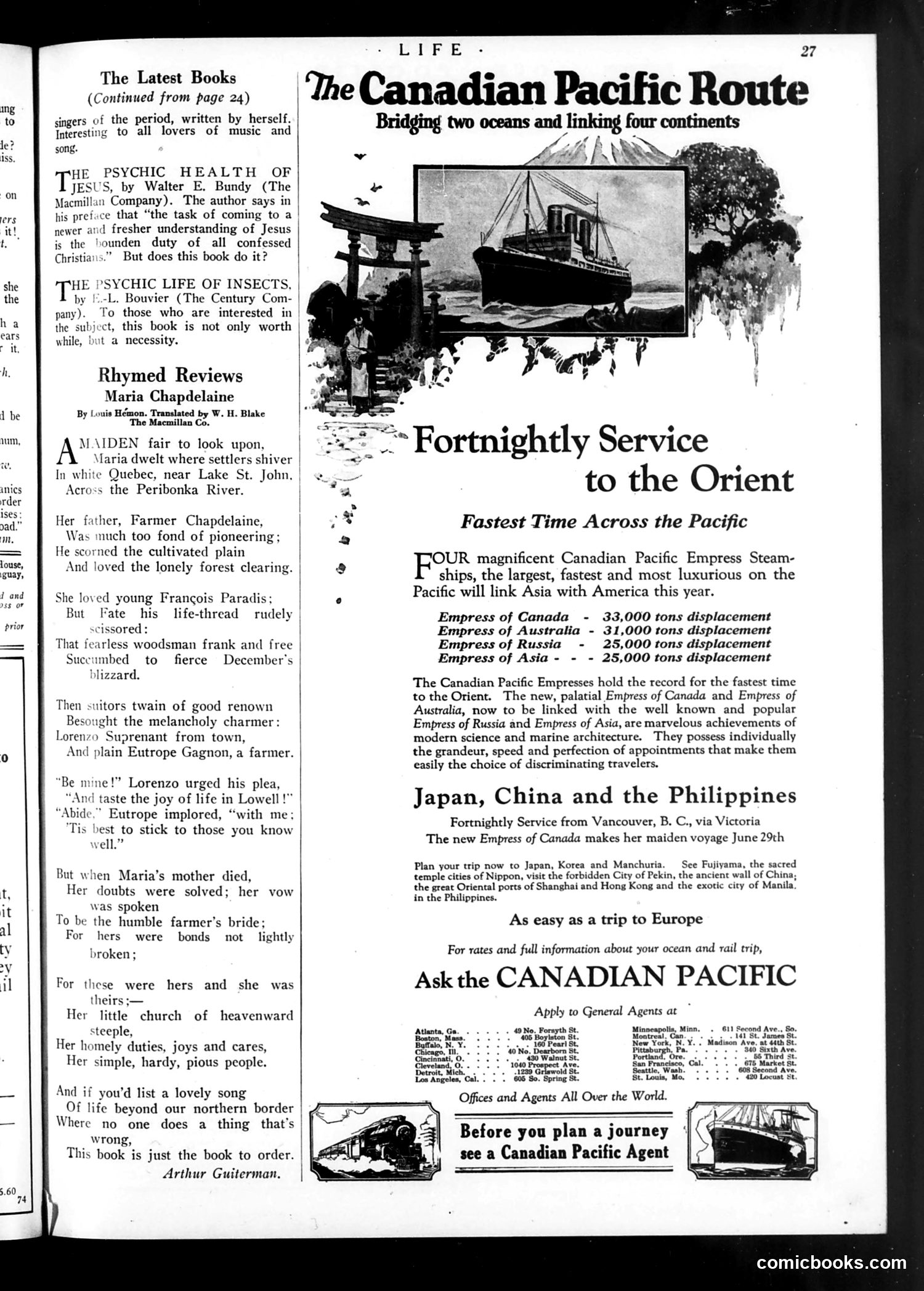
This page is **primarily advertising** with a book review section. The main content features: **Book Reviews (Left):** A rhymed review of *Maria Chapdelaine*, a French-Canadian novel about a young woman choosing between suitors—a townsman offering urban excitement versus a farmer representing traditional rural life. The reviewer (Guiterman) presents this as charming romantic territory "where no one does a thing that's wrong," gently satirizing the idealized view of rural Quebec life the novel presents. **Advertisement (Right):** The bulk of the page promotes Canadian Pacific's new luxury steamships—the Empresses of Canada, Australia, Russia, and Asia. These vessels offered the "fastest time" across the Pacific to Japan, China, and the Philippines, marketed as "as easy as a trip to Europe." The ad emphasizes modernity, speed, and luxury for "discriminating travelers." **Context:** This reflects the 1920s travel boom and Canadian Pacific's dominance in Pacific shipping, positioning transpacific travel as accessible to affluent Americans. The juxtaposition is incidental—no satirical connection between the two sections is intended.
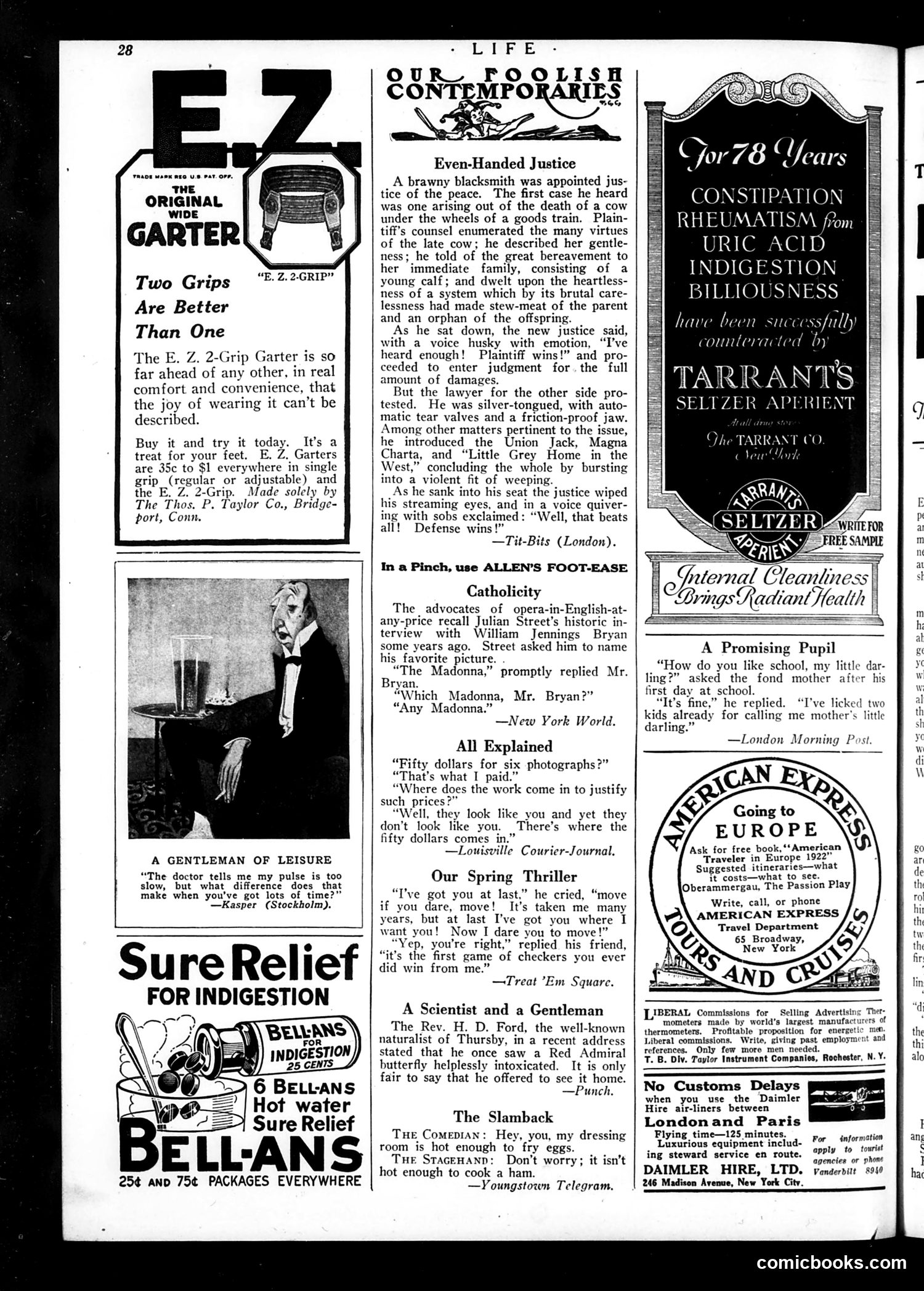
This page is primarily **advertising with comic anecdotes**, not political cartoons. The satirical content consists of brief humorous stories in the "Our Foolish Contemporaries" section. **Main cartoon/anecdote**: "Even-Handed Justice" mocks an illiterate blacksmith appointed justice of the peace. The joke: swayed by emotional appeals rather than legal arguments, he awards the plaintiff victory based on tears, then reverses for the defendant who cries even harder. The satire targets judicial incompetence and the absurdity of emotion-based verdicts. **Other brief jokes** ridicule: - Opera-in-English advocates' indifference (William Jennings Bryan doesn't distinguish between different Madonna paintings) - Photography pricing logic - Checkers prowess - A drunk butterfly - Theater temperature complaints The page is dominated by **product advertisements** (E.Z. Garters, Bell-Ans indigestion relief, Tarrant's Seltzer Aperient, American Express travel services) typical of Life's revenue model.
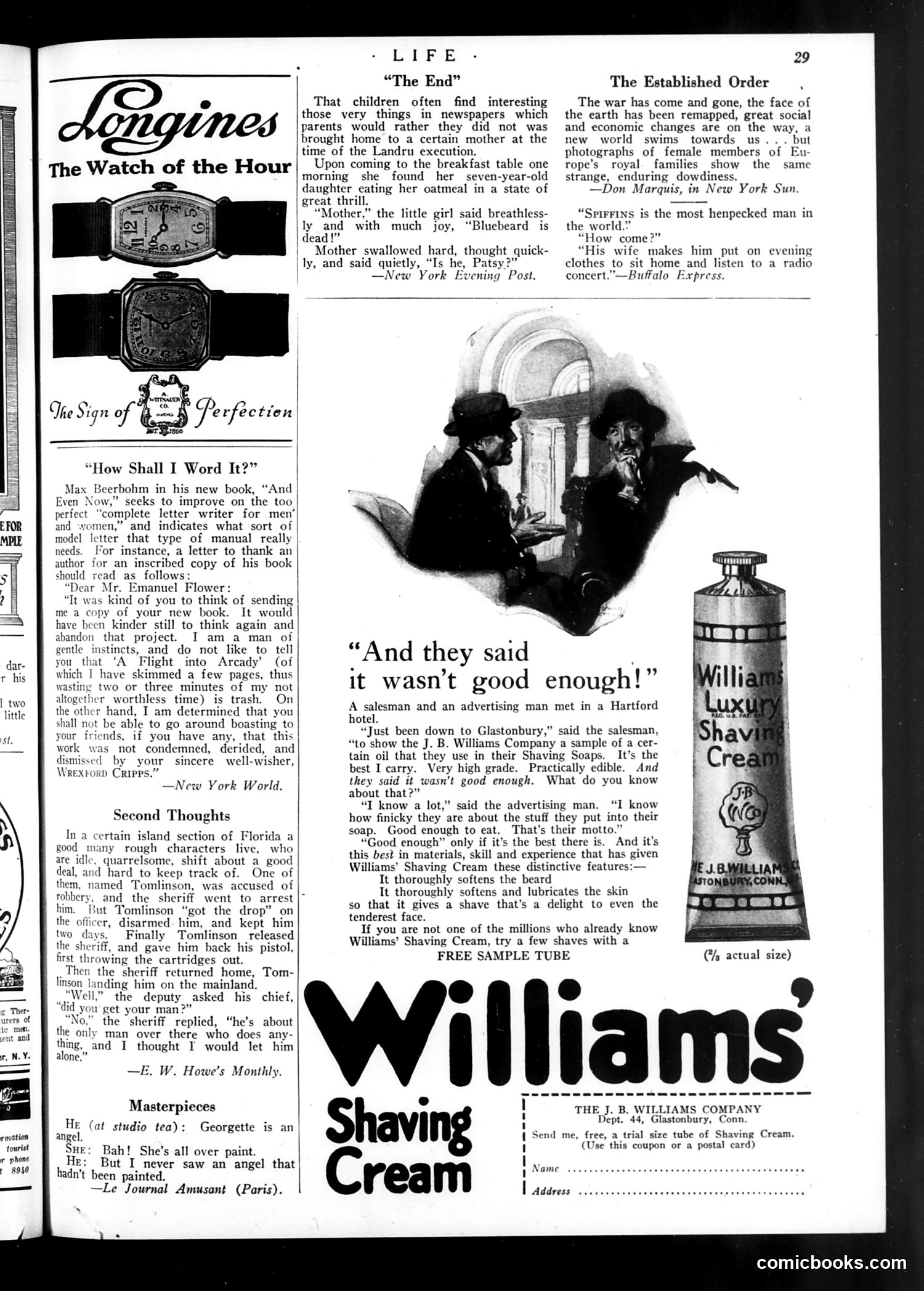
This page contains three distinct humor pieces: **"How Shall I Word It?"** satirizes overly formal "letter writer" etiquette manuals through a fake thank-you letter attributed to Max Beerbohm. The joke is the letter's brutal honesty—the writer admits he skimmed only a few pages and calls the book "trash," while maintaining perfectly polite language. It mocks the hypocrisy of social conventions that demand we lie gracefully. **"Second Thoughts"** tells of a Florida sheriff who captures a criminal but releases him because "he's about the only man over there who does anything." The satire targets the absurdity of law enforcement in rough frontier regions where the "criminal" may be more industrious than the law officer. **"Masterpieces"** (bottom) is a brief Paris-sourced joke about an angel appearing in paint at an artist's studio—wordplay on "painted" (cosmetics) versus artistic medium. The page is primarily advertising for Williams Shaving Cream, using a sales dialogue about product quality to promote a free sample.
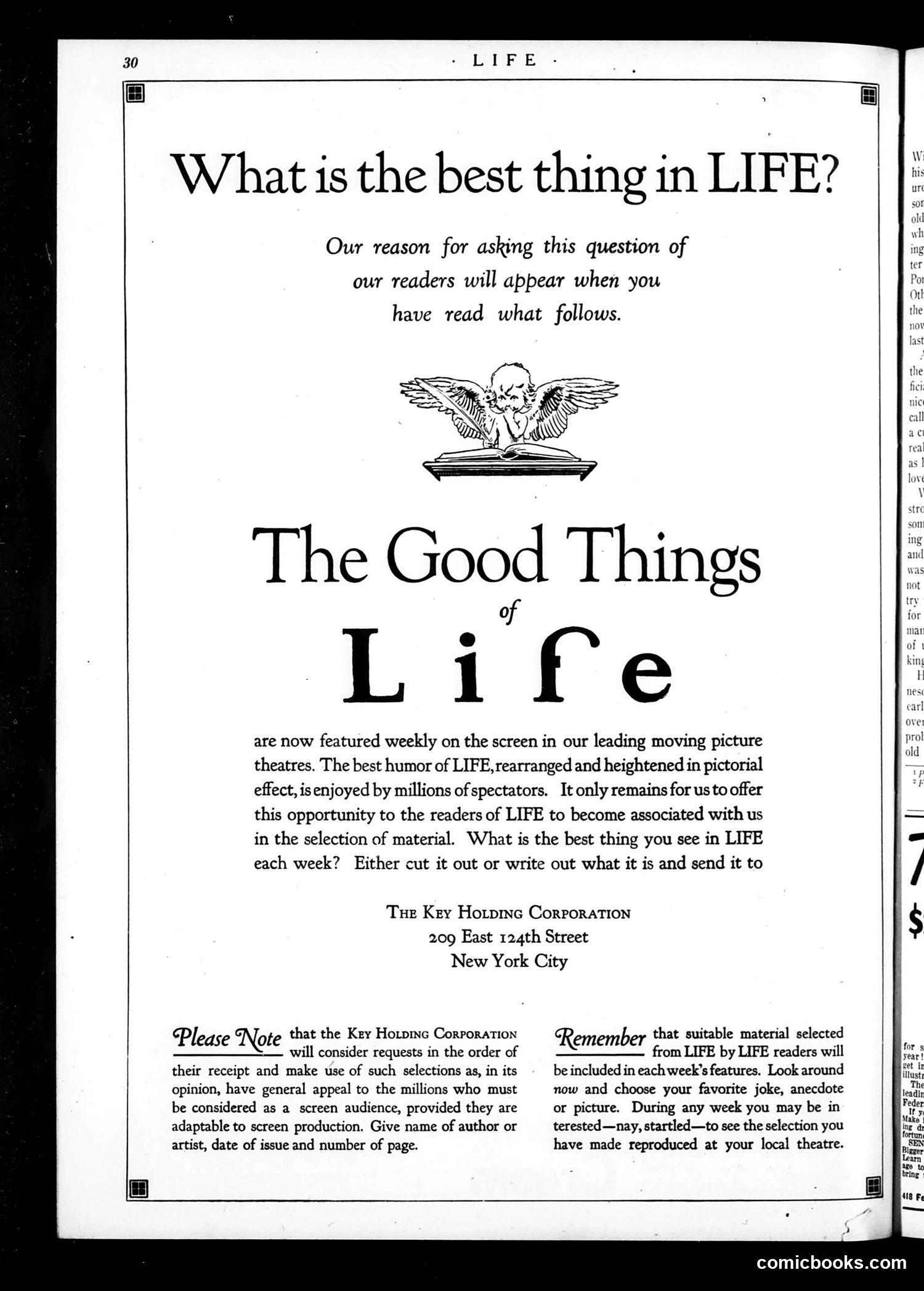
This is a **title page/advertisement**, not a satirical cartoon. Life magazine is promoting a cross-media venture with the Key Holding Corporation to adapt humorous content from Life's pages into weekly moving picture (film) shorts shown in theaters. The page invites readers to participate by submitting their favorite jokes, anecdotes, or pictures from Life's weekly issues for potential screen adaptation. The cherub illustration symbolizes the "good things" being celebrated. **Key context for modern readers:** This represents an early 20th-century multimedia licensing strategy—Life was leveraging its popular satirical humor by selling adapted content to movie theaters. This was how magazines expanded revenue before television. The invitation itself served as advertising, encouraging readers to buy Life regularly while promoting the film shorts. The tone is straightforward promotion rather than satire.
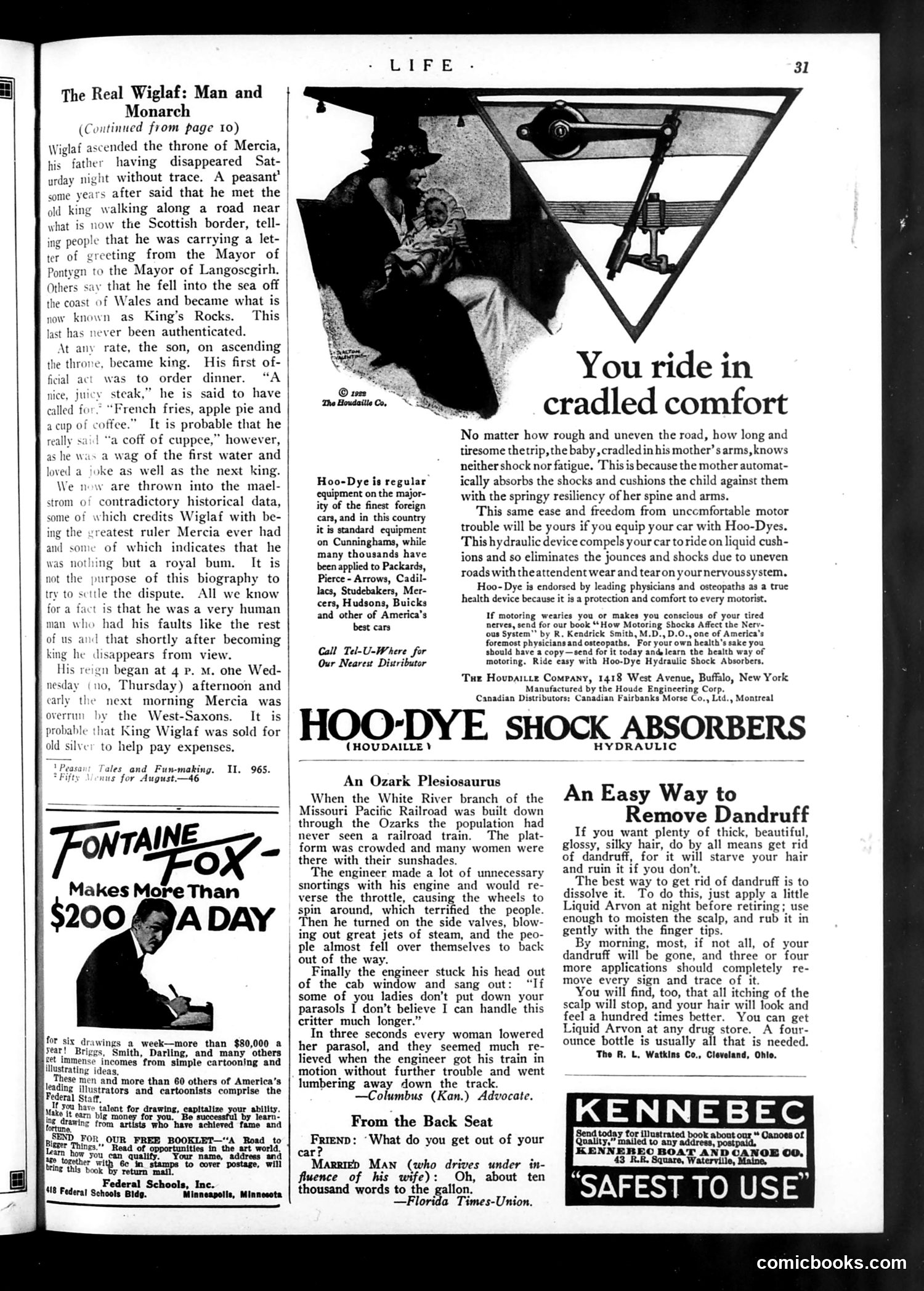
This page contains a serialized article about "The Real Wiglaf: Man and Monarch"—a fictional medieval English king whose reign lasted from 4 p.m. Wednesday until the next morning, when West-Saxon forces overran his kingdom. The satirical piece lampoons historical unreliability; competing accounts claim Wiglaf disappeared mysteriously, fell into the sea, or was "sold for old silver to help pay expenses." The primary content, however, is **advertisements**. The dominant ad promotes **Hoo-Dye shock absorbers** for automobiles, claiming they provide smooth rides for babies and comfort for motorists. Another ad recruits cartoonists for "Federal Schools," promising potential earnings over $80,000 annually. A third advertises **Fontaine-Fox** cartoons. The Wiglaf article is satirical humor about historical confusion—poking fun at how contradictory sources and lost records make medieval history unreliable. Modern readers would recognize it as early 20th-century literary satire rather than actual history.
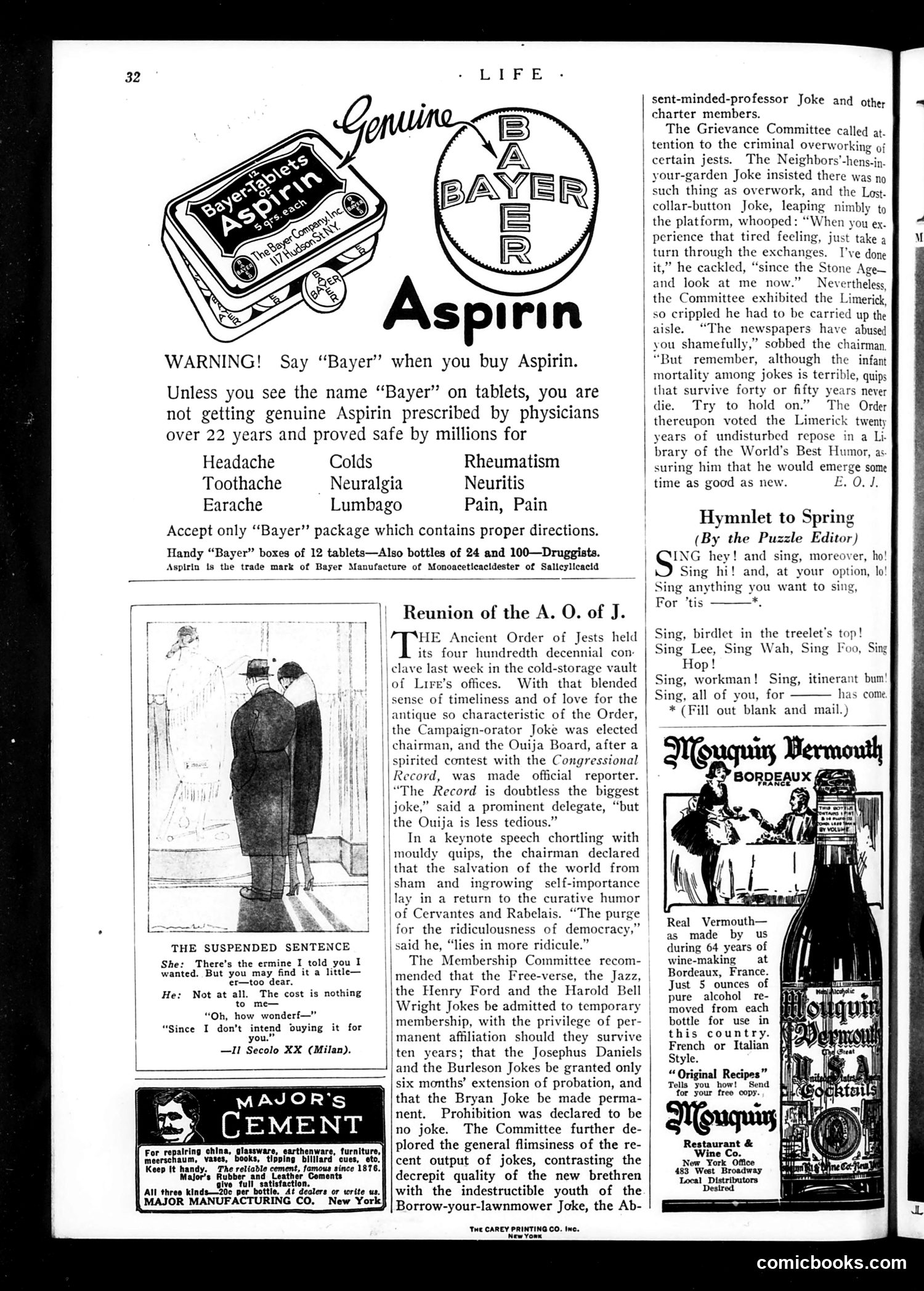
This page mixes advertising with satirical humor pieces. The dominant Bayer Aspirin advertisement warns consumers to insist on the genuine branded product—reflecting early 20th-century concerns about patent medicines and trademark protection. The main satirical content is "Reunion of the A. O. of J." (Ancient Order of Jests), a mock-serious account of jokes holding a formal convention. The satire targets contemporary political figures and events through jokes about them: Josephus Daniels (Wilson's Secretary of Navy), Albert Burleson (Postmaster General), and William Jennings Bryan receive mention. The piece mocks how some jokes become "tired" while others prove durable, with Prohibition notably declared "no joke"—likely critiquing both Prohibition policy and the joke form's inadequacy to address serious issues. "The Suspended Sentence" is a brief romantic joke playing on ambiguous phrasing. Other minor content includes word puzzles and a wine advertisement, typical of Life's mixed-content format.