
Life, 1922-04-27 · page 7 of 34
Life — April 27, 1922 — page 7: what you’re looking at
What you’re looking at
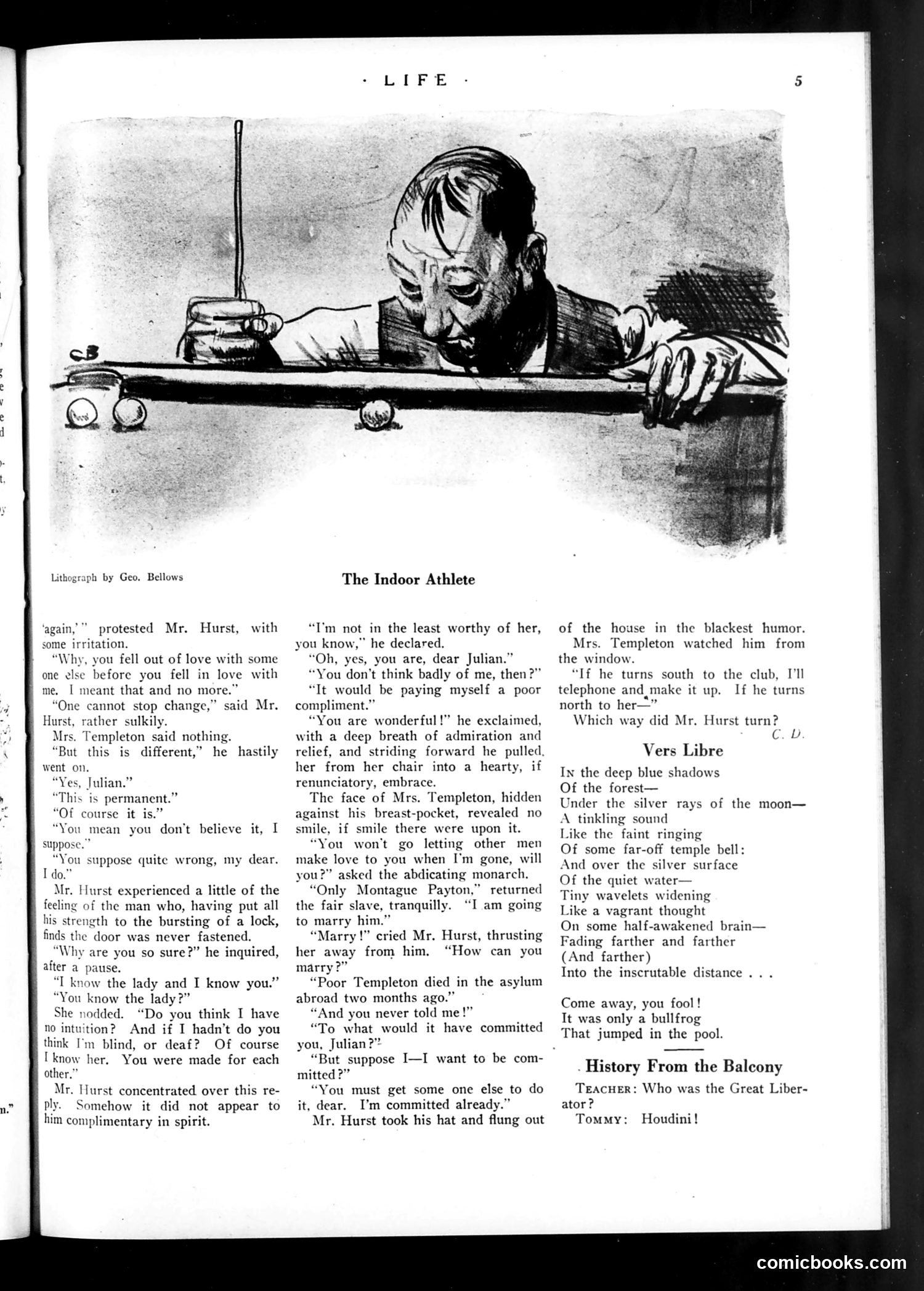
The lithograph by Geo. Bellows depicts a man hunched over a billiards table, intensely focused on his shot. The cartoon satirizes the concept of "indoor athletics"—mocking the notion that playing pool/billiards constitutes legitimate athletic activity. The exaggerated facial features and body position emphasize the absurdity: rather than genuine sports requiring physical exertion, this "athlete" merely bends over a table with a cue. The satire targets sedentary leisure activities being rebranded as athletic pursuits, likely reflecting early 20th-century debates about what constitutes "exercise" versus mere indoor recreation. The surrounding text appears to be unrelated fiction, but the cartoon's message is clear: billiards players aren't real athletes.
📄 Transcribed text from this page (OCR, searchable)
Machine-transcribed from the original scan — historical spelling and the odd misread are preserved.
Lithograph by Geo. Bellows ‘again, protested Mr. Hurst, with some irritation. “Why, you fell out of love with some one else before you fell in love with me. I meant that and no more.” “One cannot stop change,” said Mr. Hurst, rather sulkily. Mrs. Templeton said nothing. “But this is different,” he hastily went on. “Yes, Julian.” “This is permanent.” “Of course it is.” “You mean you don't believe it, I suppose.” “You suppose quite wrong, my dear. I do.” Mr. Hurst experienced a little of the feeling of the man who, having put all his strength to the bursting of a lock, finds the door was never fastened. “Why are you so sure?” he inquired, alter a pause. “I know the lady and I know you.” “You know the lady?” She nodded. “Do you think I have no intuition? And if I hadn’t do you think I'm blind, or deaf? Of course [know her. You were made for each other.” Mr. Hurst concentrated over this re- ply. Somehow it did not appear to him complimentary in spirit. The Indoor Athlete “I'm not in the least worthy of her, you know,” he declared. “Oh, yes, you are, dear Julian.” “You don’t think badly of me, then?” “It would be paying myself a poor compliment.” “You are wonderful!” he exclaimed, with a deep breath of admiration and relief, and striding forward he pulled. her from her chair into a hearty, if renunciatory, embrace. The face of Mrs. Templeton, hidden against his breast-pocket, revealed no smile, if smile there were upon it. “You won't go letting other men make love to you when I'm gone, will you?” asked the abdicating monarch, “Only Montague Payton,” returned the fair slave, tranquilly. “I am going to marry him “Marry!” cried Mr. Hurst, thrusting her away from him. “How can you marry?” “Poor Templeton died in the asylum abroad two months ago.” “And you never told me “To what would it have committed you, Julian?” “But suppose I—I want to be com- mitted ?” “You must get some one else to do it, dear. I’m committed already.” Mr. Hurst took his hat and flung out of the house in the blackest humor. Mrs. Templeton watched him from the window. “If he turns south to the club, I'll telephone and make it up. If he turns north to her—” Which way did Mr. Hurst turn? C.D. Vers Libre In the deep blue shadows Of the forest— Under the silver rays of the moon— A tinkling sound Like the faint ringing Of some far-off temple bell: And over the silver surface Of the quiet water— Tiny wavelets widening Like a vagrant thought On some half-awakened brain— Fading farther and farther (And farther) Into the inscrutable distance . . . Come away, you fool! It was only a bullfrog That jumped in the pool. History From the Balcony TeacueR: Who was the Great Liber- ator? Tommy: Houdini! comicbooks.com