
Life, 1922-04-27 · page 6 of 34
Life — April 27, 1922 — page 6: what you’re looking at
What you’re looking at
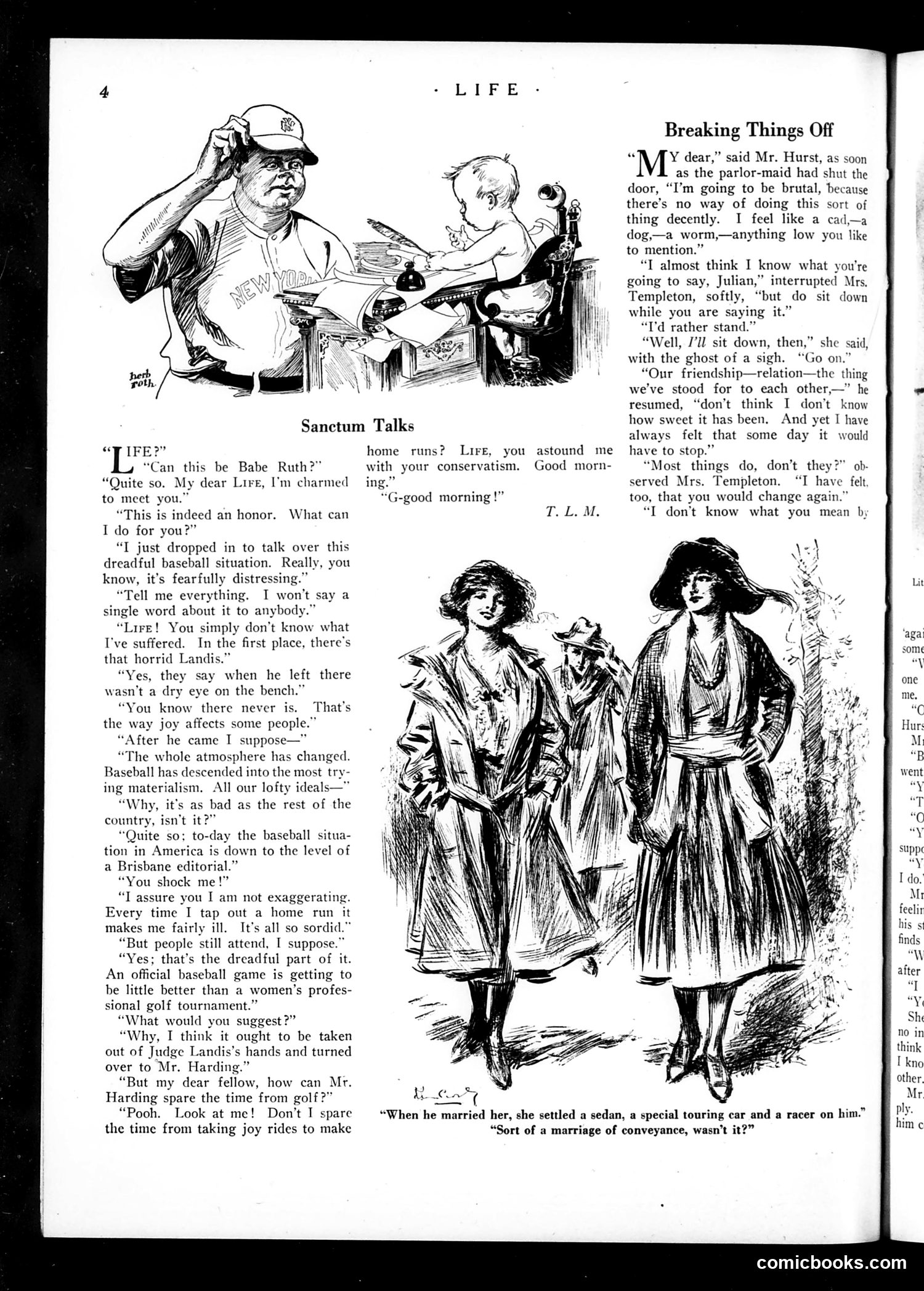
**"Sanctum Talks"** (left column): A conversation between Babe Ruth and an unnamed editor ("Life"). The editor complains that baseball has become materialistic and trivial—players now chase money rather than ideals. Ruth defends the sport, noting fans still attend games. The satire targets post-WWI American concerns that commercial sports corrupted national values. Ruth appears as baseball's defender against intellectual criticism. **"Breaking Things Off"** (right): A domestic scene where Mr. Hurst attempts to end a relationship with his wife Mrs. Templeton. The caption suggests their marriage was transactional—"a marriage of conveyance"—implying she married him for his possessions (sedan, touring car, racer). The satire mocks wealthy marriages based on material exchange rather than genuine affection. Both pieces critique 1920s materialism.
📄 Transcribed text from this page (OCR, searchable)
Machine-transcribed from the original scan — historical spelling and the odd misread are preserved.
Breaking Things Off ae Y dear,” said Mr. Hurst, as soon as the parlor-maid had shut the door, “I’m going to be brutal, because there’s no way of doing this sort of thing decently. I feel like a cad—a dog,—a worm,—anything low you like to mention.” “T almost think I know what you're going to say, Julian,” interrupted Mrs, Templeton, softly, “but do sit down while you are saying it.” “I'd rather stand.” “Well, J’ll sit down, then,” she said, with the ghost of a sigh. “Go on.” “Our friendship—relation—the thing we've stood for to each other,—” he resumed, “don’t think I don’t know Sanctum Talks how sweet it has been. And yet I have always felt that some day it would home runs? Lire, you astound me have to stop.” ‘an this be Babe Ruth?” with your conservatism. Good morn- “Most things do, don’t they?” ob- “Quite so. My dear Lire, I'm charmed ing.” served Mrs. Templeton. “I have felt, to meet you.” “G-good morning !” too, that you would change again.” “This is indeed an honor. What can T.L. M. “I don’t know what you mean by I do for you?” “I just dropped in to talk over this dreadful baseball situation. Really, you know, it’s fearfully distressing.” “Tell me everything. I won't say a single word about it to anybody.” “Lire! You simply don’t know what I've suffered. In the first place, there's that horrid Landis.” “Yes, they say when he left there wasn't a dry eye on the bench.” “You know there never is. That's the way joy affects some people “After he came I suppose—” “The whole atmosphere has changed. Baseball has descended into the most try- ing materialism. All our lofty ideals—" “Why, it’s as bad as the rest of the country, isn't it?” “Quite so; to-day the baseball situa- tion in America is down to the level of a Brisbane editorial.” “You shock me!” “T assure you I am not exaggerating. Every time I tap out a home run it makes me fairly ill. It’s all so sordid.” “But people still attend, I suppose.” “Yes; that’s the dreadful part of it. An official baseball game is getting to be little better than a women’s profes- sional golf tournament.” “What would you suggest?” Z y | “Why, I think it ought to be taken Zag ZS, : Wey” oe No in out of Judge Landis’s hands and turned Cee Fe hit think over to Mr. Harding.” ‘ zi . I kno “But my dear fellow, how can Mr. other, Harding spare the time from golf? nail | Mr “Pooh. Look at me! Don’t I spare “When he married her, she settled a sedan, a special touring car and a racer on him.” ply, the time from taking joy rides to make “Sort of a marriage of conveyance, wasn’t it?” him c comicbooks.com