
Life, 1922-04-27 · page 24 of 34
Life — April 27, 1922 — page 24: what you’re looking at
What you’re looking at
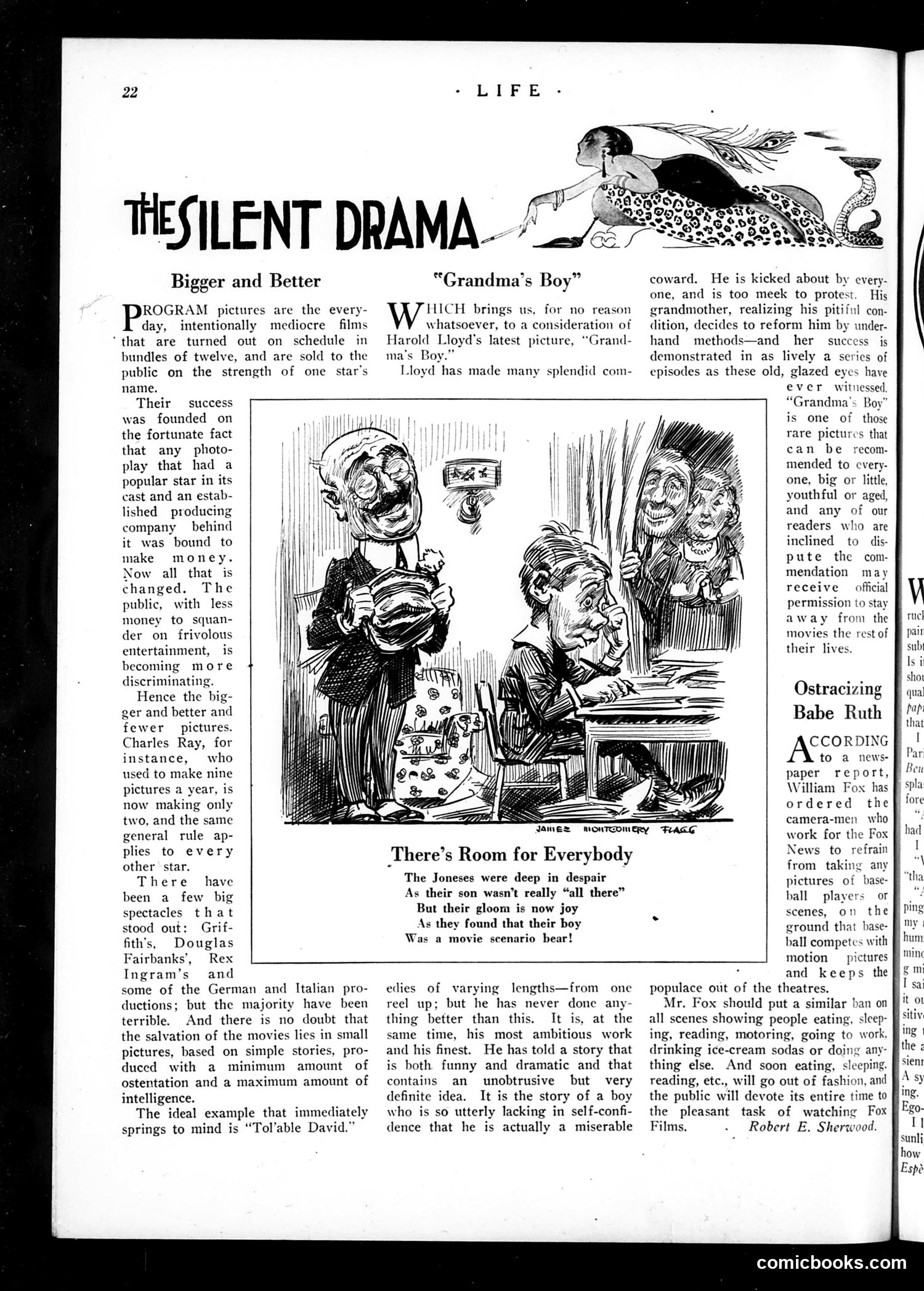
This page reviews silent films and industry trends. The central cartoon depicts a scene from Harold Lloyd's "Grandma's Boy," showing the titular grandmother with other characters—likely illustrating the plot where she reforms her timid grandson through "underhand methods." The main article argues that **Program pictures** (cheap, formulaic studio output) are dying because audiences, with less disposable income (post-WWI economic constraints), now discriminate between quality films. Studios are reducing output—Charles Ray from nine pictures yearly to two—prioritizing fewer, better productions. A secondary item satirizes **William Fox's decision to ban cameramen from filming baseball players**, claiming sports compete with movies for audiences. The writer mocks this logic: if Fox removes sports footage, shouldn't he also ban all scenes of eating, sleeping, working—anything people do in real life? The satire highlights the absurdity of blaming entertainment competitors rather than improving film quality.
📄 Transcribed text from this page (OCR, searchable)
Machine-transcribed from the original scan — historical spelling and the odd misread are preserved.
THESILENT DRAMA Bigger and Better ROGRAM pictures are the every- day, intentionally mediocre films ‘that are turned out on schedule in bundles of twelve, and are sold to the public on the strength of one star's name. “Grandma’s Boy” HICH brings us, for no reason whatsoever, to a consideration of Harold Lloyd's latest picture, “Grand- ma's Boy.” Lloyd has made many splendid com- coward. He is kicked about by every- one, and is too meek to pro His grandmother, realizing his pitiful con- dition, decides to reform him by under- hand methods—and her success is demonstrated in as lively a series of episodes as these old, glazed eyes have ever witnessed, Their success was founded on the fortunate fact that any photo- play that had a popular star in its cast and an estab- lished producing company behind it was bound to make money. Now all that is changed. The public, with less money to squan- der on frivolous entertainment, is becoming more discriminating. Hence the big- ger and better and fewer pictures. Charles Ray, for instance, who used to make nine pictures a year, is now making only two, and the same general rule ap- plies to every other star. There have been a few big spectacles that stood out: Grif- fith’s, Douglas Fairbanks’, Rex ames There’s Room for Everybody The Joneses were deep in despair As their son wasn’t really “all there” But their gloom is now joy As they found that their boy Was a movie scenario bear! MONTEOMERY FACE “Grandma's Boy" is one of those rare pictures that can be recom. mended to every- one, big or little, youthful or aged, and any of our readers who are inclined to dis- pute the com- mendation may receive official permission to stay away from the movies the rest of their lives. Ostracizing Babe Ruth CCORDING to a news- paper report, William Fox has ordered the camera-men who work for the Fox News to refrain f from taking any pictures of base- ball players or scenes, on the ground that base- hall competes with motion pictures Ingram’s and some of the German and Italian pro- ductions; but the majority have been terrible. And there is no doubt that the salvation of the movies lies in small pictures, based on simple stories, pro- duced with a minimum amount of ostentation and a maximum amount of intelligence. The ideal example that immediately springs to mind is “Tol’able David.” edies of varying lengths—from one reel up; but he has never done any- thing better than this. It is, at the same time, his most ambitious work and his finest. He has told a story that is both funny and dramatic and that contains an unobtrusive but very definite idea. It is the story of a boy who is so utterly lacking in self-confi- dence that he is actually a miserable and keeps the populace out of the theatres. Mr. Fox should put a similar ban on all scenes showing people eating, sleep- ing, reading, motoring, going to work. drinking ice-cream sodas or doing any- thing else. And soon eating, sleeping. reading, etc., will go out of fashion, and the public will devote its entire time to the pleasant task of watching Fox Films, Robert E. Sherwood. comicbooks.com