
Life, 1922-04-27 · page 26 of 34
Life — April 27, 1922 — page 26: what you’re looking at
What you’re looking at
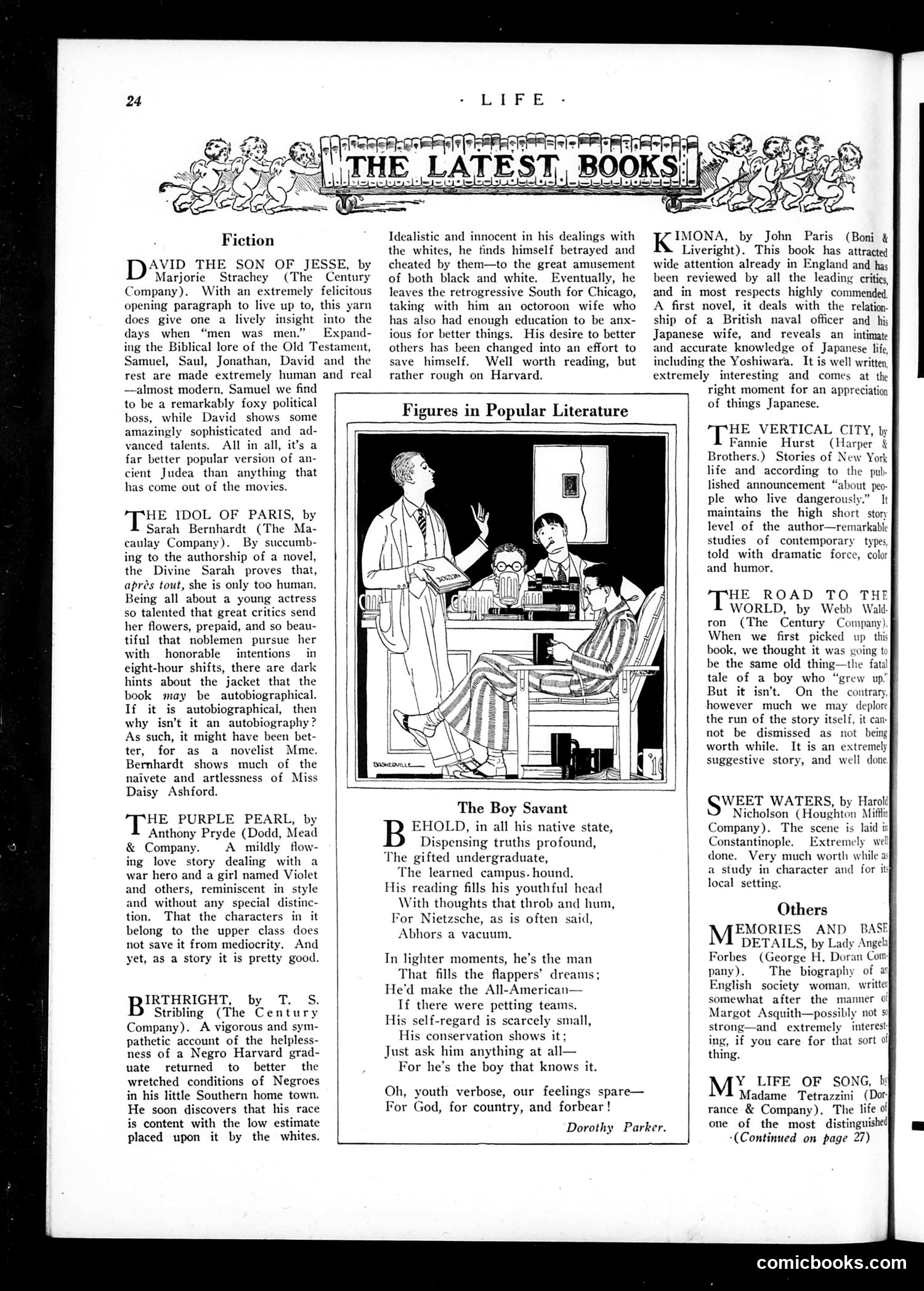
This illustration accompanies a book review section. The cartoon depicts a domestic scene with an adult (likely a parent or teacher) instructing a young boy at a desk, while two other figures observe from nearby furniture. The boy wears glasses and appears intellectually precocious. The accompanying poem "The Boy Savant" satirizes an overly educated, philosophically pretentious child who speaks in abstract intellectual language ("Dispensing truths profound," referencing Nietzsche). The satire mocks both the boy's affected sophistication and the contemporary trend of parents cultivating unnaturally intellectual children. The humor lies in the contrast between the child's youthful nature and his pompous, verbose manner. The final lines ("For he's the boy that knows it") suggest mockery of this type of precocious child who confidently displays learning beyond his years—a recognizable social phenomenon of the era that Life's readers would find amusing.
📄 Transcribed text from this page (OCR, searchable)
Machine-transcribed from the original scan — historical spelling and the odd misread are preserved.
Fiction AVID THE SON OF JESSE, by Marjorie Strachey (The Century Company). With an extremely felicitous opening paragraph to live up to, this yarn does give one a lively insight into the days when “men was men.” Expand- ing the Biblical lore of the Old Testament, Samuel, Saul, Jonathan, David and the rest are made extremely human and real —almost modern, Samuel we find Idealistic and innocent in his dealings with the whites, he finds himself betrayed and cheated by them—to the great amusement of both black and white. Eventually, he leaves the retrogressive South for Chicago, taking with him an octoroon wife who has also had enough education to be anx- ious for better things. His desire to better others has been changed into an effort to save himself. Well worth reading, but rather rough on Harvard. Kwon. by John Paris (Boni & Liveright). This book has attracted wide attention already in England and has been reviewed by all the leading critics, and in most respects highly commended, A first novel, it deals with the relation. ship of a British naval officer and his Japanese wife, and reveals an_ intimate and accurate knowledge of Japanese life, including the Yoshiwara. It is well written, extremely interesting and comes at the right moment for an appreciation to be a remarkably foxy political boss, while David shows some Figures in Popular Literature of things Japanese. amazingly sophisticated and ad- vanced talents. All in all, it’s a far better popular version of an- cient Judea than anything that has come out of the movies. HE IDOL OF PARIS, by Sarah Bernhardt (The Ma- caulay Company). By succumb- ing to the authorship of a novel, the Divine Sarah proves that, aprés tout, she is only too human, Being all about a young actress so talented that great critics send her flowers, prepaid, and so beau- tiful that noblemen pursue her with honorable intentions in eight-hour shifts, there are dark hints about the jacket that the book may be autobiographical. If it is autobiographical, then why isn’t it an autobiography? As such, it might have been bet- ter, for as a novelist Mme. Bernhardt shows much of the naivete and artlessness of Miss HE VERTICAL CITY, by Fannie Hurst (Harper & Brothers.) Stories of New York life and according to the pub- lished announcement “about peo- ple who live dangerously.” It maintains the high short. story level of the author—remarkable studies of contemporary types, told with dramatic force, color and humor. HE ROAD TO THE WORLD, by Webb Wald. ron (The Century Company). When we first picked up this book, we thought it was going t be the same old thing—the fatal tale of a boy who “grew up’ But it isn’t. On the contrary however much we may the run of the story i not be dismissed as not being worth while. It is an extremely > suggestive story, and well done Daisy Ashford. HE PURPLE PEARL, by Anthony Pryde (Dodd, Mead & Company. A mildly flow- ing love story dealing with a war hero and a girl named Violet and others, reminiscent in style and without any special distinc- tion. That the characters in it belong to the upper class does not save it from mediocrity. And yet, as a story it is pretty good. IRTHRIGHT, by T. S. Stribling (The Century Company). A vigorous and sym- pathetic account of the helpless- ness of a Negro Harvard grad- uate returned to better the wretched conditions of Negroes in his little Southern home town. He soon discovers that his race is content with the low estimate placed upon it by the whites. The Boy Savant EHOLD, in all his native state, Dispensing truths profound, The gifted undergraduate, The learned campus. hound. His reading fills his youthful head With thoughts that throb and hum, For Nietzsche, as is often said, Abhors a vacuum, In lighter moments, he’s the man That fills the flappers’ dreams; He'd make the All-American— If there were petting teams. is self-regard is scarcely small, s conservation shows it; Just ask him anything at all— For he’s the boy that knows it. Oh, youth verbose, our feelings spare— For God, for country, and forbear! Dorothy Parker. WEET WATERS, by Haroli Nicholson (Houghton Miftlc Company). The scene is laid i Constantinople. Extremely wel done. Very much worth while a a study in character and for ity local setting. Others EMORIES AND BASER DETAILS, by Lady Angel Forbes (George H. Doran Com} pany). The biography of af English society woman, write somewhat after the manner 0 Margot Asquith—possibly not s strong—and extremely interest! ing, if you care for that sort of thing. M* LIFE OF SONG, bi Madame Tetrazzini (Dor. rance & Company). The life o! one of the most distinguished (Continued on page 27) comicbooks.com