
Life, 1922-04-27 · page 22 of 34
Life — April 27, 1922 — page 22: what you’re looking at
What you’re looking at
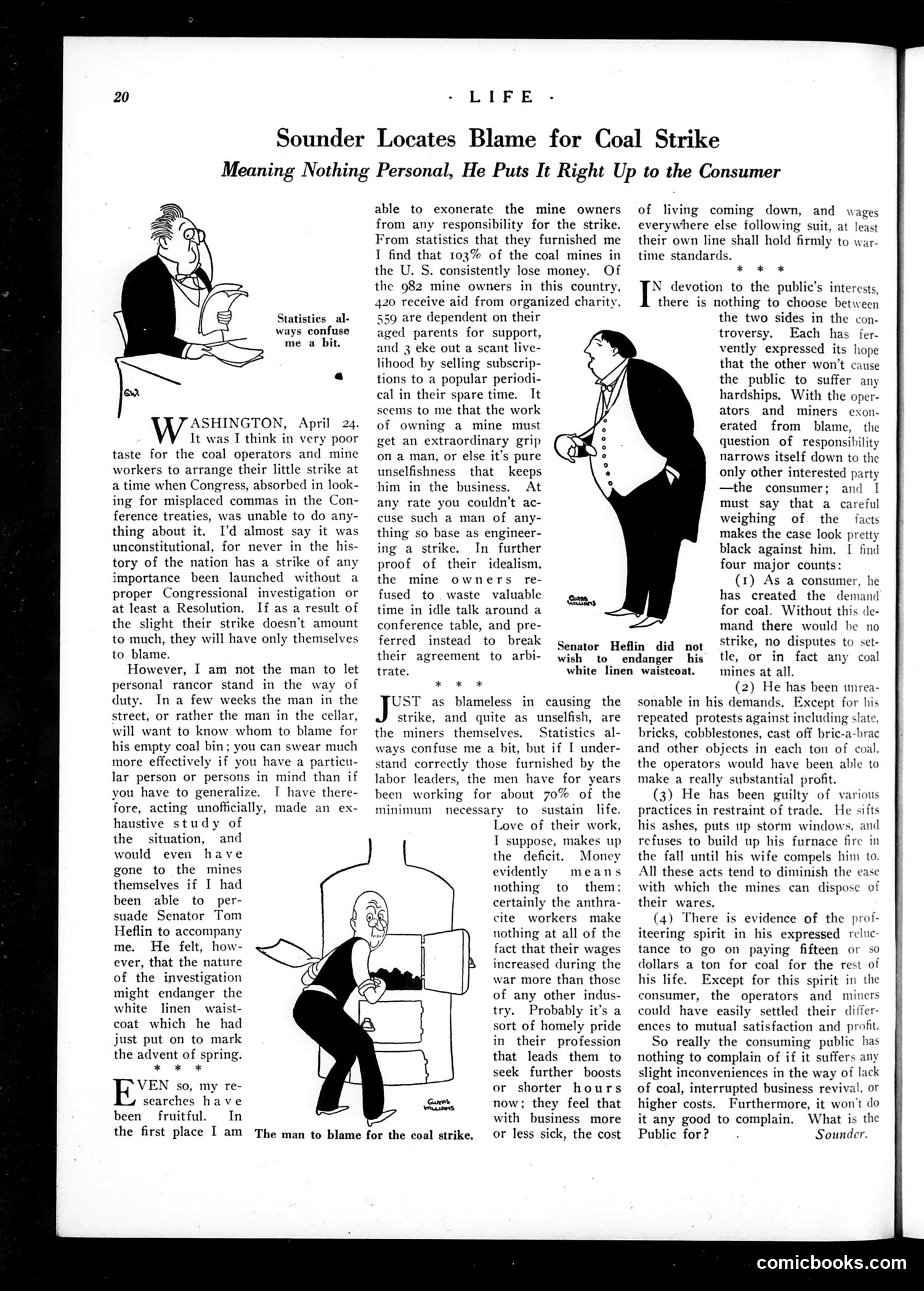
This satirical article by "Sounder" (a Life magazine columnist) uses heavy irony to critique both coal operators and miners during a 1920s coal strike, ultimately blaming consumers. **The Setup:** The author pretends to conduct an "impartial investigation" to help angry citizens identify whom to blame when their coal bins empty. **The Satire:** - Mine owners are absurdly exonerated despite losing money (allegedly 103% of mines) and breaking arbitration agreements—the author sarcastically praises their "idealism" - Miners are equally mocked for accepting poverty wages (70% subsistence) out of supposed professional pride, ignoring wartime wage increases - The cartoon illustrations show these groups as the "man to blame"—visual embodiments of the problem **The Point:** By claiming both sides are equally blameless and selfless, Sounder reveals the absurdity of their dispute. His final verdict—that consumers must accept higher prices without complaint—targets the public's frustration. The joke: when labor and management both cite noble motives while causing public hardship, ordinary people bear the cost. The piece criticizes strike dynamics and corporate/labor rhetoric rather than taking either side.
📄 Transcribed text from this page (OCR, searchable)
Machine-transcribed from the original scan — historical spelling and the odd misread are preserved.
- LIFE - Sounder Locates Blame for Coal Strike Meaning Nothing Personal, He Puts It Right Up to the Consumer tatistics al- ways confuse me a bit. a ASHINGTON, April 24. It was I think in very poor taste for the coal operators and mine workers to arrange their little strike at a time when Congress, absorbed in look- ing for misplaced commas in the Con- ference treaties, was unable to do any- thing about it. I'd almost say it was unconstitutional, for never in the h tory of the nation has a strike of any importance been launched without a proper Congressional investigation or at least a Resolution. If as a result of the slight their strike doesn’t amount to much, they will have only themselves to blame. However, I am not the man to let personal rancor stand in the way of duty. In a few weeks the man in the street, or rather the man in the cellar, will want to know whom to blame for his empty coal bin; you can swear much more effectively if you have a particu- lar person or persons in mind than if you have to generaliz I have there- fore, acting unofficially, made an ex- haustive study of the situation, and would even have gone to the mines themselves if I had been able to per- suade Senator Tom Heflin to accompany me. He felt, how- ever, that the nature of the investigation might endanger the white linen waist- coat which he had just put on to mark the advent of spring. * * * VEN so, my re- searches have been fruitful. In the first place I am The man to blame for the coal strike. able to exonerate the mine owners from any responsibility for the strike. From statistics that they furnished me I find that 103% of the coal mines in the U. S. consistently lose money. Of the 982 mine owners in this country, 420 receive aid from organized charity, g are dependent on their aged parents for support, and 3 eke out a scant live- lihood by selling subscrip- tions to a popular periodi- cal in their spare time. It seems to me that the work of owning a mine must get an extraordinary grip on a man, or else it’s pure unselfishness that keeps him in the business. At any rate you couldn’t ac- cuse such a man of any- thing so base as engineer- ing a strike. In further proof of their idealism, the mine owners re- fused to waste valuable time in idle talk around a conference table, and pre- ferred instead to break their agreement to arbi- trate. wish to xe OF J ST as blameless in causing the strike, and quite as unselfish, are the miners themselves. Statistics al- ways confuse me a bit, but if I under- stand correctly those furnished by the labor leaders, the men have for years been working for about 70% of the nece to sustain life. Love of their work, I suppose, makes up the deficit. Money evidently means nothing to them; certainly the anthra- cite workers make nothing at all of the fact that their wages increased during the war more than those of any other indus- try. Probably a sort of homely pride in their profession that leads them to seek further boosts or shorter hours now; they feel that with business more or less sick, the cost minimum Senator Heflin did not white linen waistcoat. of living coming down, and_ wages everywhere else following suit, at least their own line shall hold firmly to war- time standards. * * * I Y devotion to the public’s interests, there is nothing to choose between the two sides in the con- troversy. Each has fer- vently expressed its hope that the other won't cause the public to suffer any hardships. With the oper- ators and miners exon- erated from blame, the question of responsibility narrows itself down to the only other interested party —the consumer; and I must say that a careful weighing of. the facts makes the case look pretty black against him. I find four major counts: (1) As a consumer, he has created the demand for coal. Without this de- mand there would be no strike, no disputes to set- tle, or in fact any coal mines at all. (2) He has been unrea- sonable in his demands. Except for his repeated protests against including slate, bricks, cobblestones, cast off bric-a-brac and other objects in each ton of coal, the operators would have been able to make a really substantial profit. (3) He has been guilty of various practices in restraint of trade. He sifts his ashes, puts up storm windows, and refuses to build up his furnace fire in the fall until his wife compels him to. All these acts tend to diminish the ease with which the mines can dispose of their wares. (4) There is evidence of the prof- iteering spirit in his expressed reluc- tance to go on paying fifteen or so dollars a ton for coal for the rest of his life. Except for this spirit in the consumer, the operators and miners could have easily settled their differ- ences to mutual satisfaction and profit. So really the consuming public has nothing to complain of if it suffers any slight inconveniences in the way of lack of coal, interrupted business revival, or higher costs. Furthermore, it won't do it any good to complain. What is the Public for? Sounder. endanger his comicbooks.com