
Life, 1922-04-27 · page 12 of 34
Life — April 27, 1922 — page 12: what you’re looking at
What you’re looking at
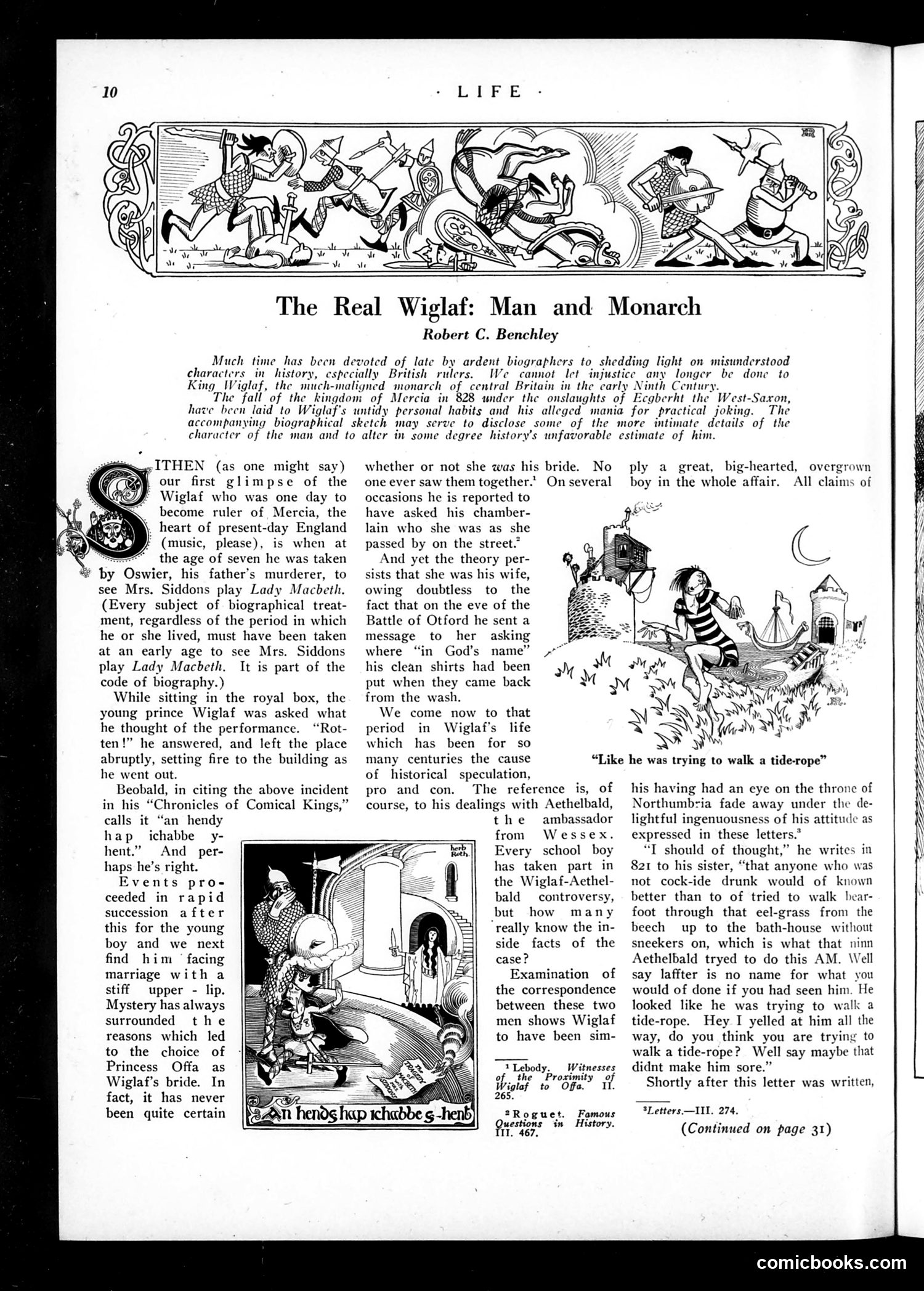
This page discusses the historical figure Wiglaf, who became ruler of Mercia (in present-day England) in the early Ninth Century. Benchley uses Wiglaf's biography to examine how little we truly know about historical figures, despite claims made about them. The article references Wiglaf's alleged bride and domestic incidents, questioning historical accuracy. The accompanying illustrations show medieval scenes—including what appears to be a figure trying to "walk a tide-rope" (likely a humorous metaphor for maintaining balance or dignity in difficult circumstances). Benchley's point is satirical: we construct elaborate narratives about historical "great men" based on fragmentary evidence, creating false certainty about intimate details we cannot possibly verify. The essay is part of Life's tradition of witty commentary on historical pretension.
📄 Transcribed text from this page (OCR, searchable)
Machine-transcribed from the original scan — historical spelling and the odd misread are preserved.
The Real Wiglaf: Man and Monarch Robert C. Benchley Much time has been devoted of late by ardent biographers to shedding light on misunderstood characters in history, especially British rulers. King Wiglaf, the mu We cannot let injustice any longer be done to t-maligned monarch of central Britain in the carly The fall of the kingdom of Mercia in 828 under the onslaughts of inth Century. Ecgberht the West-Saxon, have been laid to Wiglaf's untidy personal habits and his alleged mania for practical joking accompanying biographical sketch may serve to disclose some of the more intimate details of the character of the man and to alter in some degree history’s unfavorable estimate of him. «;ITHEN (as one might say) our first glimpse of the Wiglaf who was one day to become ruler of Mercia, the heart of present-day England (music, please), is when at = the age of seven he was taken by Oswier, his father’s murderer, to see Mrs. Siddons play Lady Macbeth. (Every subject of biographical treat- ment, regardless of the period in which he or she lived, must have been taken at an early age to see Mrs. Siddons play Lady Macbeth. It is part of the code of biography.) While sitting in the royal box, the young prince Wiglaf was asked what he thought of the performance. “Rot- ten!” he answered, and left the place abruptly, setting fire to the building as he went out. Beobald, in citing the above incident in his “Chronicles of Comical Kings,” calls it “an hendy hap ichabbe y- whether or not she was his bride. No one ever saw them together.’ On several occasions he is reported to have asked his chamber- lain who she was as she passed by on the street.” And yet the theory per- sists that she was his wife, owing doubtless to the fact that on the eve of the Battle of Otford he sent a message to her asking where “in God’s name” his clean shirts had been put when they came back from the wash. We come now to that period in Wiglaf's life which has been for so many centuries the cause of historical speculation, pro and con. The reference is, of course, to his dealings with Aethelbald, the ambassador from Wessex. hent.” And _ per- haps he’s right. Events pro- ceeded in rapid succession after this for the young boy and we next find him ‘ facing marriage with a stiff upper - lip. Mystery has always surrounded the reasons which led to the choice of Princess Offa as Wiglaf’s bride. In fact, it has never been quite certain Every school boy has taken part in the Wiglaf-Aethel- bald controversy, but how many “really know the in- side facts of the case? Examination of the correspondence between these two men shows Wiglaf to have been sim- 1 Lebody. Leathe ,Pregimity of iglaf to Offa. II. 265. Witnesses 2Roguet. Famous uestions in History. IT. 467, ply a great, big-hearted, boy in the whole affair. overgrown All claims of “Like he was trying to walk a tide-rope” his having had an eye on the throne of Northumbria fade away under the de- lightful ingenuousness of his attitude as expressed in these letters. “IT should of thought,” he writes in 821 to his sister, “that anyone who was not cock-ide drunk would of known better than to of tried to walk bear- foot through that eel-grass from the beech up to the bath-house without sneekers on, which is what that ninn Aethelbald tryed to do this AM. \ell say laffter is no name for what you would of done if you had seen him. He looked like he was trying to walk a tide-rope. Hey I yelled at him all the way, do you think you are trying to walk a tide-rope? Well say maybe that didnt make him sore.” Shortly after this letter was written, 3Letters—III. 274. (Continued on page 31) comicbooks.com SSS ASSSS =~