
Life, 1922-04-27 · page 11 of 34
Life — April 27, 1922 — page 11: what you’re looking at
What you’re looking at
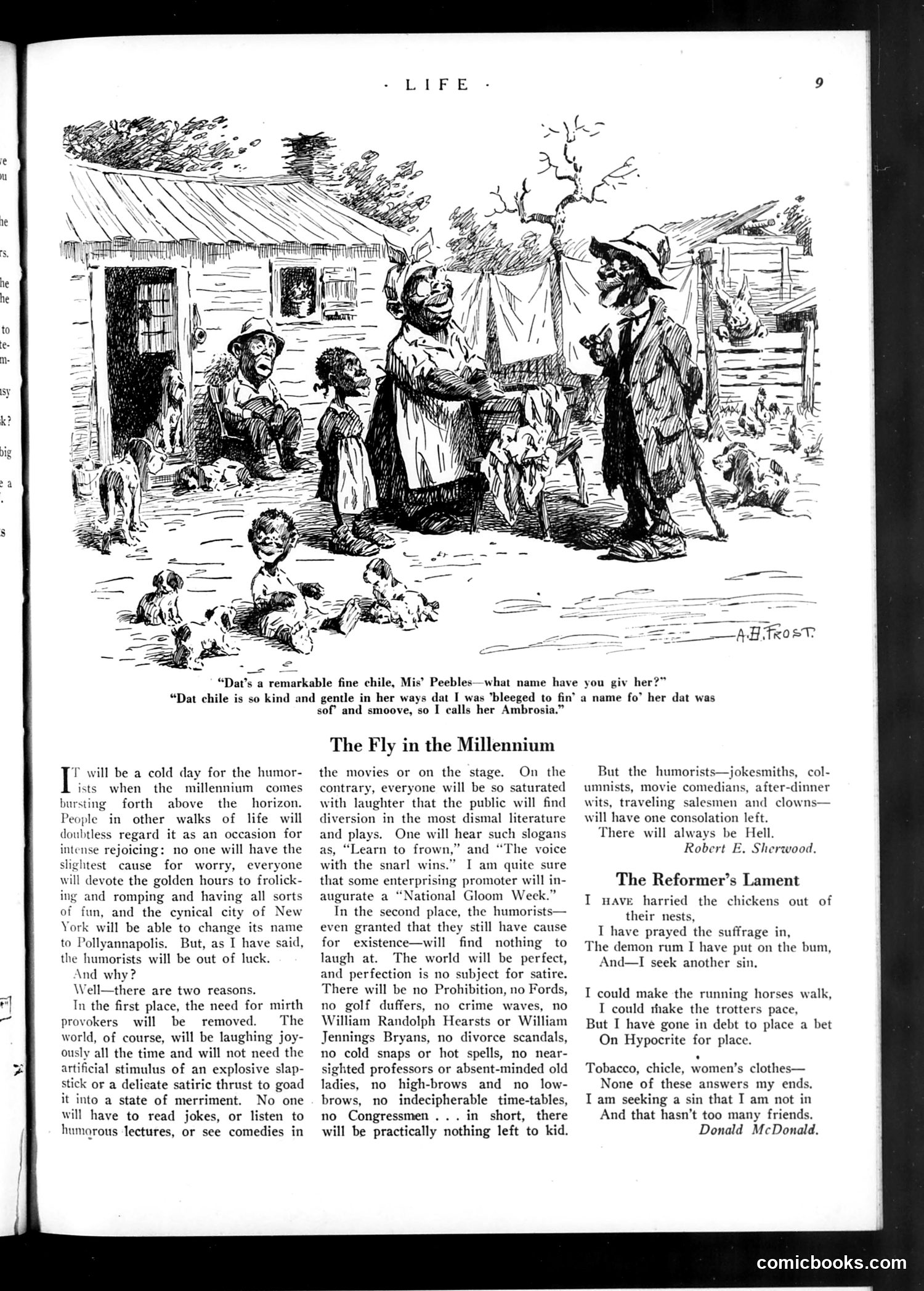
The cartoon depicts a rural scene with working-class figures and children. The dialogue identifies a child as "Ambrosia," with commentary on her gentle nature. The illustration is signed by A.B. Frost, a noted cartoonist. Below are three short humorous pieces. "The Fly in the Millennium" satirizes optimism about the coming 20th century, arguing that humorists will become obsolete in a "perfect" future world without crime, golf disputes, or divorce scandals. "The Reformer's Lament" mocks a social reformer frustrated that their causes—suffrage, temperance, and various moral reforms—haven't eliminated all vices, leaving them without purpose. The content reflects Progressive Era anxieties about social reform and technological optimism circa 1900.
📄 Transcribed text from this page (OCR, searchable)
Machine-transcribed from the original scan — historical spelling and the odd misread are preserved.
“Dat’s a remarkable fine chile, Mis’ Peebles—what name have you giv her?” “Dat chile is so kind and gentle in her ways dat I was "bleeged to fin’ a name fo” her dat was sof’ and smoove, so I calls her Ambrosia.” T will be a cold day for the humor- when the millennium comes bursting forth above the horizon. People in other walks of life will doubtless regard it as an occasion for intense rejoicing: no one will have the slightest cause for worry, everyone will devote the golden hours to frolick- ing and romping and having all sorts of fun, and the cynical city of New York will be able to change its name to Pollyannapolis. But, as I have said, the humorists will be out of luck. And why? Well—there are two reasons. In the first place, the need for mirth provokers will be removed. The world, of course, will be laughing joy- ously all the time and will not need the artificial stimulus of an explosive slap- stick or a delicate satiric thrust to goad it into a state of merriment. No one will have to read jokes, or listen to humorous lectures, or see comedies in ists The Fly in the Millennium the movies or on the stage. On the contrary, everyone will be so saturated with laughter that the public will find diversion in the most dismal literature and plays. One will hear such slogans as, “Learn to frown,” and “The voice with the snarl wins.” I am quite sure that some enterprising promoter will in- augurate a “National Gloom Week.” In the second place, the humo even granted that they still have cause for existence—will find nothing to laugh at. The world will be perfect, and perfection is no subject for satire. There will be no Prohibition, no Fords, no golf duffers, no crime waves, no William Randolph Hearsts or William Jennings Bryans, no divorce scandals, no cold snaps or hot spells, no near- sighted professors or absent-minded old ladies, no high-brows and no low- brows, no indecipherable time-tables, no Congressmen... in short, there will be practically nothing left to kid. But the humorists—jokesmiths, col- umnists, movie comedians, after-dinner wits, traveling salesmen and clowns— will have one consolation left. There will always be Hell. Robert E. Sherwood. The Reformer’s Lament I wave harried the chickens out of their nests, I have prayed the suffrage in, The demon rum I have put on the bum, And—I seek another sin. I could make the running horses walk, I could thake the trotters pace, But I have gone in debt to place a bet On Hypocrite for place. Tobacco, chicle, women’s clothes— None of these answers my ends, I am seeking a sin that I am not in And that hasn’t too many friends. Donald McDonald. comicbooks.com