
Life, 1922-04-27 · page 20 of 34
Life — April 27, 1922 — page 20: what you’re looking at
What you’re looking at
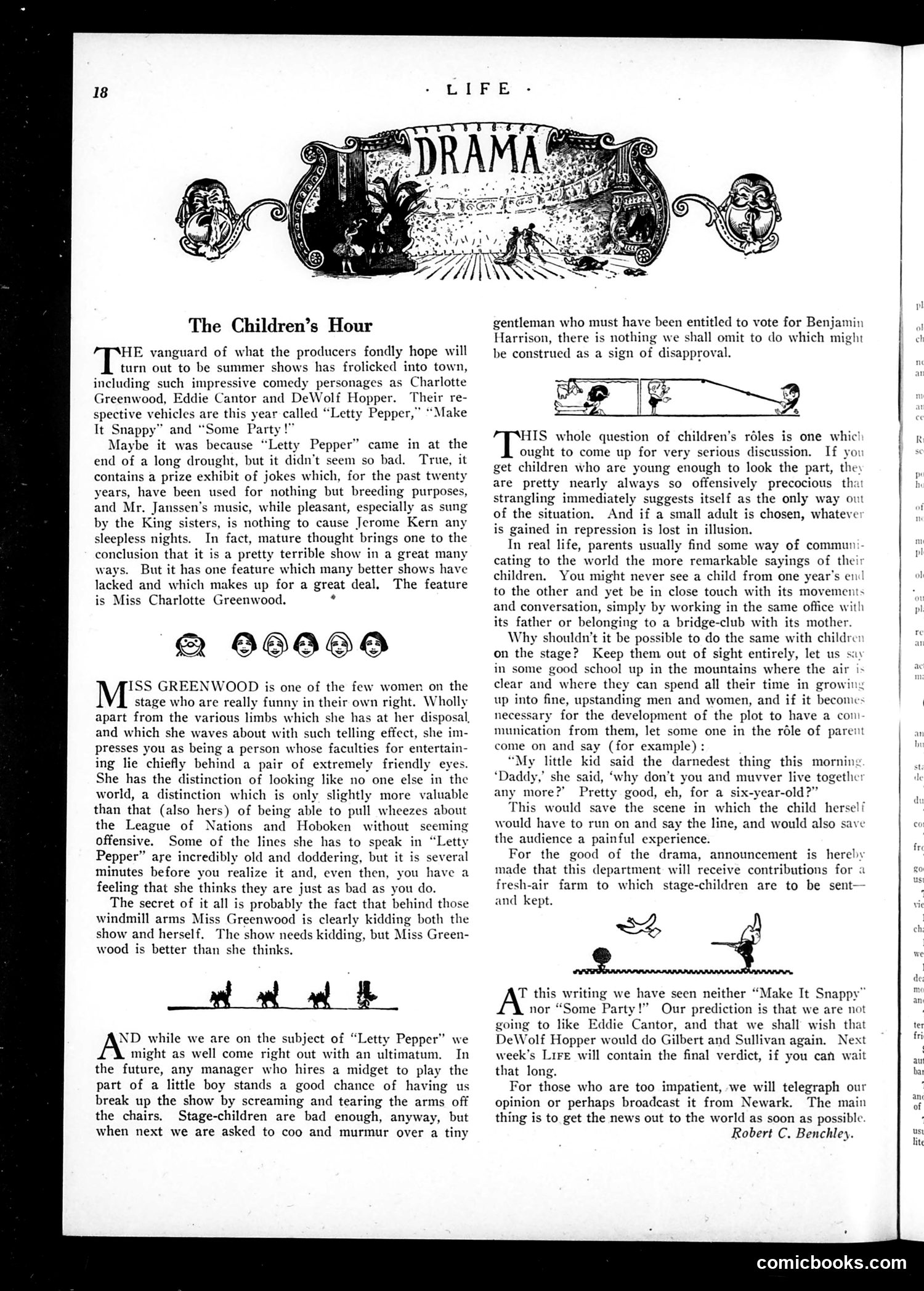
This is a theater review critiquing summer Broadway shows featuring established comedians Charlotte Greenwood, Eddie Cantor, and DeWolf Hopper. The reviewer praises Greenwood's genuine comedic talent—her ability to make old jokes work through her distinctive physical comedy and expressive eyes—while finding the shows themselves mediocre. The satire targets two issues: first, the use of midgets to play child roles (the reviewer threatens to disrupt performances if this continues), comparing them sardonically to men old enough to have voted for Benjamin Harrison (president 1889-1893, making the reference roughly 20+ years old by publication). Second, it satirizes child actors generally as either unnaturally precocious or unconvincingly played by adults. The reviewer suggests keeping children entirely offstage, communicated to audiences only through parents' anecdotes—mirroring how real people share stories about their children.
📄 Transcribed text from this page (OCR, searchable)
Machine-transcribed from the original scan — historical spelling and the odd misread are preserved.
The Children’s Hour HE vanguard of what the producers fondly hope will turn out to be summer shows has frolicked into town, including such impressive comedy personages as Charlotte Greenwood, Eddie Cantor and DeWolf Hopper. Their re- spective vehicles are this year called “Letty Pepper,” “Make It Snappy” and “Some Party Maybe it was because “Letty Pepper” came in at the end of a long drought, but it didn’t seem so bad. True, it contains a prize exhibit of jokes which, for the past twenty years, have been used for nothing but breeding purposes, and Mr. Janssen’s music, while pleasant, especially as sung by the King sisters, is nothing to cause Jerome Kern any sleepless nights. In fact, mature thought brings one to the conclusion that it is a pretty terrible show in a great many ways. But it has one feature which many better shows have lacked and which makes up for a great deal. The feature is Miss Charlotte Greenwood. : Q 986088 ISS GREENWOOD is one of the few women on the stage who are really funny in their own right. Wholly apart from the various limbs which she has at her disposal, and which she waves about with such telling effect, she im- presses you as being a person whose faculties for entertain- ing lie chiefly behind a pair of extremely friendly eyes. She has the distinction of looking like no one else in the world, a distinction which is only slightly more valuable than that (also hers) of being able to pull wheezes about the League of Nations and Hoboken without seeming offensive. Some of the lines she has to speak in “Letty Pepper” are incredibly old and doddering, but it is several minutes before you realize it and, even then, you have a feeling that she thinks they are just as bad as you do. The secret of it all is probably the fact that behind those windmill arms Miss Greenwood is clearly kidding both the show and herself. The show needs kidding, but Miss Green- wood is better than she thinks. ND while we are on the subject of “Letty Pepper” we might as well come right out with an ultimatum. In the future, any manager who hires a midget to play the part of a little boy stands a good chance of having us break up the show by screaming and tearing the arms off the chairs. Stage-children are bad enough, anyway, but when next we are asked to coo and murmur over a tiny gentleman who must have been entitled to vote for Benjamin Harrison, there is nothing we shall omit to do which might be construed as a sign of disapproval. HIS whole question of children’s réles is one whic! ought to come up for very serious discussion. If yo get children who are young enough to look the part, the are pretty nearly always so offensively precocious that strangling immediately suggests itself as the only way out of the situation, And if a small adult is chosen, whateve is gained in repression is lost in illusion. In real life, parents usually find some way of communi- cating to the world the more remarkable sayings of their children. You might never see a child from one year's e1 to the other and yet be in close touch with its movements and conversation, simply by working in the same office with its father or belonging to a bridge-club with its mother. Why shouldn't it be possible to do the same with childre: on the stage? Keep them out of sight entirely, let us say in some good school up in the mountains where the air is clear and where they can spend all their time in growiny up into fine, upstanding men and women, and if it becomes necessary for the development of the plot to have a con munication from them, let some one in the réle of parent come on and say (for example): “My little kid said the darnedest thing this morning ‘Daddy,’ she said, ‘why don’t you and muvver live togetlhi any more?’ Pretty good, eh, for a year-old?” This would save the scene in which the child herseli would have to run on and say the line, and would also save the audience a painful experience. For the good of the drama, announcement is hereby made that this department will receive contributions for « fresh-air farm to which stage-children are to be sent— and kept. T this writing we have seen neither “Make It Snappy" nor “Some Party!” Our prediction is that we are not going to like Eddie Cantor, and that we shall wish that DeWolf Hopper would do Gilbert and Sullivan again. Next week’s Lire will contain the final verdict, if you can wait that long. For those who are too impatient, we will telegraph our opinion or perhaps broadcast it from Newark. The main thing is to get the news out to the world as soon as possible. Robert C. Benchley. comicbooks.com