
A complete issue · 34 pages · 1922
Life — March 30, 1922
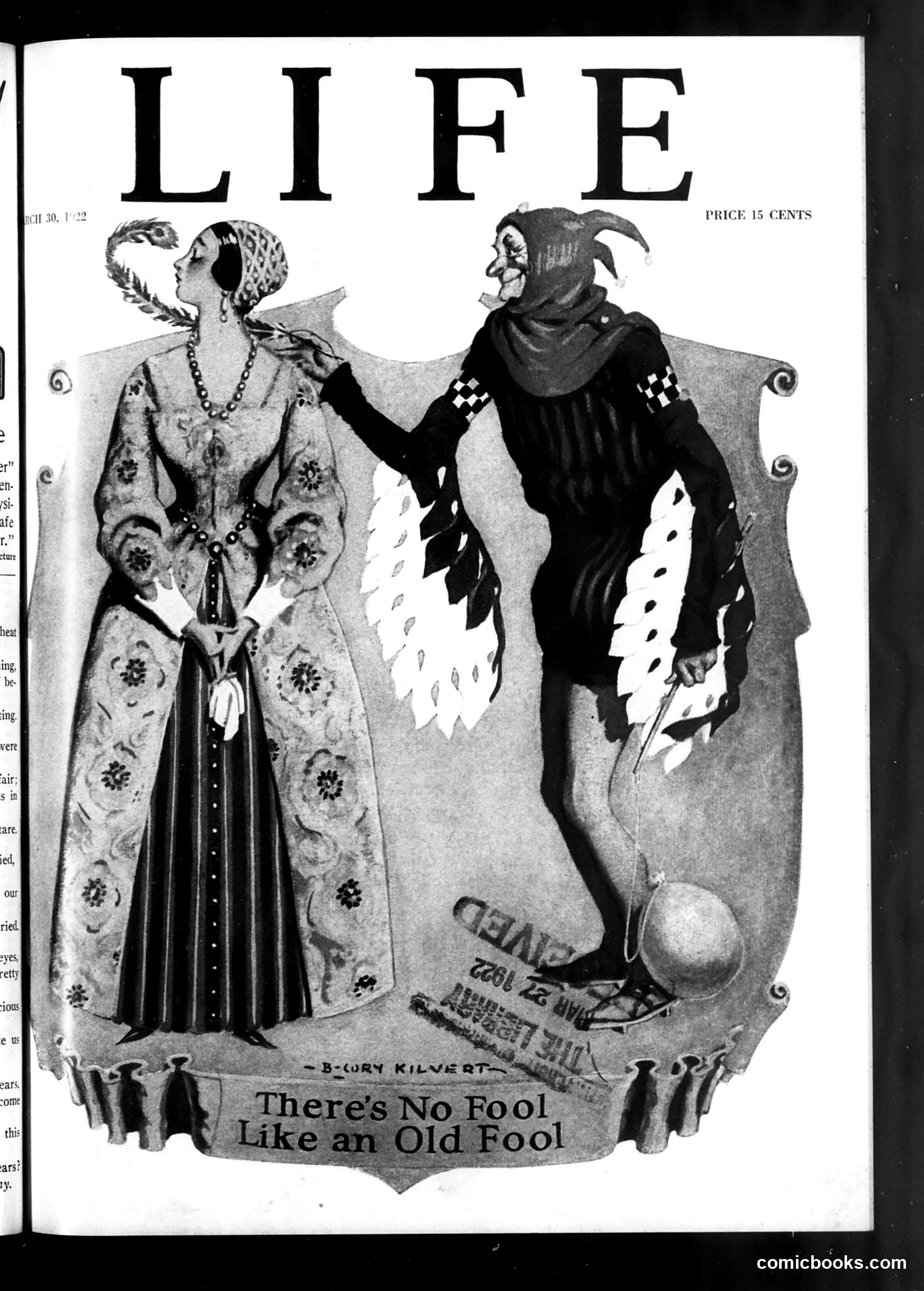
This Life magazine cover presents a classic comedic scenario contrasting youth and age. A elegantly dressed woman in an ornate, patterned gown with jewels and fashionable 1920s styling faces a grotesque fool character wearing a jester's outfit and holding a bauble. The title suggests a romantic or social entanglement where an older person is being foolish, likely by pursuing someone younger or being deceived. The woman's dignified presentation contrasts sharply with the fool's exaggerated, grotesque appearance, emphasizing the satirical point about age-inappropriate behavior or romantic delusion. The artwork credits "B. Cory Kilvert," indicating this is the magazine's cover illustration. The 15-cent price and publication details place this in the early 20th century.
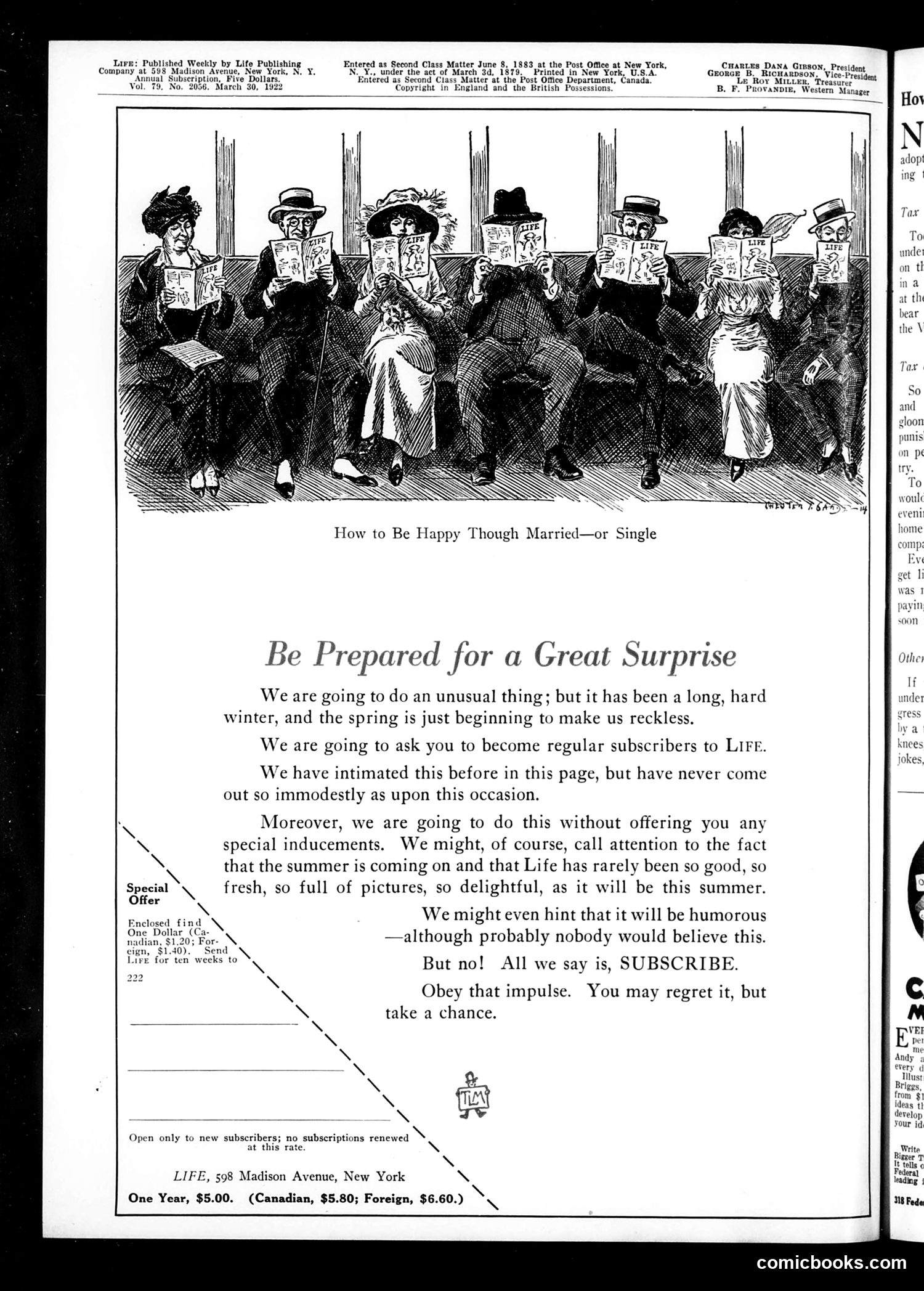
The cartoon "How to Be Happy Though Married—or Single" depicts seven figures seated together reading magazines or newspapers, representing different marital statuses. The satire appears to mock the notion that happiness depends on relationship status—the title's ironic dash suggests married and single people are equally capable of contentment (or discontent). The accompanying text is actually an advertisement disguised as editorial content, urging readers to subscribe to *Life* magazine. The publisher uses mock-earnest language ("Be Prepared for a Great Surprise," "Obey that impulse") to encourage subscriptions, promising the summer issues will be "humorous" and "fresh." The ad emphasizes subscription exclusivity and pricing, undercutting its own casual tone with commercial intent—a self-aware satire of advertising practices itself.
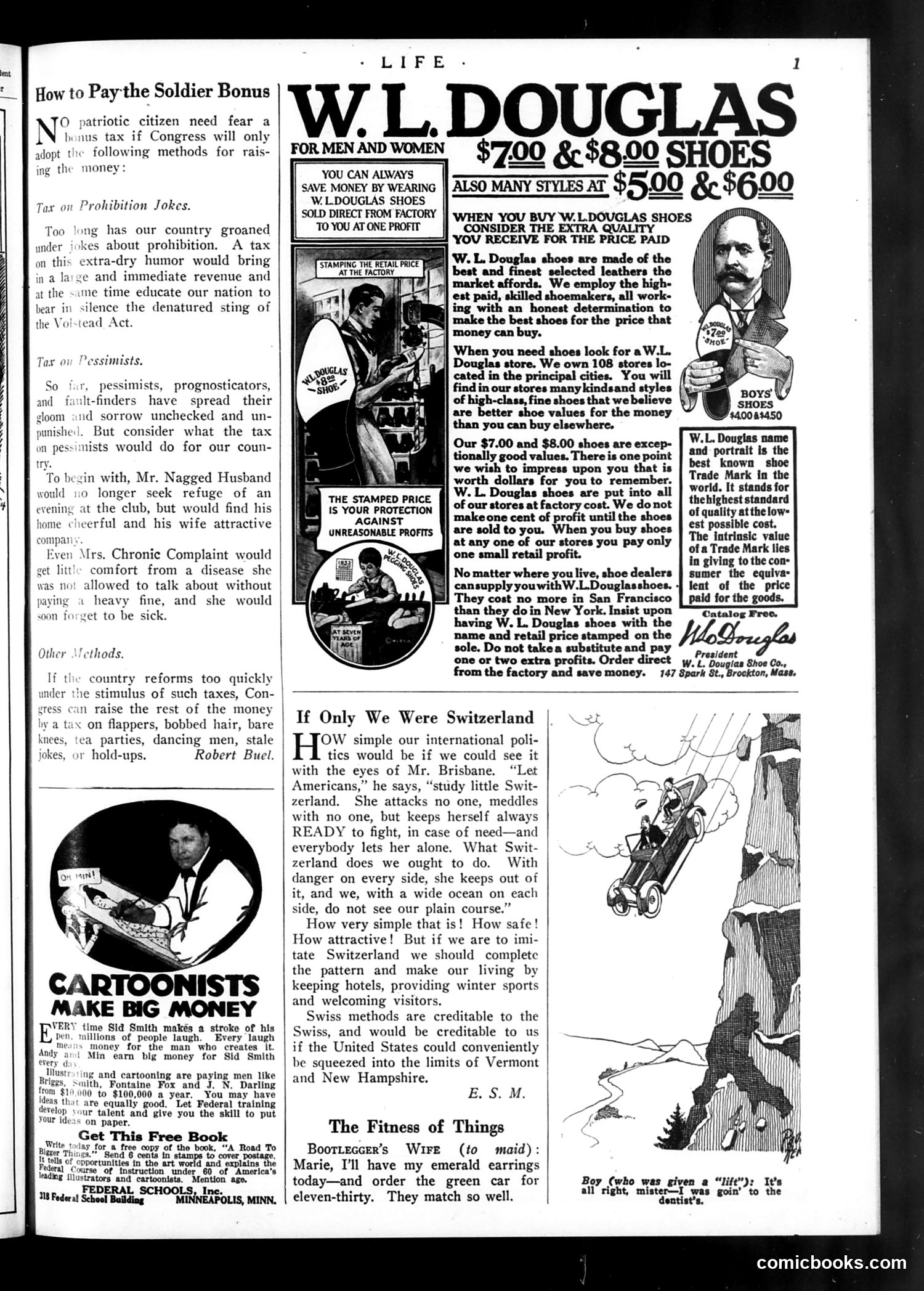
This page is primarily a W.L. Douglas shoe advertisement, with several satirical articles on the left side addressing taxation and other topics. The main cartoon shows a bootlegger's wife ordering supplies, captioned "The Fitness of Things." The satire references Prohibition-era bootlegging—illegal alcohol production during the alcohol ban. The joke is that the wife casually orders a "green car for eleven-thirty," a coded reference to bootleggers' use of fast cars for transporting illegal liquor. The caption's irony suggests the "fitness" or appropriateness of organized crime becoming normalized in American domestic life. The articles discuss humor taxation and pessimists during what appears to be post-WWI America. A separate cartoon about cartoonists making money indicates the profession's growing commercial success during this period.
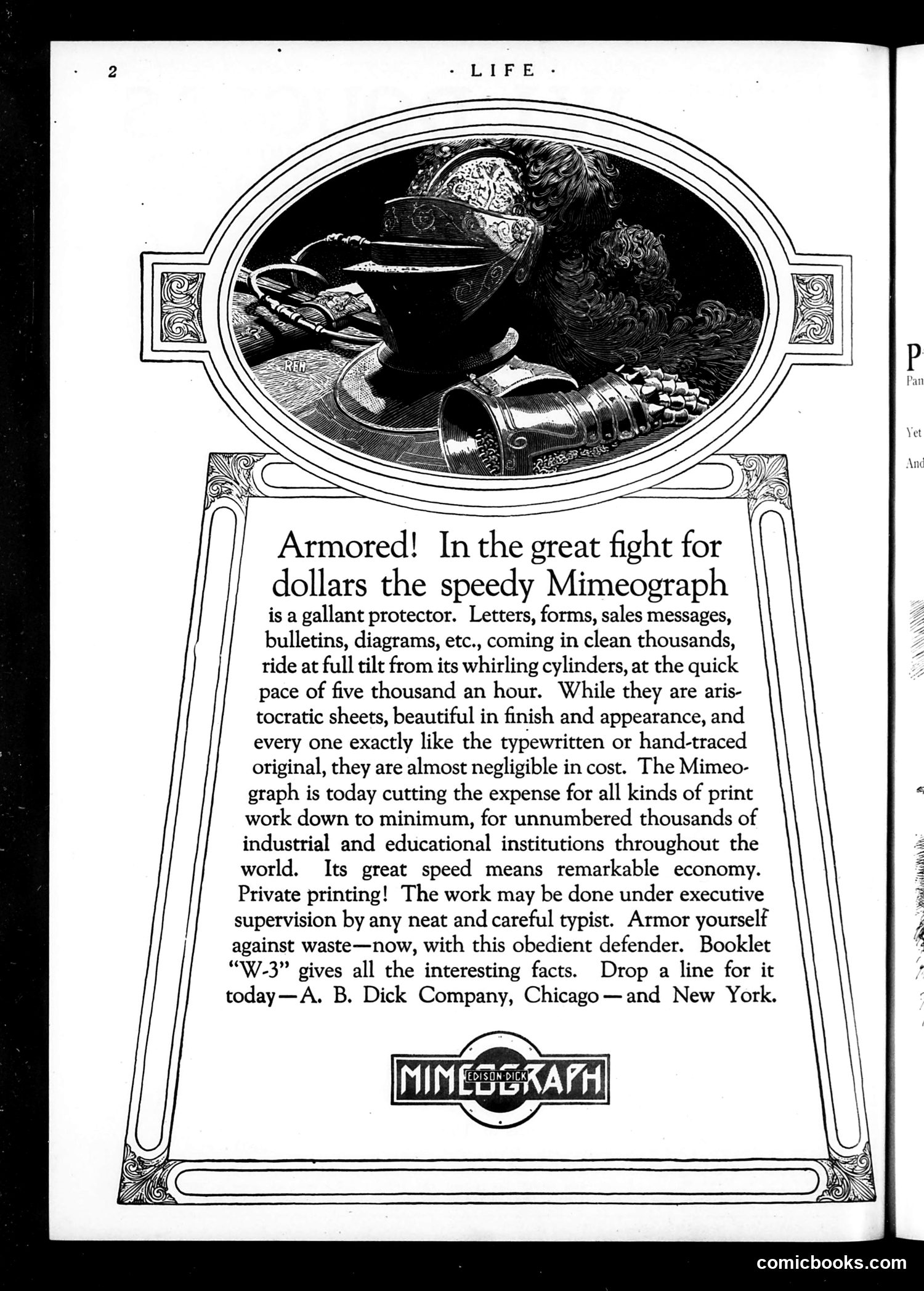
This page is primarily an advertisement for the Mimeograph machine, produced by A.B. Dick Company. The ad uses military/armor imagery—showing a knight in full plate armor with shield and sword—as a metaphor for business protection. The "Armored!" headline plays on contemporary concerns about business efficiency and cost-cutting during what appears to be an early 20th-century economic period. The advertisement promotes the Mimeograph as a "galant protector" against waste, emphasizing its speed (5,000 copies per hour) and economy for producing documents, letters, and bulletins. The armor imagery suggests that businesses need protection against financial loss—the "great fight for dollars" mentioned in the text. This is corporate advocacy messaging rather than political satire, marketed to industrial and educational institutions.
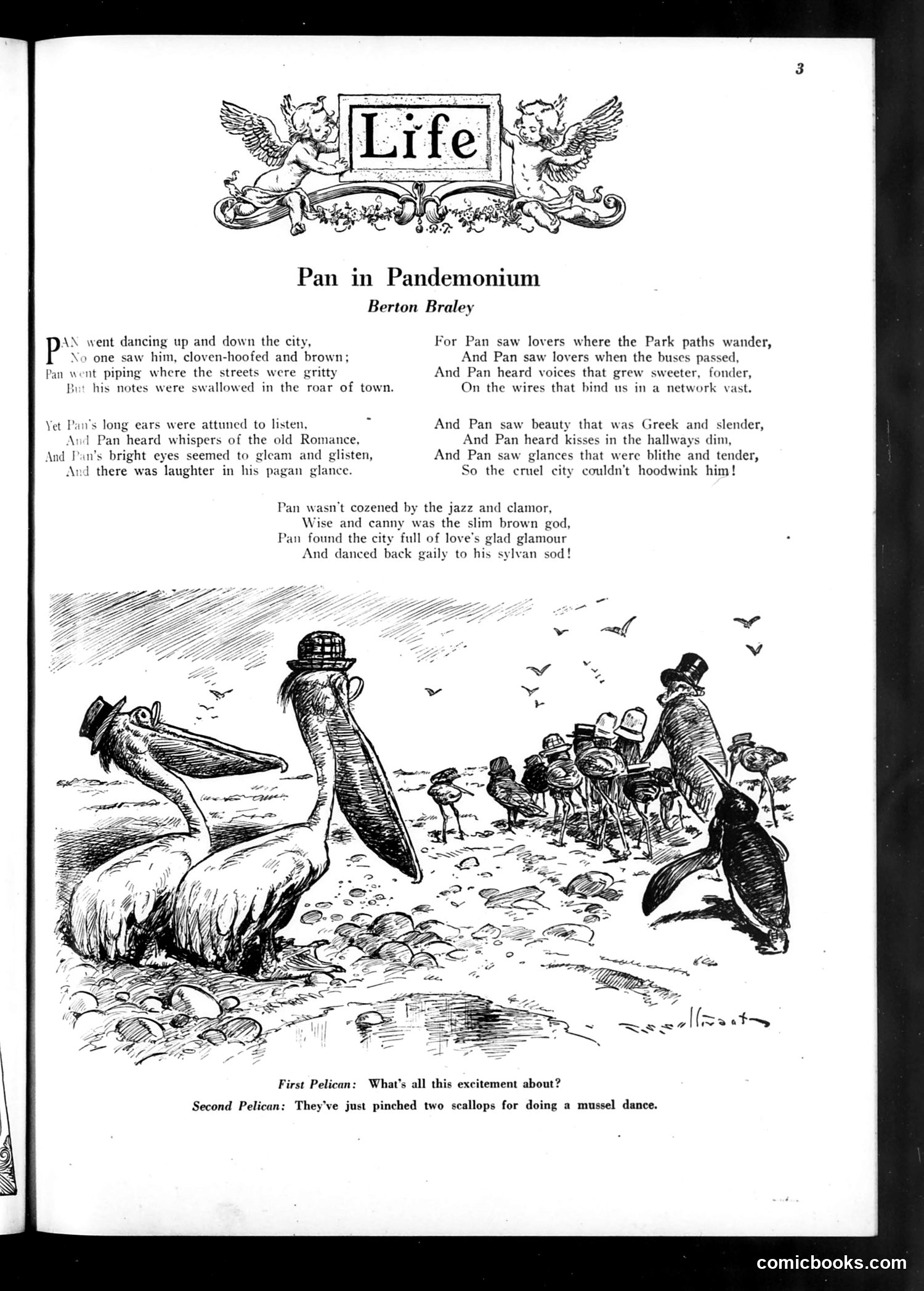
This poem celebrates Pan, the classical Greek god of nature and fertility, discovering modern urban life. The satire contrasts Pan's mythological essence with 1920s city chaos: he finds unexpected beauty in jazz, romance on park benches, and sensuality amid the noise and crowds. The accompanying illustration shows anthropomorphic pelicans in formal dress on a beach, apparently arrested for performing a "mussel dance"—a pun-based joke playing on the word "mussel" (shellfish) versus "muscle." The pelicans' human clothing and judicial arrest parody Prohibition-era law enforcement's zealousness in prosecuting even absurd offenses. Together, the poem and cartoon suggest how modern civilization constrains natural impulses and joy.
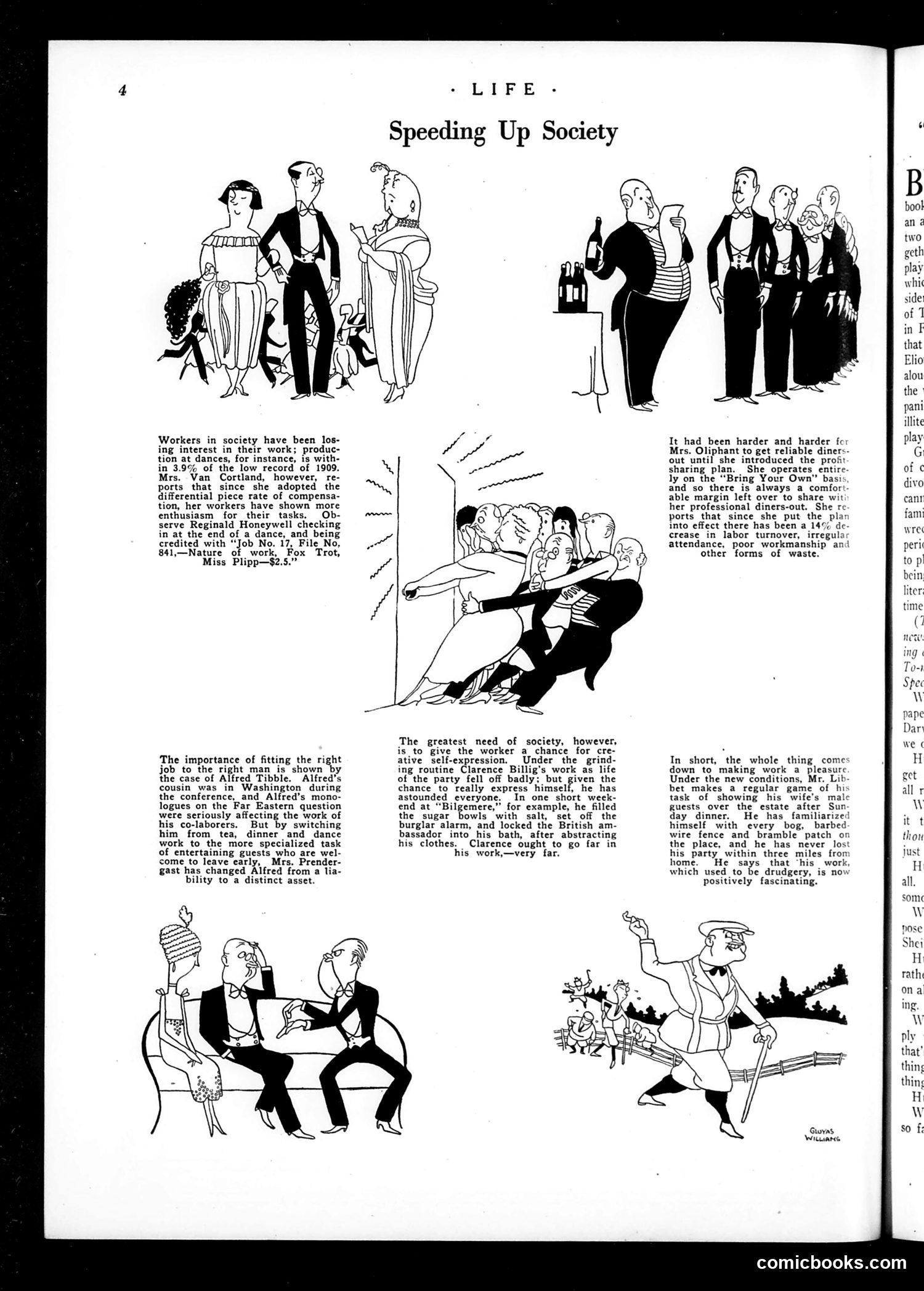
This page satirizes early-20th-century efforts to rationalize work and increase productivity. The text references Mrs. Van Cortland implementing "differential piece compensation" to boost worker enthusiasm at dances and entertainments. The cartoons mock this obsession with efficiency. One illustration shows a man literally "stretching" his dinner companions—visually exaggerating the metaphorical idea of "speeding up" social interaction. Another depicts a man energetically conducting a dinner party like an orchestra, suggesting hosts now treat social gatherings as productivity exercises rather than leisure. The underlying satire targets the era's "scientific management" movements (like Taylorism), which attempted to optimize every aspect of life—including recreation and socializing—for maximum efficiency. The magazine mocks how this mechanized thinking had invaded even intimate, personal social spaces.
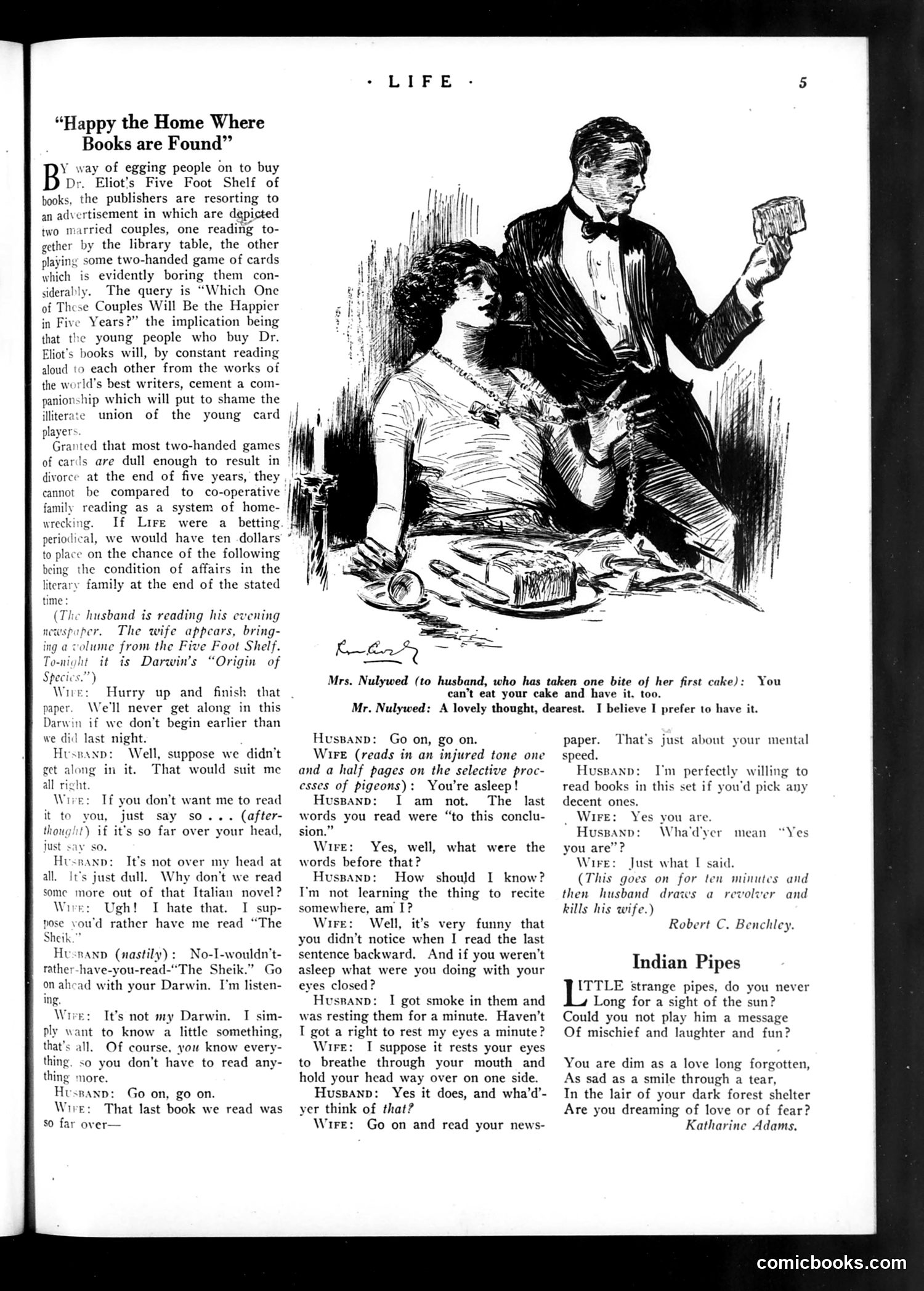
This satirical piece mocks middle-class couples who purchase Dr. Eliot's "Five Foot Shelf of Books"—a popular home library collection—as status symbols rather than for actual reading. The illustration shows a husband and wife at dinner: he holds up a book while she, mid-bite of cake, complains they can't eat while reading. Their dialogue reveals the absurdity: neither wants to actually read the books aloud to each other, yet they've bought them anyway. The satire targets the early 1900s trend of displaying unread books as markers of sophistication and culture. The husband's complaint that Darwin is "dull" underscores that these expensive sets were purchased for appearance rather than intellectual engagement—a common critique of consumer culture masquerading as self-improvement.
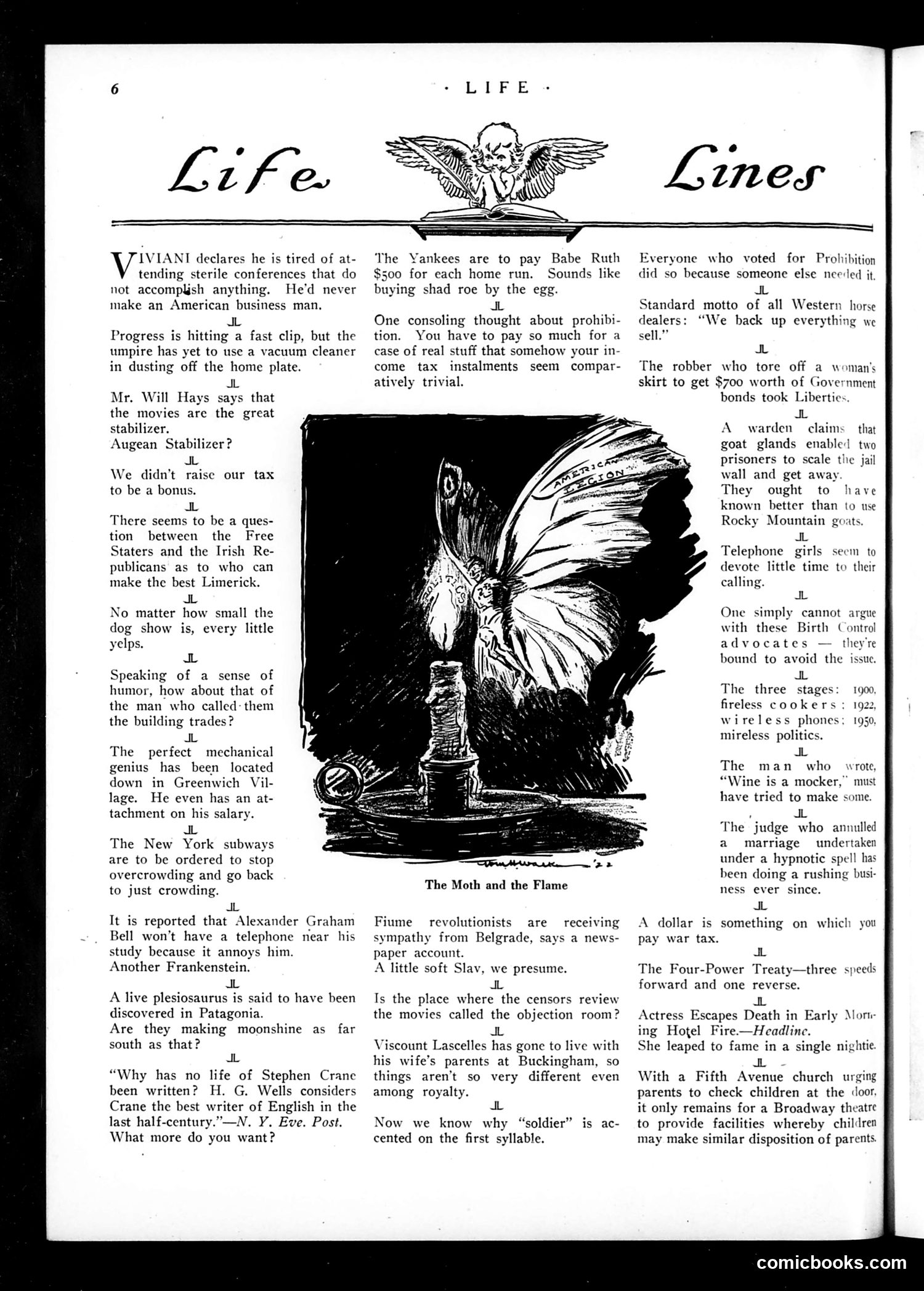
This satirical illustration depicts a moth drawn to a flame—a classical metaphor for fatal attraction or self-destructive behavior. The image appears in a column of short humor pieces and social commentary. Without additional context on this specific Life issue, the exact target is unclear, but the accompanying text suggests topical references from the 1920s era: Prohibition debates, the Babe Ruth controversy, censorship, and various social changes. The "Moth and the Flame" likely represents a contemporary figure or trend being drawn toward obvious danger or ruin. The caption's placement among pieces mocking government policies, materialism, and social hypocrisy suggests the satire criticizes either public figures ignoring warnings or society's attraction to vice—possibly relating to Prohibition-era bootlegging or similar "forbidden" temptations.
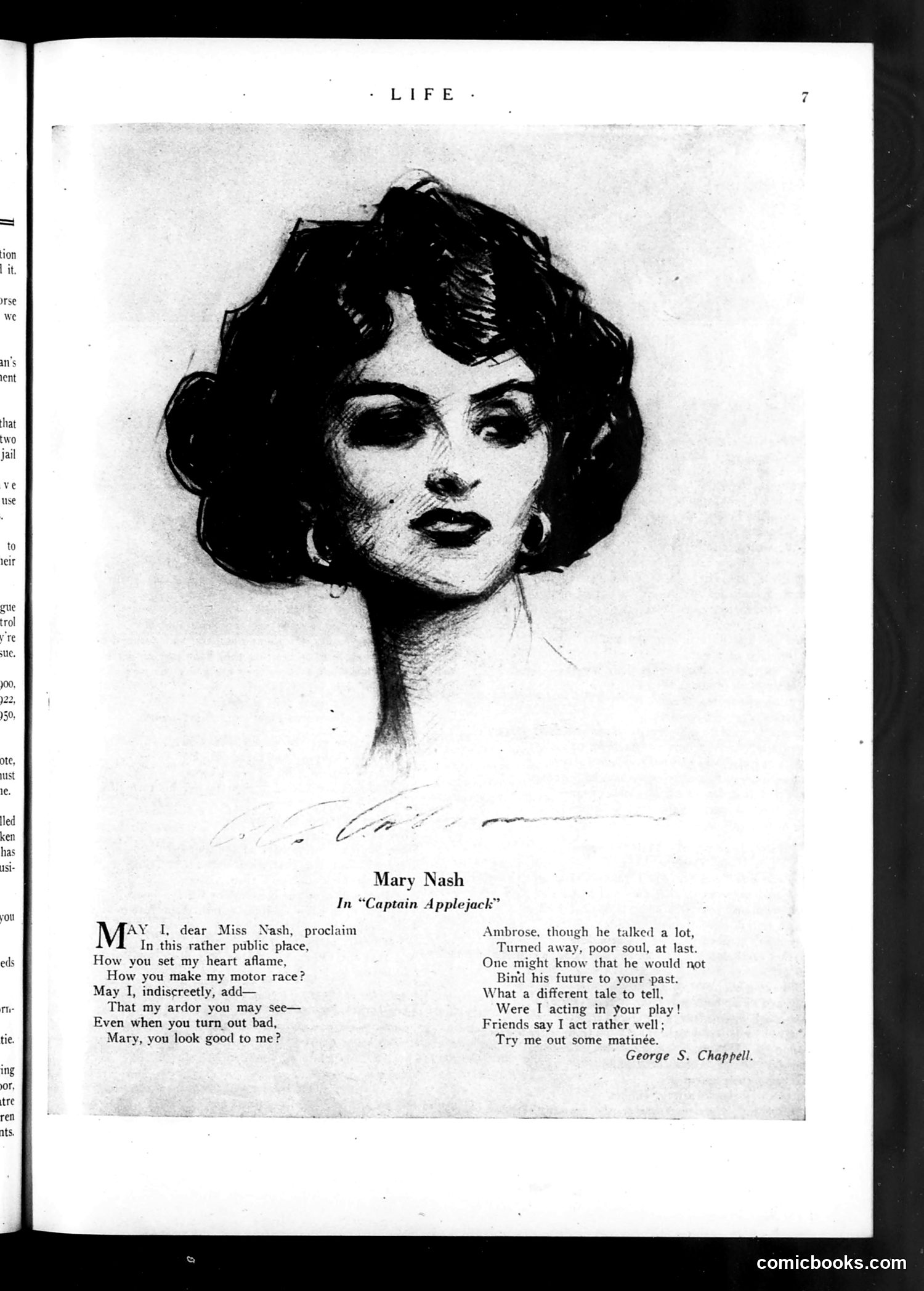
This page from *Life* magazine features a portrait of **Mary Nash**, an actress, accompanied by a poem titled "In 'Captain Applejack.'" The text is a romantic tribute written by **George S. Chappell**, expressing admiration for Nash's performance and beauty. The poem uses theatrical language ("Were I acting in your play!") and compliments her charm, suggesting she could improve an actor's career prospects. This appears to be **fan mail or admiration verse** rather than satire—a common *Life* magazine feature celebrating stage performers of the era. The piece celebrates Nash's talent and attractiveness without apparent mockery or political commentary. It reflects early 20th-century theatrical culture and the magazine's practice of featuring popular entertainers.
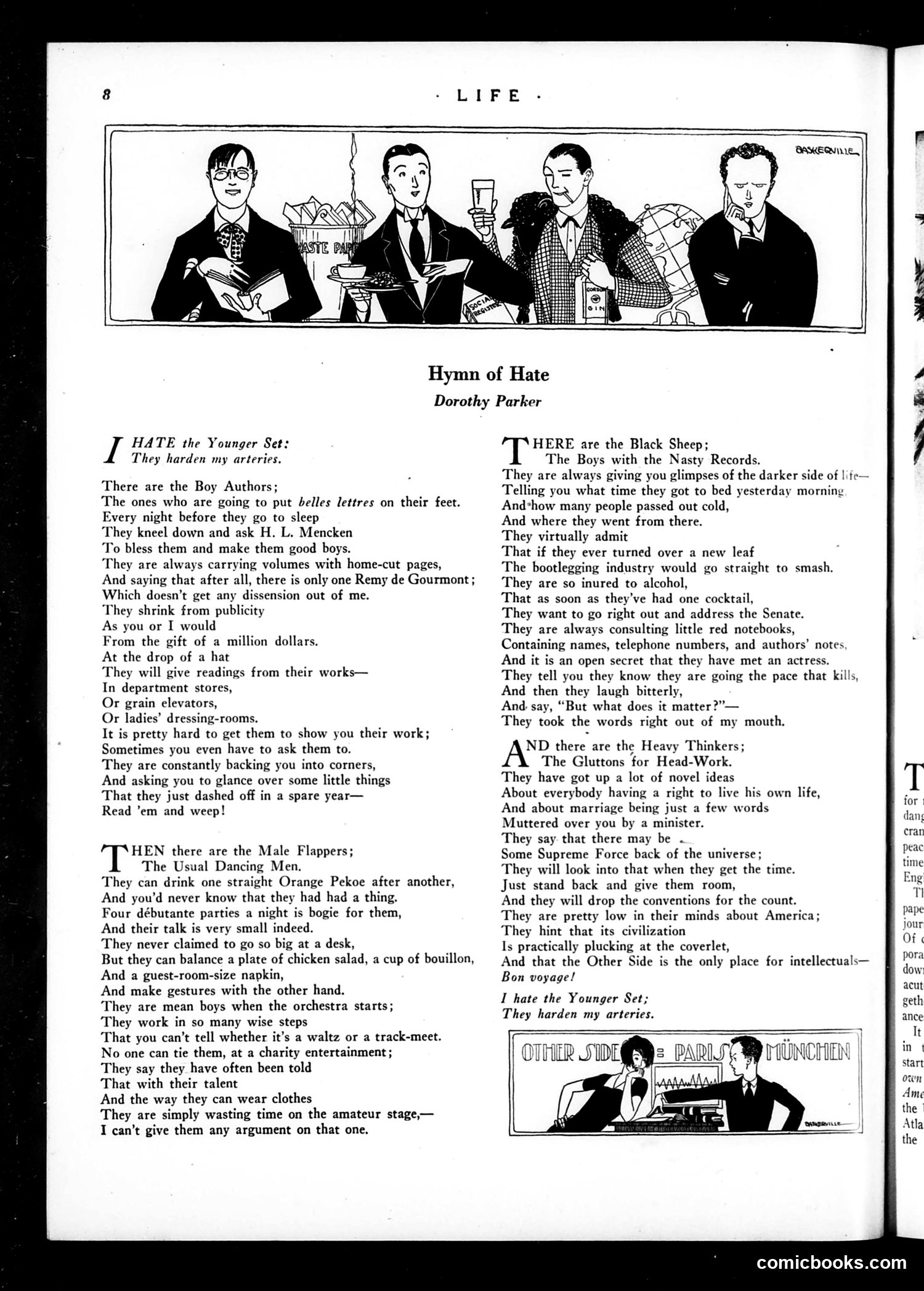
This satirical poem attacks the literary and social pretensions of 1920s Manhattan's cultural elite. Parker ridicules: **"The Younger Set"** — wealthy young people with literary ambitions who attend fashionable parties and readings but lack genuine talent or substance. **"The Male Flappers"** — young men who frequent trendy nightclubs (drinking "Orange Pekoe"), attend parties, and claim sophistication while being essentially frivolous and untalented. **"The Heavy Thinkers" and "Black Sheep"** — those who affect intellectual superiority, discuss philosophy pretentiously, and condescend to others. The cartoon at the top shows five representatives of these groups. Parker's satire mocks their posturing, wastefulness, and hollow intellectualism — the gap between their pretensions and actual accomplishment. It's a scathing critique of Jazz Age social climbers.
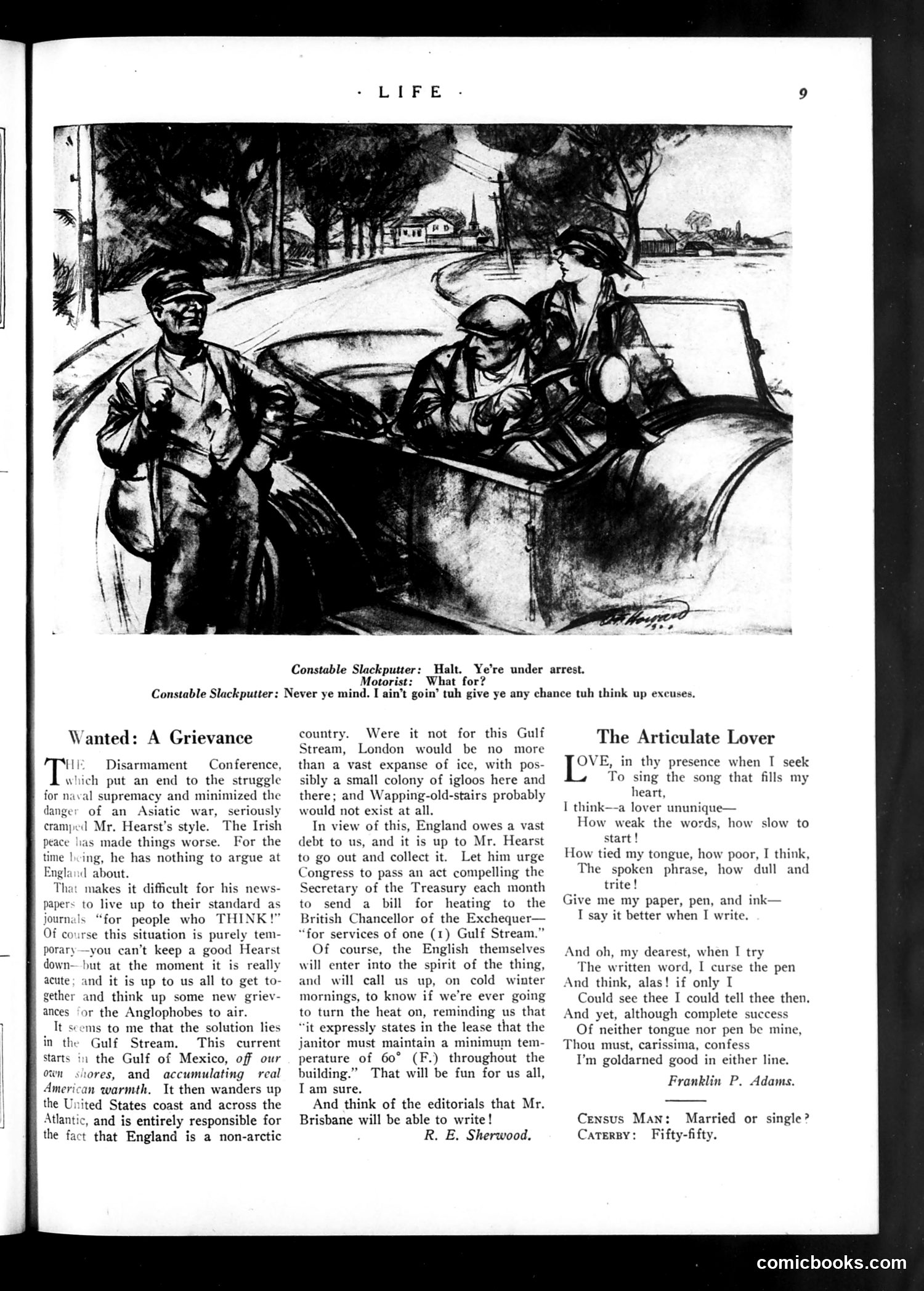
The cartoon depicts a traffic stop where a **Constable Slackputter** arrests a motorist for speeding. The constable tells the motorist he won't give excuses a chance, while the motorist protests his innocence—a humorous reversal where authority figures ignore plausible defenses. The page's articles address post-WWI concerns: "Wanted: A Grievance" criticizes the Disarmament Conference and blames England's Gulf Stream location for making it a non-arctic nation (thus responsible for global warming). This appears satirical commentary on international politics and environmental responsibility. "The Articulate Lover" is a sentimental poem about romantic expression—a tonal contrast to the political content above it.
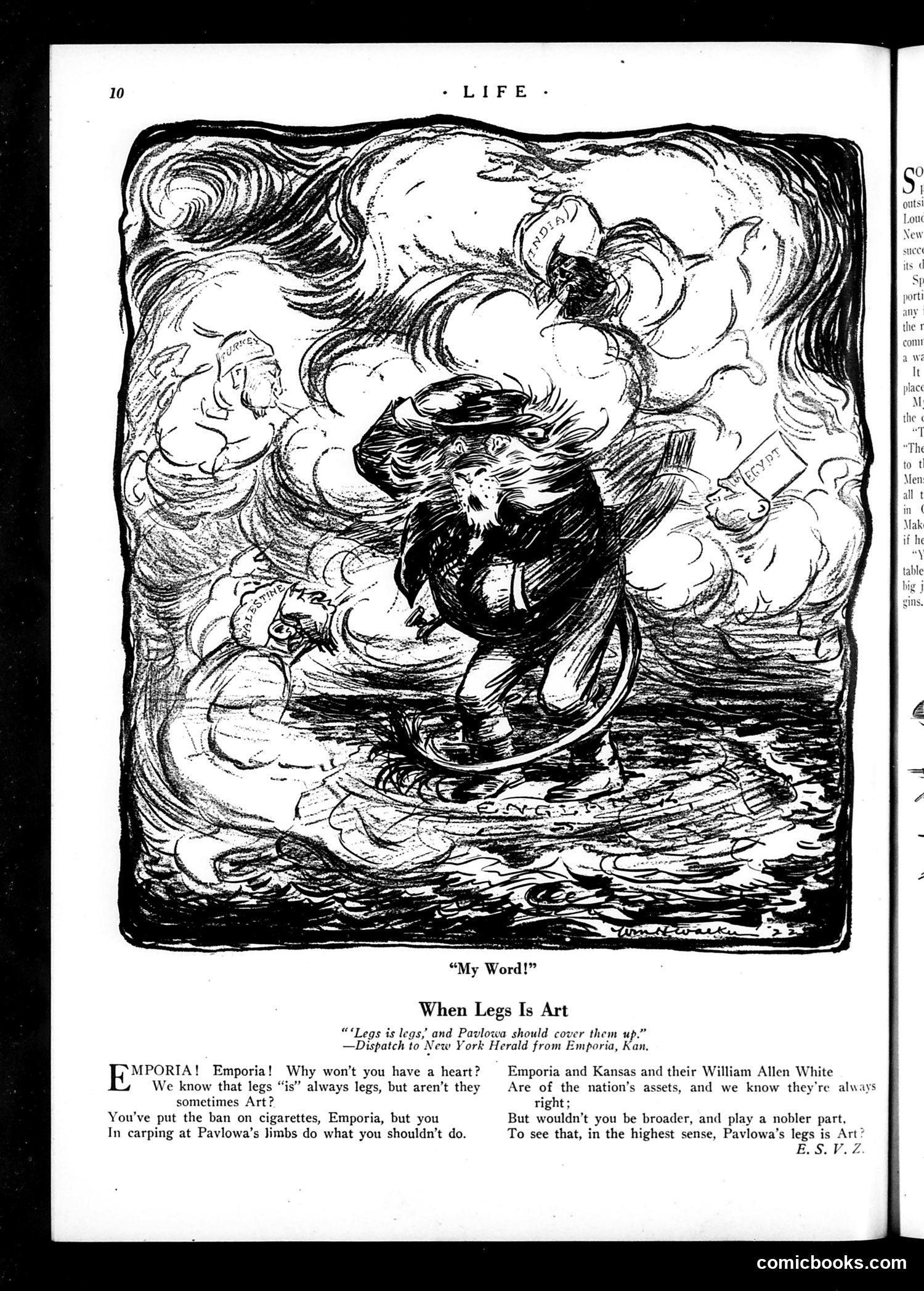
This cartoon satirizes **Emporia, Kansas** and its apparent prudishness. The illustration shows a figure (likely representing the town or its leadership) covering up legs with clouds—treating them as scandalous rather than artistic. The accompanying verse mocks this censoriousness, referencing **William Allen White** (Emporia's famous newspaper editor) and suggesting the town is hypocritically banning cigarettes while simultaneously suppressing depictions of the human body. The satire argues that prudishly "carping at Pavlowa's limbs" (referencing Russian ballerina Anna Pavlova) is artistically narrow-minded. The joke: Emporia positions itself as morally righteous, yet this selective censorship reveals inconsistent values and provincial attitudes toward art and the human form.
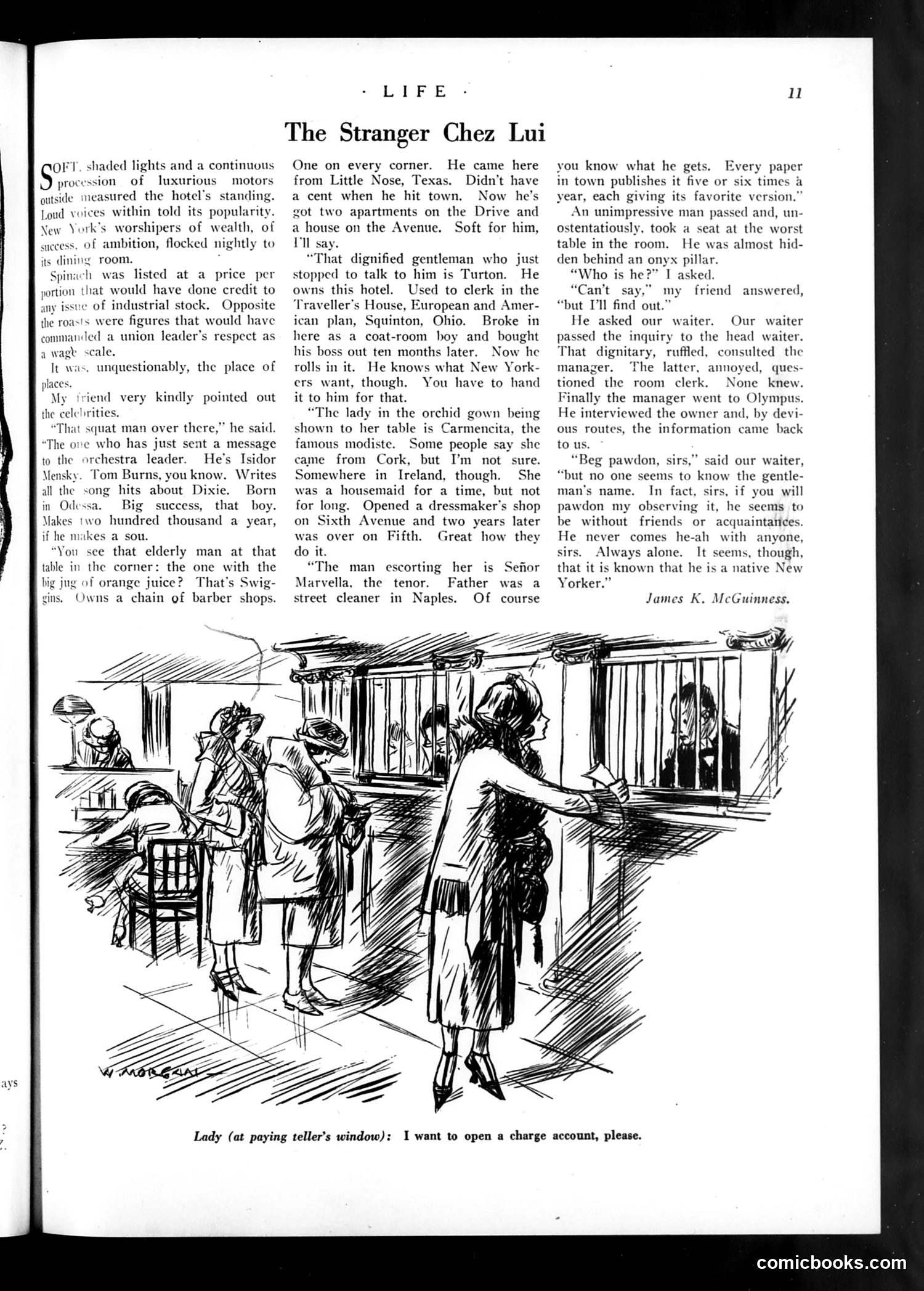
This is a humorous short story about a mysterious gentleman staying at a hotel in Little Nose, Texas. The narrator's friend identifies him as an elderly man who formerly worked as a coat-room boy and eventually became a hotel owner in Ohio—a self-made businessman. The accompanying cartoon depicts a woman at a bank teller's window requesting to open a charge account. The humor appears to satirize early 20th-century banking practices and gender dynamics: women's limited financial independence and the formality required to access credit during this era. The sketch captures the social awkwardness of the transaction, reflecting period attitudes toward women's economic autonomy.
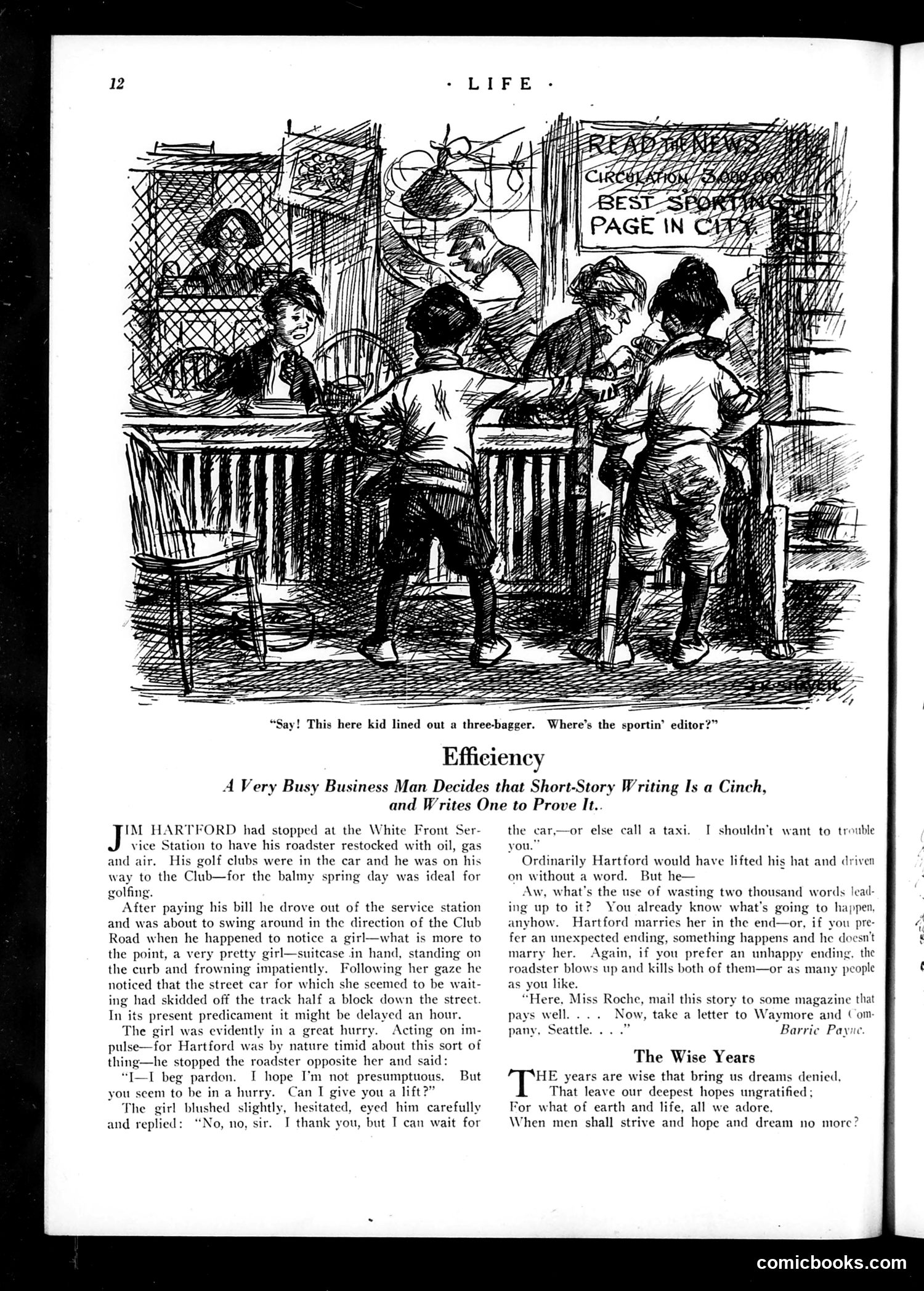
This cartoon satirizes a busy businessman's attempt to write short fiction. The sketch shows Jim Hartford at what appears to be a newspaper office, surrounded by colleagues discussing his newly written three-bagger story. The satire mocks the notion that successful businessmen can casually dash off published short stories as a sideline—treating literary creation as just another efficient business task to "cinch." The headline promises Hartford will write a story "to prove it," suggesting hubris about the ease of creative writing. The cartoon gently ridicules both the businessman's overconfidence and the era's apparent trend of wealthy, busy men attempting amateur writing. The joke relies on the audience recognizing that literary talent cannot simply be switched on through business efficiency and determination.
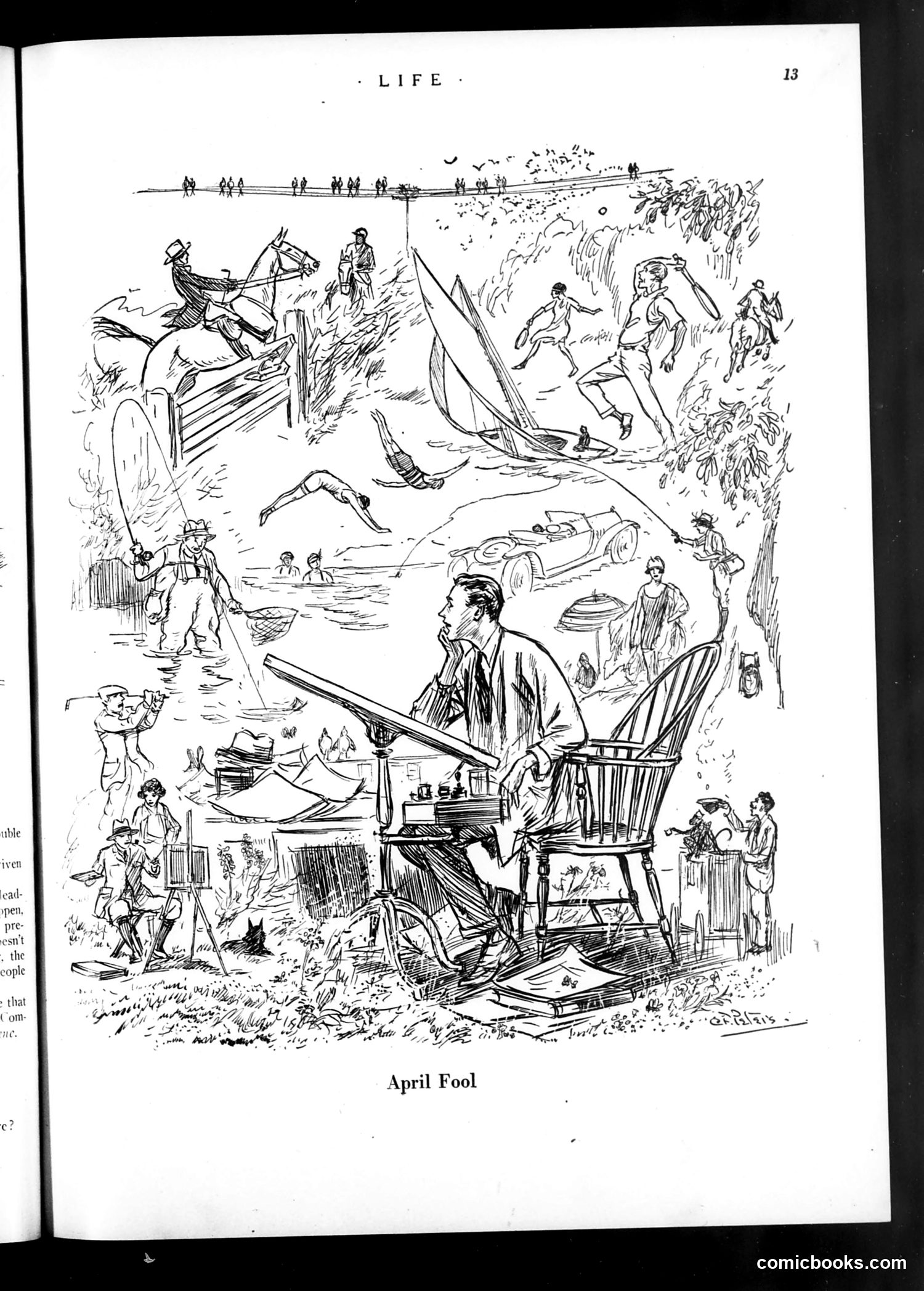
This satirical illustration depicts a man relaxing in a chair by a riverside, fishing rod in hand, seemingly content amid chaos. The surrounding scene shows various recreational activities—boating, swimming, horseback riding, automobile driving, and social gatherings—all occurring simultaneously around him. The title "April Fool" suggests the satire: the man appears to be a fool for attempting peaceful relaxation while the modern world bustles frantically around him. The cartoon likely critiques either the impossibility of leisure in an increasingly busy society, or mocks those naive enough to believe they can escape modern life's demands. The contrast between his serene pose and the frenetic activity surrounding him emphasizes the satire's point about contemporary American life.
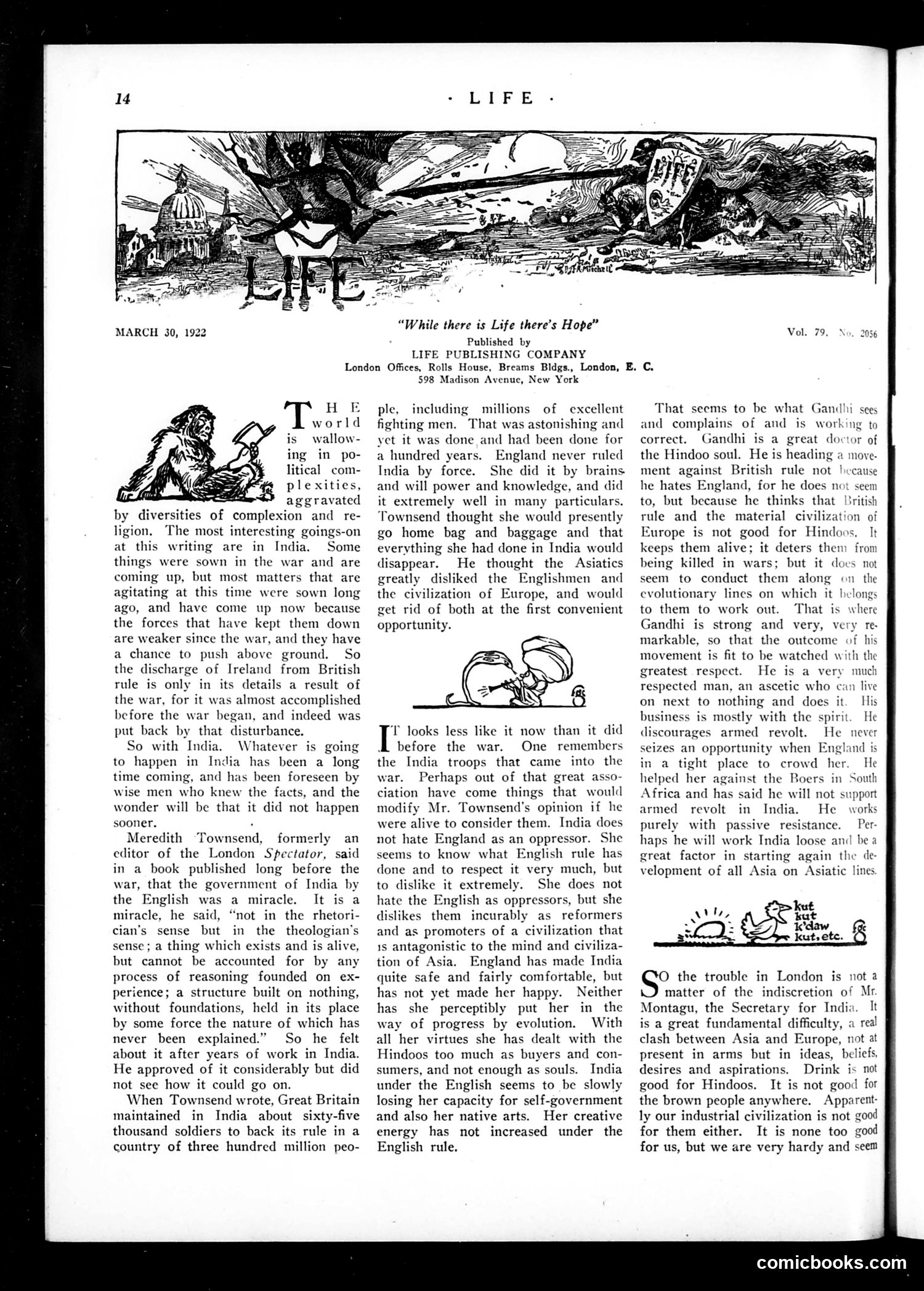
This page contains an article discussing Britain's rule in India and Gandhi's independence movement. The main illustration shows a caricatured figure (likely representing India or an Indian person) being controlled or constrained, reflecting the colonial relationship under discussion. The text debates whether British rule benefited India or oppressed it. The author acknowledges Gandhi's peaceful resistance movement and notes the contradiction: while Britain claims to have civilized India, India remains dissatisfied and seeks self-governance. The piece suggests Britain's "industrial civilization" may not actually be beneficial for Indians. A small cartoon in the lower right corner (captioned "kut kat") appears to be a separate humorous aside, though its specific meaning is unclear from this reproduction.
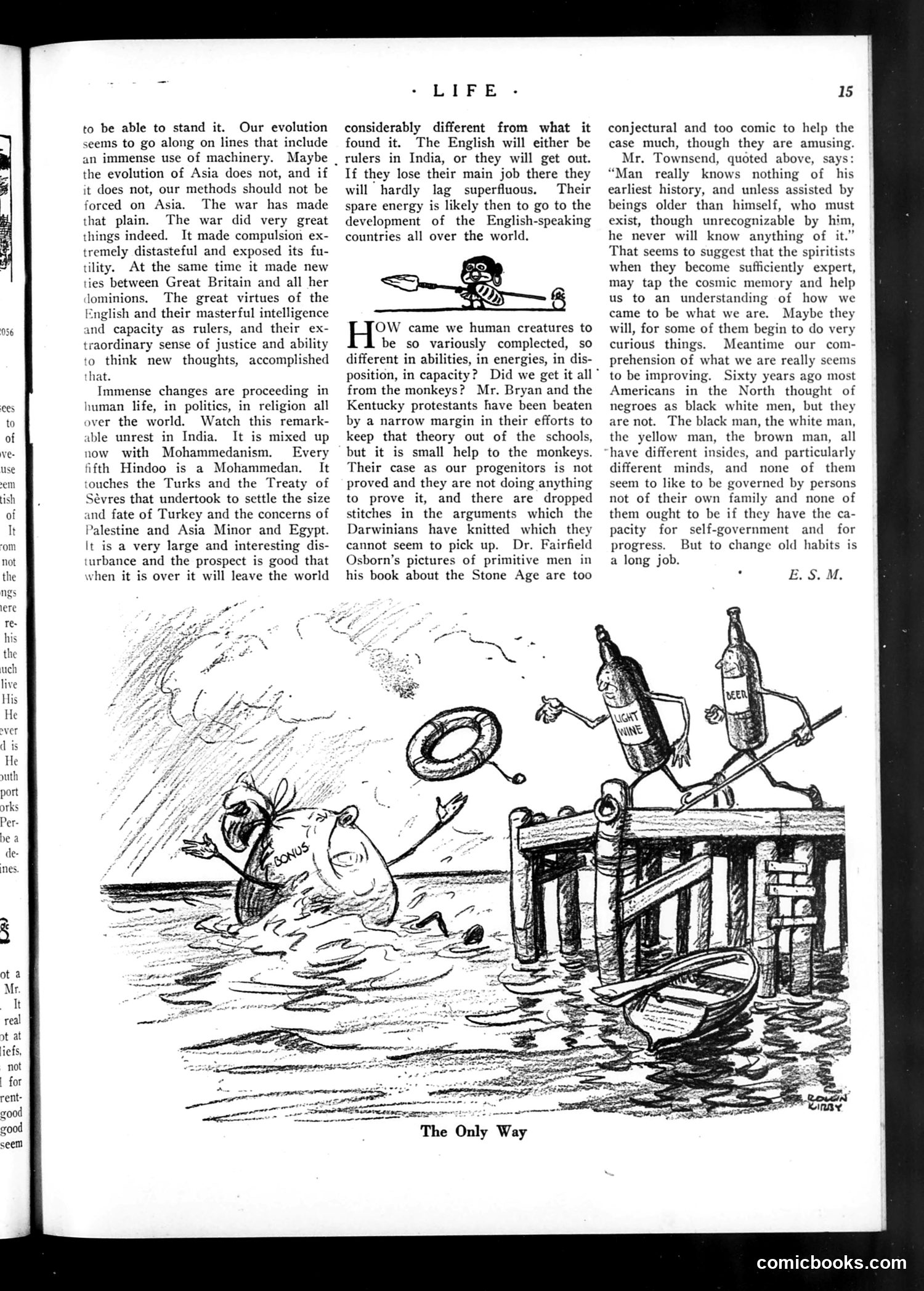
This page combines editorial text on evolution, race, and colonialism with a cartoon satirizing Prohibition-era alcohol smuggling. **The Cartoon:** "The Only Way" depicts anthropomorphized bottles of liquor escaping across water to a dock, while a figure on shore (appearing to represent law enforcement or a Prohibition agent) futilely attempts to stop them. The joke critiques Prohibition as unenforceable—smugglers will always find ways to bring alcohol into the country despite legal bans. **Historical Context:** This appears from the Prohibition era (1920-1933), when the 18th Amendment banned alcohol sales in America. The cartoon suggests that interdiction efforts are pointless; illegal importation will inevitably continue. **The Editorial Content:** Discusses human evolution, race differences, and colonial governance—reflecting early-20th-century attitudes on these topics, including references to the Scopes trial debate over teaching evolution and paternalistic views on governing non-Western peoples.
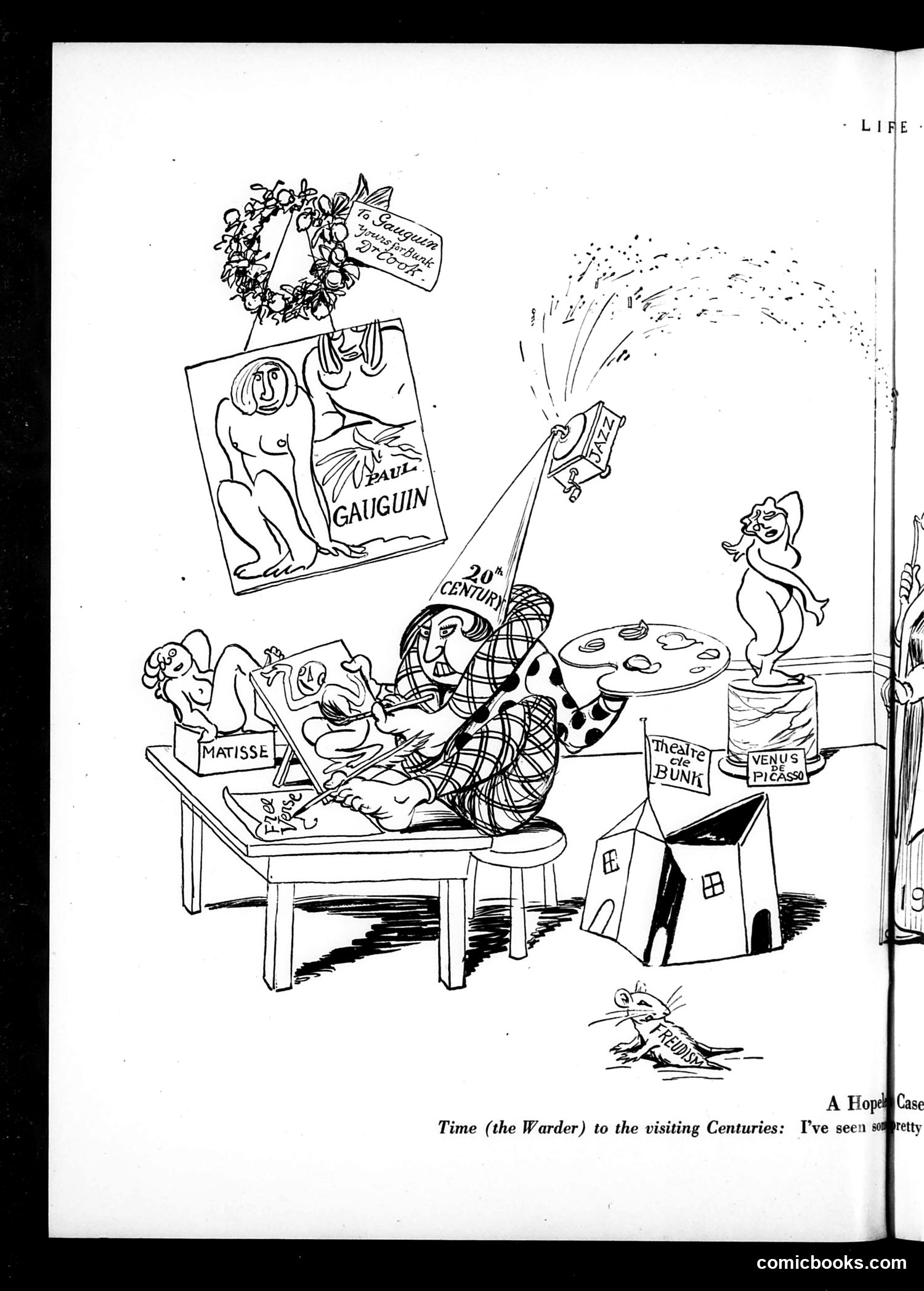
This satirical cartoon depicts **Time as a prison warden** showing famous modernist artworks to visiting "Centuries" (personified as tourists). The cartoon mocks early 20th-century avant-garde art by presenting masterpieces as curiosities in a kind of aesthetic prison. Visible artworks labeled include **Matisse, Gauguin, Picasso's Venus**, and a **20th Century** figure. The warden-figure brandishes these works as if displaying oddities, suggesting the cartoonist views modernism as bizarre or absurd rather than innovative. This reflects **conservative resistance to modern art** circa early-to-mid 20th century. The joke mocks both the artists and their admirers—implying their work is so strange it belongs behind bars. The casual tone ("I've seen some pretty comic") dismisses these movements as ridiculous rather than revolutionary.
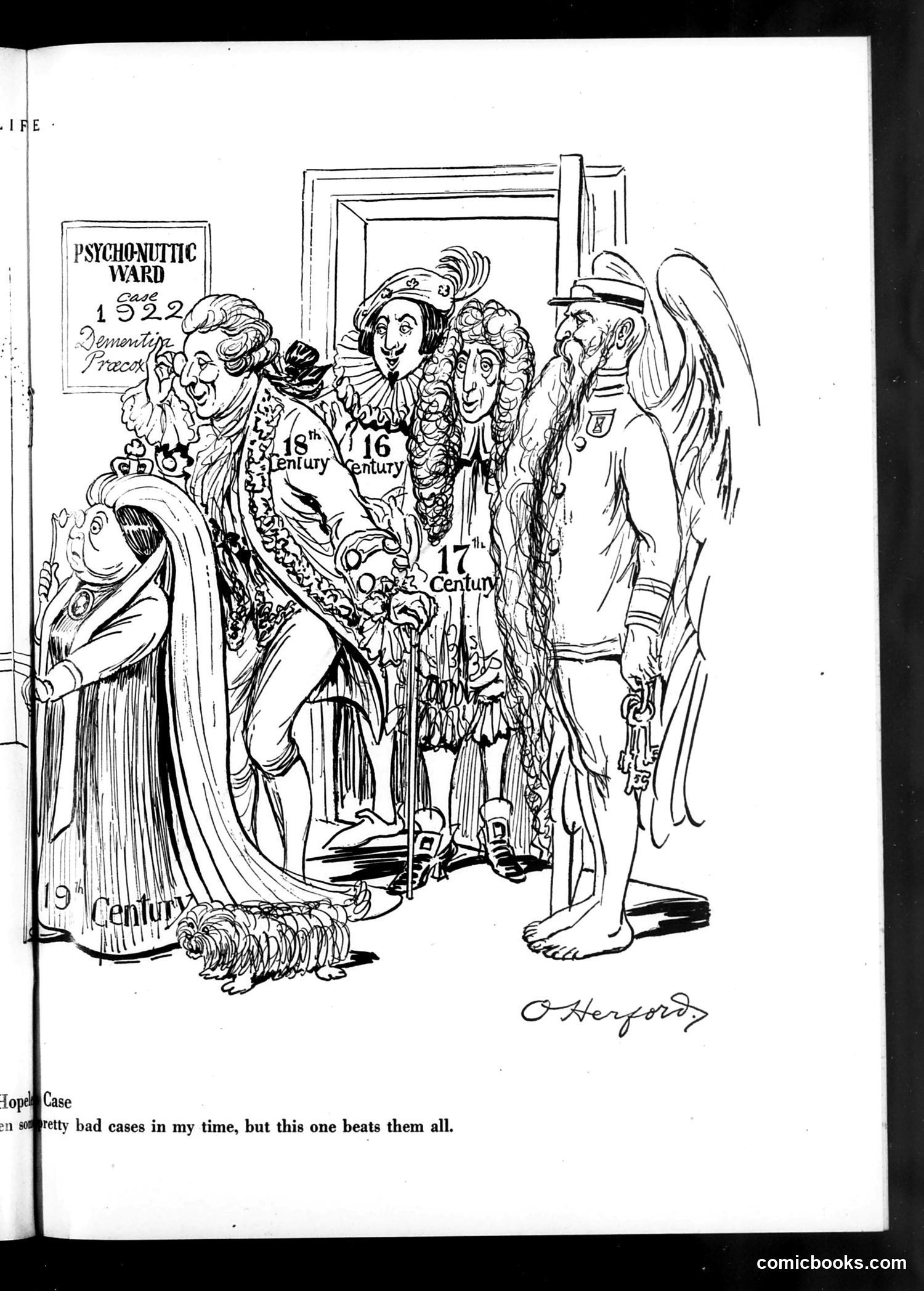
This cartoon by O. Herford satirizes psychiatric treatment through the ages. The "Psychoneurotic Ward" sign labels the scene, while figures representing different historical periods (16th, 17th, 18th, 19th centuries) crowd a doorway, along with what appears to be a modern medical professional on the right. The joke suggests that mental illness has persisted unchanged across centuries—people from various eras suffer identical psychological problems. The bottom text references "pretty bad cases," implying this particular case surpasses historical precedent. The satire likely critiques early 20th-century psychiatry as ineffective, unable to cure ailments that have plagued humanity across time. The exaggerated period costumes and caricatured faces emphasize the timelessness of human mental disturbance.
This page reviews recent Broadway productions with characteristic satirical bite. The lead article mocks Shaw's marathon play *Back to Methuselah* at the Garrick Theatre, sarcastically crediting audiences with "cultural advancement through suffering" for enduring its length. The writer catalogs absurd statistics (34,698 definitions, 75,496 "digs at Lloyd George") to ridicule the play's verbose intellectualism. Subsequent reviews cover lighter fare: *Up the Ladder*, *The Rose of Stamboul* (a musical with actress Tessa Kosta), and Eugene O'Neill's *The Hairy Ape*. The critique of *Stamboul* pokes fun at management's self-promotion as "Peer of all Musical Productions"—wordplay suggesting the production is merely adequate ("peer" = equal/comparable). The satire throughout targets pretentiousness in theater: overly intellectual drama, inflated marketing claims, and the gap between artistic ambition and execution. This reflects Life's consistent stance as a witty observer skeptical of cultural pretension.
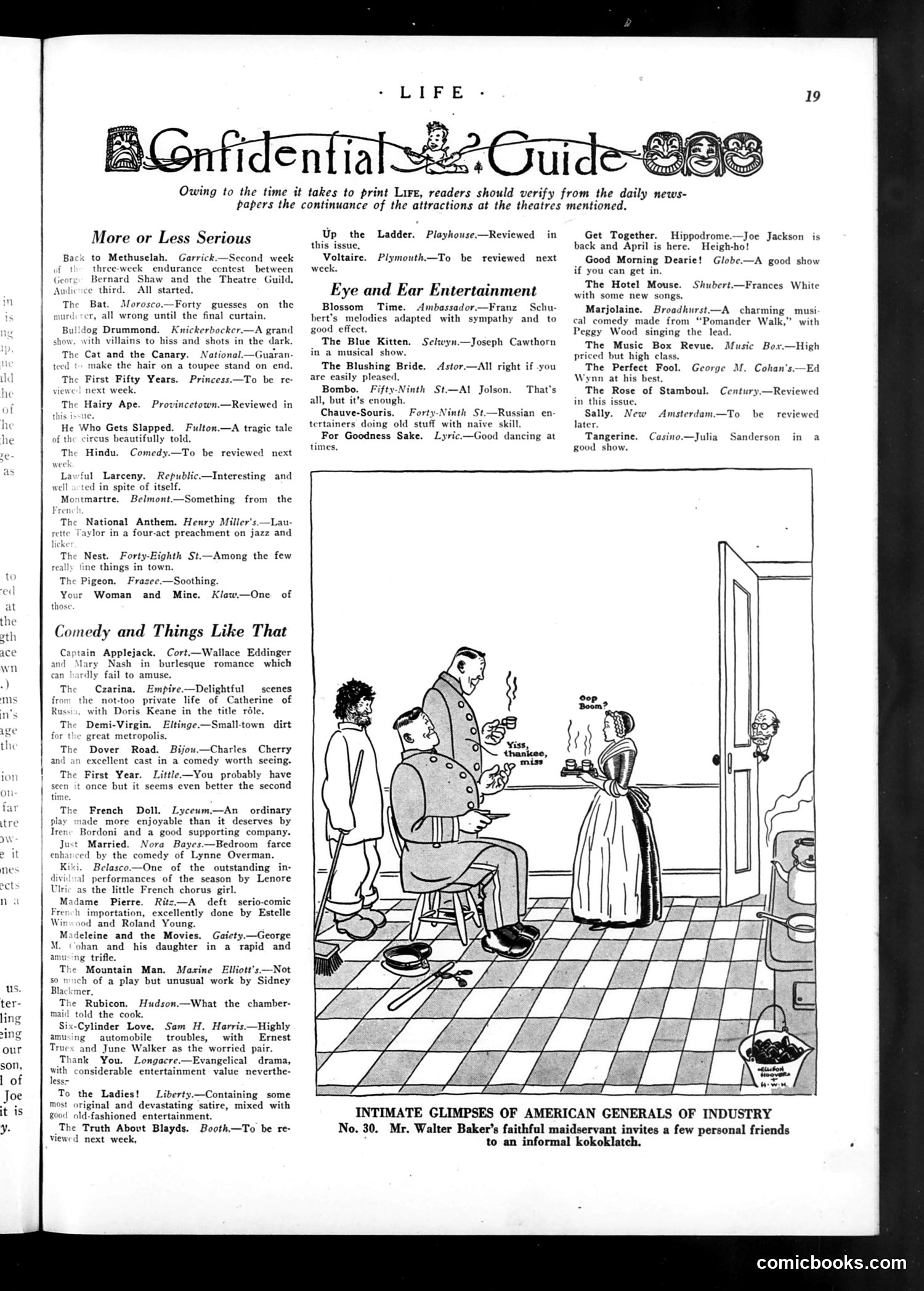
This page is a theater review section from Life magazine, not a political cartoon. It's a "Confidential Guide" listing Broadway shows currently running, with brief critical assessments. The only illustration depicts an informal social gathering—the caption identifies it as "No. 30. Mr. Walter Baker's faithful maidservant invites a few personal friends to an informal kokolatch." This appears to be part of a series called "Intimate Glimpses of American Generals of Industry," using domestic scenes humorously. The reviews themselves are standard theater criticism: Shaw's plays, comedies, musicals, and dramas are assessed for entertainment value. References like "Doris Keane," "Al Jolson," and "Lenore Ulric" name popular theatrical performers of the 1920s era. The tone is satirical throughout—reviews use ironic praise ("can hardly fail to amuse," "well-suited in spite of itself") to gently mock both productions and audiences. No specific political content is evident; this is entertainment journalism.
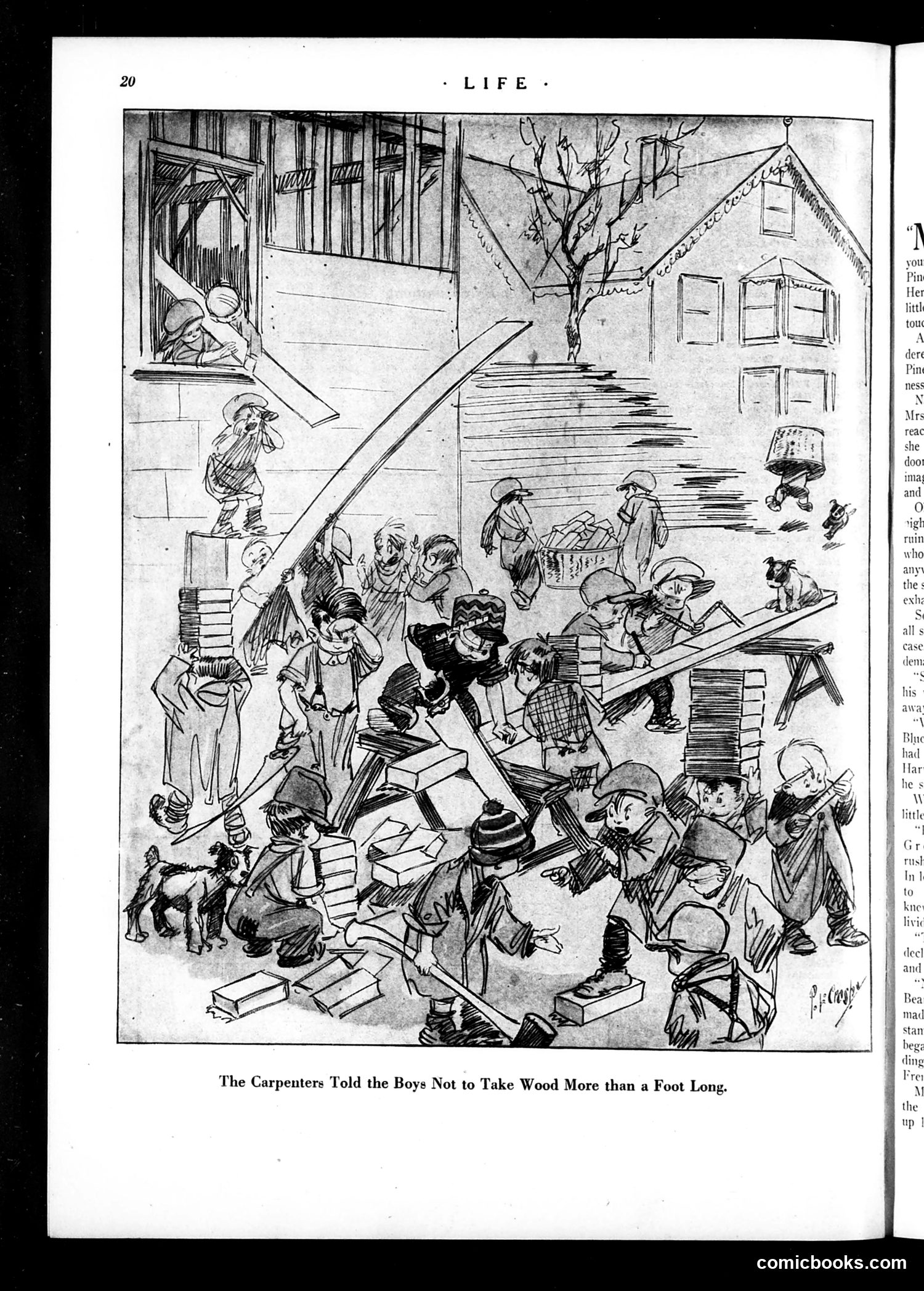
This is a humorous illustration showing a group of boys who have disregarded the carpenters' instruction. Despite being told not to take wood longer than a foot, the boys are depicted hauling away enormous wooden planks and beams—many clearly several feet long—from what appears to be a construction site near a house. The joke is straightforward: the boys have deliberately or obliviously violated a simple rule. The cartoon satirizes childhood mischief and disobedience, showing the chaos that results when children ignore adult authority. The oversized pieces of wood the boys are carrying emphasize how thoroughly they've ignored the instruction, creating a comedic exaggeration of their transgression. This reflects early 20th-century *Life* magazine's focus on gentle, domestic humor about child behavior.
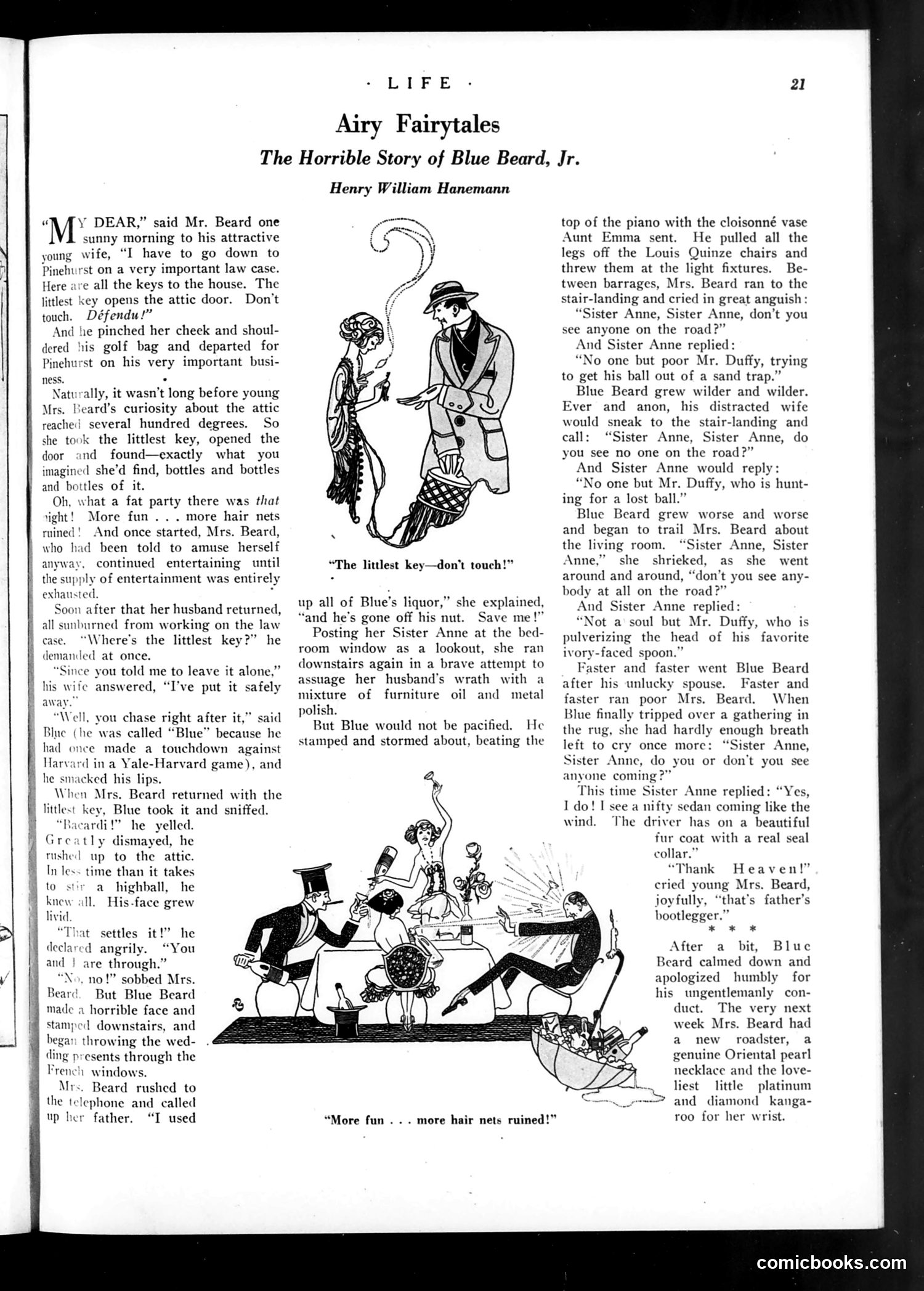
This is a humorous retelling of the classic "Bluebeard" folktale, reimagined as a modern American domestic comedy. The satire targets **Prohibition-era drinking culture** (1920s-1930s). The joke: A wife discovers her husband's secret stash of liquor in the attic—the "forbidden room" of the original tale. Rather than a chamber of murdered wives, it contains bottles. She throws a party and depletes his supply. When he discovers this, he's enraged not by infidelity but by the consumption of his hoarded alcohol. The humor relies on: - The absurdity of treating contraband liquor as seriously as the original tale's dark secrets - References to Jazz-Age excess ("hair nets ruined" at wild parties) - The husband's ridiculous rage over consumed booze - The climactic chase played as domestic farce The cartoon mocks both the culture of hidden drinking during Prohibition and the melodramatic seriousness with which men guarded their alcohol supplies.
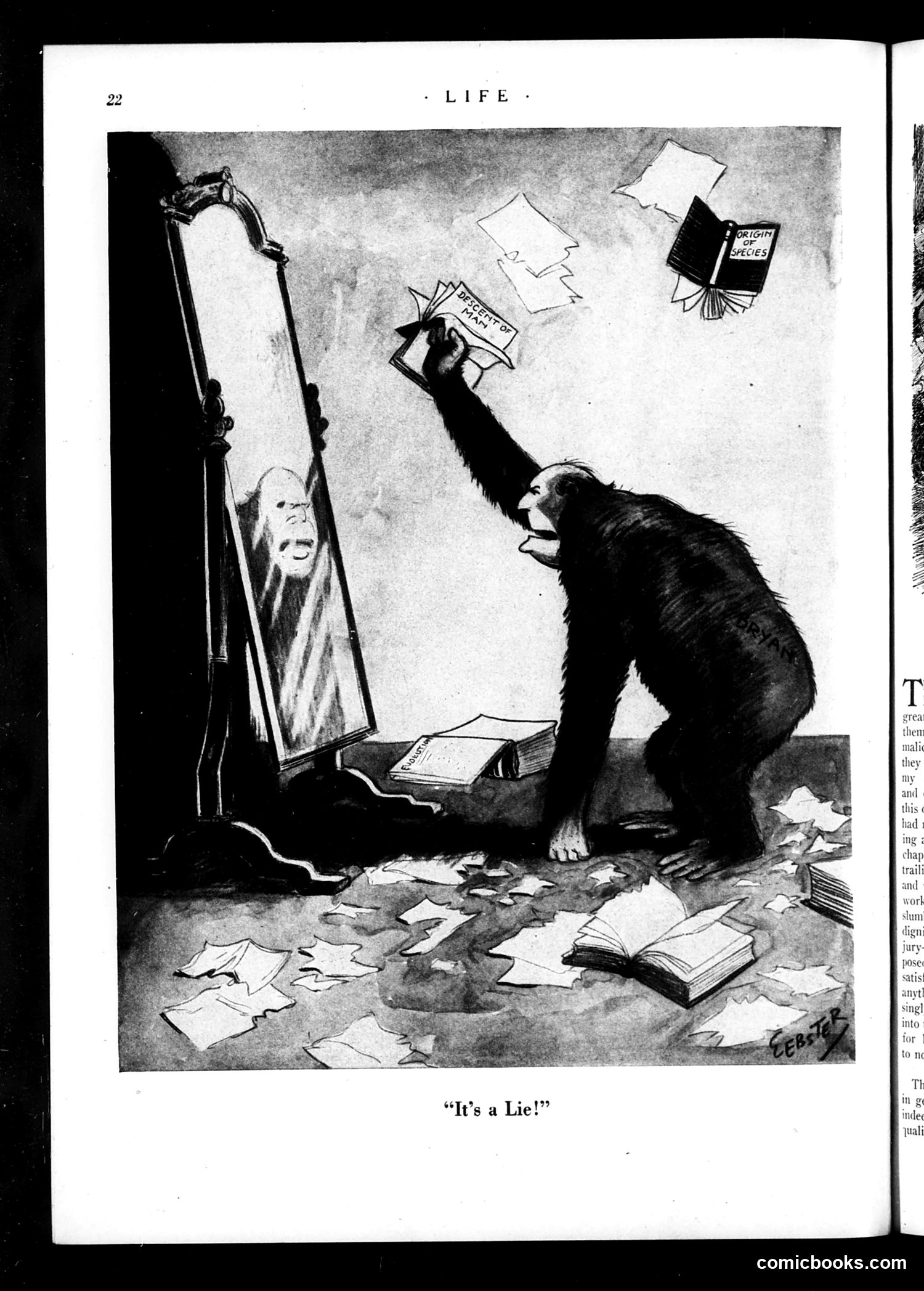
This satirical cartoon depicts a chimpanzee examining itself in a mirror while surrounded by scattered books and papers labeled "Origin of Species" and other scientific texts. The cartoon ridicules theories of human evolution, particularly Darwinian evolution. The joke plays on the clash between evolutionary science and religious/social conservatism of the era. The chimp's indignant cry—"It's a Lie!"—expresses the popular resistance to the idea that humans descended from primates, which was deeply controversial in early 20th-century America. The scattered books and the ape's gesture suggest both intellectual confusion and defensive rejection of scientific evidence. This reflects the broader cultural "monkey trial" debates of the 1920s-30s, when evolutionary theory faced fierce public and religious opposition in America.
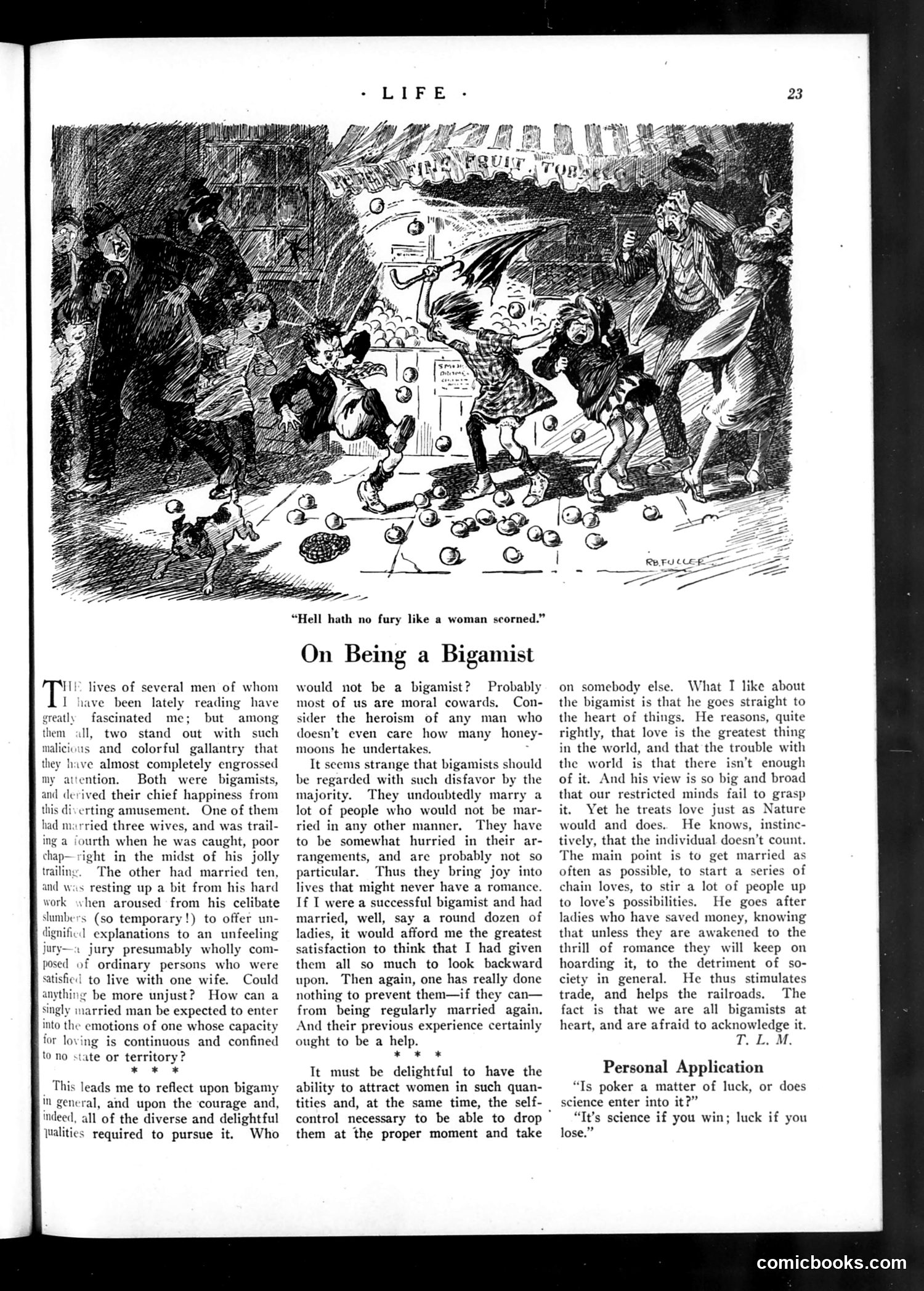
This page satirizes bigamy through deliberately absurd reasoning. The unsigned article (attributed to "T.L.M.") presents bigamy as heroic and morally defensible, arguing that bigamists perform a public service by bringing "joy" to women who wouldn't otherwise marry, and that their actions stimulate the economy and railroads. The satire works through **exaggerated logic**: the author treats serial marriage as noble rather than criminal, celebrates the "courage" required, and concludes we're "all bigamists at heart." The accompanying cartoon shows a chaotic street scene with multiple women and children surrounding a man with a large mechanical device—visually representing the disorder and deception inherent in bigamy. The epigraph "Hell hath no fury like a woman scorned" underscores the real consequences the satirical article ignores. The piece mocks both the bigamists themselves and societal attitudes that treated such offenses lightly enough to merit humorous treatment in a mainstream magazine.
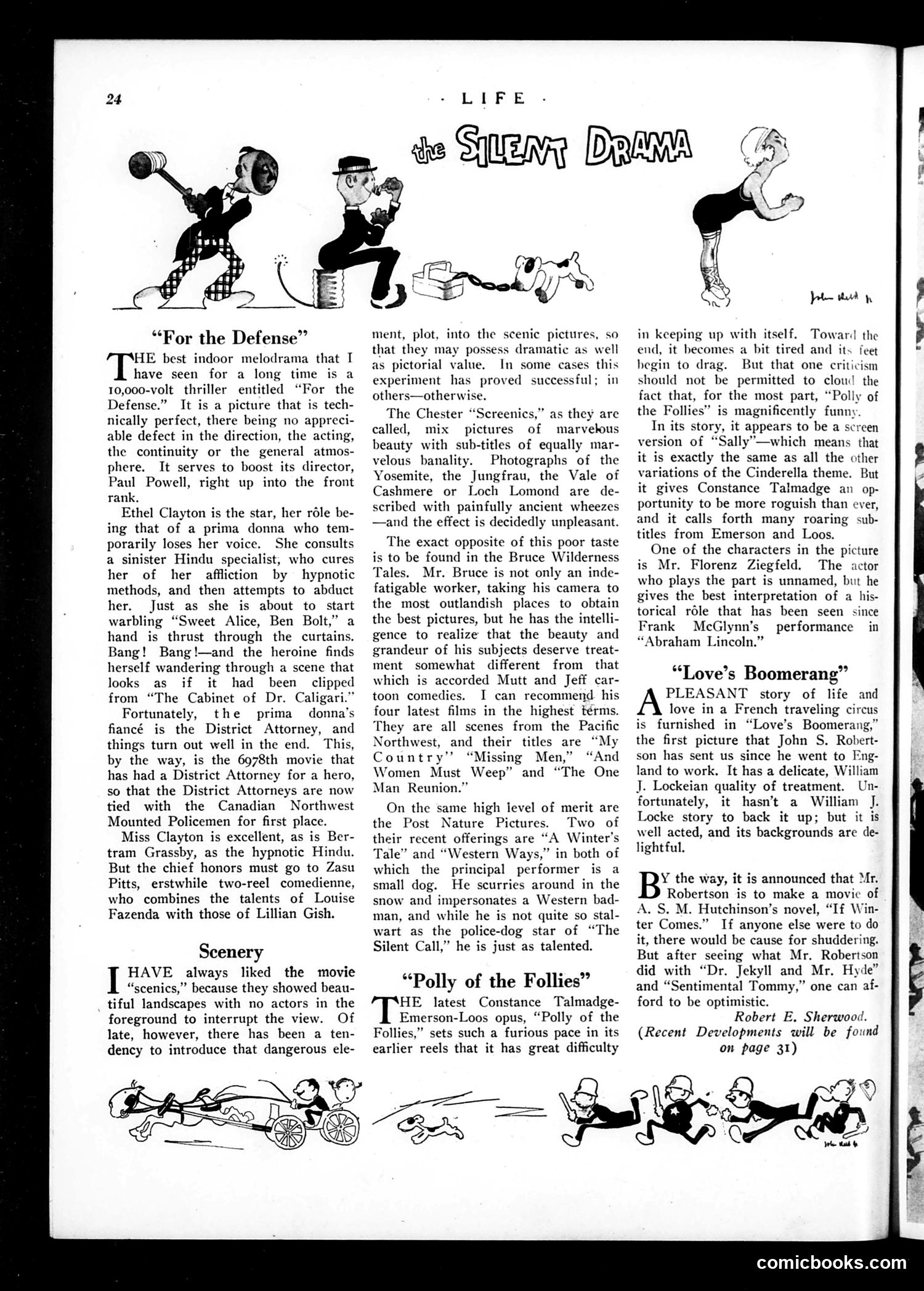
This page contains film criticism from Life magazine's entertainment section, likely from the early 1920s. The reviews discuss three films: **"For the Defense"** stars Ethel Clayton as a prima donna who loses her voice, consults a sinister Hindu hypnotist (played by Bertram Grassby), and is rescued by her fiancé—a District Attorney. The critic jokes that District Attorneys have become as common in movies as Canadian Northwest Mounted Policemen as heroic protagonists, and praises Zasu Pitts's comedic performance. **Scenic/nature films** are critiqued for mixing beautiful landscape photography with poorly-written subtitles containing "painfully ancient wheezes," contrasting favorably with Bruce Wilderness Tales, which treat scenery with appropriate dignity. **"Polly of the Follies"** (Constance Talmadge) is praised as magnificently funny but criticized for losing momentum toward the end, apparently being a screen adaptation of a stage property called "Sally." The cartoons at the page's top illustrate silent film comedy tropes and physical humor typical of the era.
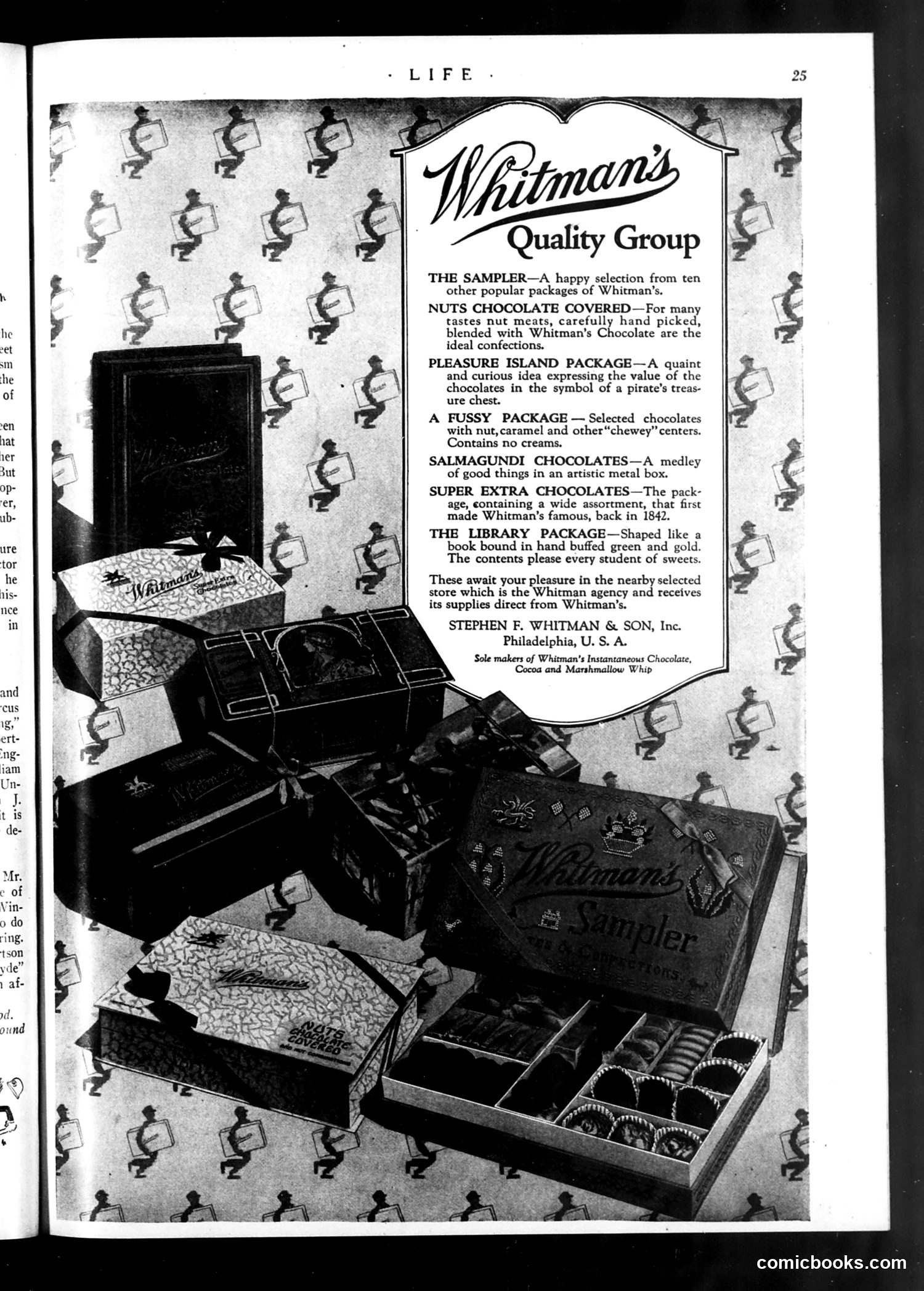
This is a **full-page advertisement**, not political satire. It showcases Whitman's chocolate gift boxes and their various product lines available in 1920s America. The page displays multiple decorative chocolate boxes arranged photographically, illustrating different packaging options: "The Sampler," "Nuts Chocolate Covered," "Pleasure Island Package" (pirate-themed), "Fussy Package," and others, including "The Library Package" shaped like a book. The repeated small figures in the background wallpaper appear to be decorative motifs rather than satirical commentary. The advertisement emphasizes that Whitman's products are "hand picked" and available through authorized retailers. The company, based in Philadelphia, positions itself as a premium chocolate maker dating back to 1842, targeting gift-givers seeking quality confections. This represents typical 1920s advertising style: descriptive, visually elaborate product display with aspirational messaging about quality and craftsmanship.
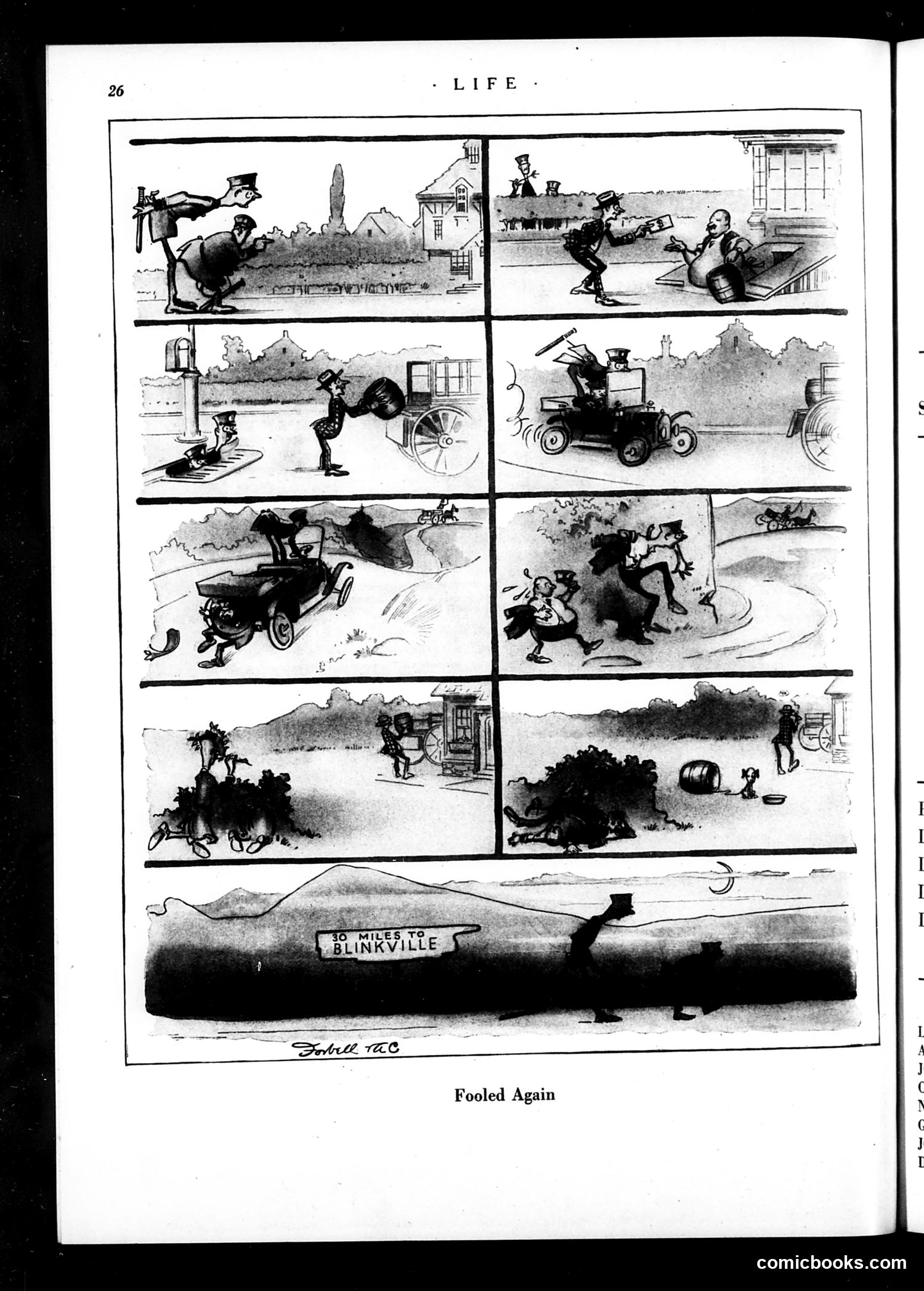
This is a sequential comic strip depicting a figure repeatedly attempting to reach "Blinkville" (visible on the final signpost). The narrative shows escalating efforts: the character begins with simple walking, progresses to operating various mechanical vehicles (hand-carts, early automobiles), and experiences increasingly chaotic mishaps at each stage. The satirical point appears to be about futile progress or false promises—despite investing in newer technologies and methods, the protagonist repeatedly fails to reach his destination, suggesting that modernization doesn't guarantee success. The title "Fooled Again" reinforces this theme of repeated deception or disappointment. Without a publication date visible, the specific political target remains unclear, though the cartoon likely satirizes either technological optimism, political reform efforts, or urban development promises of its era.
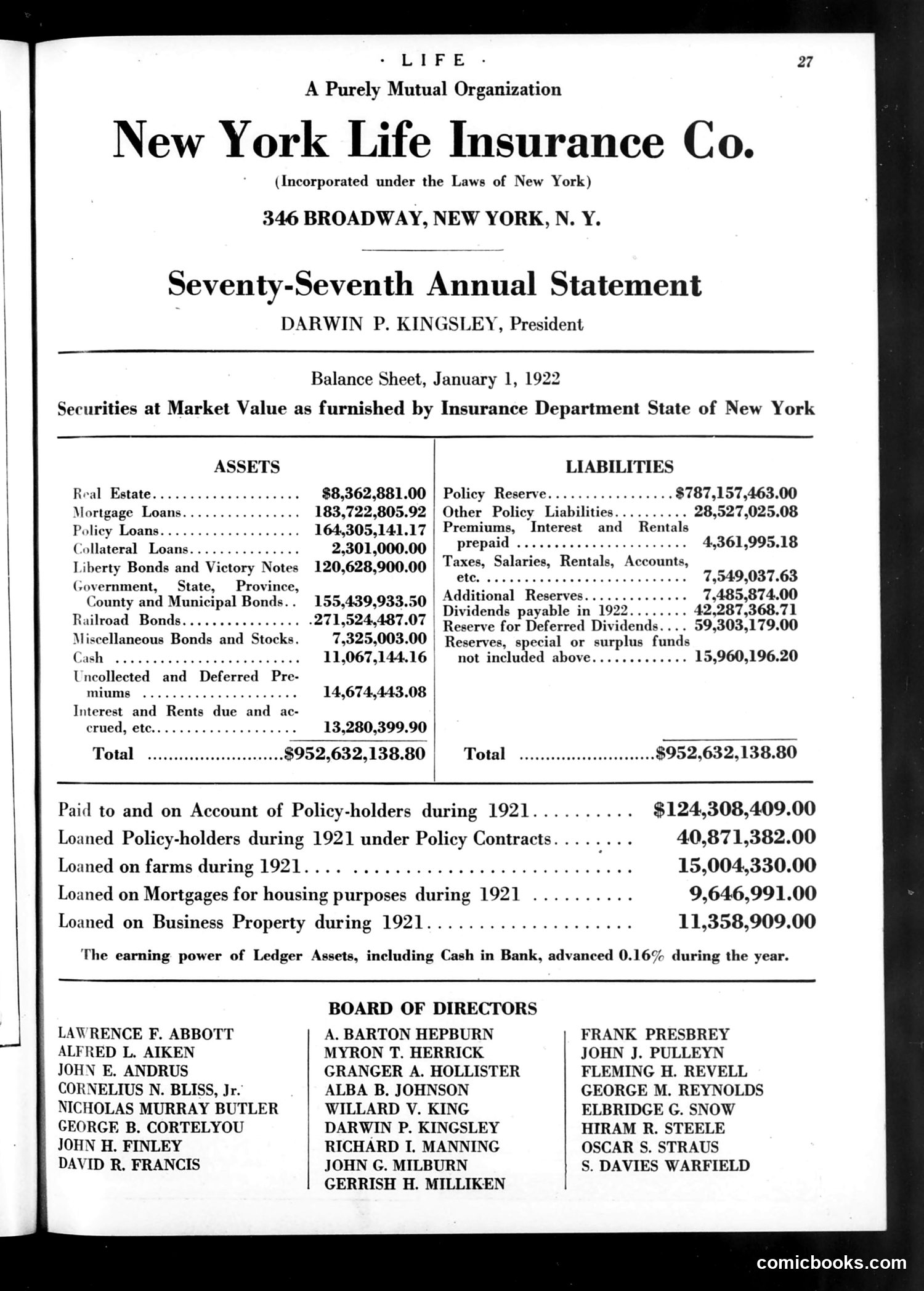
This page is **not a cartoon or satire**—it's a straightforward financial document: the 77th Annual Statement of New York Life Insurance Company dated January 1, 1922. The page presents a balance sheet showing assets of approximately $952 million (including real estate, bonds, loans, and cash) balanced against liabilities of the same amount (primarily policy reserves). It documents the company's payouts to policyholders during 1921 and loans extended for farms, housing, and business purposes. The Board of Directors listed includes prominent figures of the era like Nicholas Murray Butler (Columbia University president), George B. Cortelyou (former Treasury Secretary), and Oscar S. Straus (former Commerce Secretary)—names signaling respectability and financial soundness to potential policyholders. This appears in *Life* magazine simply as corporate advertising/public relations material demonstrating the company's financial stability during the post-WWI economic period.
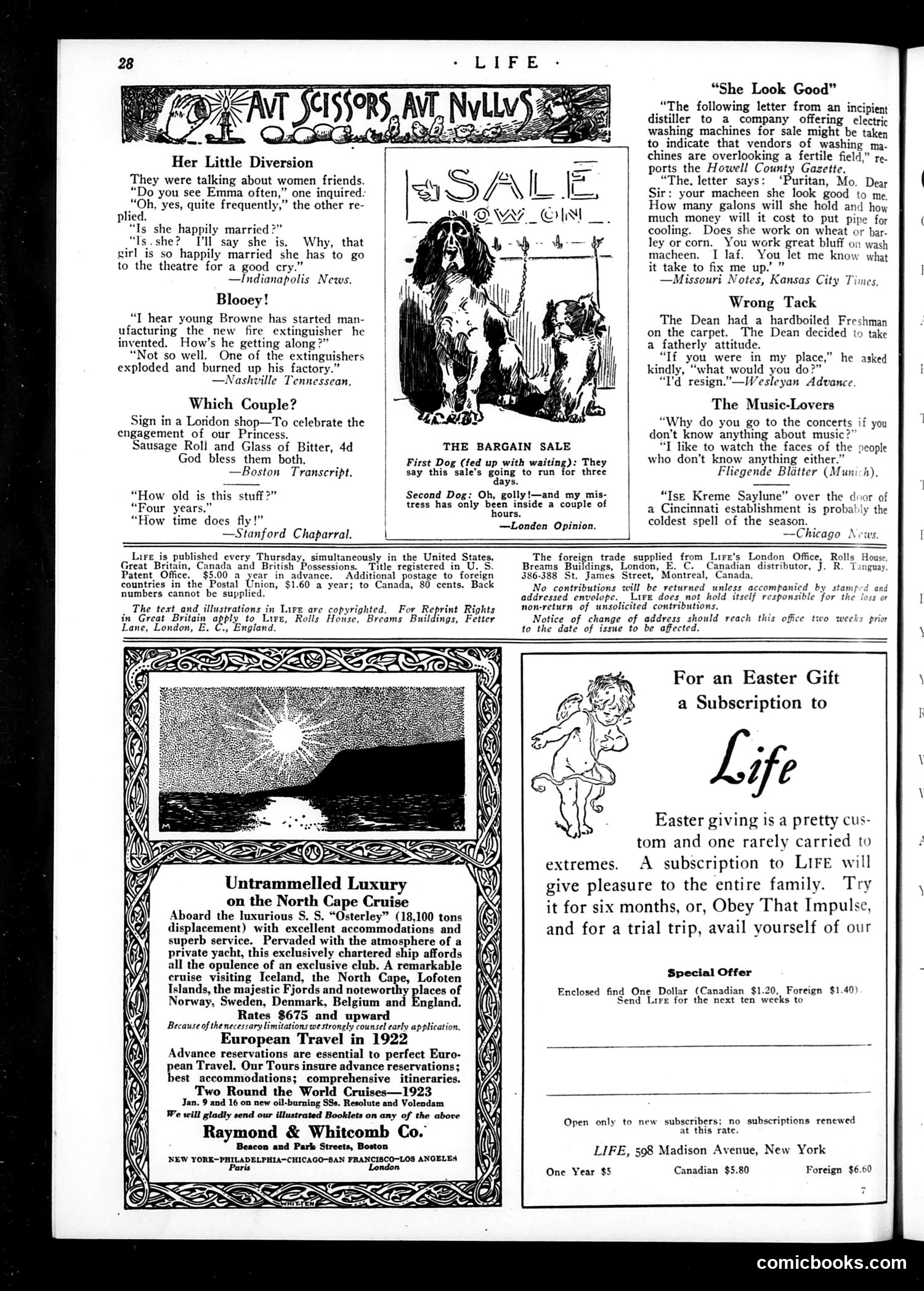
This Life magazine page (page 28) is primarily a **humor/comics section** featuring brief jokes rather than political cartoons. The content reflects early 20th-century American satirical humor: **Main cartoon**: Shows two dogs at a bargain sale—one complaining he's been waiting while his mistress shopped inside for hours. The joke mocks endless retail sales and women's shopping habits. **Other jokes** include: a woman so unhappily married she needs theater for crying; a fire extinguisher inventor whose product exploded; and a dean asking a troublesome freshman what *he'd* do—receiving the reply "I'd resign." **Social references**: The humor targets women's shopping behavior, marital dissatisfaction, failed inventions, and student discipline—typical 1920s magazine comedy. The page also advertises ocean cruises and a Life magazine subscription offer. **No identifiable political figures or events**—this is purely social satire through lighthearted jokes reflecting period attitudes toward gender roles and everyday life.
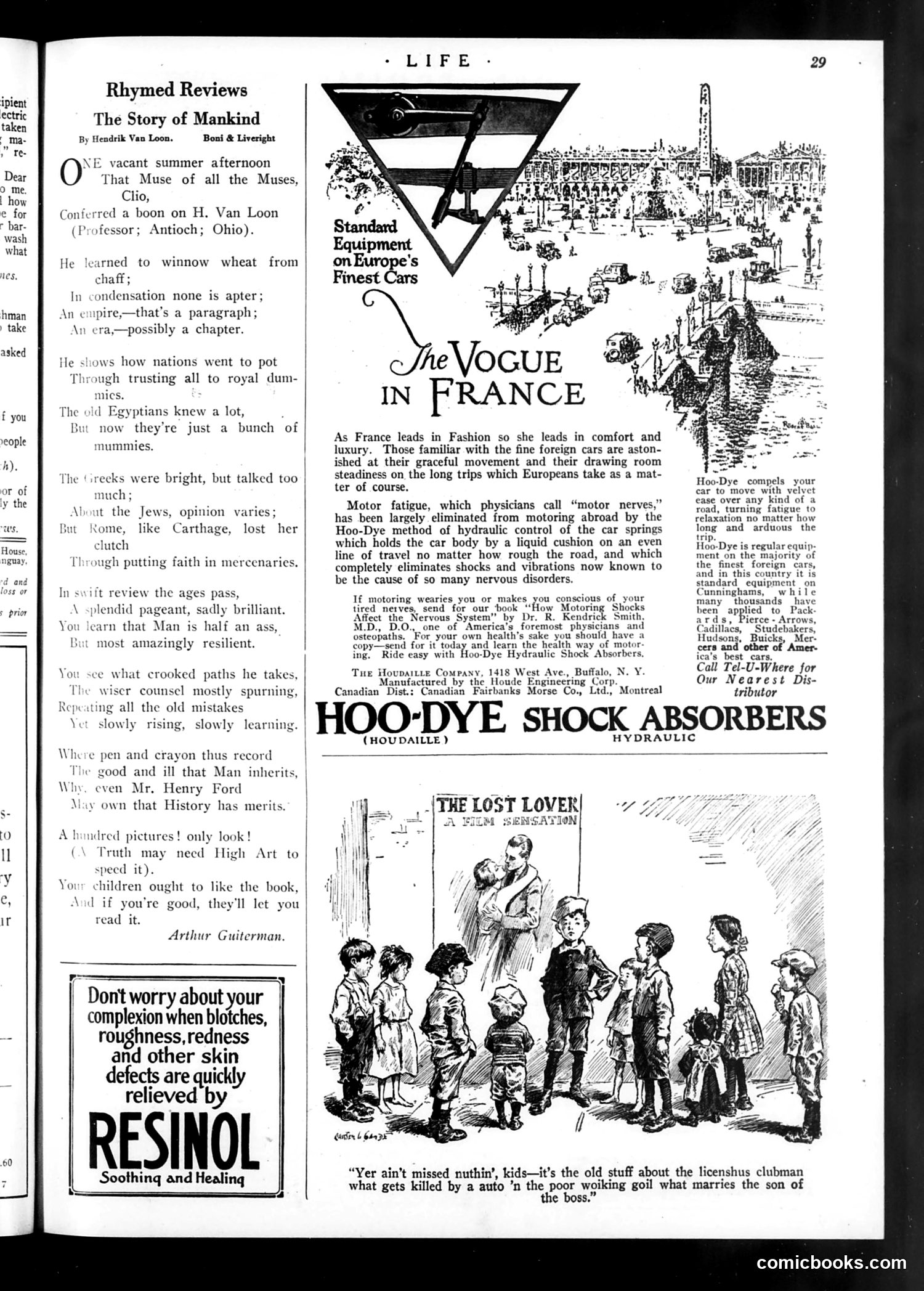
This page mixes book review, advertising, and cartoon commentary typical of 1920s *Life* magazine. **The Rhymed Review** (left column) satirizes Hendrik Van Loon's popular history book *The Story of Mankind*. Reviewer Arthur Guiterman uses comic verse to mock the book's sweeping historical oversimplifications—reducing complex civilizations to crude lessons ("old Egyptians knew a lot, / But now they're just a bunch of mummies"). The humor targets both Van Loon's reductive approach and readers' appetite for simplified history. **"The Lost Lover" Cartoon** (bottom) depicts working-class Londoners (note the accent: "licenshus," "pote woiking goil"). A street urchin dismisses a film poster as recycled melodrama—yet another story about a wealthy seducer killed by automobiles while a working girl marries his son. The satire mocks both the formula's predictability and cinema's repeated class-fantasy narratives catering to working audiences. The page is otherwise dominated by luxury car advertising, creating ironic contrast with the humble cartoon subjects.
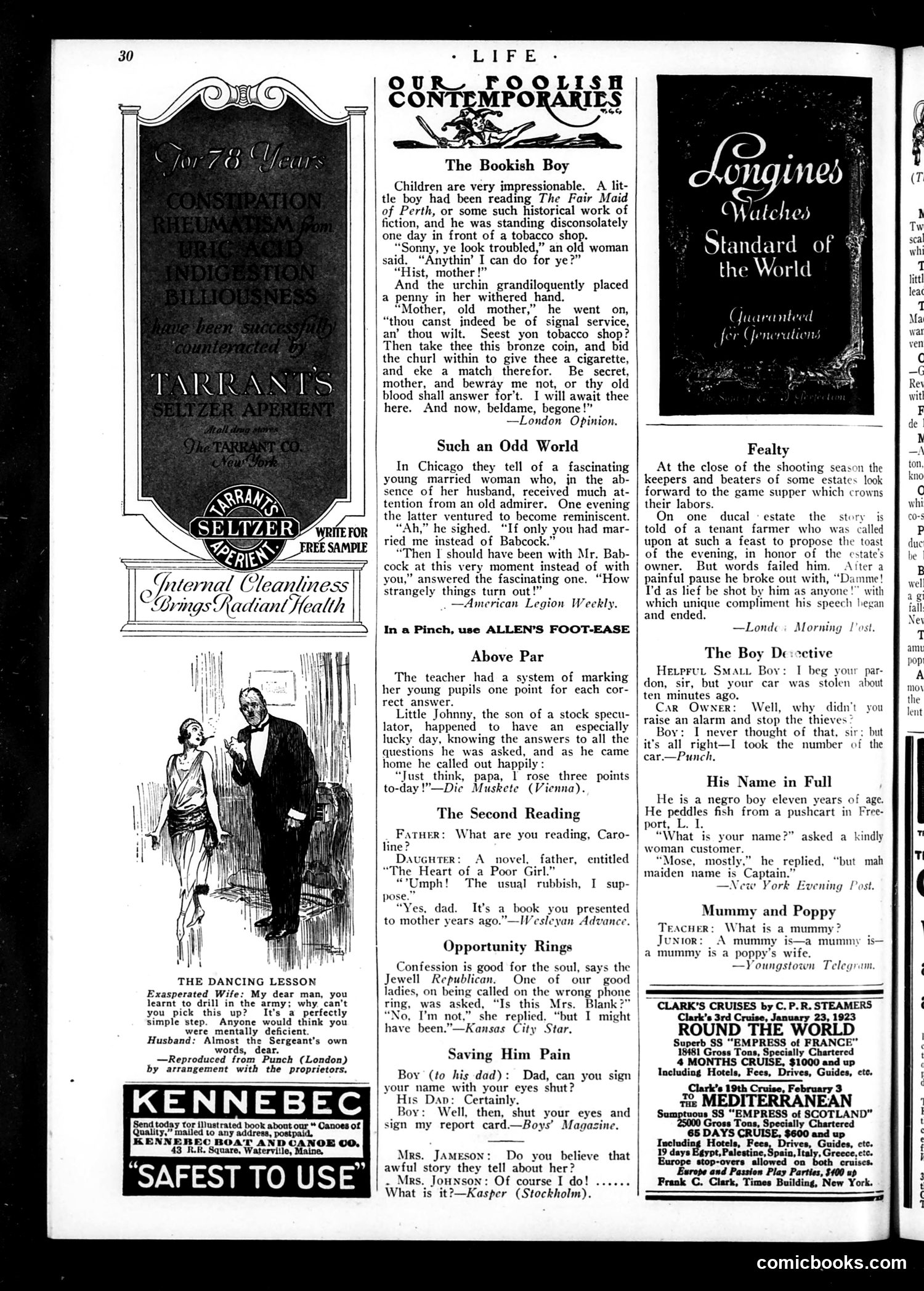
This page from *Life* magazine contains several short humor pieces typical of early 20th-century satirical journalism: **"The Bookish Boy"** mocks a child who has absorbed too much historical romance fiction, speaking in affected archaic language ("Hist, mother!") to a confused shopkeeper about buying cigarettes. **"The Dancing Lesson"** satirizes a wife attempting to teach her husband a dance step; he sarcastically notes she sounds like his old army sergeant—a jab at nagging spouses and emasculation anxiety common to the era. **"Above Par"** jokes about stock speculation: a boy brags he "rose three points" in school, but his speculator father initially misunderstands, thinking he means financial gains. **Other brief pieces** include mild mockery of gossip ("Opportunity Rings"), gender confusion on telephones, and a tenant farmer's inarticulate toast. The page is primarily **advertising** (Tarrant's laxatives, Longines watches, cruise lines), with humor serving as content filler—typical *Life* magazine format from this era.
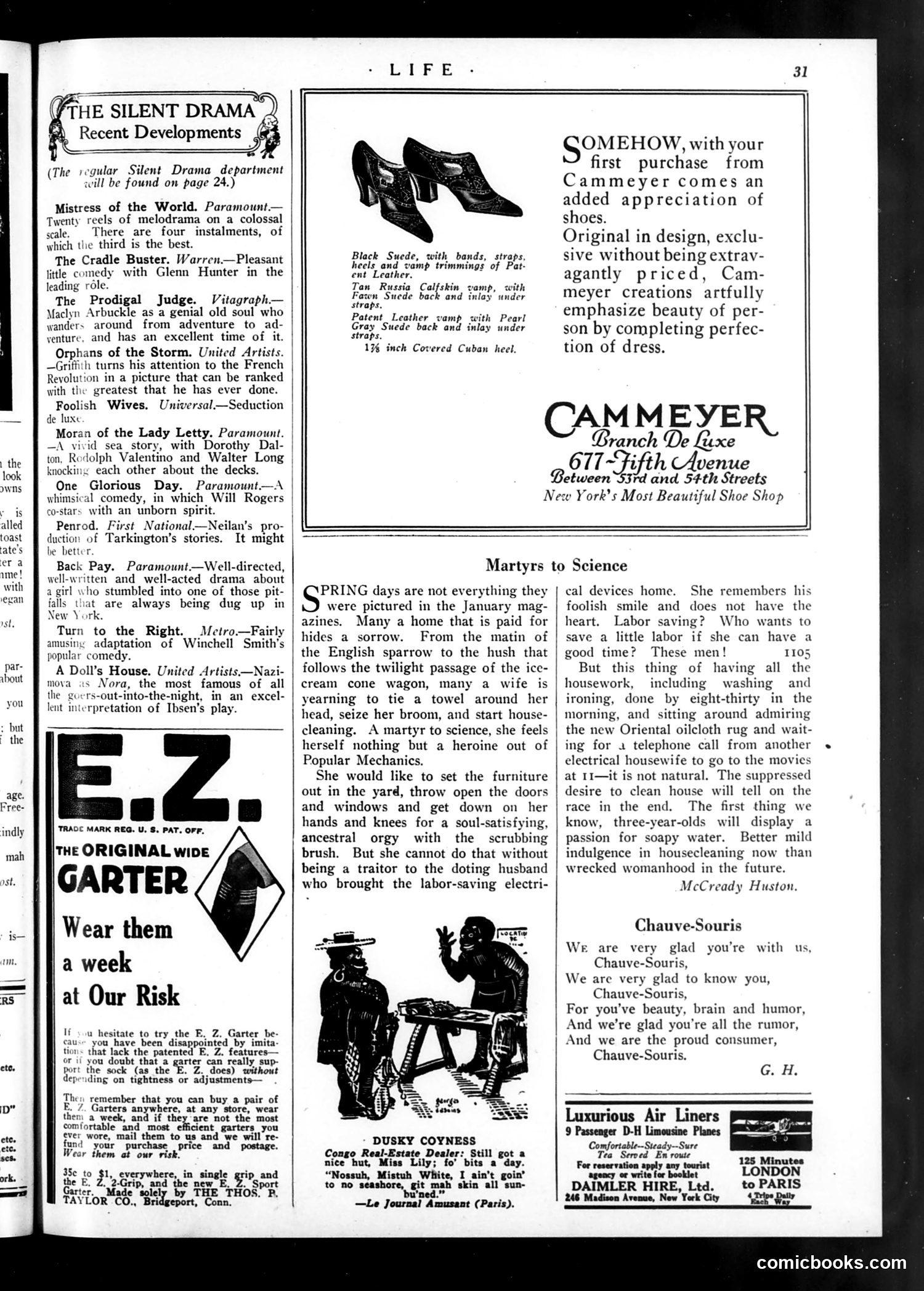
This article satirizes the burden of spring housecleaning on housewives. The author mocks the romanticization of spring described in magazines, contrasting it with domestic drudgery: women tying towels around their heads to clean house. The "martyr to science" reference likely alludes to how housewives view themselves—forced into exhausting labor (scrubbing, washing) that modern appliances and "Popular Mechanics" magazine promised would liberate them. Instead, the technology brought *more* expectations for cleanliness and domestic perfection. The piece's tone is sympathetic to women's labor while gently mocking both the magazines that oversold spring's romantic potential and the wives who internalize impossible domestic standards. It reflects 1920s anxieties about modernity, technology, and women's roles—highlighting the gap between progress-promised leisure and lived exhaustion.
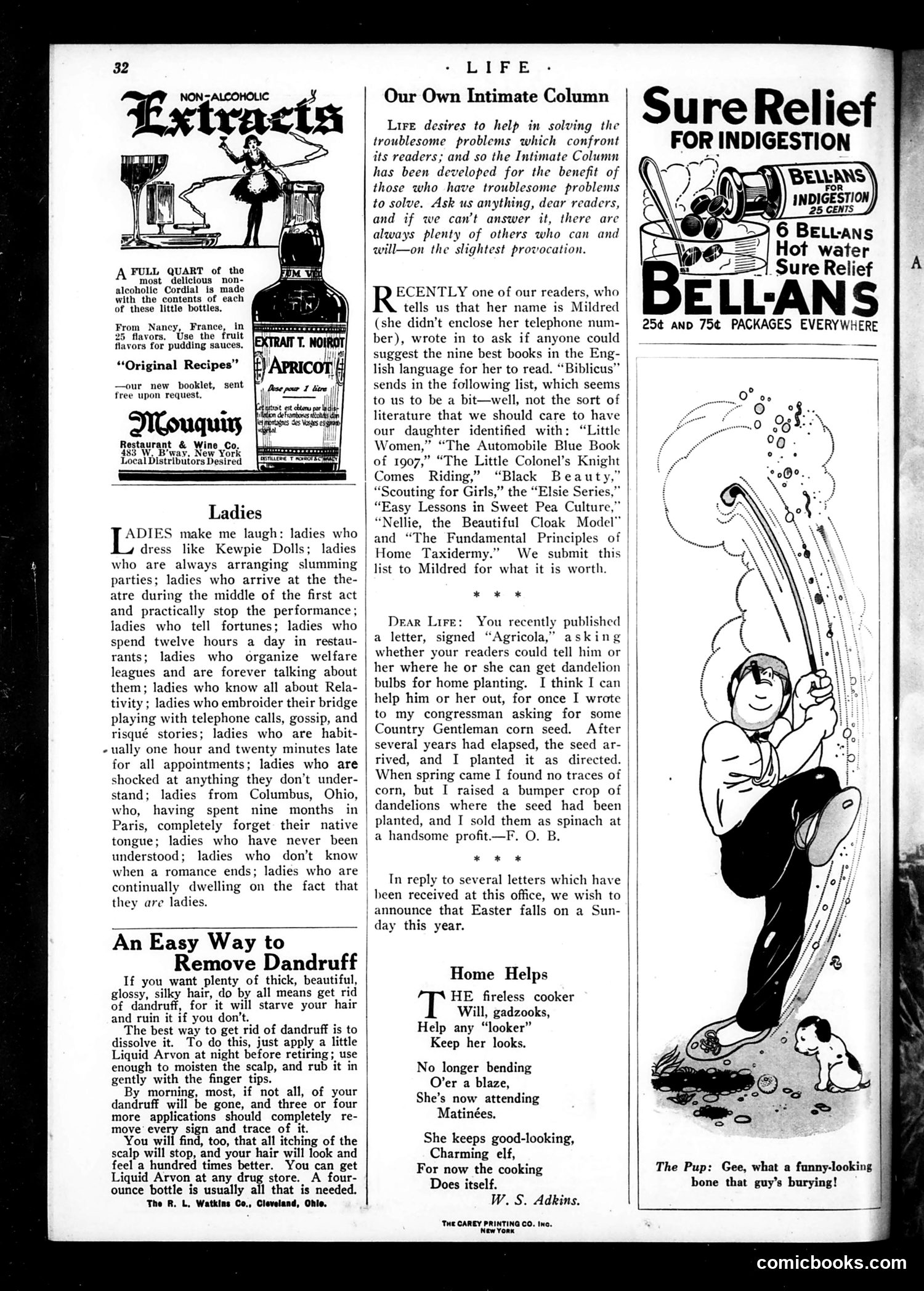
This page contains vintage advertisements and advice columns from *Life* magazine, likely from the 1910s-1920s. **Main Content:** - A humorous essay mocking upper-class women's social affectations—ladies who dress fashionably ("Kewpie Dolls"), attend theaters, claim sophistication after brief Paris visits, and prioritize social status - Product ads for non-alcoholic cordials, dandruff treatment, and digestive aids (Bell-Ans) - An "Intimate Column" advice section where readers submit problems **The Satire:** The "Ladies" piece satirizes the newly affluent American middle class, particularly women gaining social mobility through leisure activities. The jokes target pretension: women who "completely forget their native tongue" after nine months abroad, those obsessed with "Relativity" (fashionable intellectual posturing), and the general contradiction between claiming sophistication while lacking genuine understanding. **Context:** This reflects post-WWI anxieties about social climbing and women's changing roles. The humor assumes readers recognize and share disdain for these types—a common satirical strategy in early 20th-century *Life*.