
Life, 1922-03-30 · page 20 of 34
Life — March 30, 1922 — page 20: what you’re looking at
What you’re looking at
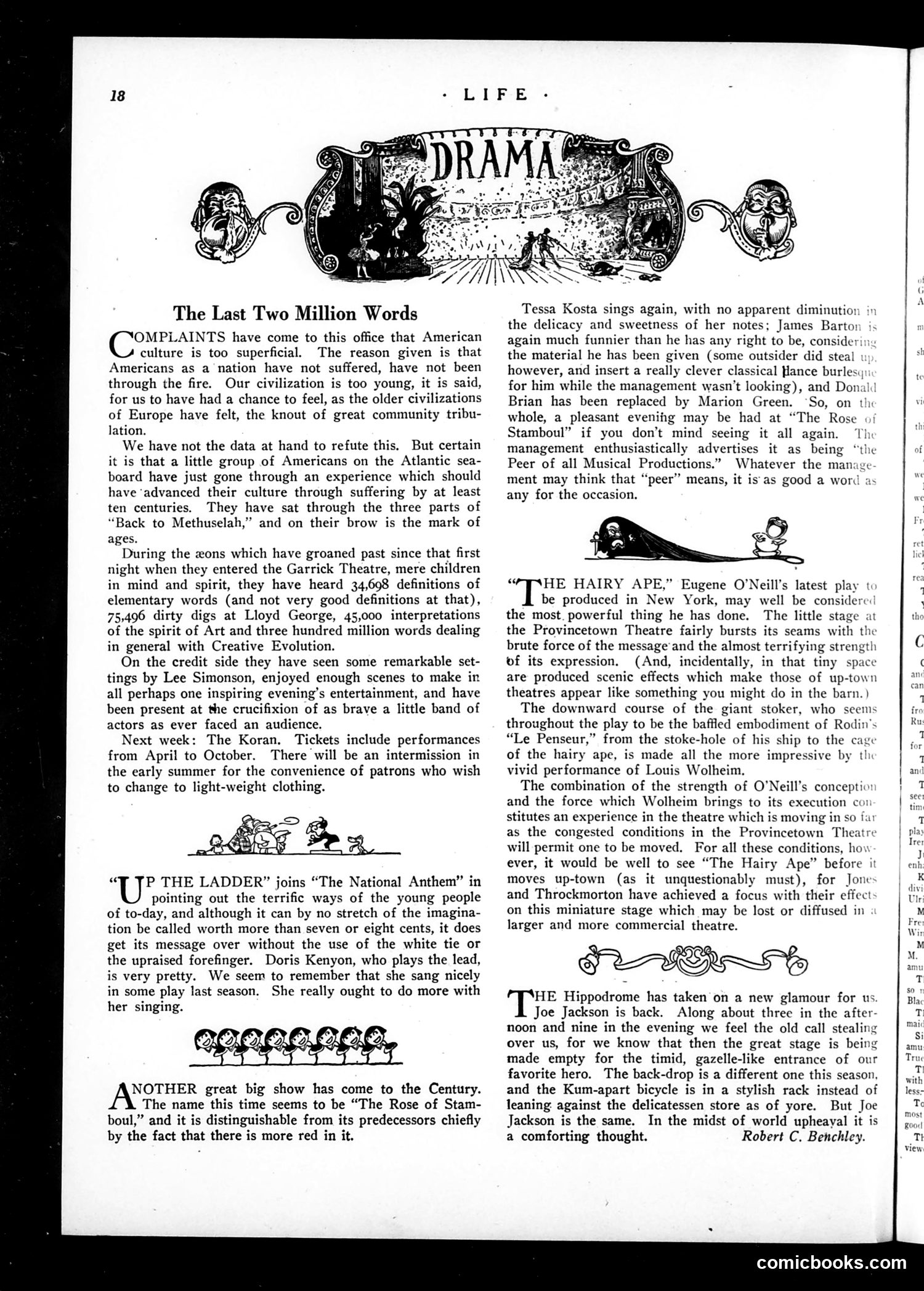
This page reviews recent Broadway productions with characteristic satirical bite. The lead article mocks Shaw's marathon play *Back to Methuselah* at the Garrick Theatre, sarcastically crediting audiences with "cultural advancement through suffering" for enduring its length. The writer catalogs absurd statistics (34,698 definitions, 75,496 "digs at Lloyd George") to ridicule the play's verbose intellectualism. Subsequent reviews cover lighter fare: *Up the Ladder*, *The Rose of Stamboul* (a musical with actress Tessa Kosta), and Eugene O'Neill's *The Hairy Ape*. The critique of *Stamboul* pokes fun at management's self-promotion as "Peer of all Musical Productions"—wordplay suggesting the production is merely adequate ("peer" = equal/comparable). The satire throughout targets pretentiousness in theater: overly intellectual drama, inflated marketing claims, and the gap between artistic ambition and execution. This reflects Life's consistent stance as a witty observer skeptical of cultural pretension.
📄 Transcribed text from this page (OCR, searchable)
Machine-transcribed from the original scan — historical spelling and the odd misread are preserved.
The Last Two Million Words (OMPLAINTS have come to this office that American culture is too superficial The reason given is that Americans as a nation have not suffered, have not been through the fire. Our civilization is too young, it is said, for us to have had a chance to feel, as the older civilizations of Europe have felt, the knout of great community tribu- lation. We have not the data at hand to refute this. But certain it is that a little group of Americans on the Atlantic sea- board have just gone through an experience which should have ‘advanced their culture through suffering by at least ten centuries. They have sat through the three parts of “Back to Methuselah,” and on their brow is the mark of ages. During the zons which have groaned past since that first night when they entered the Garrick Theatre, mere children in mind and spirit, they have heard 34,698 definitions of elementary words (and not very good definitions at that), 75,496 dirty digs at Lloyd George, 45,000 interpretations of the spirit of Art and three hundred million words dealing in general with Creative Evolution. On the credit side they have seen some remarkable set- tings by Lee Simonson, enjoyed enough scenes to make in all perhaps one inspiring evening’s entertainment, and have been present at the crucifixion of as brave a little band of actors as ever faced an audience. Next week: The Koran, Tickets include performances from April to October. There will be an intermission in the early summer for the convenience of patrons who wish to change to light-weight clothing. « P THE LADDER?” joins “The National Anthem” in pointing out the terrific ways of the young people of to-day, and although it can by no stretch of the imagina- tion be called worth more than seven or eight cents, it does get its message over without the use of the white tie or the upraised forefinger. Doris Kenyon, who plays the lead, is very pretty. We seem to remember that she sang nicely in some play last season. She really ought to do more with her singing. NOTHER great big show has come to the Century. The name this time seems to be “The Rose of Stam- boul,” and it is distinguishable from its predecessors chiefly by the fact that there is more red in it. Tessa Kosta sings again, with no apparent diminution j the delicacy and sweetness of her notes; James Bartor again much funnier than he has any right to be, consideri the material he has been given (some outsider did steal however, and insert a really clever classical Hance burlesy for him while the management wasn’t looking), and Donal Brian has been replaced by Marion Green. ‘So, on t whole, a pleasant evenihg may be had at “The Rose Stamboul” if you don’t mind seeing it all again. management enthusiastically advertises it as being Peer of all Musical Productions.” Whatever the manage ment may think that “peer” means, it is as good a word as any for the occasion. ‘ HE HAIRY APE,” Eugene O’Neill’s latest play t be produced in New York, may well be considere:| the most. powerful thing he has done. The little stage the Provincetown Theatre fairly bursts its seams with brute force of the message'and the almost terrifying strer of its expression. (And, incidentally, in that tiny space are produced scenic effects which make those of up-town theatres appear like something you might do in the barn.) The downward course of the giant stoker, who seems throughout the play to be the baffled embodiment of Rodin’s “Le Penseur,” from the stoke-hole of his ship to the c of the hairy ape, is made all the more impressive by t! vivid performance of Louis Wolheim. The combination of the strength of O’Neill’s conceptio: and the force which Wolheim brings to its execution cor stitutes an experience in the theatre which is moving in as the congested conditions in the Provincetown Thea will permit one to be moved. For all these conditions, ho ever, it would be well to see “The Hairy Ape” before it moves up-town (as it unquestionably must), for Jon and Throckmorton have achieved a focus with their effect on this miniature stage which may be lost or diffused in larger and more commercial theatre. QR p HE Hippodrome has taken on a new glamour for us. Joe Jackson is back. Along about three in the after- noon and nine in the evening we feel the old call stealing over us, for we know that then the great stage is being made empty for the timid, gazelle-like entrance of our favorite hero. The back-drop is a different one this season, and the Kum-apart bicycle is in a stylish rack instead of leaning against the delicatessen store as of yore. But Joe Jackson is the same. In the midst of world upheayal it is a comforting thought. Robert C. Benchley. comicbooks.com