
Life, 1922-03-30 · page 17 of 34
Life — March 30, 1922 — page 17: what you’re looking at
What you’re looking at
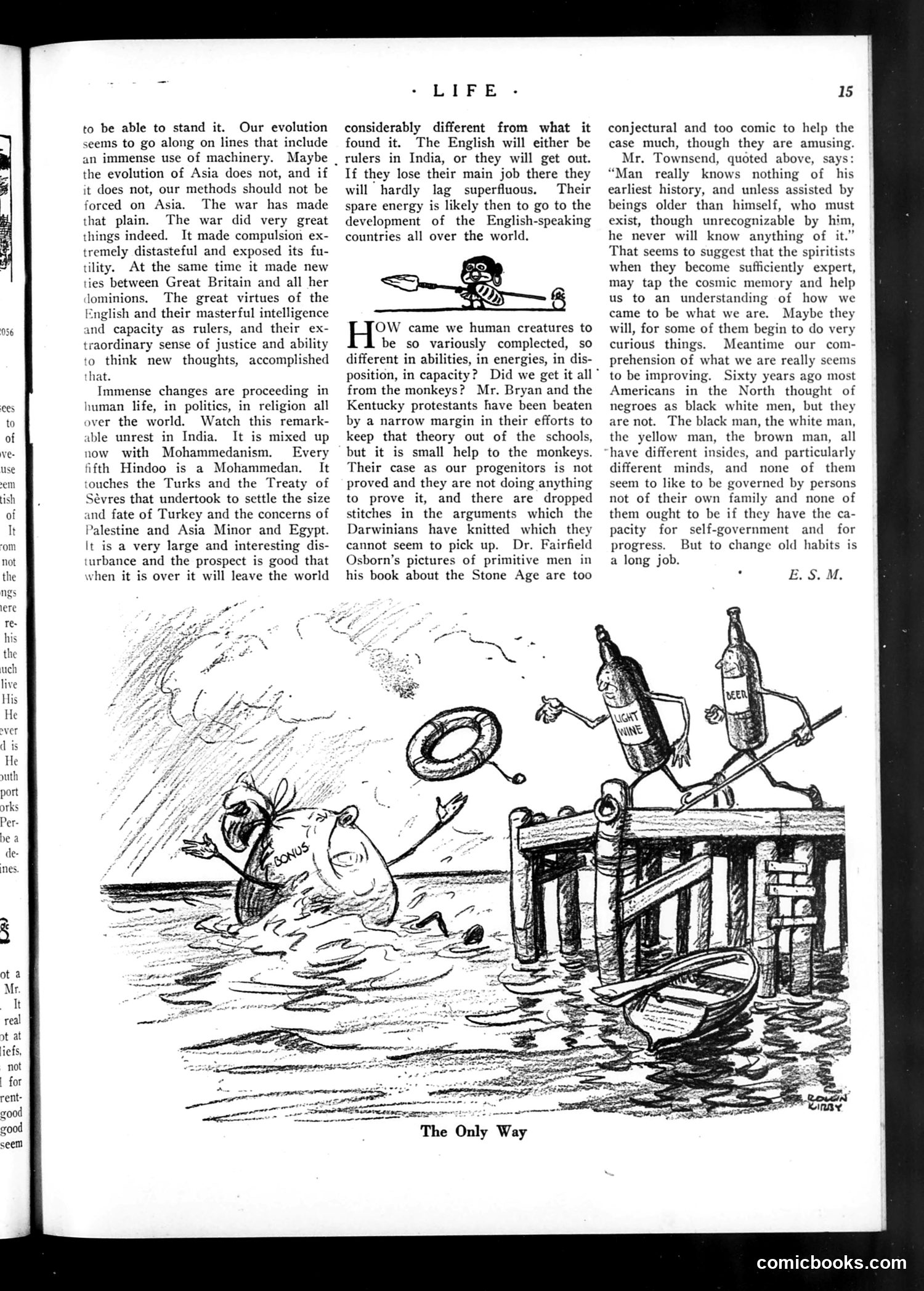
This page combines editorial text on evolution, race, and colonialism with a cartoon satirizing Prohibition-era alcohol smuggling. **The Cartoon:** "The Only Way" depicts anthropomorphized bottles of liquor escaping across water to a dock, while a figure on shore (appearing to represent law enforcement or a Prohibition agent) futilely attempts to stop them. The joke critiques Prohibition as unenforceable—smugglers will always find ways to bring alcohol into the country despite legal bans. **Historical Context:** This appears from the Prohibition era (1920-1933), when the 18th Amendment banned alcohol sales in America. The cartoon suggests that interdiction efforts are pointless; illegal importation will inevitably continue. **The Editorial Content:** Discusses human evolution, race differences, and colonial governance—reflecting early-20th-century attitudes on these topics, including references to the Scopes trial debate over teaching evolution and paternalistic views on governing non-Western peoples.
📄 Transcribed text from this page (OCR, searchable)
Machine-transcribed from the original scan — historical spelling and the odd misread are preserved.
uch live His He to be able to stand it. Our evolution seems to go along on lines that include an immense use of machinery. Maybe . the evolution of Asia does not, and if it does not, our methods should not be forced on Asia. The war has made that plain. The war did very great things indeed. It made compulsion ex- tremely distasteful and exposed its fu- tility. At the same time it made new ties between Great Britain and all her lominions. The great virtues of the English and their masterful intelligence ind capacity as rulers, and their ex- traordinary sense of justice and ability to think new thoughts, accomplished that. Immense changes are proceeding in human life, in politics, in religion all over the world. Watch this remark- able unrest in India. It is mixed up now with Mohammedanism. Every fifth Hindoo is a Mohammedan. It touches the Turks and the Treaty of Sévres that undertook to settle the size and fate of Turkey and the concerns of Palestine and Asia Minor and Egypt. It is a very large and interesting dis- turbance and the prospect is good that when it is over it will leave the world * LIFE - considerably different from what it found it. The English will either be rulers in India, or they will get out. If they lose their main job there they will hardly lag superfluous. Their spare energy is likely then to go to the development of the English-speaking countries all over the world. OW came we human creatures to be so variously complected, so different in abilities, in energies, in dis- position, in capacity? Did we get it all” from the monkeys? Mr. Bryan and the Kentucky protestants have been beaten by a narrow margin in their efforts to keep that theory out of the schools, but it is small help to the monkeys. Their case as our progenitors is not proved and they are not doing anything to prove it, and there are dropped stitches in the arguments which the Darwinians have knitted which they cannot seem to pick up. Dr. Fairfield Osborn’s pictures of primitive men in his book about the Stone Age are too The Only Way 15 conjectural and too comic to help the case much, though they are amusing. Mr. Townsend, quoted above, says: “Man really knows nothing of his earliest history, and unless assisted by beings older than himself, who must exist, though unrecognizable by him, he never will know anything of it.” That seems to suggest that the spiritists when they become sufficiently expert, may tap the cosmic memory and help us to an understanding of how we came to be what we are. Maybe they will, for some of them begin to do very curious things. Meantime our com- prehension of what we are really seems to be improving. Sixty years ago most Americans in the North thought of negroes as black white men, but they are not. The black man, the white man, the yellow man, the brown man, all have different insides, and particularly different minds, and none of them seem to like to be governed by persons not of their own family and none of them ought to be if they have the ca- pacity for self-government and for progress. But to change old habits is a long job. comicbooks.com