
Life, 1922-03-30 · page 16 of 34
Life — March 30, 1922 — page 16: what you’re looking at
What you’re looking at
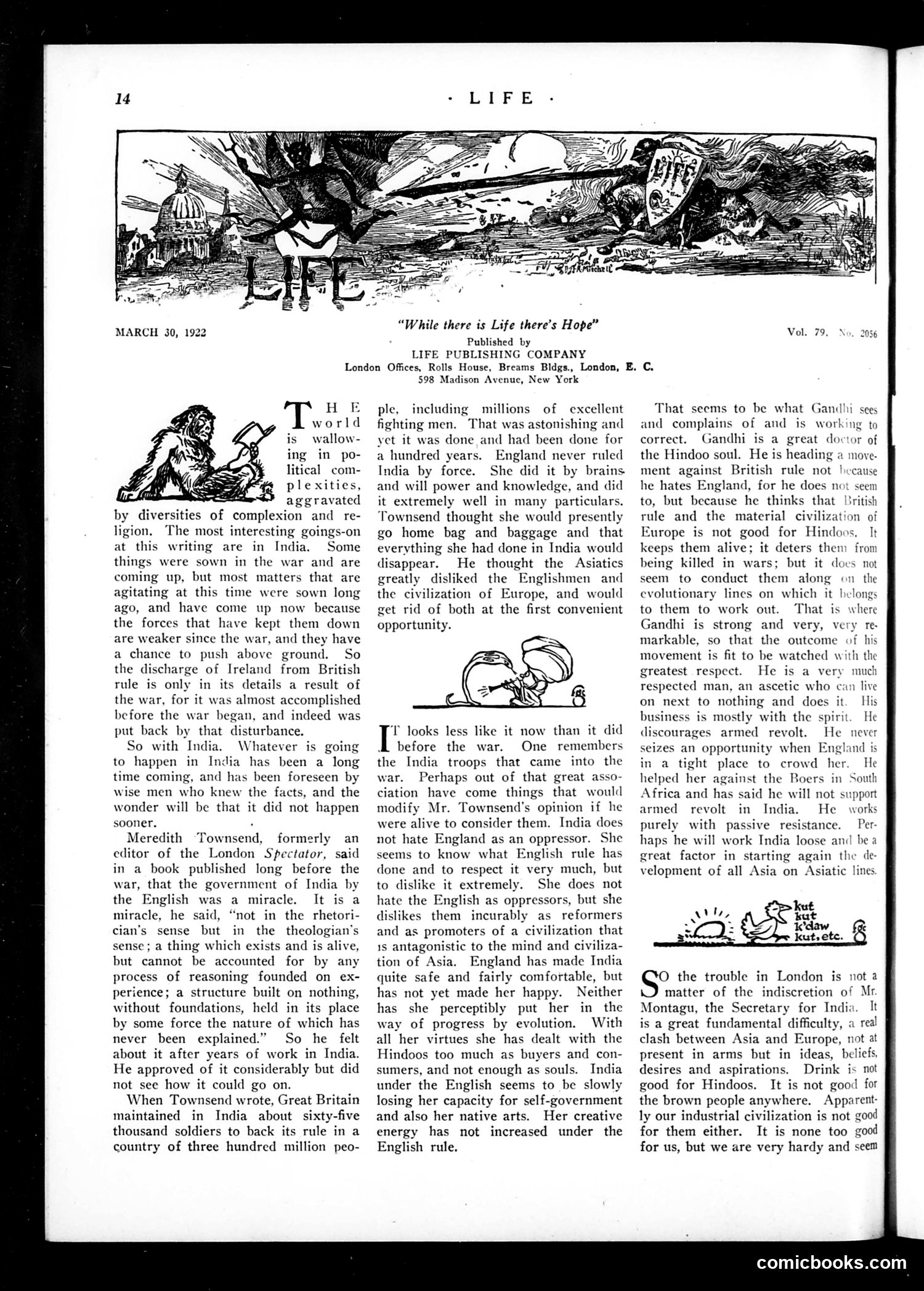
This page contains an article discussing Britain's rule in India and Gandhi's independence movement. The main illustration shows a caricatured figure (likely representing India or an Indian person) being controlled or constrained, reflecting the colonial relationship under discussion. The text debates whether British rule benefited India or oppressed it. The author acknowledges Gandhi's peaceful resistance movement and notes the contradiction: while Britain claims to have civilized India, India remains dissatisfied and seeks self-governance. The piece suggests Britain's "industrial civilization" may not actually be beneficial for Indians. A small cartoon in the lower right corner (captioned "kut kat") appears to be a separate humorous aside, though its specific meaning is unclear from this reproduction.
📄 Transcribed text from this page (OCR, searchable)
Machine-transcribed from the original scan — historical spelling and the odd misread are preserved.
MARCH 30, 1922 “While there is Life there’s Hope” Published by LIFE PUBLISHING COMPANY London Offices, Rolls House, Breams Bldgs., London, E. C. H E world wallow- ing in po- litical com- plexities, - aggravated by diversities of complexion and _ re- ligion. The most interesting goings-on at this iting are in India. Some things were sown in the war and are coming up, but most matters that are agitating at this time were sown long ago, and have come up now because the forces that have kept them down are weaker since the war, and they have a chance to push above ground. So the discharge of Ireland from British rule is only in its details a result of the war, for it was almost accomplished before the war began, and indeed was put back by that disturbance. So with India. Whatever is going to happen in India has been a long time coming, and has been foreseen by wise men who knew the facts, and the wonder will be that it did not happen sooner. : Meredith “Townsend, formerly an editor of the London Spectator, said in a book published long before the war, that the government of India by the English was a miracle. It is a miracle, he said, “not in the rhetori- cian’s sense but in the theologian’s sense ; a thing which exists and is alive, but cannot be accounted for by any process of reasoning founded on ex- perience; a structure built on nothing, without foundations, held in its place by some force the nature of which has never been explained.” So he felt about it after years of work in India. He approved of it considerably but did not see how it could go on. When Townsend wrote, Great Britain maintained in India about sixty-five thousand soldiers to back its rule in a country of three hundred million peo- 598 Madison Avenue, New York ple, including millions of excellent fighting men. That was astonishing and yet it was done and had been done for a hundred years. England never ruled India by force. She did it by brains and will power and knowledge, and did it extremely well in many particulars. Townsend thought she would presently go home bag and baggage and that everything she had done in India would disappear. He thought the Asiatics greatly disliked the Englishmen and the civilization of Europe, and would get rid of both at the first convenient opportunity. R I’ looks less like it now than it did ai before the war. One remembers the India troops that came into the war. Perhaps out of that great asso- ciation have come things that would modify Mr. Townsend's opinion if he were alive to consider them. India does not hate England as an oppressor. She seems to know what Eng! rule has done and to respect it very much, but to dislike it extremely. She does not hate the English as oppressors, but she dislikes them incurably as reformers and as promoters of a civilization that 1s antagonistic to the mind and civiliza- tion of Asia. England has made India quite safe and fairly comfortable, but has not yet made her happy. Neither has she perceptibly put her in the way of progress by evolution. With all her virtues she has dealt with the Hindoos too much as buyers and con- sumers, and not enough as souls. India under the English seems to be slowly losing her capacity for self-government and also her native arts. Her creative energy has not increased under the English rule. That seems to be what Gandhi sees and complains of and is working to correct. Gandhi is a great doctor of the Hindoo soul. He is heading a move- ment against British rule not lecause he hates England, for he does not to, but because he thinks that rule and the material civilization of Europe is not good for Hindoos, It keeps them alive; it deters them from being killed in wars; but it does not seem to conduct them along on the evolutionary lines on which it belongs to them to work out. That is Gandhi is strong and very, very re- markable, so that the outcome of his movement is fit to be watched with the greatest respect. He is a very much respected man, an ascetic who can live on next to nothing and does it. His business is mostly with the spirit. He discourages armed revolt. He seizes an opportunity when England is in a tight place to crowd her. He helped her against the Boers in South Africa and has said he will not support armed revolt in India. He works purely with passive resistance. Per- haps he will work India loose and be a great factor in starting again the de- velopment of all Asia on Asiatic lines. vhere never O the trouble in London is not a matter of the indiscretion of Mr. Montagu, the Secretary for India. It is a great fundamental difficulty, a real clash between Asia and Europe, not at present in arms but in ideas, beliefs, desires and aspirations. Drink is not good for Hindoos. It is not good for the brown people anywhere. Apparent ly our industrial civilization is not good for them either. It is none too good for us, but we are very hardy and seem comicbooks.com