
Life, 1922-03-30 · page 26 of 34
Life — March 30, 1922 — page 26: what you’re looking at
What you’re looking at
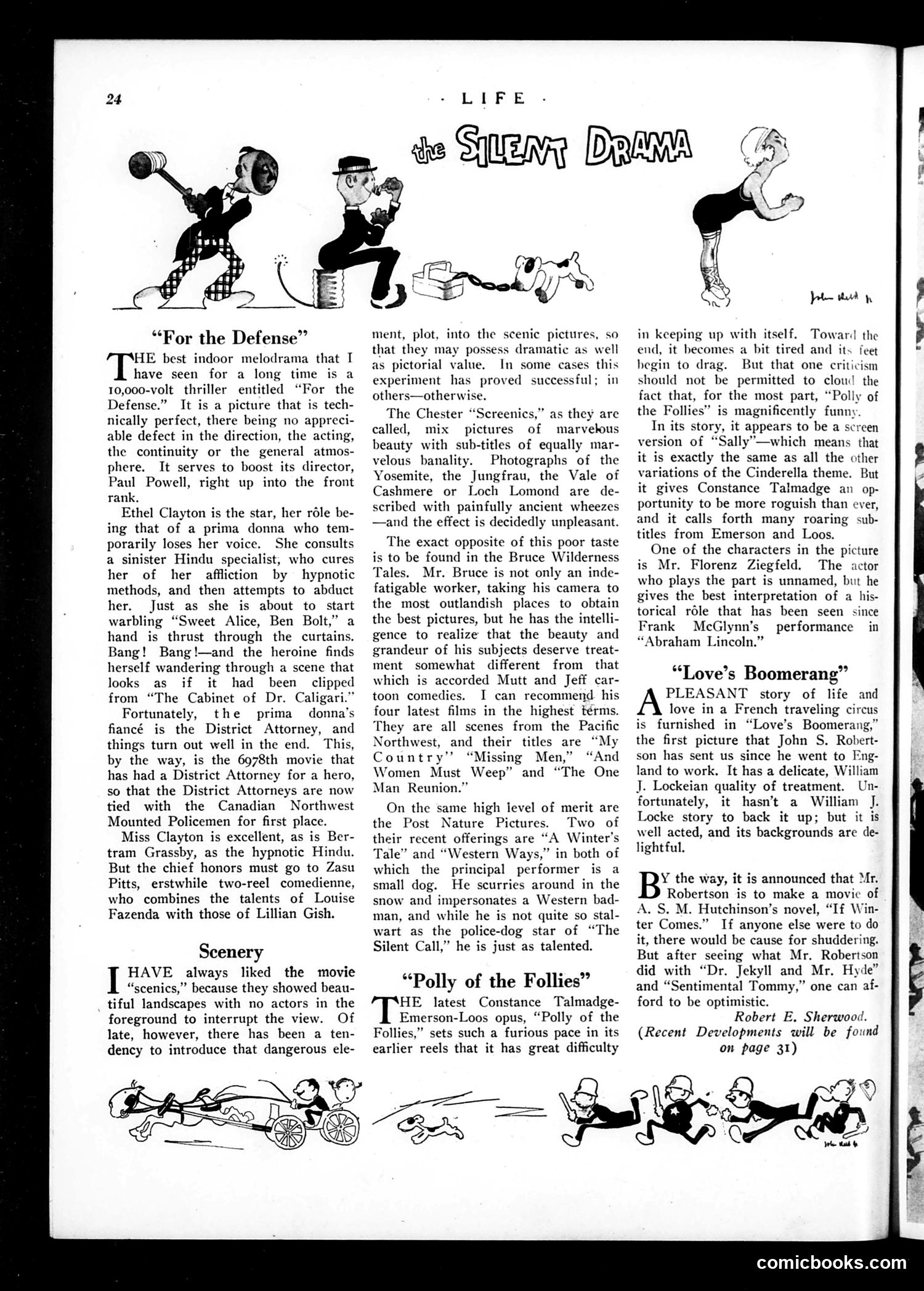
This page contains film criticism from Life magazine's entertainment section, likely from the early 1920s. The reviews discuss three films: **"For the Defense"** stars Ethel Clayton as a prima donna who loses her voice, consults a sinister Hindu hypnotist (played by Bertram Grassby), and is rescued by her fiancé—a District Attorney. The critic jokes that District Attorneys have become as common in movies as Canadian Northwest Mounted Policemen as heroic protagonists, and praises Zasu Pitts's comedic performance. **Scenic/nature films** are critiqued for mixing beautiful landscape photography with poorly-written subtitles containing "painfully ancient wheezes," contrasting favorably with Bruce Wilderness Tales, which treat scenery with appropriate dignity. **"Polly of the Follies"** (Constance Talmadge) is praised as magnificently funny but criticized for losing momentum toward the end, apparently being a screen adaptation of a stage property called "Sally." The cartoons at the page's top illustrate silent film comedy tropes and physical humor typical of the era.
📄 Transcribed text from this page (OCR, searchable)
Machine-transcribed from the original scan — historical spelling and the odd misread are preserved.
“For the Defense” HE best indoor melodrama that I have seen for a long time is a 10,000-volt thriller entitled “For the Defense.” It is a picture that is tech- nically perfect, there being no appreci- able defect in the direction, the acting, the continuity or the general atmos- phere. It serves to boost its director, Paul Powell, right up into the front rank. Ethel Clayton is the star, her réle be- ing that of a prima donna who tem- porarily loses her voice. She consults a sinister Hindu specialist, who cures her of her affliction by hypnotic methods, and then attempts to abduct her. Just as she is about to start warbling “Sweet Alice, Ben Bolt,” a hand is thrust through the curtains. Bang! Bang!—and the heroine finds herself wandering through a scene that looks as if it had been clipped from “The Cabinet of Dr. Caligari.” Fortunately, the prima donna’s fiancé is the District Attorney, and things turn out well in the end. This, by the way, is the 6978th movie that has had a District Attorney for a hero, so that the District Attorneys are now tied with the Canadian Northwest Mounted Policemen for first place. Miss Clayton is excellent, as is Ber- tram Grassby, as the hypnotic Hindu. But the chief honors must go to Zasu Pitts, erstwhile two-reel comedienne, who combines the talents of Louise Fazenda with those of Lillian Gish. Scenery HAVE always liked the movie “scenics,” because they showed beau- tiful landscapes with no actors in the foreground to interrupt the view. Of late, however, there has been a ten- dency to introduce that dangerous ele- ment, plot, into the scenic pictures, so that they may possess dramatic as well as pictorial value. In some cases this experiment has proved successful; in others—otherwise. The Chester “Screenics,” as they are called, mix pictures of marvelous beauty with sub-titles of equally mar- velous banality. Photographs of the Yosemite, the Jungfrau, the Vale of Cashmere or Loch Lomond are de- scribed with painfully ancient wheezes —and the effect is decidedly unpleasant. The exact opposite of this poor taste is to be found in the Bruce Wilderness Tales. Mr. Bruce is not only an inde- fatigable worker, taking his camera to the most outlandish places to obtain the best pictures, but he has the intelli- gence to realize that the beauty and grandeur of his subjects deserve treat- ment somewhat different from that which is accorded Mutt and Jeff car- toon comedies. I can recommend. his four latest films in the highest térms. They are all scenes from the Pacific Northwest, and their titles are “My Country” “Missing Men,” “And Women Must Weep” and “The One Man Reunion.” On the same high level of merit are the Post Nature Pictures. Two of their recent offerings are “A Winter's Tale” and “Western Ways,” in both of which the principal performer is a small dog. He scurries around in the snow and impersonates a Western bad- man, and while he is not quite so stal- wart as the police-dog star of “The Silent Call,” he is just as talented. “Polly of the Follies” HE latest Constance Talmadge- Emerson-Loos opus, “Polly of the Follies,” sets such a furious pace in its earlier reels that it has great difficulty pe mad in keeping up with itself. Toward the end, it becomes a bit tired and its feet hegin to drag. But that one criticism should not be permitted to cloud the fact that, for the most part, “Polly of the Follies” is magnificently funny In its story, it appears to be a screen version of “Sally’”—which means that it is exactly the same as all the other variations of the Cinderella theme. But it gives Constance Talmadge an op- portunity to be more roguish than ever, and it calls forth many roaring sub- titles from Emerson and Loos. One of the characters in the picture is Mr. Florenz Ziegfeld. The actor who plays the part is unnamed, but he gives the best interpretation of a his- torical role that has been seen since Frank McGlynn’s performance in “Abraham Lincoln.” “Love’s Boomerang” PLEASANT story of life and love in a French traveling circus is furnished in “Love’s Boomerang,” the first picture that John S. Robert- son has sent us since he went to Eng- land to work. It has a delicate, William J. Lockeian quality of treatment. Un- fortunately, it hasn’t a William J. Locke story to back it up; but it is well acted, and its backgrounds are de- lightful. Y the way, it is announced that Mr. Robertson is to make a movie of A. S. M. Hutchinson’s novel, “If Win- ter Comes.” If anyone else were to do it, there would be cause for shuddering. But after seeing what Mr. Robertson did with “Dr. Jekyll and Mr. Hyde” and “Sentimental Tommy,” one can af- ford to be optimistic. Robert E. Sherwood. (Recent Developments will be found on page 31) cc a comicbooks.com