
Life, 1922-03-30 · page 14 of 34
Life — March 30, 1922 — page 14: what you’re looking at
What you’re looking at
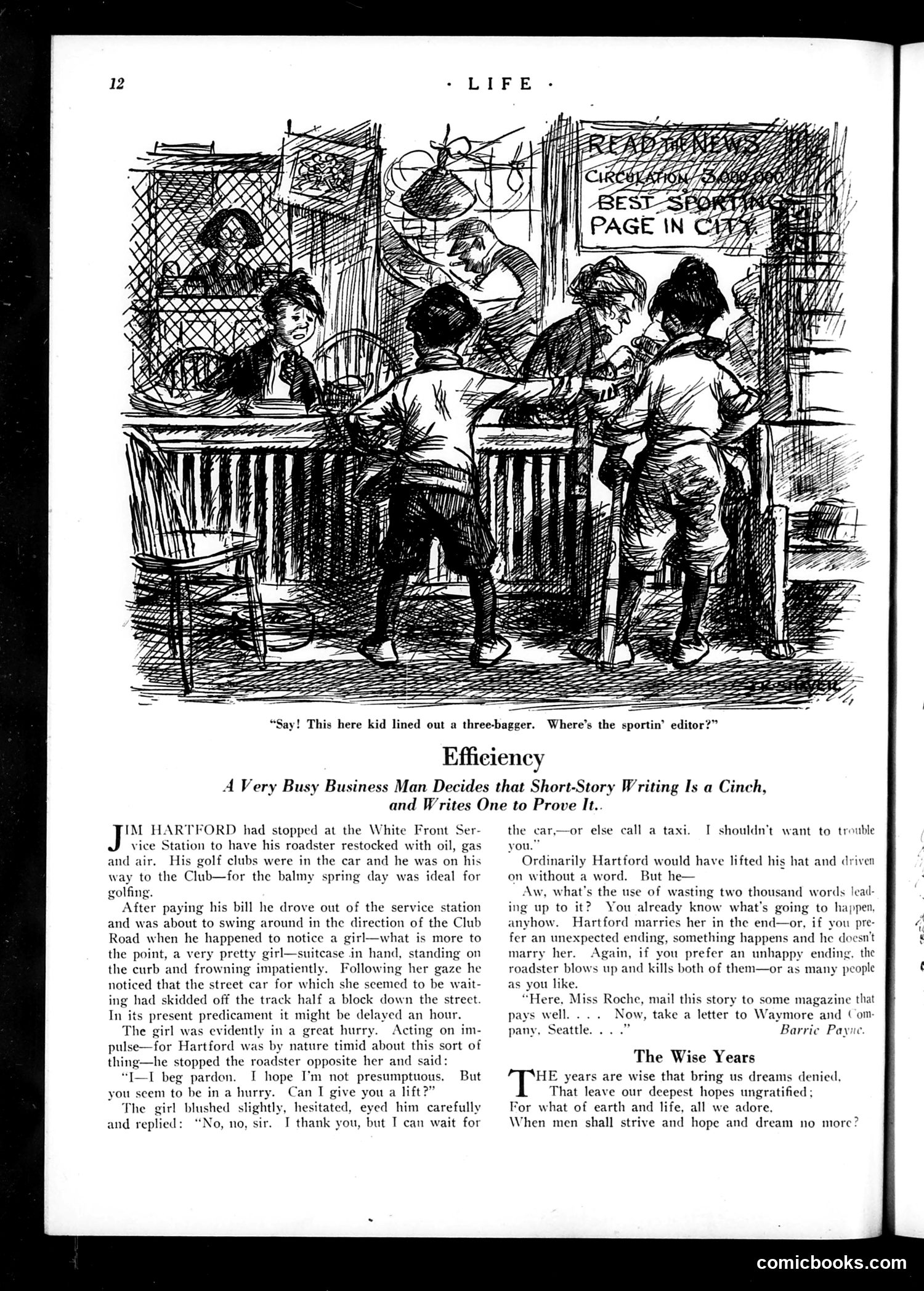
This cartoon satirizes a busy businessman's attempt to write short fiction. The sketch shows Jim Hartford at what appears to be a newspaper office, surrounded by colleagues discussing his newly written three-bagger story. The satire mocks the notion that successful businessmen can casually dash off published short stories as a sideline—treating literary creation as just another efficient business task to "cinch." The headline promises Hartford will write a story "to prove it," suggesting hubris about the ease of creative writing. The cartoon gently ridicules both the businessman's overconfidence and the era's apparent trend of wealthy, busy men attempting amateur writing. The joke relies on the audience recognizing that literary talent cannot simply be switched on through business efficiency and determination.
📄 Transcribed text from this page (OCR, searchable)
Machine-transcribed from the original scan — historical spelling and the odd misread are preserved.
“Say! This here kid lined out a three-bagger. Where's the sportin’ editor?” Efficiency A Very Busy Business Man Decides that Short-Story Writing Is a Cinch, and Writes One to Prove It.. IM HARTFORD had stopped at the White Front Ser- vice Station to have his roadster restocked with oil, gas and air. His golf clubs were in the car and he was on his way to the Club—for the balmy spring day was ideal for golfing. After paying his bill he drove out of the service station and was about to swing around in the direction of the Club Road when he happened to notice a girl—what is more to the point, a very pretty girl—suitcase in hand, standing on the curb and frowning impatiently. Following her gaze he noticed that the street car for which she seemed to be wait- ing had skidded off the track half a block down the street. In its present predicament it might be delayed an hour. The girl was evidently in a great hurry. Acting on im- pulse—for Hartford was by nature timid about this sort of thing—he stopped the roadster opposite her and said: “I—I beg pardon. I hope I’m not presumptuous, But you seem to be in a hurry. Can I give you a lift?” The girl blushed slightly, hesitated, eyed him carefully and replied: “No, no, sir. I thank you, but T can wait for the car,—or else call a taxi. I shouldn't want to trouble you.” Ordinarily Hartford would have lifted his hat and driven on without a word. But he— Aw, what's the use of wasting two thousand words lead- ing up to it? You already know what's going to happen, anyhow. Hartford marries her in the end—or, if you pre- fer an unexpected ending, something happens and he doesn't marry her. Again, if you prefer an unhappy endin: roadster blows up and kills both of them—or as many people as you like. “Here, Miss Roche, mail this story to some magazine that pays well... . Now, take a letter to Waymore and (om pany, Seattle... . Barrie Payue. The Wise Years HE years are wise that bring us dreams denied, That leave our deepest hopes ungratified ; For what of earth and life, all we adore, When men shall strive and hope and dream no more? comicbooks.com