
A complete issue · 34 pages · 1922
Life — March 2, 1922
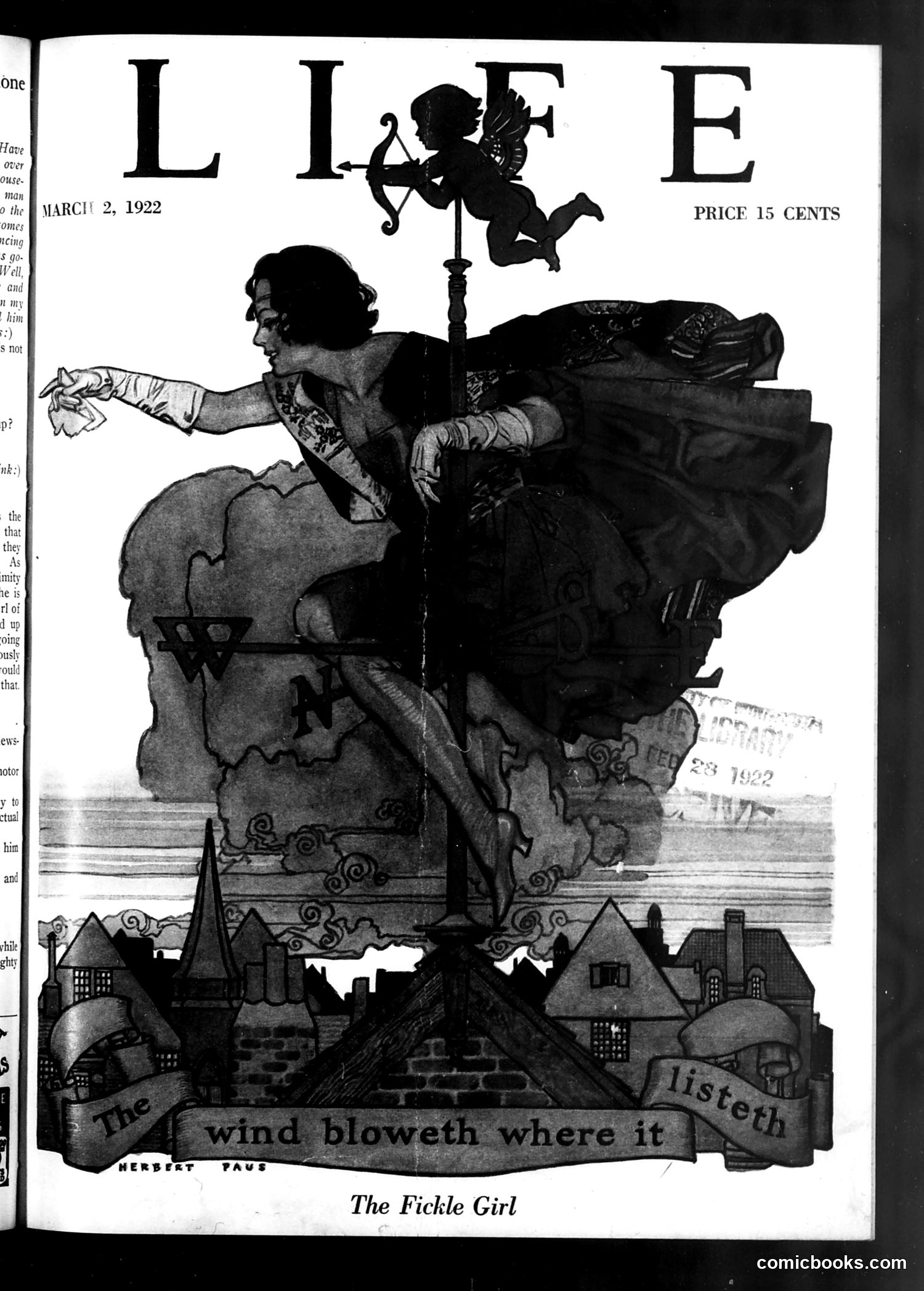
This cover illustration by Herbert Paus depicts a woman riding atop a massive, unstable structure composed of stacked heads and classical architectural elements. The tagline "The wind bloweth where it listeth" (from the Bible) suggests her capricious, unpredictable nature. The cartoon likely satirizes women's newly gained voting rights (19th Amendment ratified in 1920) and concerns about female political fickleness—a common anxiety among male commentators of the era. The precarious, top-heavy composition suggests women voters were seen as unstable forces that could topple established order. The cherub with Cupid's arrow reinforces stereotypes linking women's choices to romance rather than rational judgment. This reflects early 1920s anxieties about women's expanded political power.
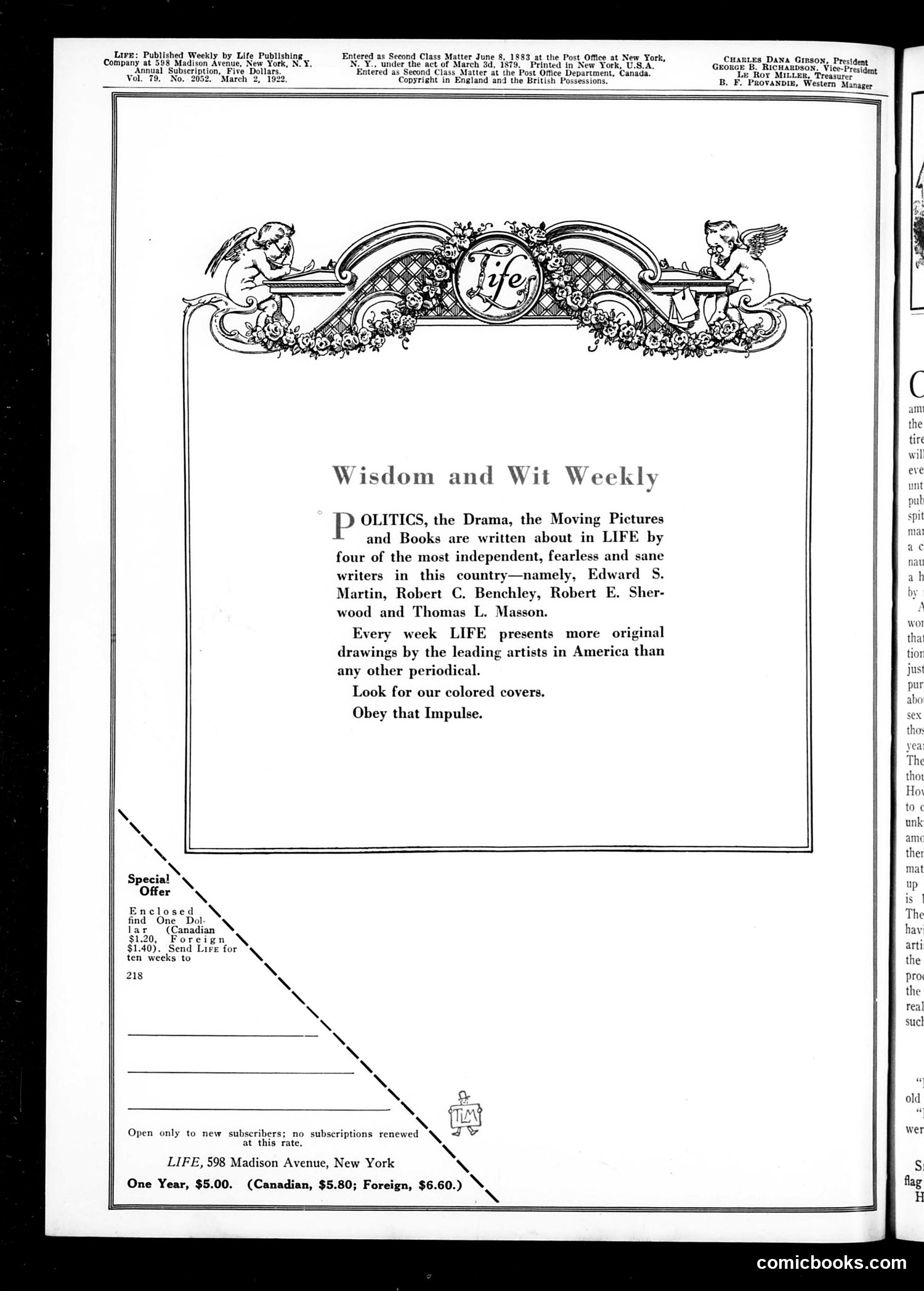
This page is primarily an **advertisement for LIFE magazine itself**, not a political cartoon. The decorative header features cherubs flanking the LIFE logo, establishing the magazine's sophisticated brand identity. The text promotes LIFE's editorial content—covering "Politics, the Drama, the Moving Pictures and Books"—written by four named contributors (Edward S. Martin, Robert C. Benchley, Robert E. Sherwood, and Thomas L. Masson). The advertisement emphasizes LIFE's artistic distinction: "more original drawings by the leading artists in America than any other periodical," and specifically highlights "colored covers," urging readers to "Obey that Impulse." A subscription offer appears below for new subscribers only ($5 annually in America). This is a **house advertisement**, not satirical content—LIFE marketing itself to potential readers.
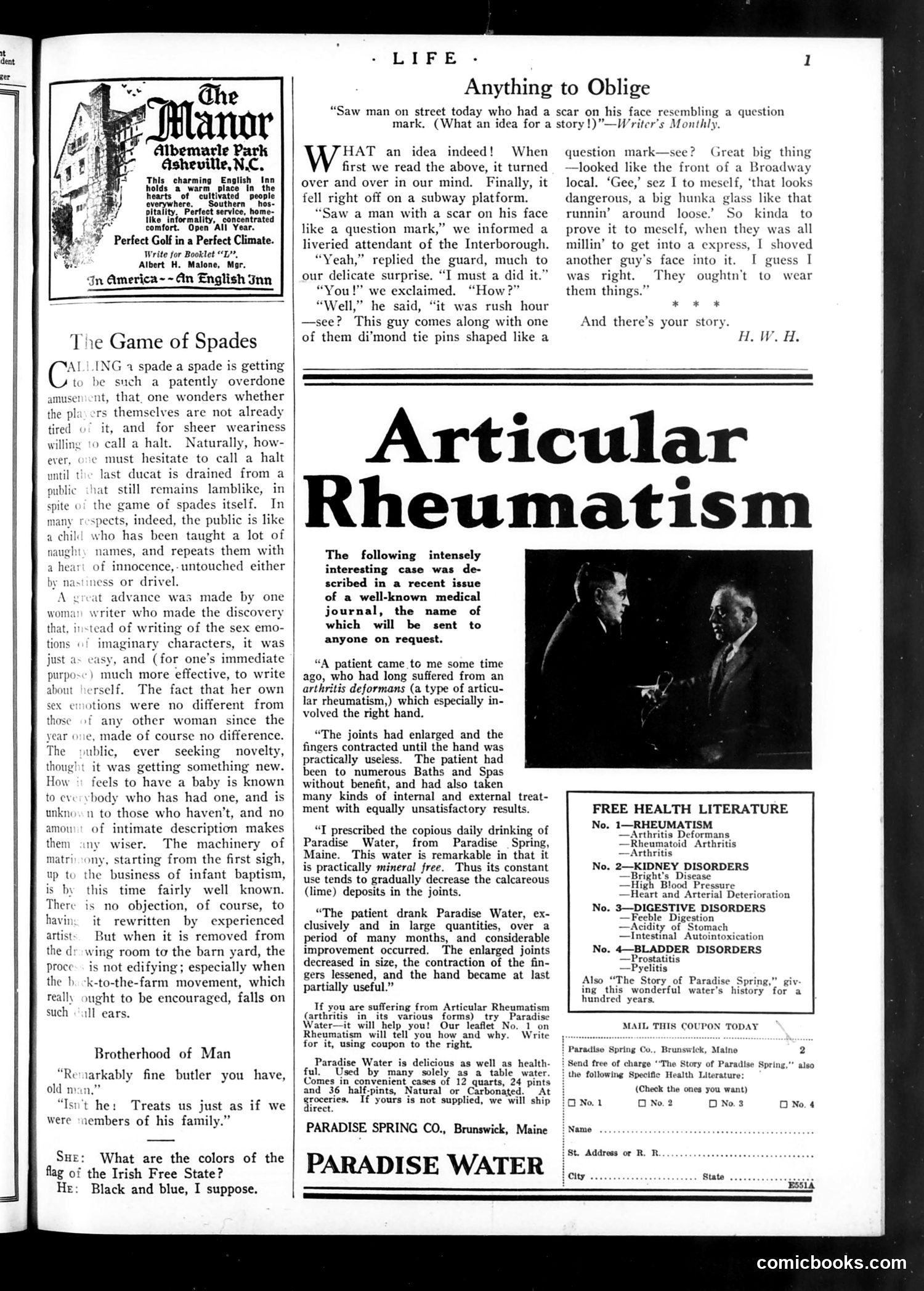
This page contains three distinct sections: 1. **"The Manor" advertisement** (upper left): A real estate ad for Albemarle Park in England, unrelated to satire. 2. **"The Game of Spades"** (left column): Social commentary on how calling a spade a spade has become taboo. The writer argues that people avoid direct language for politeness, but notes that imaginative character-writing is more effective than explicit emotional description. This critiques modern social convention around blunt speech. 3. **"Anything to Oblige"** (top right): A humorous anecdote about a man with a facial scar resembling a question mark, joking about its resemblance to Broadway theater. The satire targets absurd resemblance-spotting and theater aesthetics. The remainder features health literature advertising for Paradise Spring water, unrelated to satire.
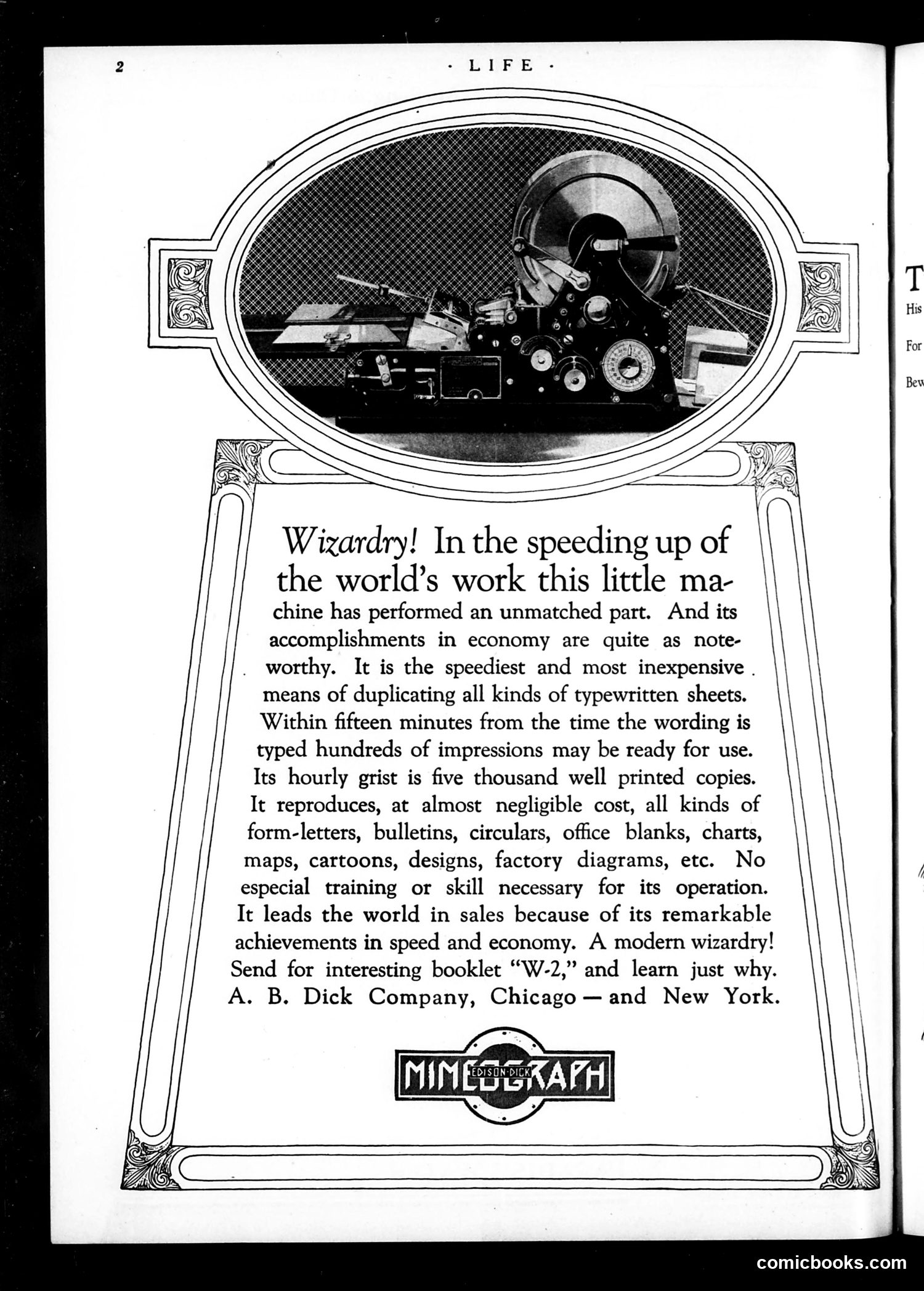
This page is primarily **advertising, not satire or political commentary**. It features a Mimeograph machine advertisement from the A. B. Dick Company, with offices in Chicago and New York. The ad uses hyperbolic language ("Wizardry!") to market the mimeograph as a revolutionary duplicating technology. The image shows the machine's internal mechanism. The copy emphasizes speed (producing "five thousand well printed copies" hourly) and economy, claiming it can reproduce documents at "almost negligible cost." The advertisement targets businesses by highlighting practical applications: form-letters, circulars, office blanks, and factory diagrams. It appeals to efficiency-minded readers by stressing that operation requires "no special training or skill." This reflects early 20th-century enthusiasm for office mechanization and mass reproduction technology.
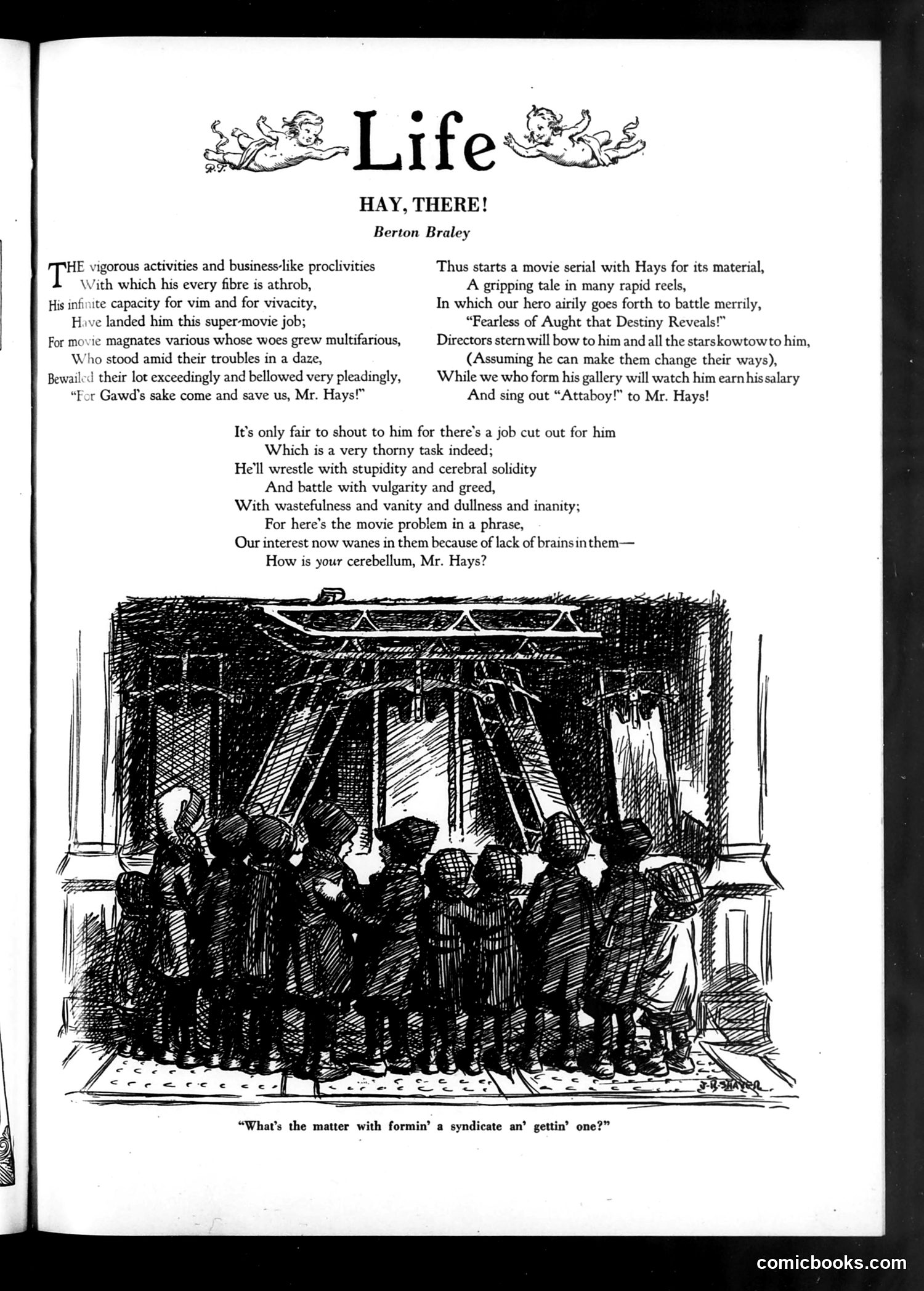
This satirical poem by Berton Braley celebrates Will H. Hays, likely Hollywood's leading figure (appears to be Will Hays, film industry executive). The text praises him for tackling the movie industry's problems—stupidity, vulgarity, greed, wastefulness, and vanity among filmmakers and actors. The cartoon depicts a movie set with numerous people gathered, seemingly representing the various problematic personalities Hays must manage. The caption's joke about "formin' a syndicate an' gettin' one" suggests industry workers organizing, possibly referencing labor disputes or union formation concerns of the era. The overall message: Hays faces an enormous task reforming Hollywood's moral standards and professional conduct. The satire celebrates his efforts while humorously acknowledging how difficult the challenge truly is.
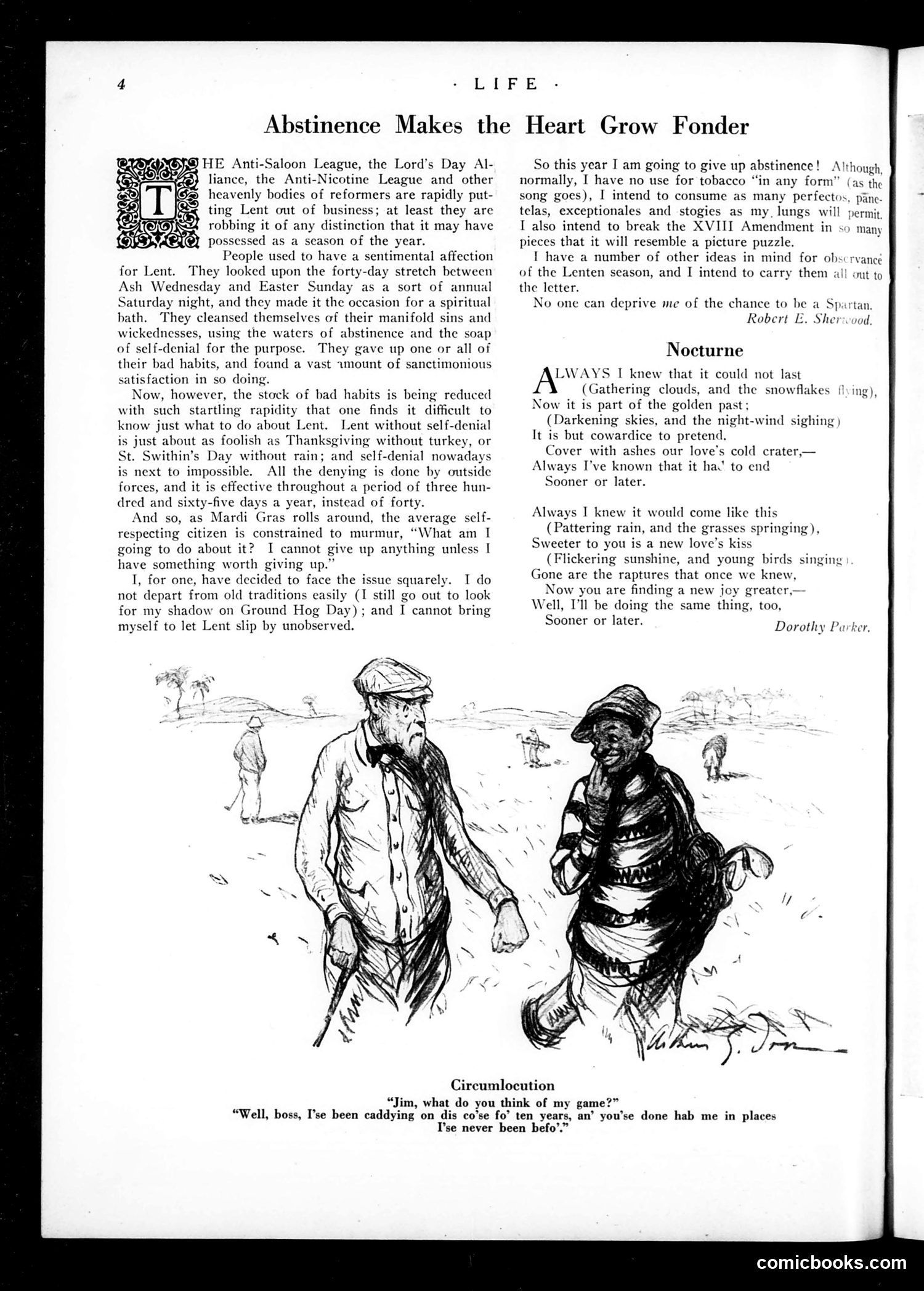
The main cartoon titled "Circumlocution" depicts two men on a golf course. One asks the other about his golf game; the second man responds with elaborate evasiveness, saying he's been caddying for ten years and has taken the first man "in places I've never been before"—a humorous non-answer to a straightforward question. The satire mocks circumlocution (speaking around a subject without directly addressing it), a common complaint about politicians and bureaucrats of the era who used verbose, evasive language instead of straight answers. The golf setting suggests leisure-class conversation, making the dodge more absurdly obvious and funny. The page's other content includes poems about Lenten abstinence and romantic topics, representing typical Life magazine miscellany.
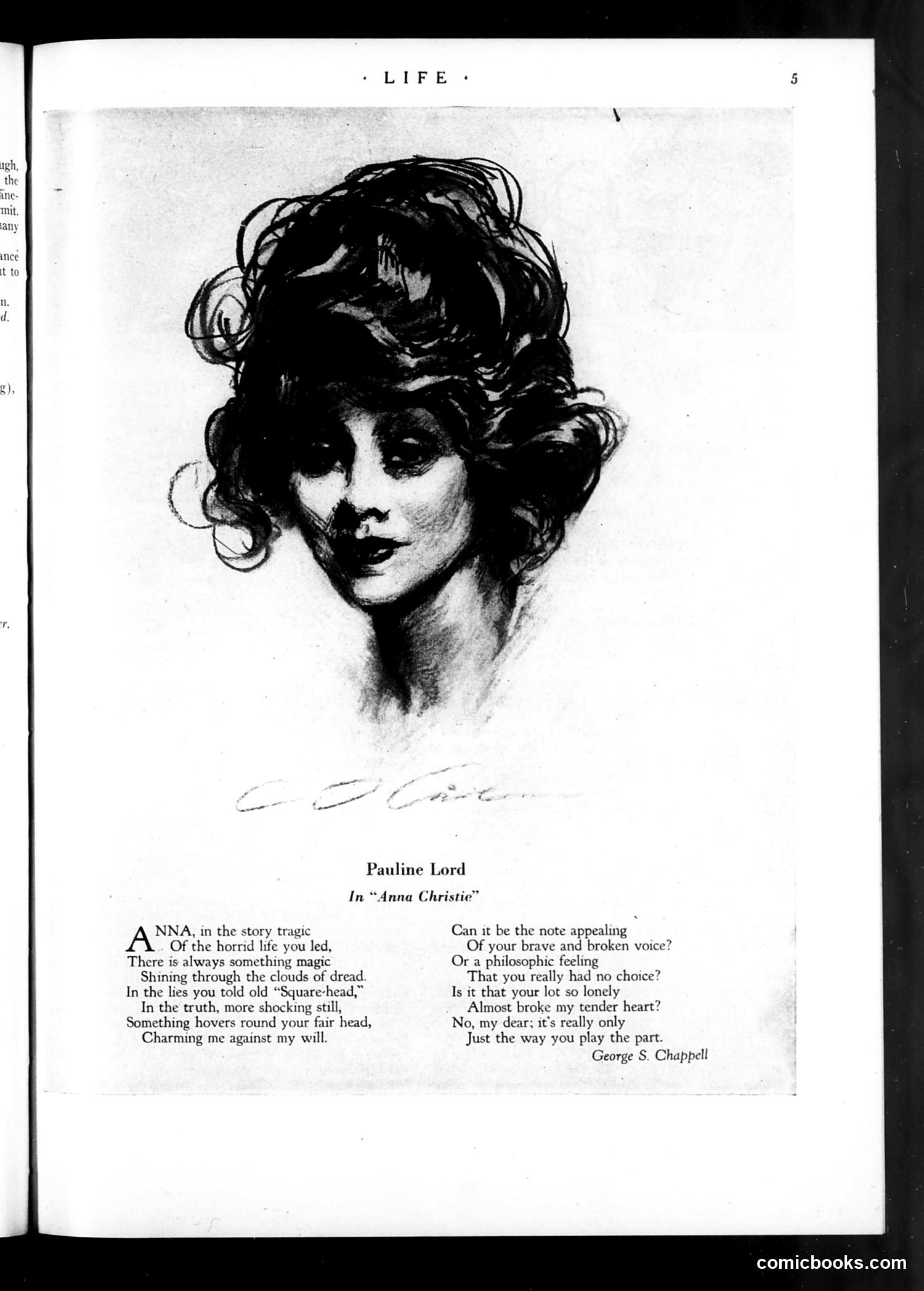
This page features a portrait sketch of actress **Pauline Lord** in her role from the play *"Anna Christie."* Below the portrait is a poem by **George S. Chappell** that appears to be a theatrical critique rather than political satire. The poem addresses the character Anna, praising Lord's performance while questioning the source of her compelling stage presence. Chappell suggests her power comes not from the play's tragic plot or philosophical depth, but simply from her skillful acting ("Just the way you play the part"). This is a **theater review in visual form**—common in *Life* magazine's coverage of Broadway productions. It's not political satire, but rather appreciative commentary on a celebrated actress's dramatic talent, likely appealing to readers interested in theater and performance arts of the era.
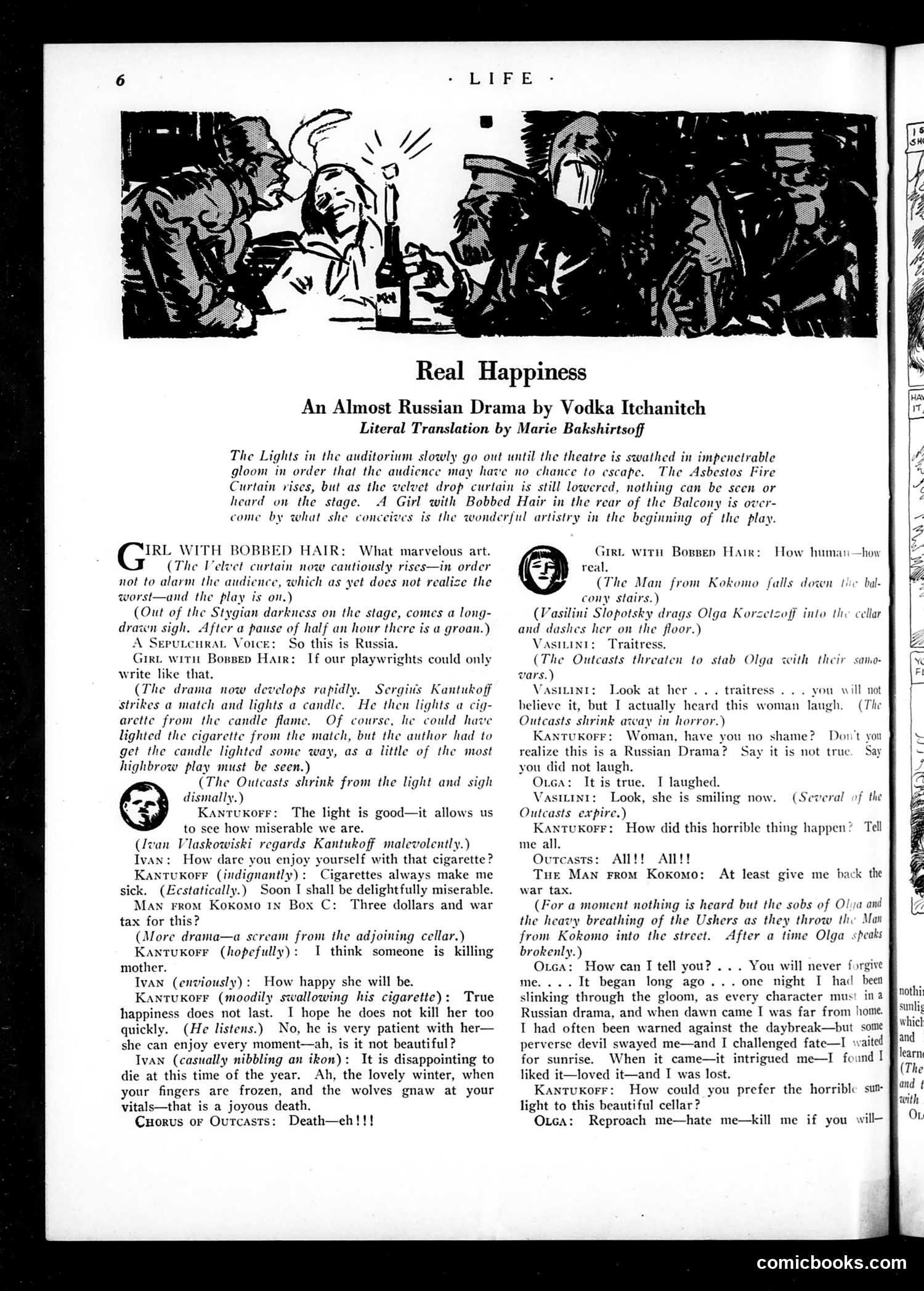
This is a satirical dramatic sketch mocking Russian literature and culture. The cartoon depicts exaggerated Russian characters in what appears to be a melodramatic scene—consistent with 19th-century Russian literary stereotypes popular in American satire. The sketch satirizes both Russian dramatic conventions (excessive emotion, fatalism, dark themes) and Russian drinking culture through the author's absurd pseudonym "Vodka Itchanitch." The dialogue includes stereotypical Russian themes: poverty, despair, and resigned suffering presented as profound philosophy. The humor targets American audiences' perception of Russians as perpetually gloomy, philosophically overwrought, and prone to theatrical displays of emotion—a common comedic trope in early 20th-century American magazines. The "almost Russian Drama" framing itself is the joke.
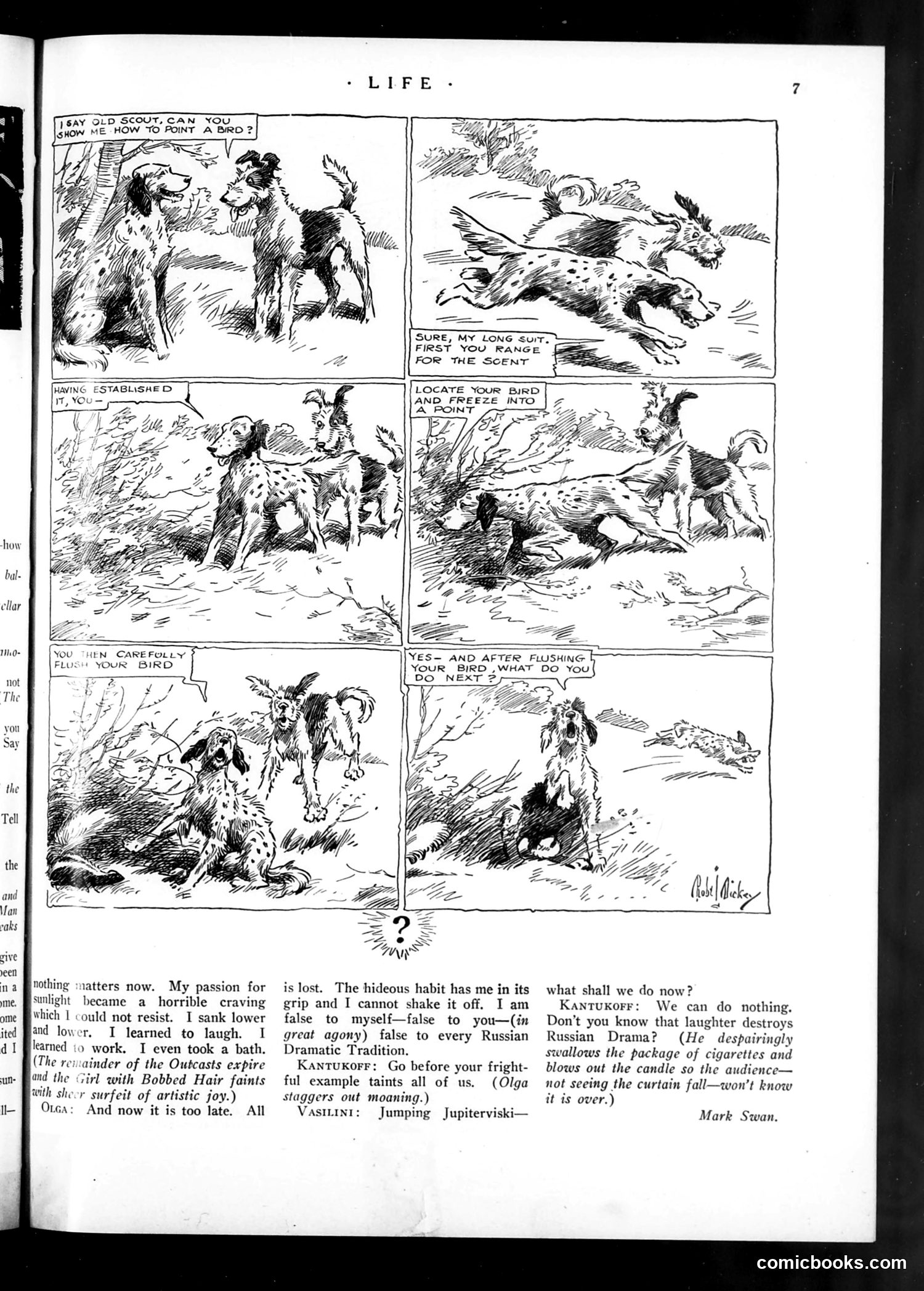
This page contains a comic strip about hunting dogs learning to point at birds, followed by a theatrical dialogue excerpt. The **comic strip** (six panels) humorously depicts a scout teaching hunting dogs the technique of locating game—establishing a point, freezing into position, and flushing out birds. The dialogue is instructional but played for comedic effect through the dogs' anthropomorphized reactions. Below the strip is an **excerpt from a Russian dramatic work**, featuring characters Olga, Kantukov, and Vasilini discussing artistic integrity and deception. The passage critiques false pride and theatrical artifice, with Mark Swan (the credited author/translator) noting the irony of a dramatic tradition that conceals its own mechanics from audiences—a meta-commentary on theatrical conventions. The juxtaposition suggests Life was mixing light humor with cultural/literary commentary.
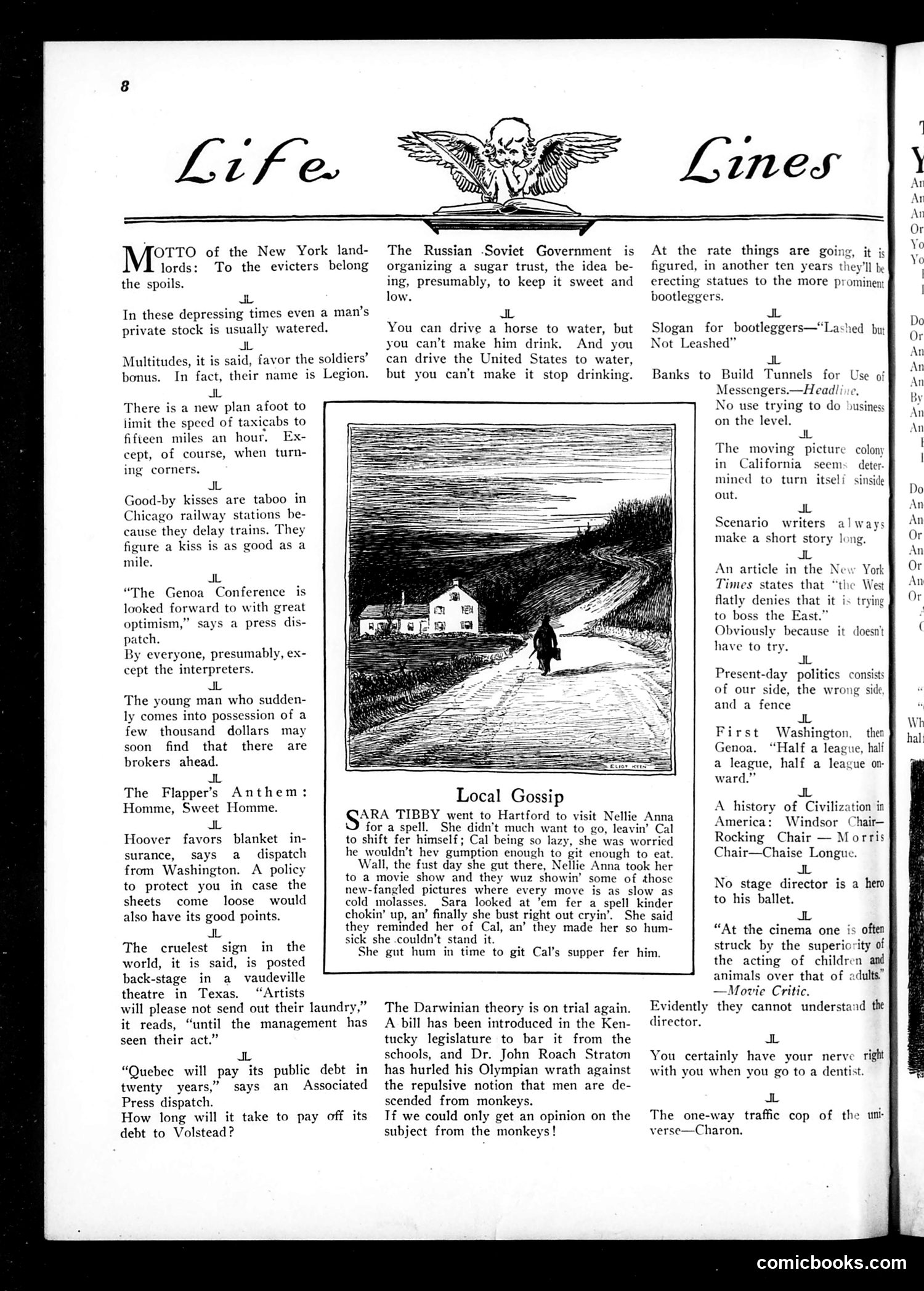
This page contains **satirical brief commentary and anecdotes** rather than political cartoons. The central illustration shows a rural cottage scene—likely meant to evoke pastoral simplicity contrasting with modern complications. The "Local Gossip" section features humorous anecdotes about everyday life, including a story about Sara Tibby visiting Hartford. The scattered one-liners mock contemporary issues: taxicab speed limits, the Genoa Conference's optimistic prospects, and the Flapper's cultural phenomenon ("Homme, Sweet Homme"). There's also commentary on the **Darwinian theory debate**—apparently a contemporary controversy in schools—and a quip about dentistry anxiety. The overall tone is **light, gossipy social satire** aimed at urban American readers, poking fun at politics, technology, and cultural trends of the early 1920s era.
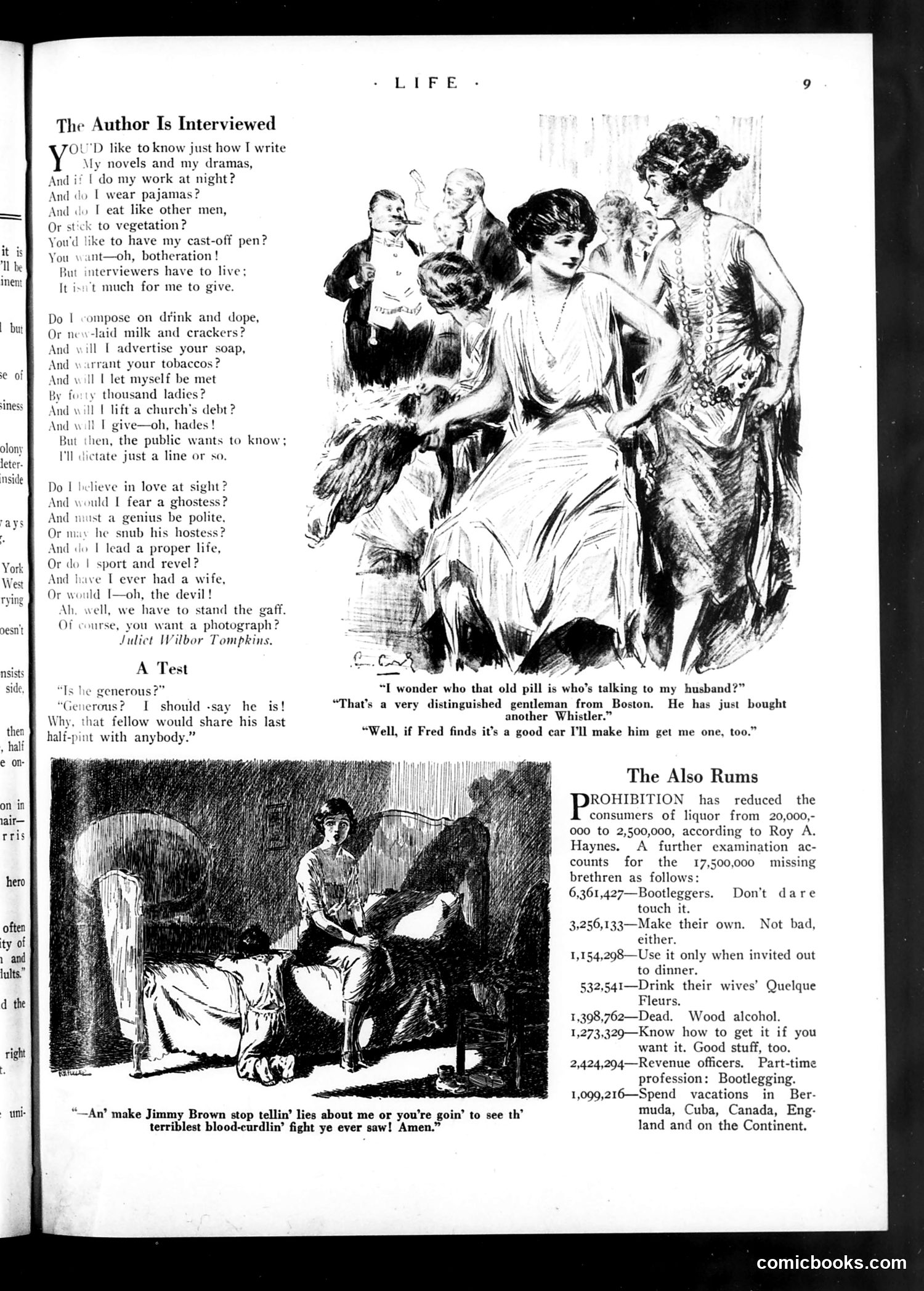
**Top Section - "The Author Is Interviewed":** A humorous poem mocking intrusive interview questions posed to writers. The accompanying illustration shows a woman author being pestered by multiple interviewers asking personal questions (about her writing habits, diet, love life, etc.). The satire targets both nosy journalists and society's obsession with celebrities' private lives. **Middle Section - "A Test":** A brief joke about generosity, playing on definitions. **Bottom Section - "The Also Rums":** Political satire on Prohibition. The text lists statistics showing alcohol consumption supposedly reduced from 20 million to 2.5 million consumers, then humorously catalogs where the "missing" 17.5 million people actually went—bootleggers, home distillers, etc. The accompanying illustration shows people drinking secretly. It mocks Prohibition's failure to eliminate drinking.
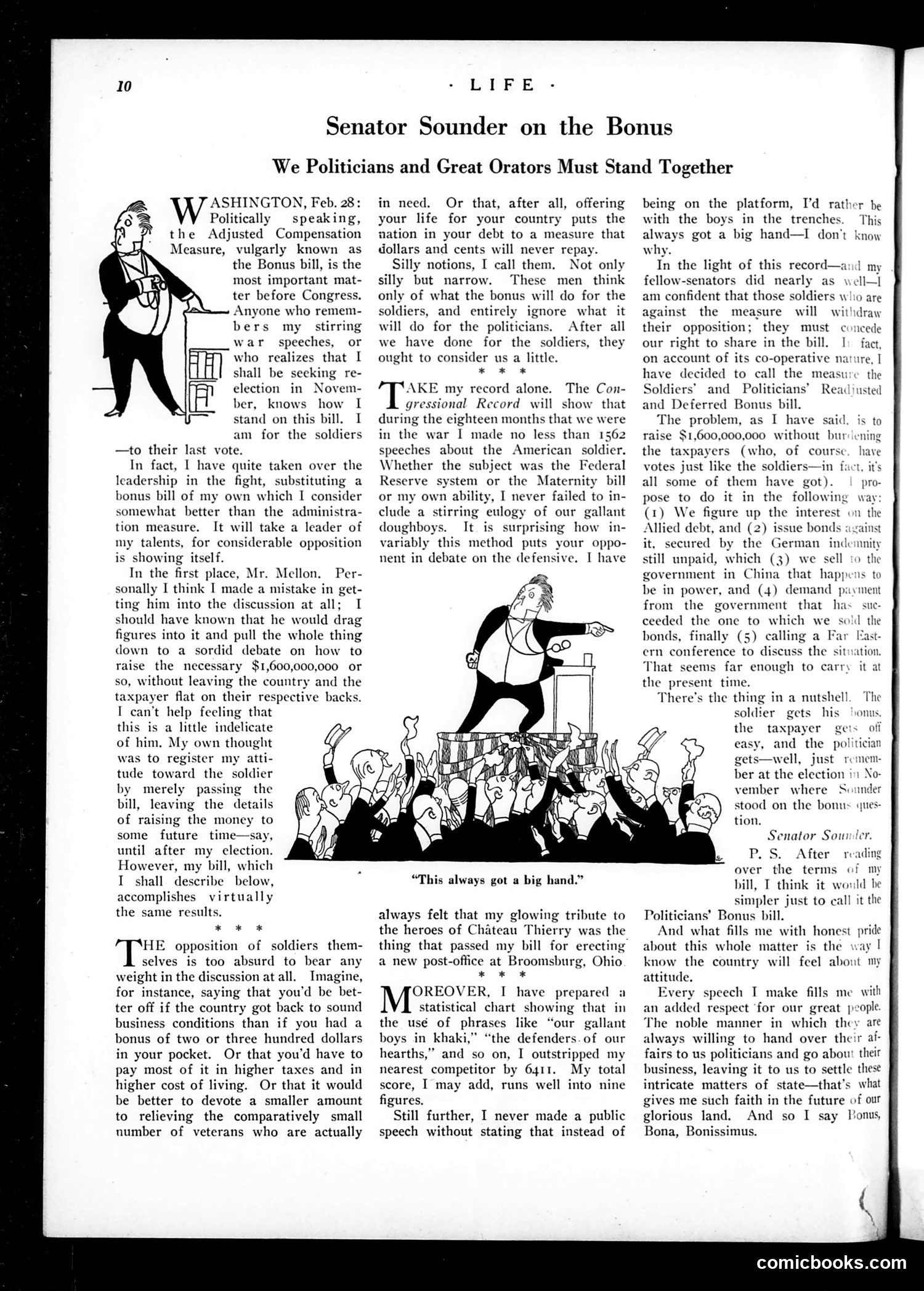
This page features Senator Sounder's argument **for** the Adjusted Compensation Measure (the "Bonus Bill"), which would provide financial compensation to WWI veterans. The main cartoon shows Sounder standing on a platform, gesturing dramatically while a crowd of soldiers below reaches upward toward him—a visual metaphor for political support and the soldiers' stake in the outcome. The satire targets **two audiences**: politicians who oppose the bonus (whom Sounder criticizes for narrowness) and soldiers themselves, whom he characterizes as selfishly focused only on their own compensation rather than the country's broader financial health. The headline "This always got a big hand" captures the satirical point: appealing to veterans' interests is reliable political theater, regardless of fiscal responsibility.
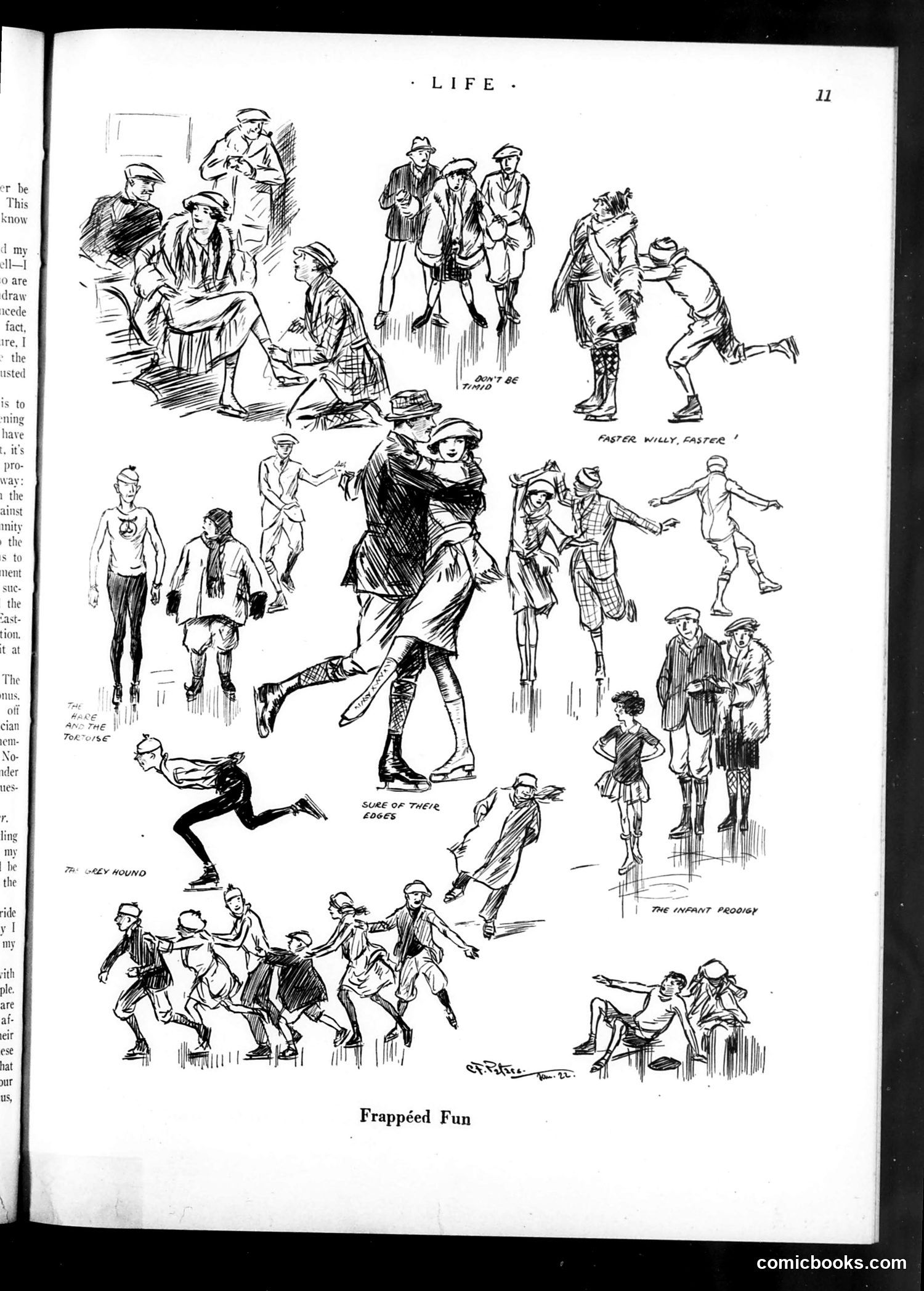
This page presents a series of sketches depicting various outdoor recreational activities and games, titled "Frappéed Fun" (likely a pun on "frapped," meaning bound or lashed). The illustrations show: - Children and adults engaged in street games and activities - Scenes labeled "Faster, Willy, Faster!" and "Slice of Their Losses" - A figure performing a skating move ("The Giddy Round") - Group games including what appears to be children playing together - An "Infant Prodigy" scene with adults and children The satire appears to mock contemporary leisure activities and childhood play, presenting them with exaggerated characterizations typical of early 20th-century Life magazine's humorous social commentary. The exact historical context and specific social critique, however, remains unclear without additional publication date information.
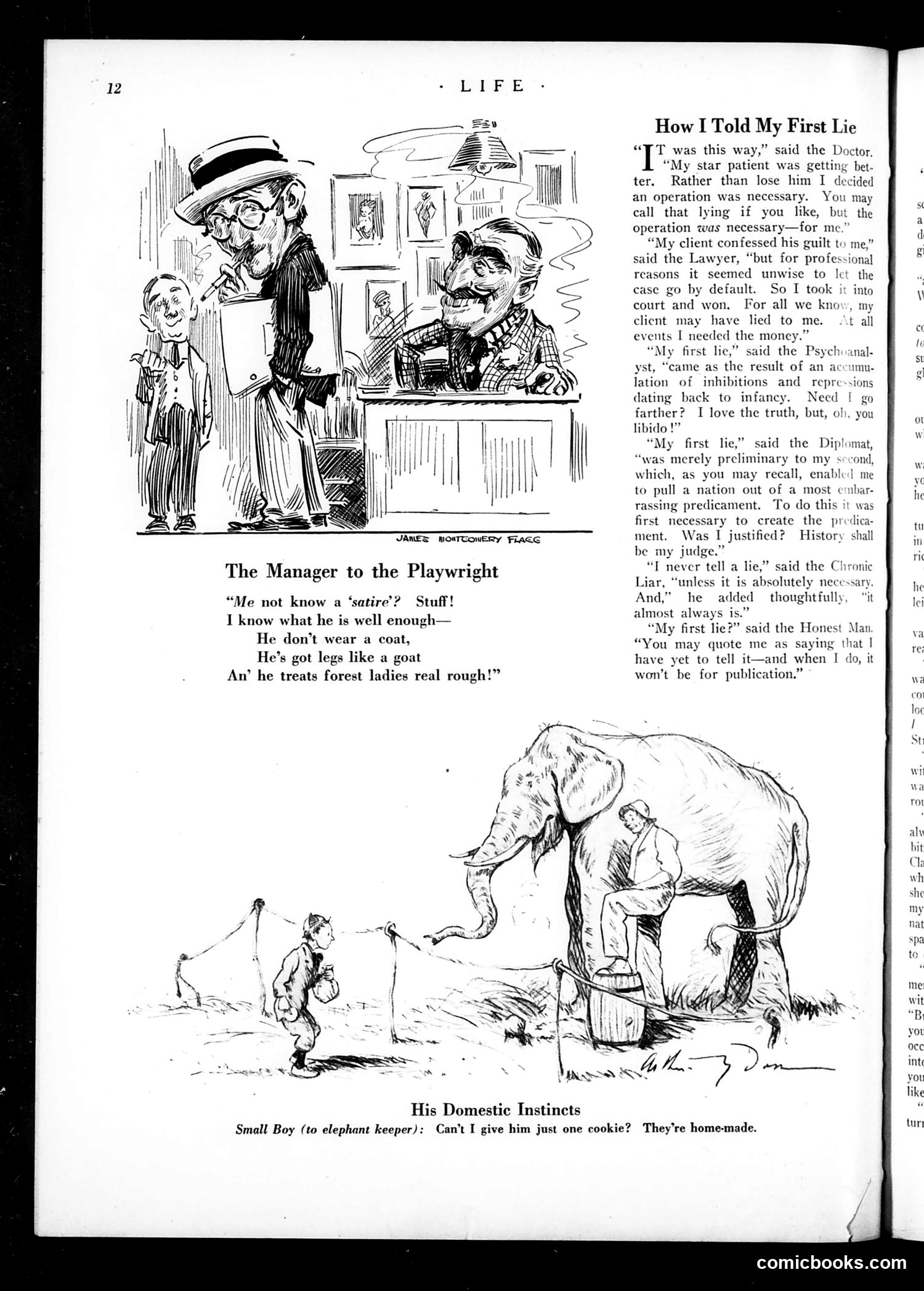
This page contains three separate satirical pieces: **"The Manager to the Playwright"** (top): A caricatured theater manager dismisses the concept of "satire," claiming he judges performers by crude physical characteristics rather than artistic merit. The satire targets philistine entertainment producers who lack sophistication. **"How I Told My First Lie"** (right column): Various professionals—a Doctor, Lawyer, Psychoanalyst, Diplomat, Chronic Liar, and Honest Man—each justify their first dishonesty through self-serving rationalizations. This satirizes how different professions rationalize deception as necessary or justified. **"His Domestic Instincts"** (bottom): A small boy asks an elephant keeper for a cookie, calling them "home-made." The humor lies in the boy's naive domesticity juxtaposed against the wild animal—a gentle, whimsical piece rather than political satire.
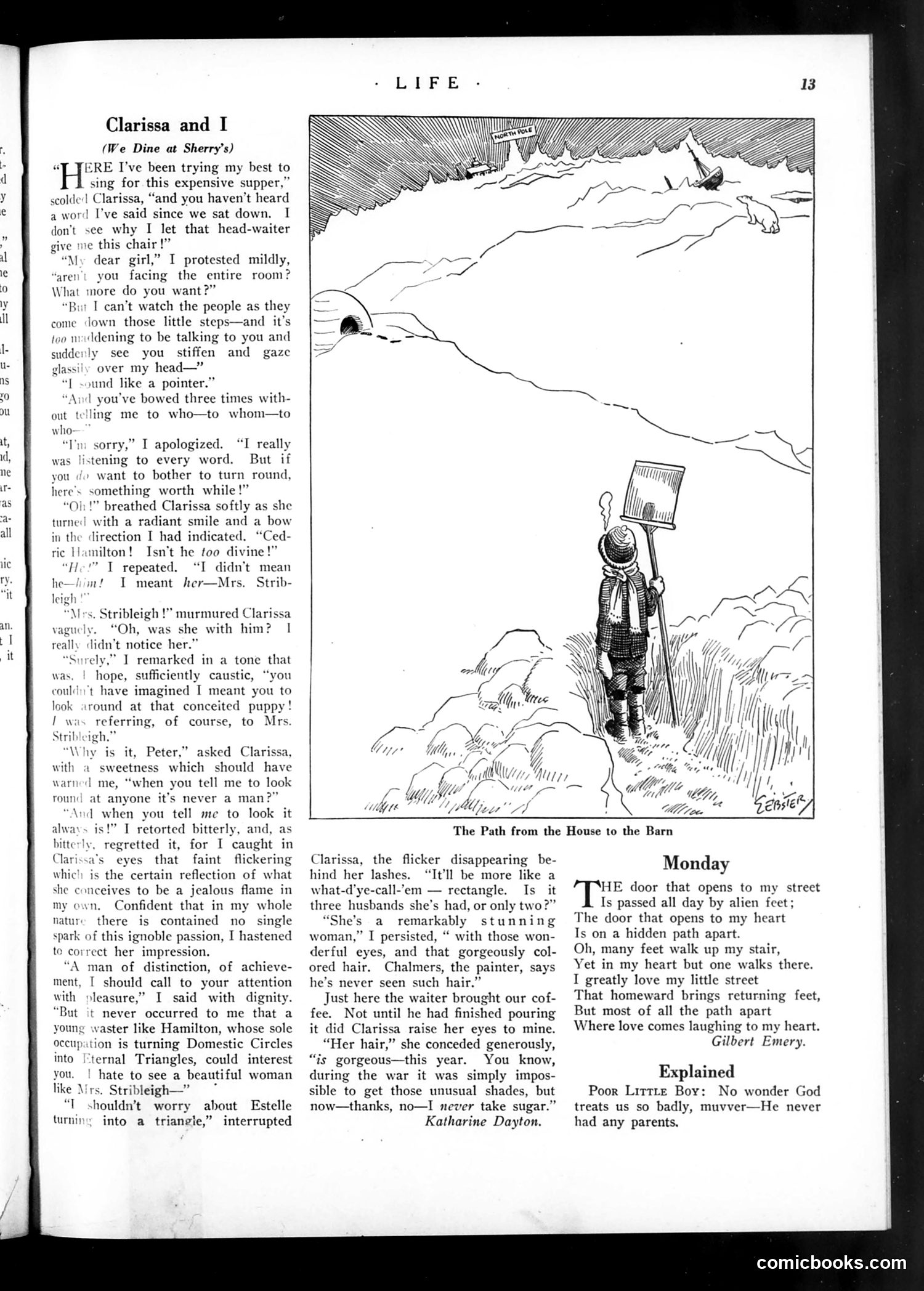
This page contains a short story titled "Clarissa and I (We Dine at Sherry's)" and a separate poem called "Monday." The main illustration depicts "The Path from the House to the Barn"—a figure carrying a lantern walking along a rural path in snow. The dialogue between the narrator and Clarissa is a romantic comedy about dinner etiquette and social graces. The humor centers on the narrator's awkwardness: he's been criticized for his posture and manners, and Clarissa has caught him staring at her intensely multiple times. His attempts at apology reveal his obliviousness to social cues. The page is primarily literary content rather than political satire. The "Explained" section at bottom contains a brief joke about poor orphans and parental indifference.
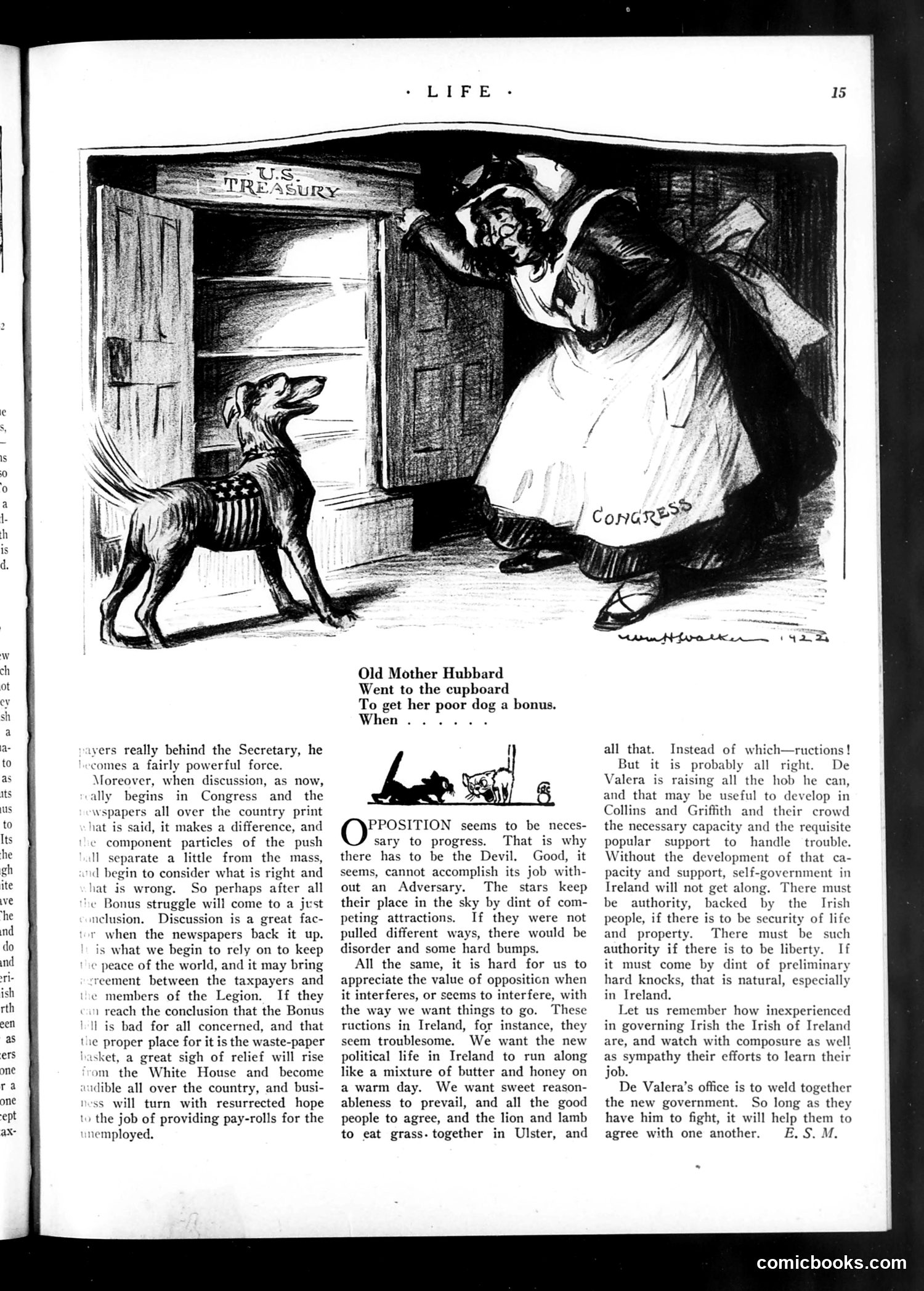
This cartoon satirizes the U.S. government's debate over a soldiers' bonus (likely the post-WWI veteran's compensation). The image shows "Old Mother Hubbard" (representing the U.S. Treasury or government) reaching into an empty cupboard labeled "U.S. TREASURY" while a dog in military uniform (representing veterans) watches hopefully. The figure labeled "CONGRESS" stands nearby. The accompanying nursery rhyme parody mocks the government's inability to provide promised bonuses to impoverished veterans. The satirical point: the cupboard is bare—there's no money available, yet soldiers expect compensation. The text discusses how Congressional debate and newspaper coverage might eventually reach the "right" conclusion: that the bonus should be abandoned. The passage also tangentially addresses Irish political conflicts under De Valera, suggesting opposition and struggle can ultimately strengthen governance. The cartoon's humor relies on the ironic gap between government promises and fiscal reality.
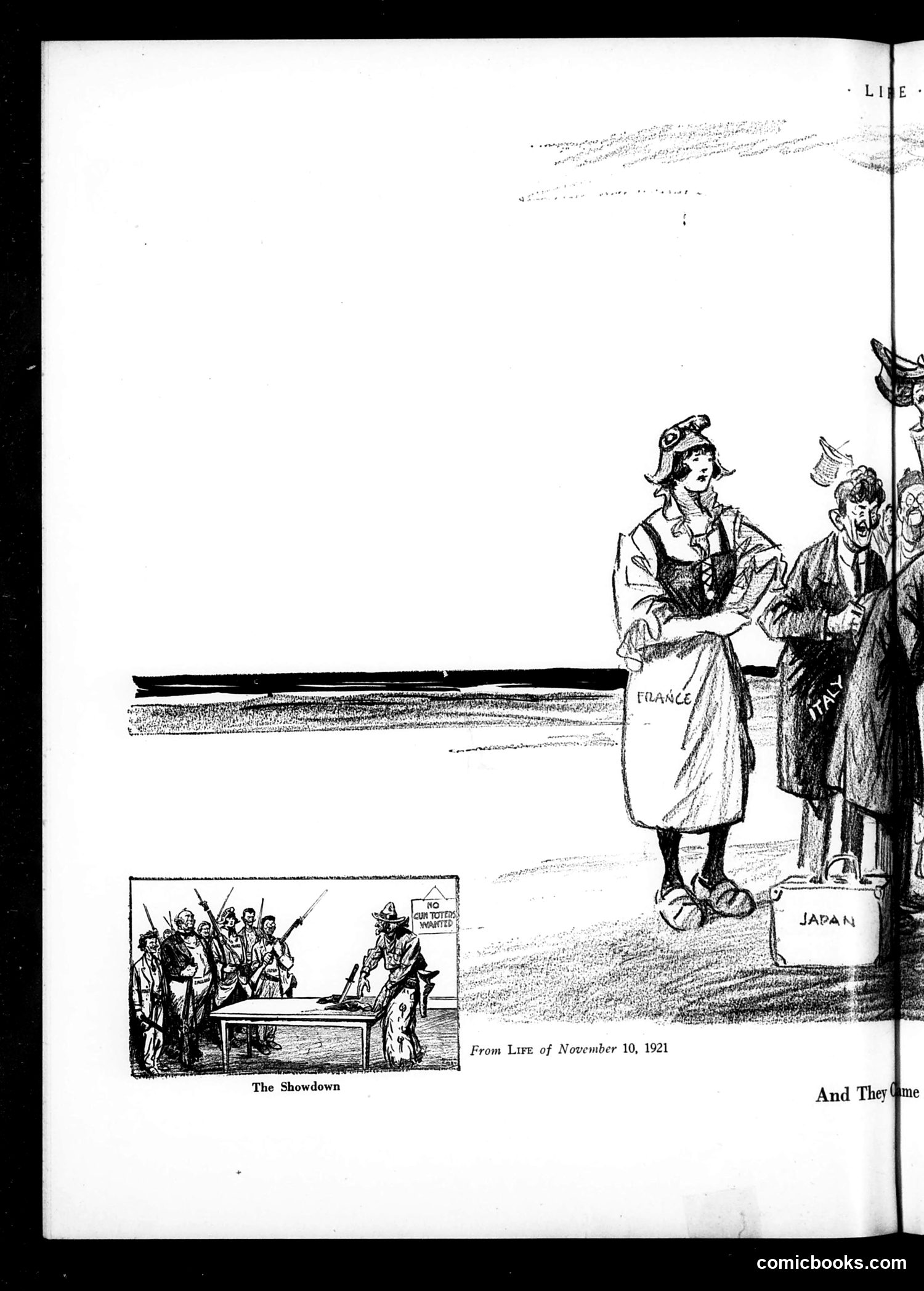
This cartoon depicts post-WWI tensions, likely addressing the Washington Naval Conference (November 1921). The main panel shows personified nations: France and Japan appear as figures on a platform labeled with their names, while military figures (appearing to represent various powers) observe "the showdown" at a negotiating table below. The satire suggests nations are preparing for confrontation over naval armament and Pacific dominance. France and Japan's prominent positioning indicates they were key players in these disputes. The theatrical staging—with onlookers and formal arrangement—mocks the dramatic posturing of international diplomacy. The cartoon critiques how nations engaged in tense negotiations over military power and territorial interests, treating serious geopolitical conflict as performative spectacle for public consumption.
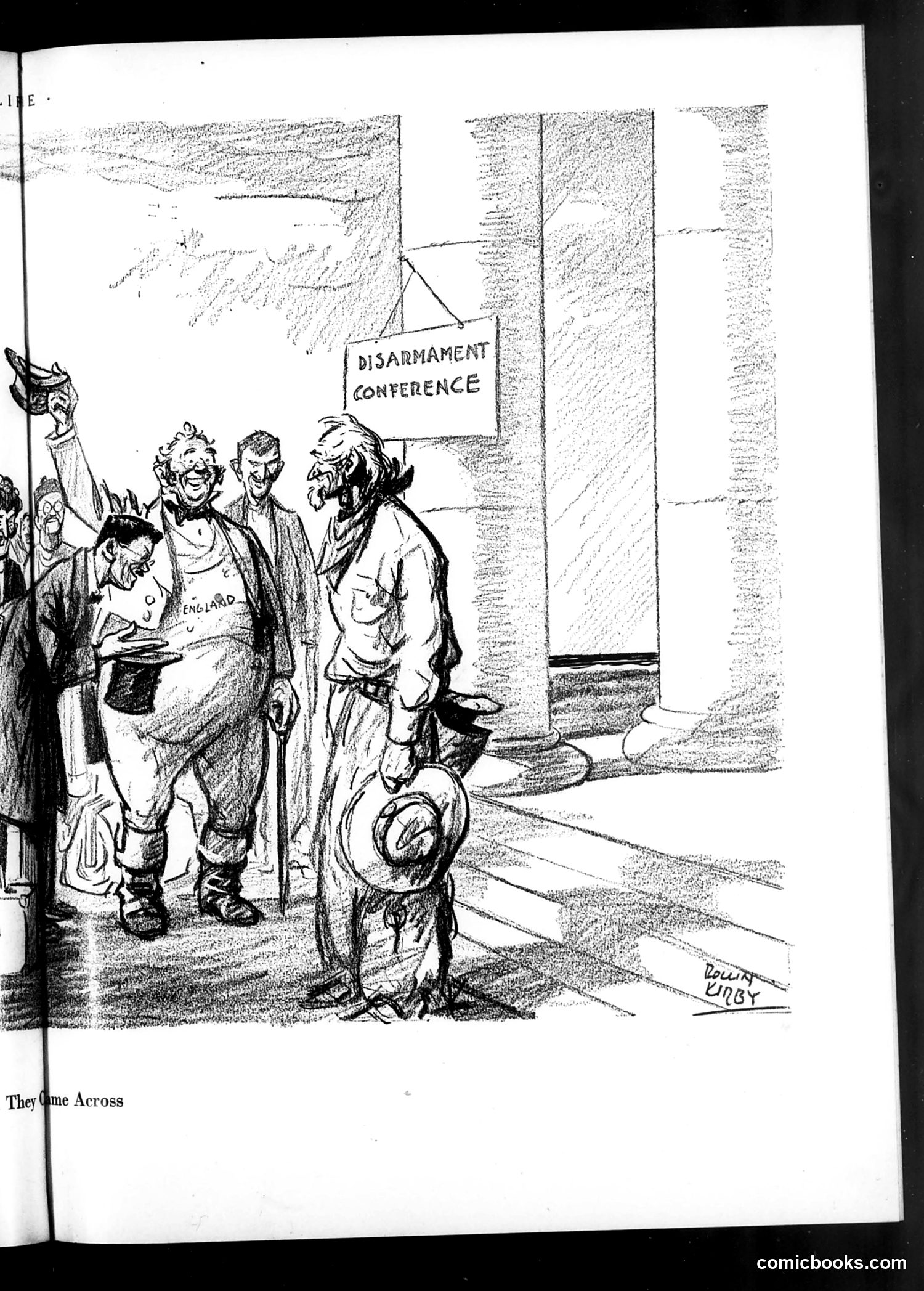
This political cartoon depicts figures approaching a "Disarmament Conference" building. The visible caricature labeled "ENGLAND" suggests British representation at what appears to be an interwar disarmament negotiation—likely referencing 1920s-1930s League of Nations efforts to reduce military armaments after World War I. The cartoon's satire likely critiques the hypocrisy or ineffectiveness of such conferences: the figures appear menacing or militaristic despite entering a disarmament venue, suggesting nations weren't genuinely committed to reducing weapons. The exaggerated facial features and body language convey skepticism about participants' true intentions. The artist's signature appears to read "Dorman Kirby" or similar. Without the full page context or specific date, the exact conference referenced remains unclear.
This page contains theater reviews from Life magazine's drama section, circa early 1920s. The critic discusses three Broadway plays: **"The Cat and the Canary"** — A horror thriller that genuinely frightens audiences (the opening anecdote describes a woman clutching her escort's arm in terror during the performance). **"The Bat"** — An earlier thriller the critic compares unfavorably, criticizing actress May Vokes's comedic relief as undermining the horror atmosphere. **"The Nest"** — A French play translated by actress Grace George, praised for its sophisticated, naturalistic dialogue and emotional subtlety. The critic commends the ensemble cast, particularly Lucile Watson, for intelligent performances that avoid wooden theatrical affectation. The small decorative illustrations (turtles, figure sleeping) are typical period ornaments. The reviewer (Robert C. Benchley, identifiable from the signature) uses humor and casual language to discuss theatrical merit and audience psychology.
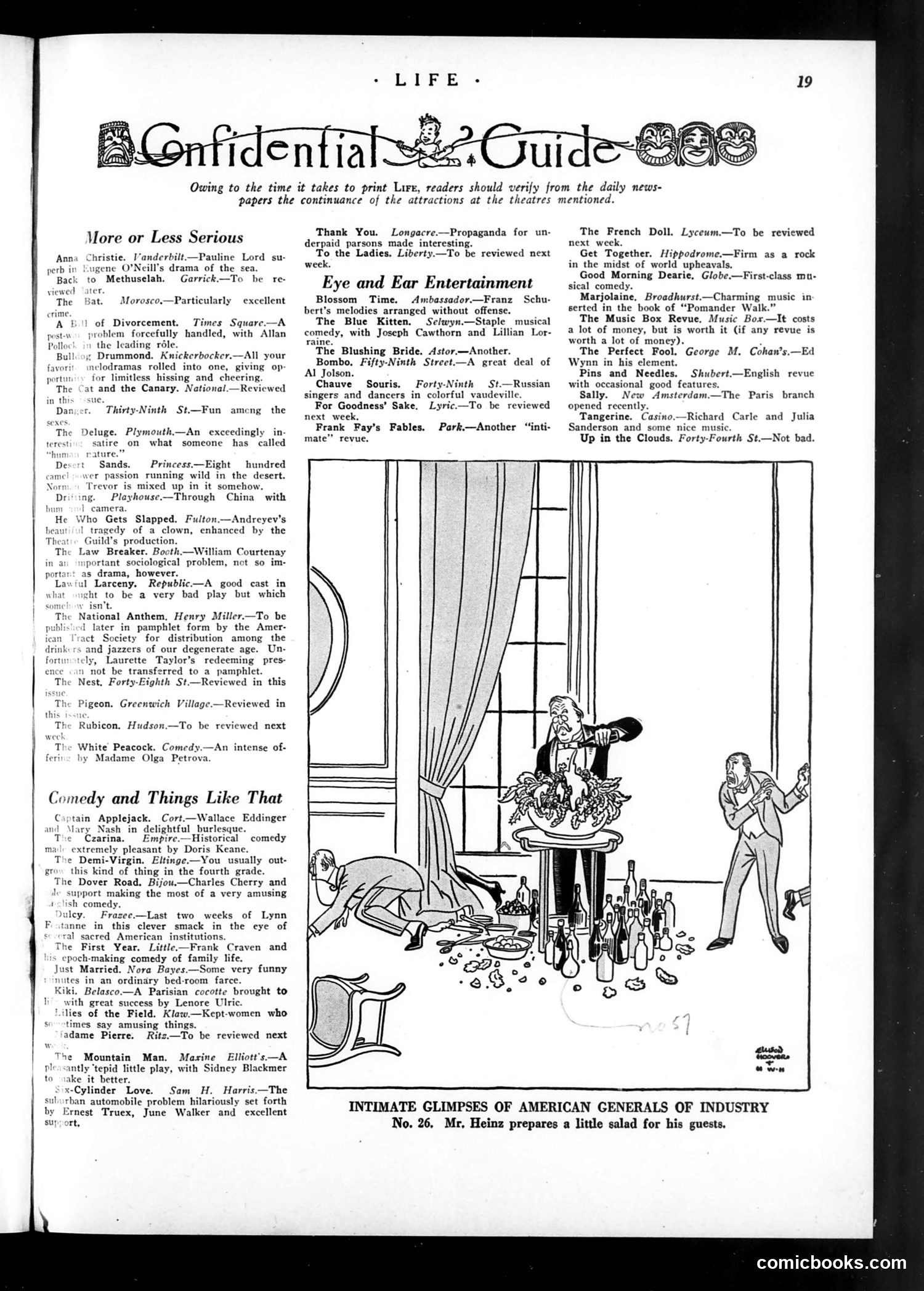
This page is primarily a **theatre review guide** for Broadway productions, not a political cartoon. It lists current shows with brief critical assessments, organized by category: "More or Less Serious," "Comedy and Things Like That," and "Eye and Ear Entertainment." The single illustration depicts a domestic scene labeled "INTIMATE GLIMPSES OF AMERICAN GENERALS OF INDUSTRY No. 26: Mr. Heins prepares a little salad for his guests." This appears to be gentle satirical commentary on wealthy industrialists, humorously showing one at a trivial domestic task. The cartoon pokes fun at the contrast between these powerful business figures and everyday housework. The page serves primarily as entertainment guidance rather than political satire, reflecting Life's role as a cultural/theatrical publication of the 1920s era.
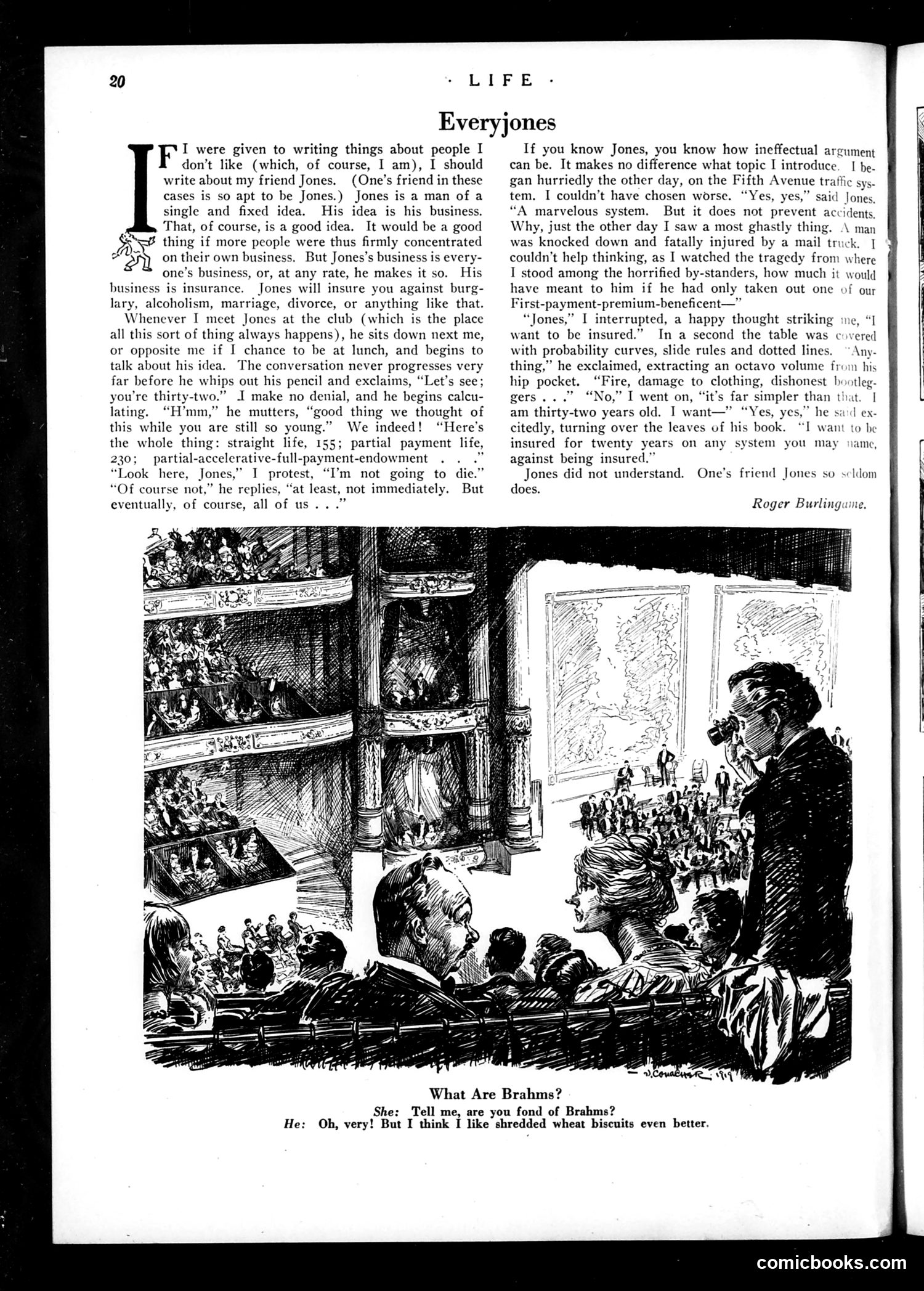
This essay-cartoon mocks the archetypal insurance salesman obsessed with his single product. "Jones" represents a type: a man who reduces every conversation—whether about traffic accidents, business, or casual club chat—to insurance opportunities. The satire targets his relentless sales pitch, his ability to extract probability tables and complex formulas at any moment, and his complete inability to recognize when someone is joking or uninterested. The narrator's final plea—to be "insured...against being insured"—is the punchline: Jones cannot even comprehend someone wanting protection *from* him. The bottom cartoon is a separate, simpler gag: a woman asks if her companion enjoys "Brahms" (the composer); he misunderstands it as "bran" (a breakfast cereal), preferring shredded wheat biscuits. It's a pun-based joke about mishearing.
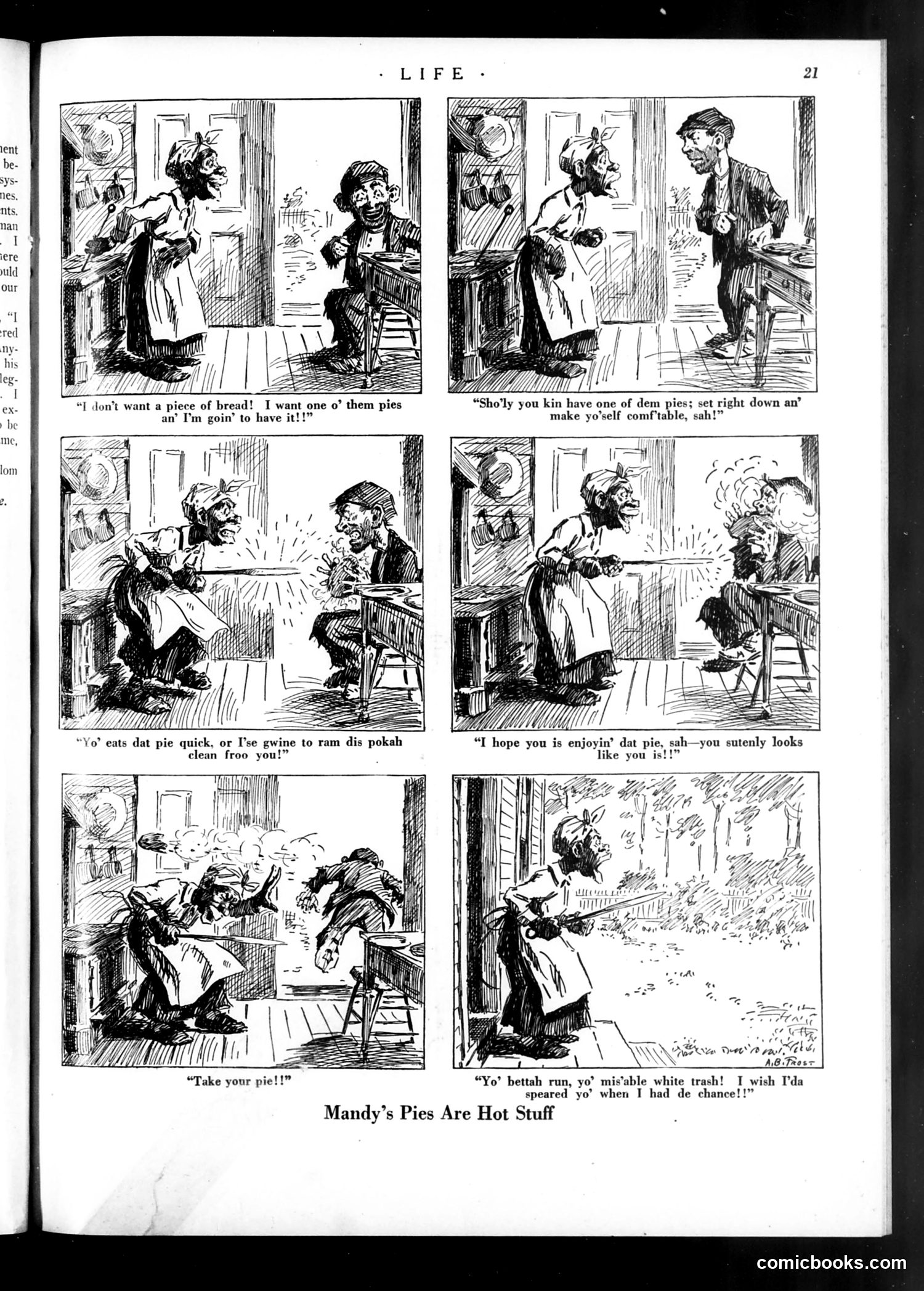
This comic strip uses racist caricature and dialect to depict a violent confrontation over pie. The character "Mandy" (drawn with exaggerated features) initially welcomes a white man, offering him pie with affected Southern Black dialect ("Sho'ly you kin have one of dem pies"). The narrative escalates through threats and violence—the man threatens to "ram dis pokah clean froo you," culminating in physical assault and pursuit. The "joke" relies on period stereotypes: a Black woman character, depicted as aggressive and dangerous, serving as a vehicle for slapstick violence. The thick dialect and violent outcome reflect early-20th-century racist humor conventions in American satirical magazines, where Black characters were routinely portrayed as targets for ridicule and violence. Modern readers would recognize this as expressing deeply offensive stereotypes normalized in that era.
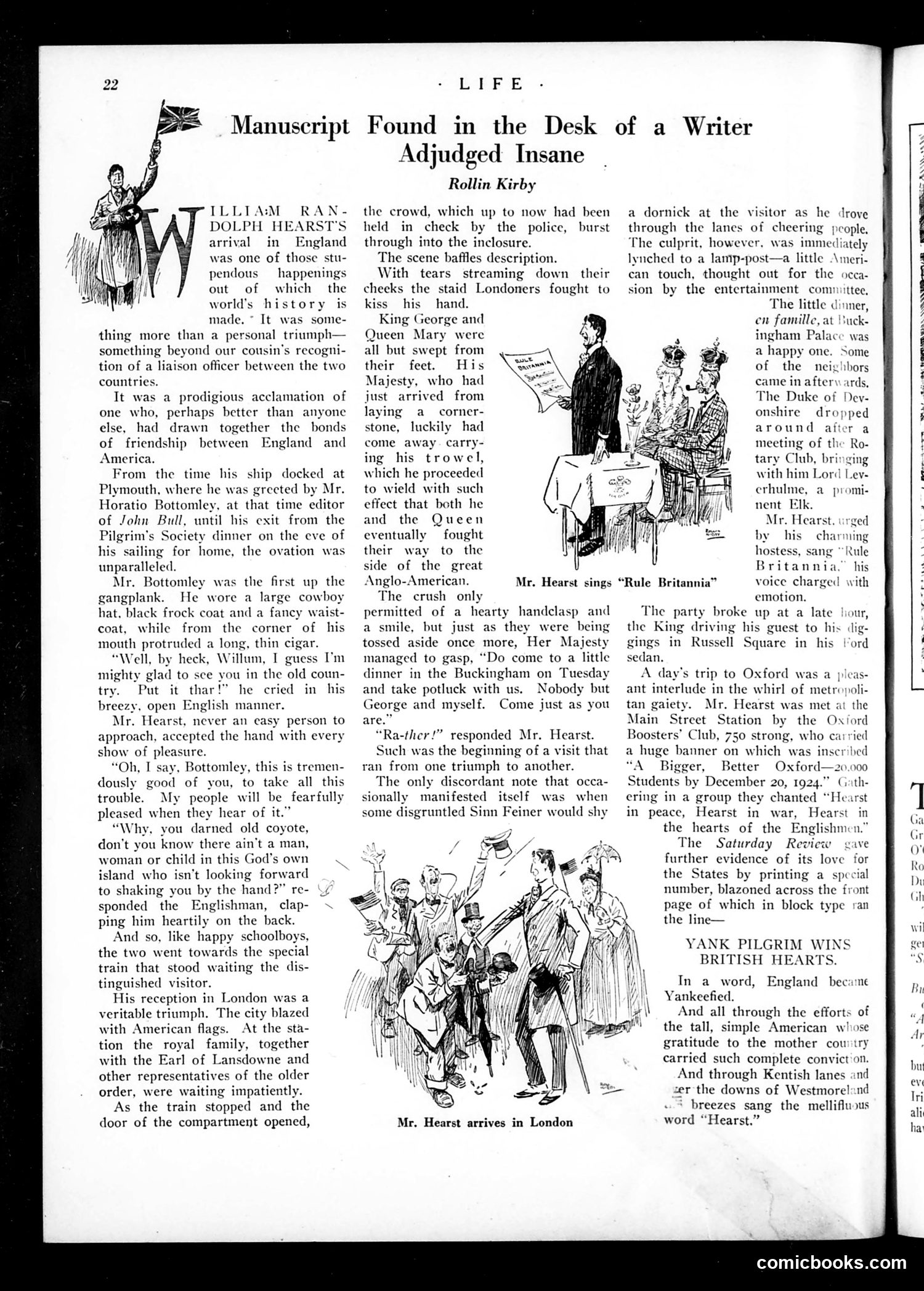
By Rollin Kirby, this satirical piece mocks William Randolph Hearst's 1924 visit to England as a triumphant diplomat. The cartoon depicts an absurdly exaggerated reception: King George and Queen Mary nearly trampled by crowds, Horatio Bottomley (editor of *John Bull*) greeting him in cowboy attire, and even Irish Sinn Féiners' protest stones met with American-style lynching. The satire targets Hearst's outsized ego and America's brash self-importance. The framing device—presented as a "manuscript" from an insane writer—suggests the whole narrative is delusional fantasy. Reality intrudes only through "disgruntled Sinn Feiners" throwing rocks, hinting at genuine political tensions Hearst's visit papered over. Kirby mocks both Hearst's pretensions to international significance and American cultural chauvinism masquerading as friendship.
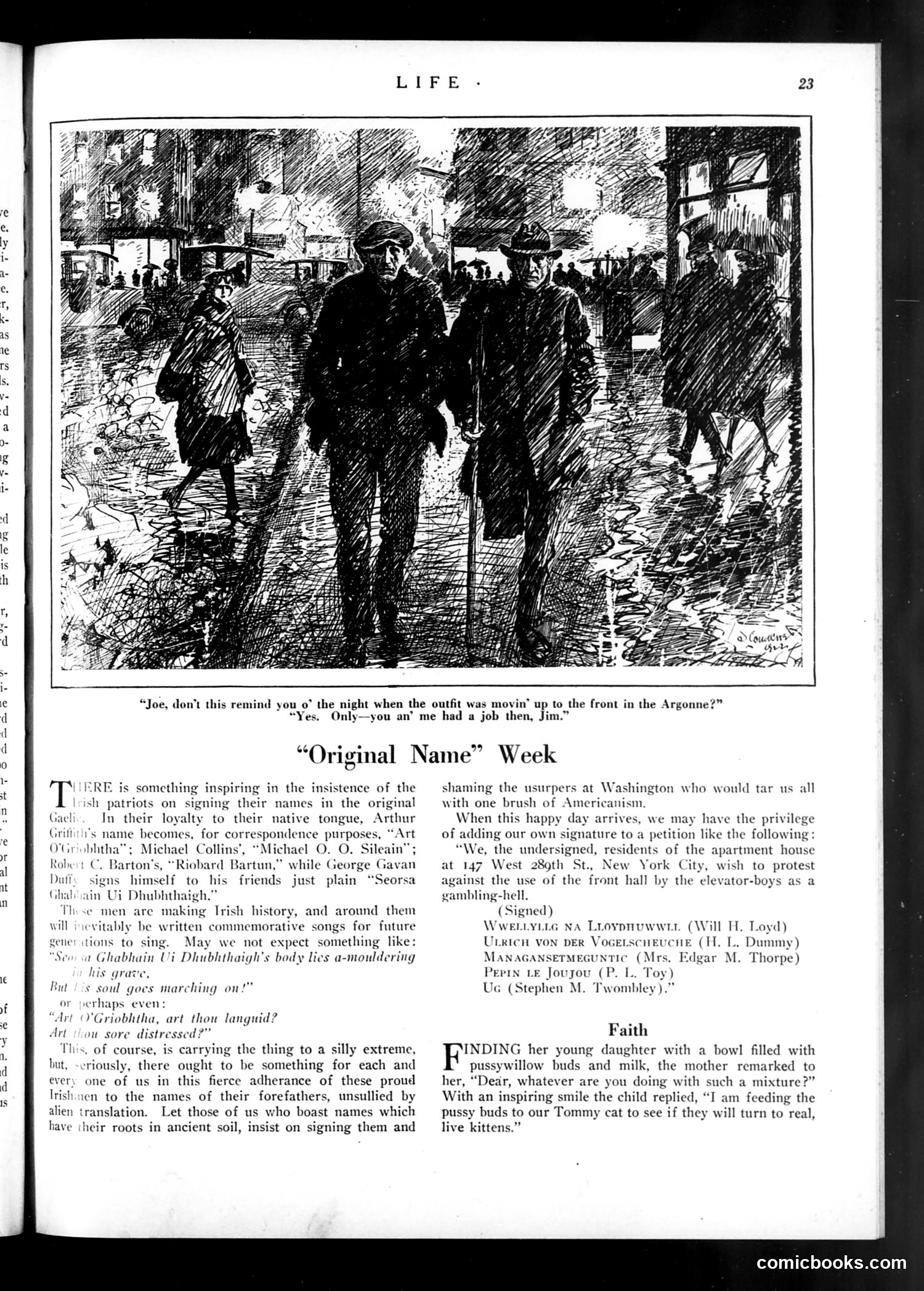
This page satirizes Irish nationalists' insistence on using Gaelic versions of their names—a political statement about Irish identity and independence. The cartoon depicts WWI soldiers, with dialogue referencing the Argonne Offensive, where one veteran notes that he and his companion actually "had a job then"—implying they had purpose, unlike now. The article mocks this naming practice as carried to absurd extremes, while paradoxically praising it as a form of resistance against "Americanism" and Washington's homogenizing influence. The satire is two-edged: Life simultaneously celebrates Irish pride in ancestral heritage while ridiculing the impracticality of adopting difficult Gaelic names. The petition example (residents protesting elevator-boys' gambling) demonstrates how ridiculous such formal Gaelic signatures become in mundane American contexts—the joke being that noble cultural pride clashes comically with everyday apartment-building complaints.
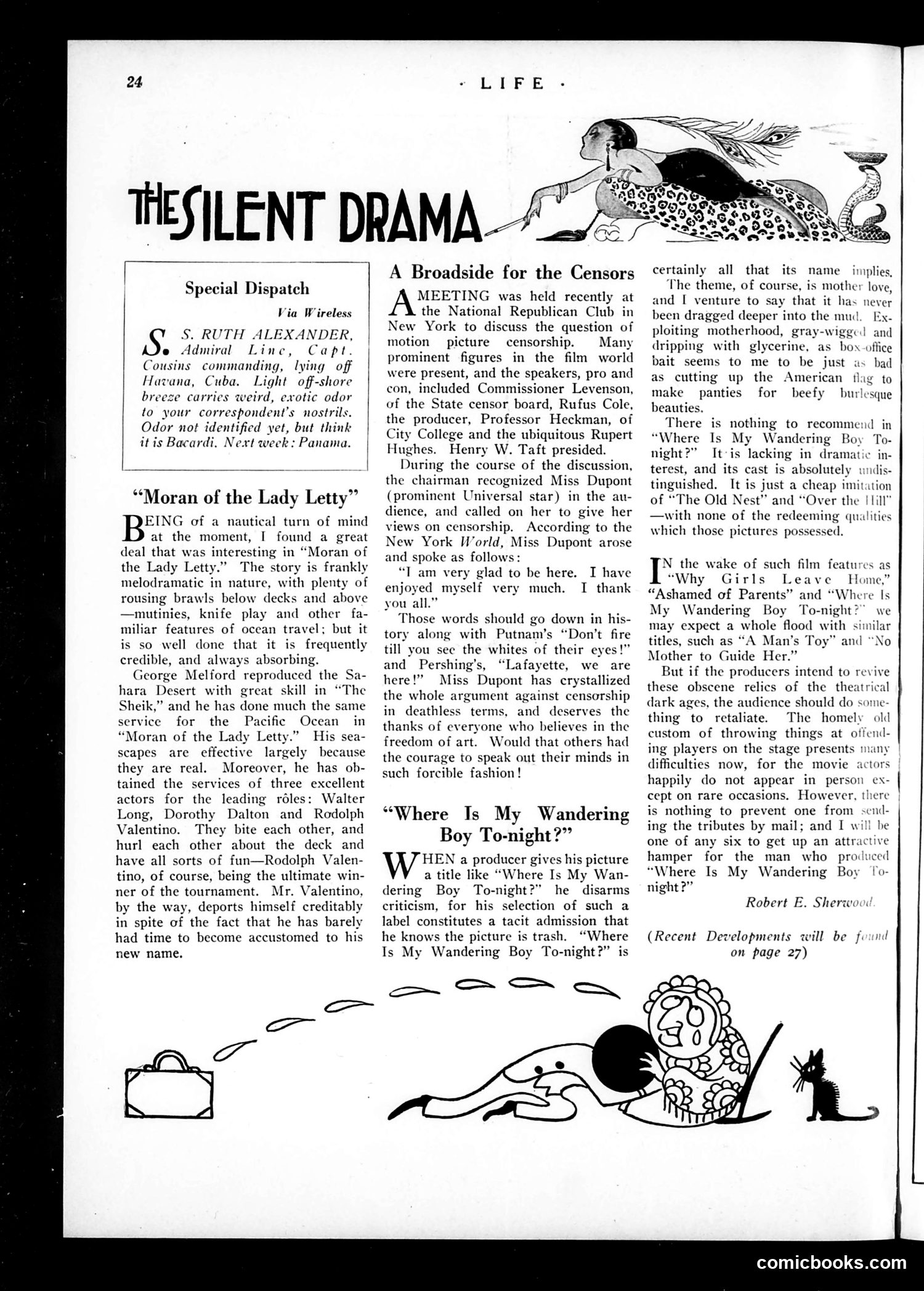
This page from *Life* magazine contains film reviews critiquing early 1920s silent movies. The main satire targets **film censorship** and **exploitative melodrama**. The "Broadside for the Censors" section mocks a censorship debate at the National Republican Club. A Universal actress (Miss Dupont) is called upon to defend artistic freedom but offers only bland pleasantries ("I am very glad to be here"). The author sarcastically suggests her trivial remarks constitute a profound statement comparable to famous historical quotes—ridiculing how weak the pro-freedom argument actually was. The bottom section attacks sentimental exploitation, specifically condemning "Where Is My Wandering Boy To-night?" as cheap melodrama cynically milking "mother love" for box-office profit, using glycerine tears and manipulative imagery. The author argues the film's own title—invoking a sentimental old song—admits the picture is "trash." The cartoons and decorative elements are period Art Deco styling typical of *Life*'s visual design.
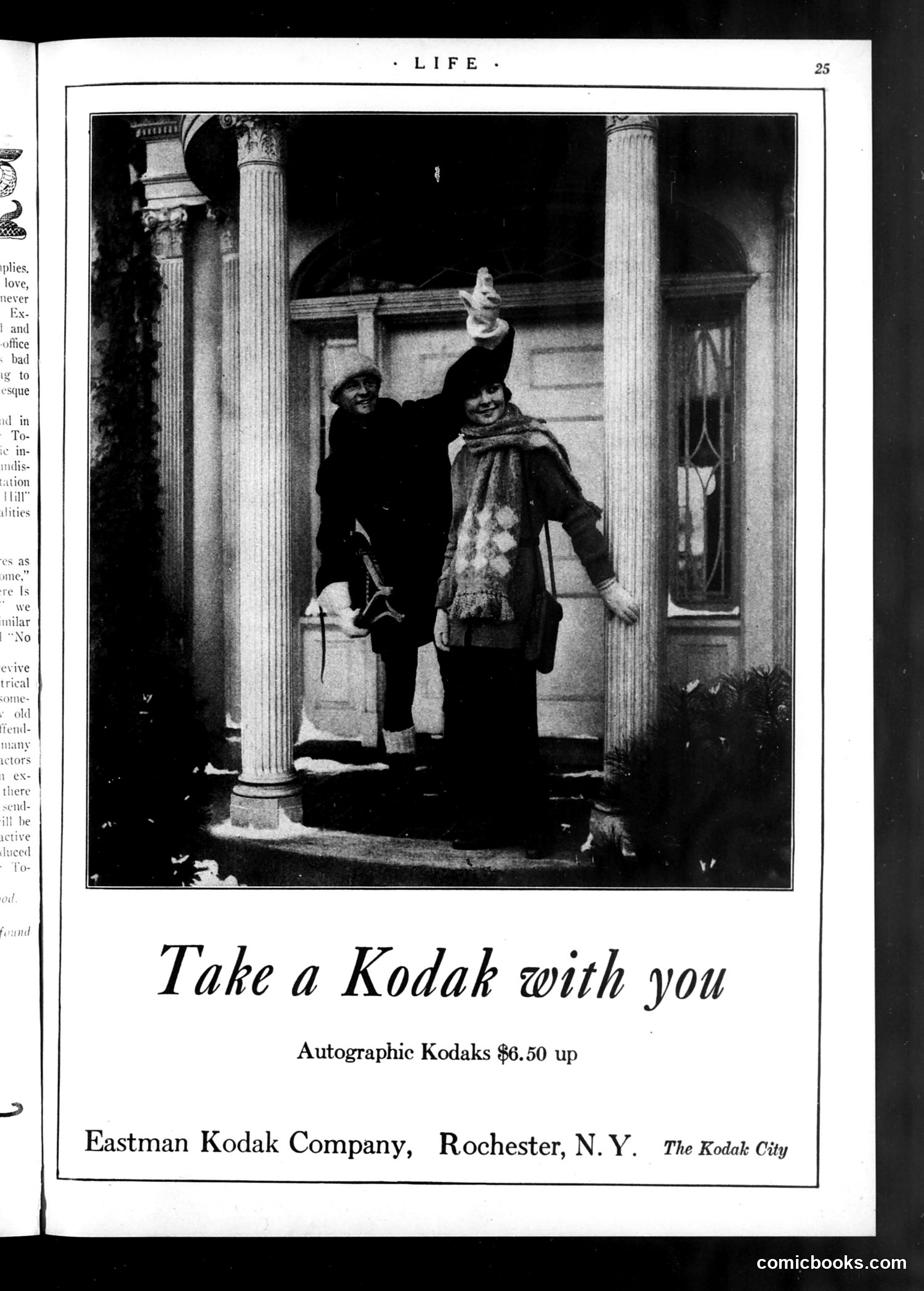
This is a **straight advertisement, not satire or political commentary**. The page shows a Kodak camera ad from Life magazine featuring two well-dressed figures standing in an elegant columned doorway—likely representing fashionable society people of the era. The ad's message is straightforward: portable Autographic Kodak cameras (priced from $6.50 up) allow people to capture memories while traveling or socializing. The elegant setting and dressed figures suggest cameras are now accessible luxuries for middle-to-upper-class consumers, not just professional photographers. The tagline "Take a Kodak with you" emphasizes the camera's portability—a selling point for the emerging consumer photography market of the early 20th century.
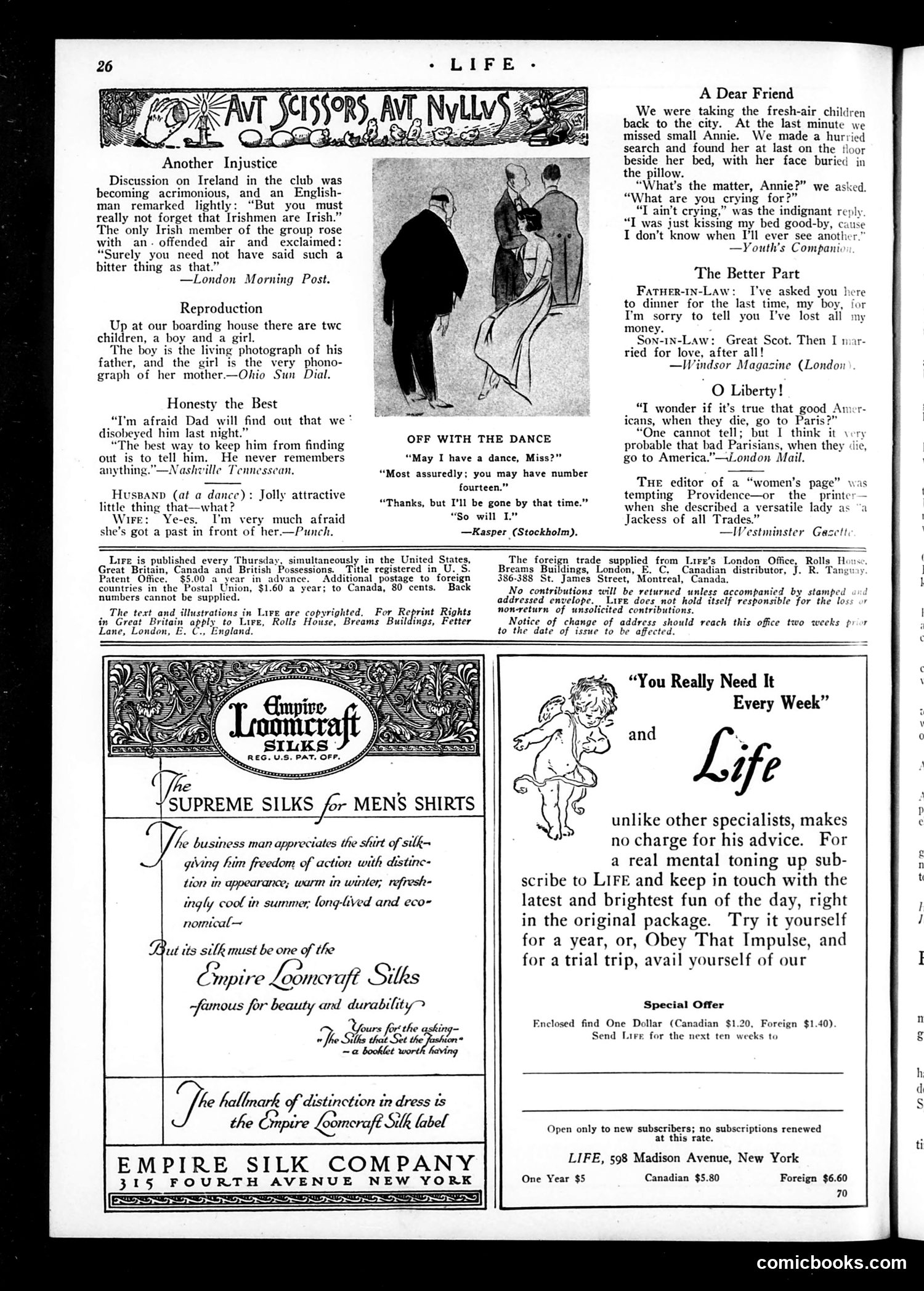
This page from *Life* magazine contains several brief humorous anecdotes and advertisements rather than a single cartoon. The humor relies on ironic reversals and wordplay typical of early 20th-century satire: - **"A Dear Friend"** depicts sentimental pathos: a foster child says goodbye to her bed, not knowing when she'll return—the joke being her emotional attachment to an object rather than people. - **"The Better Part"** uses irony: a son-in-law claims he married for love only *after* learning his father-in-law lost his fortune—suggesting he married for money. - **"O Liberty!"** satirizes American and French stereotypes, joking that bad Parisians go to America after death as punishment. - **Various brief jokes** mock human nature: dishonest children, wives' past indiscretions, and social awkwardness at dances. The page also advertises Empire Loomcraft Silk shirts and promotes *Life* magazine subscriptions. These are genteel, moralistic jokes aimed at middle-class readers, relying on recognizable social situations rather than political references.
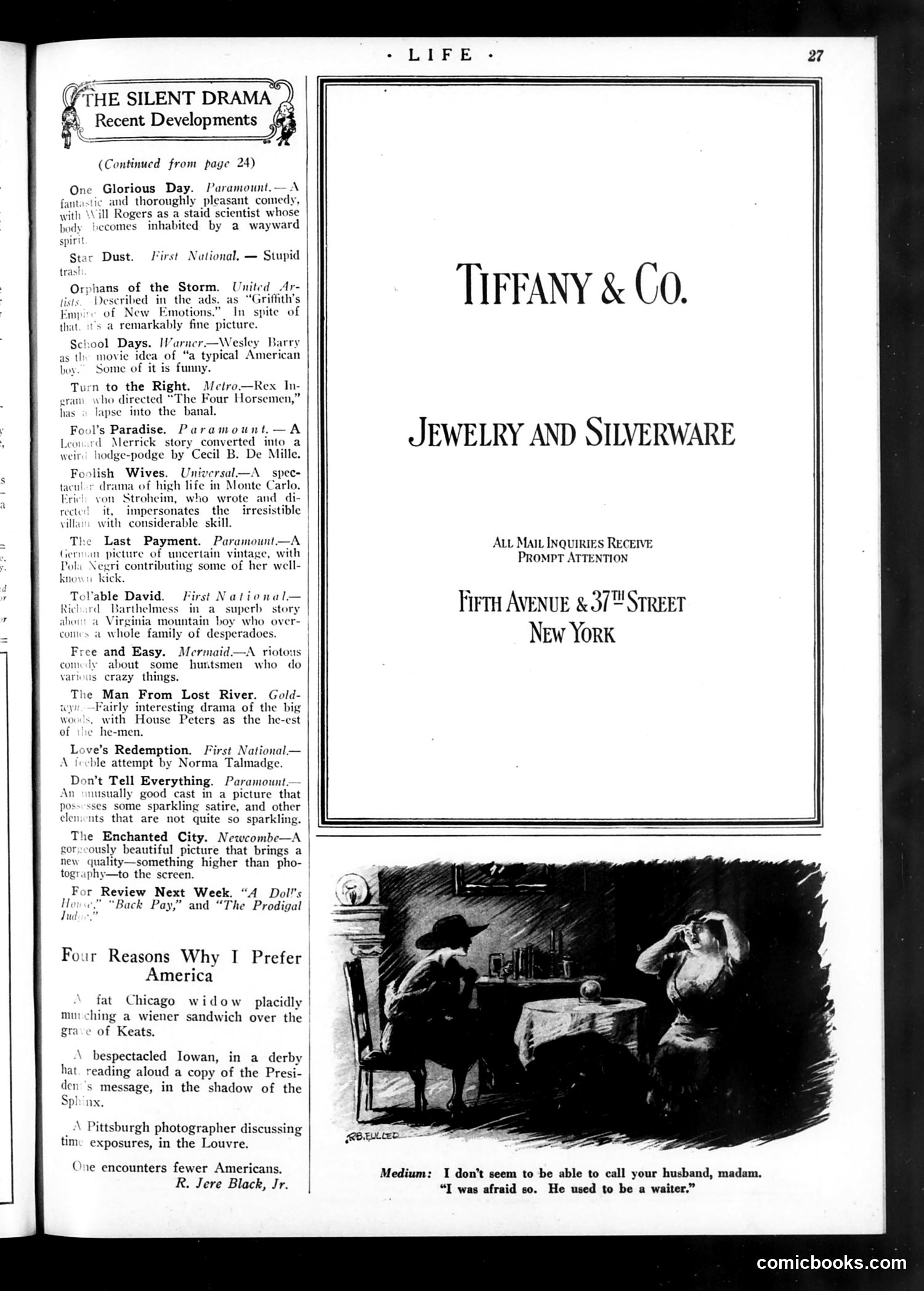
**Main Content:** This page contains two distinct sections: film reviews and a cartoon. **The Cartoon (bottom):** A sketch shows a medium attempting to contact a woman's deceased husband via séance. The humor hinges on the husband's profession—he was a waiter. The joke plays on the stereotype that waiters were notoriously difficult to reach or serve customers, extending this trait absurdly to the afterlife. It's a mild jab at service workers' reputation for unavailability or evasiveness. **Film Reviews Section (left):** "The Silent Drama: Recent Developments" lists brief reviews of silent films from major studios (Paramount, Metro, First National, etc.), naming stars like Will Rogers, Erich von Stroheim, and Pola Negri. The reviews use sarcastic, dismissive language ("stupid," "lapse into the banal"), reflecting Life's satirical editorial voice toward contemporary cinema. **Advertisement:** The right side features a Tiffany & Co. jewelry advertisement, typical of high-end magazine placement from this era.
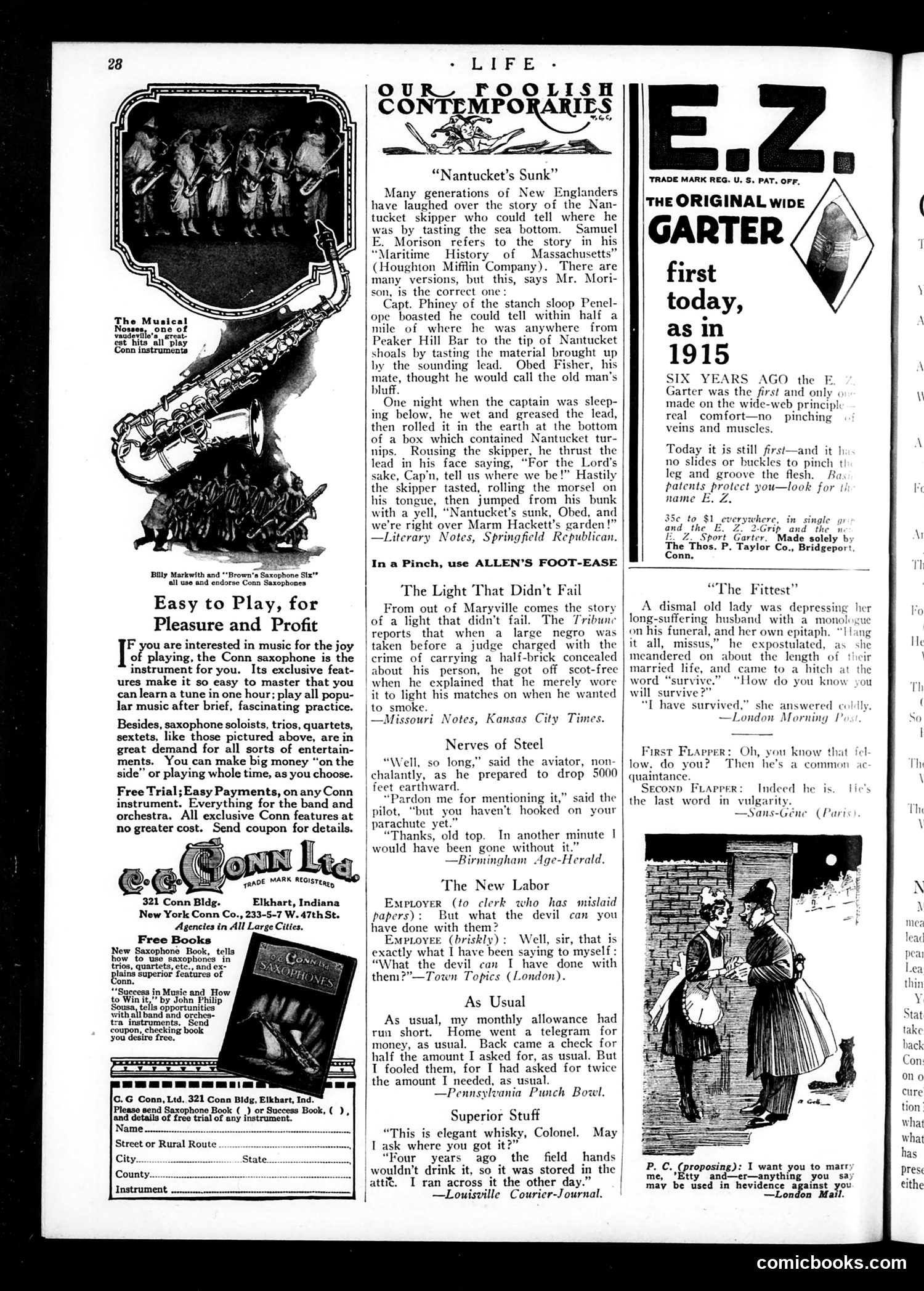
This page from *Life* magazine combines humor columns with period advertising. The satirical content includes: **"Nantucket's Sunk"**: A tall-tale about a New England sea captain famous for identifying his location by tasting the ocean bottom. A practical joker tricks him with greased lead and dirt, making the captain absurdly declare Nantucket has sunk—a joke playing on regional maritime folklore and gullibility. **"The Light That Didn't Fail"**: A racist anecdote about a Black man arrested with a half-brick, who escapes charges by claiming he used it to light cigarettes—mocking both the absurdity of the excuse and suggesting Black defendants' unreliability. **"Nerves of Steel"**: An aviator forgets his parachute before jumping, treating it casually—dark humor about early aviation dangers. The dominant advertising promotes Conn saxophones as easy-to-learn instruments for earning money, reflecting 1920s consumer culture. The page reflects *Life*'s satirical style mixing regional humor with period prejudices now considered offensive.
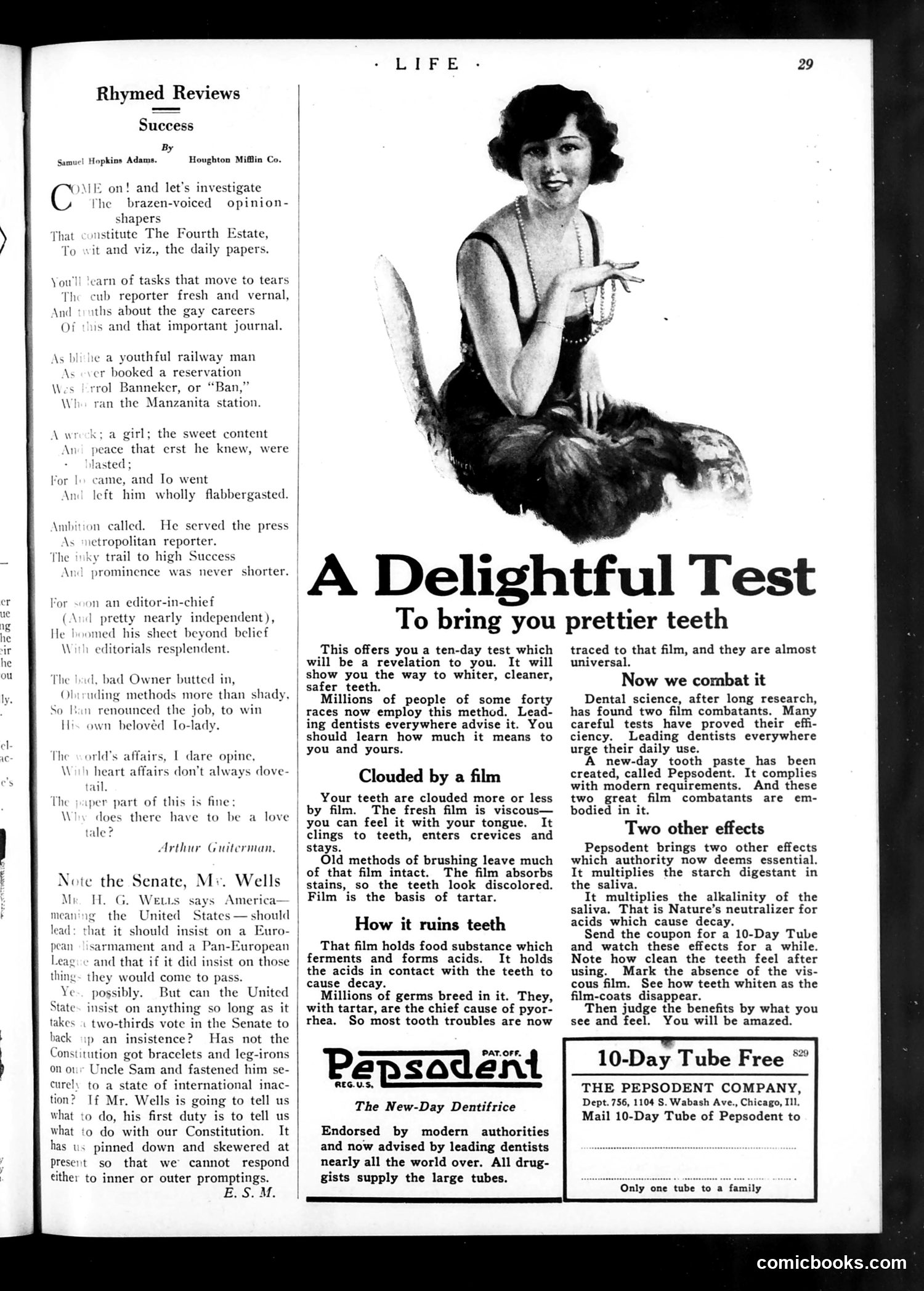
This page contains two distinct sections: **Left side - "Rhymed Reviews":** A poetry review of a book called "Success" by Samuel Hopkins Adams (Houghton Mifflin Co.). The verse satirizes the American success narrative, following a young man's rapid climb from railway worker to metropolitan reporter to editor-in-chief—only to have his career derailed when a corrupt newspaper owner ("bad Owner") interferes, forcing him to abandon his ambitions for love ("his own beloved lo-lady"). The poem's author, Arthur Guiterman, suggests that worldly success and personal happiness are fundamentally incompatible. Below this is a brief political commentary by "E.S.M." criticizing H.G. Wells's advocacy for European disarmament, arguing the U.S. Constitution's two-thirds Senate requirement for treaties makes American insistence on anything internationally impossible. **Right side:** A full-page advertisement for Pepsodent toothpaste, featuring a glamorous woman and promoting a "10-Day Tube Free" trial, emphasizing the product's ability to remove film from teeth and prevent decay.
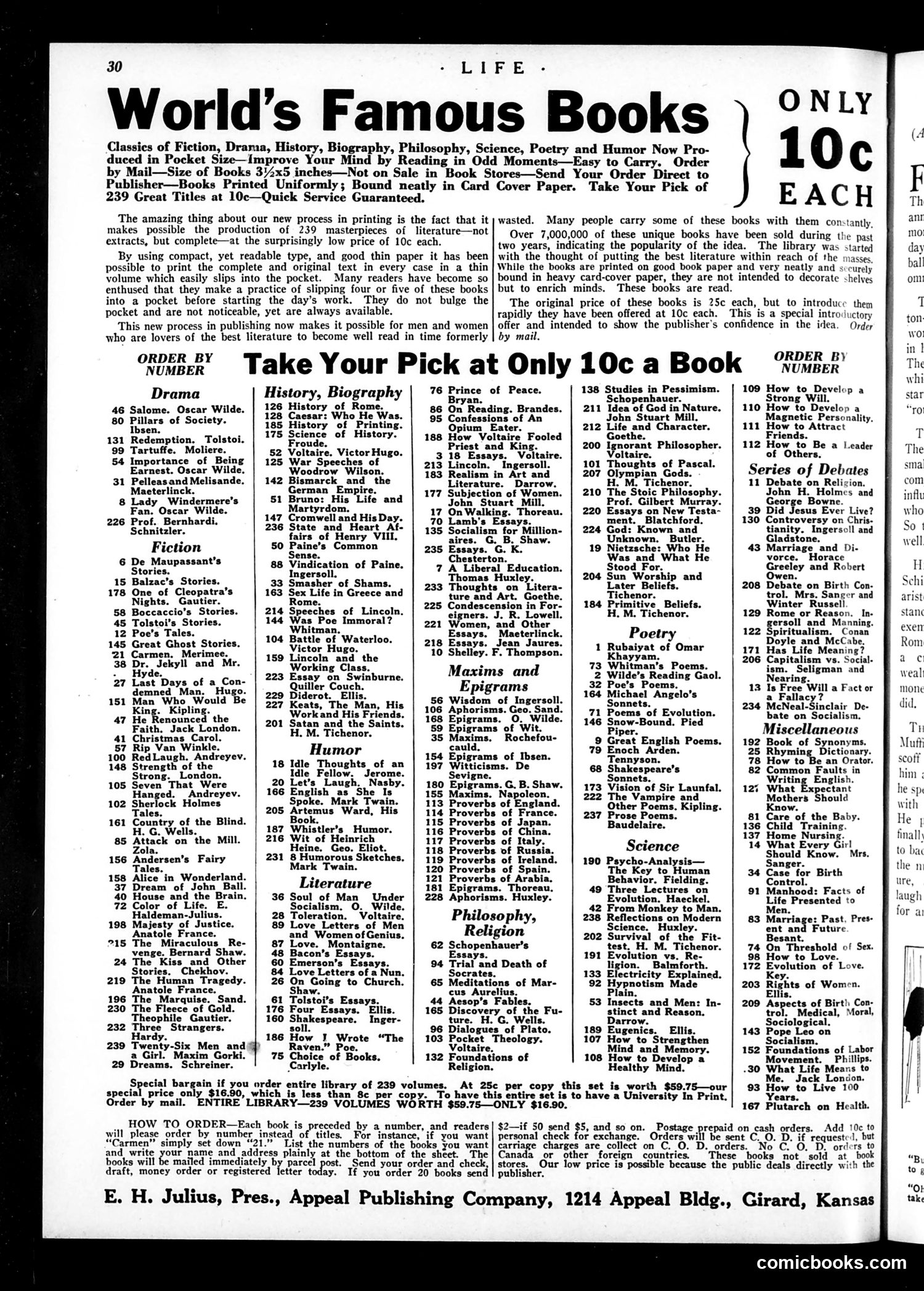
This is a **book catalog/advertisement page**, not a political cartoon or satirical content. It appears in *Life* magazine but serves as a direct-mail promotion for the Appeal Publishing Company. The page advertises 239 classic books—fiction, drama, history, philosophy, poetry—available at 10 cents each through mail order. The appeal is democratic: working people can now afford "masterpieces of literature" in pocket-sized, complete (not abridged) editions. The marketing emphasizes practicality: books small enough to slip into a pocket during workdays. The catalog lists titles by Oscar Wilde, Tolstoy, Mark Twain, Lincoln's speeches, and similar canonical works—suggesting early 20th-century ambitions to make "high culture" accessible to ordinary Americans. There is no cartoon or political satire visible on this page.
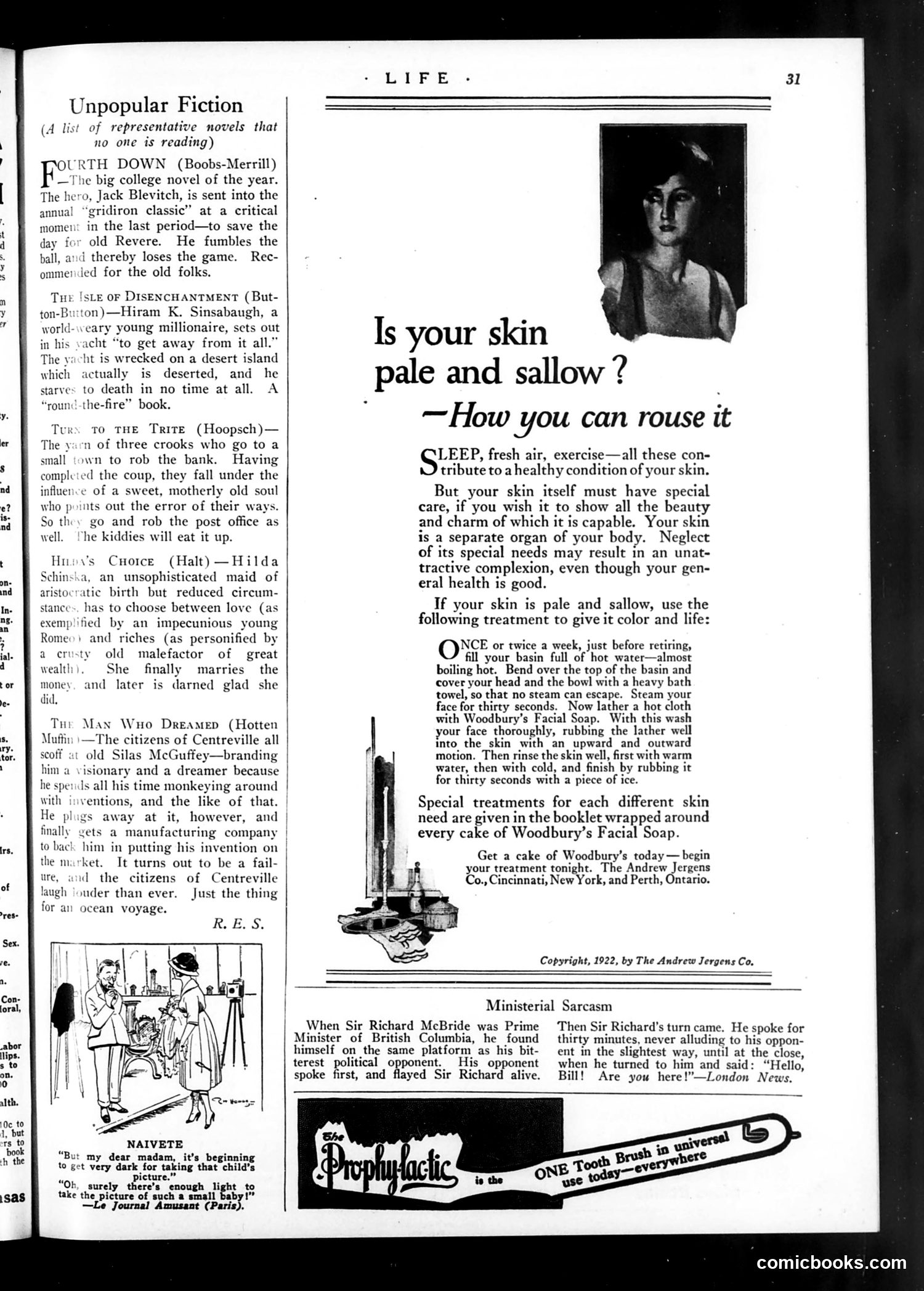
This page from *Life* magazine (1922) satirizes contemporary novels nobody actually reads. The "Unpopular Fiction" section humorously summarizes forgettable books with titles like *Fourth Down* (a college football novel where the hero loses the game) and *The Isle of Disenchantment* (where a rich man seeking escape starves on a deserted island). These mock reviews poke fun at predictable, poorly-written popular fiction of the era. The bulk of the page is dominated by a **Woodbury's Facial Soap advertisement** promising to cure pale, sallow skin through steam treatments and cold rinses. At the bottom, a brief anecdote titled "Ministerial Sarcasm" describes a British Columbia political exchange: Sir Richard McBride's opponent speaks first and attacks him harshly; McBride then calmly responds with only pleasantries, seemingly taking the high road—the humor lying in his dignified non-response to vitriol.
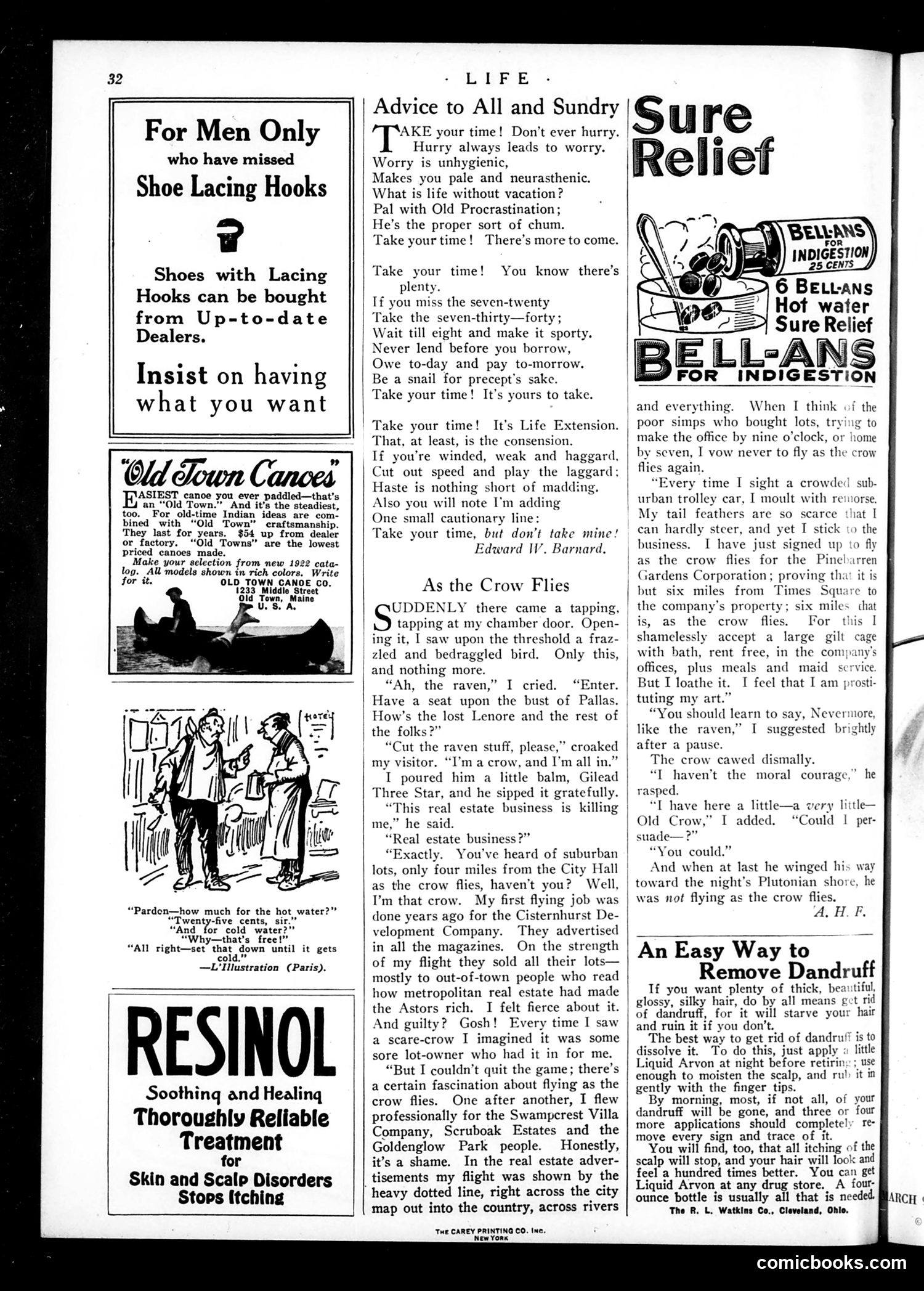
This page from *Life* magazine contains primarily **advertisements and humorous fiction**, not political cartoons. The main literary piece, "As the Crow Flies," is a satirical story that parodies Edgar Allan Poe's "The Raven." A exhausted crow visits the narrator complaining about his work in real estate advertising. The joke mocks the common marketing phrase "as the crow flies"—used to describe short distances to the city—which lures suburban lot buyers into believing commutes are shorter than they actually are. The crow, guilt-ridden from helping sell these lots to gullible purchasers, has molted his feathers from stress and regrets his complicity in the deceptive scheme. The satire targets **fraudulent suburban real estate development** and misleading advertising practices of the 1920s era, when speculative lots far from cities were aggressively marketed to unsuspecting buyers. The remaining content consists of product advertisements (shoe lacing hooks, canoes, Resinol skin treatment, Bell-Ans indigestion remedy) and a brief humorous French joke about water pricing.