
Life, 1922-03-02 · page 20 of 34
Life — March 2, 1922 — page 20: what you’re looking at
What you’re looking at
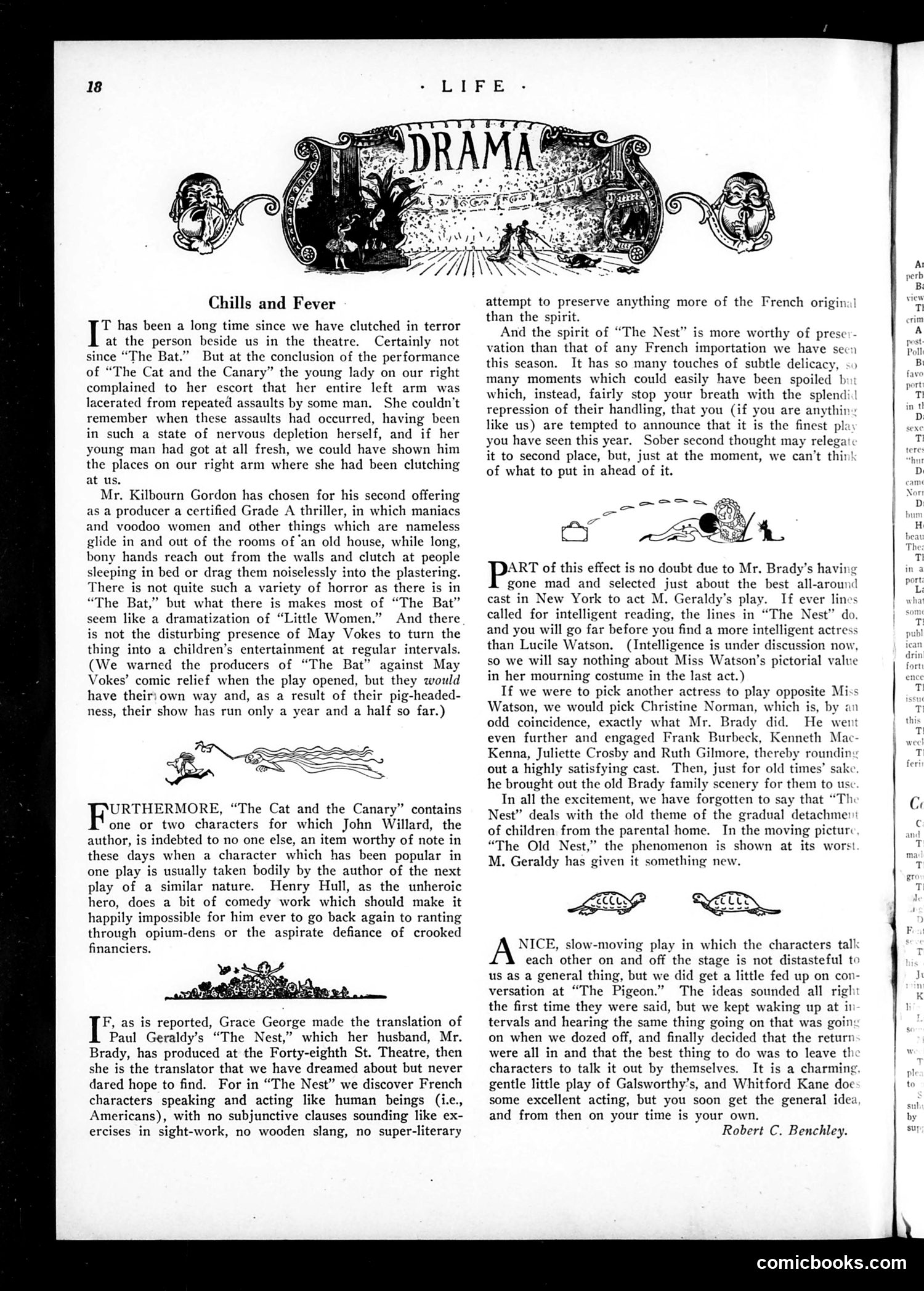
This page contains theater reviews from Life magazine's drama section, circa early 1920s. The critic discusses three Broadway plays: **"The Cat and the Canary"** — A horror thriller that genuinely frightens audiences (the opening anecdote describes a woman clutching her escort's arm in terror during the performance). **"The Bat"** — An earlier thriller the critic compares unfavorably, criticizing actress May Vokes's comedic relief as undermining the horror atmosphere. **"The Nest"** — A French play translated by actress Grace George, praised for its sophisticated, naturalistic dialogue and emotional subtlety. The critic commends the ensemble cast, particularly Lucile Watson, for intelligent performances that avoid wooden theatrical affectation. The small decorative illustrations (turtles, figure sleeping) are typical period ornaments. The reviewer (Robert C. Benchley, identifiable from the signature) uses humor and casual language to discuss theatrical merit and audience psychology.
📄 Transcribed text from this page (OCR, searchable)
Machine-transcribed from the original scan — historical spelling and the odd misread are preserved.
Chills and Fever T has been a long time since we have clutched in terror at the person beside us in the theatre. Certainly not since “The Bat.” But at the conclusion of the performance of “The Cat and the Canary” the young lady on our right complained to her escort that her entire left arm was lacerated from repeated assaults by some man. She couldn't remember when these assaults had occurred, having been in such a state of nervous depletion herself, and if her young man had got at all fresh, we could have shown him the places on our right arm where she had been clutching at us. Mr. Kilbourn Gordon has chosen for his second offering as a producer a certified Grade A thriller, in which maniacs and voodoo women and other things which are nameless glide in and out of the rooms of‘an old house, while long, bony hands reach out from the walls and clutch at people sleeping in bed or drag them noiselessly into the plastering. There is not quite such a variety of horror as there is in “The Bat,” but what there is makes most of “The Bat” seem like a dramatization of “Little Women.” And there is not the disturbing presence of May Vokes to turn the thing into a children’s entertainment at regular intervals. (We warned the producers of “The Bat” against May Vokes’ comic relief when the play opened, but they would have their! own way and, as a result of their pig-headed- ness, their show has run only a year and a half so far.) URTHERMORE, “The Cat and the Canary” contains one or two characters for which John Willard, the author, is indebted to no one else, an item worthy of note in these days when a character which has been popular in one play is usually taken bodily by the author of the next play of a similar nature. Henry Hull, as the unheroic hero, does a bit of comedy work which should make it happily impossible for him ever to go back again to ranting through opium-dens or the aspirate defiance of crooked financiers. F, as is reported, Grace George made the translation of Paul Geraldy’s “The Nest,” which her husband, Mr. Brady, has produced at the Forty-eighth St. Theatre, then she is the translator that we have dreamed about but never dared hope to find. For in “The Nest” we discover French characters speaking and acting like human beings (i.e., Americans), with no subjunctive clauses sounding like ex- ercises in sight-work, no wooden slang, no super-literary attempt to preserve anything more of the French origina! than the spirit. And the spirit of “The Nest” is more worthy of presey- vation than that of any French importation we have s this season. It has so many touches of subtle delicacy many moments which could easily have been spoiled b which, instead, fairly stop your breath with the splendi! repression of their handling, that you (if you are anythin like us) are tempted to announce that it is the finest pl: you have seen this year. Sober second thought may relegat: it to second place, but, just at the moment, we can’t thin| of what to put in ahead of it. oe te. ART of this effect is no doubt due to Mr. Brady’s having gone mad and selected just about the best all-around cast in New York to act M. Geraldy’s play. If ever lines called for intelligent reading, the lines in “The Nest” do. and you will go far before you find a more intelligent actress than Lucile Watson. (Intelligence is under discussion now, so we will say nothing about Miss Watson’s pictorial value in her mourning costume in the last act.) If we were to pick another actress to play opposite Miss Watson, we would pick Christine Norman, which is, by an odd coincidence, exactly what Mr. Brady did. He went even further and engaged Frank Burbeck, Kenneth Mac- Kenna, Juliette Crosby and Ruth Gilmore, thereby roundin out a highly satisfying cast. Then, just for old times’ sake. he brought out the old Brady family scenery for them to usc In all the excitement, we have forgotten to say that “Th Nest” deals with the old theme of the gradual detachme: of children from the parental home. In the moving pictur: “The Old Nest,” the phenomenon is shown at its worst M. Geraldy has given it something new. KEELE Re pe S = S NICE, slow-moving play in which the characters talk each other on and off the stage is not distasteful to us as a general thing, but we did get a little fed up on con- versation at “The Pigeon.” The ideas sounded all right the first time they were said, but we kept waking up at it tervals and hearing the same thing going on that was goin on when we dozed off, and finally decided that the returr were all in and that the best thing to do was to leave th characters to talk it out by themselves. It is a charming gentle little play of Galsworthy’s, and Whitford Kane doe some excellent acting, but you soon get the general idea and from then on your time is your own. Robert C. Benchley. comicbooks.com