
Life, 1922-03-02 · page 15 of 34
Life — March 2, 1922 — page 15: what you’re looking at
What you’re looking at
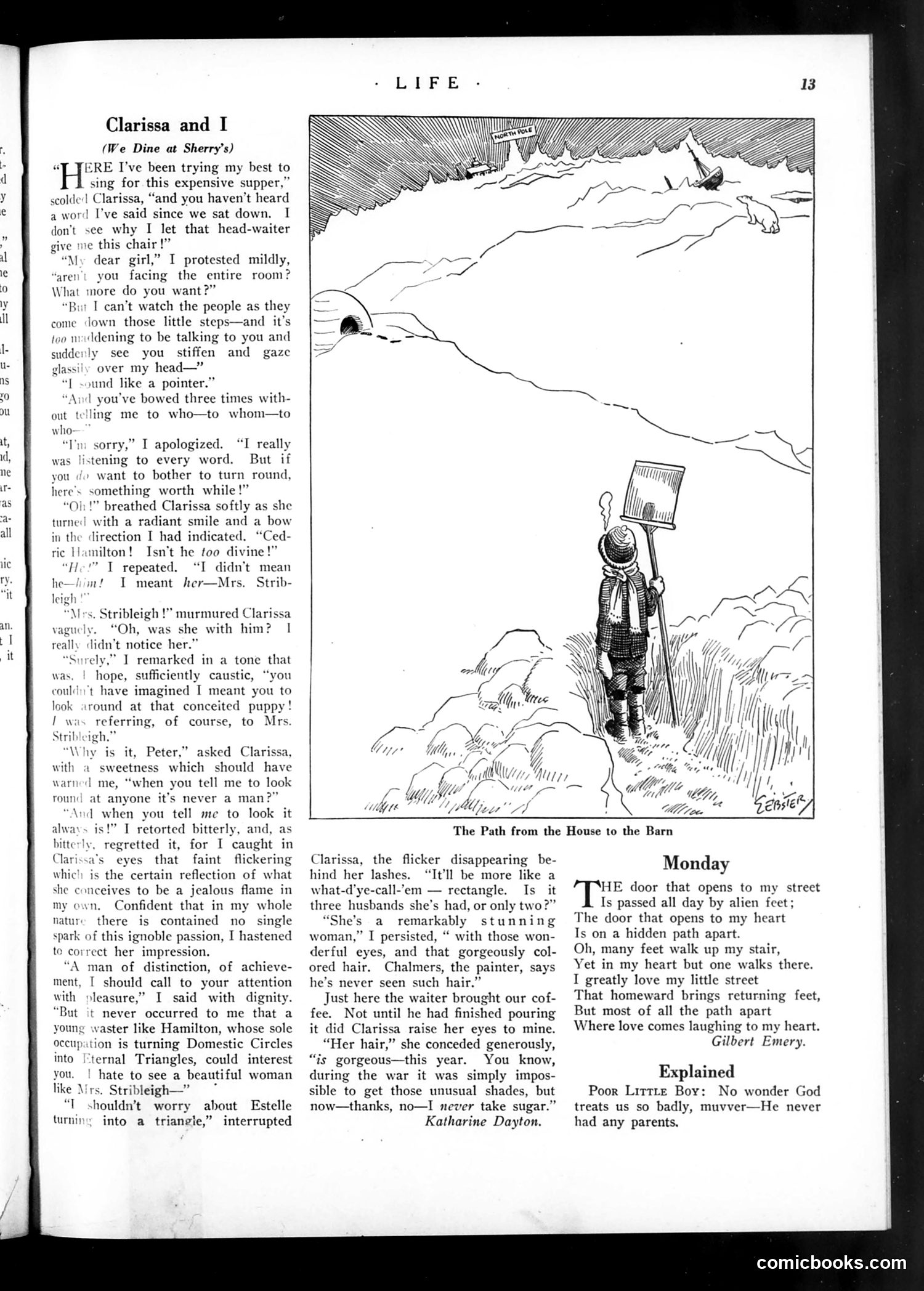
This page contains a short story titled "Clarissa and I (We Dine at Sherry's)" and a separate poem called "Monday." The main illustration depicts "The Path from the House to the Barn"—a figure carrying a lantern walking along a rural path in snow. The dialogue between the narrator and Clarissa is a romantic comedy about dinner etiquette and social graces. The humor centers on the narrator's awkwardness: he's been criticized for his posture and manners, and Clarissa has caught him staring at her intensely multiple times. His attempts at apology reveal his obliviousness to social cues. The page is primarily literary content rather than political satire. The "Explained" section at bottom contains a brief joke about poor orphans and parental indifference.
📄 Transcribed text from this page (OCR, searchable)
Machine-transcribed from the original scan — historical spelling and the odd misread are preserved.
Clarissa and I (We Dine at Sherry’s) “T_JERE I've been trying my best to sing for this expensive supper,” scolde:! Clarissa, “and you haven't heard a word I've said since we sat down. I don't see why I let that head-waiter give me this chair!” “My dear girl,” I protested mildly, ‘are’ you facing the entire room? What more do you want?” “Bur | can’t watch the people as they lown those little steps—and it’s too nvldening to be talking to you and suddenly see you stiffen and gaze over my head—” vund like a pointer.” | you've bowed three times with- ling me to who—to whom—to come glass out te who- “I'm sorry,” I apologized. “I really listening to every word. But if want to bother to turn round, here's something worth while!” “Oh!” breathed Clarissa softly as she turned with a radiant smile and a bow in the direction I had indicated. “Ced- ric Hamilton! Isn't he too divine!” “He!” I repeated. “I didn’t mean he—/iim! I meant her—Mrs. Strib- was you s. Stribleigh !” murmured Clarissa y. “Oh, was she with him? 1 lidn’t notice her.” ely,” I remarked in a tone that hope, sufficiently caustic, “you t have imagined I meant you to round at that conceited puppy! | was referring, of course, to Mrs. Stribleigh.” “Why is it, Peter,” asked Clarissa, with a sweetness which should have warned me, “when you tell me to look at anyone it’s never a man?” 1 when you tell me to look it is!” I retorted bitterly, and, as regretted it, for I caught in eyes that faint flickering is the certain reflection of what she conceives to be a jealous flame in my own. Confident that in my whole nat there is contained no single spark of this ignoble passion, I hastened to correct her impression. man of distinction, of achieve- I should call to your attention with pleasure,” I said with dignity. “But it never occurred to me that a young waster like Hamilton, whose sole Occupation is turning Domestic Circles into [ternal Triangles, could interest you. | hate to see a beautiful woman like Mrs. Stribleigh—” —* “Tl shouldn’t worry turnir coul: look roun alway hitte Clarissa’s whic! ment, about Estelle into a triangle,” interrupted LIFE —_ N FEE jo =, LOC. —/ Clarissa, the flicker disappearing be- hind her lashes. “It'll be more like a what-d’ye-call-’em — rectangle. Is_ it three husbands she’s had, or only two?” “She’s a remarkably stunning woman,” I persisted, “ with those won- derful eyes, and that gorgeously col- ored hair. Chalmers, the painter, says he’s never seen such hair.” Just here the waiter brought our cof- fee. Not until he had finished pouring it did Clarissa raise her eyes to mine. “Her hair,” she conceded generously, “Ys gorgeous—this year. You know, during the war it was simply impos- sible to get those unusual shades, but now—thanks, no—I never take sugar.” Katharine Dayton. The Path from the House to the Barn Monday HE door that opens to my street Is passed all day by alien feet; The door that opens to my heart Is on a hidden path apart. Oh, many feet walk up my stair, Yet in my heart but one walks there. I greatly love my little street That homeward brings returning feet, But most of all the path apart Where love comes laughing to my heart. Gilbert Emery. Explained Poor Lirtre Boy: No wonder God treats us so badly, muvver—He never had any parents, comicbooks.com