
Life, 1922-03-02 · page 24 of 34
Life — March 2, 1922 — page 24: what you’re looking at
What you’re looking at
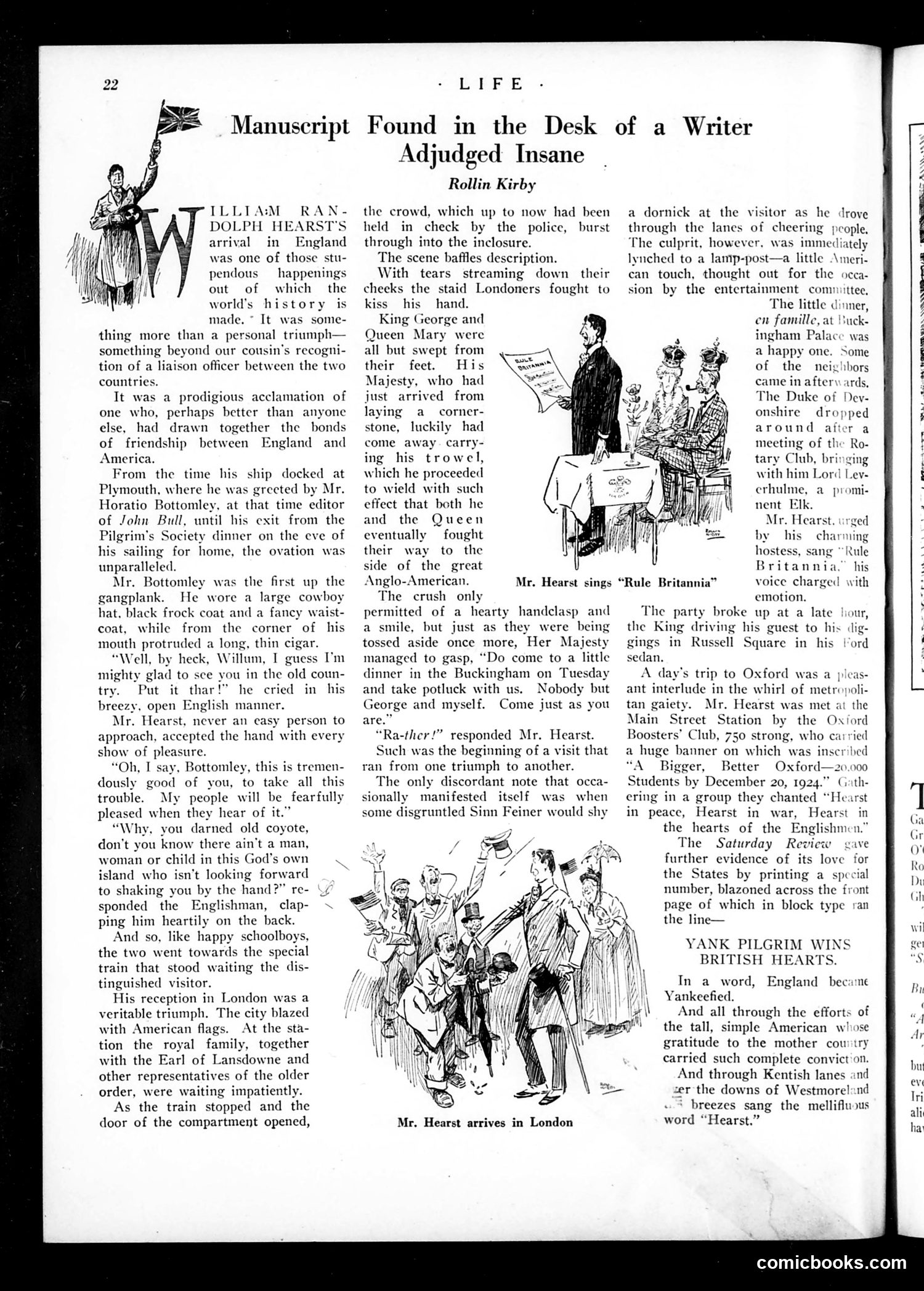
By Rollin Kirby, this satirical piece mocks William Randolph Hearst's 1924 visit to England as a triumphant diplomat. The cartoon depicts an absurdly exaggerated reception: King George and Queen Mary nearly trampled by crowds, Horatio Bottomley (editor of *John Bull*) greeting him in cowboy attire, and even Irish Sinn Féiners' protest stones met with American-style lynching. The satire targets Hearst's outsized ego and America's brash self-importance. The framing device—presented as a "manuscript" from an insane writer—suggests the whole narrative is delusional fantasy. Reality intrudes only through "disgruntled Sinn Feiners" throwing rocks, hinting at genuine political tensions Hearst's visit papered over. Kirby mocks both Hearst's pretensions to international significance and American cultural chauvinism masquerading as friendship.
📄 Transcribed text from this page (OCR, searchable)
Machine-transcribed from the original scan — historical spelling and the odd misread are preserved.
EEF E « Manuscript Found in the Desk of a Writer Adjudged Insane Rollin Kirby ILLIAM RAN DOLPH HEARST'S arrival in England was one of those stu- pendous happenings out of which the world’s history is made. ~ It was some- thing more than a personal triumph— something beyond our cousin's recogni- tion of a liaison officer between the two countries. It was a prodigious acclamation of one who, perhaps better than anyone else, had drawn together the bonds of friendship between England and America. From the time his ship docked at Plymouth, where he was greeted by Mr. Horatio Bottomley, at that time editor of John Bull, until his exit from the 's Society dinner on the eve of ng for home, the ovation was unparalleled. Mr. Bottomley was the first up the gangplank. He wore a large cowboy hat, black frock coat and a fancy waist- coat, while from the corner of his mouth protruded a long, thin cigar. “Well, by heck, Willum, I guess I'm mighty glad to sce you in the old coun- try. Put it thar!” he cried in his breezy, open English manner. Mr. Hearst, never an easy person to approach, accepted the hand with every show of pleasure. “Oh, I say, Bottomley, this is tremen- dously good of you, to take all this trouble. My people will be fearfully pleased when they hear of it.” “Why, you darned old coyote, don’t you know there ain’t a man, woman or child in this God’s own island who isn’t looking forward to shaking you by the hand?” re- sponded the Englishman, clap- ping him heartily on the back. And so, like happy schoolboys, the two went towards the special train that stood waiting the dis- tinguished visitor. His reception in London was a veritable triumph. The city blazed with American flags. At the sta- tion the royal family, together with the Earl of Lansdowne and other representatives of the older order, were waiting impatiently. As the train stopped and the door of the compartment opened, the crowd, which up to now had been held in check by the police, burst through into the inclosure. The scene baffles description. With tears streaming down their cheeks the staid Londoners fought to kiss his hand. King George and Queen Mary were all but swept from their feet. His Majesty, who had just arrived from laying a corner- stone, luckily had come away. carry- ing his trowel, which he proceeded to wield with such effect that both he and the Queen eventually fought their way to the side of the great Anglo-American. The crush only permitted of a hearty handclasp and a smile, but just as they were being tossed aside once more, Her Majesty managed to gasp, “Do come to a little dinner in the Buckingham on Tuesday and take potluck with us. Nobody but George and myself. Come just as you are.” “Ra-ther!” responded Mr. Hearst. Such was the beginning of a visit that ran from one triumph to another. The only discordant note that occa- sionally manifested itself was when some disgruntled Sinn Feiner would shy Mr. Hearst sings Mr. Hearst arrives in London “Rule Britannia” a dornick at the visitor as he drove through the lanes of cheering people. The culprit, however, was immediately lynched to a lamp-post—a little .\meri- can touch, thought out for the occa- sion by the entertainment comniittee. The little dinner, en famille, at uck- ingham Palace was a happy one. Some of the neighbors came in afterwards, The Duke of Dev- onshire dropped around after a meeting of the Ro- tary Club, bringing with him Lord Lev- erhulme, a promi- nent Elk. Mr. Hearst. urged by his charming hostess, sang “Rule Britannia.” his voice charged with emotion. The party broke up at a late fiour, the King driving his guest to his dig- gings in Russell Square in his lord sedan. A day's trip to Oxford was a jleas- ant interlude in the whirl of metropoli- tan gaiety. Mr. Hearst was met at the Main Street Station by the Oxiord Boosters’ Club, 750 strong, who carried a huge banner on which was inscribed “A Bigger, Better Oxford—20.000 Students by December 20, 1924.” Gath- ering in a group they chanted “Hearst in peace, Hearst in war, Hearst in the hearts of the Englishmen.” The Saturday Review gave further evidence of its love for the States by printing a spccial number, blazoned across the front page of which in block type ran the line— YANK PILGRIM WINS BRITISH HEAR’ In a word, England became Yankeefied. And all through the efforts of the tall, simple American whose gratitude to the mother country carried such complete convict'on. And through Kentish lanes and zer the downs of Westmorel:nd breezes sang the mellifluous word “Hearst.” comicbooks.com a a f