
Life, 1922-03-02 · page 29 of 34
Life — March 2, 1922 — page 29: what you’re looking at
What you’re looking at
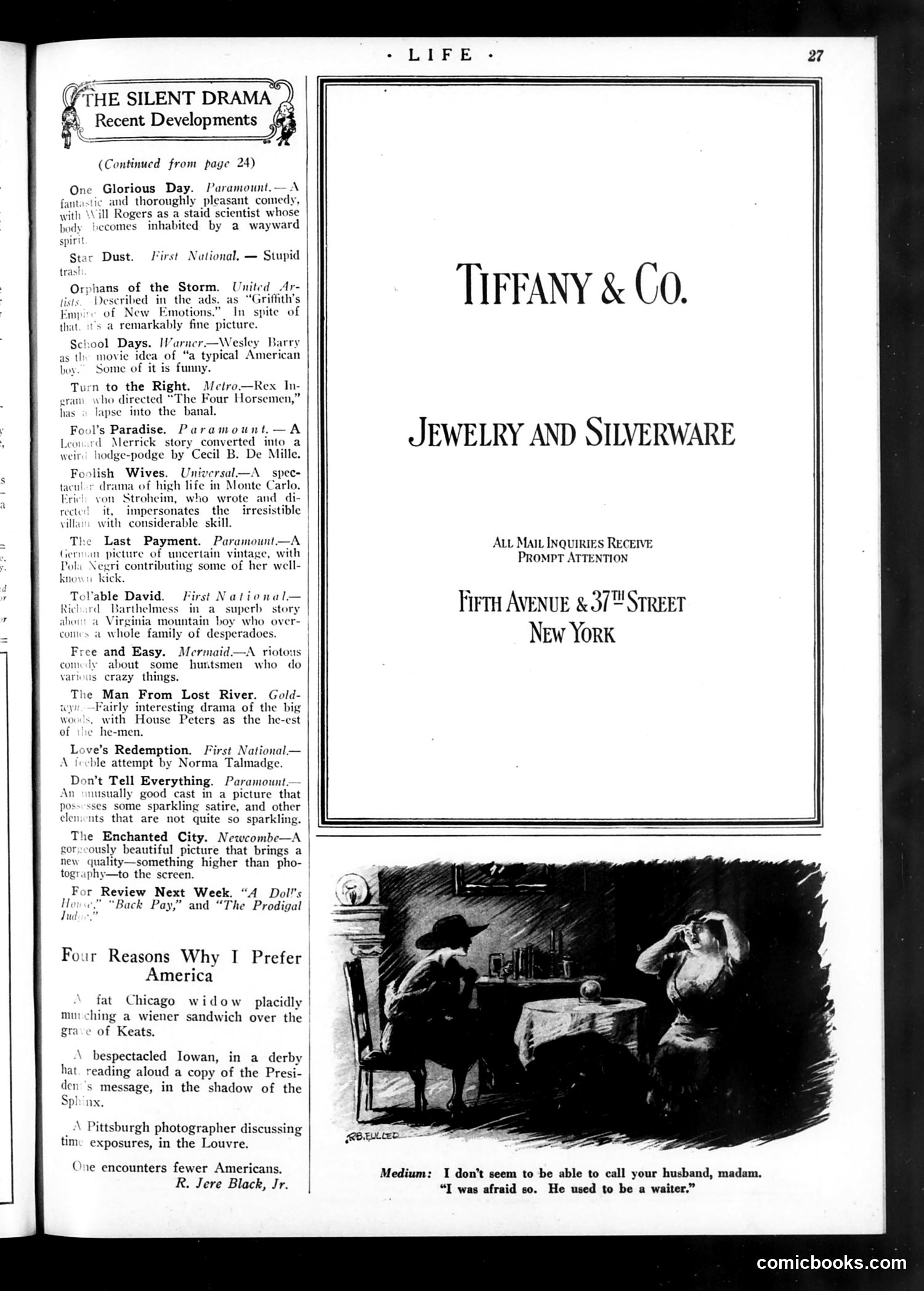
**Main Content:** This page contains two distinct sections: film reviews and a cartoon. **The Cartoon (bottom):** A sketch shows a medium attempting to contact a woman's deceased husband via séance. The humor hinges on the husband's profession—he was a waiter. The joke plays on the stereotype that waiters were notoriously difficult to reach or serve customers, extending this trait absurdly to the afterlife. It's a mild jab at service workers' reputation for unavailability or evasiveness. **Film Reviews Section (left):** "The Silent Drama: Recent Developments" lists brief reviews of silent films from major studios (Paramount, Metro, First National, etc.), naming stars like Will Rogers, Erich von Stroheim, and Pola Negri. The reviews use sarcastic, dismissive language ("stupid," "lapse into the banal"), reflecting Life's satirical editorial voice toward contemporary cinema. **Advertisement:** The right side features a Tiffany & Co. jewelry advertisement, typical of high-end magazine placement from this era.
📄 Transcribed text from this page (OCR, searchable)
Machine-transcribed from the original scan — historical spelling and the odd misread are preserved.
(tHE SILENT DRAMA Recent Developments (Continued from page 24) One Glorious Day. Paramount.—A fantastic and thoroughly pleasant comedy, with \Vill Rogers as a staid scientist whose body hecomes inhabited by a wayward spirit tras! Orphans of the Storm. Uni Ar- tists. Described in the ads. as “Griffith's Empire of New Emotions.” In spite of that. 1's a remarkably fine picture. School Days. Warner —Wesley Be as ty movie idea of “a typical Ameri boy. Some of it is funny. Turn to the Right. Metro—Rex In- gram who directed “The Four Horsemen,” has « lapse into the banal. Fool’s Paradise. Paramount,—A Leonrd Merrick story converted into a weirs hodge-podge by Cecil B. De Mille. Foolish Wives. Universal—A __ spec- tacul.y drama of high life in Monte Carlo. Eric, yon Stroheim, who wrote and di- rected it, impersonates the irresistible villas: with considerable skill. The Last Payment. Paramount—A German picture of uncertain vintage, with Pola Negri contributing some of her well- known kiek. Tol'able David. First National— Richird Barthelmess in. a superb st abou! a Virginia mountain boy who over- conics a whole family of desperadoes. e and Easy. Mermaid—aA riotous | | ly about some huntsmen who do s crazy things. Man From Lost River. Gold- wy ‘airly interesting drama of the big wools, with House Peters as the he-est of ic he-men. Love’s Redemption. First National— \ fechle attempt by Norma Talmadge. Don’t Tell Everything. Paramount. An onusually good cast in a picture that pos me sparkling satire, and other clenents that are not quite so sparkling. The Enchanted City. Newcombe—A gor-cously beautiful picture that brings a | new quality—something higher than pho- tography—to the screen. For Review Next Week. “A Dol’’s Jud Four Reasons Why I Prefer America fat Chicago widow placidly | mui ching a wiener sandwich over the grave of Keats. \ bespectacled Iowan, in a derby hat. reading aloud a copy of the Presi- dens message, in the shadow of the Sphinx. _\ Pittsburgh photographer discussing time exposures, in the Louvre. One encounters fewer Americans. R. Jere Black, Jr. | Star Dust. First National, — Stupid TIFFANY & Co. JEWELRY AND SILVERWARE ALL MAIL INQquIRIES RECEIVE PROMPT ATTENTION Firty AVENUE & 37" STREET New YorK Me “Back Pay,” and “The Prodigal Medium: I don’t seem to be able to call your husband, madam. “I was afraid so. He used to be a waiter.” comicbooks.com