
Life, 1922-03-02 · page 25 of 34
Life — March 2, 1922 — page 25: what you’re looking at
What you’re looking at
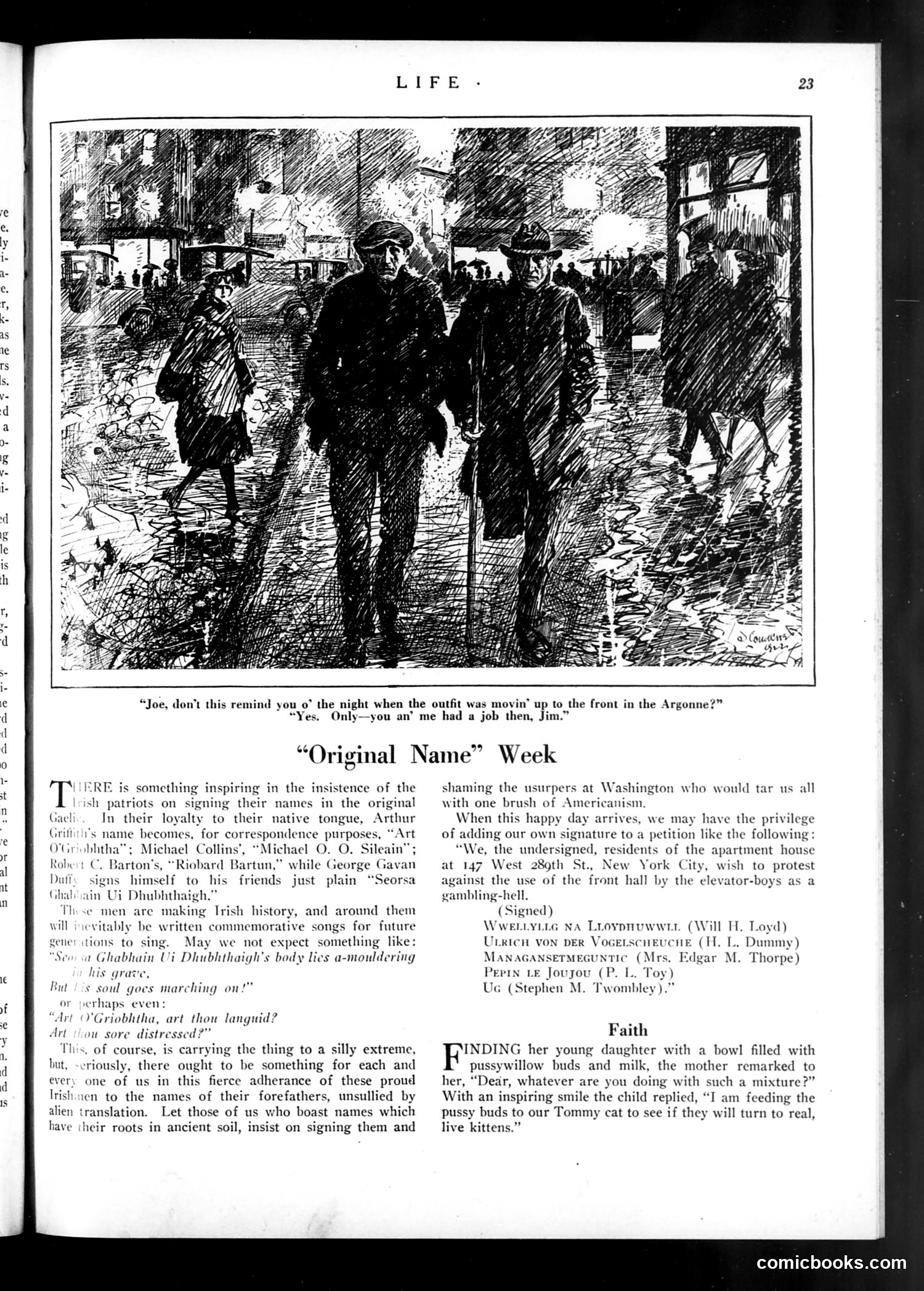
This page satirizes Irish nationalists' insistence on using Gaelic versions of their names—a political statement about Irish identity and independence. The cartoon depicts WWI soldiers, with dialogue referencing the Argonne Offensive, where one veteran notes that he and his companion actually "had a job then"—implying they had purpose, unlike now. The article mocks this naming practice as carried to absurd extremes, while paradoxically praising it as a form of resistance against "Americanism" and Washington's homogenizing influence. The satire is two-edged: Life simultaneously celebrates Irish pride in ancestral heritage while ridiculing the impracticality of adopting difficult Gaelic names. The petition example (residents protesting elevator-boys' gambling) demonstrates how ridiculous such formal Gaelic signatures become in mundane American contexts—the joke being that noble cultural pride clashes comically with everyday apartment-building complaints.
📄 Transcribed text from this page (OCR, searchable)
Machine-transcribed from the original scan — historical spelling and the odd misread are preserved.
“Joe, don’t this remind you 0” the night when the outfit was movin’ up to the front in the Argonne?” “Yes. Only—you an’ me had a job then, Jim.” “Original Name” Week T ERE is something inspiring in the insistence of the sh patriots on signing their names in the original Gael In their loyalty to their native tongue, Arthur Grifiti’s name becomes, for correspondence purposes, “Art O'Griobhtha”; Michael Collins’, “Michael O. O. Sileain”; Robert C. Barton's, “Riobard Bz Dutiy signs himself to his Ghabain Ui Dhubhthaigh.” lise men are making Irish history, and around them will ivevitably be written commemorative songs for future gene) tions to sing. May we not expect something like: “Seo ca Ghabhain Ui Dhubhthaigh’s body lies a-mouldering his grave, tun,” while George Gavan friends just plain “Seorsa But //s soul goes marching on!” or perhaps even: “Art O'Griobhtha, art thou languid? Art thou sore distre 7 This, of course, is carrying the thing to a silly extreme, but, ously, there ought to be something for each and every) one of us in this fierce adherance of these proud Irish nen to the names of their forefathers, unsullied by alien translation. Let those of us who boast names which have (heir roots in ancient soil, insist on signing them and shaming the usurpers at Washington who would tar us all with one brush of Americanism. When this happy day arrives, we may have the privilege of adding our own signature to a petition like the following: “We, the undersigned, residents of the apartment house at 147 West 289th St., New York City, wish to protest against the use of the front hall by the elevator-boys as a gambling-hell. (Signed) WWELLYLLG NA Lioypnuwwet. (Will H. Loyd) ULricu von DER Vo “HEUCHE (H. L, Dummy) MANAGANSETM tic (Mrs. Edgar M. Thorpe) Pepin LE Jouyou (P. L. Toy) Uc (Stephen M. Twombley).” Faith INDING her young daughter with a bowl filled with pussywillow buds and milk, the mother remarked to her, “Dear, whatever are you doing with such a mixture?” With an inspiring smile the child replied, “I am feeding the pussy buds to our Tommy cat to see if they will turn to real, live kittens.” comicbooks.com