
Life, 1922-03-02 · page 26 of 34
Life — March 2, 1922 — page 26: what you’re looking at
What you’re looking at
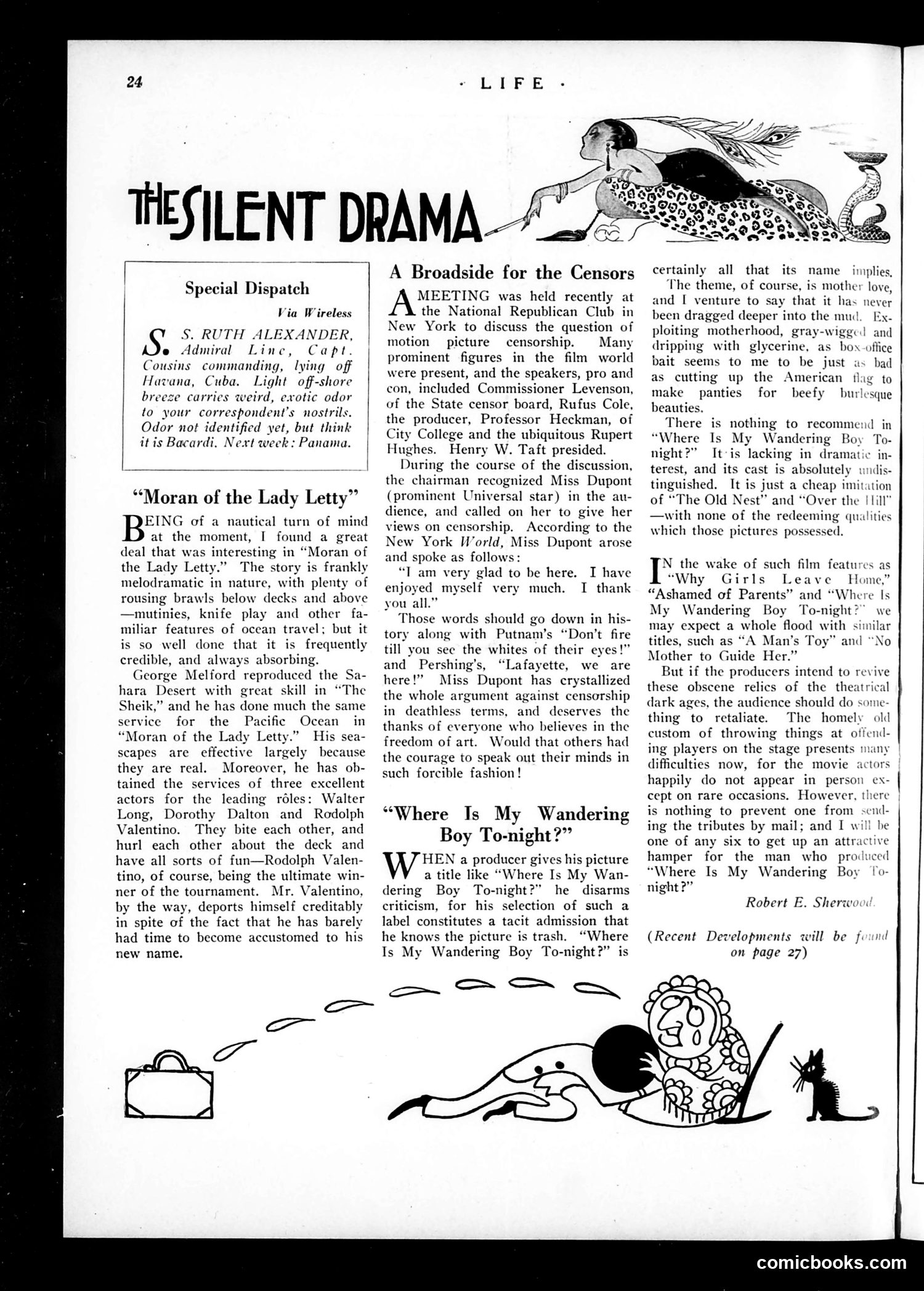
This page from *Life* magazine contains film reviews critiquing early 1920s silent movies. The main satire targets **film censorship** and **exploitative melodrama**. The "Broadside for the Censors" section mocks a censorship debate at the National Republican Club. A Universal actress (Miss Dupont) is called upon to defend artistic freedom but offers only bland pleasantries ("I am very glad to be here"). The author sarcastically suggests her trivial remarks constitute a profound statement comparable to famous historical quotes—ridiculing how weak the pro-freedom argument actually was. The bottom section attacks sentimental exploitation, specifically condemning "Where Is My Wandering Boy To-night?" as cheap melodrama cynically milking "mother love" for box-office profit, using glycerine tears and manipulative imagery. The author argues the film's own title—invoking a sentimental old song—admits the picture is "trash." The cartoons and decorative elements are period Art Deco styling typical of *Life*'s visual design.
📄 Transcribed text from this page (OCR, searchable)
Machine-transcribed from the original scan — historical spelling and the odd misread are preserved.
Special Dispatch Via Wireless S. RUTH ALEXANDER, e Admiral Line, Capt. Cousins commanding, lying off Havana, Cuba. Light off-shore breeze carries we exotic odor | to your correspondent’s nostrils. Odor not identified yet, but think itis Bacardi, Next week: Panama. | | “Moran of the Lady Letty” EING of a nautical turn of mind at the moment, I found a great deal that was interesting in “Moran of the Lady Letty.” The story is frankly melodramatic in nature, with plenty of rousing brawls below decks and above —mutinies, knife play and other fa- miliar features of ocean travel; but it is so well done that it is frequently credible, and always absorbing. George Melford reproduced the Sa- hara Desert with great skill in “The Sheik,” and he has done much the same service for the Pacific Ocean in “Moran of the Lady Letty.” His sea scapes are effective largely because they are real. Moreover, he has ob- tained the services of three excellent actors for the leading réles: Walter Long, Dorothy Dalton and Rodolph Valentino. They bite each other, and hurl each other about the deck and have all sorts of fun—Rodolph Valen- tino, of course, being the ultimate win- ner of the tournament. Mr. Valentino, by the way, deports himself creditably in spite of the fact that he has barely had time to become accustomed to his new name. A Broadside for the Censors yA MEETING was held recently at the National Republican Club in New York to discuss the question of motion picture censorship. Many prominent figures in the film world were present, and the speakers, pro and con, included Commissioner Levenson, of the State censor board, Rufus Cole, the producer, Professor Heckman, of City College and the ubiquitous Rupert Hughes. Henry W. Taft presided. During the course of the discussion, the chairman recognized Miss Dupont (prominent Universal star) in the au- dience, and called on her to give her views on censorship. According to the New York World, Miss Dupont arose and spoke as follows: “I am very glad to be here. I have enjoyed myself very much. I thank you all.” Those words should go down in his- tory along with Putnam’s “Don’t fire till you see the whites of their eyes!” and Pershing’s, “Lafayette, we are here!” M Dupont has crystallized the whole argument against censorship in deathless terms, and deserves the thanks of everyone who believes in the freedom of art. Would that others had the courage to speak out their minds in such forcible fashion! “Where Is My Wandering Boy To-night?” HEN a producer gives his picture a title like “Where Is My Wan- dering Boy To-night?” he disarms criticism, for his selection of such a label constitutes a tacit admission that he knows the picture is trash. “Where Is My Wandering Boy To-night?” is certainly all that its name _ implies, he theme, of course, is mother love, and I venture to say that it has never been dragged deeper into the mud ploiting motherhood, gray-wigge:| and dripping with glycerine, as box-office bait seems to me to be just us bad as cutting up the American flag to make panties for beefy beauties. There is nothing to recommend in “Where Is My Wandering Boy To- burlesque night?” It-is lacking in dramatic in- terest, and its t is absolutely wndis- tinguished. It is just a cheap imitation of “The Old Nest” and “Over the | ill” —with none of the redeeming qualities which those pictures possessed. the wake of such film features as I ‘Why Girls Leave ome,” “Ashamed of Parents” and “Where Is My Wandering Boy To-night?” we may expect a whole flood with similar titles, such as “A Man’s Toy” and “No Mother to Guide Her.” But if the producers intend to revive these obscene relics of the theatrical dark ages, the audience should do some- thing to retaliate. The homely old custom of throwing things at offend- ing players on the stage presents many difficulties now, for the movie actors happily do not appear in person ex- cept on rare occasions. However, there is nothing to prevent one from send- ing the tributes by mail; and I will be one of any six to get up an attractive hamper for the man who produced “Where Is My Wandering Boy night?” Robert E. Sherwov (Recent Developments will be found on page 27) comicbooks.com