
A complete issue · 34 pages · 1921
Life — October 20, 1921
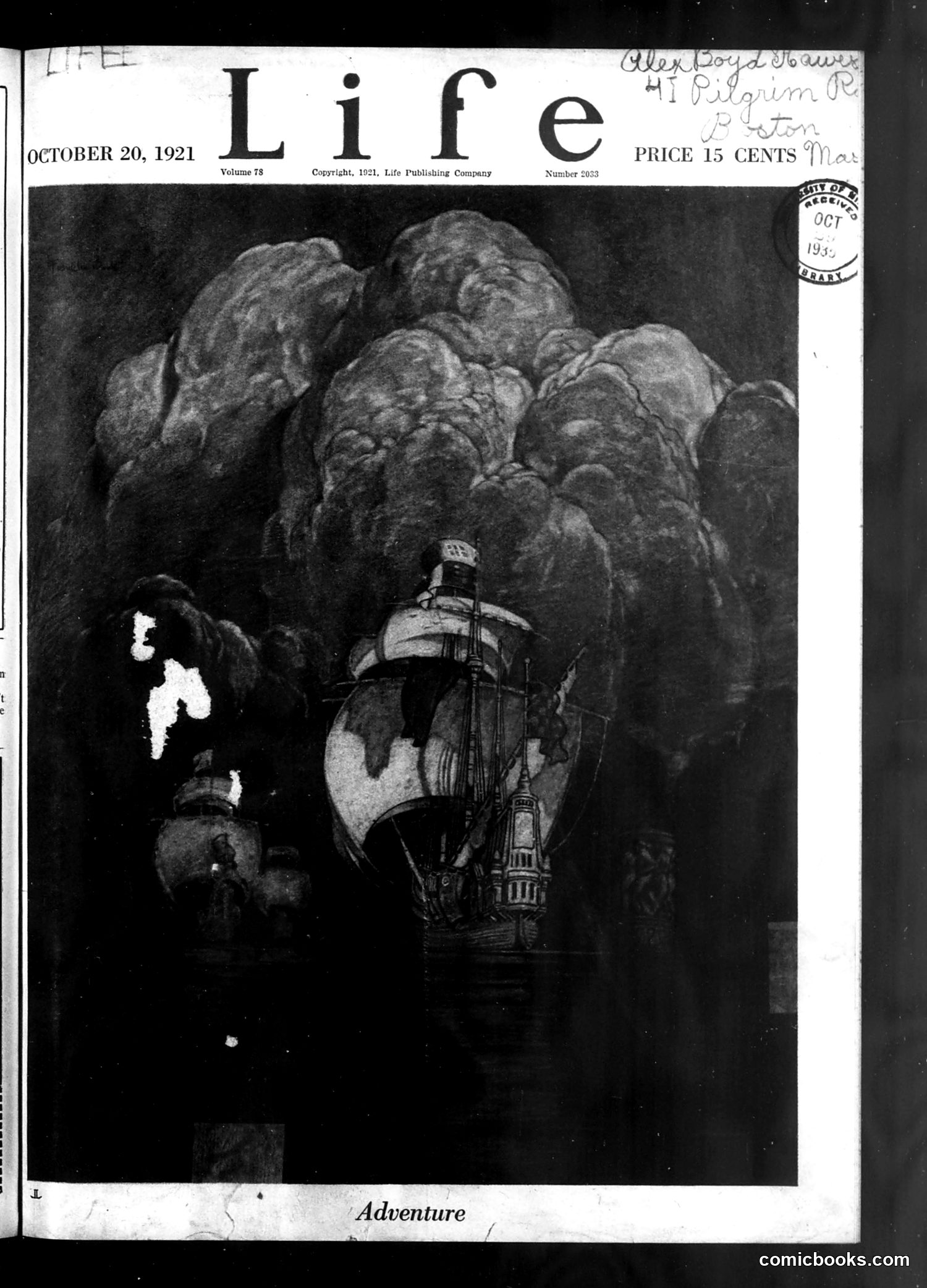
This cover illustration is titled "Adventure" and depicts a dramatic nighttime scene: a small figure (appearing to be a person or explorer) stands before massive, looming rock formations or cliffs shrouded in darkness. The composition emphasizes scale and danger—the tiny human dwarfed by imposing natural forces. Without additional context from the magazine's interior text, the specific reference is unclear. This could illustrate a literal adventure story featured in that issue, or it might satirize contemporary exploration, mountaineering expeditions, or even metaphorically represent human ambition against overwhelming odds. The theatrical, dramatic style was typical of Life's cover art during this period, designed to intrigue readers and encourage purchase.
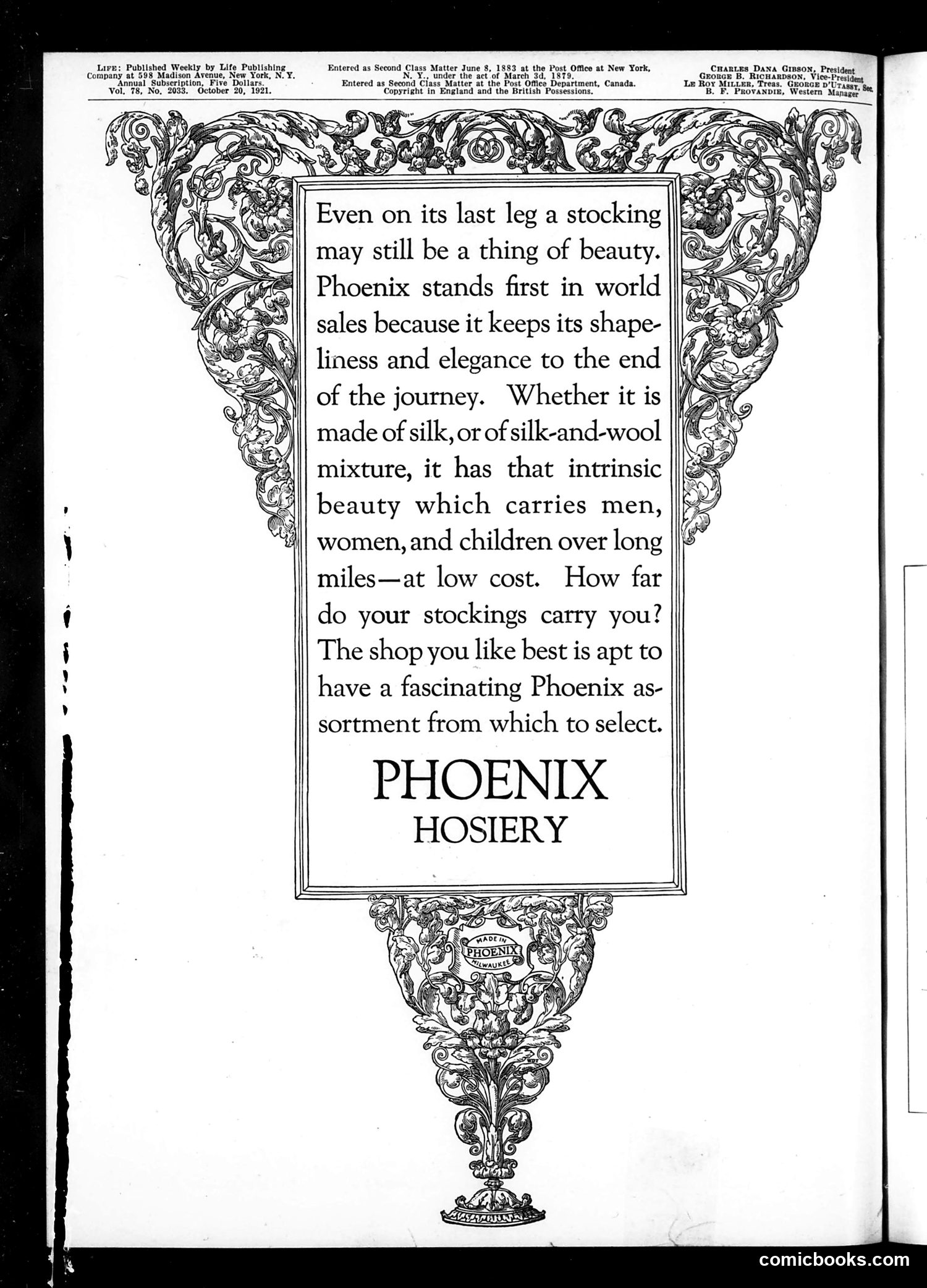
This is a **product advertisement, not a political cartoon**. It's a 1921 Life magazine ad for Phoenix brand stockings. The ornate decorative border frames a pitch emphasizing that Phoenix hosiery maintains its "shapefulness and elegance to the end of the journey"—a metaphor for durability through wear. The ad addresses consumers directly ("How far do your stockings carry you?"), positioning the product as long-lasting and elegant despite inevitable wear. The phrase "even on its last leg" plays on the double meaning of "leg" (the garment part and idiomatic expression). This was typical early 20th-century advertising copy, appealing to both practicality (durability at low cost) and aesthetics (beauty and elegance). No satire or political commentary is present—this is straightforward commercial marketing.
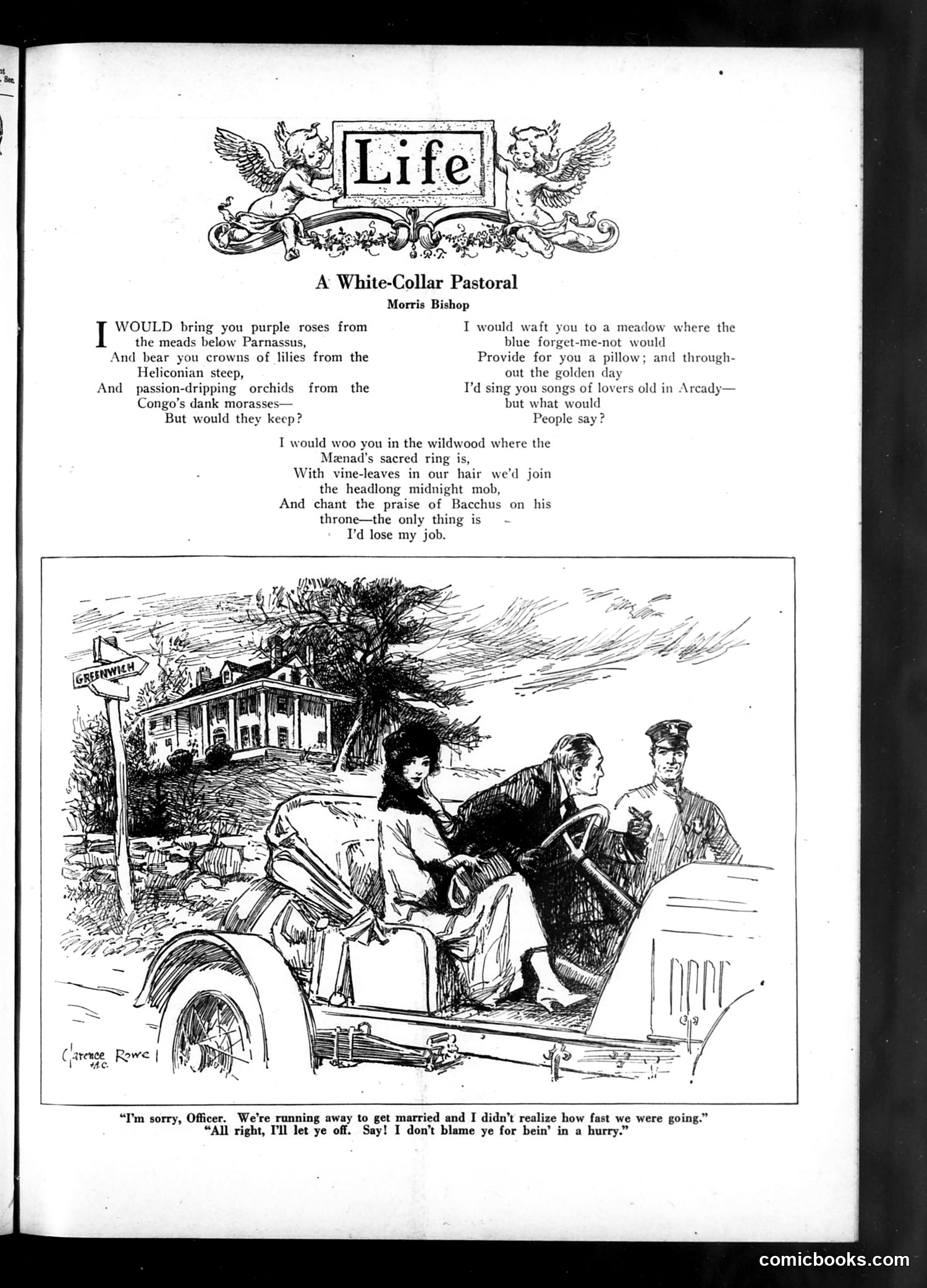
This poem and cartoon satirize the romantic idealization of rural life by office workers. The poem mocks the notion that city professionals could abandon their jobs for pastoral bliss—repeatedly asking "but would they keep?" each romantic scenario, ultimately concluding "I'd lose my job." The cartoon illustrates this tension: a couple in an automobile speeds past a rural homestead, apparently eloping. A police officer attempts to stop them, but the driver dismisses the traffic violation, claiming they're rushing to get married and didn't notice their speed. The satire targets the fantasy of escaping white-collar respectability versus the practical realities of employment and social obligation that trap modern workers in their routines.
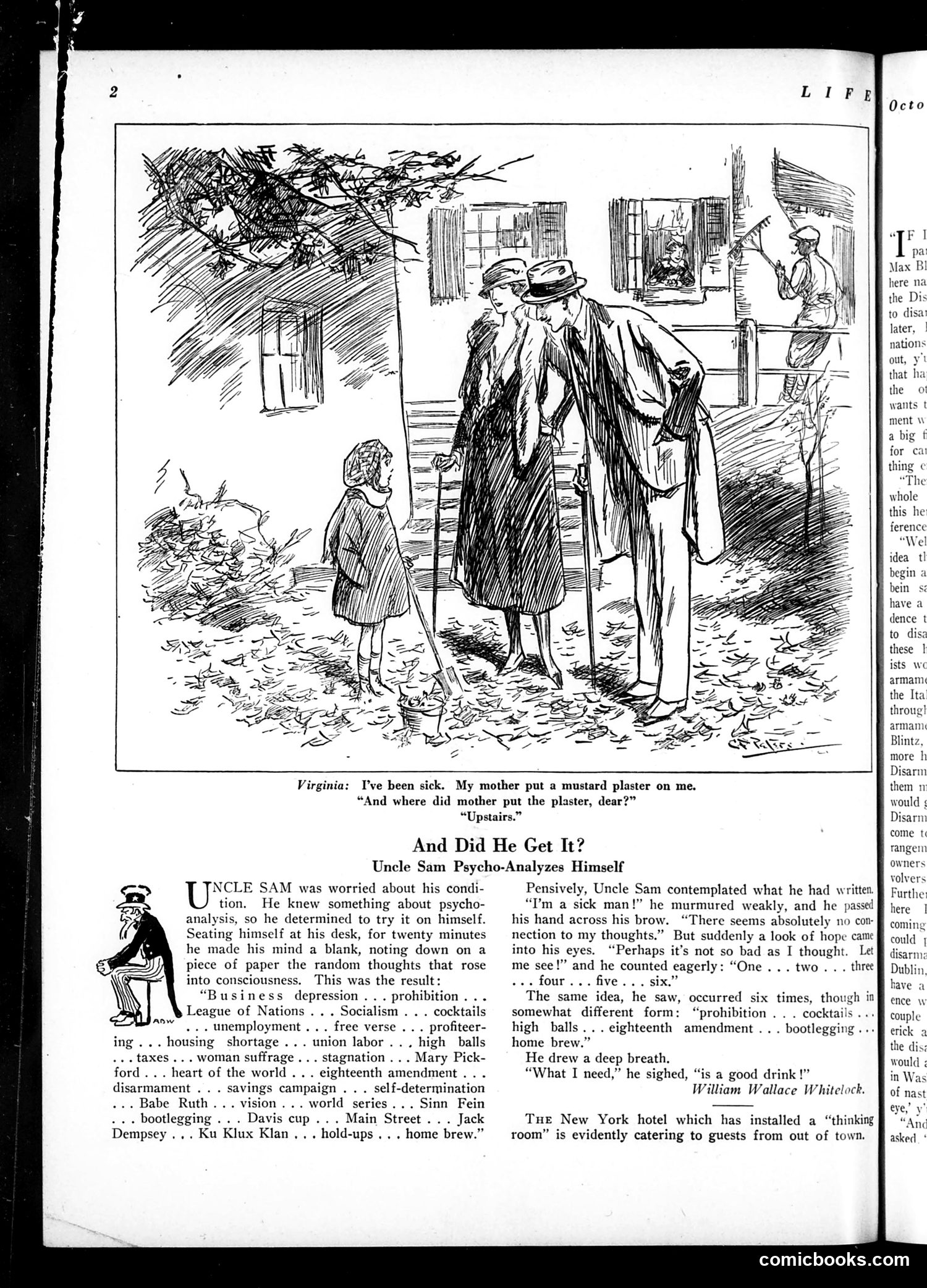
This satirical piece titled "And Did He Get It?" mocks psychoanalysis through "Uncle Sam Psycho-Analyzes Himself." The cartoon shows Uncle Sam (the personified United States) speaking with a child about a mustard plaster placed "upstairs"—a crude analogy for America's internal problems. The satire criticizes America's obsession with psychoanalysis as a cure-all. Uncle Sam's stream-of-consciousness listing—"Prohibition...Socialism...cocktails...housing shortage...union labor...high balls...taxes...woman suffrage...Mary Pickford...heart of the world...eighteenth amendment...disarmament...Babe Ruth...bootlegging...Ku Klux Klan"—mocks the era's social anxieties and contradictions (note the simultaneous mention of Prohibition and cocktails, bootlegging). The joke suggests that merely identifying America's problems through analysis won't solve them. The "thinking room" reference in the text reinforces this critique of 1920s therapeutic trends.
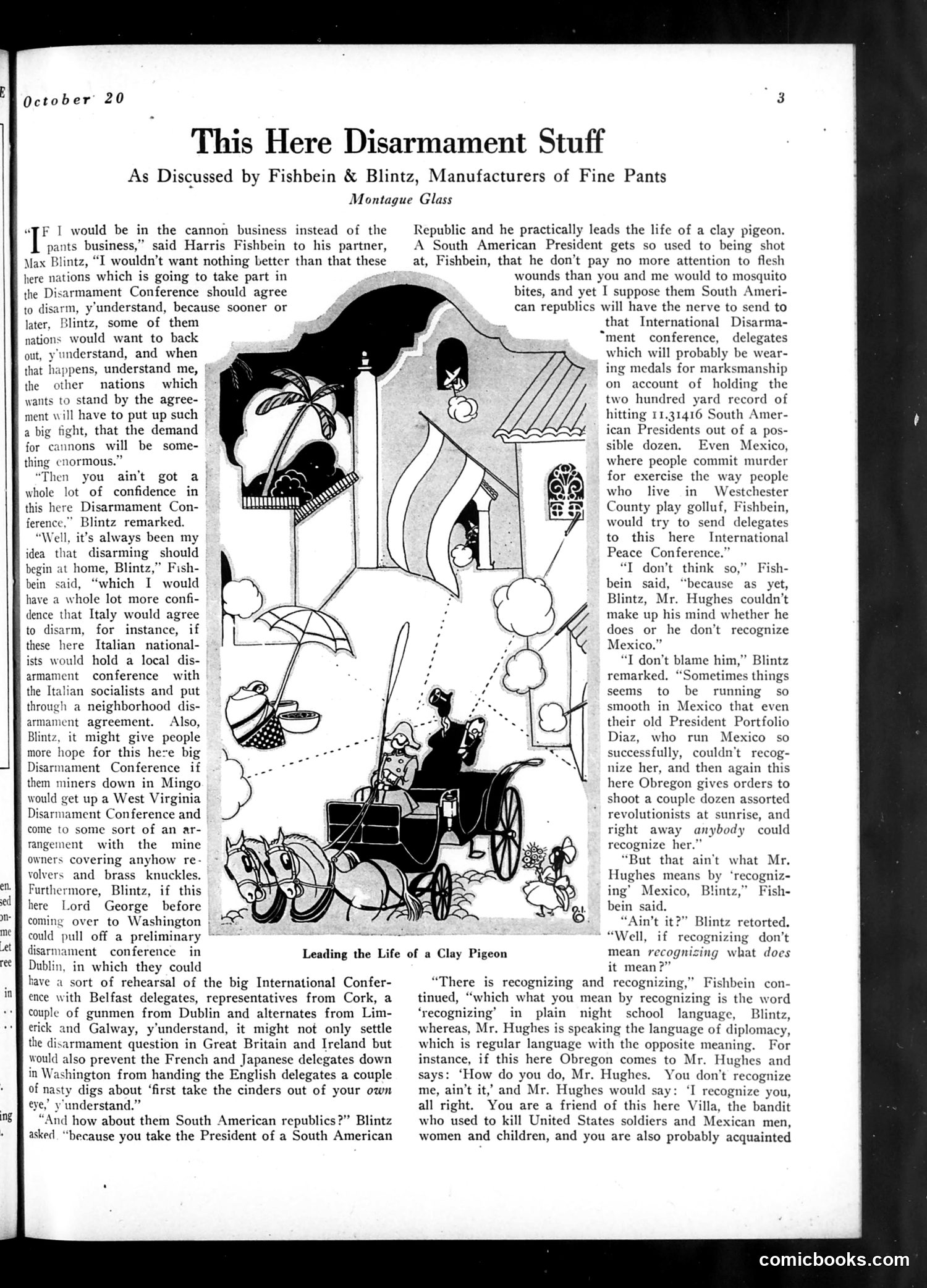
This satirical piece discusses the 1920s Disarmament Conference through a conversation between Harris Fishbein and Max Blintz, pants manufacturers. The central cartoon depicts a figure driving a cart labeled with various nations' symbols, leading a "clay pigeon"—a metaphor for nations being used as targets or dupes in diplomatic negotiations. The satire mocks the naive belief that international disarmament conferences will actually work. Fishbein argues that nations won't genuinely disarm because self-interest always prevails—using examples like Mexico and various South American republics, which despite peace talks continue military conflicts. The "clay pigeon" imagery suggests that smaller nations are expendable pawns in great power politics, while disarmament remains mere diplomatic theater.
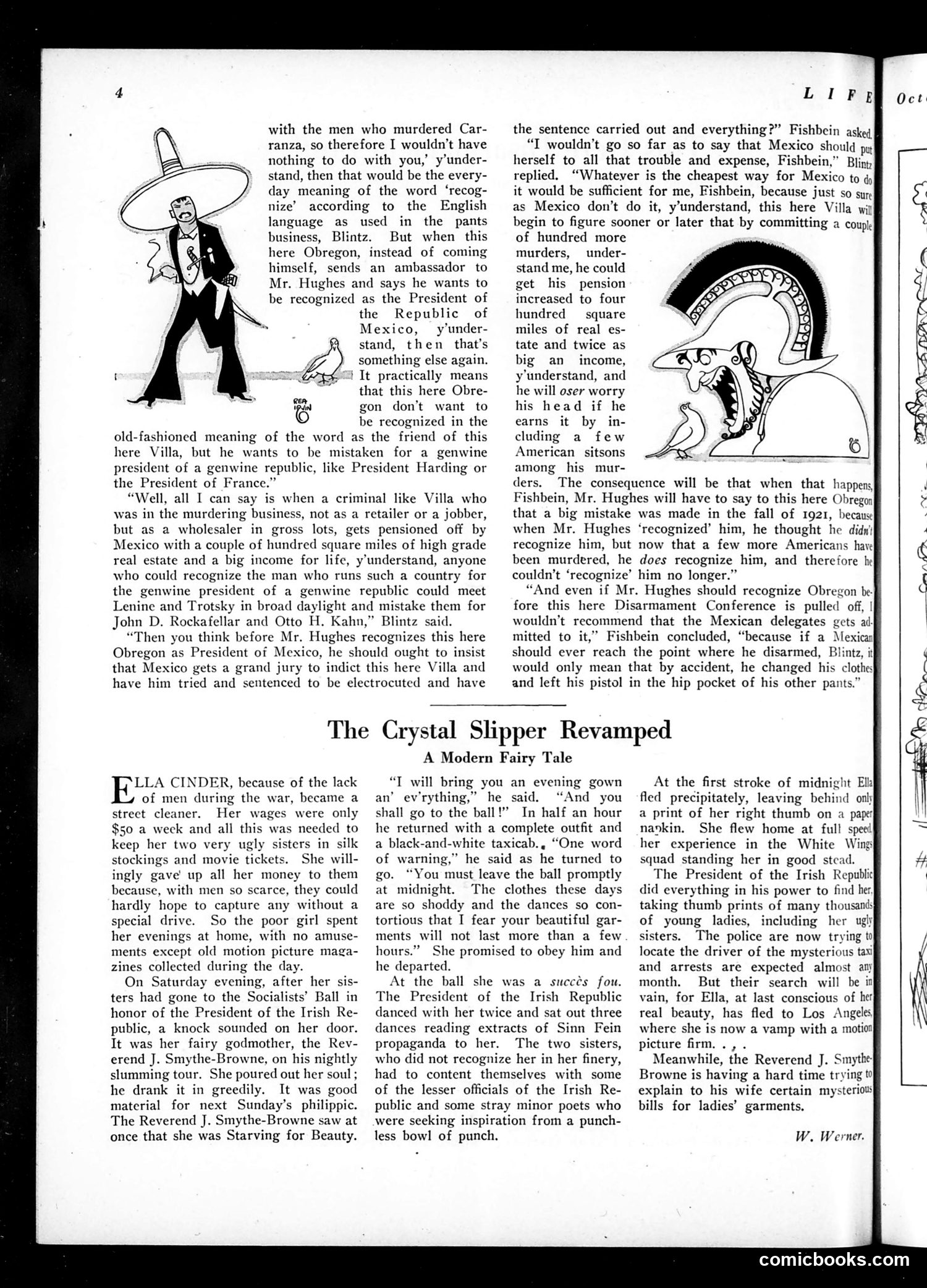
The left cartoon depicts a Mexican figure in traditional dress (large sombrero, formal jacket) labeled as Villa, referencing **Pancho Villa**, the Mexican revolutionary general. The satire concerns U.S. diplomat Charles Evans Hughes's potential recognition of Villa's government. The text argues Villa—a criminal "wholesaler" in murders—shouldn't receive diplomatic legitimacy merely because he controls territory. The cartoon's humor relies on the absurdity of granting presidential status to an acknowledged murderer. The right cartoon shows Villa as a devil or demon, reinforcing the satirical point: recognizing such a figure would be a grave diplomatic mistake. This reflects 1920s American anxieties about Mexican political instability and U.S. foreign policy decisions during Mexico's post-revolutionary period.
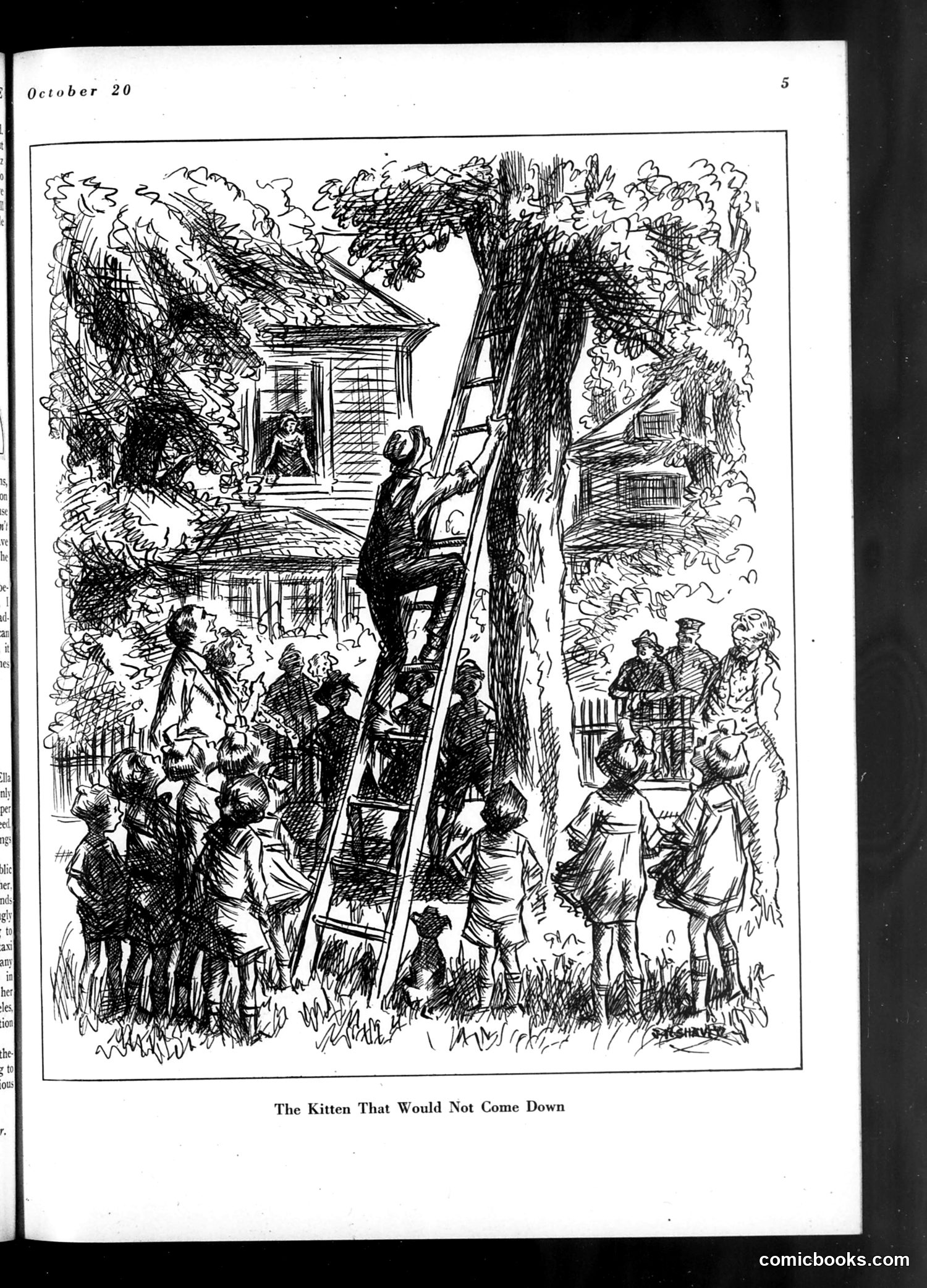
This illustration depicts a domestic scene where a kitten has climbed a tall tree and refuses to descend. A man stands on an extended ladder attempting rescue while a crowd of onlookers—adults and children—gathers below, watching the spectacle. The cartoon satirizes public fascination with minor domestic crises. The gathering crowd and the man's dramatic ladder-climbing effort suggest how ordinary people become invested in trivial neighborhood incidents, treating them as significant events worthy of collective attention and intervention. This reflects a timeless human tendency to transform small problems into community spectacles—a social observation about crowd mentality and the entertainment value of minor mishaps that Life's satirical magazine would have found amusing for its readership.
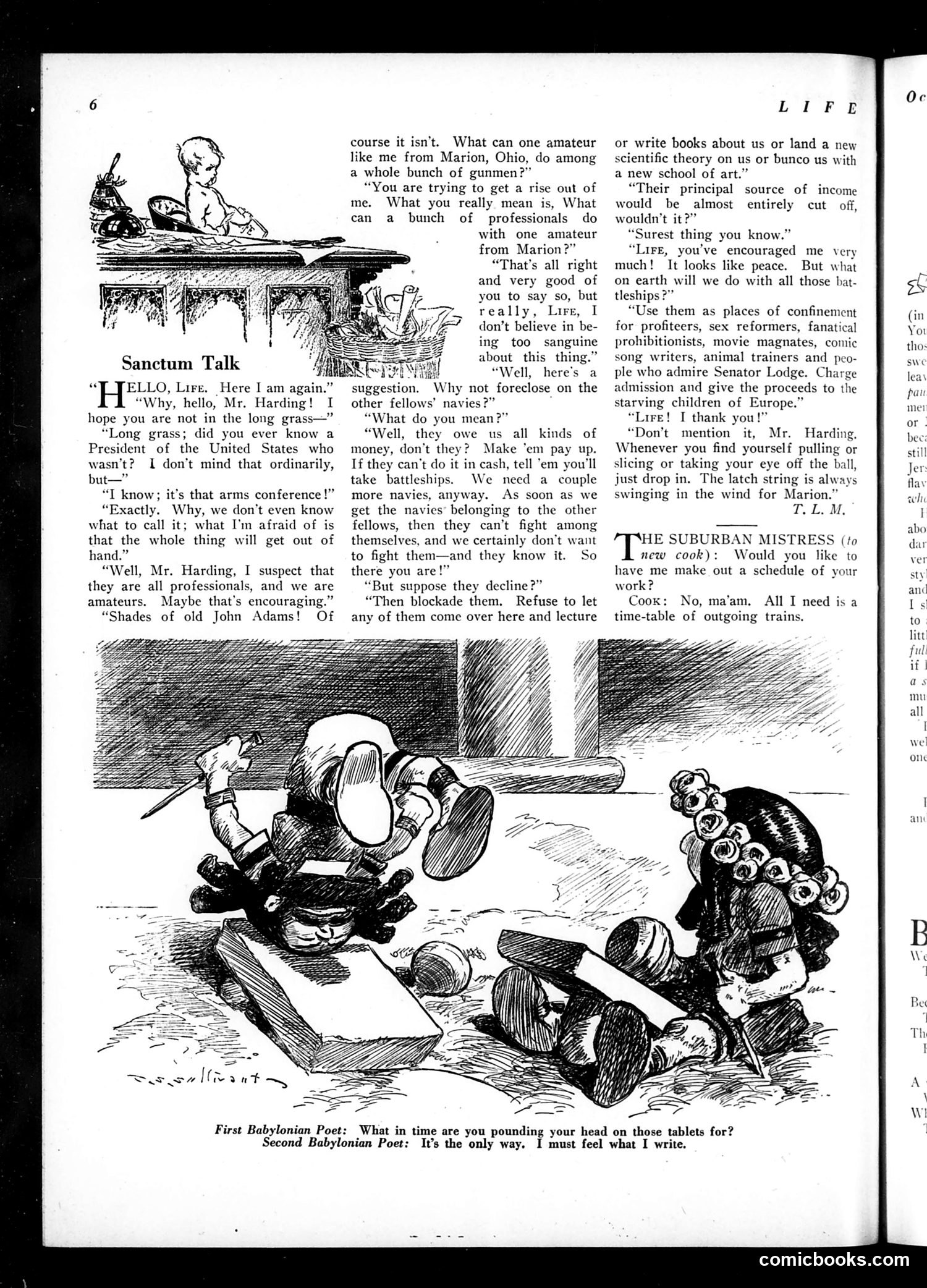
This page contains two distinct pieces of satirical content: **"Sanctum Talk"** (upper section): A dialogue between Mr. Harding (likely President Warren G. Harding) and "Life" magazine's editor discussing naval conferences and military preparedness. The satire criticizes how politicians and amateurs discuss serious matters like naval policy without genuine expertise, suggesting such important decisions are made superficially. **Lower cartoon**: Depicts two "Babylonian Poets" literally pounding their heads on tablets while writing. The caption mocks pretentious artistic methods—one poet claims he must "feel what I write," suggesting modern poets engage in absurd physical rituals to justify their work. This satirizes avant-garde artistic affectation and the performative nature of creative pretension popular in the 1920s.
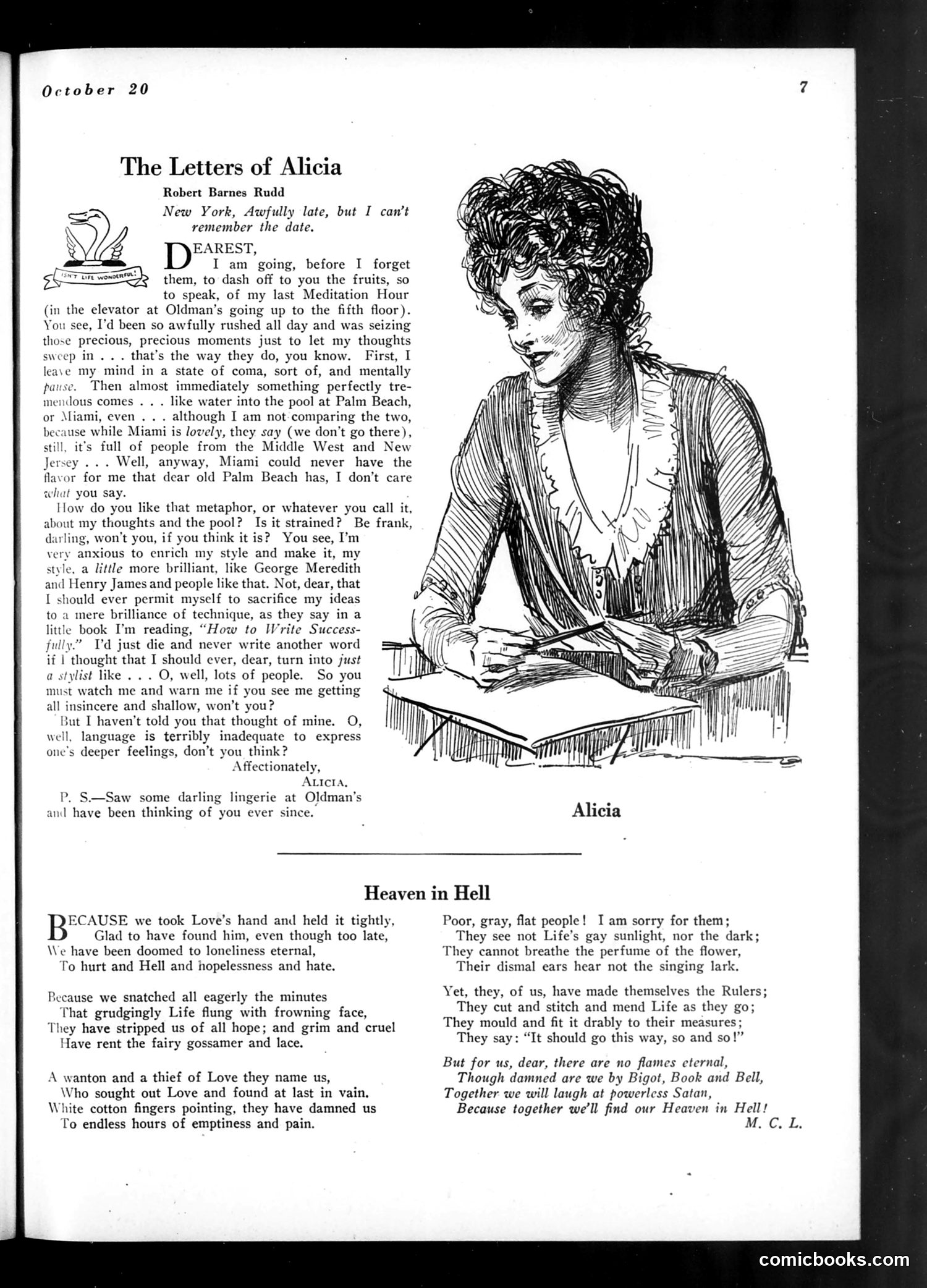
This page from *Life* magazine features two distinct pieces: **"The Letters of Alicia"** is a humorous column by Robert Barnes Rudd presenting a fictional letter from a woman named Alicia writing from New York. She humorously describes her scattered mental state, comparing her thoughts to water flowing into a pool, and critiques Miami and Palm Beach as shallow resort destinations populated by Midwesterners. The piece gently satirizes both women's introspection and the superficiality of wealthy leisure culture. **"Heaven in Hell"** is a poem (possibly by M.C.L.) that appears to be a romantic or philosophical piece about lovers finding happiness despite earthly suffering and societal judgment—possibly referencing social disapproval of an unconventional relationship. Both pieces showcase *Life's* satirical approach to contemporary social commentary and relationships.
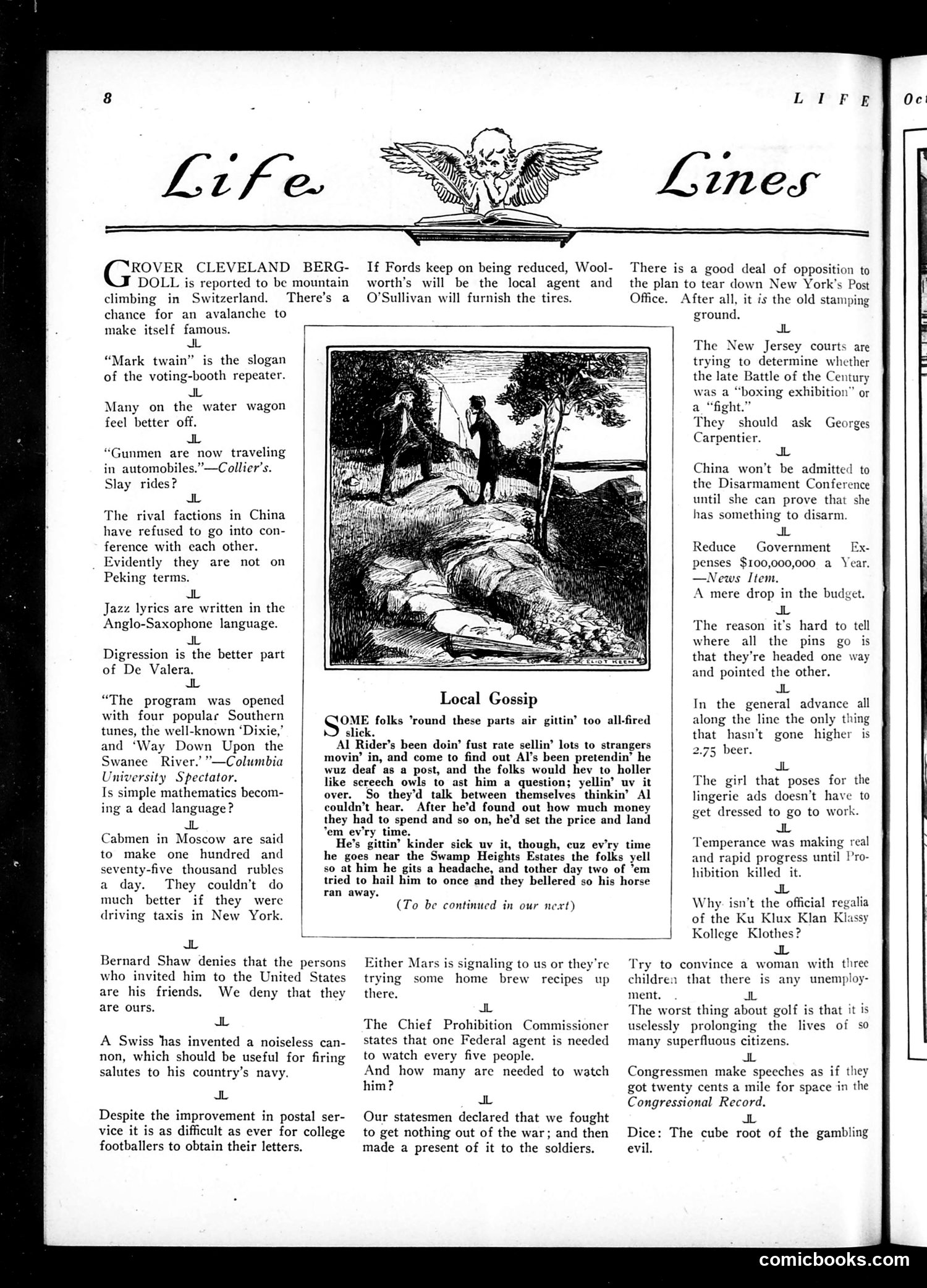
This page contains a satirical "Local Gossip" section with a woodcut illustration showing two men examining what appears to be a body or unconscious person on the ground. The accompanying text describes neighborhood gossip about people selling property lots to strangers and romantic entanglements—someone named Al pretending to be dead, financial disputes over land prices, and domestic complications. The illustration's dark humor matches the gossipy tone: it visualizes the scandalous "death" referenced in the text as comic melodrama. The overall page mocks small-town or suburban social drama—people's tendency to fabricate stories, engage in petty financial schemes, and create romantic intrigue within their communities. It's gentle satire of everyday human nature rather than political commentary.
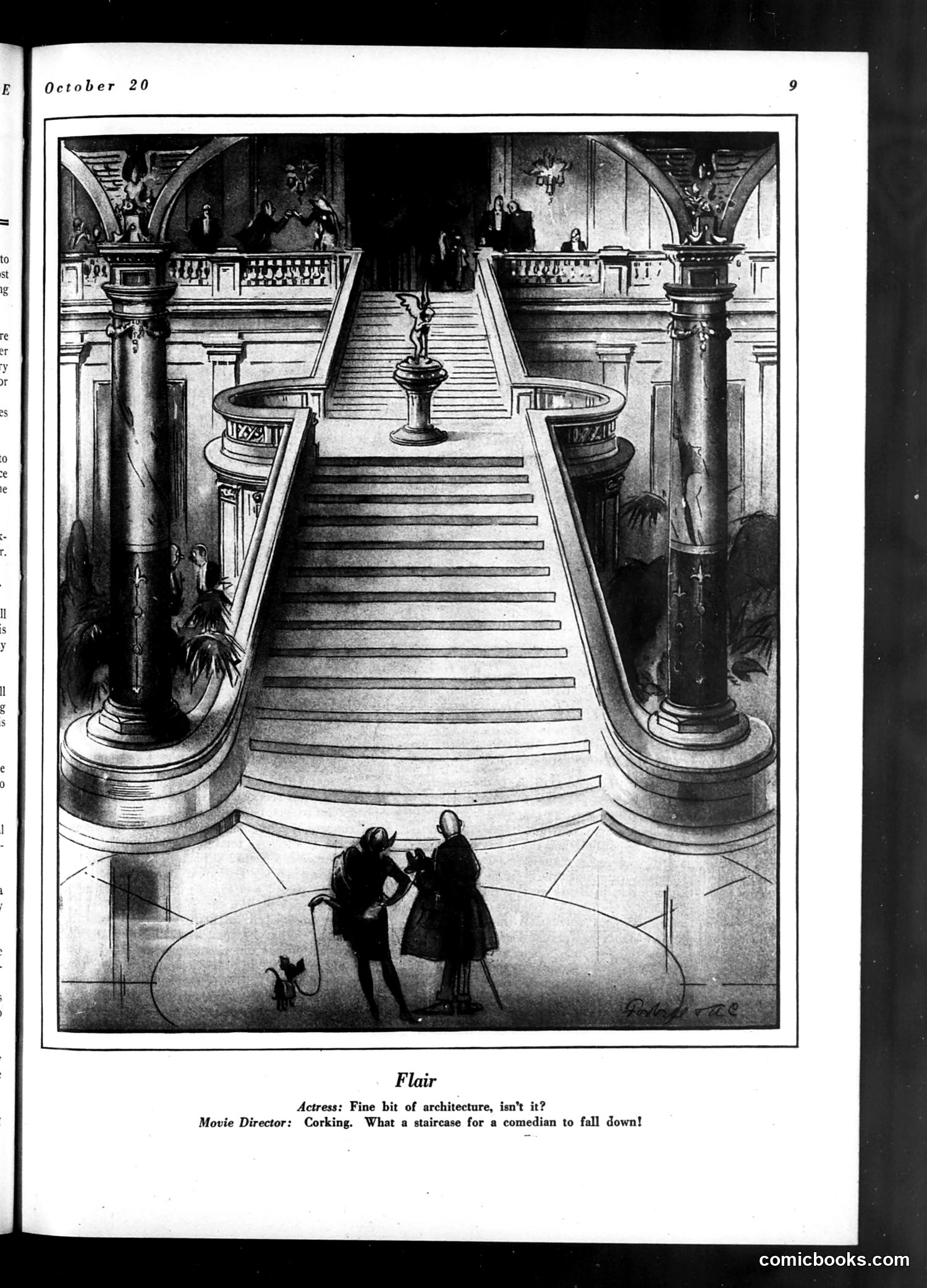
This single-panel cartoon satirizes Hollywood filmmaking pretension. The image shows a grand, symmetrical staircase with classical architecture—columns, balustrades, and formal design elements. Two figures stand in the foreground examining the space. The caption presents dialogue between an actress and a movie director (identified as "Corking"): **Actress:** "Fine bit of architecture, isn't it?" **Movie Director:** "Corking. What a staircase for a comedian to fall down!" The joke mocks how directors prioritize spectacle and comedic effect over genuine artistic or architectural merit. The director cares only about the staircase's potential for physical comedy (a pratfall), not its aesthetic value. This satirizes Hollywood's focus on entertainment value over genuine artistry.
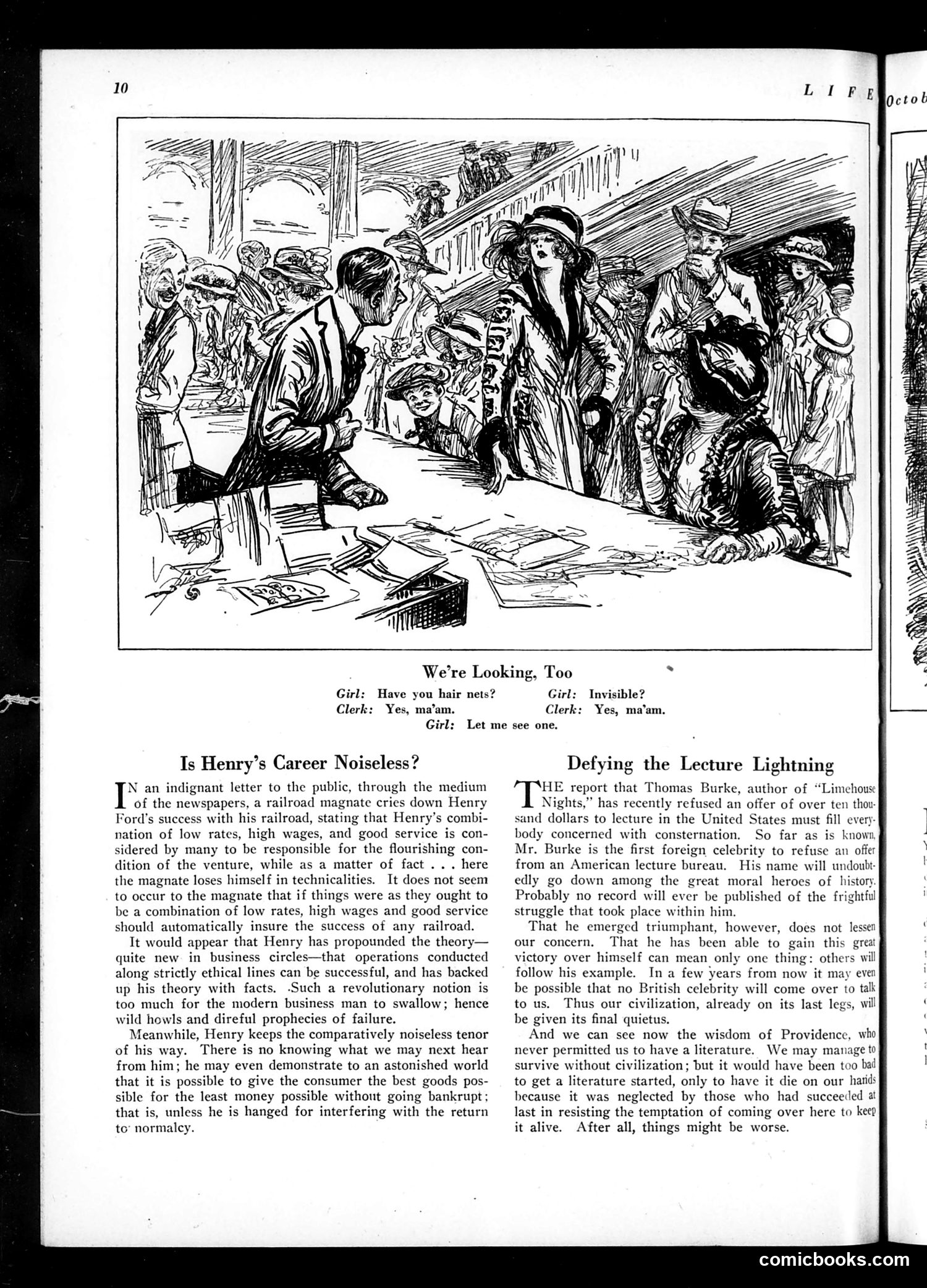
This cartoon depicts a street scene where a clerk is showing hair nets to a girl customer. The humor is a visual pun: the girl asks if the clerk has "invisible" hair nets, and when shown one, she cannot see it—because it's invisible. The joke plays on the absurdity of marketing an "invisible" product; the girl's literal inability to view the merchandise undercuts the sales pitch. The surrounding crowd of onlookers suggests this is a public transaction that has drawn attention, possibly satirizing both gullible consumers and dubious sales tactics of the era. The cartoon mocks both the product marketing and the customer's expectations in early 20th-century consumer culture.
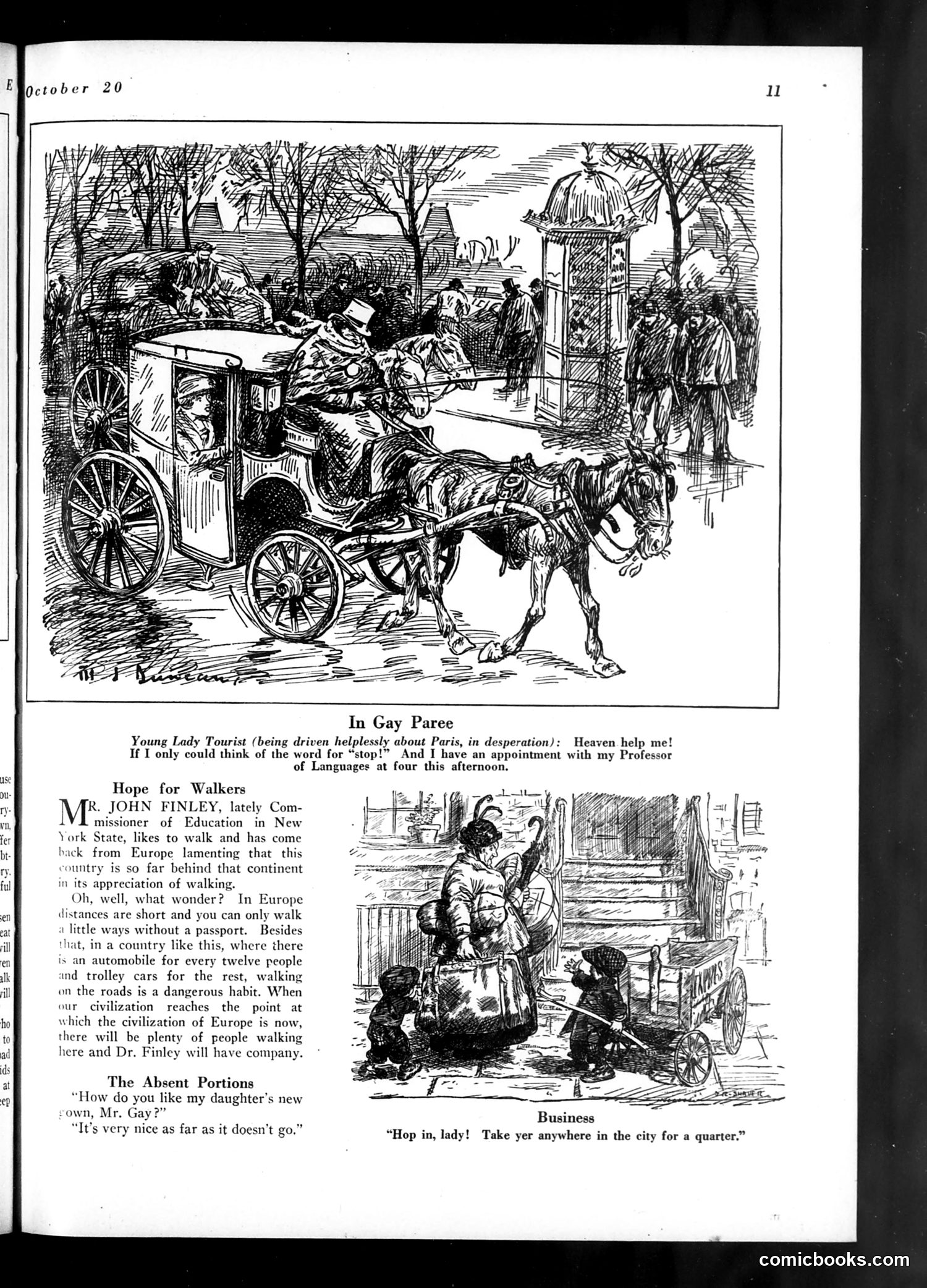
This page contains three separate satirical items: 1. **"In Gay Paree"**: A cartoon mocking American tourists in Paris. A young female tourist sits helplessly in a horse-drawn carriage, frustrated because she can't remember the French word for "stop" and has a language professor appointment at four. 2. **"Hope for Walkers"**: A brief article about Mr. John Ripley, a New York State education commissioner, who walked across Europe. It jokes that American civilization will eventually adopt European-style walking when automobiles become impractical. 3. **"The Absent Portions"** and **"Business"**: Two separate joke vignettes about town-planning and cab fares, likely humorous observations about contemporary life. The satire targets American tourist incompetence abroad and automobile culture.
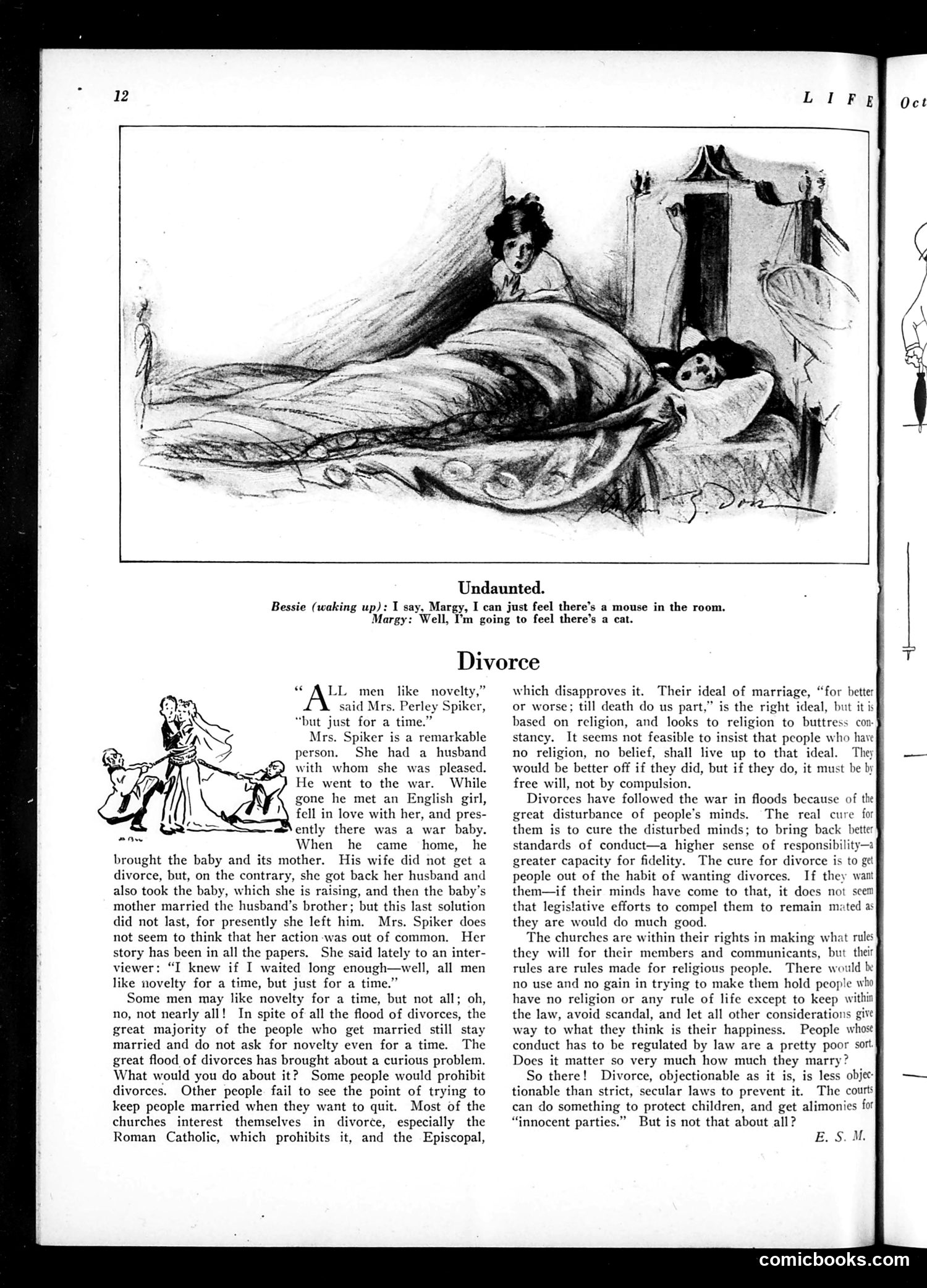
The cartoon titled "Undaunted" shows a humorous domestic scene: a woman in bed feels "a mouse in the room," while her companion responds she'll "feel there's a cat" — a joke about escalating anxieties or one-upmanship in worry. The accompanying article discusses divorce in early 20th-century America, focusing on Mrs. Perley Spiker, described as a "remarkable person" who married, had children during her husband's wartime absence, then divorced rather than pursue novelty. The piece argues that divorce itself isn't the problem; rather, churches and society should focus on strengthening marriage through better moral standards and responsibility, rather than prohibition. The author suggests legal divorce protections for "innocent parties" represent a practical, if imperfect, solution.
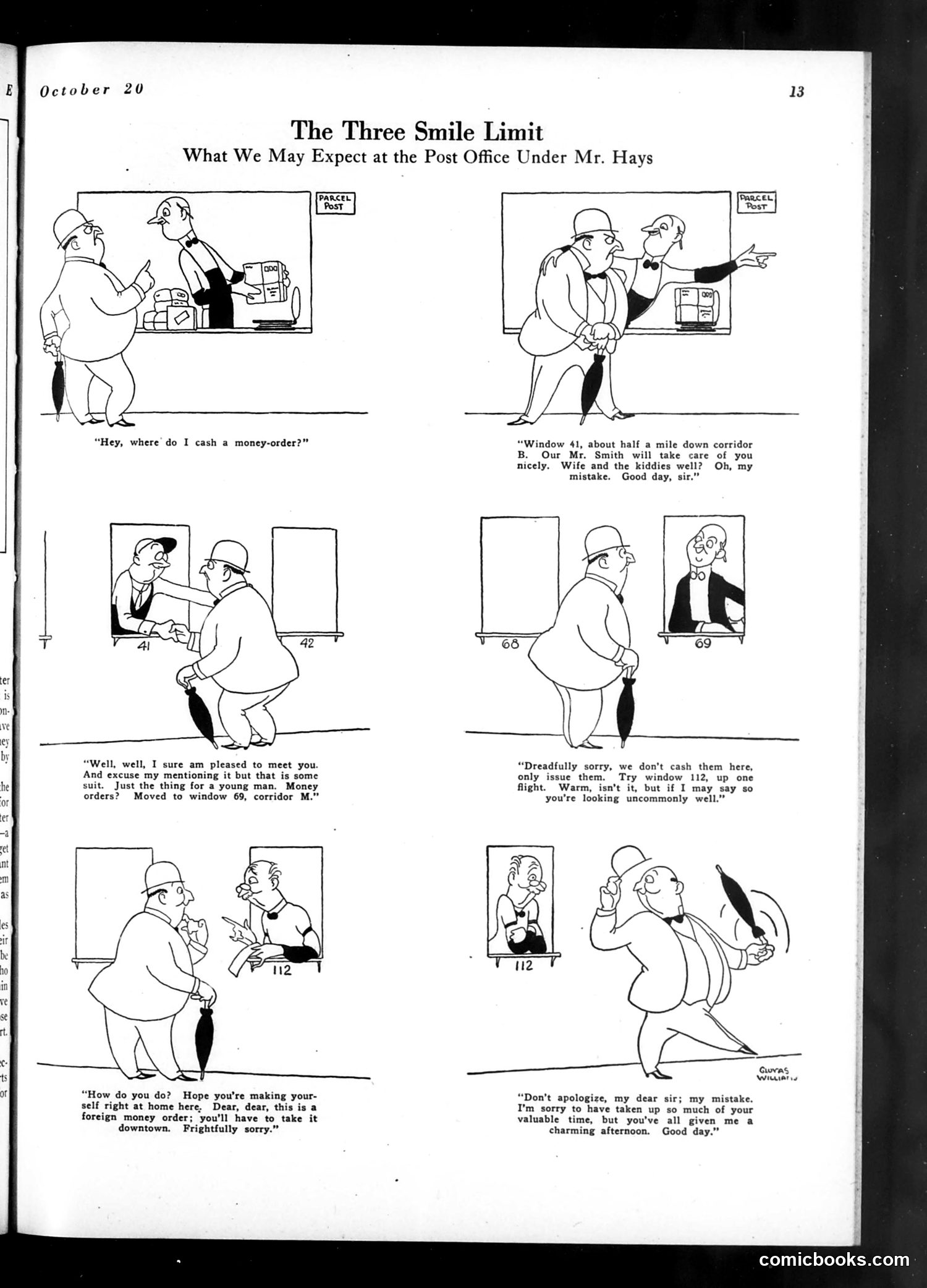
This satirical cartoon series depicts a post office clerk's deteriorating patience with customers. The title "The Three Smile Limit: What We May Expect at the Post Office Under Mr. Hays" references Will H. Hays, likely postmaster general or a newly appointed official implementing efficiency reforms. The sequence shows a customer service interaction where the clerk maintains professional courtesy through three increasingly absurd customer requests (money orders, redirected windows, foreign currency exchanges). By the final panel, the clerk's patience is exhausted—he's literally fleeing in distress. The satire mocks new postal management's emphasis on efficiency and courtesy limits, suggesting that bureaucratic "smile quotas" for customer service are unrealistic and dehumanizing, ultimately backfiring when genuine human frustration emerges.
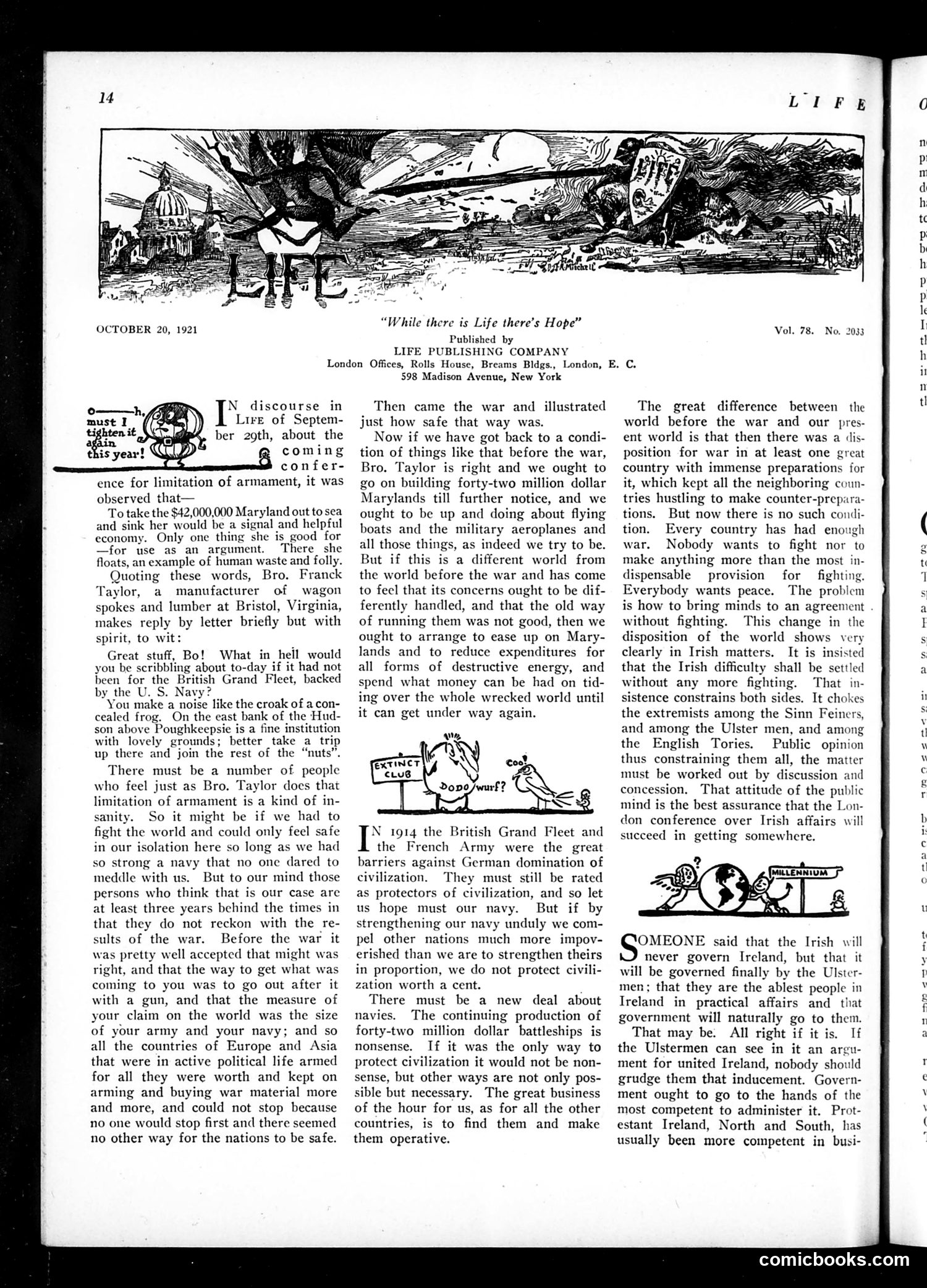
The page contains editorial text debating post-WWI military policy and Irish independence—not political cartoons. The visible cartoon appears in the middle: a small figure labeled "INSTINCT" confronts another labeled "DODO," likely satirizing outdated thinking about naval armament. The "DODO" represents obsolete military reasoning. The main text discusses whether nations should reduce military spending after WWI. One writer argues Britain's naval dominance (the "Grand Fleet") no longer justifies enormous expenditure, while another defends maintaining strong defenses. A separate section addresses Irish governance, opposing the notion that only the "Ulstermen" or English Tories should decide Ireland's fate. The satire targets those clinging to pre-war military logic as extinct as the dodo bird.
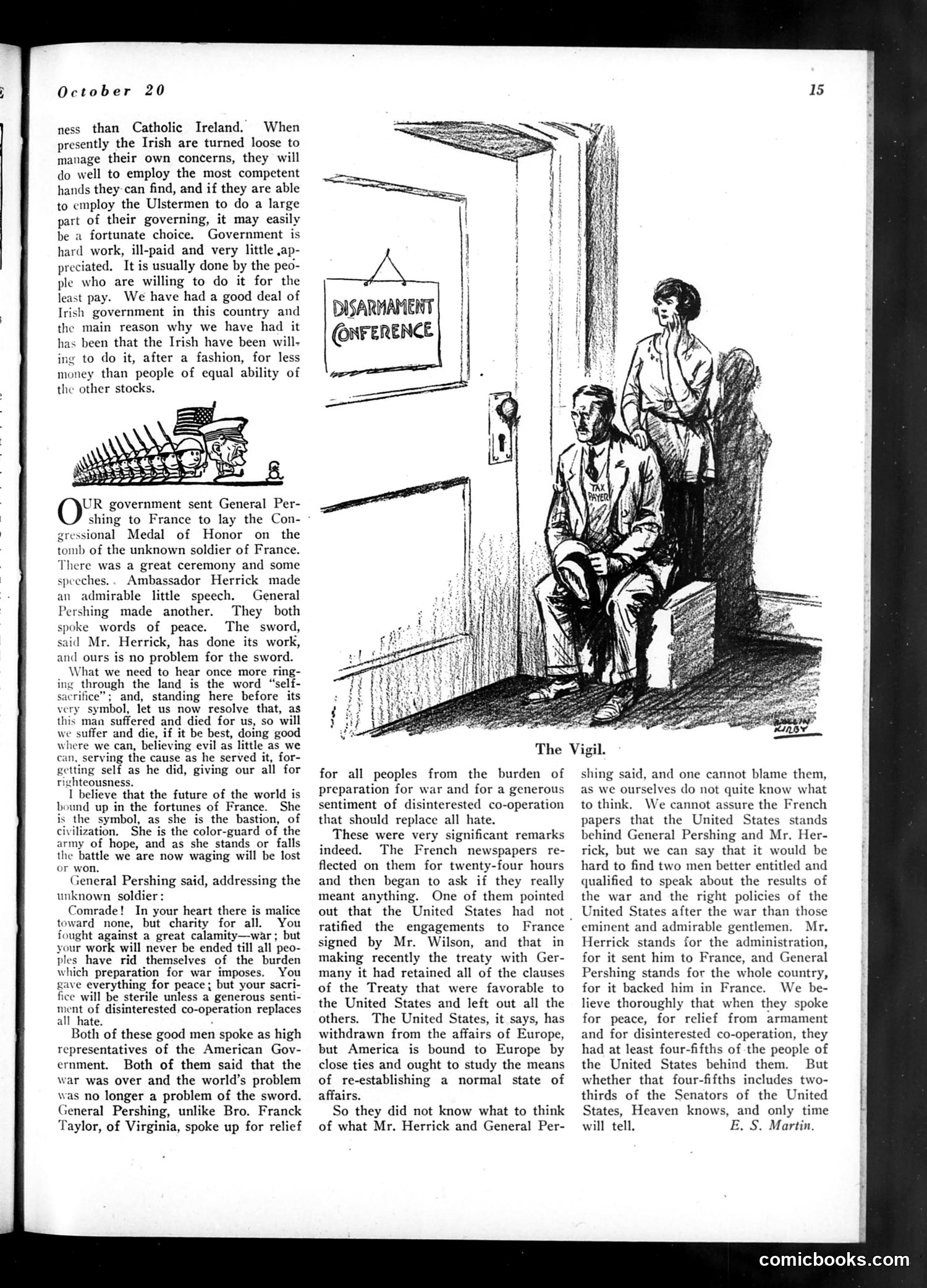
This page critiques post-WWI American foreign policy contradictions. The cartoon shows two figures maintaining a vigil outside a "Disarmament Conference" room, symbolizing uncertainty about U.S. commitment to peace. The accompanying text reports on General Pershing's ceremonial speech at the tomb of France's unknown soldier, where he and Ambassador Herrick eloquently advocated for disarmament and international cooperation to replace war-making. However, the article's real point—indicated by the skeptical French newspaper response—exposes the hypocrisy: while America publicly champions peace and disarmament, it has actually withdrawn from European affairs while simultaneously binding itself to Europe through treaties. The U.S. ratified favorable treaty clauses but ignored unfavorable ones, suggesting self-interest rather than genuine "disinterested co-operation." The satire targets the disconnect between American rhetorical idealism and actual diplomatic behavior, leaving even the French confused about U.S. sincerity.
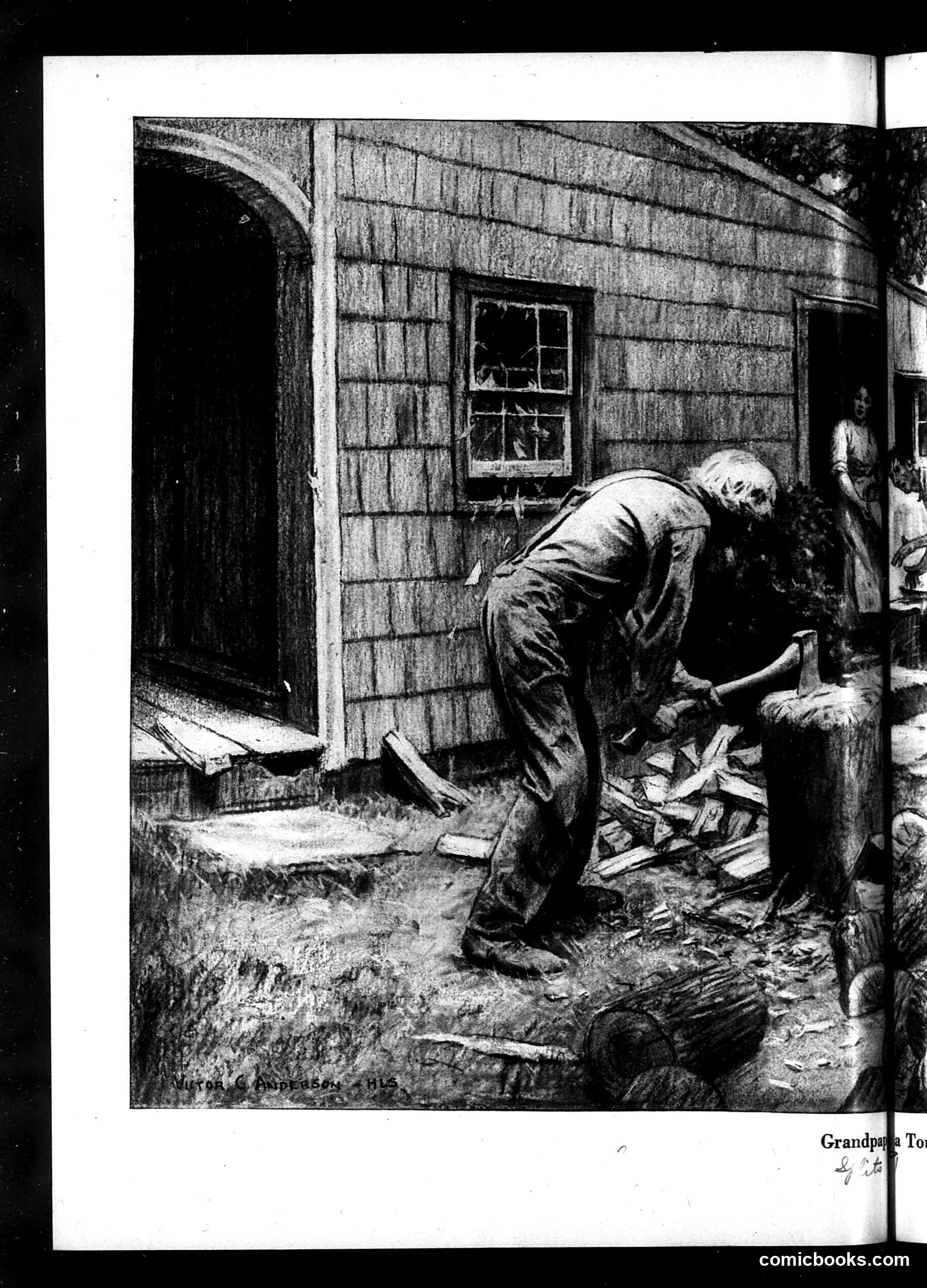
This black and white photograph depicts an elderly man bent over, chopping wood outside a rustic wooden building with a small window. The image appears to be captioned "Grandpa's To[...]" (text cut off). Without the complete caption or surrounding article text, the specific satirical point is unclear. However, this appears to be documentary or humorous *Life* magazine content from the early-to-mid 20th century, likely depicting rural American life. The photograph may be illustrating themes about aging, rural labor, or self-sufficiency—possibly ironical commentary on "back to basics" nostalgia or Depression-era hardship. The exact satirical target and historical context cannot be definitively determined from the image alone.
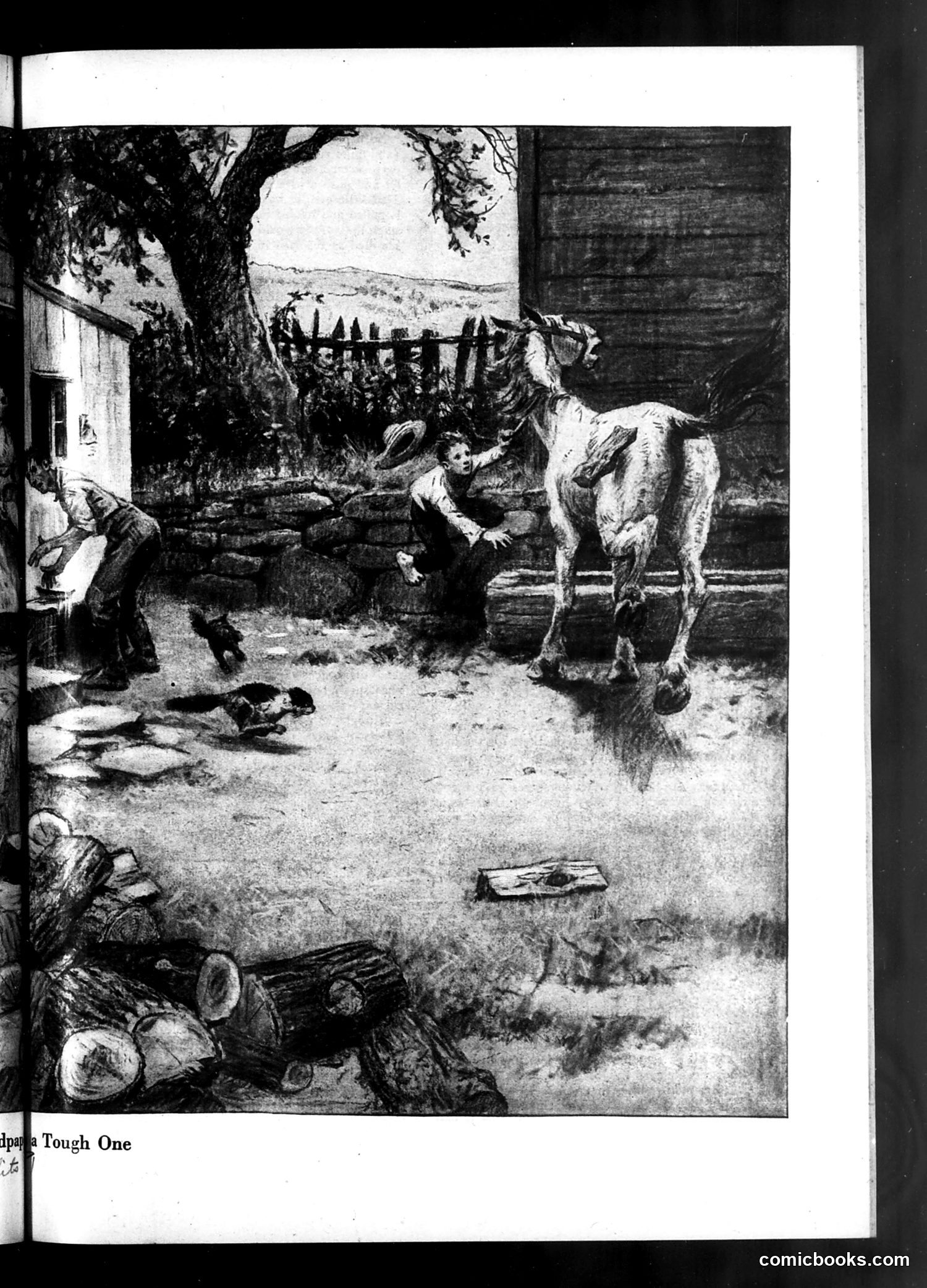
This page shows an illustration titled "A Tough One" depicting a rural courtyard scene. A man appears to be negotiating with or examining a horse, while another figure watches from a doorway on the left. The setting includes a cottage, bare tree, and distant landscape with cypress trees suggesting Mediterranean or Southern European locale. The visible text only reads "A Tough One" and the website attribution. Without additional context from the magazine issue, I cannot definitively identify the specific political or social satire intended. The title suggests difficulty in a transaction or negotiation, possibly commentary on rural trade or animal dealing, but the exact satirical target remains unclear from the image and text alone.
This page contains theater criticism by Robert C. Benchley reviewing three Broadway musicals. The cartoons are simple decorative elements showing performers in exaggerated poses—typical of the era's theatrical illustrations rather than political satire. The reviews discuss: 1. **"The O'Brien Girl"**: Benchley humorously complains that a song he'd been promoting was removed from the Boston version before reaching New York, making him look uninformed to acquaintances. He mocks his own embarrassment over this. 2. **"Lilies of the Field"**: He criticizes the plot as dull but praises supporting actress Josephine Drake over star Marie Doro, who mainly "weep[s] a lot and push[es] a little girl in and out." 3. **"Blossom Time"**: He praises its emotionally affecting music for evoking nostalgia and regret about life's unfulfilled ideals. The humor is personal and self-deprecating rather than political—typical of Benchley's witty theater commentary style for *Life* magazine during the 1920s.
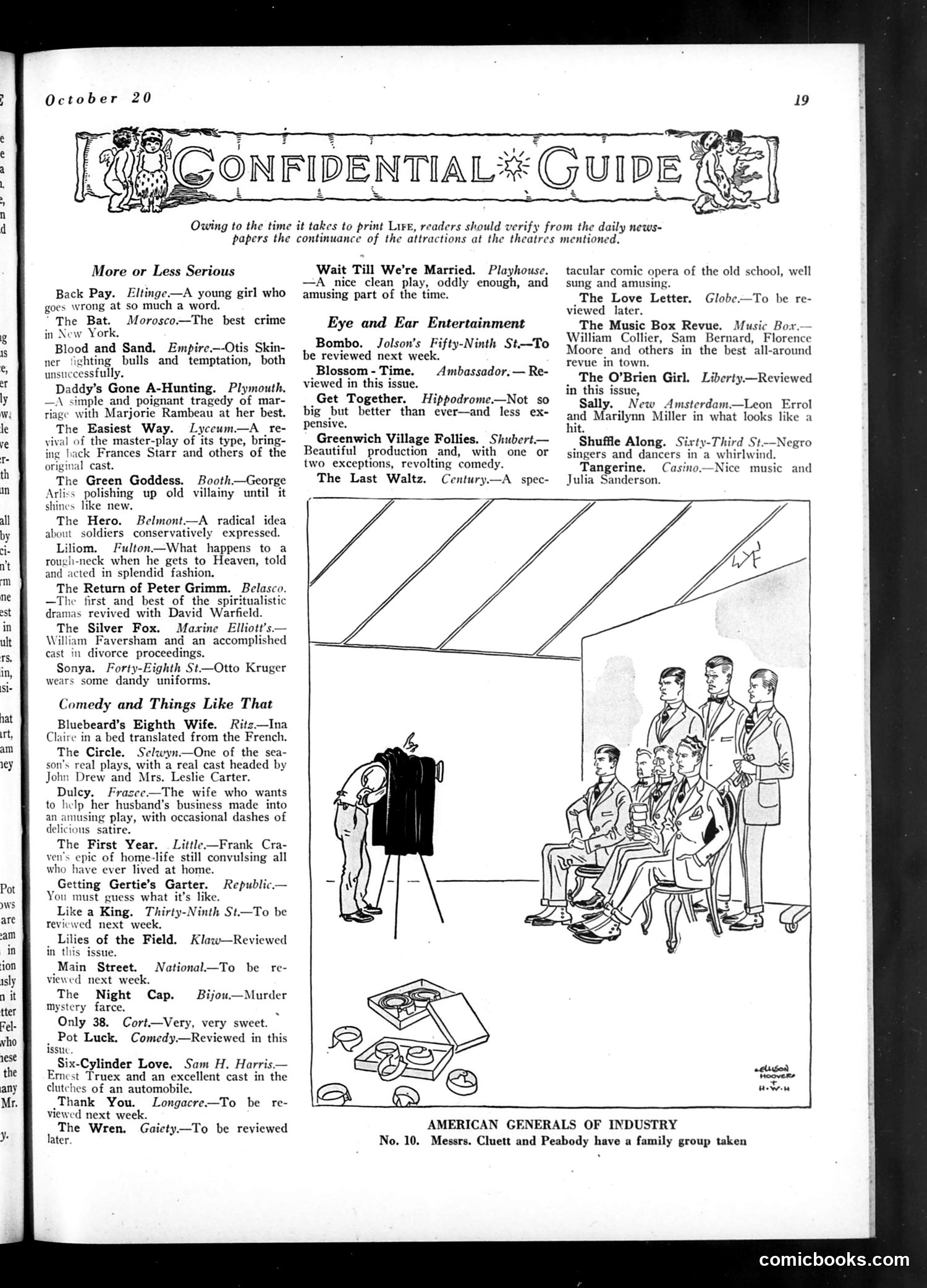
This page is primarily a **theater guide** reviewing Broadway shows currently playing, with brief satirical commentary on each production. The reviews use witty one-liners to characterize plots—for example, "Blood and Sand" is described as "Otis Skinner fighting bulls and temptation, both unsuccessfully," and "Dulcy" is "The wife who wants to help her husband's business made into an amusing play." The **illustration** at bottom shows what appears to be an advertisement or photo feature titled "American Generals of Industry" (No. 10), depicting Messrs. Cluett and Peabody with a family group posed around what looks like industrial equipment or machinery. This juxtaposes the theatrical content above with contemporary business/industry figures—typical of Life's approach mixing entertainment, social commentary, and commercial content. The page demonstrates Life's role as a cultural arbiter reviewing entertainment while celebrating American business leaders.
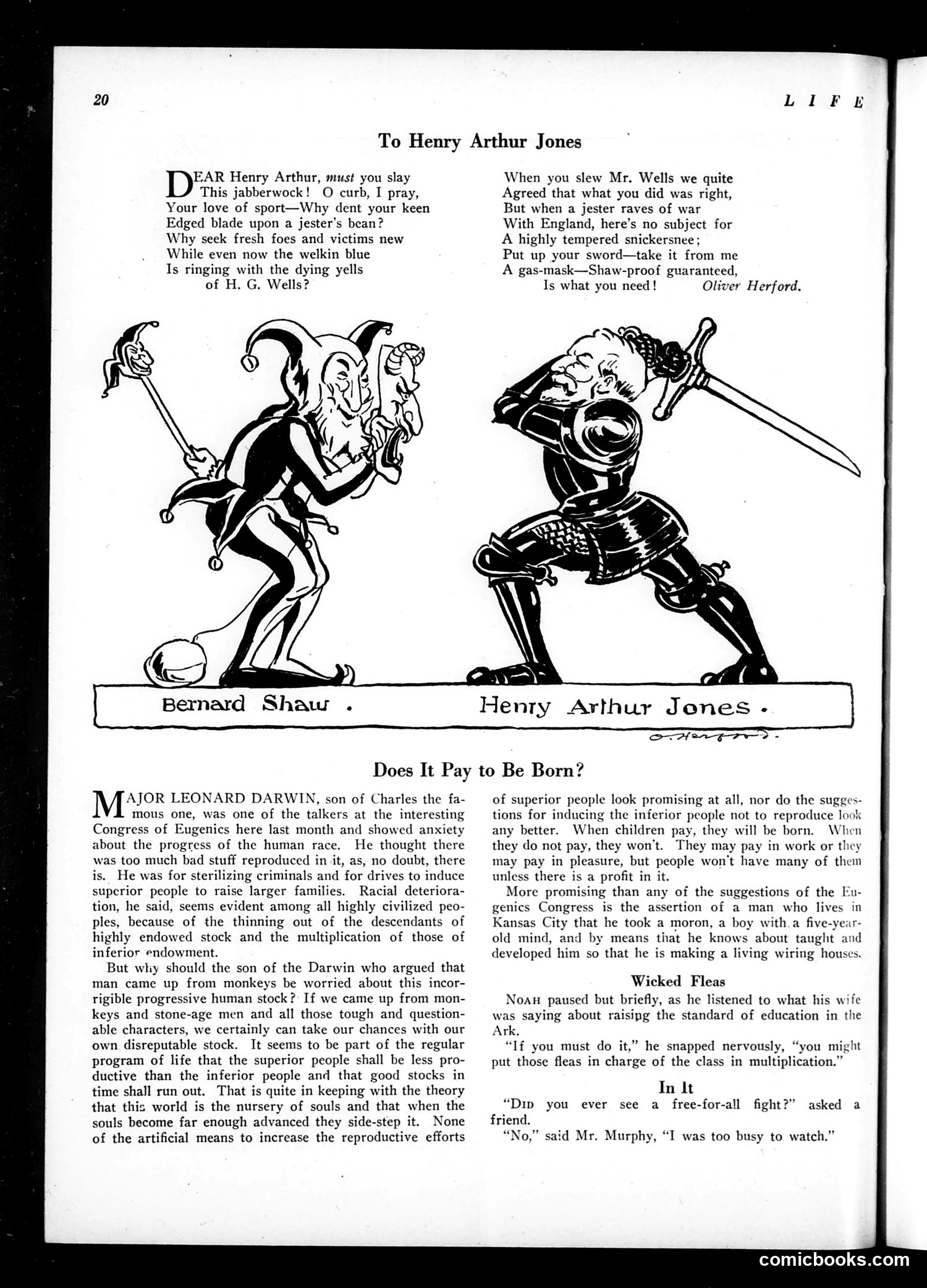
This page features a satirical poem-cartoon mocking playwright Henry Arthur Jones (depicted right, in armor with sword). The cartoon contrasts Jones with caricatured figures of George Bernard Shaw (left, as a jester) and H.G. Wells. The satire references Jones's aggressive theatrical criticism and public feuds. Shaw and Oliver Herford (the poem's author) jokingly suggest Jones has already "slain" Wells verbally and should stop attacking fellow writers. Shaw sarcastically recommends Jones trade his "sword" for a "gas-mask—Shaw-proof guaranteed," implying Shaw himself is the real target of Jones's vitriol. The joke turns on early-1900s literary rivalries: these were famous quarrelsome intellectuals known for public attacks on each other's work. The poem treats their disputes as mock-warfare, a witty commentary on aggressive critical egos among prominent writers of the era.
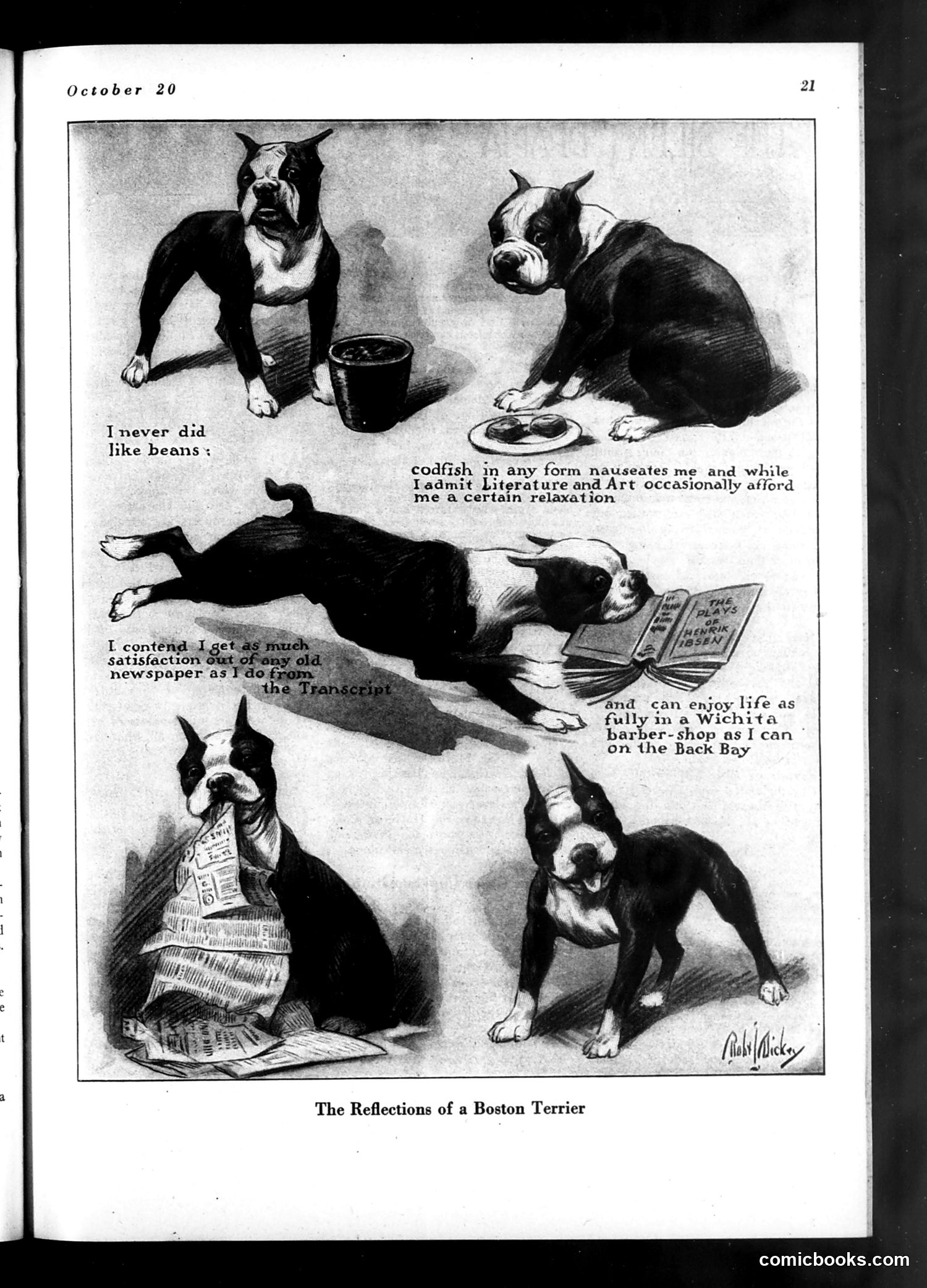
This is a humorous illustrated essay presenting a Boston Terrier's philosophical musings about life. The dog expresses snobbish preferences: dislike of beans, disgust at codfish, and modest appreciation for literature and art. The satire targets pretentious Boston society—the "Back Bay" reference evokes that wealthy, cultured neighborhood. The joke is that this dog claims cosmopolitan tastes while also contentedly accepting simple pleasures (a Wichita barber-shop), and enjoys reading newspapers. The cartoon anthropomorphizes the terrier to mock human affectation and class consciousness, suggesting Boston's elite aren't much more refined than a dog, despite their pretensions. The breed itself—a Boston Terrier—adds to the local humor.
This article mocks Universal Film Company's attempt to exclude professional critics from reviewing their low-budget film "The Rage of Paris" at New York's Central Theatre. Universal explicitly asked newspapers not to send regular critics, claiming the film was made for average moviegoers ("Mr. and Mrs. Public"), not analytical reviewers. Life's editors accepted this challenge ironically, sending an ordinary audience member instead. That person's review proved damning—the plot made no sense, and the film was poorly constructed. The satire's point: Universal's advertisement backfired spectacularly. Rather than protecting their mediocre product, excluding professional critics only highlighted its worthlessness. Life argues that producers have repeatedly tried this tactic unsuccessfully, and that good films actually *welcome* critical scrutiny. The implication is clear—Universal's defensive posturing proves the film deserves the criticism they tried to avoid.
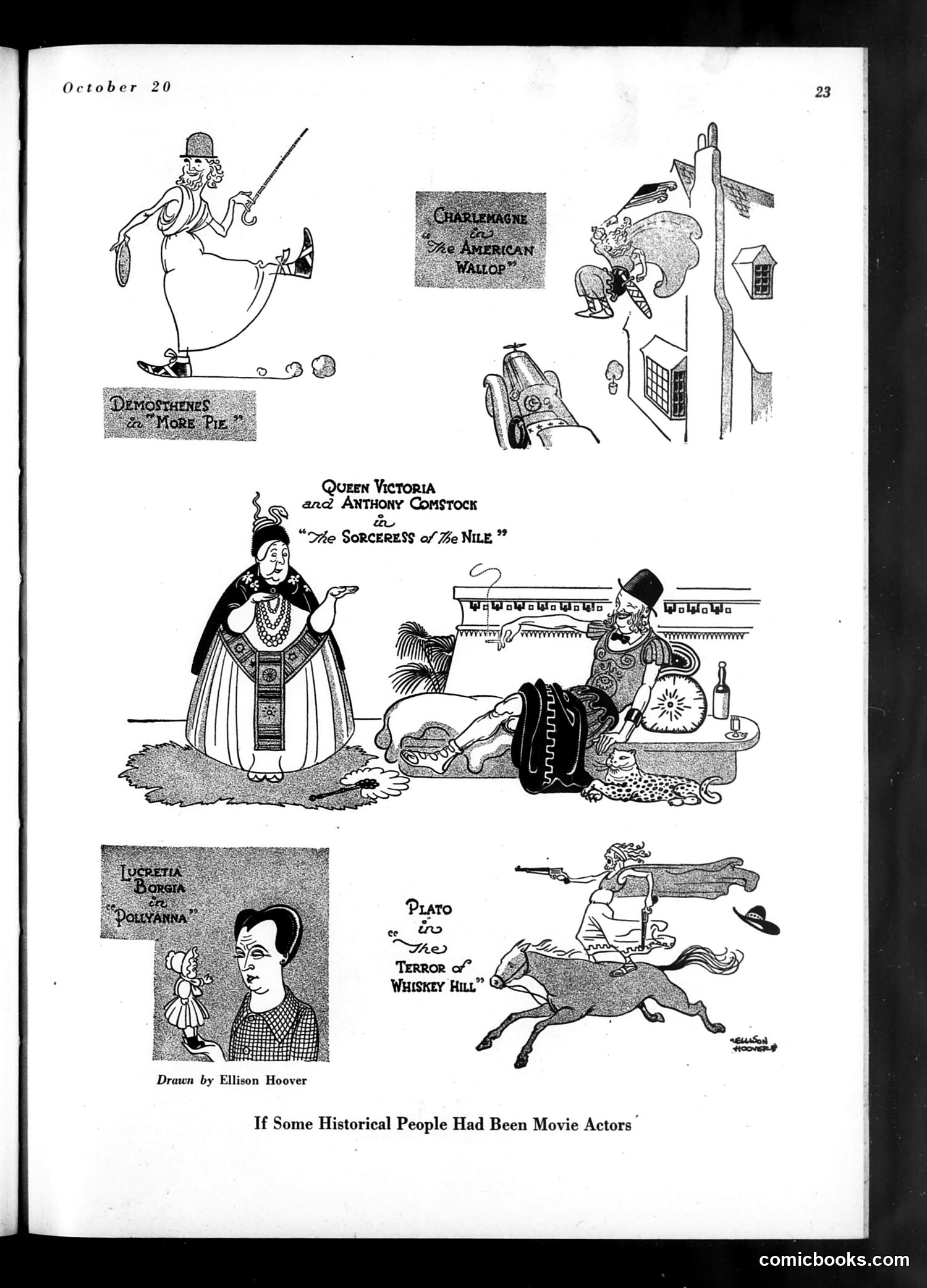
This satirical page imagines famous historical figures as characters in silent films. The cartoons parody period movie titles and scenarios: - **"Demosthenes to More Pie"**: A comedic take on the ancient orator - **"Charlemagne & American Wallop"**: Charlemagne in a slapstick scene - **"The Sorceress of the Nile"**: Queen Victoria and Anthony Comstock (a real anti-obscenity activist) in an Egyptianrome drama - **"Lucretia Borgia"**: The Renaissance poisoner depicted as a scheming character - **"Plato in the Terror of Whiskey Hill"**: An action scene with the philosopher The humor relies on the incongruity of dignified historical figures in melodramatic or comedic movie plots. This reflects 1920s-30s fascination with both cinema and historical drama. The page mocks both overwrought movie titles and the gap between historical importance and entertainment value.
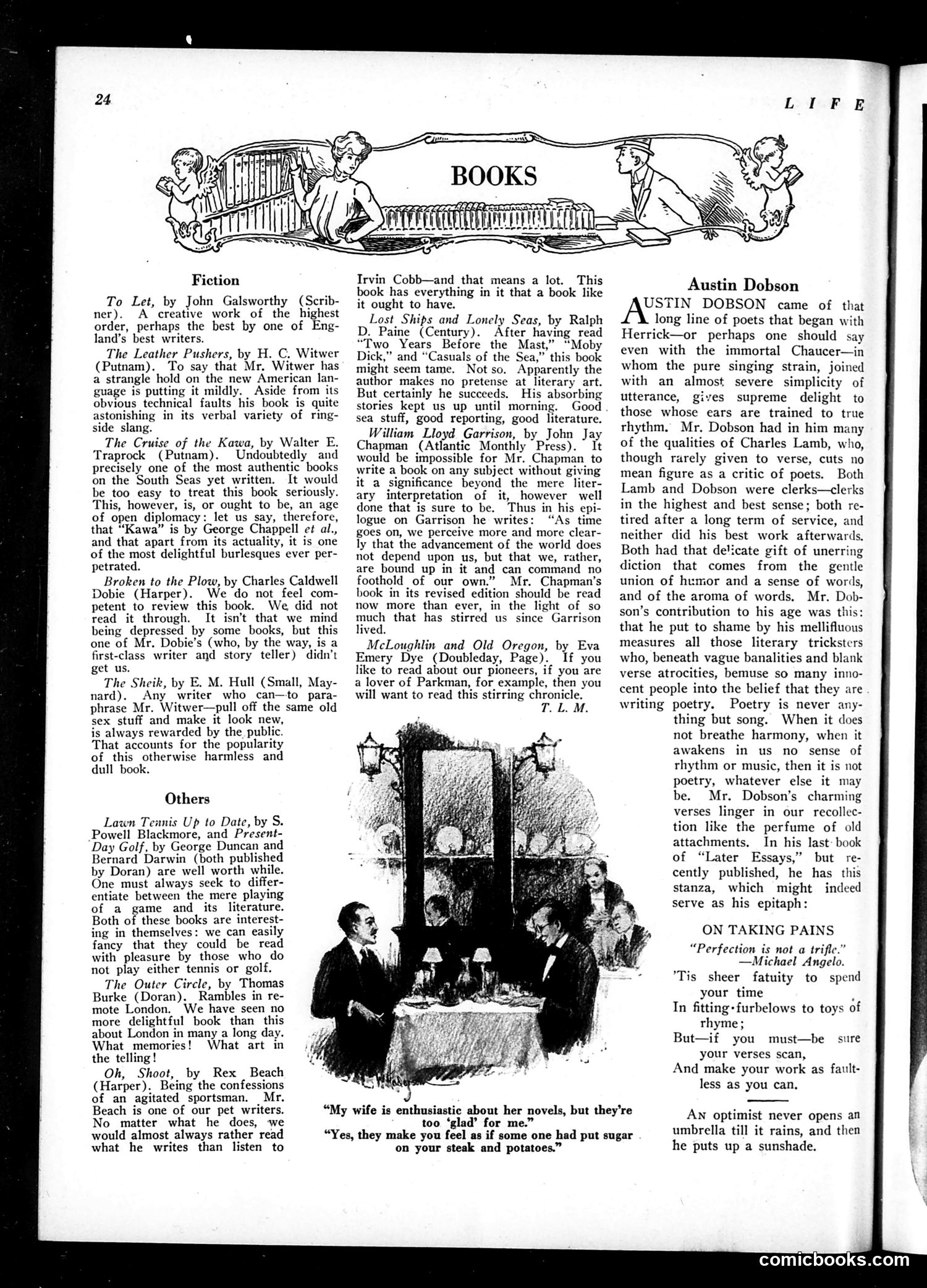
This is a **book review section** from Life magazine, not a political cartoon page. The main illustration shows two men dining, with the caption joking that one man's wife reads novels that make her feel "glad" he exists—a domestic humor dig at romantic fiction's unrealistic standards. The reviews themselves are literary criticism of early 1920s books. Notable: the critic dismisses *The Sheik* as "harmless and dull" despite its popularity, suggesting readers reward "sex stuff" over quality. The review praises *William Lloyd Garrison* (a biography) for its contemporary relevance to post-WWI society. References to classic sea literature (*Moby Dick*, *Two Years Before the Mast*) establish the magazine's educated, elite readership. The tone is sophisticated but accessible—Life positioned itself as smart entertainment for educated Americans. No major political content appears on this page.
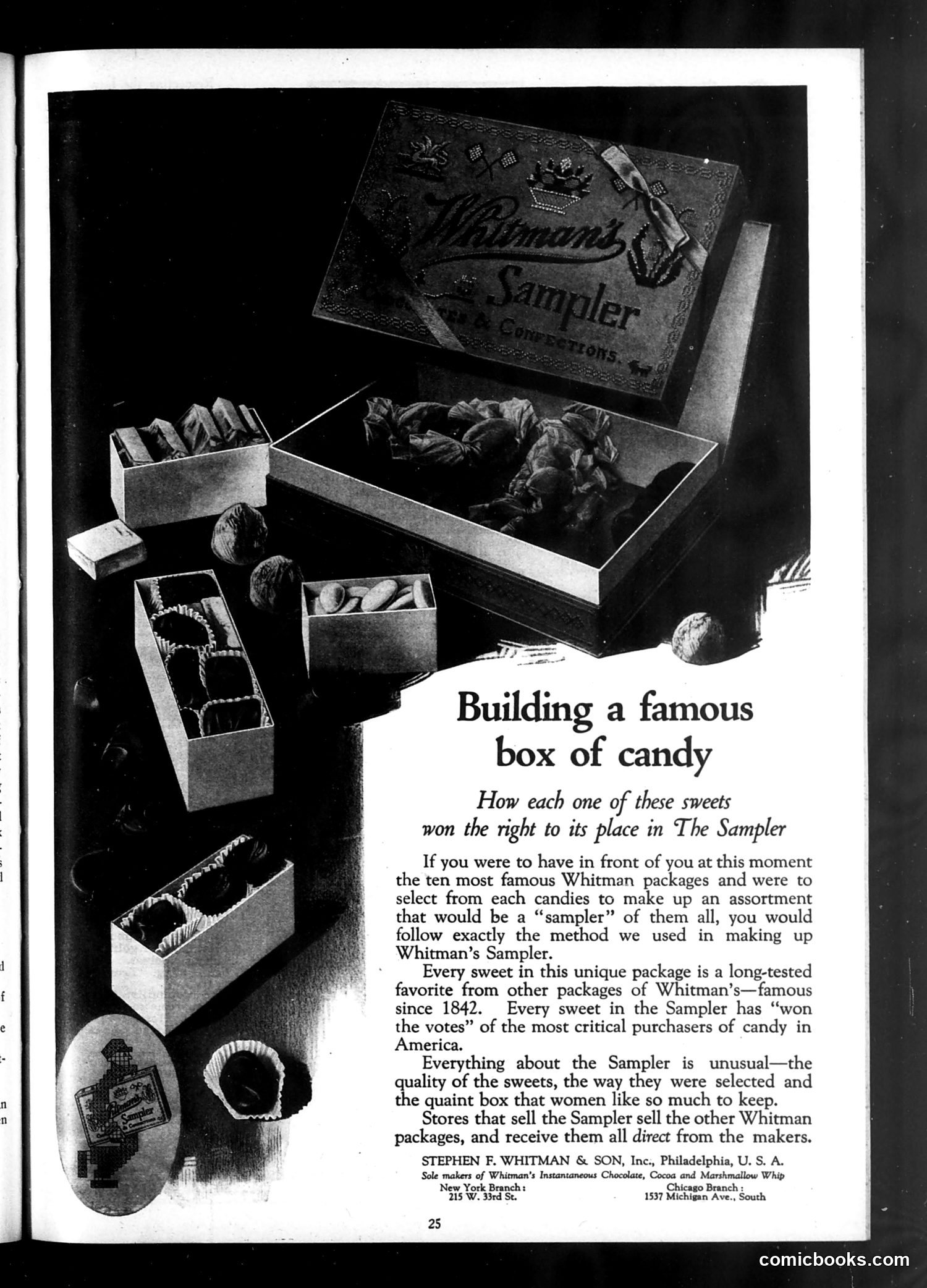
This is not a political cartoon but a **product advertisement** for Whitman's Sampler candy, published in *Life* magazine. The page showcases an opened box of assorted candies with various compartments displaying different confections. The advertisement's strategy emphasizes **curation and prestige**: each sweet in the sampler was allegedly "selected" from Whitman's ten most popular products, representing candies that have "won the votes" of America's most discerning candy buyers. The ad targets women specifically, noting they appreciate the "quaint box" enough to keep it after consuming the contents. The copy stresses the company's heritage (operating since 1842) and quality control. This reflects early 20th-century marketing that positioned branded, packaged goods as trustworthy alternatives to bulk candy, appealing to middle-class consumers' desire for known quality and refined taste. There is no satire or political content—this is straightforward commercial messaging typical of *Life* magazine's advertising sections.
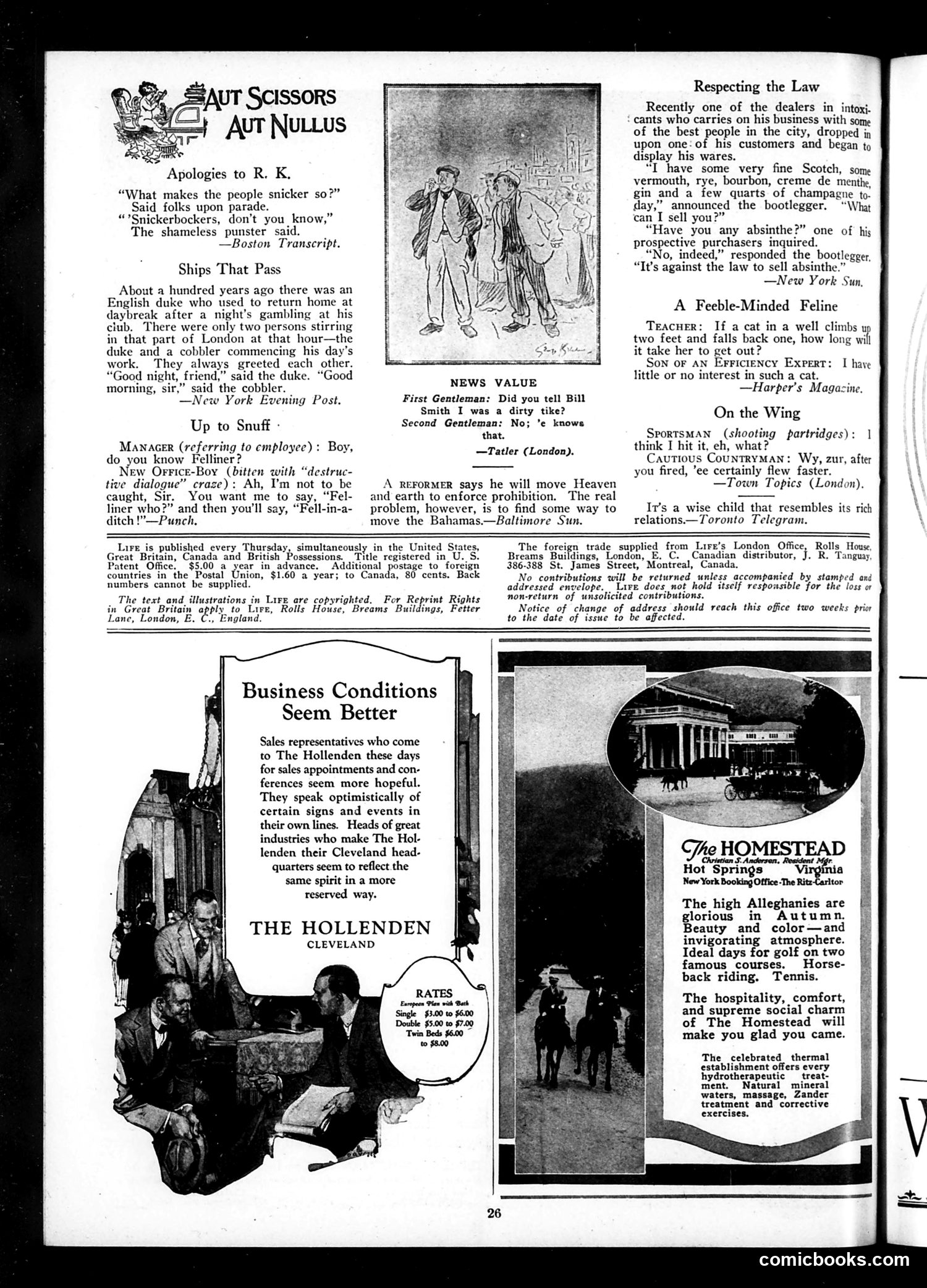
This page from Life magazine contains multiple brief satirical jokes and two advertisements. The humor relies heavily on wordplay and social commentary typical of early 20th-century American satire. The "Snickerbockers" joke plays on the double meaning of the word—both the knickerbockers (baggy pants) and a pun on "snicker." The "Ships That Pass" anecdote satirizes class differences between an English duke and cobbler who greet each other daily with opposite salutations. "Up to Snuff" mocks office boys' overuse of a contemporary comedic format. The "Respecting the Law" piece satirizes Prohibition's absurdity: a bootlegger illegally sells alcohol but refuses absinthe because "it's against the law"—highlighting the hypocrisy of selective law-breaking during Prohibition. Other jokes target topics like reformers, education, and hunting mishaps. The page is primarily advertisements for The Hollenden hotel in Cleveland and The Homestead resort in Virginia, suggesting business optimism during this period.
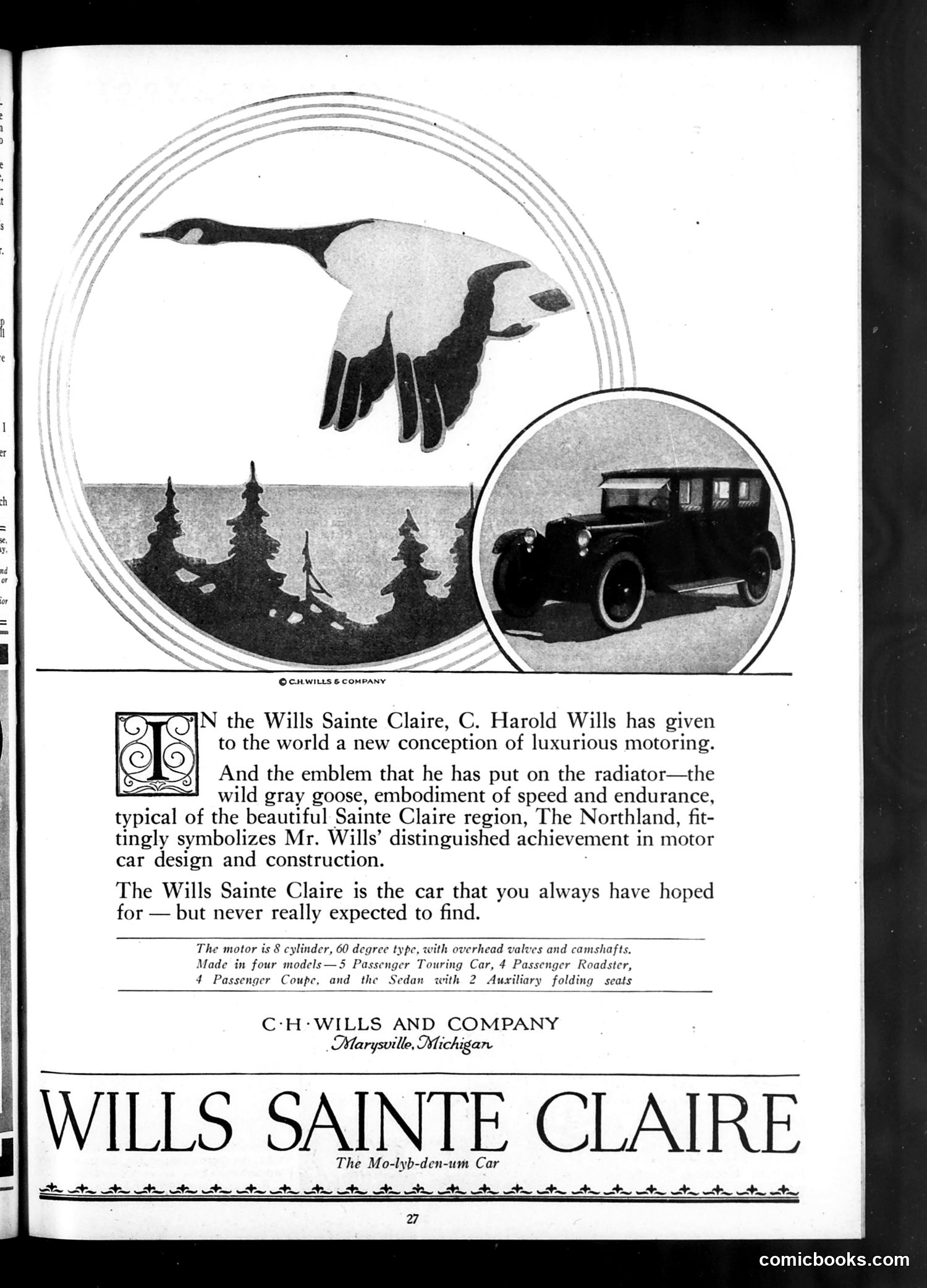
This is primarily a **luxury car advertisement**, not political satire. It promotes the Wills Sainte Claire automobile manufactured by C. Harold Wills in Marysville, Michigan. The page uses symbolic imagery: a wild gray goose (the car's radiator emblem) represents "speed and endurance" and connects to the Sainte Claire region of northern Michigan. The inset circle shows the actual vehicle—a substantial touring car typical of 1920s luxury automobiles. The advertising copy positions this as an aspirational product: "the car that you always have hoped for — but never really expected to find," appealing to wealthy consumers seeking distinction in automotive design. The subtitle "The Mo-lyb-den-um Car" references molybdenum steel, a technical detail emphasizing superior construction. The specifications (8-cylinder engine, multiple body styles) target affluent buyers seeking both performance and prestige. This represents early automotive advertising's strategy of combining natural symbolism with engineering credentials to justify premium pricing.
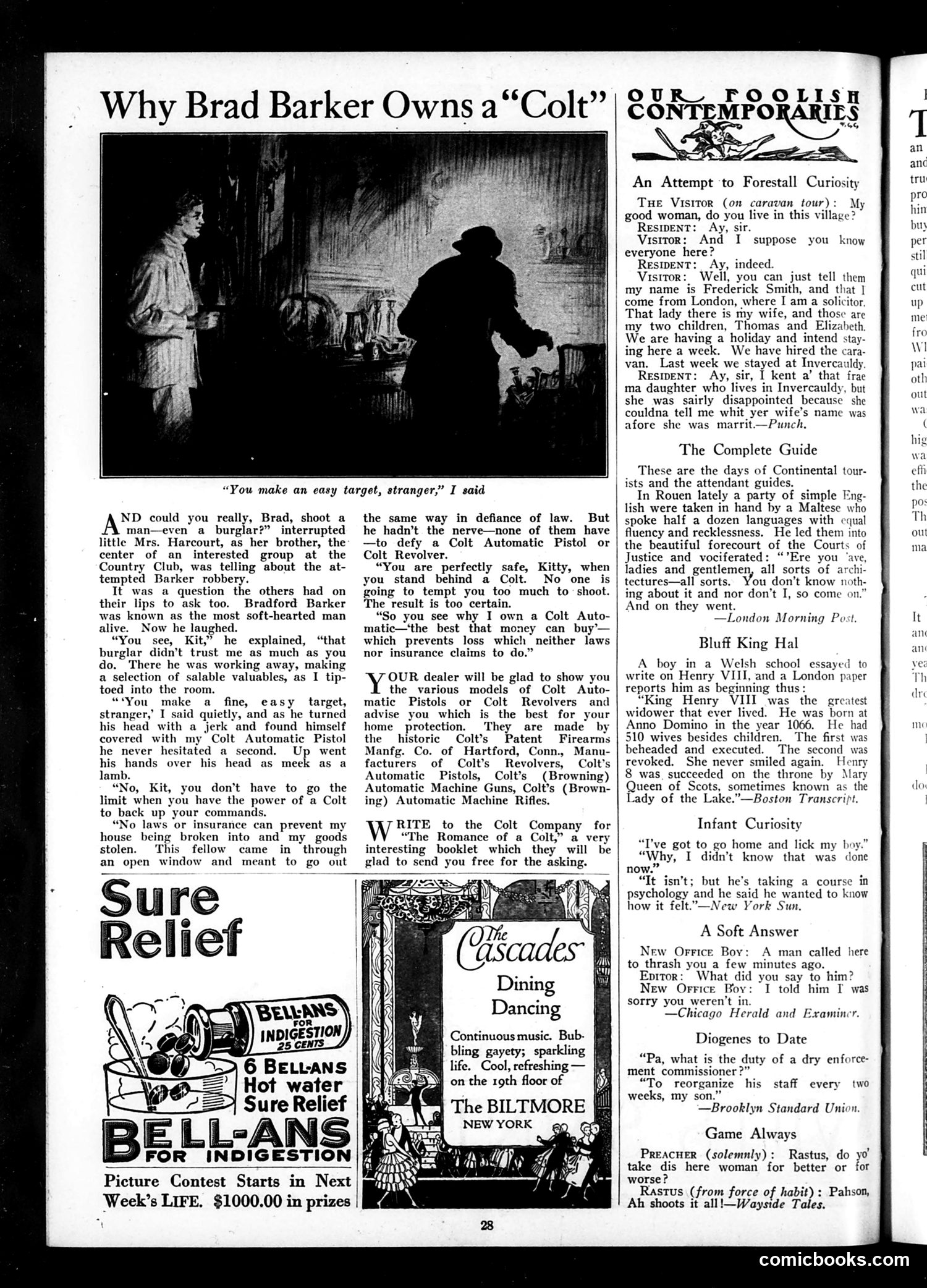
This page is primarily **advertisement and filler content** rather than political satire. The dominant feature is a Colt Automatic Pistol advertisement disguised as a story about "Brad Barker," a soft-hearted country club member who shoots a burglar with his Colt. The narrative argues that owning a Colt provides superior home protection because its mere presence prevents confrontation—the burglar surrenders without resistance. The accompanying small humor pieces (titled sections like "An Attempt to Forestall Curiosity," "The Complete Guide," "Bluff King Hal," and "Infant Curiosity") are unrelated jokes from *Punch* and other publications, typical filler for Life magazine. The page also advertises indigestion relief (Bellans), a hotel (The Biltmore), and announces an upcoming picture contest. There is no coherent political or social satire—this is a commercial page typical of early 20th-century magazine advertising strategy.
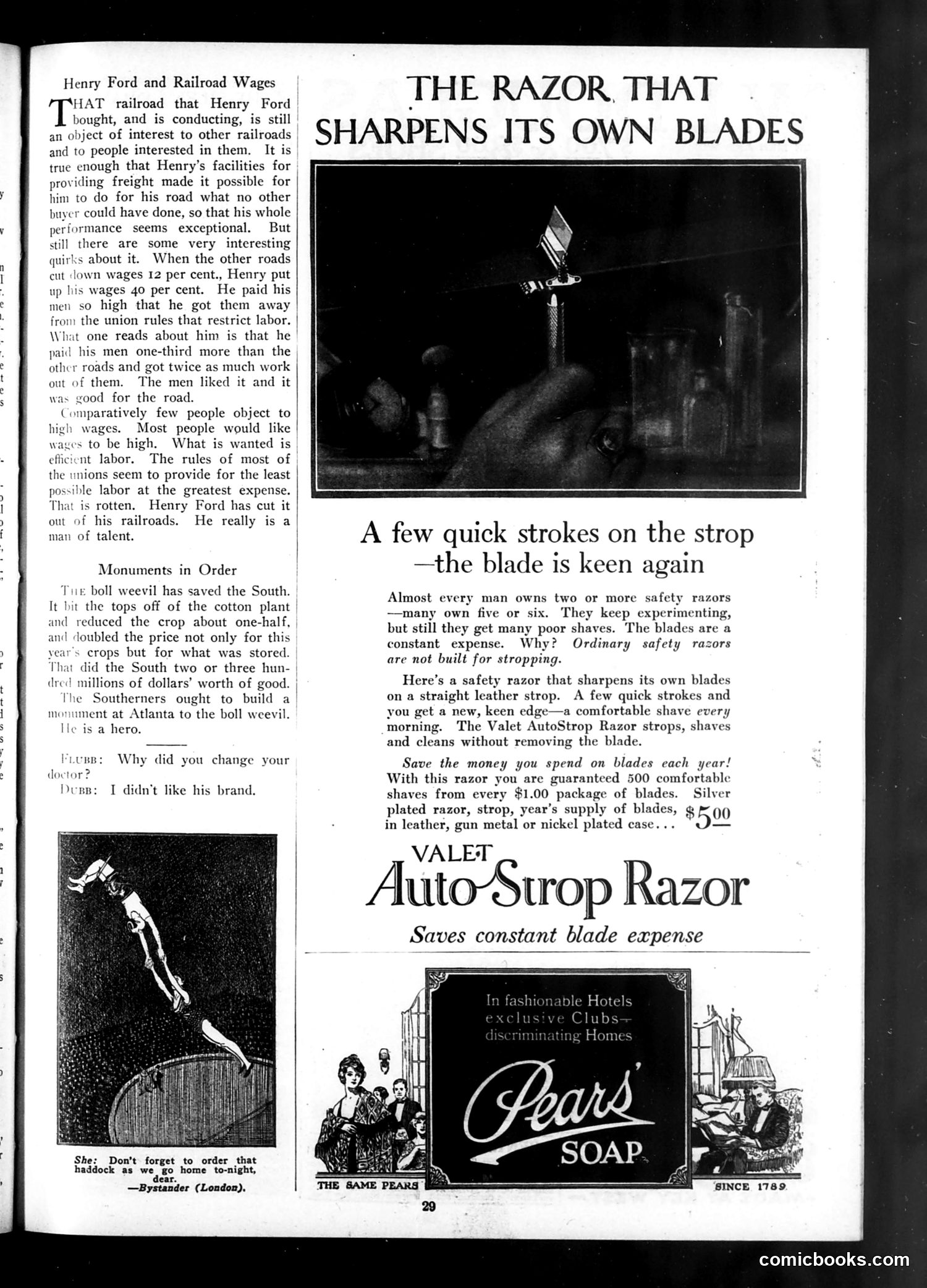
This page contains **editorial commentary and advertisements** rather than political cartoons. The main article criticizes **union labor practices** while praising Henry Ford's railroad management. The piece argues Ford paid workers 40% higher wages than competitors, which allowed him to bypass union restrictions on labor output. The satirical point: Ford proved that high wages combined with freedom from union rules produced both worker satisfaction and greater productivity—implying unions unnecessarily restrict efficiency. A secondary brief item praises the **boll weevil** (a cotton pest) for devastatingly Southern crops, ironically calling it a "hero" because destroying half the harvest doubled prices, enriching farmers overall. The page is primarily **advertisements**: the Valet AutoStrop Razor (a self-sharpening safety razor) and Pears' Soap. These occupy more space than editorial content, typical for Life magazine's business model. The humor and political messaging center on **labor economics and industrial management**—distinctly early-20th-century concerns.
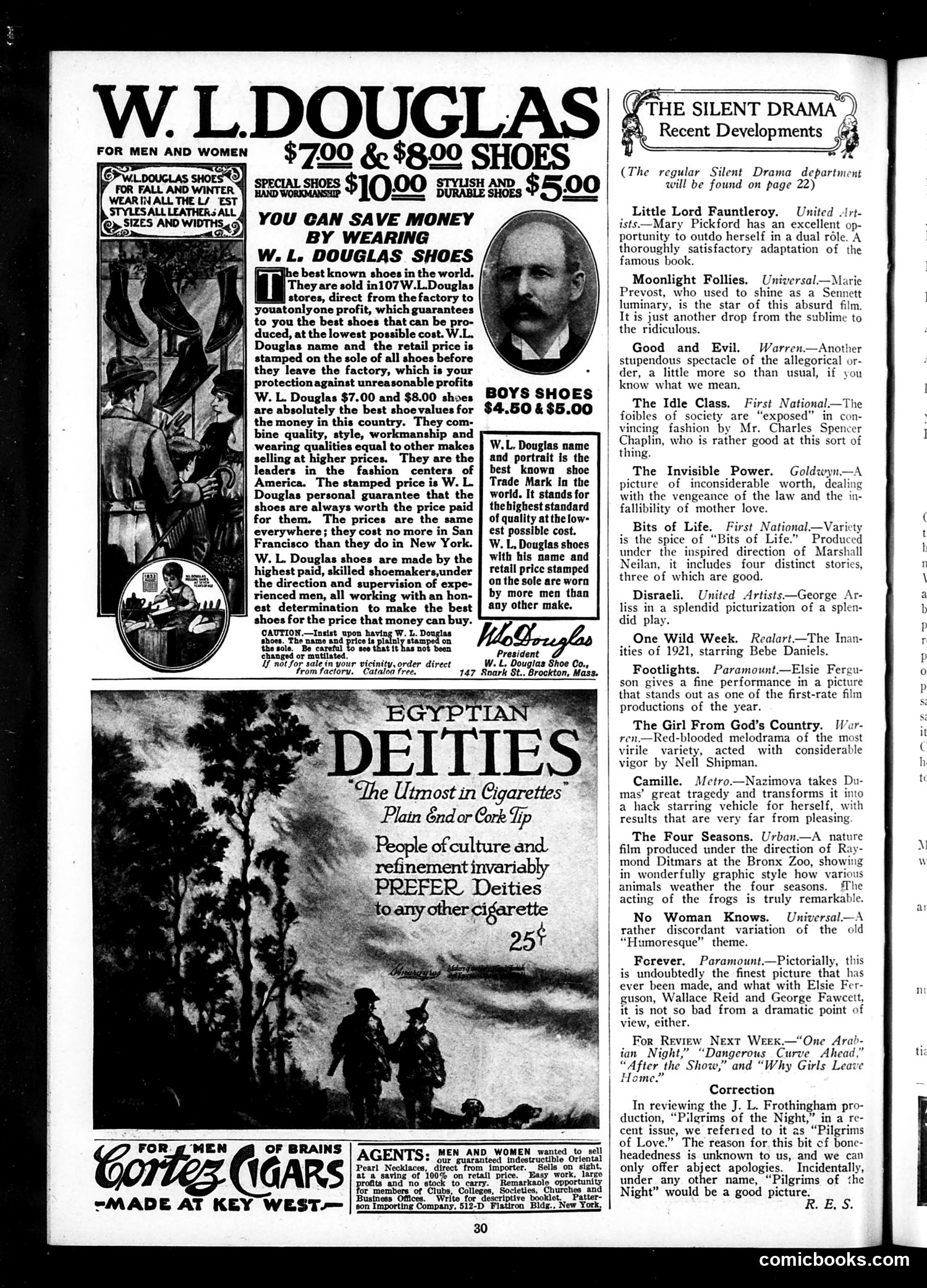
This page is primarily **advertising and entertainment reviews**, not satire or political commentary. The left side features a large **W.L. Douglas Shoes advertisement**—a major shoe manufacturer emphasizing quality and fair pricing. The ad's selling point is that the company stamps the retail price directly on shoe soles, guaranteeing customers they're not overpaying regardless of location. This addresses a real consumer concern of the era: retail markup variation. Below that is an **Egyptian Deities cigarette ad**, appealing to notions of sophistication and cultural refinement. The right column contains **film reviews** from Life's "Silent Drama" department, critiquing contemporary motion pictures (many starring silent-era stars like Mary Pickford and Charlie Chaplin). Reviews are brief and often dismissive—typical of the magazine's satirical tone applied to entertainment rather than politics. No political cartoons or social satire appear on this page. It's a straightforward commercial and entertainment section typical of 1920s mass-market magazines.
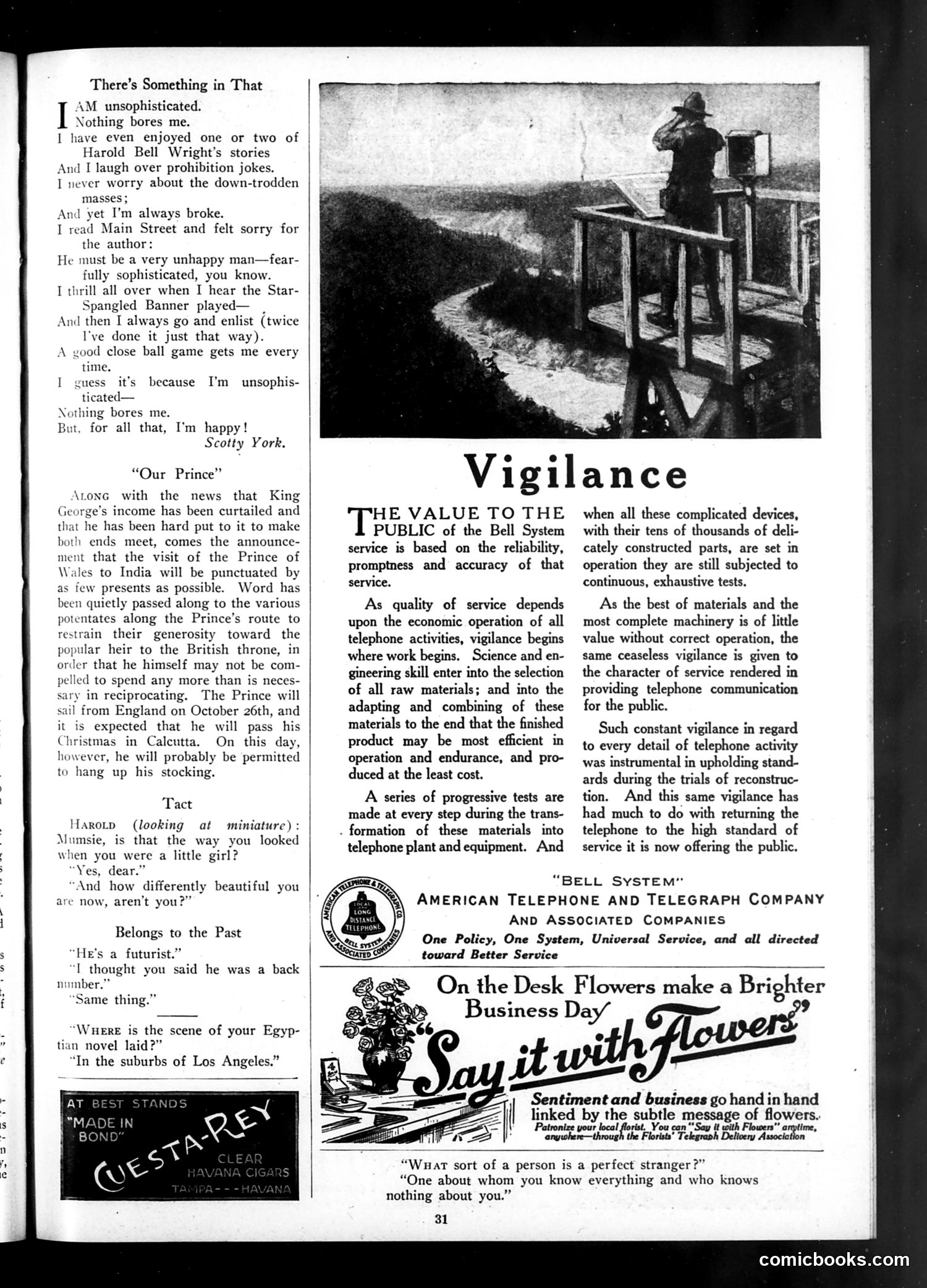
This page contains several satirical pieces typical of 1920s Life magazine humor: **Main Content:** The "There's Something in That" poem by Scotty York satirizes the unsophisticated American everyman—someone who enjoys simple pleasures (baseball, the national anthem) and repeatedly enlists in the military, yet claims nothing bores him while remaining perpetually broke. The humor lies in the contradiction between his claimed contentment and obvious financial struggles. **Short Humor Pieces:** Brief dialogues mock social pretension and changing fads: a futurist is called a "back number," Egyptian novels are set in suburban Los Angeles (mocking literary modernism), and a man compliments his mother's changed appearance with awkward tact. **Advertisements:** The bulk of the page comprises ads for Bell Telephone System (emphasizing reliability and quality control) and florists ("Say it with Flowers"), representing typical 1920s corporate messaging about service excellence and consumer sentiment. The page reflects post-WWI American culture with references to prohibition, modernist literature ("Main Street"), and repeated military service.
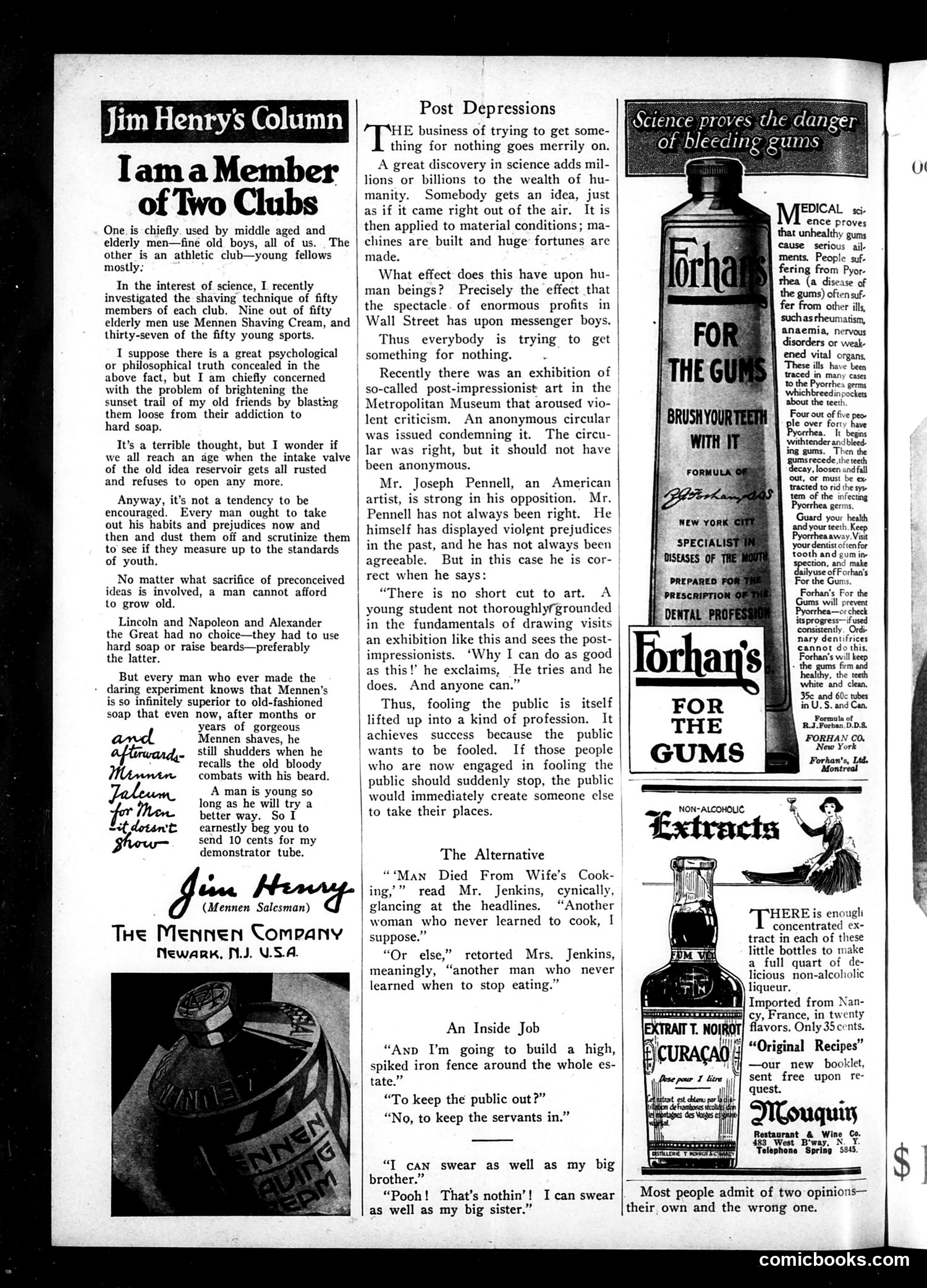
**Jim Henry's Column ("I am a Member of Two Clubs"):** This is a **Mennen shaving cream advertisement disguised as editorial commentary**. Henry, identified as "Mennen Salesman," claims to have conducted a scientific survey showing young men (37 of 50) prefer Mennen cream while older men (9 of 50) use it. The satire is self-aware: Henry frames aging as mental rigidity—older men won't abandon "hard soap"—positioning Mennen adoption as proof of youthful progressiveness. The pitch argues that embracing new products keeps men mentally young. **"Post Depressions" column:** Commentary on post-impressionist art exhibited at the Metropolitan Museum, criticizing both the artists (who fool the public with shortcuts) and the public (who want to be fooled). References artist Joseph Pennell's opposition to modernist art. **Right-page advertisements:** Medical and commercial products (Forhan's toothpaste, Extract T. Noirot, Curacao liqueur, Mouquin restaurant) typical of early 20th-century Life magazine advertising.