
Life, 1921-10-20 · page 5 of 34
Life — October 20, 1921 — page 5: what you’re looking at
What you’re looking at
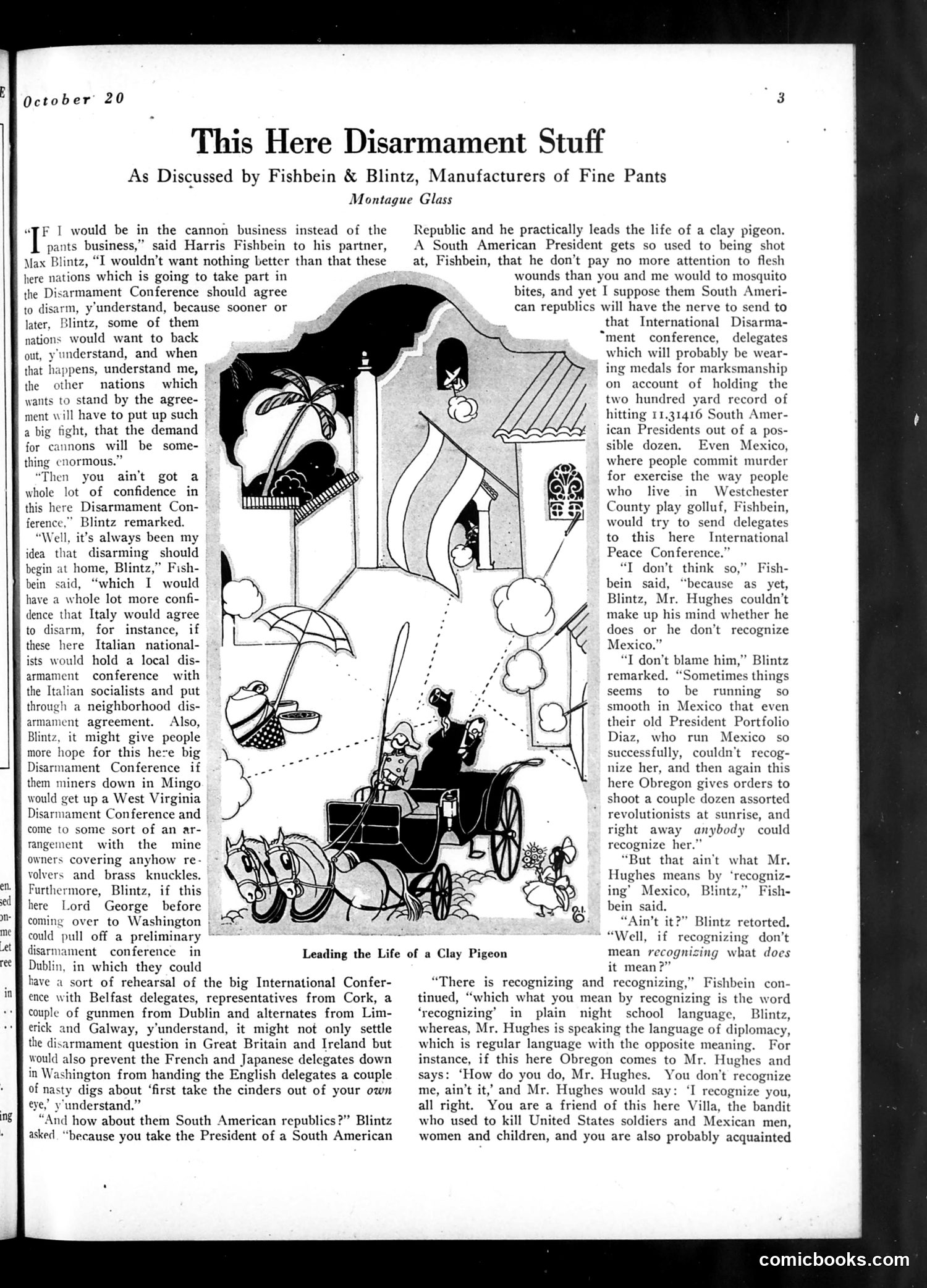
This satirical piece discusses the 1920s Disarmament Conference through a conversation between Harris Fishbein and Max Blintz, pants manufacturers. The central cartoon depicts a figure driving a cart labeled with various nations' symbols, leading a "clay pigeon"—a metaphor for nations being used as targets or dupes in diplomatic negotiations. The satire mocks the naive belief that international disarmament conferences will actually work. Fishbein argues that nations won't genuinely disarm because self-interest always prevails—using examples like Mexico and various South American republics, which despite peace talks continue military conflicts. The "clay pigeon" imagery suggests that smaller nations are expendable pawns in great power politics, while disarmament remains mere diplomatic theater.
📄 Transcribed text from this page (OCR, searchable)
Machine-transcribed from the original scan — historical spelling and the odd misread are preserved.
October 20 This Here Disarmament Stuff As Discussed by Fishbein & Blintz, Manufacturers of Fine Pants Montague Glass “JF I would be in the cannon business instead of the I pants business,” said Harris Fishbein to his partner, Max Blintz, “I wouldn’t want nothing better than that these here nations which is going to take part in the Disarmament Conference should agree to disarm, y’understand, because sooner or later, Blintz, some of them nations would want to back out, y'understand, and when that happens, understand me, the other nations which wants to stand by the agree- ment will have to put up such a big fight, that the demand for cannons will be some- thing cnormous.” “Then you ain't got a whole lot of confidence in | this here Disarmament Con- ference,” Blintz remarked. “Well, it’s always been my idea that disarming should begin at home, Blintz,” Fish- bein said, “which I would have a whole lot more confi- dence that Italy would agree to disarm, for instance, if these here Italian national- ists would hold a local dis- armament conference with the Italian socialists and put through a neighborhood dis- armament agreement. Also, Blintz, it might give people more hope for this here big Disarmament Conference if them miners down in Mingo would get up a West Virginia Disarmament Conference and come to some sort of an ar- rangement with the mine owners covering anyhow re- volvers and brass knuckles. Furthermore, Blintz, if this here Lord George before coming over to Washington could pull off a preliminary disarmament conference in Dublin, in which they could have a sort of rehearsal of the big International Confer- ence with Belfast delegates, representatives from Cork, a couple of gunmen from Dublin and alternates from Lim- erick and Galway, y’understand, it might not only settle the disarmament question in Great Britain and Ireland but would also prevent the French and Japanese delegates down in Washington from handing the English delegates a couple of nasty digs about ‘first take the cinders out of your own eye,’ y'understand.” “And how about them South American republics?” Blintz asked “because you take the President of a South American Leading the Life of a Clay Pigeon Republic and he practically leads the life of a clay pigeon. A South American President gets so used to being shot at, Fishbein, that he don’t pay no more attention to flesh wounds than you and me would to mosquito bites, and yet I suppose them South Ameri- can republics will have the nerve to send to that International Disarma- “ment conference, delegates which will probably be wear- ing medals for marksmanship on account of holding the two hundred yard record of hitting 11.31416 South Amer- ican Presidents out of a pos- sible dozen. Even Mexico, where people commit murder for exercise the way people who live in Westchester County play golluf, Fishbein, would try to send delegates to this here International Peace Conference.” “I don’t think so ish- bein said, “because as yet, Blintz, Mr. Hughes couldn’t make up his mind whether he does or he don’t recognize Mexico.” “I don’t blame him,” Blintz remarked. “Sometimes things seems to be running so smooth in Mexico that even their old President Portfolio Diaz, who run Mexico so successfully, couldn't recog- nize her, and then again this here Obregon gives orders to shoot a couple dozen assorted revolutionists at sunrise, and right away anybody could recognize her.” “But that ain't what Mr. Hughes means by ‘recogniz: ing’ Mexico, Blintz,” Fish- bein said. in’t it?” Blintz retorted. “Well, if recognizing don’t mean recognising what does it mean?” “There is recognizing and recognizing,” Fishbein con- tinued, “which what you mean by recognizing is the word ‘recognizing’ in plain night school language, Blintz, whereas, Mr. Hughes is speaking the language of diplomacy, which is regular language with the opposite meaning. For instance, if this here Obregon comes to Mr. Hughes and says: ‘How do you do, Mr. Hughes. You don't recognize me, ain’t it, and Mr. Hughes would say: ‘I recognize you, all right. You are a friend of this here Villa, the bandit who used to kill United States soldiers and Mexican men, women and children, and you are also probably acquainted comicbooks.com