
Life, 1921-10-20 · page 24 of 34
Life — October 20, 1921 — page 24: what you’re looking at
What you’re looking at
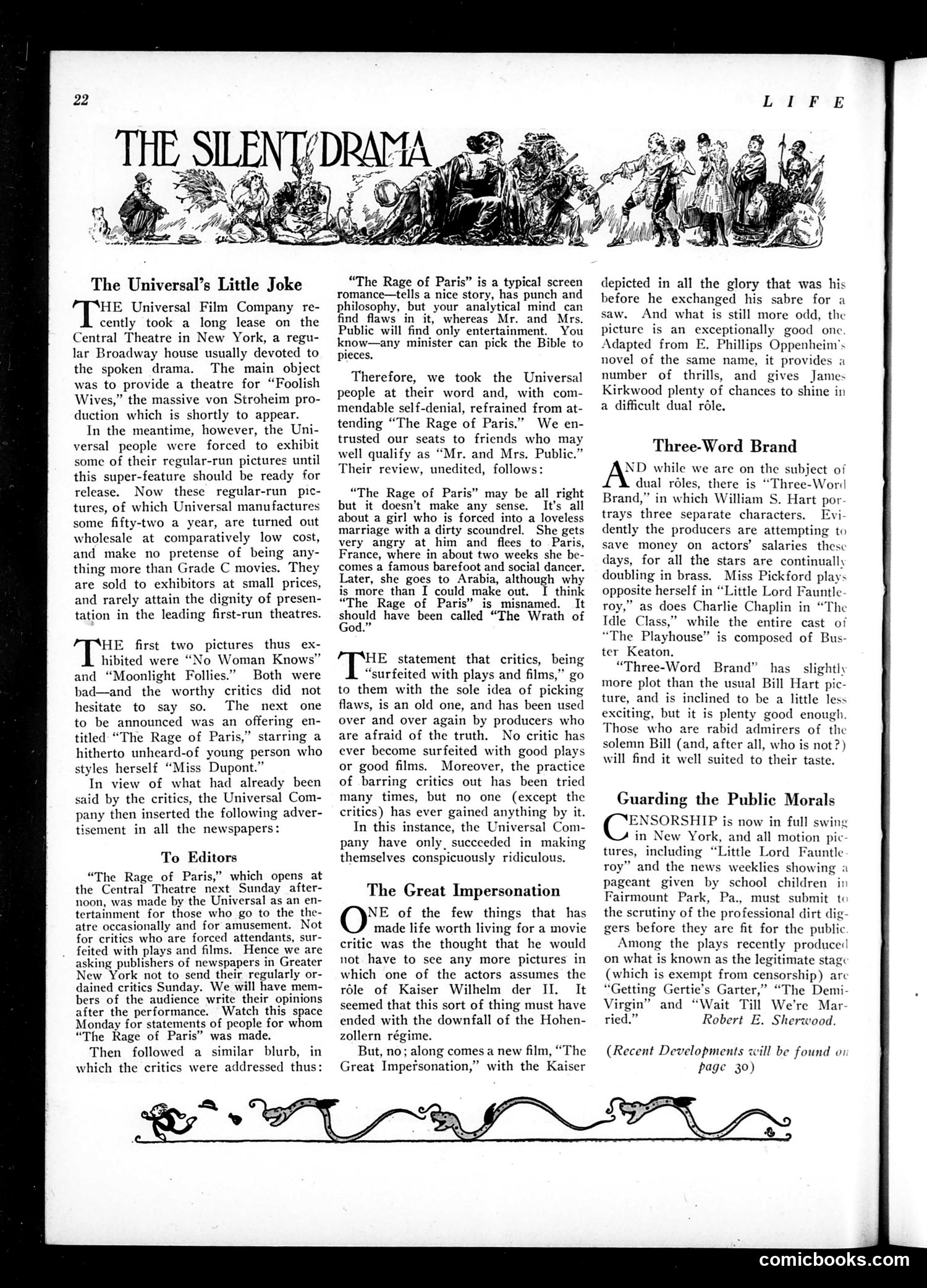
This article mocks Universal Film Company's attempt to exclude professional critics from reviewing their low-budget film "The Rage of Paris" at New York's Central Theatre. Universal explicitly asked newspapers not to send regular critics, claiming the film was made for average moviegoers ("Mr. and Mrs. Public"), not analytical reviewers. Life's editors accepted this challenge ironically, sending an ordinary audience member instead. That person's review proved damning—the plot made no sense, and the film was poorly constructed. The satire's point: Universal's advertisement backfired spectacularly. Rather than protecting their mediocre product, excluding professional critics only highlighted its worthlessness. Life argues that producers have repeatedly tried this tactic unsuccessfully, and that good films actually *welcome* critical scrutiny. The implication is clear—Universal's defensive posturing proves the film deserves the criticism they tried to avoid.
📄 Transcribed text from this page (OCR, searchable)
Machine-transcribed from the original scan — historical spelling and the odd misread are preserved.
The Universal’s Little Joke ‘HE Universal Film Company re- cently took a long lease on the Central Theatre in New York, a regu- lar Broadway house usually devoted to the spoken drama. The main object was to provide a theatre for “Foolish Wives,” the massive von Stroheim pro- duction which is shortly to appear. In the meantime, however, the Uni- versal people were forced to exhibit some of their regular-run pictures until this super-feature should be ready for release. Now these regular-run pic- tures, of which Universal manufactures some fifty-two a year, are turned out wholesale at comparatively low cost, and make no pretense of being any- thing more than Grade C movies. They are sold to exhibitors at small prices, and rarely attain the dignity of presen- tation in the leading first-run theatres. HE first two pictures thus ex- hibited were “No Woman Knows” and “Moonlight Follies.” Both were bad—and the worthy critics did not hesitate to say so. The next one to be announced was an offering en- titled “The Rage of Paris,” starring a hitherto unheard-of young person who styles herself “Miss Dupont.” In view of what had already been said by the critics, the Universal Com- pany then inserted the following adver- tisement in all the newspapers: To Editors “The Rage of Paris,” which opens at the Central Theatre next Sunday after- noon, was made by the Universal as an en- tertainment for those who go to the the- atre occasionally and for amusement. Not for critics who are forced attendants, sur- feited with plays and films. Hence we are asking publishers of newspapers in Greater New York not to send their regularly or- dained critics Sunday. We will have mem- bers of the audience write their opinions after the performance. Watch this space Monday for statements of people for whom “The Rage of Paris” was made. Then followed a similar blurb, in which the critics were addressed thus: “The Rage of Paris” is a typical screen romance—tells a nice story, has punch and philosophy, but your analytical mind can find flaws in it, whereas Mr. and Mrs. Public will find only entertainment. You know—any minister can pick the Bible to pieces. Therefore, we took the Universal people at their word and, with com- mendable self-denial, refrained from at- tending “The Rage of Paris.” We en- trusted our seats to friends who may well qualify as “Mr. and Mrs. Public.” Their review, unedited, follows: “The Rage of Paris” may be all right but it doesn’t make any sense. It’s all about a girl who is forced into a loveless marriage with a dirty scoundrel. She gets very angry at him and flees to Paris, France, where in about two weeks she be- comes a famous barefoot and social dancer. Later, she goes to Arabia, although why is more than I could make out. I think “The Rage of Paris” is misnamed. It should have been called “The Wrath of od. ‘HE statement that critics, being ‘surfeited with plays and films,” go to them with the sole idea of picking flaws, is an old one, and has been used over and over again by producers who are afraid of the truth. No critic has ever become surfeited with good plays or good films. Moreover, the practice of barring critics out has been tried many times, but no one (except the critics) has ever gained anything by it. In this instance, the Universal Com- pany have only, succeeded in making themselves conspicuously ridiculous. The Great Impersonation NE of the few things that has made life worth living for a movie critic was the thought that he would not have to see any more pictures in which one of the actors assumes the role of Kaiser Wilhelm der II. It seemed that this sort of thing must have ended with the downfall of the Hohen- zollern régime. But, no; along comes a new film, “The Great Impersonation,” with the Kaiser depicted in all the glory that was his before he exchanged his sabre for a saw. And what is still more odd, the picture is an exceptionally good one Adapted from E. Phillips Oppenheim’s novel of the same name, it provides a number of thrills, and gives James Kirkwood plenty of chances to shine in a difficult dual réle. Three-Word Brand ND while we are on the subject of dual réles, there is “Three-Word Brand,” in which William S. Hart por- trays three separate characters. Evi dently the producers are attempting to save money on actors’ salaries thesc days, for all the stars are continually doubling in brass. Miss Pickford plays opposite herself in “Little Lord Fauntle roy,” as does Charlie Chaplin in “The Idle Clas while the entire cast of “The Playhouse” is composed of Bus- ter Keaton. “Three-Word Brand” has. slightly more plot than the usual Bill Hart pic- ture, and is inclined to be a little less exciting, but it is plenty good enough Those who are rabid admirers of the solemn Bill (and, after all, who is not?) will find it well suited to their taste. Guarding the Public Morals C ORSHIP is now in full swing in New York, and all motion pic tures, including “Little Lord Fauntle roy” and the news weeklies showing « pageant given by school children i: Fairmount Park, Pa., must submit. t the scrutiny of the professional dirt dig- gers before they are fit for the public Among the plays recently produce: on what is known as the legitimate stag: (which is exempt from censorship) arc “Getting Gertie’s Garter,’ “The Demi- Virgin” and “Wait Till We're Mar- ried.” Robert E. Sherwood. (Recent Developments will be found v1 page 30) comicbooks.com