
Life, 1921-10-20 · page 14 of 34
Life — October 20, 1921 — page 14: what you’re looking at
What you’re looking at
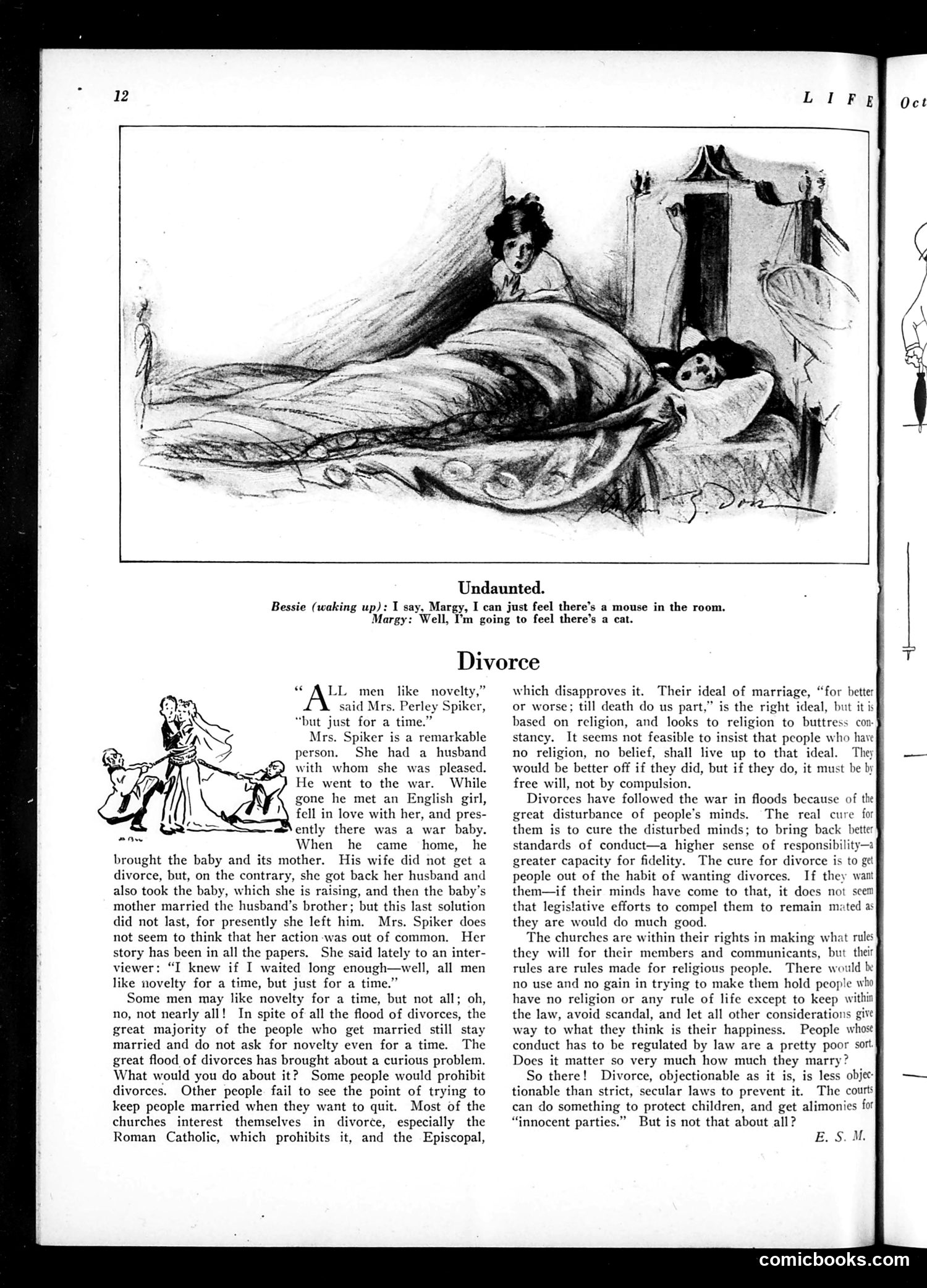
The cartoon titled "Undaunted" shows a humorous domestic scene: a woman in bed feels "a mouse in the room," while her companion responds she'll "feel there's a cat" — a joke about escalating anxieties or one-upmanship in worry. The accompanying article discusses divorce in early 20th-century America, focusing on Mrs. Perley Spiker, described as a "remarkable person" who married, had children during her husband's wartime absence, then divorced rather than pursue novelty. The piece argues that divorce itself isn't the problem; rather, churches and society should focus on strengthening marriage through better moral standards and responsibility, rather than prohibition. The author suggests legal divorce protections for "innocent parties" represent a practical, if imperfect, solution.
📄 Transcribed text from this page (OCR, searchable)
Machine-transcribed from the original scan — historical spelling and the odd misread are preserved.
Undaunted. Bessie (waking up): I say, Margy, I can just feel there’s a mouse in the room. Margy: Well, I'm going to feel there’s a cat. Divorce “A men like novelty,” aid Mrs. Perley Spiker, “but just for a time.” Mrs. Spiker is a remarkable person. She had a husband with whom she was pleased. He went to the war. While gone he met an English girl, fell in love with her, and pres- ently there was a war baby. anew When he came home, he brought the baby and its mother. His wife did not get a divorce, but, on the contrary, she got back her husband and also took the baby, which she is raising, and then the baby’s mother married the husband’s brother; but this last solution did not last, for presently she left him. Mrs. Spiker does not seem to think that her action was out of common. Her story has been in all the papers. She said lately to an inter- viewer: “I knew if I waited long enough—well, all men like novelty for a time, but just for a time.” Some men may like novelty for a time, but not all; oh, no, not nearly all! In spite of all the flood of divorces, the great majority of the people who get married still stay married and do not ask for novelty even for a time. The great flood of divorces has brought about a curious problem. What would you do about it? Some people would prohibit divorces. Other people fail to see the point of trying to keep people married when they want to quit. Most of the churches interest themselves in divorce, especially the Roman Catholic, which prohibits it, and the Episcopal, which disapproves it. Their ideal of marriage, “for better or worse; till death do us part,” is the right ideal, but it is based on religion, and looks to religion to buttress con- stancy. It seems not feasible to insist that people who have no religion, no belief, shall live up to that ideal. They would be better off if they did, but if they do, it must be by free will, not by compulsion. Divorces have followed the war in floods because of great disturbance of people's minds. The real cure for them is to cure the disturbed minds; to bring back better standards of conduct—a higher sense of responsibility greater capacity for fidelity. The cure for divorce is to get people out of the habit of wanting divorces. If they want them—if their minds have come to that, it does not seem that legislative efforts to compel them to remain mated as they are would do much good. The churches are within their rights in making what rules they will for their members and communicants, but their rules are rules made for religious people. There would be no use and no gain in trying to make them hold people who have no religion or any rule of life except to keep within the law, avoid scandal, and let all other considerations give way to what they think is their happiness. People whose conduct has to be regulated by law are a pretty poor sort Does it matter so very much how much they marry? So there! Divorce, objectionable as it is, is less objec tionable than strict, secular laws to prevent it. The courts can do something to protect children, and get alimonies for “innocent parties.” But is not that about all? E. S. M. comicbooks.com