
Life, 1921-10-20 · page 17 of 34
Life — October 20, 1921 — page 17: what you’re looking at
What you’re looking at
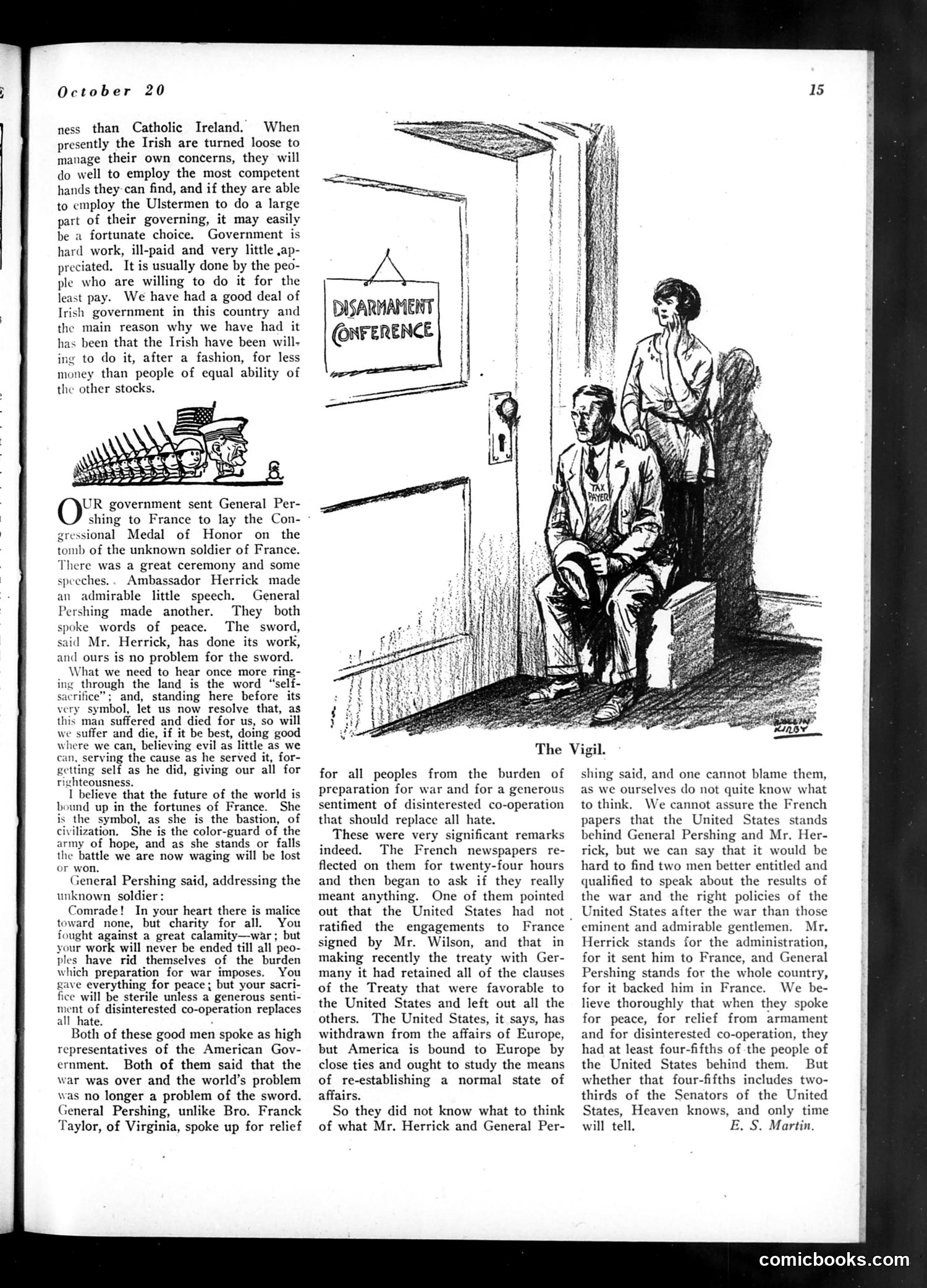
This page critiques post-WWI American foreign policy contradictions. The cartoon shows two figures maintaining a vigil outside a "Disarmament Conference" room, symbolizing uncertainty about U.S. commitment to peace. The accompanying text reports on General Pershing's ceremonial speech at the tomb of France's unknown soldier, where he and Ambassador Herrick eloquently advocated for disarmament and international cooperation to replace war-making. However, the article's real point—indicated by the skeptical French newspaper response—exposes the hypocrisy: while America publicly champions peace and disarmament, it has actually withdrawn from European affairs while simultaneously binding itself to Europe through treaties. The U.S. ratified favorable treaty clauses but ignored unfavorable ones, suggesting self-interest rather than genuine "disinterested co-operation." The satire targets the disconnect between American rhetorical idealism and actual diplomatic behavior, leaving even the French confused about U.S. sincerity.
📄 Transcribed text from this page (OCR, searchable)
Machine-transcribed from the original scan — historical spelling and the odd misread are preserved.
October 20 ness than Catholic Ireland. When presently the Irish are turned loose to manage their own concerns, they will do well to employ the most competent hands they-can find, and if they are able to employ the Ulstermen to do a large part of their governing, it may easily be a fortunate choice. Government is hard work, ill-paid and very little ,ap- preciated. It is usually done by the peo- ple who are willing to do it for the least pay. We have had a good deal of Irish government in this country and the main reason why we have had it as been that the Irish have been will- to do it, after a fashion, for less money than people of equal ability of the other stocks. UR government sent General Per- shing to France to lay the Con- gressional Medal of Honor on the tomb of the unknown soldier of France. There was a great ceremony and some speeches.. Ambassador Herrick made an admirable little speech. General Pershing made another. They both spoke words of peace. The sword, said Mr. Herrick, has done its work, and ours is no problem for the sword. What we need to hear once more ring- ing through the land is the word “self- sacrifice”; and, standing here before its very symbol, let us now resolve that, as this man suffered and died for us, so will we suffer and die, if it be best, doing good where we can, believing evil as little as we can, serving the cause as he served it, for- getting self as he did, giving our all for righteousness. . | believe that the future of the world is bound up in the fortunes of France. She is the symbol, as she is the bastion, of civilization. She is the color-guard of the army of hope, and as she stands or falls the battle we are now waging will be lost or won, General Pershing said, addressing the unknown soldier: Comrade! In your heart there is malice toward none, but charity for all. You fought against a great calamity—war ; but your work will never be ended till all peo- ples have rid themselves of the burden which preparation for war imposes. You gave everything for peace ; but your sacri- fice will be sterile unless a generous senti- ment of disinterested co-operation replaces all_hate. Both of these good men spoke as high representatives of the American Gov- ernment. Both of them said that the war was over and the world’s problem was no longer a problem of the sword. General Pershing, unlike Bro. Franck Taylor, of Virginia, spoke up for relief DISARMAMENT QNFERENCE The Vigil. for all peoples from the burden of preparation for war and for a generous sentiment of disinterested co-operation that should replace all hate. These were very significant remarks indeed. The French newspapers re- flected on them for twenty-four hours and then began to ask if they really meant anything. One of them pointed out that the United States had ratified the engagements to France signed by Mr. Wilson, and that in making recently the treaty with Ger- many it had retained all of the clauses of the Treaty that were favorable to the United States and left out all the others. The United States, it says, has withdrawn from the affairs of Europe, but America is bound to Europe by close ties and ought to study the means of re-establishing a normal state of affairs. So they did not know what to think of what Mr. Herrick and General Per- not shing said, and one cannot blame them, as we ourselves do not quite know what to think. We cannot assure the French papers that the United States stands behind General Pershing and Mr. Her- rick, but we can say that it would be hard to find two men better entitled and qualified to speak about the results of the war and the right policies of the United States after the war than those eminent and admirable gentlemen. Mr. Herrick stands for the administration, for it sent him to France, and General Pershing stands for the whole country, for it backed him in France. We be- lieve thoroughly that when they spoke for peace, for relief from armament and for disinterested co-operation, they had at least four-fifths of the people of the United States behind them. But whether that four-fifths includes two- thirds of the Senators of the United States, Heaven knows, and only time will tell. E, S. Martin. comicbooks.com