
Life, 1921-10-20 · page 16 of 34
Life — October 20, 1921 — page 16: what you’re looking at
What you’re looking at
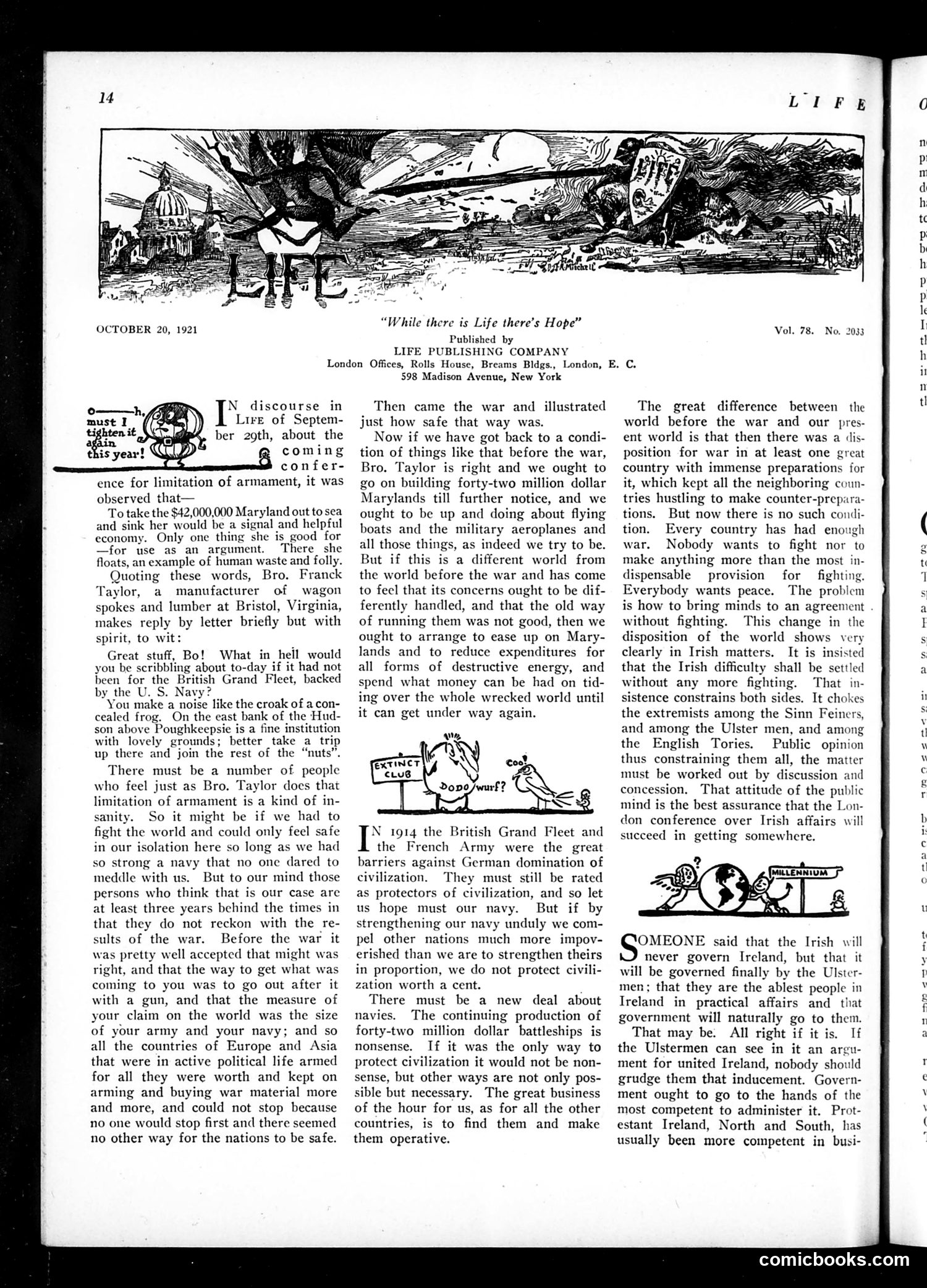
The page contains editorial text debating post-WWI military policy and Irish independence—not political cartoons. The visible cartoon appears in the middle: a small figure labeled "INSTINCT" confronts another labeled "DODO," likely satirizing outdated thinking about naval armament. The "DODO" represents obsolete military reasoning. The main text discusses whether nations should reduce military spending after WWI. One writer argues Britain's naval dominance (the "Grand Fleet") no longer justifies enormous expenditure, while another defends maintaining strong defenses. A separate section addresses Irish governance, opposing the notion that only the "Ulstermen" or English Tories should decide Ireland's fate. The satire targets those clinging to pre-war military logic as extinct as the dodo bird.
📄 Transcribed text from this page (OCR, searchable)
Machine-transcribed from the original scan — historical spelling and the odd misread are preserved.
OCTOBER 20, 1921 London Offices, Rolls House, Breams Bldgs., Is discourse in Lire of Septem- ber 29th, about the coming confer- ence for limitation of armament, it was observed that— To take the $42,000,000 Maryland out to sea and sink her would be a signal and helpful economy. Only one thing she is good for —for use as an argument. There she floats, an example of human waste and folly. Quoting these words, Bro. Franck Taylor, a manufacturer of wagon s and lumber at Bristol, Virginia, ma reply by letter briefly but with spirit, to wit: Great stuff, Bo! What in heil would you be scribbling about to-day if it had not been for the British Grand Fleet, backed by the U. S. Navy? You make a noise like the croak of a con- cealed frog. bank of the Hud- son above Poughkeepsie is a fine institution with lovely grounds; better take a trip up there and join the rest of the “nuts”. There must be a number of people who feel just as Bro. Taylor does that limitation of armament is a kind of in- sanity. So it might be if we had to fight the world and could only feel safe in our isolation here so long as we had so strong a navy that no one dared to meddle with us. But to our mind those persons who think that is our case are at least three years behind the times in that they do not reckon with the re- sults of the war. Before the war it was pretty well accepted that might was right, and that the way to get what was coming to you was to go out after it with a gun, and that the measure of your claim on the world was the size of your army and your navy; and so all the countries of Europe and Asia that were in active political life armed for all they were worth and kept on arming and buying war material more and more, and could not stop because no one would stop first and there seemed no other way for the nations to be safe. “While there is Life there’s Hope” Published by LIFE PUBLISHING COMPANY 598 Madison Avenue, New York Then came the war and illustrated just how safe that way was. Now if we have got back to a condi- tion of things like that before the war, Bro. Taylor is right and we ought to go on building forty-two million dollar Marylands till further notice, and we ought to be up and doing about flying boats and the military aeroplanes and all those things, as indeed we try to be. But if this is a different world from the world before the war and has come to feel that its concerns ought to be dif- ferently handled, and that the old way of running them was not good, then we ought to arrange to ease up on Mary- lands and to reduce expenditures for all forms of destructive energy, and spend what money can be had on tid- ing over the whole wrecked world until it can get under way again. WA NS N 1914 the British Grand Fleet and the French Army were the great barriers against German domination of ci ation. They must still be rated as protectors of civilization, and so let us hope must our navy. But if by strengthening our navy unduly we com- pel other nations much more impov- erished than we are to strengthen theirs in proportion, we do not protect civili- zation worth a cent. There must be a new deal about navies. The continuing production of forty-two million dollar battleships is nonsense. If it was the only way to protect civilization it would not be non- sense, but other ways are not only pos- sible but necessary. The great business of the hour for us, as for all the other countries, is to find them and make them operative. Vol. 78. No. 2033 London, E. C. The great difference between the world before the war and our pres- ent world is that then there was a dlis- position for war in at least one great country with immense preparations for it, which kept all the neighboring coun- tries hustling to make counter-prepara- tions. But now there is no such condi- tion. Every country has had enough war. Nobody wants to fight nor to make anything more than the most in- dispensable provision for fighting. Everybody wants peace. The problem is how to bring minds to an agreement . without fighting. This change in the disposition of the world shows very clearly in Irish matters. It is insisted that the Irish difficulty shall be settled without any more fighting. That in- sistence constrains both sides. It chokes the extremists among the Sinn Feiners, and among the Ulster men, and among the English Tories. Public opinion thus constraining them all, the matter must be worked out by discussion and concession. That attitude of the public mind is the best assurance that the Lon- don conference over Irish affairs will succeed in getting somewhcre. OMEONE said that the Irish will never govern Ireland, but that it will be governed finally by the Ulster- men; that they are the ablest people in Ireland in practical affairs and that government will naturally go to them. That may be. All right if it is. If the Ulstermen can see in it an argu- ment for united Ireland, nobody should grudge them that inducement. Govern- ment ought to go to the hands of the most competent to administer it. Prot- estant Ireland, North and South, has usually been more competent in busi- comicbooks.com