
Life, 1921-10-20 · page 20 of 34
Life — October 20, 1921 — page 20: what you’re looking at
What you’re looking at
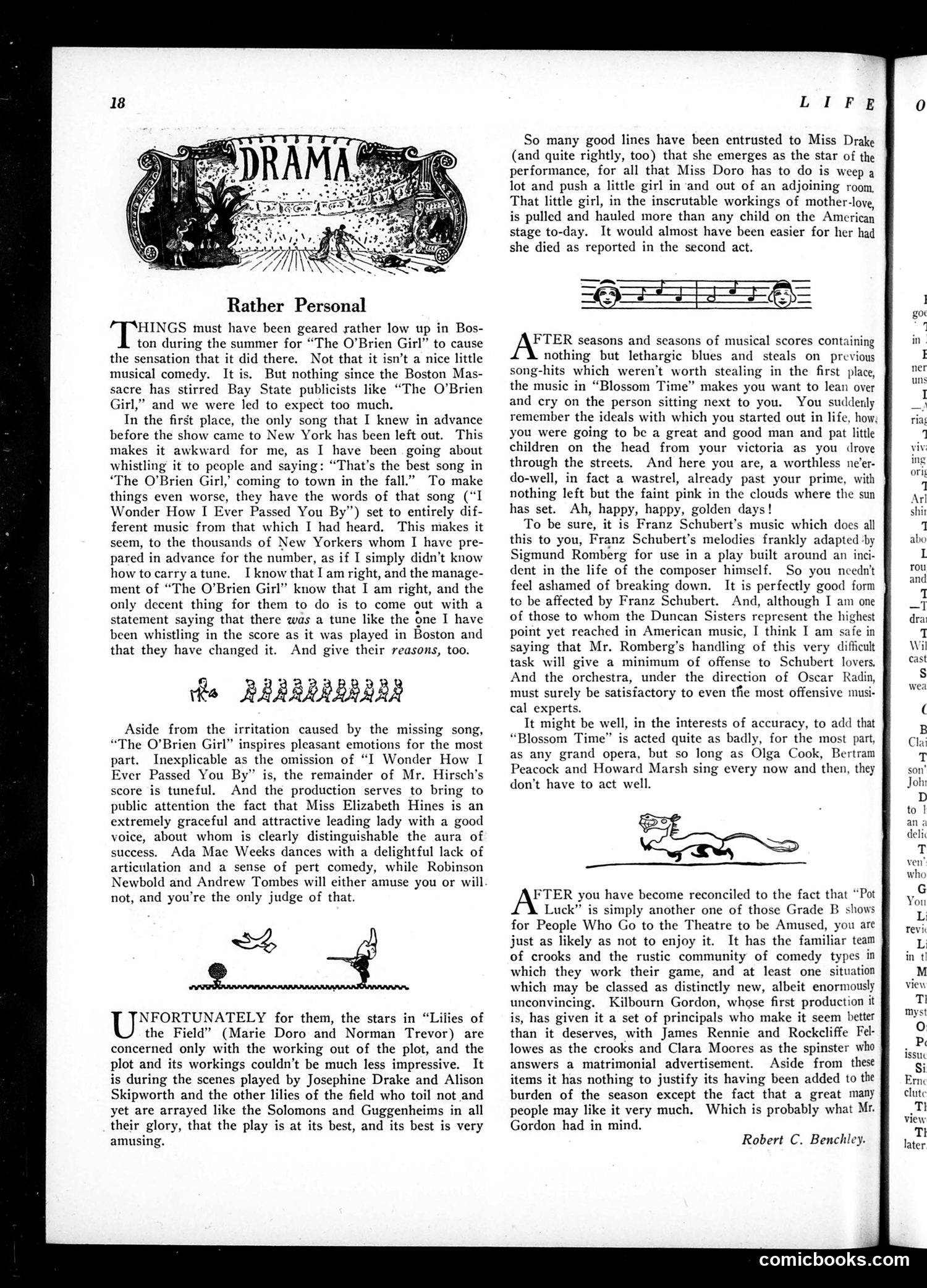
This page contains theater criticism by Robert C. Benchley reviewing three Broadway musicals. The cartoons are simple decorative elements showing performers in exaggerated poses—typical of the era's theatrical illustrations rather than political satire. The reviews discuss: 1. **"The O'Brien Girl"**: Benchley humorously complains that a song he'd been promoting was removed from the Boston version before reaching New York, making him look uninformed to acquaintances. He mocks his own embarrassment over this. 2. **"Lilies of the Field"**: He criticizes the plot as dull but praises supporting actress Josephine Drake over star Marie Doro, who mainly "weep[s] a lot and push[es] a little girl in and out." 3. **"Blossom Time"**: He praises its emotionally affecting music for evoking nostalgia and regret about life's unfulfilled ideals. The humor is personal and self-deprecating rather than political—typical of Benchley's witty theater commentary style for *Life* magazine during the 1920s.
📄 Transcribed text from this page (OCR, searchable)
Machine-transcribed from the original scan — historical spelling and the odd misread are preserved.
Rather Personal HINGS must have been geared rather low up in Bos- ton during the summer for “The O’Brien Girl” to cause the sensation that it did there. Not that it isn’t a nice little musical comedy. It is. But nothing since the Boston Mas- sacre has stirred Bay State publicists like “The O’Brien Girl,” and we were led to expect too much. In the first place, the only song that I knew in advance before the show came to New York has been left out. This makes it awkward for me, as I have been going about whistling it to people and saying: “That’s the best song in ‘The O'Brien Girl,’ coming to town in the fall.” To make things even worse, they have the words of that song (“I Wonder How I Ever Passed You By”) set to entirely dif- ferent music from that which I had heard. This makes it seem, to the thousands of New Yorkers whom I have pre- pared in advance for the number, as if I simply didn’t know how tocarryatune. I know that I am right, and the manage- ment of “The O’Brien Girl” know that I am right, and the only decent thing for them to do is to come out with a statement saying that there was a tune like the one I have been whistling in the score as it was played in Boston and that they have changed it. And give their reasons, too. 6 322% . the BAARRRBR ERS Aside from the irritation caused by the missing song, “The O’Brien Girl” inspires pleasant emotions for the most part. Inexplicable as the omission of “I Wonder How I Ever Passed You By” is, the remainder of Mr. Hirsch’s score is tuneful. And the production serves to bring to public attention the fact that Miss Elizabeth Hines is an extremely graceful and attractive leading lady with a good voice, about whom is clearly distinguishable the aura of success. Ada Mae Weeks dances with a delightful lack of articulation and a sense of pert comedy, while Robinson Newbold and Andrew Tombes will either amuse you or will not, and you're the only judge of that. = NFORTUNATELY for them, the stars in “Liiies of the Field” (Marie Doro and Norman Trevor) are concerned only with the working out of the plot, and the plot and its workings couldn’t be much less impressive. It is during the scenes played by Josephine Drake and Alison Skipworth and the other lilies of the field who toil not and yet are arrayed like the Solomons and Guggenheim in all their glory, that the play is at its best, and its best is very amusing. LIFE So many good lines have been entrusted to Miss Drake (and quite rightly, too) that she emerges as the star of the performance, for all that Miss Doro has to do is weep a lot and push a little girl in and out of an adjoining room, That little girl, in the inscrutable workings of mother-love, is pulled and hauled more than any child on the American stage to-day. It would almost have been easier for her had she died as reported in the second act. =6==-ES 6s FTER seasons and seasons of musical scores containing nothing but lethargic blues and steals on previous song-hits which weren't worth stealing in the first place, the music in “Blossom Time” makes you want to lean over and cry on the person sitting next to you. You suddenly remember the ideals with which you started out in life, how; you were going to be a great and good man and pat little children on the head from your victoria as you drove through the streets. And here you are, a worthless ne’er- do-well, in fact a wastrel, already past your prime, with nothing left but the faint pink in the clouds where the sun has set. Ah, happy, happy, golden days! To be sure, it is Franz Schubert’s music which does all this to you, Franz Schubert's melodies frankly adapted -by Sigmund Romberg for use in a play built around an inci- dent in the life of the composer himself. So you needn't feel ashamed of breaking down. It is perfectly good form to be affected by Franz Schubert. And, although I am one of those to whom the Duncan Sisters represent the highest point yet reached in American music, I think I am safe in saying that Mr. Romberg’s handling of this very difficult task will give a minimum of offense to Schubert lovers. And the orchestra, under the direction of Oscar Radin, must surely be satisfactory to even the most offensive musi- cal experts. It might be well, in the interests of accuracy, to add that “Blossom Time” is acted quite as badly, for the most part, as any grand opera, but so long as Olga Cook, Bertram Peacock and Howard Marsh sing every now and then, they don’t have to act well. AUTER you have become reconciled to the fact that “Pot Luck” is simply another one of those Grade B shows for People Who Go to the Theatre to be Amused, you are just as likely as not to enjoy it. It has the familiar team of crooks and the rustic community of comedy types in which they work their game, and at least one situation which may be classed as distinctly new, albeit enormously unconvincing. Kilbourn Gordon, whose first production it is, has given it a set of principals who make it seem better than it deserves, with James Rennie and Rockcliffe Fel- lowes as the crooks and Clara Moores as the spinster who answers a matrimonial advertisement. Aside from these items it has nothing to justify its having been added to the burden of the season except the fact that a great many people may like it very much. Which is probably what Mr. Gordon had in mind. Robert C. Benchley. comicbooks.com