
Life, 1921-10-20 · page 8 of 34
Life — October 20, 1921 — page 8: what you’re looking at
What you’re looking at
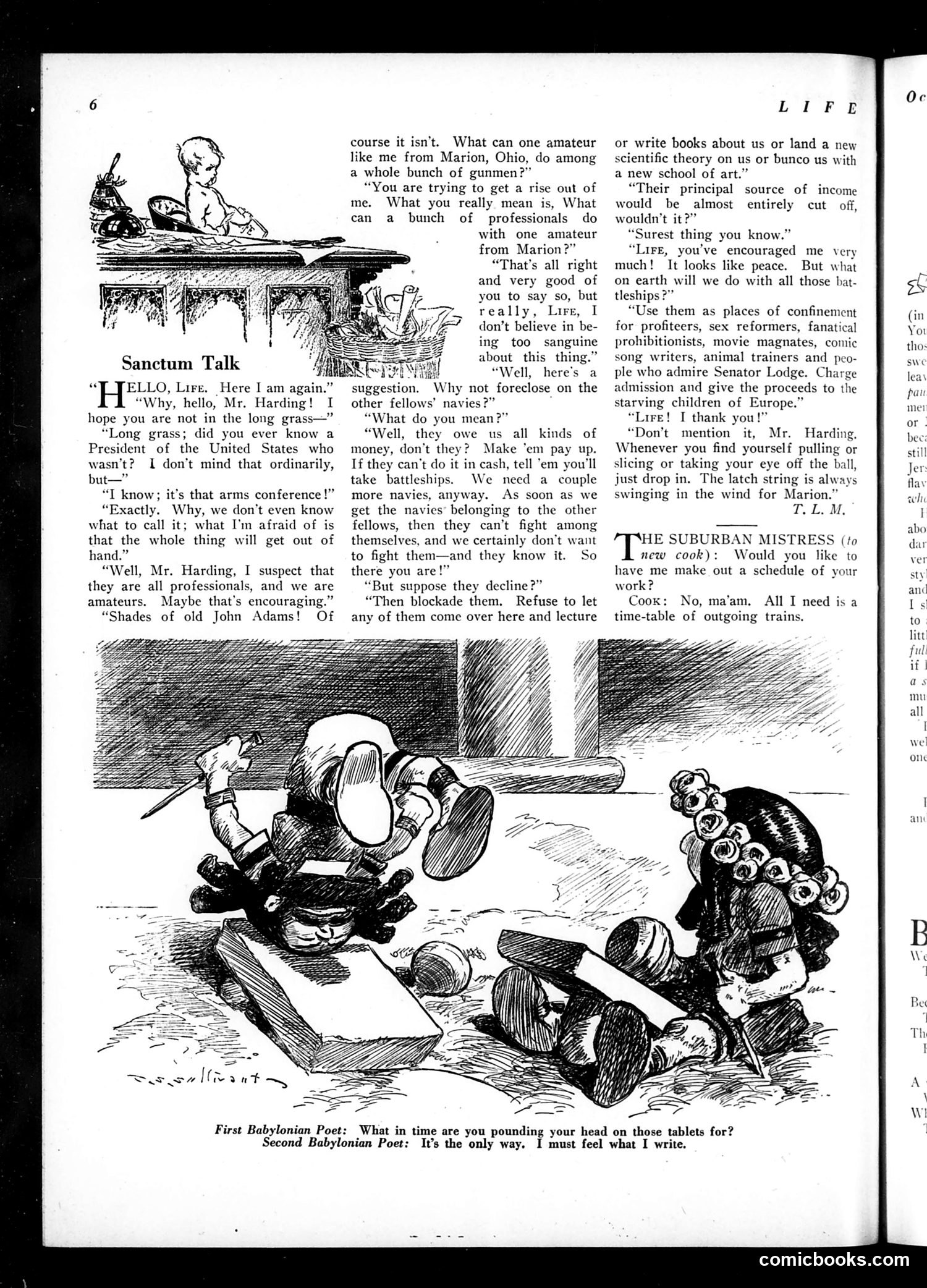
This page contains two distinct pieces of satirical content: **"Sanctum Talk"** (upper section): A dialogue between Mr. Harding (likely President Warren G. Harding) and "Life" magazine's editor discussing naval conferences and military preparedness. The satire criticizes how politicians and amateurs discuss serious matters like naval policy without genuine expertise, suggesting such important decisions are made superficially. **Lower cartoon**: Depicts two "Babylonian Poets" literally pounding their heads on tablets while writing. The caption mocks pretentious artistic methods—one poet claims he must "feel what I write," suggesting modern poets engage in absurd physical rituals to justify their work. This satirizes avant-garde artistic affectation and the performative nature of creative pretension popular in the 1920s.
📄 Transcribed text from this page (OCR, searchable)
Machine-transcribed from the original scan — historical spelling and the odd misread are preserved.
Sanctum Talk s ELLO, Lire. Here I am again.” “Why, hello, Mr. Harding! I hope you are not in the long grass—” “Long grass; did you ever know a President of the United States who wasn’t? I don’t mind that ordinarily, but—” “I know; it’s that arms conference!” “Exactly. Why, we don’t even know what to call it; what I'm afraid of is that the whole thing will get out of hand.” “Well, Mr. Harding, I suspect that they are all professionals, and we are amateurs. Maybe that’s encouraging.” “Shades of old John Adams! Of course it isn’t. What can one amateur like me from Marion, Ohio, do among a whole bunch of gunmen?” “You are trying to get a rise out of me. What you really mean is, What can a bunch of professionals do with one amateur from Marion?” “That's all right and very good of you to say so, but really, Lirr, I don’t believe in be- ing too sanguine about this thing.” HI “Well, here's a suggestion. Why not foreclose on the other fellows’ navies?” “What do you mean?” “Well, they owe us all kinds of money, don’t they? Make ‘em pay up. If they can’t do it in cash, tell "em you'll take battleships. We need a couple more nav anyway. As soon as we get the navies’ belonging to the other fellows, then they can’t fight among themselves, and we certainly don’t want to fight them—and they know it. So there you are!” “But suppose they decline?” “Then blockade them. Refuse to let any of them come over here and lecture LIFE or write books about us or land a new scientific theory on us or bunco us with a new school of art.” “Their principal source of income would be almost entirely cut off, wouldn’t it?” “Surest thing you know.” “LIFE, you've encouraged me very much! It looks like peace. But what on earth will we do with all those bat- tleships ?” “Use them as places of confinement for profiteers, sex reformers, fanatical prohibitionists, movie magnates, comic song writers, animal trainers and peo- ple who admire Senator Lodge. Charge admission and give the proceeds to the starving children of Europe.” “Lire! I thank you!” “Don’t mention it, Mr. Harding, Whenever you find yourself pulling or slicing or taking your eye off the ball, just drop in. The latch string is aly swinging in the wind for Mario T. L. M. HE SUBURBAN MISTRESS (to new cook): Would you like to have me make out a schedule of your work? Cook: No, ma’‘am, All I need is a time-table of outgoing trains. First Babylonian Poet: What in time are you pounding your head on those tablets for? Second Babylonian Poet: It’s the only way. I must feel what I write. comicbooks.com